Here’s another short poem by Sara Teasdale that I’ve done the Parlando Project thing to by making it into a song. As a young woman, Teasdale won the Pulitzer Prize for poetry in 1918, but as the century continued her poetry lost some of its literary/academic esteem for not being written in the manner of High Modernism’s Hermetic allusions.*
Teasdale grew up in the same turn-of-the-century St. Louis Missouri as High Modernism’s Chief Mage T. S. Eliot, though I’ve never been able to establish that they ever met as young people. One plausible reason why not: both were educated in gender-segregated schools for the most part. And Teasdale’s early life was like late-life Emily Dickinson in its isolation, largely confined to a room in her family’s home due to some vaguely defined illness. As a young woman she was able to break away from that confinement, moving to New York City and engaging with other literary figures there during her heyday as a poet. Like her contemporary Edna St. Vincent Millay, she married a non-literary man after romances with other poets, but Teasdale’s marriage was less successful.
Teasdale’s Pulitzer-honored collection was titled Love Songs, and that does describe her most common subject. Today’s poem, at least on face value, is one step removed from a personal experience love poem, posing itself as a poet-supplied maxim applicable to a disappointed-in-love younger woman.** I’d dispute that the poem’s advice is only useful for women — but then the specific in poetry often stands for the general. Here’s a link to the text of this short poem.
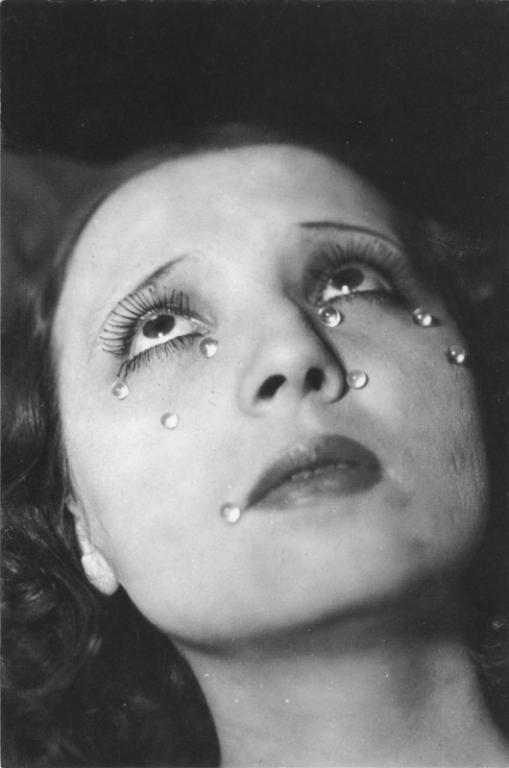
“This truth, this hard and precious stone, lay it on your hot cheek.” Photograph by Man Ray
.
Like many of the poets I feature here, Teasdale’s Wikipedia page is brief and fragmentary — but one thing it does document: her work has been set to music often, and by a wide range of composers. Early in this project I mentioned that singer-songwriter Tom Rapp’s setting of a Teasdale poem was an early inspiration for me. One could make the case that it was us composers, more than literary academics, who maintained Teasdale’s art until it could be re-engaged with.
Part of me wishes I could’ve produced a more polished performance of Teasdale’s “Advice to a Girl,” but my current life often reduces the time I can spend on the musical pieces. I like the harmonic cadence in this song’s music, but I expressed that with just an expeditious strummed guitar part along with some acoustic bass accompaniment. Still, the idea’s there now, and an unexpressed idea easily fades and disappears. You can hear my performance with the audio player below. If you don’t see any audio player, there’s also this highlighted link which will open a new tab with its own audio player.
.
*That I’d write “Hermetic” there indicates that my moods and mind are not opposed to that kind of poetry — but then I’m also not opposed to poetry that speaks of our ordinary and present human relationships, which in their complexities and footnotes exceed any grimoire’s or textbook’s breadth. Just as with music, I’m a poetry eclectic.
**This poem could easily be read as someone talking to and soothing the memory of their own younger self. Our youth may lord over us with its misapprehensions we cannot correct, and that time-separated self often benefits from our wiser selves speaking to them from later up the years.
Here’s another one of these posts that is going to jump around a bit, though I’ll keep it brief, and there’s a heartbreak poem set to music that I’ll end with.
I don’t post every time some figure influential to me dies. It should be apparent to long-time readers of this that that group of influences is wide, and therefore large. Still sometimes the spirit moves me. This week a midlist musical figure, John Mayall, died. He was 90 — so not a surprise to any actuaries in my audience — but his extraordinarily long musical career (he was still regularly touring up until the last few years) might have masked the imminence of that death.
I can’t quite figure how many of you will recognize his name, and of those that do, how many will see why I’d count him as an influence. I often worry, what with the variety of the musical settings I publish here for strangers to listen to, that someone listening to one, two, or three of the Parlando musical pieces will think that I’m fixed in some musical genre. “Oh, he does folk-song-like stuff with solo acoustic guitar.” “Some kind of rough garage rock thing, isn’t it?” “Do you know you sound like Bob Dylan?” “What’s with all those orchestral instruments — and was that a sitar?” “You know, that beatnik to poetry slam kind of spoken word over spare Jazz backing stuff.”
To my mind, my aim is to vary the music, just as it’s my intent to present different sources for the words. But what’s that got to do with John Mayall who was not generally filed in any of those genre bins. If you look for Mayall’s work, he’ll be filed under “Blues.”
Blues, that great Afro-American musical approach, is (while often imperceptibly) as close as a center as I can find in my music. The other day one of the household teenager’s friends arrived when I was in another part of the house practicing guitar over an entirely not-Blues chord progression I had ginned up. I stopped, wanting not to intrude sonically on their get-together. When I met up with the young visitor (who plays guitar themselves) I apologized for the racket, and they replied, “Blues is always cool.”
Odd, I thought. I certainly didn’t think of the idea I was working with was Blues, but then the things I was playing over it used embellishments that I learned from musicians who played within a recognizably Blues song and harmonic structure.
“[Blues] is about – and it’s always been about – that raw honesty with which the blues express our experiences in life, something which all comes together in this music, in the words as well. Something that is connected to us, common to our experiences. To be honest, though, I don’t think anyone really knows exactly what it is. I just can’t stop playing it.”
Read the whole interview in that link above if you want an overview of the man’s career and its variations on what you might think defines the Blues— but I admire Mayall regardless of genre borders, because his career exemplified something I call the Indie Spirit. He was a “get in the van” sustainable-costs touring musician when D. Boon was a fresh kindergarten graduate. Like Grant Hart, he did the graphic design for his band’s records from the very start. He played for small audiences in small venues through most of his career, and ballroom and converted movie theater venues were about as big a draw as he could muster at the height of his popularity. If that bothered him (it didn’t seem to) it didn’t stop him. He played his music without a thought to maximizing its commercial potential, a genial stubbornness that I admire. Furthermore, every band he put together over around 60 years of music-making had musicians that were better than he was, and he based his bandleading on letting them shine. Every obit tries to list those once bandmembers, but the list extends over the horizon because that group of boosted musicians, like the bandleader, included many individual talents that never became big stars while making fine music.*
A song not by John Mayall: “You look to me like misty roses…” The roses from a morning walk my wife took. The picture of Mayall is on a pillar overlooking where Dave Moore plays in my studio space.
.
That went on longer than I expected, but here’s a piece I just finished, with words from the American poet Sara Teasdale. Teasdale is another writer from the first third of the 20th century whose poetry I can’t resist setting with music. Much of Teasdale’s poetry is short and compressed like today’s selection “Dooryard Roses.” And much of it expresses heartbreak, as this poem does. But like the Blues, it tries to be honest and straightforward about it, and to sing it so we can say back to the singer “Yeah, I’ve been there too. Is that what you figured about it? Well, we’re both still here, so sing it some more!”
The music I composed for this piece, is it Blues? Maybe I don’t know, but I don’t think it is. I just can’t stop playing it. You can hear it with the audio player gadget below. No gadget? This highlighted link is your alternative then.
.
*A personal factor in my connection to John Mayall’s music: alternative voice and frequent keyboard player in this Project, Dave Moore, is the person who introduced me to Mayall’s records. In those 20th century days when one might fruitfully evaluate a person by their record collection contents, Dave didn’t need any help there — I’d already heard his poetry — but he’s why I came to hear and follow Mayall’s music.
Summer has event dates for me. Wedding anniversary for my living wife, death anniversary for my dead wife. In between, my birthday. A birthday has the same date on the calendar, but they change over the years in their nature. I can still recall the birthdays for singular digit ages, those massive markers toward becoming, achieving oneself. And then there are the rights-granting ages, 18 and 21; or certain decade mileposts, 30 and 50.
Now aged, the age number becomes hazy, defining less. A fair number of people who’d be my age aren’t, due to death. Most of my cohort have some collection of Marley’s Ghost chronic conditions, mild to significant. This is, after all, the portion of life that takes away things, slowly or all-at-once.
But it’s important to add to this calculation, life adds each day too. I’m celebrating my birthday today with my wife and a couple of friends. We’ll meet at an art museum’s restaurant. Everyone and I have not stopped breathing.
I celebrated my actual birthday by getting an ultrasound study of my aorta. My doctor suggested it since I had smoked in my twenties, and there’s some increased risk that this major artery can later swell and be at risk for a rupture, something that is in that all-at-once class of ageing events. Weird going through a test like the one when I first saw the shadow of my child, to know if I have a shadow of death inside me.*
To a degree not equaling my enjoyment of life right now with my little family and this Project, with still being able to hop on a bicycle and ride, with the ability to meet an instrument and come to an agreement on some music, I do have a sense of shadows. Multiple family members, all younger than me, have had some mild to more significant cognitive issues diagnosed this past year. Slowly or all-at-once — that’s birthdays, that’s aging. I’m enjoying the days slowly.
“Upon our couch we lay as lie the dead,/Sleeping away the unreturning time.” Go ahead Vincent, it’s OK to take a nap. It what you get done when you wake up that counts.
.
Today’s musical piece is my setting of a sonnet by Edna St. Vincent Millay. You can read the text of her poem here if you’d like at this link, and listen to my performance with the audio player below. I had a half-a-dozen beginnings/basic tracks of Parlando musical pieces sitting on my hard drive, and I selected this one mostly out of how near to being finished it seemed. Then as I set down to write today’s post — asking myself what I was thinking — I realized the poem expressed elements of my life this summer.
I remember when I presented my first Millay sonnet for this Project, years ago. I knocked her then for using too much archaic language and sentence order, an affliction her contemporary Modernists were seeking a cure for. “Rejoicing Veins” is from later in Millay’s career, and by then the language in this one shows little of that fault. This is another poem that seems to me to speak accurately about old age, yet this was written by a 40-year-old poet. Vinny, that doesn’t seem so old to me, but you got it right!
There’s that graphical audio player now, or if you don’t see it, this highlighted link that will open a new tab with its own audio player.
I completed the off-the-cuff recording of my musical performance of this Robinson Jeffers poem a few days ago, but it’s taken me awhile to figure out what I wanted to say about my encounter with it, and secondarily how you, my valued readers and listeners, might receive it. In “Be Angry at the Sun” Jeffers is ostensibly writing a poem, but it seems he wants to give a political speech about political speech. TL:DNR, he’s not a fan. Here’s a link to the full text of Jeffers’ poem, but since he’s writing about speech, I thought it might best be heard.
I sometimes make rock music, but like my spouse, Jeffers knew how to build with stone, constructing his own castle-like home from local seaside rocks.
.
Politics and poetry mix and don’t. Politicians will quote poems. A few poets (or diverted poets) have run for, even obtained public office. Personal political engagement by poets is likely no more rare than political engagement by nurses, baristas, bookkeepers, or shopkeepers. In my foray into social media* during the past year or so, I’ve often found an expectation that any posting poet or writer should declare their stance and allegiances.
Let me admit a reluctance to do so. My reaction is internal and perhaps odd: it feels like those calls to the pulpit at a Protestant Christian tent revival or Billy Graham’s mid-20th century adaptation of them to the TV age. It’s not oversimplified to be summarized thusly: make a simple public declaration in your acceptance of Jesus as your savior, and by that simple act, your soul’s continuous existence and the worthiness of your life has been assured. There are usually sub-clauses to that declaration: you will be expected to perform acts consistent with it. How consistent must those acts be with the declaration? Empirically, it varies considerably, which to my outlook makes the insistence and importance of the declaration problematic.
Now, some who read this may be Protestant Christians. You are welcome here. Your outlook, your understanding, your lives, may find nothing troubling about that act. I believe I understand your beliefs there fairly well. Long time readers here will know that myself and two other voices you’ve heard here are “PKs” (Preacher’s Kids). We literally grew up with variations of Protestant Christianity.
I also grew up with politics. I proudly wore my Stevenson campaign button as a grade-schooler. I participated at low-levels with campaigns for office and issues quixotic and successful for decades. I’ve been to political conventions. So, to you the readership here that are politically engaged: I have some understanding of your actions there.
So why this particular Robinson Jeffers poem, and why do I find it problematic yet worthy of considering today? Long-time readers may recall one of the poetic maxims I’ve expressed here: poems aren’t just about a message, an idea the poem wishes to express — they are more about how it feels to experience that idea, the sensations of the moment.
I was attracted to the Jeffers poem because I recognized that moment, that feeling. Perhaps you do to. I’ve been living in it this week: politicians and jurists seeming to speak as political operatives have increased my disgust. And this is not because (as Jeffers, the poet I’m voicing today, might believe) that politics is essentially dirty, though Jeffers and I will agree it’s humanly imperfect. Jeffers wrote this poem in the run-up to WWII. Unsaid within the poem, he’s specifically knocking Franklin Roosevelt,** a great and consequential American President, but he’s another of those Modernists who seems to have had, if not full-fledged admiration for fascism, at least a belief that it was no worse than other existing political schemes. There’s a lesson here: those who believe that politics is exploitative, dirty, always disreputable, will be drawn to or tolerate the belief that it’s best handled by leaders who revel in that themselves — the dirty men who will handle the dirty job, while we can stay clean sweet-smelling artists. Stone, not ivory tower in Jeffers case, but the same idea.
So, as you listen to my performance of Jeffers poem about politics and political speech, know my aim is to say that if you feel pain and disgust at what you’re hearing and seeing, I feel it too. Best as I can tell, I don’t share Jeffers prescription and proscription for politics, but in the world of today’s poem and my expression of it, I’m saying if you despair: you’re likely just one person, one citizen, someone without extraordinary powers. Your choices, your actions alone didn’t cause our country and our world to be in this state. How do we turn our nation away from letting the dirty men to do dirty jobs from being left unfettered? I’m a composer and writer, I can’t say I know more than a nurse, barista, bookkeeper, or shopkeeper.
Audio player gadget below for most of you. Is your sub-caucus not seeing any player? This highlighted link will open a new tab with it’s own audio player.
.
*I’ve given in and now post on short-post-format social media after eschewing it for a decade or more. It’s been good and bad. Like poetry, it lets me practice reigning in my long-windedness; and I can engage in it when distractions abound. Alas, it becomes its own distraction when I do have longer blocks of time or energy. In theory, like poetry, it could be complex while being concise. In practice, it’s mostly superficial —something one can relax with when needed —but that “just give me a momentary diversion while I scroll through my timeline” expectation stunts it.
**To those who might want to remind me of FDR’s faults and bad acts. I have long had a strong interest in history. I know of them.
The great American poet Emily Dickinson writes about death a lot, so maybe I should pause for a moment to mention how inescapable the living’s experience of death was in her time and place, what with disease, injury, a deadly Civil War, graveyards within the city limits, and approaching death happening often at home.
Because I lived across the street from death? When a child, Emily Dickinson’s family did not live in the Dickinson Homestead (now the Dickinson Museum), but at another house, located across the road from the town cemetery where she would later be buried. A child is born, plays, grows up, and crosses the fence.
.
The poem I’ll sing below today speaks to that. If you’d like to follow along, here’s a link to the text of “As far from pity, as complaint.” This poem is more than its message —most good poems are — but let me write down here a sentence to summarize what I read this poem as saying: rather than pity, dread, or anger toward death, a result we cannot change, we should emulate the dead themselves who demonstrate that life is not everlasting — but the predicament of dying, and the predicament of living, are everlasting.
That’s a worthwhile thought, and poems in Dickinson’s time and place were often expected to deliver a lesson. But why is this a poem, why is this an Emily Dickinson poem? An essay, a sermon, a sympathy card, a letter, a conversation all could deliver this message as well or better as 12 lines not even pentameter-long and broken with the skeleton spaces of the pervasive Dickinson dashes (as if her “trade was bone.”)
Because it sings this situation, even silently on the page. There’s a dancer’s force, a singer’s force, an instrument’s augmented force in this way of telling. If death is inevitable — as is also meter, repetition, rhyme, the flow of sound into shapes — might we be comforted by these shapes? We live. We die. The shape of life continues. Quod Erat Demonstrandum, thus it is demonstrated.
When encountering this poem earlier this summer I sensed an intra-poem image-rhyme in this poems 7th and 8th lines. A better-known Dickinson poem which attracts us with what seems like mundane charm, “I’ll tell you how the Sun rose,*” has summer children playing from dawn — and at the end, disappearing over the horizon’s fence-line at sunset. That’s the continuing shape of our lives.
You can hear my musical performance of “As far from pity, as complaint” with the audio player below. If your way of reading this blog is numb to that revelation, don’t complain, I offer this highlighted link as a way to open a new tab that will have its own audio player so you can hear it.
Today’s piece is a fairly well-known poem by the Spanish poet. Given that I’ve played guitar nearly for 50 years and been interested in poetry for more than that, I keep thinking I must have run into it before this year. If that’s so, why don’t I recall considering it?
My answer is going to sound more judgmental than I mean it: bad translations. No, maybe I shouldn’t use “bad” here. I don’t suspect any moral failing or lack of effort by translators of this poem. And given that I’m not all that knowledgeable about the work of Lorca and have only the most limited grasp of his native language, I should have no standing to rate other published translations of “La Guitarra.” What I do know is that native speakers find his poetry passionate and vivid, and the English versions seem to my ears and heart (those being the entry points for poetry) stilted and muffled.
I’m not going to link any of the English translations I found of “The Guitar.” None I’ve seen seem fully effective to me, though I cannot say that they might be effective for others. I’m not going to link or line-by-line dis the translations I’ve seen. I will say that the first one I saw at one of the leading poets and poetry organization’s site was representative. I didn’t find it musically compelling, and it was a jumble of abstracted images that had little sock, little immediate feeling evoked. I assume the translator had the advantages I must clearly concede I don’t have. Why might their work not succeed, at least to this reader?
Two theories. Other translators may have been too literal in carrying over Lorca’s original sentence structure, which might be natural and unaffected in his Spanish. This is poetry, so one can make a case that how it’s said is essential — but when languages order words differently, following the original sentence structure and word order too exactly damages the natural vividness of a person speaking. Secondly, Lorca to my slight knowledge connects to Surrealist expression, a style of poetry I loved as a young man and still like to connect with today. Surrealism likes the wild and incongruous image; and from its ancestor Dada, it’s often willing to take an image in a random, raw and undercooked state. This creates a problem for me when I translate Surrealist and Dada work.
You see, I view my task as a translator to primarily find the images in the work and to then portray those images in clear modern English, and secondarily give the poem a word-music in the new language that gives pleasing movement and return to the poem. What if the original intent was to mystify the reader, to present an image that was intentionally confounding? I risk, while puzzling out the text in a language I don’t know well, to over-simplify or over-determine an image. I fear embarrassment of doing that, but I think it’s the better risk because vivid images that the reader/listener grasps and gasps are compelling to me.
As to the word-music, my version of “The Guitar” rephrased Lorca somewhat, aiming to make him sound like an English speaker. While doing that I tried to make the poem musical in English. The poem was already using repetition for poetic effect in Spanish, and I added just a touch more.
As you might imagine, this poem about the expression of a musical instrument has been set to music before my attempt you can hear today. While not a Lorca expert I know that he connected too with Spanish Deep Song and the evocation in that tradition of “Duende,” a difficult to translate term that some Afro-American musicians have seen as analogous to the Blues. I played a nylon string guitar for my setting, the type of guitar associated with Spain, and the simple chord progression I used would not be foreign to that tradition. But both from my skill level and inclination what I played for this song was simple and sparsely ornamented. Though the harmony wasn’t Blues, I approached playing this as if it was American Blues. Another Blues element I introduced that wasn’t in Lorca’s poem: my version has a gendered call and response. The guitar is a her, the singer (there’s no singer in Lorca’s poem) is a he.
I think there’s a misapprehension of Carl Sandburg’s poetry: that it’s simple, prosy work: that it says what it says, hearty single-minded messages with some decorative metaphor. Tastes differ, and mine may not be a guide to anyone else, but I sometimes don’t find him so. As I continue trying different things during the summer with this multipart personal story, I’ll return to our regular stuff at the end today with an example of Sandburg mysterioso.
The finale of my June trip to Iowa City to see what I could find out about an even more under-considered Midwestern 20th century poet, Edwin Ford Piper, was planned to be a visit to Galesburg Illinois, a small city just east across the Mississippi river where Sandburg was born. Piper and Sandburg compare easily. Both born in the American Midwest a couple of decades after the Civil War, both part of early 20th Century literary movements we no longer take as much notice of. Both were attracted to a broad swath of memorized vernacular music that would be called “Folk Music.” They knew each other, even shared stage programs. Sandburg’s 1927 music collection The American Songbag established what American folk music would be for my mid-century generation,* and from examining Piper’s papers I could see his definition paralleled Sandburg’s. Piper was one of the contributors to American Songbag.**
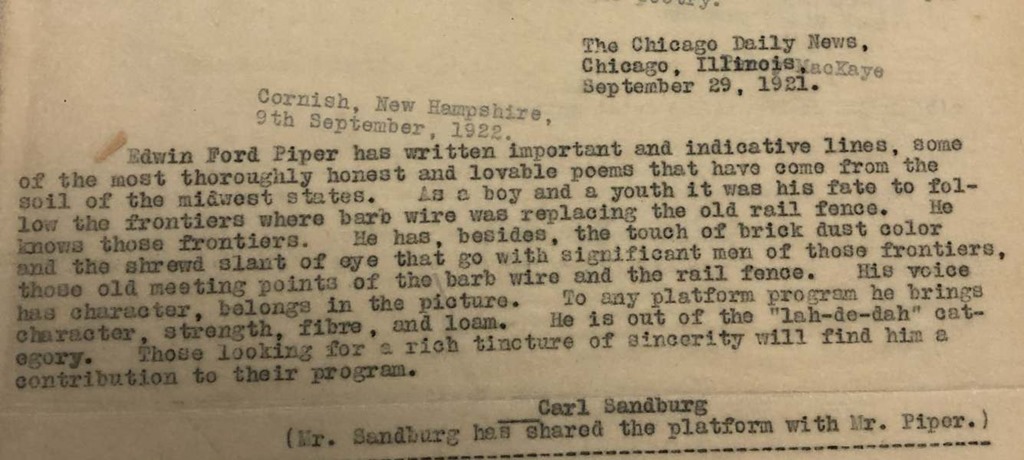
Poet Sandburg blurbing poet Edwin Ford Piper. I also saw a note from Sandburg thanking Piper for songs used in Songbag, but don’t have a picture of that.
.
We arrived at Galesburg early for the 1 P.M.-opening of the Sandburg birthplace site. We wandered the wondering-what-it’ll-become-in-the-21st-century business district with its building facades still showing a variety of past decades abandoned styles left to fade, and browsed a charming small bookstore there. We were going to have an early lunch somewhere, and decided to just get sandwiches and go eat them in the small area behind the birthplace on benches by the Remembrance Rock there.
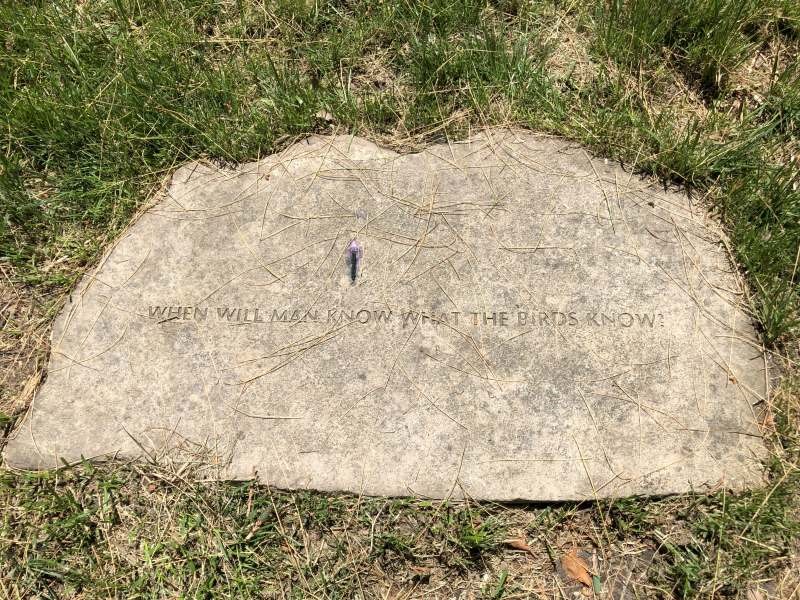
The rock is an unremarkable bolder, utterly plain and unshaped as a design choice.*** Sandburg and his beloved wife and partner’s ashes are buried under it. The lawn it sits on behind the house is circled by bushes and a few trees, and rather than any sense of a park, it reminded me of the backyard of the house where I grew up in Iowa. One thing the photos I have seen of the rock didn’t show: a ring of irregular, small, flat, stones that circle it, each engraved with a line from a Sandburg poem. If one wished, one could ceremoniously walk from flat grounded rock to rock stepping with your foot-soles on his words, which it seemed to me to be what one of Sandburg’s models Whitman has commanded — and so I did. There’s a nice bust of Sandburg on a stand there too, but to my sense of the place, walking his words was more meaningful. I’d told my wife that Sandburg’s father was a railroad blacksmith, and she figured that the neighborhood might have been handy for rail workers. After our lunch, she took a little stroll while I waited, and she came back to report that just over a rise a block away was the railroad line.
…but then all the birds know is to poop on poetry-engraved rocks, same as any other.
.
One of the site’s staff members arrived ahead of opening time to do a little yard work, and when that time arrived, he changed tasks to welcoming and serving as a guide for about 30 older folks in an adult learning program who arrived from Peoria in two small busses. Beside the birthplace (our host preferred to not call it a house, but a railroad worker’s hut) there was another small, somewhat rundown house next door that served as the site’s offices and a small room of memorabilia backed with an illustrated wall timeline of Sandburg’s life. Behind the two houses was a garage that has been turned into a cozy theater space where they host musical acts in homage to that part of Sandburg’s heritage.
My wife and I plus the 30 others overwhelmed the birthplace site’s capacity. Resourcefully the staff divided the group into two, and after watching a short video on Sandburg our half got to walk through the birthplace hut or house. If you are familiar with the modern tiny house movement, the floorplan and the maximal utilization of it would strike a resonance. Outhouse, no plumbing or running water, it’s decorated in late 19th century Swedish immigrant homey style, but a couple, a young child, and a baby would have been a tight fit, much less our troop of visitors. I recall visiting a reconstructed Lincoln birthplace cabin as a child, and though the Sandburg birthplace is wood-frame construction, not a log cabin, the square footage and amenities might have struck Lincoln biographer Sandburg as similar.
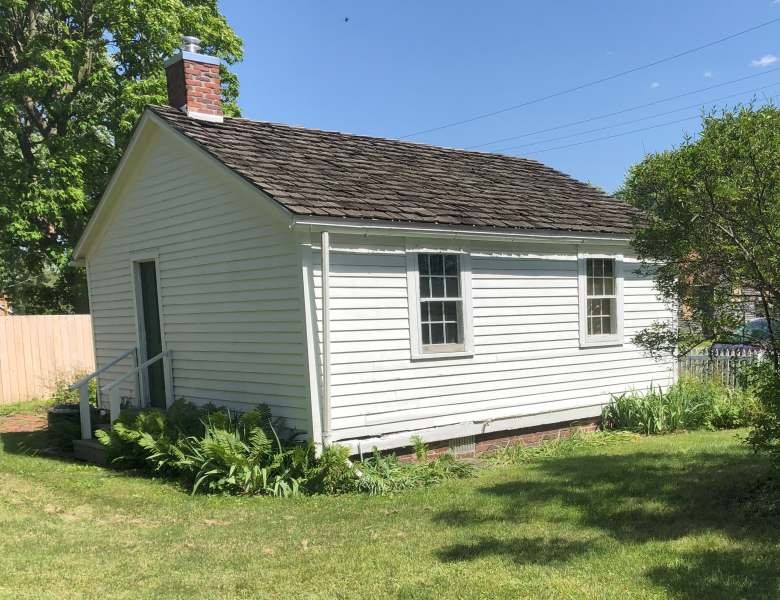
Sandburg’s birthplace: house, hut, cabin. This side shows the smallness best I think.
.
Perhaps because of the touring group’s visit, there was a special performance by a singer-guitarist whose name I didn’t catch, who did a short re-creation of Sandburg singing and talking about his life. I enjoyed that effort. Before leaving, I asked one of the leaders of the visiting group, an old professor, who had some years on your old guy reporter here, what Sandburg biography he’d recommend. He cited Penelope Niven’s bio, and I bought it at the site’s store.
No one hides the fact Carl Sandburg might not have much direct memory of the birthplace as his family moved to another Galesburg house while he was only a toddler**** But the link to his parents and the choice of it for a burial place (which was I believe his doing) speaks to the meaning to him. Unlike the larger house and goat farm where Sandburg spent his post-WWII life until he died that is a National Parks Service site, the birthplace is run by the State of Illinois and some local spirit and volunteerism. Sandburg retained throughout his life a fondness for Galesburg, never hid his roots there, and Galesburg was also the place where he attended college after his stint in the Army, though he never completed a degree.
Which brings me to today’s new musical piece, a setting of a Sandburg poem about someone who apparently left town wiping the dust off their shoes at the city limits. In his collections Sandburg called the poem “Gone,” but the main character’s name sticks in some memories, so it also gets called by the first line, or by the character’s name that appears in that line: “Everybody loved Chick Lorimer in our town.” Here’s a link to the text of the poem.
I promised mystery in this one. There are things left out, and various implications some of which complicate, some of which conflict, are left open. Can we even take that opening statement at face value? Not now, certainly not in 1916 could it be said that we all love “a wild girl” with a dream “she wants.” Some might, many would not. Wildness and dream-holding create envy, often a lot of it.
Is Chick Lorimer someone that everyone in town has marked as special, marked for greater things — someone so preeminent in their youth where that envy would be tamped down? If so, why the sudden leaving, with no one knowing where or why? Does a recognized prodigy, much loved, leave a place without saying goodbye? That would be a rare story.
Perhaps the “everyone” is a casual overstatement, referring only to a small group of friends who shared ideas? Later the poem seems to refer to larger numbers however.
Is she not actually loved by much of the town, and “loved” in a narrow, sexual, sense by many men? The “Dancer, singer, and laughing passionate lover” line could give testimony to that thought. That line is followed by two specific but puzzling lines, and their very specificity says we should pay attention to them. “Were there ten men or a hundred hunting Chick?” “Hunting” is a word choice, though we do say we hunt for the lost all the time without thinking of hunting as in wild game. Why the specific range, “ten or a hundred?” If this noteworthy young person is gone, no other info, that’s a missing person. Have they come to harm, are they being hunted for something they’re suspected of doing wrong? Why can’t they say, between 10 and 100 for the number of hunters? This hunt seems secretive from that wide range: 10 might be a small matter, 100 a greater one — but even 100 would be small if this is a universally beloved light of a town, unless it’s a very small town. It seems significant that the poem’s speaker can’t give a better estimate. And that’s followed by another stat: “five men or fifty with aching hearts.” The numbers are still widely separated, but they’re also halved from the number of hunters.
To perform this, I felt I had to have some plot in mind as I sang it. In my mind, Chick is a free-spirited libertine, and to a large degree that “loved” means no-strings sex. Chick likely left because she wanted something more, or because the disapproval of her “loving” everybody was getting intolerable. The maybe just five “aching heart” men thought they were, or could be, her significant partner.*****
How bohemian was poet Sandburg’s experience early in the 20th century? When he first moved to Chicago he lived in what was in effect a free-thinkers commune run by a strange guy, Parker Sercombe. From my reading, “Free Love” was just as much a topic in bohemian culture in the early 1900s as it was in the 1960s.
But maybe I’m wrong, and maybe your reading is different. It could be that Chick is like “Chuck” Sandburg (the name he used then) wanting to see the world, wanting to follow their dream. Sandburg had bicycled around Illinois, rode trains legally and illegally to other parts of the US, and he’d already been to Puerto Rico in the Army by the time he wrote this. Chick could be his anima. Sandburg never felt entirely alienated from his hometown or family however. He came back through town, wrote letters to his family, and so on. And if you want to see his beginnings and his decided final place to remember him, one goes to Galesburg.
To hear my performance of “Gone” AKA “Chick Lorimer” you can use the audio player below. Do you feel nobody knows where the audio player has gone? This highlighted link will open a new tab with its own audio player.
.
*If you never cared about the post WWII folk revival for whatever reason, I will point out that Rock’n’Roll became self-aware artistic and literary-flavored “Rock Music” in the later 60s because folk revival musicians transferred their backgrounds into bands with electric instruments after The Beatles, electric Blues bands, and “Dylan goes electric” emerged to take over college and post-graduate audiences in the US. Over in the UK, the folk revival to Rock pipeline was supplied by “Skiffle” — an American jug-band folk revival style that swept UK youth in the 50s, merging with a peculiar British Trad Jazz revival that often featured the Blues element of pre-WWII Jazz.
**Piper’s wife, in her own papers collection at the University of Iowa library, claims that Piper’s contributions were greater than Sandburg credits in Songbag. Possible, I suppose, though the nature of Piper’s song collecting revealed by my examination of his papers shows a collaborative effort with collectors sharing with each other freely. Piper’s unpublished collection, like Sandburg’s published one, wasn’t done with a sense of ownership of songs.
****The family didn’t get sudden wealth, it supplemented the railroad wages by renting out rooms in the succeeding houses, and the children worked to add to the family income as they grew older.
*****For a fuller story fleshed out from the short poem’s details, there’s this 50 minute early 1960s TV episode from the Route 66 series which uses the poem idea as its central motif and title, with the leading man reciting Sandburg’s poem 2/3 of the way in. This linked version has hokey colorization of the series fine B&W photography, but it is easily viewable.
Today is Juneteenth, a holiday coming into greater recognition as a celebration of the ending of America’s race-based chattel slavery. Why this date? I repeatedly warned you that I can’t tell a story simply and briefly, but for this holiday I have an excuse.
Slavery began in the American British colonies somewhat haphazardly, but by the time we became an independent country we had lots of laws, customs, and beliefs to entrench it. As it often is with the mechanics of oppression, the structures to hold it up took work to maintain, and by the 1850s there was great worry between slaveholders that it would collapse. In the 1860 election, Lincoln won, and even though he’d stated a politician’s compromise middle ground on the slavery issue, his party included enough abolitionists that most powerful slave-holders were ready to press their states to rebel and set up their own government. Civil war ensued.
Which didn’t free the slaves — at least not yet.
Of course the enslaved had been freeing themselves, when they could, all along. Armed rebellions hadn’t worked for more than moments, but the brave, lucky, and skilled might successfully flee at least from the slave-holding states if not to Canada where US law couldn’t touch them.* But it wasn’t easy traveling all that far.
Once the war started in 1861, some enslaved people recognized they could try a shorter route: just make it to the Union troop’s camps, and a good many did just that, which created an awkward situation. You see: nothing had ended slavery’s legal framework, Lincoln still maintained he wasn’t doing that (if only because a few slave-holding states and slaveholders remained on the Union side). He just wanted to put down the rebellion.** Law still said the slaves were property.
Someone on the Union side came up with a peculiar idea. If the enslaved were legally property, they could be confiscated during wartime like a cannon, horse, ship or other enemy property could be. Dehumanizing language? Sure, but escaping past the Union lines meant an increasing chance that they wouldn’t be taken back.
Eventually, Lincoln supersized that freedom, by declaring that all the enslaved in the states in rebellion were free. This, the Emancipation Proclamation was issued at the beginning of 1863. American slaves elsewhere? Nope, not in the Proclamation. Slave owners in places under Confederate rebel control? Not gonna listen to Lincoln’s order. In April of 1865 Robert E. Lee surrendered the bulk of Confederate troops, but that still didn’t mean all enslaved were free, and the legal matter wasn’t consolidated until December of that year with the adaptation of the 13th Amendment.
A couple chapters back I talked about how slow by modern standards communication could be in the mid-19th and early 20th century. Well, it was slower yet when not everyone was on-board with the news. Juneteenth, with an absurdity that is so often a part of America’s racial history, celebrates when Union troops got over to Texas in June of 1865 to announce that the war had been over for over a month and the enslaved in Confederate Texas were no longer legally slaves.
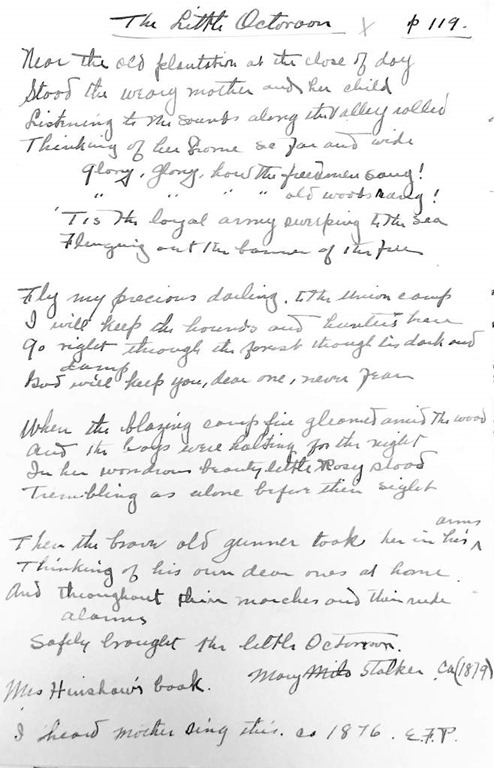
When I left off I was (more or less) talking about folk songs and the songs collected in the American Midwest before WWI by poet Edwin Ford Piper. I’ve also already mentioned that folk songs aren’t unchanging, and aren’t pure. While going through the yellowing paper in Piper’s archives, I came upon this song, handwritten in his own handwriting. He has the title as “The Little Octoroon.” Things aren’t going to get simple here readers. I can’t be simple.
The song as Edwin Ford Piper heard it from his mother
.
Octoroon is a largely obsolete word, derived from a lot of rigmarole regarding how Black someone was. It means 1/8th (octo=8) Afro-American. In general, the mumbo-jumbo legal biochemistry in American history regularly said it didn’t make much difference. Half, quarter, sixteenth — hell, for those who had trouble with fractions it was sometimes written down as: 1% Black, you’re legally Black.
An octoroon may not look Black. I can still recall when I was 14 or so, and having grown up in a tiny rural Iowa town. An Afro-American man who was a civil-rights activist was to visit my church camp. He arrives. Wait — that man’s Black? I remember in my naivete looking at his summer hands and forearms. The man had freckles people!
So why does this song, which is clearly a song from the Union and Abolitionist side make some point about the child being an octoroon? This will get weird: it was possible to be an abolitionist and a white supremacist thinking Afro-American’s inferior. Yes, you could be smart and ignorant at the same time! If you’re trying to end chattel slavery, and you’re counting votes or troops, you might not care to make a sticking point about this, ugly as it is. Those with pseudo-scientific beliefs such as an octoroon is “nearly a white person” might have stirrings of respect. (Ugh!) And then at the unconscious, illogical level, there’s the factor of that person looking much like me, so maybe they should have rights like me. Even if it’s a song (something with no visual element) those factors may have entered into its composition.***
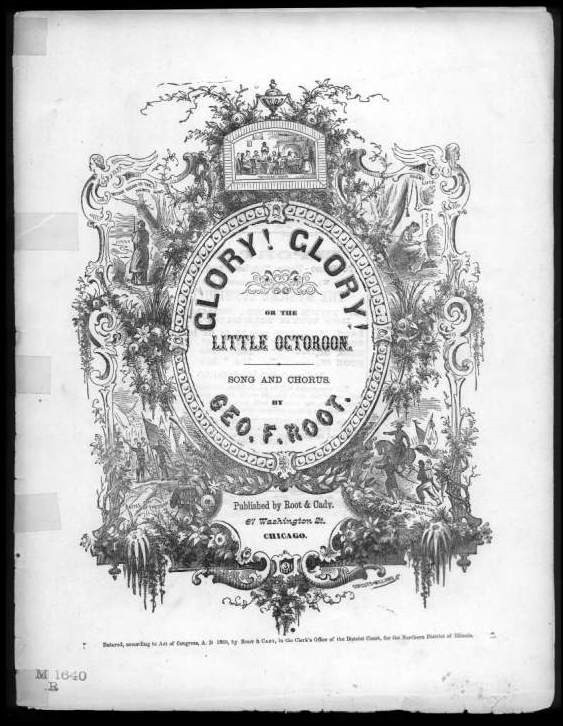
While there are no notes I saw in the archive that Piper knew this, this song does have a composer: George F. Root. Root didn’t quite reach Stephen Foster or Dan Emmett level of 19th century American songwriter fame, but he had his “hits” such as they were in the pre-recording era. During the Civil War period and based out of Chicago, he specialized in songs for the Union side.
The sheet music from George F. Root’s music publishing firm. When Piper remembers his mother singing this tune, it would have been only 10-years-old.
.
Did Piper’s mother learn this from someone else? Was there sheet music in a piano bench for this, unknown to the 5-year-old Piper? In the quiet library archive, I visualized two white people, a mother and child, in rural frontier Nebraska sharing this song. The differences in the printed song from the one Piper wrote down from his mother’s singing say this isn’t likely a handwritten copy from sheet music.****
Here’s my conclusion, which I hope I’ve demonstrated even though I’ve trimmed parts of this piece back: Juneteenth is the most complicated American legal holiday. The only simple thing about the holiday is that it stands for freedom and the lifting of oppression. Taken at its whole, though messy and with calculated delay, that makes it a favorite of a person like me, who still cries and wonders at how simple truths and rights take so long to be established. The song I’m performing today, its path and turning into a folk song, isn’t that complicated — but yes, the path of American freedom is.
You can hear my performance of Root’s “The Little Octoroon” with the audio player below. No player? This highlighted link is an alternate.
.
*In 1850 a Fugitive Slave Act was passed that required northern state governments, not just the federal government to return enslaved people who reached northern states. Some cities and states wouldn’t comply (there’s this Minnesota case for one example).
Piper’s mother was in Canada near the US border in this era. It’s possible that fugitive slaves might have crossed over into her region. I also note that Piper says she was singing it in 1876, perhaps because that’s the border of Edwin Ford Piper’s memory, but I read the date and think about it being the year Reconstruction largely ended and new de-jure laws and customs greatly restricted Afro-American citizenship.
**No, Nicki Haley, slavery was the cause of the Civil War, even though many liked to parse Lincoln’s compromise and coalition statements of this time to make it sound like it wasn’t. The flaw in that framing? Lincoln didn’t start the war, the South did, and they were explicit in proclaiming why they did it.
***There’s another song using this terminology that this Project has already presented: Longfellow’s scathing pre-Civil War poem “The Quadroon Girl.”In Longfellow’s poem the situation leading to that poem’s mixed-race child is laid out: feudal concubinage and/or rape by slaveholders. For making a speech implying the same, Longfellow’s friend, US Senator Charles Sumner was beaten to within an inch of his life on the floor of congress.
****The biggest difference: the printed song’s title calls out the chorus — it’s officially “Glory, Glory, The Little Octoroon.” I only sang the martial chorus twice in my performance because I was more drawn to the bravery and sacrifice told in the verses. We have two holidays that say soldiers made us free, but it’s not only soldiers.
I followed Piper’s transcription for the words, not the printed lyrics, honoring the chain of transmission to me rather than accuracy. I also modified Root’s tune and chords to suit my tastes and tendencies. I could not help but think of these things as I sang this: first, the mother, her family heritage caught in that sexual exploitation making the choice to stay and face the slave hunters and their dogs to assure her child’s escape. We never find out if she and the daughter will be reunited, or even if she survives. Then next I think of those pursuers who to the degree they are portrayed in the song would be gaslight villains — but in history they would be real people doing great evil, who could be thinking they were serving justice. And then lastly, the final-verse gunner who cares for the child, though he’s more the Horatio of the story, with the mother being the tragic hero. I ask you not to skip over the villain characters. It’s fine if you empathize with the gunner, but some great dangers in one’s life (and often to other lives) are those middle souls, like the slavecatcher pursuers, who have a system that tells them they are arduously, justly, doing right.
Very often I find myself unable to tell a story simply. While I find internal joy in expanding complexity there is a painful element too. Even when under the spell of things I’ve experienced and learned, I retain enough self-awareness to see what effect my expression has on others, the burden of strangeness. Then the reach between the teller and the listener becomes haphazard, unstable — pile it too high and it tiresomely topples — and so in some break for breath partway in, I realize I’ve dumped a cluttered mass of thought debris on a listener, long past any interest.
Perhaps this is why I’m attracted to lyric poetry, constrained as it is to moments, often held tight within the stiff glass bottles of forms.
Here’s a personal story that’ll go many places coming from the place I find myself in this June. It starts, I’ll guess, earlier this year when I came upon a poem, “The Last Antelope,” a striking, empathetic account of the end of an animal’s life and wildness after settlers captured it. Edwin Ford Piper was the author, and there were only scattered bits of information to be found about him. Scattered and bits do not constrain my curiosity — if the bits were great distances apart, the space between them could hold a lot of things: born 1871 in rural Nebraska, parents part of early European-origin settlement there. Largely self-educated in a land of necessary child-farmhand-so-never-more-than-half-year schools, still goes on to university in Omaha studying literature with a specialization in Chaucer, and then to the University of Iowa where as a professor he helped establish the idea of teaching and granting degrees in creative writing.
The modern convention of a university as patronage for artists, and the rise of the credentialed MFA-holding poet is not without controversy — but isn’t it odd, this man who taught himself in a small town on the fluid boundary between the 19th Century Wild West and the 20th Century staid Midwest took that journey.
In the middle of this, the same man had a compulsion to collect songs ordinary people brought with them while journeying, the words and music carried in the light baggage of memory. He wrote down songs his relatives and townsfolk knew by heart. He asked others to send him more by mail. He paid particular attention to the songs of those on the move: hobos, cowboys, and other traveling workers. Did this connect with his literary poetry? There are no recordings of Piper reading his poetry, but accounts say he declaimed it with a musical lilt — perhaps like the surviving recordings of Yeats, or maybe like the more bombastic Vachel Lindsay — and at times he would break into full song. His students took to calling him “The Singing Professor.”
Since this Project is “Where Music and Words Meet” you can see why I’d be attracted. And I’m a small-Midwestern-town boy, though without degrees. But did that seem strange then, to mesh high culture and the songs remembered by old women and rude mechanicals?
Piper was born just west of the Missouri River in Nebraska — and in Illinois, just to the east of the Mississippi River and less than a decade later, Carl Sandburg was born to an immigrant railway blacksmith who signed his name with an X. Iowa, the state where I was born in the middle of the next century, and Minnesota, the state where I’ve lived the longest, sit in a delta between those two tremendous rivers. Sandburg too mixed the latest in Modernist poetry with folk songs he collected and sang. Did Piper influence Sandburg? Did Sandburg influence Piper? Or are they the same genus of plant, raised in the same climate, but in separate plots? Questions.
Answers fork like river systems. Even with little information being readily available on Piper, I was already in flood stage. And here’s how much my wife loves me: for our 20th anniversary she agreed to go on a road trip with me to Iowa City and Sandburg’s home-town of Galesburg. My scenery in Iowa City? An archive of Piper’s papers* held in the university library there. Our grand museum of the arts of poetry and song to visit on the trip: a railway worker’s shack in a small rust-belt city, a town worn-out but still running like a paint-shedding Oldsmobile.
Two considerations worried me as I thought about this trip, one for my wife and one for myself. For my wife, I worried if there’d be something rewarding for her to do while I enthused at the library. She was able to solve that one easily, locating nature reserves, parks, and trails within an hour’s drive. I often tell her that she’s a nymph, and I complement her on how seriously she takes her job to supervise the plants and animals when she returns with soggy hiking boots from her hikes with pictures of landscapes, mushrooms, wildflowers, birds, and other critters. I love her pictures and stories on return (her stories briefer and better organized) — but my old joints ache just thinking about hiking for hours.
For myself I worried about my old-ager endurance. The library was two-thirds of a mile from where we’d stay. I’d need to hoof it with my laptop bag back and forth, which would have been a trifle in my youth, but nowadays longer term standing and walking is troublesome. I considered taking a bicycle with me, which would have made the library to-and-from easy, but a lot of hotel/AirBnB places don’t have any good places to lock up overnight, and on further consideration I thought that a bike would just be one more thing to worry about, taking my focus away from the trip’s main goals. And then I worried too about spending full days at the library’s special collections reading room. Because my time was limited, and to minimize the walking, I planned no break for lunch. I’d need to keep my focus and energy up, something that I have not been consistently able to do this year even with all the comforts of home.
On average I bike at least once every day in my normal routine, often in the morning. In the past two years I’ve not been a longer distance bicyclist, but 30-50 miles a week easily exceeds those 150 minutes exercise recommendations, and it lets me get to a café for morning breakfast and handle a lot of routine shopping and other trips. I ride year-round. In 2016 I bought my first 21st Century winter bike with studded tires; and in 2019 I upgraded the winter season bicycle to a Fat Bike with monstrous 4.5-inch-wide tires that handled ice and snow with the challenging ice ruts and potholes that my city’s current “We’ll get to all the streets in 3 days after the snow stops” plowing regime supplies. My overall stamina for the walk wasn’t my worry so much as how well my joints and stiff back would take the more load-bearing walk.** And to make it through the day I’d planned, there’d be no old-man’s afternoon nap either.
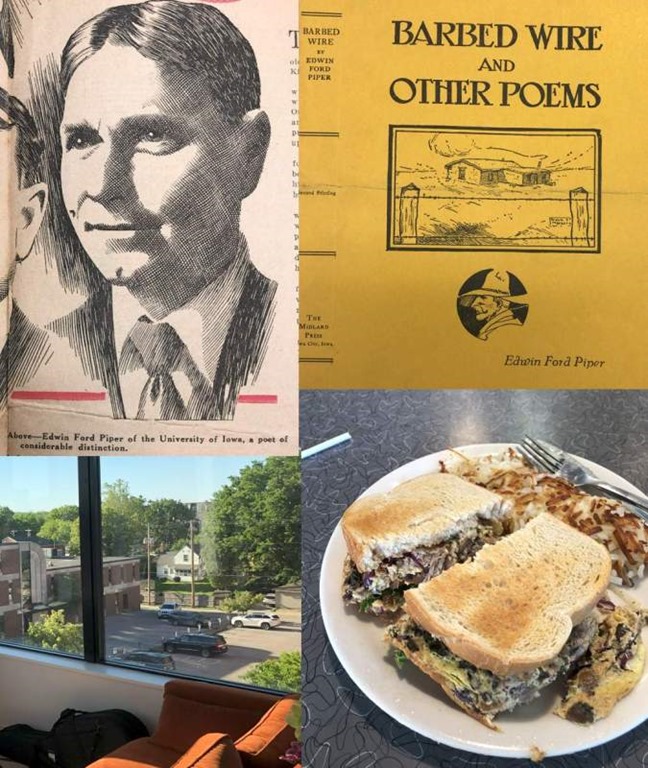
Piper, once a “poet of considerable distinction.” A later version of his collection Barb Wire. My Iowa City view, and yes the guitar got some use. Example breakfast.***
.
The first day we arrived at Iowa city was hot and very humid, so I put on my best hot weather clothing. Spouse-nymph headed off at dawn for her day’s supervisory encounter with nature, and I planned a big breakfast fuel-up. I’m a “eat little meat” kind of guy, but for good or ill I take the lacto-ovo part of my lesser meat diet seriously, so I’m a big frittata, omelet, hash, scrambler kind of guy most mornings. I note that I eat like an old-time farmer, despite never farming, but the good thing about this higher fat/protein kind of meal is that it can hold me until supper, and that was my plan.
I put on my best hot weather clothes, slung my bag over my shoulder, and headed for the university’s main library building for my encounter with poet-professor Piper’s papers.
Thus ends Chapter One.
Here’s a musical performance I put together in March of Piper’s “The Last Antelope.” You can play it with the audio player you should see below. No player? This highlighted link is another way to hear it.
.
*When I arrived at the library archives will-call desk, I asked them to pick Piper’s Papers. The librarian suggested puckishly that I was nearly reconstructing the old tongue-twister folk-rhyme, Roud Folk Song index 19745.
**Local papers/forums are full of folks who bemoan bike lanes in my city, often remarking that “not everyone is young and fit.” Despite that, most bicyclists I meet and see on my city’s streets aren’t of the MAMIL (Middle-Aged Man in Lycra) variety — and I’m maybe 1.5 letters of that acronym. I joke with my wife that as my joints get older, a bicycle is becoming a “fore-and-aft wheelchair” for me, allowing me increased mobility and beneficial low-impact movement for the old joints.
***That’s a St. Paul Sandwich: egg foo young on sourdough with lettuce, tomato slices and mayo. Near as anyone knows, my Twin City of St. Paul has no tradition regarding it, and no restaurant there serves it now. Its origin is something of mystery.
It’s been an eventful June so far for me, and I plan to be writing like a real blogger about what I’ve experienced in the last couple of weeks shortly. Then too, just this week I started working on a few further Parlando audio pieces. At least one may make the cut to appear here in the next few days.
This weekend is Father’s Day, and a new musical piece that I thought I’d present for that turned out too rough, even for my tastes. So, here’s a well-loved poem by Kevin FitzPatrick that alternate Parlando Project voice Dave Moore performed with The LYL Band a couple of years ago. It seems apropos. Kevin’s books of poetry are available from this website: kevinfitzpatrickpoetry.com Today’s poem appears in his 1987 collection Down on the Corner.
“Bicycle Spring” was first presented here in 2022, but for today’s post I remastered it and made this little video for it. Here it is:
.
Wishing my versatile readers and listeners a happy Summer.