Lilacs (version) — Amy Lowell as Patti Smith

Attention is an investment. Today’s piece combines two poets that had my attention this Spring. Regarding one poet, this expenditure was long-standing, for the other, the attention is more short-lived, conditional. My attention requests yours, so let me get on with this as I try to be brief while providing context.

Fifty years ago I had just bought a cheap nylon-string guitar from the unsold Christmas stock at a local J. C. Penny’s store. I was learning to play it because I, a poet, wanted to write songs. I can’t say much for how substantially I’ve mastered guitar playing, but I have learned how to make songs.

I had models in early 1975 for what I was trying to do. My internal list of influences was shorter than it would be now, but it wasn’t just one or two. Certainly one was a young woman roughly my age who I’d read was performing her poetry with an electric guitar player and who had written a few literary pieces I’d seen published.*  In the Fall of 1975 she released her first record album. I bought that LP the week it was released, likely at the sprawling Lloyds store on the edge of town.

The Seventies were a heyday for recording. The record business had recently become bigger economically and Rock music was huge culturally. Oddly, at the same time of this growth there was a falling off of the visionary and exploratory stuff that had attracted me as a teenager. Key artists of the previous decade had died or been diminished. Commercial filters along with endemic chemical narcissism and dependency reduced the force of many of those still recording. That debut record I eagerly bought — Horses,  by the Patti Smith Group — was nothing like those compromises, and it retains considerable uniqueness to this day. It’s a poetry record as much as it’s a Rock music record. Large portions are chanted rather than sung. Smith’s words, however delivered, demanded a listen from the heart and the pelvis before taking the long-way around to the brain. What Smith was doing wasn’t unprecedented for a woman (or a man for that matter), but it was rare then, and still is. But I don’t want to diminish the music on the record either, the band, the Patti Smith Group, were also doing things underrepresented in 1975, despite their irregular formation. Writer Lenny Kaye had been the electric guitarist backing Smith at those NYC poetry readings earlier in the decade, and now he had another guitarist, Czech refugee Ivan Kral, to expand the sound, along with a rhapsodic keyboardist Richard “DNV” Sohl, and a drummer, Jay Dee Daugherty, who had joined the group just before going into the studio. They were fellow explorers to Smith, willing to go places they didn’t have charts or established trading routes for.

Horses  gathered some attention. It was the spearhead of a musical revitalization movement that soon got a reductionist name: “Punk Rock.” Released on a major record label in this era meant that it had to be reviewed. While Horses  is now recognized as a landmark, a signpost to new paths, the reviews then were mixed, though usually respecting its ambition. It was not a commercial blockbuster, sales were modest, but that was OK then as first albums were allowed mere “worthy of attention” response. My own reaction wasn’t as a critic or chart watcher — I needed inspiration, and I overwhelmingly welcomed it.

To get to today’s Parlando piece we need to move on to the PSG’s meeting up with the problematic-second-album syndrome. That album, Radio Ethiopia,  sold even less than the first, and the Rock critics were even more mixed in opinions. It was a shot-by-both-sides response. These contradictory judgments were issued: it was even less commercial than Horses,  it was trying to be a mainstream Rock record and so wasn’t Punk; it indulged too much in Smith’s self-mythologizing (evidence: she, a woman without credentials, played naïve guitar on the LP’s longest jam), it was too much a band-record featuring the Group instead of Smith.

I liked Radio Ethiopia. More inspiration as far as I was (and still am) concerned. A song from that doomed follow up has remained in Smith’s repertoire for the rest of her career: the breakup song “Pissing in a River.”   In this linked 20 minute 21st century account of Radio Ethiopia  and that song, Smith herself movingly describes her state of mind while making that expression. She was so full of doubts that the wholly committed vocals that mesh with Ivan Kral’s compelling four-chord cycle in “Pissing in a River”  are credited by Smith to her brother, who came to the studio just to stand next to her, silently, at the mic. Last time here I spoke of how our relationships with others broaden what we see and report as artists. I teared up listening to Smith’s account this week, another testimony.

Lilacs

The version I used for performance is roughly half the length of the original poem.

.

This Spring, as I made tentative plans for National Poetry Month pieces here, I made a note next to a poem “Lilacs”  by pioneering early 20th century Modernist poet Amy Lowell: “Long. Maybe do it Patti Smith style?”

I have not played much attention to Lowell, though one musical performance of a poem of hers is a personal favorite of mine. In the landmark era when English-language Modernist poetry emerged, she was a controversial figure — those mixed reviews again. It’s undeniable that she helped popularize the new free-verse style as a poet, anthologist, critic, and promoter — but otherwise these were arrayed against her: she was a woman, not gender-conforming, overweight, and suspected of being a wealthy bougie poetic interloper on the bohemian Modernists. I’ll add my own personal count against Lowell: a lot of her poetry doesn’t consistently reward my interest. My current theory is that she’s something like Wordsworth, a poet whose best work may be diminished by a mass of undistinguished work, and great lines sit next to meh ones. But also like Wordsworth, her value in theorizing and promoting a new prosody must be acknowledged.**

“Lilacs,”  the poem that gathered some of my attention, is an example of the good and bad as I see things with Lowell. There’s immediacy in the poem that attracts me for performance (Lowell was an enthusiastic public reader). “Lilac’s”  theme, remembering her New England ancestry,*** would befit her cousinoid Robert Lowell later in the 20th century, and I loved lines that sounded like Allen Ginsberg (“Clerks….reading ‘Song of Solomon’ at night, so many verses before bed-time, because it was in the Bible”) and Frank O’Hara (“Parks where everyone walks and nobody is home.”) ****

So, I did one of my “use what fits me best” editing jobs on Lowell’s original text, excerpting what I thought of as the most vital images in the poem, reshaping some of the lines, and following through on my first-thought of performing it in the manner of the Patti Smith Group.

That incantatory “Pissing in a River”  chord cycle was a good match. I needed to rotate myself into each player’s role to create the ensemble, getting the rhythmic core down with a drum program, adding a bass line, and then performing each channel of the song’s double-tracked rhythm guitar bedrock. I used a sophisticated arpeggiator to create a right-hand piano part, but on evaluation I was so proud that I could get the just-little-different precision of the doubled guitar parts that I removed the piano.*****

Now it was time for the vocal recording pass. I made an unusual choice to try to improve what I fear is the least successful part of my recordings: as my expedient to Patti Smith’s brother undergirding her resolve, and only as preparation for the take using Amy Lowell’s words, I recorded an entire “scratch take” performance of “Pissing in a River,”

My four-chord riff cycle isn’t played exactly as the PSG recorded it, but the last part of my recording was an even larger departure from my inspiration. As a musician I’m a full-idiot/half-way savant. The part I’m most comfortable in is lead guitar playing, so my version isn’t a copy of theirs, I looked to another mode, their adventuresome NYC scene-mate guitarists: Tom Verlaine, Richard Lloyd, Ivan Julian, and Robert Quine. The performance in my recording of “Lilacs (version)”  includes what some (many?) would consider overplaying. As I (too?) often do, I continue to play during the vocal passages. I know this is incorrect — but more than correctness, I worry that it might detract from the song. Asking myself why I do this, my answer is that because my voice can’t provide the melodic elaboration I’d offer if I was a more skilled singer; and as a poet, I think the words can be (are?) powerful enough to compete with wailing electric guitar.

I leave that last thought with this restatement: as a writer, it’s OK to whisper — understatement has its power — but even if you read unaccompanied, or write for the silent but companiable page, consider if your chosen words are committed so they could go toe-to-toe with a cranked guitar. Sometimes you might want that.

You can hear my performance melding impressions of the 1970s Patti Smith Group with parts of the 1920s Amy Lowell poem “Lilacs”  using the audio player below. No player? It hasn’t been dropped by the record company man — it’s un-displayed by some ways of reading this blog.  This highlighted link is an alternative way to rock it, as it will open a new tab with its own audio player.

.

*The page poem I still specifically recall was “Dylan’s Dog”  (aka “Dog Dream”).

**As I mentioned recently, the issue of being too prolix and prolific with putting out work is something I worry about with the Project and myself.

***Like fellow New Englanders Cummings and Millay (and the British Housman) already performed this National Poetry Month here, Amy Lowell is presenting Spring as a memory of the quill-written past wafting through graveyards unkempt by their Modern age.

****As with a lot of early 20th century female Modernists, Amy Lowell dropped off the canonical map in mid-century as High Modernism and the New Critics came to the fore. Lowell’s popularizing efforts gained little credit as poetry sought a refuge in elite understandings and “serious subject” male-centric viewpoints. Our current century is re-evaluating that.

*****As a naïve keyboard player, arpeggiators are a crutch I often lean on. Give them a chord and their rule-based fingers will present a more sophisticated output. I border on shame when using them, though similar tactics are all over modern music. I’ve tried to bargain with my guilt by referring to my favorite arpeggiator as “DNV” — the nickname Lenny Kaye gave to Richard Sohl who was a vital elaborator of the earliest PSG records. “DNV” stood for “Death in Venice” because Kaye thought Sohl looked like an actor from the movie version of Thomas Mann’s story.
The Vanishing Red

Do you think you know Robert Frost? You know: steadfast New England farmers, Currier and Ives snowfalls, happy roads less traveled by. We might think of Frost as the friendly Modernist, with good ol’rhymes and rhythms and narratives of American scenes of Americans bearing up to the burdens of life.

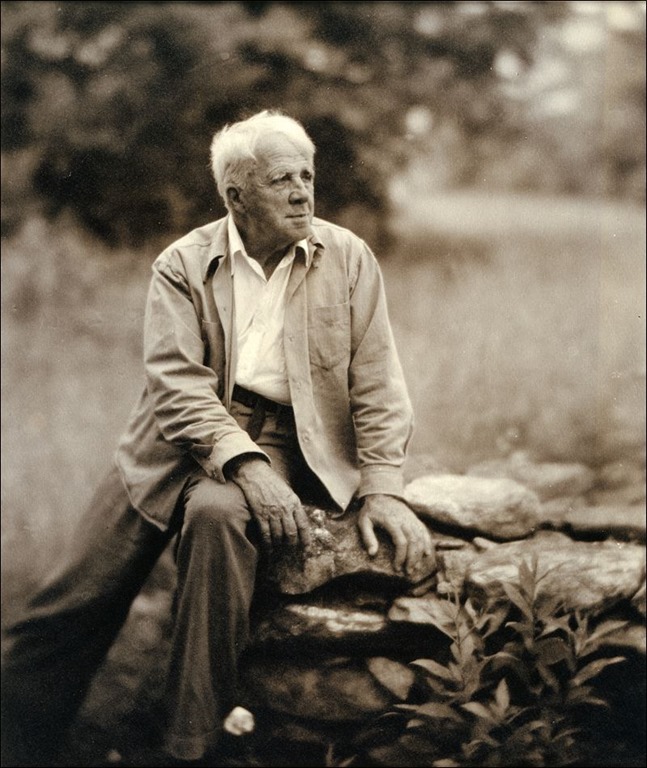
Robert-Frost on a wall

Robert Frost. Wry poet of the good old days—or maybe not?


Today’s piece is instead the hard-boiled Robert Frost. It’s blank verse, but the beat is implied, the sentence structures beat against it, and my performance choice was to not emphasize the meter. What “The Vanishing Red”  portrays is, straight up, a racially-motivated murder, and the way Frost tells the tale uses sly ways to frame this story.

He doesn’t get out of the first line before he starts this framing. One of our characters is called the “Red Man” by history. A term roughly equivalent to the N-word for indigenous Americans, but one that in Frost’s time was not considered socially unacceptable.*  Frost wasn’t going to shock or disgust his readers in 1916 with that epithet at the start of his poem, like he might some today, but he wants us to know from the start that the race and history of this man is material to what is going to happen—but we don’t meet him yet.

Instead we meet another man, the Miller, who’s talking in a way we might find familiar. He starts out by telling us he’s not guilty of something before he’s even been charged with it, claims too that he’s not one of that PC brigade who “talks round the barn” instead of straight talk, that he’s a get-it-done doer.

Frost adds just a tiny bit of narration after the Miller’s speech. Some may read this narration as excusing the man, but the narrator’s pointing us to think about two things as the story will continue. The narrator says, let’s not consider this as history (“too long a story”) or politics (“who began it”). As we’ll soon see, we’re going to consider this as an Imagist poet would consider it, as a presentation of what Ezra Pound called “an intellectual and emotional complex in an instant of time.” History can be dulled by time. Politics says there are two sides.

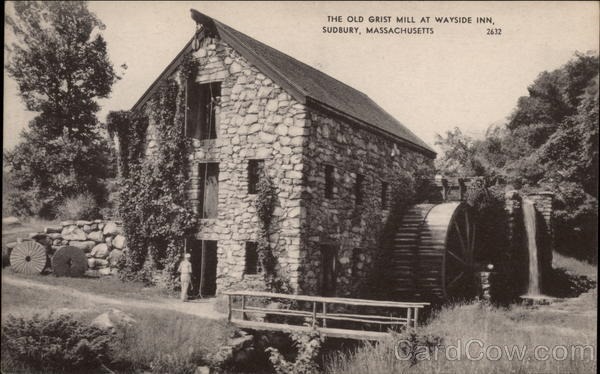
Old Grist Mill

Nostalgic postcard or dark satanic mills?  Frost reports, you decide.


But first we have one more exchange of dialog. Our unnamed “Red Man” is at the Miller’s mill, and we hear nothing he says directly, but we do hear what the Miller puzzles about what the other man is communicating. The Miller portrays the other man as without English words, but he interprets some “guttural exclamation” anyway as surprise, and this is somewhat sketchy. Is the native American puzzled by the mill’s mechanism? Surprised at being seen by the Miller?

Is the Miller even reading the other man well? I think not. Afterall, the Miller has another reaction, stronger than his sense of what the other man may be feeling, and Frost’s narrator also doesn’t “talk around the barn:” it’s disgust. But that’s not what our Miller portrays in his next piece of dialog. He acts friendly, offers to show “John” his mill.**  Ah, the “Red Man” has a name, he’s not some reductionist cypher for an entire continent’s indigenous peoples, and since it’s an English name, we might surmise that he might even be one of the Massachusetts tribes that attempted to synthesize with the new rulers, taking to Christianity and living in “praying towns.”

And now the Imagist poem begins, ten lines. The Miller opens a trap door and shows John the water-power wheel, and a poem that has been entirely without imagery suddenly gets a vivid image. The wheel’s water forebodingly is like struggling, thrashing fish. The door closes, and the door’s handle (a metal ring) we are told makes enough noise with this shutting to be heard above the noise of the mill. And the Miller returns upstairs, alone. The wheel’s turned around to the beginning of the story where the Miller laughs, though it’s not quite a laugh. He meets a customer carrying more meal to be ground at the mill, who doesn’t understand what has just happened. We ourselves are just understanding what has happened.

What has happened? The racist Miller has thrown John, the “Red Man” into the mechanism and killed him. Frost wants you to feel that by showing you this moment in time, but he also wants you to vividly feel the lack of notice, the vanishing in the title, which isn’t some passive mystery, it’s an act of human cruelty.

Today’s music is two pianos, bass and drums. I’ve been suffering from a cold for the past few days which made completing today’s spoken word component a challenge, and I did miss one phrase in Frost’s text and didn’t get another one completely correct, but you didn’t get to hear any of the coughs and voice cracks from the bad tracks either. To hear “The Vanishing Red”  use the player below.


*For example, the college I went to over 50 years ago called its sports teams the Redmen then. I had a tiny part in the beginning of the process to change that.

**Acton Massachusetts had a grist mill and more. I can’t find any pictures of them, but the town still has a Grist Mill Road.

I’ll Tell You How the Sun Rose

After our short trip to Chinese translation, let’s return again to Emily Dickinson, who is observing another morning.

This LYL Band performance of “I’ll Tell You How the Sun Rose”  is a bit imperfect. Alternative Parlando Project reader Dave Moore takes the lead here, but he and I are singing instead of our usual recitative, and we’re caught at the top of our singing range as well. Dave even bobbles a word in the line “The hills untied their bonnets.” So, yes, this leads to some imperfection—but this lyric is so perfect that perhaps it can carry us along anyway.

I suggest you listen to this piece now and then read my discussion of what I see in it afterward. Dickinson, like a good melody, doesn’t require understanding before enjoyment. The player to hear it is at the bottom of this post.

“I’ll Tell You How the Sun Rose”  begins with a homespun 19th century village dawn, and the singer starts right off almost bragging that they can tell us how the sun comes up. As proof, Dickinson unleashes a string of lovely, singing metaphors for sunrise, looking down from the dawn only once to let us see the squirrels running about as if with the news of the day. She concludes this section with finest simplicity: “That must have been the sun!”

Isn’t that a strange way to sum up dawn? It comes up and it’s already past tense, like Meng Haoran’s morning in the last post, and Dickinson comments on this common splendor as if she’s a surprised alien from another planet who has never seen the sun. Her boast that she can tell us “how the sun rose”—something she and all of us should already know, set in nothing more special than a prosaic town—becomes instead a small, whispered, apprehended wonder.

In the second section, Dickinson shifts gears so smoothly that no matter how many times you read or hear this poem you will never notice. There is a little engagement of the gears as she says of sunset “I know not,” unlike our first gear’s “I’ll tell you;” but we’re soon on to a rural scene with the sun rays like children climbing up and then down a stairway over a hedge or fence row (a stile).  At that point, there’s a bustle in your hedgerow as the dusk becomes a grey robed “dominie,” a strange and archaic word perhaps even in Dickinson’s 19th century, and a sure stumper for any modern English speaker.

A dominie is a Latin word meaning the leader of a congregation, a minister, a pastor—and ‘pastor” is derived from the word for shepherd—and that’s just what our grey dusk becomes as it leads the children of the dawn, now dusk, away like a flock, closing the bars, closing the gate, so that they cannot return.

Some readers are so charmed by Dickinson’s first section that they feel it is pedantic to think that this sunset section is describing a passage to death, “The undiscovered country from whose bourn, no traveler returns,” so no wonder that Dickinson moved from “I’ll tell you” to “I know not.”

That dominie seems so removed from the pleasant village of the first section, so foreign. Another subtle word choice contrasts the two sections. There’s only 88 words in this piece, and five of them are colors. “Rose” puns for dawn pink in the first line and then dawn is “amethyst,” a word for both purple and a semi-precious stone. The sunray children are “yellow”, and our strange dominie is dusky “gray.” The stile sunset stairway that the sunray children are climbing is “purple.” So out of our five colors, one of them is roughly the same color. In the first section, it’s semi-precious and wondrous, but in the second it’s just purple—a ruling, royal color perhaps—but those sunset ray children’s steps are ruled over not ruling, not shining like the amethyst steeples of the dawn.

stile sunset

Putting on the stile


Did you listen to the performance of “I’ll Tell You How the Sun Rose”  before reading all this? I feel a bit here as if I’m acting  like that dominie myself, leading you past the plain and beautiful dawn, over the stile, and closing the gate to simply hearing the sound and the manner of expression of Dickinson. Too often we make too much of the meaning of poetry, and particular the deeper meaning of poems. Just as Meng Haoran’s poem from last time can be understood well enough to be enjoyed by children, this poem too can be enjoyed as compressed observation. Perhaps it’s because I am an old man, one who has tried to write and make music for many years, that I care to see what is underneath the sun rays, to look over the stile, and to find what is inside Emily Dickinson’s expression.

To hear the LYL Band perform “I’ll Tell You How the Sun Rose,”  use the player below.

Winter is Good

Here in the upper Midwest we are now in the middle of winter, and so are in a various ambivalence about it. Part of us doesn’t like the burden of winter, part of us wants to taunt it, and show that we can still have the upper hand over it, and some of us, those who don’t want to stop reading the book of nature, can find a cold, white chapter to puzzle over and admire.

I’ve already spoken here about how Minneapolis was settled as something of a colonial outpost of New England. The author of the words for this episode, Emily Dickinson was a lifelong New Englander, steeped in Transcendentalist thought, so we know she’s read that Winter chapter.

Just before dawn this morning, I jumped on my winter bicycle and took a ride to my favorite breakfast café.  It was seasonable, 20 degrees Fahrenheit and snowing, the streetlight globes surrounded with particulate halos of pelting snow. My tires were crunching the snow, the big knobs of their tread like typewriter keys imprinting the blank pavement’s page. It really was quite beautiful, if obscure of meaning. Summer rain saturates us, inebriates us. Snow surrounds us, but we are never more than a transient part of it, unable to understand its dance.

Roughneck in snow closeup

Winter is good – his Hoar Delights!  Also, there is tea and a frittata involved.


Emily Dickinson’s words are featured here a lot because she’s a great lyric poet and her words fit with music almost without effort. I learned decades ago that Dickinson favored “hymn meter,” that 8,6,8,6 syllable verse that makes much of Dickinson singable to the melodies of “Amazing Grace” or the “Gilligan’s Island” theme song. For “Winter is Good” I decided to throw out that pattern, turning some lines into refrains and marrying it to a melody similar to the Christmas carol “Joy To the World” instead.

Dickinson’s second verse is a doozy. Just 17 words in her text, but it twists so wildly. “Generic as a Quarry”—there’s winter’s white page I suppose. “And hearty – as a Rose-“ not sure where we go there. Dickinson was an avid gardener, and she no doubt missed her summer plants, but my best guess is just rosy cheeks.  And finally, the concluding two lines “Invited with asperity/But welcome when he goes.” A jokey finish that seems like it’s singing the old joke about the pleasure of hitting oneself on the head with a hammer because it feels so good when you stop.

Our various ambivalence aside, that’s what the Winter chapter in the book of nature says to us Northerners, our words arise and are recovered over by the white page; our music only the spaces between silence, soon to be drifted in.

To hear the LYL Band play this hymn to winter with words by Emily Dickinson, click on the gadget below.

An Old Man’s Winter Night

This is the most difficult set of words to read coherently that I’ve presented so far in the Parlando Project. Robert Frost’s “An Old Man’s Winter Night” looks on the page like any other chunk of blank verse (“blank verse:” unrhymed iambic pentameter). Shakespeare wrote whole sections of plays with this rhythm, and the walking one/two with a backbeat of an iamb has a forward propulsion that leads the reader to flow through the words.

The problem is, that even the most iron-lunged and fleet-tongued rapper has to pause for breath sometime. In general, it helps to pause for meaning, where the break for breath adds meaning. However, in the Parlando project I’m seeking to merge the words with music, and the musical cycles also suggest pauses.

Robert Frost larger

I saida hip hop,
The hippie to the hippie
The hip hip a hop, and you don’t stop

“An Old Man’s Winter Night” was tough because I decided on a cycle of chords for the music, rather than basing the harmony around a drone, or simply “through composing” the music to follow the words without a repeating structure. I made that choice unconsciously, but I think I was responding to Frost. The poem seems to repeat itself, and my sense of the syntax was that the sentences seemed to start and begin again, like unto the central incident in the poem of an old person in a room not remembering why he had gone to that room. So the problem was: where to break the cycle of the circular speaking, keeping to cycling verses of chords, while helping the listener understand the meaning.

I got it almost right I think. I was further inspired as I worked by being in the midst of a Midwest below-zero cold snap while recording this.

I normally do not base my readings on others, though it might have helped me to listen to other solutions to my reading problem. Only after committing to the version you’ll now hear, did I listen to Robert Frost’s own reading of his poem and another good reading which does an excellent job of bringing out the meaning. Of those two, Frost aims to bring out the music in his rhythms, but it’s not a perfect reading. Authors have an advantage, in that they likely know the poem’s meaning—but they are also disadvantaged by that—since they know, they cannot always choose what the listener will need to have emphasized. By combining “An Old Man’s Winter Night” with music, I have another advantage over Frost’s own reading: I don’t have to follow the word’s rhythms closely to bring out the music.

“An Old Man’s Winter Night” embodies aged rural loneliness, something that even today’s modern communications can do little to ameliorate. For those of my generation who only remember Robert Frost as an old man, I’d like to point out that Frost first published this when he was 44. Frost beautifully describes being alone, separated, cut off; evoking all the surrounding emotions of that situation—yet he doesn’t once mention loneliness or any of those allied emotions by name. A great trick to pull off, don’t you think?

To hear my reading combined with music, use the gadget that appears below.

Eros

Time and the universe are designed to make us disappear. What makes us cry at that? What makes us laugh at that? What is the agreement we can reach with that?

The words in this piece are from Ralph Waldo Emerson. Emerson is another of those 19th century New England worthies that we’ve touched on before. Many other writers were encouraged, promoted, and inspired by Emerson in their day.

Ralph Waldo Emerson

Ralph Waldo Emerson (Lake and Palmer not available)

If Walt Whitman and Emily Dickinson are the father and mother of modern American poetry, Emerson is their common grandfather.

For Dickinson, Emerson’s heterodox religious views seem to have buffered her from her family’s more conventional Christianity. Emerson’s ideas of individuality, of attention to inner voices and discernment, and on the book of nature illuminate Dickinson’s world-view. Some of what is obscure and puzzling in Dickinson (a poet whose music can grab us long before her meaning and vision can become clear) opens up when read in the light of Emerson and his circle.

Walt Whitman, that iconoclast who otherwise defies all authority, promoted his career on the back of an enthusiastic letter of praise from Emerson. He published that letter for PR effect, and then blurbed it prominently in subsequent editions of Leaves of Grass. Never shy, Whitman’s work often trumpets Emersonian ideas and concepts, sometimes taking them farther than Emerson would. Emerson may have written this poem and titled it  “Eros,” but Whitman’s poetic accounts of physical love caused Emerson to personally consul discretion to Whitman.

Dickinson’s personal library contained the Emerson poetry collection where this poem, Eros, appeared. When writing to Emerson’s colleague, Thomas Higginson, Dickinson said this of Higginson’s mention of Whitman:

You speak of Mr Whitman-I never read his Book-but was told that he was disgraceful

However, Emily Dickinson was quite capable of portraying herself to Higginson in misleading ways, so one never knows. Ralph Waldo Emerson visited Dickinson’s hometown. He even stayed next door during the visit. Biographers say she attended Emerson’s lecture but didn’t meet him.

Thomas higginson-cyclist

Thomas Higginson, Transcendentalist and long-tail cargo bike pioneer

So Emerson, Whitman, Dickinson. Each of the poets had seen Emerson, each read him, but the other side of the triangle probably never closed. Dickinson was not widely published in Whitman’s lifetime, preventing Whitman from reading her work, and Dickinson may not have read Whitman. So let’s leave it at Ralph Waldo Emerson, and put it shortly:

Emerson is the theory, and Dickinson and Whitman are the practice.

Emerson also wrote poetry, though his considerable 19th century fame came from other things. As a popular lecturer and essayist, he was able to introduce his ideas widely into American culture. As a scene-maker, he declared American independence in cultural matters roughly 60 years after the political fact of independence, and his school of thought, Transcendentalism, was in America the 1960’s counter-culture of the 1840’s.

For such an influential person, particularly as an influence to poets, his poetry is not always rewarding.

To put it frankly, Eros is strangely worded. It’s rhymed and loosely metrical—but despite the casualness with structure, some lines read like someone trying to contort English syntax to fit a strict metrical form. The next-to-last line “And, how oft soe’er they’ve turned it,” is an abomination. It sort of echoes the meter of the first part of the couplet, but it just doesn’t sound good or make it’s point well. I’m also not clear on the image in that line. Are “men and gods,” or some other “they”, turning love on a lathe and not improving its natural form?

So, regarding that line, good Transcendentalists may well just respond: “OK, Ralph, whatever.”  The strong point in Eros, to put “To love and to be beloved” in the center of existence’s meaning is strong enough to overlook infelicities.

In creating this piece, I did some things to try to convey the poem’s strengths. I turned the separated rhyming lines “To love and be beloved” and “’Tis not to be improved” into repeating refrains to bring out that central thought. Musically I use a favorite tactic of mine: repeated motifs that seem at first to be repeating, but are actually changing. Sonically the guitar part has a modulated echo that adds a bit of microtonal warble, and I treated the vocal with a light “throat singing” effect. My sonic goal there was to tip my hat to Emerson and Transcendentalism’s introduction of Asian religious concepts to America.

To here my music and reading of Ralph Waldo Emerson’s Eros, click on the gadget below.