Musicians Wrestle Everywhere — Emily Dickinson hears songs as they are created

I’ve just spent much of a day with Emily Dickinson. I’ll tell you it was enjoyable, not the least because there is a factor in many of her poems: they grow when you spend time with them.

It started late last night. I noted that I had been looking at early examples of “jazz poetry,” poetry from the previous Twenties that celebrated jazz music and jazz musicians. A thought occurred to me: I’ve gone too far into #NationalPoetryMonth without a Dickinson poem. Which of her poems might deal with music?

“Musicians Wrestle Everywhere”  came up in searches, though it was not a Dickinson poem I’d seen before.*  Here’s a link to the full text, and here’s another to a manuscript of it in Dickinson’s own hand. After my first reading of it, my reaction was, “I don’t know if I can fit this with the jazz poetry. While ‘Musicians’ is the first word, the musicians largely go away and we’re off into Dickinson’s headspace.” Well, my second thought was, “This could work some other way and time, disconnected from the Jazz poetry stuff. Let me see what I can do about making it a song for later use.”

Dickinson attracts composers. She often uses a folk-music meter adopted also by many Protestant hymns,** and the compression of her poetry leads to short texts ideal for art-song. “Musicians Wrestle Everywhere”  has already been set by eminent American Modernist composer Elliott Carter.

I didn’t want to go toe to toe with Carter. My mood today was to make this somewhat foggy poem more immediately understandable on first listen, while Carter emphasized the poem’s more abstract thought-music. Wrestling with Dickinson’s words and my desire today as I tried singing it and working out my music, I decided to make some minor changes to the words*** and to add a refraining line. The former tactic is generally frowned upon, and many a living author will forbid it. The later, repeating a line or section, is generally allowed. One of the reasons that page poetry often seems less effective as song is that we have a strong desire for repetition in song. I think if even when silently listening we are “singing along,” and we desire to know when some part is recognized as coming around again. Refrains bring us into the song, even on first listen.

So, what is the poem’s point that I hope to make clearer in my song and performance? I believe that Dickinson is saying that musicians, and herself, extract from the time and vibrations of crowded reality our new tunes, rhythms, timbres, and harmonies. Those composing ears aren’t merely transcribing. They might refine melodies within the strife of conflicting environmental sounds, but to some larger degree they are hearing the unheard music that does not exist, though founded or surrounded, in observable reality or philosophy. In the final verse she mentions some think what inspires composers is the pagan “music of the spheres” or some choir of angels, or the departed in heaven — the later a place the skeptical Dickinson is not sure of.

So where does new music come from, if not just imitation, transcription, a cosmic mechanism or ancestral angels? This is the reason for my refrain, to make more adamant what I think Dickinson may be saying. Why are our April trees budding? Why is there new life in our spring without our trying or thought — and in notion of our stewardship of the Earth, despite our neglect? “I think it’s that new life” the now refraining line repeats. Life, creation, poetry, music, it wants to happen.

Elmo Hope is a thing with feathers

I would be ahistorical to suspect that Emily Dickinson’s piano improvisations were anything like Elmo Hope. On the other hand, if my lame joke tempts you to listen to some of Hope’s recordings…

.

By the time I’d worked out a meaning to Dickinson’s poem I’ve come to think that it is a compliment to the Jazz poetry I was looking at before after all. The Jazz poems of the previous Twenties I’d seen mostly observed the musicians and provided a listener’s appreciation of what they were putting down. In Dickinson’s poem, she’s the musician, the composer themselves.

By late this afternoon I’d completed the music and recorded the acoustic guitar, bass guitar, cello and violin parts for my song setting of “Musicians Wrestle Everywhere.”  The player gadget to hear my performance is below for many of you, but if you don’t see it, this highlighted hyperlink will open a new tab to play it too.

.

*She wrote over 1800 poems, so another fine thing about exploring Dickinson is that there can easily be a new poem to experience. Which reminds me to point out that this project has over 500 pieces to experience here too.

**Yes, I know the bit about how you can sing many Dickinson poems to the “Gilligan’s Island Theme,”  or “The Yellow Rose of Texas,” or as this post reminds us, many hymn tunes. The post also has a short summary of what’s known about Dickinson’s musical involvement. The author notes that Dickinson was familiar with mid-19th century string-based dance music as well as having some ability to improvise on piano. I wonder at the Celtic and African strains that might have crept into Amherst by the 1860s. The only instrument Dickinson mentions in her poem is the tamborin, which appears to be an African derived hand-held drum instrument.

***I wanted to modernize the syntax and usage a bit to add to the clarity for the contemporary listener. A line in the third verse uses one of the few archaic terms in this poem “Dames” which has largely fallen out of American usage even as a faux-genteel slang term for women. By expanding the following term from “Men” to gentlemen I echo a somewhat outdated formality and may have helped make clearer that the “bright Majority” of “vanished Dames and Gentlemen” are the dead of the past.

Reapers

Let me continue in our celebration of National Poetry Month. Yes, but.

Though some of my international readers may not suspect this, others of you may wonder how I’m doing after another incident were someone in my metropolitan area was killed in a government incident that seems unnecessary and unjust. I’d describe my overall reaction as numbed thought, and I’ll leave it at that. It’s not that I don’t have thoughts, but in our instantaneous world, thousands have already written and there’s no scarcity of takes — if you need anyone to supply a template or echo for your own response, you can have that in abundance.

I continue because I think there’s still a shortage of what poetry and music can bring to us. Poetry, like many tweets or blog posts, can make arguments, present hot takes of their authors; but it also can work differently, it can take an attentive reader or listener and by attracting them and presenting something to pay attention to, allow its audience to form their own changes in perception.

Today’s piece, “Reapers”  by pioneering Afro-American Modernist Jean Toomer attempts that. In his 1923 book-length work Cane,  where this poem first appeared, Toomer presents such things, moments and situations that ask for that response from its readers. That’s an inefficient process. How many will read, how many will really read in that extension where we accept the task of creating a whole-hearted response to what the author presents? Some things work on one, quick, reading. We may already believe we know, we agree. A brief amen is all that is called for. Other work may just seem slight to our moods and perception, and we skip any deeper step. Today’s poem is called “Reapers,”  but I think here of the Christian parable of the sower.

“Reapers”  presents two rural scenes. In the first, harvesting or mowing is being accomplished as it had been done for millennia with the reapers being people with scythes. With intent they ready their blades, sharpening the edges with abrasive stone honing blocks. Toomer presents the scything that follows as silent music, a rhythmic swinging represented with precise meter and one pair of perfect end-rhymes followed by another pair of perfect rhymes that are in themselves near-rhymes to the first pair.

In the second scene we are taken to an era particular to Jean Toomer’s time. The mower, the reaper, is a mechanical machine drawn by horses,*  the immediate ancestor to our present engine-driven farm machinery. That machinery was likely not as silent, but instead of presenting the clank of its mechanism, Toomer auditorily zooms in on the squealing sound of a “field rat” picked up and wounded in its belly by the mechanical, systematic blades of the horse-drawn mower.

horse-drawn mower

“I see the blade, blood-stained, continue cutting…” a small version of the horse-drawn cutter in Toomer’s poem

.

This poem is easy to see as a pair with another we’ve presented here, a poem by Robert Frost, “Mowing.”  Here’s a link to the text of Toomer’s “Reapers,”  and here’s a link to the text of Frost’s poem. In Frost’s poem, the reaper with the hand-swung whispering scythe scares another animal, a plausibly Edenic snake. Toomer’s rat is not so lucky. Did Frost’s reaper, working like the scythe wielders in the first half of Toomer’s poem, stop their motion and take their poet’s eye, recorder, and projector to the escaping snake? In Toomer’s further observation he asks us to see and hear the horses and more directly the machinery of the mechanical mower that has no such observation, and the horse’s driver is intent on operating them, not the work itself. They do not stop, it’s not their design, they continue, cutting, blood-stained.

I will not write a post here about systematic racism. It’s a term with some value of conciseness, and from that, the easiness of easy rejection or restatement. The term has one mooted objection for example: that it’s not even racism — which to any extent that’s true doesn’t make it better, it makes it worse. Ethnic prejudices leading to evil acts are as old as recorded history, likely as old as the first bone scythes and then metal, beaten, plowshares — but Toomer’s poem asks us to watch its successor: a colder mechanized blade of efficient expectations and ways of doing.

A player gadget to hear my performance of Toomer’s “Reapers”  in my modest acoustic guitar setting may appear below. If you don’t see a player, this highlighted hyperlink will open a tab or window to play it too.

.

*My father, born around the time of Cane, late in his life wanted to make clear to me that he’d driven horse-drawn farm machinery in his youth. He did this late enough in my own life that I heard him, and thought, and think, about what he was trying to present to me in that.

What the Thunder Said Part 3

As part of this project’s celebration of #NationalPoetryMonth we now return to our serial performance of the entirety of T. S. Eliot’s “The Waste Land.”  When we last left off in the landmark poem’s concluding section, the narrator was seemingly alone in the dry waste land of the title. Some ambiguous creatures have been observed on the bleak landscape, but in this section the narrator reveals, and yet doesn’t reveal, who else is here.

Right as today’s piece begins, two more possible persons are introduced, yet never named. Besides the narrator, there’s someone they are speaking to, and what the narrator first says to this second is that the narrator senses there’s a third present. We are told nothing about the person the narrator is speaking to, but some mysterious elements of the third are stated.

Who are the three? Let me cut to the chase: I don’t know. Critics and readers can provide plausible guesses, but their evidence is not determinate. I’ve always read the narrator in this section as being the poem’s author, the poet T. S. Eliot himself. Reportedly much of the poems final section was drafted while Eliot was hospitalized with what was characterized then as a “mental breakdown.” So, I’m going to call the narrator Eliot from now on. Who is he speaking to? As I said previously this month, the second could be the reader: you, me, us, those who have followed this fragmented journey from its opening memories of Europe before WWI through a series of disconsolate scenes and characters who speak in a variety of voices, and who seem both connected to immortal time and yet stuck in an inescapable post-war meaninglessness.

It could also be Eliot talking to himself, or part of himself, and since this second person is not described as mysterious, they seem well enough known to the narrator to not need any description or introduction — after all, when you talk to yourself, you don’t need to ask for an ID. And the third, the one that Eliot says he sees walking beside the other two? All we learn is that what they wear is non-descript, a brown hooded garment, and that Eliot can’t even tell their gender.

So, we don’t know, it remains a mystery. It’s been my experience in writer’s groups that elements like this will often be pointed out as errors, oversights or faults to be corrected. While this is a judgement made by fellow writers, I’m not sure if all (many? most?) readers feel the same in a case like this. That said, in performance, performers often feel they do need to have a working theory that they can tie their work to. And for me, I’ve worked here with the idea that the other two, besides the distressed narrator Eliot, are in an amorphous sense: us the audience, another element of Eliot, and our potential healing future aspects. That’s odd 3 into 2 math, but it makes sense emotionally to me. Other than one being known and the other unknown, there’s no real difference in this working theory between the second personage and the third, they are fractured into separate aspects from the first, the narrator. That fracture is partly why the narrator/Eliot is distressed, but that he can see these elements and begin to speak to them can be part of some level of reintegration.

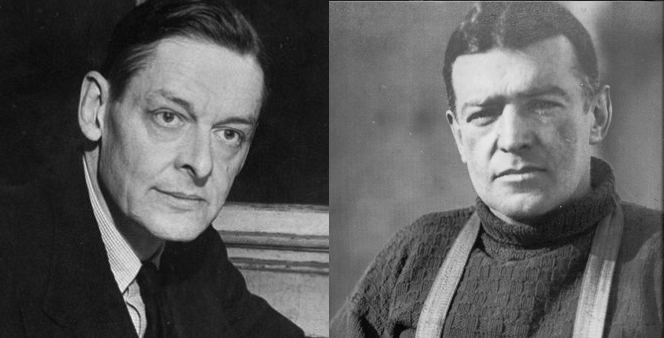
Eliot himself said that he took the idea of a mystery third person materializing from a contemporary account of a remarkable adventure story: the Antarctic survival saga of Ernest Shackleton’s explorers party whose ship was trapped and destroyed in ice.*  While trekking across his waste land, Shackleton had written that he saw an extra man helping with their load. Enough others have had similar visions that the phenomenon has even been given the name “The Third Man factor.”

Eliot and Shackleton

Eliot and Shackleton. Third man not shown. Should I have looked for a picture of Harry Lime or Jack White?

.

Please don’t take this as a take-it-to-the-bank or make-your-grade definitive exegesis of this piece of “The Waste Land,”  but instead as a thought, a suggestion, that in times of trouble you may be visited by that element of your future that wishes to heal you, and that creature will be hard to recognize as you express this internally or externally — for in our troubles we may believe there is no future, no future you or us. Let this third walk beside you, even if you can’t quite know them, or know them yet.

My performance of this part of “What the Thunder Said”  from T. S. Eliot’s “The Waste Land”  can be heard either with a player gadget some of you will see below, or with this highlighted hyperlink which will open a new tab or window to play it.

.

*Eliot probably learned of this from Shackleton’s own accounts published around the time Eliot wrote “The Waste Land.”  I learned about the Shackleton story 22 years ago from a crackling-good hour-long radio documentary made by a former co-worker of mine, John Rabe, which I’ll link here. Note that Rabe’s documentary sums up the lesson many draw from Shackleton’s story then and now, that we can endeavor to survive unimaginable trials, and that we can survive.

The Origin of Baseball

Let’s hope I don’t overextend my love for American poet Kenneth Patchen with yet another example of his work today, which happens to be the opening day for baseball in my city. Patchen wasn’t quite the modern day spoken word poet, but even 80 years ago he was writing in a form that works in that presentation — though more here in a mode where the listener is immediately attracted by references to our common life and speaking idiom, and then finds the poem going off somewhere else between its lines before it ends.

Many poets are indifferent readers of their own work, but Patchen is usually quite good. I actually muffed one line in his text today, but Patchen has modified several lines, either from the variations of performance, or in the case of the lips of the “girls of heaven” he seems to choose a gentler metaphor here.

.

Baseball used to brand itself as “America’s Pastime,” and this poem makes something of that with its intimations that like love’s fancy and poetry it fills time and makes a joke of watches and schedules. I note too, that Patchen, the pacifist whose world was at war when he wrote this, knows that concerted effort is not always noble, and that the blessing of wasted time is better than time wasting from want or wasting one’s fellow humans.

Oh yes, the prophets among us can see clearly that professional baseball is a business enterprise, full of the commercial slight-of-hand that parodies patriotism and oh-so-righteous conflict. I myself remarked last year as I was reading the newspaper, that I had finished the section dealing with the businessmen who wear uniforms and was now moving on to the — why-is-it-separate?  — sports section. But then, oh prophets, who really can find any remedial pleasure in cheering on a grocery chain or brokerage firm?

As I write this, over at the baseball field the home team has just answered the visitors’ one run with four runs in the bottom of the 3rd and now a light rain says we stop and wait for rainbows — or if the game is called, it will all go away as if it had never happened. Time knows it’s real. Everything else is illusions.

Here’s a link to the full text of this poem in case you want to read as well as hear it. The player for my performance of Kenneth Patchen’s “The Origin of Baseball”  is below. Don’t see the player gadget? This highlighted hyperlink will also play it.

.

Eliot’s Oak

The river of history runs only in one direction.*  And so on our river journey, the Modernist poetic landmark “The Waste Land”  will arrive, and stopping and resting on the landing there will mark us as well past the headwaters, and our memories will diminish of the headwaters, even if the very water that carries our boats flows from there. T. S. Eliot wrote many letters and critical essays, he must have written somewhere about his American poetic forbearers — but if so, the spotty scholar writing this is so far unaware of what he said.

If one searches on that subject, one will see many mentions of Eliot’s Modernism supplanting the American 19th century New England worthies headed up by one Henry Wadsworth Longfellow. And then something else might turn up, like this deserves-to-be-better-known sonnet of Longfellow’s titled “Eliot’s Oak.”   Here’s a link to the text if you’d like to follow along.

If we largely forget Longfellow these days, we tend to forget Longfellow the writer of short lyric poems to an even greater extent. If this sonnet had been attributed to Keats or Shelley, it would be no less antique in some of its usage, but I suspect it would be better remembered and rated for achievement. Besides the “speakest,” “days remote,” “eventide,” and “hath” language, its chief crust of old-fashionedness is its use of the pathetic fallacy, where a tree is addressed and converses in the poem. We’d forgive Keats and Shelly for this, where we likely won’t forgive Longfellow. If we allow that bald-faced metaphor to pass, we might notice that the imagery in the poem develops in an admirably subtle way. In the sound of the tree’s leaves the poem hears a variety of sounds whose meaning is just out of reach, and masterfully Longfellow transitions to say that different people will hear different nearly intelligible languages in this sound. Am I stretching this conceit’s move too much to say that this 1876 poem has just sought to impress upon us a key tenet of cultural Modernism?

As Longfellow’s sonnet reaches its turn for a final six lines, we are forced, as much as we might be in parts of “The Waste Land,”  to seek out what is being referred to. With “The Waste Land,”  it wouldn’t be extraordinary to believe that some of the readers of this blog would have some knowledge of Richard Wagner, Jacobean drama, Metaphysical poets, or Ovid; and it’s even more likely today that some here would have some understanding of Hindu religious thought and writings, which will get called out in the upcoming concluding sections. But, do any of you know of the “Apostle of the Indians, Eliot…” Longfellow speaks of, what this story means, and how dark it is? I didn’t.

Eliot Oak before 1936

The Eliot Oak still stood in Longfellow’s time, and long enough for a trolley line to run past it.

.

In the 17th century, the Puritans who founded the European colonization of Massachusetts included this stalwart preacher John Eliot who came to believe that he was called to preach to the indigenous Algonquin tribes there. The Puritans had a strong streak of religious zealotry, and given that and the commercial interests of colonization, many regarded the natives of their new colony has the devil’s savage minions. John Eliot believed them to be merely unconverted fellow humans.**  As Longfellow’s poem indicates in his Biblical allusion in lines 10-11, Eliot views the indigenous as fellow members of the Abrahamic family, potential “people of the book.” At first, all this was only a philosophical/theological debate. Eliot was allowed to learn their language, preach Christianity to them, and form somewhat autonomous villages of “praying Indians.” In an act of superhuman intellectual and literary effort he managed to translate the entire Christian Bible into their native language. Just this massive translation alone would be remarkable, but these tribes had no written language, so he had to devise a way to use the western alphabet to depict it. Nor was it an easy job to then print the resulting Bible: the press had to be imported, and the work of setting the type and printing was not trivial either. Eliot headed this project, but it should also be noted that the first nations people who worked with him were indispensable.

The resulting book, in a first edition of 1000, Mamusse Wunneetupanatamwe Up-Biblum God, wasn’t just the first time anyone had created a new written language to publish a Bible, it was the first  Bible to be printed in what would later become the United States.

Now of course the whole issue of evangelical Christianity and native cultures is a complex subject. Even those of you who do not know John Eliot’s particular story will include some who know some of the harmful incidents in such matters. Yes, this story gets dark, but there’s also a strange redeeming element in the end too.

In 1675 some of the Algonquins began a three-year uprising against the colonialists, leading to what was called King Phillips’ War. It makes no difference that Eliot’s converts are co-religionists of the colonialists or if they have any allegiance to the rebels. The very fact that many of them are now fluent in the native languages and English makes any of them prime suspects as spies and informants by both sides. Some of Eliot’s converts are killed, and the rest are shipped off to a concentration camp where many starve, despite Eliot’s efforts. Oh, and most copies of the Eliot bible are deliberately destroyed. Those theological debates have become warfare.

I promised there would be a ray of light in this. I’m not sure this had happened yet when Longfellow wrote his poem — and if so, he prophecies it in the poem’s last line — but in the ensuing colonial disaster inflicted on the native peoples, their language was wiped out. People still existed who were descendants of this Algonquin tribe, but they could not speak it’s Wampanoag language. Surviving copies of Eliot’s Bible become the Rosetta Stone that allows the language to be revived.

John Eliot Memorial Newton Mass

The same year Longfellow wrote his poem a memorial on a spot where Eliot preached to the Algonquin was built. I wondered through Google Streetview to find it still stands, though it looks ignored.

.

In summary, as you listen to today’s audio piece, it may just seem like a facile little ditty about a talking tree and this, whatever Eliot,*** who isn’t even T. S. Eliot. Understand what its images and references point to, and it’s a memento of one of the least-known and most-impressive American literary achievements and a link to the complex tragedy of some who hoped to turn in some way from genocide. Perhaps it’s the romantic in me, but consider some of the lost or just unheard stories of the land we live on during this #NationalPoetryMonth, the lips that spoke them, the hearts that heard them. The river of history may run in one direction — but go ahead, make a fool of yourself, and listen to the trees. Or listen first or second to my performance of Longfellow’s “Eliot’s Oak.”  You can use the player gadget if you see it below, or this highlighted hyperlink will open a new tab or window to play it too.

.

*Except in Chicago. See this.

**Here’s a short, two-page summary of John Eliot’s efforts in PDF format written for a local church that bears his name.

***So, is John Eliot related to T. S. Eliot? I don’t have a family tree or other such documentation, but it’s highly likely. Eliot’s family was known to descend from early Puritan colonists.

What the Thunder Said Part 2

Let’s continue with my serialized performance of T. S. Eliot’s “The Waste Land,”  moving onto the next portion of its concluding section “What the Thunder Said.”

The poem is called “The Waste Land,”  but except for that title’s general metaphoric weight and a few passing foreshadowing lines, it’s only here, more than 300 lines into the poem, that we finally enter the landscape promised in the title. It some kind of rocky desert, almost Martian, and the poem’s speaker is also like unto an astral traveler descended from a spaceship onto it. Later in the section we learn that there is at least one other traveling with the speaker, but this is yet unrevealed, and even then, there is nothing definite about this traveling companion.

Mars The Waste Land cover

“Damn Martian cicada infestation, and this dry grass sure could use some rain.” Alt-timeline Eliot in another genre.

.

Who are the two people? No name is given to the speaker of this section, and it’s easy to think it’s the poet himself, though some have figured the speaker to be Tiresias, the male/female time-lost wanderer featured elsewhere in the poem — though if Tiresias is something of a Virgil in this Divine Comedy,  perhaps they could just as well be the companion to the poet here. Another theory has the second to be either Jean Verdenal, the friend and putative lover of Eliot who had been killed at Gallipoli in WWI, or Eliot’s wife Vivienne Haigh-Wood. It’s also possible to read the unnamed companion as us, the reader, accompanying the now unmasked Eliot to the poem’s conclusion.

These are all theories of scholars, whose greater knowledge and reading I respect. I personally have always read the “two” as the divided self, and I perform the poem from this understanding.

There are glimpses of others in this landscape, “red sullen faces sneer and snarl from doors of mudcracked houses” but are they visions, hallucinations, or inhuman if living? I read them as these — perhaps out of preference — as Eliot seems to have shared a substantial portion of the crude racial/ethnic stereotypes of his culture.

Today’s section was, at least at one time, Eliot’s personal favorite part of the poem. In 1923 he wrote to Ford Madox Ford saying there were “about thirty good lines in The Waste Land”  and he wondered if Ford could decern them. Ford didn’t try, so Eliot revealed that he was talking about “The 29 lines of the water-dripping song in the last part.”

If I was put in FmF’s place, I wouldn’t have picked these lines out from the over 400 of the poem. There is a musical logic to this section — that’s there throughout much of “The Waste Land”  — but here, instead of the vivid yet mysterious characters we have met in the run up to this section, we have — for a moment — what seems like a short interval of self-pity.

Today’s musical performance of this part of “The Waste Land”  tries to track Eliot’s landscape and outlook. A player gadget will appear at the bottom of this post for many of you to play it, but if you don’t see that, this highlighted hyperlink will open a window or new tab to play it too.

What will we find as we press further into The Waste Land  during the final installments of our serialized musical performance of the entirety of Eliot’s landmark poem for National Poetry Month? Check back here or follow the Parlando Project to find out.

.

What the Thunder Said Part 1

It’s April, time to celebrate U. S. National Poetry Month! We’ve had a tradition here over the past five Aprils of performing “The Waste Land”  in serial-installment fashion, and now this year we’ve come to the landmark Modernist poem’s final section: “What the Thunder Said.”

Since the Parlando Project officially launched in August 2016 it’s been a tremendous effort to lead this exploration of a variety of poetry and ways it can be performed with original music. Last year we crossed the 500th piece threshold — an incredible achievement in creative productivity that I’m often proud of. One could spend hours here just exploring the poets we’ve featured and the ways we’ve performed their work. Though I expect most listeners will enjoy only a portion of what the Parlando Project does, I’d say this month is a good opportunity to wander randomly through our archives or use the search function to see what we’ve explored.

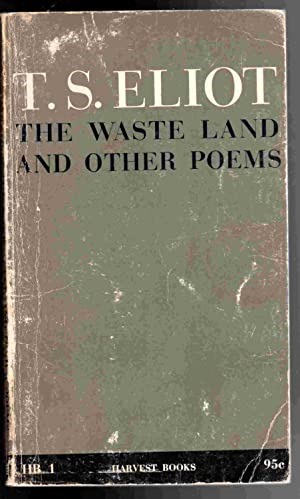
The Waste Land paperback cover

Putting a little worn patina on The New, The Modern…

.

I am a little sad and a fair bit intimidated in reaching this section of “The Waste Land,”  the ending. It has become harder for some uninteresting reasons to keep up this project’s pace, but as I come to this April, I know I’m going to miss my annual return to the sprawling collage that is Eliot’s great poem. Though I’m hugely grateful for the ability to come this far, sadness is all around me, friends and relatives in suffering situations that I’m unable to address or help, and a sad tribunal is taking place a few blocks from where I sit and write.

I’ve always found this section of the poem a confrontation with sadness, and as it largely removes the masks and personas that have peopled the rest of the poem, I think it’s the most difficult to perform, both for audience-effectiveness and because the performer should/must confront that element inside themselves.

I’ve always found this section of the poem a confrontation with sadness, and as it largely removes the masks and personas that have peopled the rest of the poem, I think it’s the most difficult to perform…

As dysfunctional and damaged as they may have been, today’s section of “The Waste Land”  transitions us from the unreal city, its duplicitous characters, and the sweaty faces and the hubbub of “He do the police in different voices” sections, and begins to move us to the titular waste land that will be the stage on which that final confrontation with sadness will occur. Musically, I open this with an urgency as the battle is about to begin. And so, to hear my performance of the first part of “What the Thunder Said”  from “The Waste Land”  you may be able to use a player gadget below. If you don’t see the gadget, this highlighted hyperlink will alternatively play it.

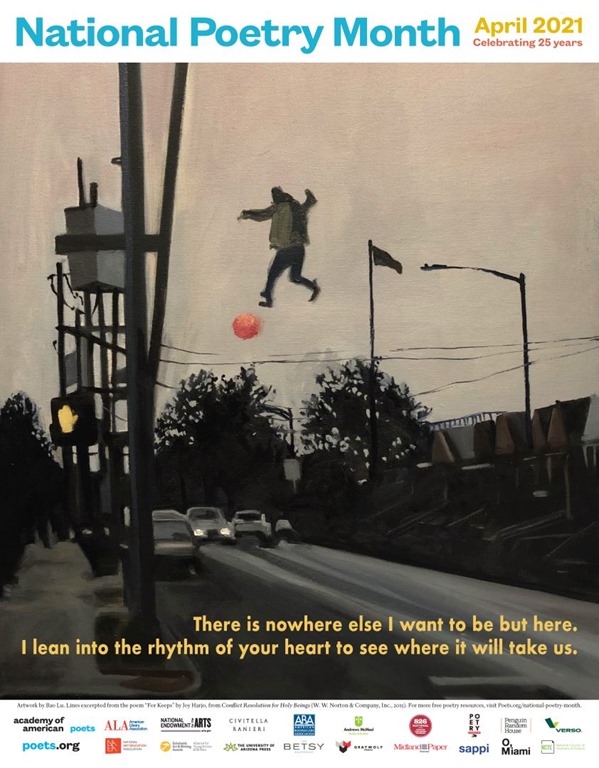
2021 NPM Poster_1080

Thank you for reading and listening. Over the rest of April, I plan on pressing on to the end of the poem, and to present as much other work here regarding the sister arts of poetry and music as I can. Click follow or come back, check out the other things here, and spread the word about this Project. Those of you who’ve done that are what keep this going.

.

Confucian Ode on Blake, Dickinson, and Whitman

It’s time to wrap up our National Poetry Month celebration, and once more I’m going to present a piece where I wrote the words as well as the music, a piece in celebration of the unpredictability of poetic genius. In the “Song of Myself”  section I presented a few days back, Whitman proclaims that America contains multitudes, plain and profound things, contradictions—and furthermore that everyone of us can contain all and each of that.

He could have spoke the same of the world, even if he was a believer in American Exceptionalism. But he wasn’t alone in American beliefs. Artist, printmaker, and poet William Blake thought as much in London even as we struggled here for independence. And in the era Blake wrote his “America, a Prophecy,”  in our America, a young woman, who had been abducted from Africa and enslaved, Phillis Wheatley, filled the next fold of her future by writing her book of poetry.

And by Whitman’s time we had Emily Dickinson, born a free white woman in a prosperous household, yes, but not yet in a time when those of her gender could hold for the power of her own mind. Her grandfather, her father, her brother all made and read the law, but she fully became Shelley’s unacknowledged legislator of the world.

In all the oppressions and focused indifference of America and the world, humankind still has these poets. Let us wonder and rejoice in them—and also those living now—who, whatever their given lot in life, open themselves to a blessed consciousness and find someway to convey it to us.

Speaking now of my poem that makes up today’s text: I think I called it a Confucian ode not only because I tried to use whatever understanding I have of how Li Bai and Du Fu expressed themselves in 8th century China, but in the sense that the much older odes collected by the school of Confucius were intended to instruct society as a whole, not just serve as an anthology for other poets.

Confucian Ode to Blake Dickinson and Whitman

Here the text of today’s piece. Classical Chinese poems don’t use punctuation either.


The process of explaining poems can suffer from the explaining the joke or speaking about music dangers. But since I have a passing acquaintance with this poem’s author, let me say a few words about my intent this time. In the first stanza, I note the priors from which our three poets came: William Blake’s father was a hozier, a maker of socks,*  Emily Dickinson, as we’ve already discussed was the daughter of a lawyer, and Walt Whitman’s father was a house carpenter.

If poetic accomplishment was a matter of instruction, none of them would have stood a chance. Of course, there are other poets with fine educations, and poets whose households were steeped in literary culture and expectations; but in the area of poetry, they historically stand side by side with these of more modest backgrounds.

A couple of years back I presented two poems together, one by Carl Sandburg and the other by Ezra Pound that spoke of Dickinson and Whitman. The better educated Pound takes a side-swipe at Whitman who he declares he once merely detested, saying Pound’s time is for carving, though grudgingly, that Whitman “broke the new wood.”

Pound has a point. I too think Whitman could have used a good editor, though perhaps then he wouldn’t be Whitman, so capable of maddening us to contradiction with his excess. In this year’s portion of “The Waste Land,” “Death by Water,”  editor Pound took the exceedingly well-educated Eliot’s lengthy tale of a shipwreck and drowning and carved out the sharpened epitaph we now know, that I could present this month. So, in the second stanza I make my bow to craft, and to those of us who help preserve and present the work and souls of poets. I speak of this craft and preservation as a container, much as the poets are containers for the blessed consciousness they open themselves up to receive.

In the third stanza, I make a new connection to the first two stanzas. I speak of those wealthy in this world, with fine socks and gloves, lawyers to take care of their contracts, and builders to make their towers. If you are an American these days, you may think I refer to a particular someone who puts his name on lots of tall buildings—but that name is writ in water. By such actions and pride they are saying the buildings are not the point, they—their selves—are what is contained in them.

Trump tower with shadow on name

If we’re labeling things, the top on the other side should say “noggin.”


I end the poem with another stanza and a final couplet, continuing to tie the preceding in. This is my attempt at the “music of thought” I speak about often when I speak of poetry: a power that finds harmonies in thoughts, images—rhymes in things not only in words. Why must we say and share our poetry? Because it’s not ours. In acts like the Parlando Project and histories of much, much more, humanity preserves and presents it, and celebrates it in National Poetry Month.

Yes, if we wrote it, we stayed still to write it down, practiced the discipline to convey what blessed consciousness may have conveyed to us, removed the words and other personal cruft that obscured it, cut the cord and buried the now shabby afterbirth. We share it, not because it is ours, but because it has worth.

Thank you for reading and listening, thank you for the kind words. Thanks to Dave, Heidi and Bert for helping make this project happen. April is ending, but May can be filled with poetry too, so follow this and spread the word. The player to hear my performance of “Confucian Ode on Blake, Dickinson, and Whitman”  is below.


*And so, by way of a footnote, our April-born William Shakespeare’s father made gloves.

Death by Water

Long-time readers here will know that the Parlando Project has been performing a section of T. S. Eliot’s “The Waste Land”  each year to celebrate National Poetry Month.*   It’s been a major task, and if one were to listen to all those past sections, you’d get a fair sample of the variety of original music we create for these performances. Similarly, the amount of work that goes into all of the Parlando Project has been huge (we’re rapidly approaching our 450th piece), but this year’s section of “The Waste Land”  is small—the smallest section of Eliot’s Modernist landmark.

I recall when I first encountered “The Waste Land”  as a teenager how puzzling the whole thing was. Right from the start it was confusing, with allusions and foreign language phrases that I had no way of decoding. It was said to be important, and it certainly seemed to be quite the accumulation of something,  but its hard to grasp nature didn’t make it easy to like. I could understand only a little about what Keats was saying in a poem like “Ode on a Grecian Urn”  back then too, but the essence of that poem’s longing and attractive mystery was there from my first reading. Eliot’s poem? It just seemed complex, even in an off-putting way.

But when my past-times teenager got to his year’s section, “Death by Water,”  I found poetry I could take in immediately had slipped into the much larger corpus of this poem. “Death by Water”  is a small elegy, and what allusions it had (like Keats’) were alluring. “Phoenician,” even at that age, had the right kind of mystery, what with the seafaring and alphabet. That feint echo of Shakespeare’s “Full fathom five” sea-change coral-bones. The straightforward sense of mourning.

For all its shortness, I doubt I was alone in finding it one of the most impactful parts of “The Waste Land.”  If you’d like to read this short, 10-line section by itself here’s a link to it.

Teenaged T S Eliot
The teenaged T. S. Eliot before he adopted the Harry Potter eyewear.


In 1952, decades after “The Waste Land” was written, this section took an important part in a literary controversy. A Canadian critic, John Peter, published an article that year claiming that the key to understanding “The Waste Land”  was that it was almost entirely a disguised elegy to a French medical student who Eliot knew in Paris before the war: Jean Verdenal. The strong inference in this theory was that Verdenal and Eliot were gay lovers. In 1952 this was not only sensational to the degree it might still be today, it was outright dangerous. To be homosexual was more than a notional criminal offence—and furthermore by this point T. S. Eliot was the living model of a religiously conservative Modernist and a Tory in his politics.

Eliot was furious at this article. Lean solicitors were called in. Retractions were demanded. In the end, Peters not only apologized, the magazine that had published the article tried to round up all extant copies and destroy them.

A couple of decades later, after Eliot had died, this reading was raised again, and this concept of the poem is still being explored in our century.

On one hand, Eliot made no secret that he admired the young Verdenal. They shared a love for the poetry of LaForgue and Mallarmé and acknowledged times together as college students in Paris. Eliot opened his first published poetry collection Prufrock and Other Observations  with a fond dedication to Verdenal.

“Death by Water”  was a key exhibit in this reading of “The Waste Land.”   In late April of 1915, Verdenal was serving as a medical officer in the doomed WWI Gallipoli** campaign with the French army fighting along with British and ANZAC forces. Accounts written afterward said Verdenal was heroic in trying to deal with the mass carnage on the Allied side as they tried to gain a beachhead at the edges of the Middle East. He was killed, and there was little ability to bury the dead on the beaches as the invasion failed. They were left to the tides or thrown in the water. A cruel month indeed.

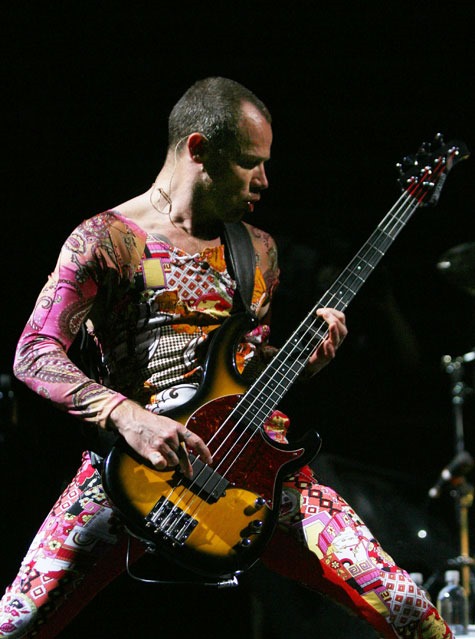
Flea Bass

Now to press levity next to death: I used to mispronounce Phlebas as if it had three syllables. Apparently it’s pronounced with two, phoenicianally/phonetically, close to “Flea Bass”—though I think with a short, not long A sound. The next time you see RHCP, you’ll enter the whirlpool and think of T. S. Eliot.


Knowing this, it’s easy to see Phlebas as Verdenal. But I knew nothing of this when I first read “Death by Water.”  And you don’t have to know it either to have the words work for you in some way. Eliot had a theory for that, a well-respected theory back in mid-century: “Objective Correlative.” Eliot, by his own theory then, would hold that it makes no difference what the relationship was for him to this other young man in pre-WWI Paris. Subconscious? Sublimation? Closeted? Self-protection? Platonic, or Dionysius denied? No matter. You consider Phlebas or you don’t. Their bones are picked in whispers now anyway.

So, here’s my new addition to the Parlando Project’s ongoing serial performance of “The Waste Land”  available with the player gadget below. Perhaps another one where a legitimate singer might better serve my composition, but I like the current of the acoustic guitar music enough to submerge you in it.


*You know: “April is the cruelest month….” That one. No one has said as much, but between the opening line to “The Waste Land,”  the prologue to Chaucer’s “The Canterbury Tales,” and Shakespeare’s birthday, April seems like a logical choice for National Poetry Month.

**Another casualty of that campaign, a young British poet-soldier who died of an illness on a ship headed to those beaches: Rupert Brooke. One of the most popular pieces ever presented here is my recasting of a piece Brooke wrote on that troop ship heading to Gallipoli.

An Old Man on Record Store Day

The Parlando Project is mostly about presenting other people’s words. I like that. It adds variety and it lets me write about what encounters with those words bring forth. We’ve done that over 400 times since this thing kicked off publicly in 2016

So, we’re always ready to celebrate National Poetry Month. Any month is poetry month here! But every once in awhile I slip in one of my own poems. Sometimes it’s just because I have something I want to say to this adventuresome audience, but it’s often because I’ve read something someone else wrote and I think of something I wrote (or should write, and then write) that relates to it.

A blog I read regularly by Paul Deaton has ranged over various subjects in the past couple of years, but lately he’s been writing some about the past, including lives that range back into his parents and grandparents generations. I’m not going to go back that far, I’m only going to go back to when I was a young man. Given my age, this is “Boomer” territory that’s been already over-farmed—but bear with me. This isn’t really a poem about the past, it’s about someone in my generation who has a past, but presently. For those Gen X and Millennials who find this insufferable, I remind you that I’ve been priming my High Schooler who isn’t a Millennial to blame Gen X and Millennials for ruining things for the current and subsequent generation. I urge other geezers, crones and wise-ass elders to do the same. As our aged, but still very stable emperor demonstrates, the best thing to do to deflect blame is be proactive in shoveling it elsewhere. I don’t know why that should work, but it does!

Anyway, I’ve presented quite a few poems this year by younger-than-mid-life poets whose poems speak as if they are aged.

Besides National Poetry Month, April is supposed to bring us Record Store Day. It would have been last Saturday, an annual celebration of those venerable little stores that once again were selling dark flat petroleum circles that sing when you poke them with a needle. Our current crisis has canceled that.

Now back in my day…Oh man, having a past and dragging it around does make one insufferable doesn’t it…this sort of thing was serious business for me. I had little spending money, but I would hope to have it in order to buy one of those foot-square pieces of art with the circles inside. Something cool. Something that represented my generation.

I can remember a particular spring afternoon. Somehow my girlfriend and I had caged a ride in a keyboard player’s new AMC Javelin to travel to Iowa’s capital city where there was a “head shop” (which is where the best new records were sold, along with, well, “smoking accessories.”) On the way we listened to an 8 Track tape of the Moody Blues To our Children’s Children’s Children.  When we got there, I could merely marvel, as I had barely enough for one record album, and couldn’t decide which one to get or if I might need the money for something else. So, the only thing I bought was a pinned badge: a smaller, paler circle, containing a bit of the cover art to the Cream’s Wheels of Fire  record.

Badge
A circle from “The Sixties.”


Recalling this day 50 years ago or so, says paradoxically to me what music and recordings meant to me then. A record was a precious clue to take me through days or weeks. Foolishness? It’s always been partly that.

But of course something else was on my mind, and the mind of some of my generation on that non-official, just another record store day. War. Justice. The cutting edge of the then gap between generations and elders that had been through WWI, WWII and the Korean War, and were often sure we were ducking our war turn. Our best thoughts of ourselves were that there were more important battles, and of course some of us didn’t succeed in avoiding the war they wanted us to fight. And some of us went off looking for Eden, a place you can sort of find, and then lose track of again.

What else does that memory mean? What does it mean presently? That’s what today’s short piece is about. The player gadget is below to hear it.