Since There Is No Escape: Thanatopsis-Turvy.

Here’s another piece that has been in process for nearly a month. It’s also another that I’ve held back because I feared it would be either disturbing or unattractive. It should be apparent by now that this Project doesn’t exactly pander to an audience — what with its inconsistency and stubborn variety — but I do sincerely appreciate those who take some of their time to read or listen to it. So let me explain.

Sara Teasdale’s “Since There Is No Escape”  is a piece of gothic romanticism. Since my tastes are wide-ranging, it’s not the first time I’ve touched on that strain of expression — “The Dark Cavalier”  from earlier this month would be another example. These are pieces with a kind of dark beauty to them, and therein is the danger. For, at least to some, there’s a simplifying morbid pull to that kind of thing.

Do gothic pieces impel that kind of response? They have a defense. I wrote that “The Dark Cavalier”  implies skeptical elements while expressing the dank promises of death. “Since There Is No Escape”  might be said to go further, presenting itself as a memento mori exercise, a way of praising life by starkly expressing the inevitability of death. As an old person I’ll frankly acknowledge that the ending of any expectation of unlimited numbers of years ahead of me motivates me in getting on with what I do. At my age, my cohort of fellow art-workers near and far from me are dying off. Yes, that’s inevitable, but I’m not going to put on a big black-crepe production about it either. Let it get me off my butt and onto my work — but beyond that, those concerns could just get in the way and constrict my vision.

Teasdale means to say nearly the same thing, but with poetry it isn’t so much about what is said (unlike a book or essay) but more about what it feels like to say it. The emotional moment in this poem is stuck a bit — and it’s a short poem which contains only a moment — in the contemplation of death and the romanticism of life and song against it. If “The Dark Cavalier”  sees death as a lover who promises to be faithful, a quality many lovers promise with crossed finger bones, the “Since There Is No Escape’s”  singer sees death as a chief magnifier of the author’s art.

Maybe that’s so. Maybe there’s no escape from that: that we value the transience of life, love, and art because it’s transient. Memento mori is a motivator, as I acknowledge, but it can get in the way of living, which has a right to the flavor of the inconsequential and the illusionary non-obsolescence of the present.

Teasdale not having it

An oft used picture of Sara Teasdale. I’m struck by the enigmatic expression.

.

All this sounds like I’m dragging on Teasdale, whose word-music pulls me in, and whose poetry is worthy of greater attention. It’s not that simple. The poète maudit stance can be overvalued as the only true outlook — it’s not the only way to frame life and living — but poetry and song that expresses those emotions allows us to examine those feelings in ourselves, in others. That then is my explanation: those who believe life is richer and stranger can find value in examining and acknowledging that gothic outlook.

A few words on the music for today’s audio piece. I’d like to give a romantic explanation for the elaborate ensemble you’ll hear when you listen to it: three (count’em) three pianos, two Mellotron parts, organ, upright bass, drums, and a large mixed chorus of voices. I could write about the music trying to express the richness of life that Teasdale says she’ll miss, or that those are the choral voices of sweet and solemn death angels singing above us temporary earth dwellers.

Don’t let anyone else know, but that fair field full of folk set of sounds is due to my setting up a new more powerful audio production computer because I’ve finally started to run into issues with larger numbers of more demanding virtual instruments in some of my arrangements. This music was motivated by me layering in a bunch of those VIs to see that I’d successfully reauthorized them, and to test that the upgraded computer was able to run them at low latency settings without glitching. Perhaps this is a parable: that you can find substance while you are only concerned with the mundane, since it was freeing to play the various lines on these instruments on my plastic piano keyboard unconcerned with their lasting success.

To hear my performance of Sara Teasdale’s “Since There Is No Escape”  you can use a graphical player you should see below. No player? There’s still a way, this highlighted link will open a new tab with its own audio player. Those wanting to follow along with the text of the poem can find it at this link.

The Oxen

As stories go, the Christmas birth story as it has been accumulated through the centuries is quite the thing, isn’t it? Let me be honest with you: the overall theological interjections, who Jesus is, what he means, what is his relationship with what is a godhead are philosophical questions. Perhaps they are of supreme importance (some believe this so), but philosophy makes my head hurt. I may be an indifferent singer, but as a poet or poetry audience it’s the song that attracts me. Music, even small music, is sensory, it resonates. And if one takes all the things that have been added to the Christmas story, it’s the shepherds in the field, not the big angelic hosannas or even salvation — it’s the details that grab me.

One of my favorite Christmas posts by this project was my adaptation of Longfellow’s “Three Kings”  from three years ago. My adaptation focused on a new mother watching the breathing of her infant while the wisemen wizard’s gifts are explained in eschatological terms. What a contrast that is!

This year I decided to set this decidedly rural Thomas Hardy poem “The Oxen.”  which deals with one of the miracles that have been added as details to the Christmas manger scene. Hardy brings a novelist’s gift to his poem. His Christmas birth story is told as a story within a story within a story: countryside English children of Hardy’s youth’s era being told around a fireside that since there were stabled oxen in attendance to the Incarnation on the first Christmas, they and their kin were struck then, and ever after on its anniversary, with the need to kneel and worship the babe.

The speaker in the poem, telling us of being told this story is savvy. He recalls that no child on that hearthside wondered if the elder telling the tale had made it up. Those workaday adults seemed to have no time for authoring fantasy tales — and, in point of fact, they didn’t make it up. Like all great folklore, it’s a miracle of which we don’t know the author of.

So, the poem closes with two Christmas miracles: the cattle bowing in worship every Christmas Eve as midnight comes, and the miracle of plain, ordinary folks telling a joyous tale. Hardy closes by saying he wants the continued promise of those miracles.

Manger 6

The ox may be worshipful, but the donkey may just be asking when baby Jesus can get out of the hay supply

.

As so often with things these days I had to set this poem to music quickly. As quickly as I wrote the music, I then had to wait for a couple of days for when the unscheduled time came that I could record it. I had trouble fretting the guitar that afternoon. I had had to scrub my hands hard to remove grease and dirt from doing some bicycle maintenance earlier that day, and my fingertips were still softened, a bit raw, and not ready for the wires. Still, I managed to get the basic tracks down. I added the rest of the parts you can hear in the performance below with my Little Plastic Keyboard which didn’t challenge the fingers so much. The sound I wanted to add, even in the drum parts, was bell-like — Clarence-angels getting their wings — but listening back to the result I think, unconsciously, I was recreating some of the sound of “Tim Hardin 3 Live in Concert,”  a document of a gig the addicted singer and guitarist performed so high, despite it being a recorded date, that the skilled Jazz musicians playing with him had to dance en-pointe to try to follow him. That tension, that seeking concord, that going to the stable expecting a miracle and dealing with what one finds instead, is to me the very spirit of Christmas.

You can hear my performance of Thomas Hardy’s “The Oxen”  with the audio player gadget below. No player to unwrap? This highlighted link is another way to hear it, as it will open a new tab with its own audio player.

Anna Akhmatova’s “Love”

It wasn’t a conscious plan, but I’ve been pretty tough on love within recent presentations here. Today’s piece from Russian poet Anna Akhmatova continues that, but it wasn’t something I just started to work on either. My efforts on this 1912 love poem “Liubov”  began when I did a fresh English translation of it last June. Perhaps because of its striking winter imagery, I decided not to publish it until later in the year. I stuck with this decision even though I’d also completed writing the music eventually used for the performance you can hear below.

It was only this week when I decided it was winter enough to complete my work on this, and oh does Akhmatova’s “Love”  fit in with the Australian poet Kenneth Slessor’s “Wild Grapes”  and Margaret Widdemer’s “The Dark Cavalier.”   Her poem wastes no time making its sinister case for distrusting love: it opens with a cold-blooded snake shape-shifting itself into a frosty heart, persistent, and pretending to be as harmless as a dove. It ends with the poet warning others that desire “Knows how to cry so sweetly/with prayers of an aching violin” and its final statement that the hint of interest shown by any man’s smile now sends fears, warning, to the poem’s speaker.

It’s such an arresting statement that it sounds like the judgement of a woman’s hard-won experience. One never knows with poets and their conjured personas, but this is a poem of a young woman, written when Akhmatova was in her early 20s, and the poet herself later rejected her early work off-hand as “naïve poems by a frivolous girl.”*  Yet, even by that age she was already participating in avant-garde circles within an adventurous life of shifting romantic alliances.**

Akhmatova by Modigliani

Portrait of the young Akhmatova reclining on a couch by Modigliani

Anna Akhmatova on couch

Later photo of Akhmatova on a couch. “Is that a smiling winter snake-heart-dove at my frosty window? I’m in no mood to get up to answer.”

.

In my translation (which relied on English literal glosses as I don’t speak Russian) I followed my usual practice: to try to determine what images the poet is presenting, and then to vividly portray them in a way in contemporary English language word-music, even if that’s not closely tied to the original “tune” of the poem’s native language. I thought the solutions I came up with for this poem worked well, and I hoped my instrumental music would add to that. I had recorded the basic tracks of energetically strummed acoustic guitar and my vocal first, and then found it somewhat difficult this month to work out a keyboard part to flesh out some additional melodic interest. I tried to follow myself with the added keyboard arpeggiation, but the eccentricities of the rhythm was challenging. My final judgement was the tension of my attempts might be a feature not a bug, and perhaps you’ll find it so too. You can hear the musical performance of my translation of Anna Akhmatova’s poem “Love”  with the audio player below. If you see no player, this alternate method is offered: you can use this highlighted link which will open a new tab with its own audio player.

*Akmatova’s life was complicated by more than love affairs, as she lived through two world wars, a revolution, and shifting and threatening political currents in the USSR. It’s not impossible for older writers to see their work as a progression and to discount the fondness readers have for their previous work, but living through such history suggests that shifting cultural expectations could have made expressing such doubts an external expectation.

**From choice, chance, and restriction, she lived her life within the bounds of the old USSR. However, before this poem was published, she’d traveled to Paris where she met artists and writers there. If Gertrude Stein had her Picasso portrait to display in her famous French apartment, Akhmatova had a portrait by Modigliani which she carried with her and displayed in her living spaces throughout her life.

The Dark Cavalier

Long time readers here will know I’ve referred several times to an observation by former US Poet Laureate Donald Hall that I’ve called Donald Hall’s Law. Here’s how I’ve recorded what Hall wrote:

The majority of poets who receive prizes, notice and ample publication in their time, will be unread 20 years after their death.

If they are unread at 20 years post-mortem, their fate beyond that rarely changes, save by scattered efforts like this weird Project and its versatile readers and listeners. So, today’s piece is by one such awarded and forgotten poet, Margaret Widdemer. I can’t really claim that Widdemer is a great talent awaiting rediscovery. I fear some antiquated elements in her poetry make reading her in large doses more of an academic exercise. As an indifferent scholar with many other tasks in this project, I can only say I’ve skimmed her work. Yet, per Hall’s Law, she was a prolific oft-published prize winner. Widdemer was first published as a novelist in 1915, and in the silent film era several of her novels were adapted into movies. Her poetry has several modes and subjects, and she wrote selections dealing with social issues, including child labor and women’s suffrage. Perhaps the height of her prize-winning resume came fairly early, when she tied Carl Sandburg in the voting for the 1919 Pulitzer Prize for poetry, becoming the co-winner that year. Anyone who knows me knows I maintain that Sandburg is due for a reappraisal — but if Sandburg’s undervalued, he at least has a current value. If Widdemer was his peer in 1919, her stock has long ago dropped off the literary stock exchange.

Widdemer’s Pulitzer Prize winning poetry collection was The Old Road to Paradise,  and it contained a representative mix of what I’ve seen while skimming her poetry. She writes rhymed verse, and her poems often seem to have music implied in their structure and prosody — you could class many of them as literary ballads or songs. Despite this structure, I’m unaware that she’s been commonly set to music by composers.*

At least to me, the most interesting of Widdemer’s work combines that “just asking for a musical setting” structure with strong fantasy elements.**  Given that fantasy literature retains cultural interest in the present day, these Widdemer poems are the ones that might have revival interest. Today’s selection “The Dark Cavalier,”  included in her Pulitzer book, is one such poem. Furthermore, if it was written more recently and set to music, we’d easily see it genre-wise as Goth. It certainly risks being disturbing, the poem being spoken by a seductive Death who wishes to lure the weary or troubled listener to settle for his stable and grave-set romance. The poem’s outlook is such that one could feel that reprints should have footnotes about the 988 number established for those dealing with suicidal thoughts. Yet it seems to be one of the relatively-known of her nearly-unknown works, and it was selected in 1958 as the title for a late selected poems collection.

Dark Cavalier

I didn’t know Widdemer married a cellist when I composed this, but this setting is acoustic guitar with a simple string quartet accompaniment.

.

In musical performance I tried to undercut the poem’s speaker’s luring spiel, to bring out a little of the subsumed caddishness in a suitor who offers an everlasting relationship, when we know, that even for prize-winning poets, their attention will quickly fade.

You can hear my performance of the musical setting I did for Margaret Widdemer’s “The Dark Cavalier”  with the audio player gadget you may see below. No player to be seen? Some ways of reading this blog will suppress that player, so I offer this highlighted link that will open a new tab with its own audio player.

.

*Widdemer married the year she received the Pulitzer. Her husband was also a prolific author, but it’s also said he was a proficient cellist who wrote book-length biographies of composers.

**One recent reader noted that she wrote a poem about a “Gray Magician” in “Middle Earth” before Tolkien, which indicates that Widdemer may have had some knowledge like JRRT did of Old English. I also suspect that she must have been aware of the revival of interest in older British Isles folk-music by Cecil Sharp, Francis James Child, et al.

Wild Grapes

I left a comment on the Fourteen Lines blog last month when I saw he’d posted this Kenneth Slessor poem. I didn’t know the poem, but I wrote that blog’s host that he and I may be the only Americans who appreciate Kenneth Slessor.

Slessor is an Australian poet, and Australia is a long way off, but then over in our hemisphere we’re not obligated to keep all the poets of the first half of the 20th century in mind either. I know little about his life other than the short-ish Wikipedia article. I did a more elaborate search a few years back, and I recall he was considered by some as a pioneering Modernist in his country.*

Some of his poems I’ve read don’t move me on encounter. There are elements in his verse at times that vaguely remind me of a troop of other British poets contemporary to Slessor in the U. K. What is that that leaves me cold in that field of first half-century British poets? Stilted, too formal language, non-vital metaphors, musicality that can only barely contest those first two failures. This could be my failing, my taste may not be yours, and another apprehension (mis or otherwise) of mine is that there’s a whiff of posh-boy entitlement and clubishness in too many. I’m a Midwestern American, I could be wildly misjudging this. I make no claim of authority.

But no matter that, because his best poems move me like few other pieces of verse can. They have Modernism’s Classicism streak, that idea that the poet doesn’t always presume to tell you what the characters in the poem think, nor does he directly tell you what to think about what goes on, even though the selection of what he portrays intends an effect.

I know nothing of Slessor’s poetic influences.**  In the Wikipedia article someone says he was compared by someone favorably to Yeats. I’d have to squint to see that one. Someone else said Baudelaire, and I can see that somewhat, though Slessor avoids the bad-boy-boast persona. Indeed, in my favorite Slessor poems, he’s not in them at all, he’s just the observer, and we only know him by his senses — which as we read those poems, become our senses.

Such a poem is “Wild Grapes.”  I can see and smell the marshy landscape, the broken orchard, and the sight, the shape, the texture, the musky taste of a wild black grape.

Isabella Grapes

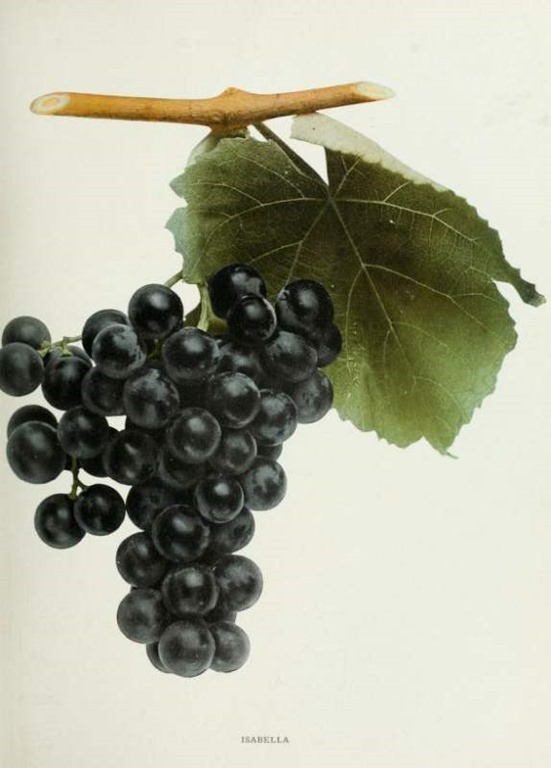
Isabella grapes, not a greatly loved variety by connoisseurs.

.

Then as the poem reaches its penultimate stanza, a bit of mystery arrives. There is a sense there of a ghost, a “dead girl” named the same as the grape variety — and as the poem moves to its conclusion, seen as a union of the two, before we move to a final disturbing line.

Ending poems is hard — at least I find it so. I could generate a hundred good starting lines, and yet with the same effort still not come up with a single good last one. Slessor’s last line grabs me. There’s a reason the ghost’s spirit stays in the deserted place. Maybe it’s her similarity to that wild black grape. Or maybe it’s some emblazoned event, before the orchard was abandoned, its sweet fruits of apple and cherry still tastable and ripe. The poem’s voice only suggests: kissed or killed there. Is there a dichotomy, a distance between those two suggestions? Perhaps Slessor intended that — but here’s what I think: I read that line, implying an “and” not the written “or,” as a vivid allusion of sexual violence.***

You can hear my performance of Kenneth Slessor’s “Wild Grapes”  with an audio player many will see below. No player? This highlighted link will open a new tab with it’s own audio player.

.

*He wrote poetry between the end of WWI and the end of WWII, so not in the very first wave of Modernism elsewhere, but Australian culture might have lagged a bit from Britain, France, and the U. S.

**I can see Rilke and Robert Frost in his poetry, and there’s nothing outlandish to think he might be familiar with their work. A prominent object in this poem are grapes, and I thought of this poem by Rilke, and this one by Frost, which also feature that fruit — but I don’t know. Though my favorite Slessor poems are more sensuous, there’s an epitaph character sometimes that reminds me of a somewhat forgotten early American Modernist, Edgar Lee Masters.

***I suspect more women, from more experience of violence chained with sexuality, would see that reading. Slessor wrote “or,” and his typewriter had other keys if he wanted to use them. He could just be musing on a range of things and the unknowability of the lives on what sounds like a plot once occupied by lower-class settlers or convict exiles from Ireland.

Lambing (Night-Born Lambs)

Over the years I’ve presented a fair number of poems by authors well-known for their prose work — James Joyce, Thomas Hardy, Emily Brontë, D. H. Lawrence, and so on — but as I prepared today’s set of words for performance I thought of something I told its author, poet Kevin FitzPatrick, more than once: “If I came upon the matter of this poem, I’d probably choose to make it into a short story instead of a poem.”

That may sound like a harsh judgement. When I said this once, Kevin’s friend Ethna McKiernan once torted back at me sharply “It’s a narrative poem!”

Yes, I know that form. I may be personally more invested in the lyric poem’s momentary compression, but narrative is a perfectly valid approach. And if you look carefully at how Kevin writes, he subtly weaves into his work touches that are poetic extensions to efficient prose storytelling. I tried to explain to Ethna that I had a second part to my statement about Kevin’s poems like “Lambing,”  “…but you make it work when you make that your choice.”

This poem’s background is implied in small details within it, and Kevin FitzPatrick’s last collection strung together a series of poems portraying this part of his biography: in later middle-age Kevin’s life-partner Tina decided she wanted to run a small but diversified farm, and each weekend, Kevin would leave from his office job in the Twin Cities to this rural farm across the border in Wisconsin. Kevin was thoroughly a city boy, so many of the poems let us use his unaccustomed eyes to pay attention to the rural culture and tasks of this farm. One trait the poems often touch on: the web of interdependence and cooperation between the community of farmers and country dwellers around Tina’s farm. In “Lambing”  we meet Jim and Rose, neighbors and the former owners of Tina’s farm who are called to bring their knowledge to the incidents of the poem.

Kevin worked hard at keeping his narratives tight yet clear. Parlando alternate voice Dave Moore and I would give him notes, which Kevin was always gracious in receiving, and his solutions (not always ours) to problems we might note nearly always improved the poems.*  Unlike more elusive and allusive poetry I won’t have to act the village explainer to assist new readers to understand what’s going on in “Lambing.”

Instead, I’d like to point out that this isn’t just prose with more line-breaks. While not exactly a Robert-Frost-style blank verse poem, the Iambs with the lambs** put subtle music to this story. The sound of lines like “Their lantern lit up the shelter late” would in a lyric poem call attention to their sound, so don’t let the flow of the story overlook them if you want to pay attention to how this poem might work its way. And while not a compressed Imagist poem, the small details speak to that kind of poetic impact: Rose’s green dress shoes, the just-born lamb “like something discarded,” the nursing lambkin’s tail twirling like a gauge’s needle gone wacky.

Lambing illustration

Unintended in FitzPatrick’s spring-set poem, but this time of year I think manger/crèche.

.

Kevin FitzPatrick’s final collection, titled Still Living in Town,  contains more poems about his farm experience, and other things as well. It’s a fine, fine book, and its poems are as carefully straightforward as today’s example. Here’s a link to more information on his poetry and a place to buy this book.

I performed Kevin’s “Lambing”  today with a piano, drums, and keyboard bass musical backing. At the end of the poem performance there’s a short, less than two-minute, purely instrumental piece for synthesizer and arco bass which I call “Night-Born Lambs”  that was inspired by the experience of working on the performance of this poem, and from thoughts of Kevin. You can hear this pairing with the audio player gadget you should see below. What if you don’t see that player?  This highlighted link is a backup, and it will open a new tab with its own audio player.

.

*I forget who said it, but I always remember this rule-of-thumb: when someone points out an issue with a draft you submit for notes: “They are usually correct in seeing something is a problem, but that doesn’t mean that their suggested solutions are also correct.”

**Type-nerd note: depending on what typeface you read this with, that sentence could seem a puzzling typographic tautology.

Thanksgivings

I’d hoped to have some more new musical pieces ready this month, but as I’ve reached the eve of the American Thanksgiving holiday I thought I’d mention a previous Parlando Project piece that has gotten attention this month as people on the Internet look for poetry about that holiday.

The post, the one people seek, presents this little marvel from Emily Dickinson:

One day is there of the series
Termed “Thanksgiving Day”
Celebrated part at table
Part in memory —
Neither Ancestor nor Urchin
I review the Play —
Seems it to my Hooded thinking
Reflex Holiday
Had There been no sharp subtraction
From the early Sum —
Not an acre or a Caption
Where was once a Room
Not a mention whose small Pebble
Wrinkled any Sea,
Unto such, were such Assembly,
‘Twere “Thanksgiving day” —

Though silent on the page, I can hear Dickinson’s voice start out examining this holiday at arm’s length. It has claims to be a historical commemoration (the landing of English colonialists in her home state of Massachusetts in 1620) but its observance, then as well as now, is basically a big meal, often with extended family in attendance. Many folks reading this today recognize or remember being in that in-between state of age at a Thanksgiving gathering, no longer a child, but not one of the family elders — neither urchin nor ancestor. Similarly, the Thanksgiving holiday in Dickinson’s time was of unclear seniority: it claimed to represent those 17th century English settlers and their harvest feast, yet the promotion of a U.S. holiday that became the one we celebrate now was a new movement of the mid-19th century.

Dickinson at first reviews it as if a pageant, and then as she starts to become a little harder to follow, with “Hooded thinking.” My guess is she’s meditating on it as if a monk or a nun wearing a habit. Her resulting take: “Reflex Holiday.” Fair — most holidays, most of the time, have elements of reflex: they are set celebrations, dates on a calendar. Sincere thanks-giving requires no excuse or appointment. If Dickinson had ended there, we’d have a poem in a predominate style of our age: a sharing of an observation from one sensibility to any and all, not unlike an Internet post.

Thanksgivings with ghosts
“Celebrated part at table/Part in memory —”

.

Dickinson however also has an abstract mode where our less agile minds may not follow as rapidly as her poem jumps away in the next lines. Have we subtracted from the piety of the Pilgrim settlers? And then the most obscure set of lines in the poem: “Not an acre or a Caption/Where was once a Room.” Huh?

I may not understand those lines. I certainly didn’t when I performed the poem a few years back, but this occurs to me: talk of acres as if in a deed, and the use of the curious word “Caption,” reminds me that she was a smart woman in a family where the men were lawyers. Caption is a legal term, it means, I find out, “that part of a legal instrument such as indictment, commission etc., which shows where, when and by what authority that legal instrument is taken, found, or executed.” Understanding that usage I think it highly likely she’s saying that the holiday celebration may not be on firm legal standing. Is she just commenting on the holiday not yet being a national holiday as it eventually became in the U.S.? Or does she have — or do we, her readers today, have — a reading outside the borders and celebration of the poem drawn by a culture of colonizers whose small settlement was under the forbearance of those already there?*

Dickinson closes by saying the original Thanksgiving assembly was like the proverbial pebble that spreads ever widening ripples in the water. Yes, big circles long past the pebbles. History is an unending cycle of theft and accumulation, deliverance and conquest. Kindness and fellowship are short in comparison. Oh, so short. And so sweet. Thanks for the sweetness is what I’ll celebrate.

Here’s an audio player below to the musical piece I performed using Dickinson’s words. Don’t see it? This highlighted link is a backup.

.

*A native American summary statement on this Thanksgiving matter comes to mind, considering the indigenous population brought food to that first harvest feast: “We did the giving. We got no thanks.” Could these matters have been on Dickinson’s mind? I don’t have the scholarship to support that. Should that injustice be our only thought as we celebrate our families and give thanks? No, I’m not saying that, but even as a “reflex,” a required simple thought and remembrance, that thought seems due on this day.

The Route of Evanescence

Here’s another little mystery, a riddle inside a riddle, which makes up a new song using the words of Emily Dickinson — but first a little of me sounding like a regular blog that talks about itself.

As assured time to work on this project has largely disappeared, I’ve been turning to simpler compositions and quicker realizations of them to cope with this, but over the past few months a number of pieces have sat in limbo, waiting to be rediscovered, waiting for decisions to be finished or abandoned. In going through some of these this month and I came upon a recording session for “A Route of Evanescence”  from last August.

I recall the session. It was just me and a couple of acoustic guitars, with access to my quiet studio space. I had some advance notice, maybe a day or so, that I’d have that time. On the hurry-up, I prepared a number of compositions to record, and when the day came, I set about laying down tracks singing and playing that pair of acoustic guitars. I’m not an exact or exacting guitar player by temperament, but when I haven’t played as much, my old hands produce more imperfections. None-the-less the limited time meant that I pressed on. I think I may have recorded basic tracks for at least two or three tunes that day. It’s likely that I’ve already presented at least one of the others here, but not this one. Why?

I might have blanched at releasing too many acoustic guitar tunes in a row. Despite my limitations I like what I can do with that instrument, but “like” means that I could fall into doing that over and over, and my temperament also doesn’t like doing that. I might frustrate you a little* by jumping around musical goals and genres, but a bored artist won’t interest an audience either. Or maybe I had some songs more distinctly about summer that I wanted to get out before the end of the season, and so this one was set aside?

Listening again to the raw tracks I thought it sounded pretty good. It’s harmonically different from some ruts I fall into, and the playing and singing is at a level that represents what the composition is. I may have thought I’d record some additional tracks, build out a more elaborate arrangement back then — but it stood by itself when I listened this month. Therefore, I mixed it and made it ready for distribution. **

route of evanescence

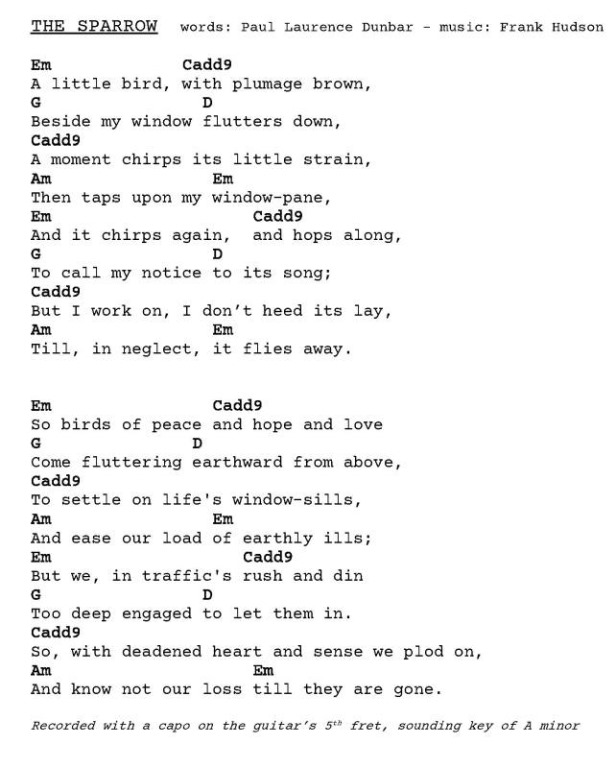
Here the chord sheet for today’s Chimera. That 2nd inversion G is a neat sound.

.

And then, as I went to prepare this blog post, there was one additional surprise. I thought it was one Dickinson poem that I performed back in August, the one named in the recording files, but the song was made from two: “A Route of Evanescence”  (F. 1489) and “Ferocious as a Bee without a wing”  (F. 1492).

Why did I combine them? I don’t remember. They sound good as a combined piece, though doing so may confuse Dickinson’s intended mystery, because both appear to be riddle poems. As a poetic or sung genre, the riddle has a long tradition (folk music, going back to the Middle Ages, has a bunch of them). The lyric gives you hints that don’t exactly make sense until you figure out, or are told, what the subject or answer of the riddle is. “A Route of Evanescence’s”  answer/subject is the ruby-throated hummingbird. “Furious as a Bee without a wing’s”  may be a honeypot ant.***  The riddle poem, and Dickinson’s examples of that, are antecedents of the early-20th century Imagist poem, where the moments details are exact, but inference or the title may be necessary to interpret the details meaning. Evanescence, as in the charged moment, is part of that Imagist creed.

Both of these are later Dickinson poems, written in the late 1870s more than a decade after the vast majority of her work written in the 1860s. Dickinson by then may have been like me, writing shorter and shorter — sometimes on scraps of envelopes or the back of food packaging in her case — trying to find autumn creation in the midst of life.

To hear this Chimera song combining a hummingbird and a honey ant, use the audio player gadget you may see below. No player to be found?  This highlighted link will open a new window with an audio player.

.

*Those I frustrate more than a little likely aren’t reading this. I keep thinking there are a goodly number of listeners who’ve heard one to a few of the Parlando Project audio pieces, but finding even a single ill-tasting example, leave off listening here for something elsewhere where they expect consistent rewards.

**I use an audio streaming service that is designed for podcasters, who are typically long-form talkers about their subjects. I could do a talking podcast, more or less replacing these written posts about the exploration that makes up this Project, but I don’t see the demand. So, the Parlando Project podcast is just these musical performances you see at the bottom of the blog posts. You can subscribe to or browse the last 100 or so Parlando audio pieces on most places you can get podcasts — except for Spotify, which for some reason they never shared with me, dropped the Parlando podcast distribution from their podcast section a few years back.

***A fascinating class of creatures that I knew nothing about. I’m not yet even sure if a species of it was found in Dickinson’s 19th century Massachusetts, or if Dickinson knew of this insect. This poem seems to use many similar words to another very short Dickinson poem (F. 1788) that is the penultimate poem in the Franklin listing of the complete Dickinson poems. However mysterious, it’s an image Dickinson returned to.

Van or Twenty Years After

One of the interesting things about 20th century Modernism was that so much of its propagation seems to be based on a handful of pollinators who migrate from one place to another. Some of these pollinators are known but little-read today, others lesser-known, their names themselves faded from cultural memory.

I suspect Gertrude Stein fits into the first group. As a personage, often handily viewed via Picasso’s painted portrait, she remains known. Her main location, early 20th century Paris, remains revered for its scene, and her salon there filled with Modernist paintings can’t be left off the maps as Americans in Paris then gravitated to her. We can add to that notableness, that as the fluent domestic partner in a long-term relationship with another woman, she remains to this day something of a gay icon.

But is she read? I suspect her The Autobiography of Alice B. Toklas  retains interest for its witness to the era. Her novels? Not sure they’re read much beyond scholars — and maybe they’re under-read even there. I gather her poetry remains controversial in this sense of the word: it’s spoken of in passing, its unusualness taken stock of — and after that its import is generally dismissed. When it was new, Stein’s poetry was often treated as a breathalyzer test. If you heard it and took it as meaningful or important you must be an intoxicated acolyte of Modernist excess. I don’t know if we’ve moved on from that stance. We may forget Hemmingway was a Modernist nowadays,* but we can never see Stein as anything more than an Modernist provocateur.

Reading Stein’s prose-poems today we still find them sounding unlike most literary poetry of the present. If we’re reminded of anything, it might be Dr. Seuss books for early readers, full of repetitions rhythmically repeated.**

Sometime in my Twenties I was curious about her work, part of my early interest in Modernism and the movements that emerged from it in the last decade to be called The Twenties. I remember plowing through one or more of her novels*** and reading what of her poetry I could find, out of consideration that as an experimentalist she might have some discoveries I could put to use in my own writing. What do I remember from doing that a half century ago? Not so much passages or particular elements, more an idea which I continue to hold for: that the way we use language to express reality and consciousness has been constrained by expectations and convention.

What remains of that interest in Stein now decades later? I enjoy her in limited doses because it still can break those expectations on the floor, and stomp on the broken fragments in time to a word-music I can enjoy.

Stein-Van Vechten-Dodge-Seuss

Gertrude Stein, Carl Van Vechten, Mabel Dodge, Dr. Seuss. First 3 pictures are photographs by Van Vechten.

.

I don’t know how much of that old interest of mine my friend, poet, and bandmate in The LYL Band, Dave Moore remembers, but when we got together earlier this fall to record some new things, he broke out this Parlando-worthy selection from Stein’s prose-poetry portraits of those she had met and interacted with. I asked him what he’d want readers/listeners here to know about “Van or Twenty Years After,”  and this is what he wrote back:

To avoid Morrison conclusions, I might shift the title to Van & Stein (Iowa boy made weird) — otherwise, references to Mabel Dodge in a history of first American surrealists, found in the library free stack, made me seek out the Gertrude piece about her, which turned out to be in a collection featuring this piece referencing her friendship with Van (sheesh my brain won’t pull up his name, I’m sure it wasn’t Dyke or Heusen), from which I excerpted this section delighted the way it concluded with a joke, then when I presented it to Frank I was incapable of delivering the sound of repetitious notes I had in my head, so anything salvageable here is probably due to Frank’s remixing skills.”

So, who’s the man the Van in Stein’s piece? Carl Van Vechten. Like Stein, Vechten was another of those Modernist pollinators, and he was an early and ardent proponent of Stein’s writing. His name, his own writing? By now he’s largely fallen into the second group, as Dave’s honest stumble testifies. Myself? I knew his name from my interest in Modernism, but nothing of his biography or work until I began to run into him as I read and studied more about the Harlem Renaissance which he was intimately involved in.****   It was only then that I discovered where he was born and grew up: Cedar Rapids, Iowa. And the Mabel Dodge Dave mentions? If you were to cross-reference Gertrude Stein, Carl Van Vechten, and Mabel Dodge’s blue links in their Wikipedia articles, you wouldn’t have to make more than one Kevin-Bacon-jump to encompass the whole Modernist enterprise in Europe and the United States. Pollinators.

After all that history, some of it often forgotten, we’re left with Stein’s words. Here’s a link to the whole prose-poem portrait which Dave took his segment from. You might enjoy them as word-music not having to judge them, or risking them replacing other poetries you enjoy. I did when Dave performed them. You can hear that performance with the graphical audio player below.  See no player? This highlighted link will open a new tab with an audio player.

.

*We’re likely to charge Hemmingway with a lot of other sins — most of which he committed in flagrante — while forgetting his successful revolutions. Hemmingway, the young writer forging his style, was one of those who sought out Stein in Paris.

**Dr. Seuss (Theodore Geisel) likely knew of Gertrude Stein from the circles he ran in. I did a quick web search and found no instant citation of any considerations of a stylistic influence there. I can’t be the only one this has occurred to.

***An admission: I’ve never been much of a novel reader. Most book and literature lovers can embarrass me by exposing my lack of chair time with novels.

****Van Vechten wasn’t just Iowan, he was white. Some early Modernists recognized elements of Black and African culture as aligned with their Modernist project, and some young Afro-American writers and artists felt the same way. Modernism was not immune to racism, but this cross-pollination brought attention and prestige to Afro-American artists and art. This connection had and has its strained and strange elements — no doubt about it — but it’s important.

Another connector here: Van Vechten was bisexual, so were some of the members of the Harlem Renaissance (though some variation of The Closet was usual then).

The Dumb Soldier

I spent Thursday recovering from a brace of winter vaccinations. I was tired and achy enough that I even missed attending my treasured monthly Midstream Poetry reading, but besides whatever mojo the shots might give me from winter respiratory crud, it made me grateful upon waking up Friday with my usual level of old-guy energy. I took a crisp 34 degree F. bike ride for a veggie sandwich and tea at a local bakery, and then spent a good deal of the day finishing some live LYL Band recordings from last September. Only then did I recall that I should do something for Veteran’s Day — or Armistice Day as it used to be called here in the United States. Armistice Day is still the name in much of the rest of the world that experienced WWI, and perhaps because I’ve been thinking a bit more about British poets this week, I quickly settled on two poems by British authors.

The post just before this one, Housman’s “Soldier from the wars returning”  was the first poem I wanted to do, and it’s a straightforward poem of simple gratitude for a veteran’s service. The second one is a little stranger, and I made it stranger yet. Can we be sure Robert Louis Stevenson wished his poem “The Dumb Soldier”  to be read as a whimsical piece about a child’s toy? He published it in A Child’s Garden of Verses  after all.

There were no sensitivity readers for children’s books then,* but the nature of the poem’s story is not benign. It starts right out with the poem’s speaker burying a soldier, which from the text alone we don’t know yet is a toy. When we read “leaden eyes” we might get the hint that it’s a cast metal toy soldier — but if we were to hear this poem as I performed it, without context, sung by an adult, even that detail might not tell us clearly what is going on.

I leaned into that strangeness. I trimmed a couple of stanzas for better performance length and chose to truncate the final one, leaving off the reveal that this is a toy soldier that will return to the child’s shelf. This left this a more ambiguous buried soldier then unable to tell us anything about what they’ve seen.

The Dumb Soldier

Here’s the chord sheet for my version of Stevenson’s poem. To read his original text, here’s a link.

.

Although written decades before the first Armistice Day in 1918, this mode of the silent war dead is clearly apt for that holiday as celebrated outside the U.S.**

It was late Friday night before I was ready to perform these two poems as songs. I had music written, and for practicalities sake, I was able to quickly use my studio space to record the pair of songs with just acoustic guitar for accompaniment. Neither of these are perfected or sophisticated performances, they are more or less what you’d hear if I was to present them off the cuff. You can hear my version of “The Dumb Soldier”  with an audio player below, unless you don’t see any such player. Some ways of reading this blog won’t display that, so I give you this highlighted link that will open a new tab with an audio player in those cases.

.

*”Dumb” used as a term for someone who cannot speak is now a highly impolite term. Given the sacrifice and suffering of war, that term’s objectionableness might be a lesser concern.

**Since the U.S. had an existing holiday, Memorial Day, for remembering those who died in military service, the U. S. Armistice Day became Veteran’s Day to celebrate all who served, particularly the living. Housman’s poem, couched though it may be in the particulars of WWI, speaks to that element of the holiday. As a mid-century child, I can recall Armistice Day was still used occasionally in my youth for November 11th since veterans and others who had experienced that war were numerous.