Dolphins (Heroes)

I live in a city where 12-string guitars are over-represented. Since I’ve only lived in Minneapolis for 50 years, I can’t say for sure why that’s so. Folk-revival pioneers Leadbelly and Pete Seeger, likely the ur-source for the instruments post WWII use, have no direct connection, but by The Sixties™ this powerful but awkward branch of the guitar family had a nexus of players here. The guitar playing other two sides of the Pythagorean Koerner, Ray, and Glover trio played 12-string. Leo Kottke made the beast a virtuoso instrument while working the small clubs and coffeehouses of the Twin Cities. John Denver had fallen in love with a Minnesota girl and played a lot of 12-string (and who can say what is the cause and effect there). By the time I arrived in the Seventies, Ann Reed, Peter Lang, and Papa John Kolstad also played 12-string in small venues. The year my ten-year-old Pontiac rolled into town, a local college student, Steve Tibbetts, was self-recording his first LP featuring 12-string landscapes pebbled with percussion over which roamed howling electric guitar wolves.

At that point I owned my J C Penny’s nylon string guitar and a weird amorphously shaped Japanese electric guitar I’d bought at a flea market and for which I couldn’t yet afford an amp.  Accommodating my new hometown, I soon felt I should get a 12-string guitar. A year or so after arriving I managed to afford a Cortez 12-string acoustic which was sold as a sideline item at the local Musicland record store. My memory was it cost $79. Designed to outwardly look like a “professional” instrument at the lowest cost, it could have been the music equivalent of costume jewelry or a stage prop. As these sorts of things go it wasn’t as bad sounding as modern forum-dwelling guitar aficionados would suspect, and mine had pretty good “action,” reasonable string height to allow easier fretting.

Later in the Seventies I added a DeArmond sound-hole pickup and I played this guitar with the LYL Band, and for the rest of the 20th century. With their double sets of strings, 12-strings sometimes warp and self-destruct under the increased string tension – but cheap and cheerful as the Cortez was, it’s held up, though the top has bellied-up over the years.

I eventually got a better 12-string, but I kept the Cortez around. A few years back I set it up to use Steve Tibbetts stringing variation where most of the octave strings are replaced with unison strings.*

Now let’s jump the month just ending, January 2026. As a writer I can’t paper over the immense mood shift this entails: from oddities about the types of guitars, to lives being mangled by intended government action.

I still feel unable to write fully about my reactions to the many injustices and atrocities that are incurring at the hands of thousands of federal agents that are roaming my city and the rest of Minnesota this winter. The first of the murders this month, the shooting of Renee Good in front of her wife happened on the street just across the alley of my home office and “Studio B.” If I hadn’t been wearing headphones and working on music for this Project I would have heard the gunshots – instead, it was my wife who rushed in to tell me. As of the end of the month, we’ve had a non-fatal shooting and one more murder by the federal agents, and a daily grind of sufferings. I won’t be the one to try to catalog all the careless to cruel things that are happening day after day. It sorrows me, and perhaps you, and at least for now, this information is available elsewhere. Nor will I offer enough praise for the ordinary people in this city who are trying to mitigate that suffering and plead for its ending. I will call out one thing many of them are doing: they’re seeking to be “Observers,” the term that has come to be used for folks who feel called to witness and record with their phones what our own government agents are doing to the people living around us. Think about this for a moment as you read this: these Observers are intending to go to where cruel things are being done by armed bullies who will use their weapons – issued along with pledges from their leadership that they will face no consequences – to rough up, to detain with and without charges, to attack with chemical and “less-lethal” munitions, to in two infamous cases, to kill them. Folks were doing this before Renee Good was killed – and after she was shot, more signed up. After the next murder of Alex Pretti pushed to the ground holding his cell phone camera: more again signed up.

I think of the incredible bravery of the American Civil Rights movement of the mid-20th century, and this is like unto that. But here’s something else I think concerning that role, something I don’t recall being written much about yet. There’s a chance that these observers are going to see armed agents of our government kill someone in front of them, and they’ll be tasked with recording that. The infamous murders of the Sixties’ Civil Rights movement happened in darkness and rural separation, though the corporal brutality of clubs, dogs, and firehoses was done in public and was sometimes filmed.

Along with bravery, that’s an additional heavy burden to take on. And some are now carrying that specific burden. We have memorials to Alex Pretti and Renee Good, but I want to stop and think of those that witnessed their killings, and what they must be carrying in their minds. My mind is once removed, however close to me these things happened, and yet it’s filled with conflicting and intense reactions – but they were there, in that instant as this happened. Dozens of people in my city, some intentional observers, some protesters, some just bystanders, are carrying that as I write this.

So, the name that most often arises in my heart this month after the many insults to justice and mercy isn’t one of the detained or murdered, but is instead, Rebecca Good, Renee Good’s spouse, who was apparently observing ICE action on the broad avenue near her house and mine. When the federal agents came up to their car and began to hassle Renee, Rebecca tries to draw their attention away from her partner. In that moment, I read her actions as saying: detain me, let Renee get away, throw me down onto the ice and snow and get a few punches or sprays of mace into the eyes while you strap cuffs on me. Rebecca can’t get in as Renee puts the car in drive, the doors are locked. On one of the videos you can hear her say “Drive babe,” allowing herself to be left behind with the agents. And then the shots.

You hear her voice in another video, moments later, sitting on the side of that broad road just behind my house, saying that they’ve killed her spouse, and moaning that she was the one that suggested they move to Minneapolis. I should transcribe her exact words, but I can’t bear to watch that video again just for journalist precision tonight.

Another jarring transition I can’t engineer now. In between Renee Good’s murder and Alex Pretti’s, and thinking of Rebecca and other survivors, and of the witnesses, observers, I somehow fell to thinking of a song written by another 12-string guitar player of The Sixties,™ Fred Neil, “The Dolphins.”   Neil’s songwriting was a mixture of earnest and off-hand, an unusual combination. “The Dolphins”  is a somber wail about the cruelty of the world compared to the swimming pods of the famously playful aquatic mammals, and it’s just a handful of words.** Neil’s career was one of those “better known to other musicians” ones, and his song was covered by others back then, particularly those who played the 12-string guitar. Now if we move onto the Seventies – that off-brand extension of The Sixties™ – I’ve always thought that when another songwriter who played a lot of 12-string guitar in The Sixties, David Bowie, had to have been thinking of Neil’s song when, in the midst of his Cold-War-Berlin masterpiece “Heroes,”  he has one of the lovers kissing next to the armed guards around that inland city’s border wall think of dolphins again.

Fred Neil had a rich baritone voice, and David Bowie was a talented singer. I, alas, am mostly singing things here myself, yet I wanted to make a realization of those two songs while thinking of Rebecca Good, and others I didn’t (and still don’t) know how to number and name in this time. That would mean no first-rate vocalist, and I also decided to go primitive on the 12-string guitar, using that old Cortez 12-string. As the song progresses I strummed that 50-year-old box loudly, and I didn’t necessarily want a pretty 12-string with a rich sound.

.


*One of the features of the Cortez is a “zero-fret,” a still unusual feature that brings two benefits: it insures optimum string height in the “cowboy chord” first position area for easy playing and allows greater freedom in using different gauge strings at the player’s whim. Conventional 12-strings use a thinner string tuned an octave above the regular string for the low E, A, D, and G strings. Steve Tibbetts (like Leadbelly) instead uses two regular gauge, unison not octave tuned, strings for some of the courses. My Cortez 12-string has unison D and G strings.

**Neil’s choice of the dolphins, however casual it seems in his song, was a serious one. He drifted out of the music business in the Seventies and spent the rest of his life working on a dolphin support/conservation project.

Fall 2021 Parlando Project Top Ten, numbers 7-5

Let’s continue our Top Ten countdown of those pieces that you liked and listened to the most this autumn. Regular readers here may not be surprised that death features in some way in each of today’s three poems, as illnesses, infirmities — and yes, folks I’ve known a long time dying — have been part of the year for me.

Everyone that dies or is limited by infirmities is a lesson, one you listen to more richly and intently as you get older. It’s a lesson that makes me press immediately against what limits age has put on me, gives me a sense to use what I have presently before it’s gone. Oh, I am sad that I’ll not hear Kevin or Ethna’s voices again, except in memory or recordings — thin mirrors those. Dave reminds me that it reminds him when I post older LYL Band recordings where he was able to pound and roll the keys. Our family continues to deal with my wife’s mother descending, as politely as she can carry it, into dementia. But those that go before us are meant to teach us. Don’t skip the lessons.

Why Now, Vocalissimus  by Frank Hudson. When I posted this audio piece, shortly after I wrote it, I said right out I wasn’t sure what I meant by it. That state may be unnerving for a writer. After all, aren’t you supposed to know? If you don’t know, how can you present anything vividly to the reader or listener?

Well, there’s a theoretical structure, a mythological structure, that seeks to explain that. It says that we are conduits for muses, external things. We don’t have to be outstandingly worthy, exceptionally preceptive, or precisely eloquent, since we are in this scheme conduits of something outside us. Frankly, this can lead to a lot of bad poetry: inchoate self-expression bearing the costume of inspiration. But then everything leads to bad poetry — all artists fail as I remind readers here often. But what of us readers, us listeners? We fail too, grasping partially what much art conveys.

My understanding of what I wrote back in September has grown as I live with this set of words. Part of our job as living, breathing artists is to carry forward the work of those who’ve left off working. We are not just creators, but also carriers. So, if you write poetry, bring words down onto the page or speak your own words, know that I’m charging you to also preserve and enliven those others who have no voices left to carry the spark. And that’s what I try to do here with the Parlando Project.

My performance of “Why Now, Vocalissimus”  is available below with a graphical player. Don’t see it? Then his highlighted hyperlink.

.

Heidi Randen’s picture of a milkweed husk spoke to me this autumn.

.

6. The Shadow on the Stone by Thomas Hardy.  A complicated ghost story, a complicated haunting. As I wrote when posting this, English poet Thomas Hardy had a dysfunctional marriage — and yet, like many folks forced by fact into the separation of death and mourning, he still felt the returning presence of the intimate dead.

I rather liked the music I composed and played for this one. It has a weird loping groove that I find attractive. To hear the performance, some will see the player, and the others can use this highlighted hyperlink.

.

5. God Made Mud by Kurt Vonnegut.  I decided to present several short excerpts from Vonnegut novels that work as poetry this fall on the occasion of the 99th anniversary of his birth. The LYL Band had recorded them well over a decade ago, on the week Vonnegut died. Why didn’t I wait for the nice, round 100-year birthday? See the start of this post for why.

In Vonnegut’s novel Cat’s Cradle  the text I used here is the last rights of an imagined religion. Like the theoretical/mythological structure of muses directing us to write poetry, Vonnegut proposes a useful if compressed Genesis story that asks us to recognize that the nagging mystery of death is no harder to explain than the overlooked mystery of living at all.

Yes, player gadget below for some, and this highlighted hyperlink for others to hear it too.

.

Halfway through this fall’s Top Ten. The rest will be posted here soon.

Lament (after Sheng-yu’s Lament by Mei Yao-che’en)

It was difficult to return to work on new pieces for this project yesterday. November was blustery and very gray, the whole world seemed to shiver. It was weather to huddle up, as curled and still and hidden as one could be. None-the-less I rode my bike to breakfast, and when I rode past a small pond I could see three ducks on the soon to be frozen water. I wondered; did they miss the migration memo? Are three enough of a formation to make the long southward flight? Are they waiting for a greater flock to gather that I suspect won’t be coming around?

Having completed my Kurt Vonnegut series, I am reminded of a whimsical concept his made-up religion Bokononism introduced: the “karass,” a term for a group of disparate people strangely linked together without their knowledge that yet still seem to be working with a common purpose and unknowable goal.

If so, poet Robert Okaji and I may be in such a flock.

Ostensibly independently, Okaji and I both find creating American English translations/adaptations of classical Chinese poetry rewarding. We even often use the same source of literal glosses of the poems since neither of us understand the language those poets wrote in. Okaji’s practices have informed some of what I do with translation in that he allows himself to extrapolate English poetry from these old poems where his or the modern American reader’s understanding might otherwise be puzzled, unsure, or unmoved.*  This weekend I read one of his adaptations, “Sheng-yu’s Lament (after Mei Yao-ch’en)”  and was struck, as he apparently was, by the depiction of grief and loss.

Okaji’s version is quite good, but I still wanted to try my own adaptation. I approach translating classical Chinese poetry like I approach translating from French, German, or Spanish. My primary goal is to understand first what the poet wants us to see, to sense — the imagery. With poetry the “word-music” is highly important in the original language, but generally I do not try to transpose the sounds or even the sound-organization of the original language into English. I do like to retain something of what I call “the music of thought” in the original poem, the order and arrangement of the images in the poem’s journey.

I always start wanting to honor the original poet, the original poem, but despite that I often get carried away with a desire to change the way the poem ends to something that occurs to me from the experience of the other poet’s poem. This may be a failure, a fault on my part, and so when I do that here I try to cite what liberties I took. Okaji has a concise way to handle this issue: he calls his adaptations into American English “After…” which gives one license to do what the muse wills.

Lament

Robert Okaji’s fine translation is available here, and he also includes the English-language gloss we both used to create our versions of this poem. Besides his blog which includes selections from the full variety of his poetry, you can download a selection of his “after…” poems adapted from the Chinese here.

.

I started out thinking about how to render the first word: “heaven” in the gloss, a word carried over by Okaji. Best as I understand Chinese culture, the term “heaven” often carries a connotation closer to the concept of “fate,” and I actually used fate in the second draft, and then reverted to heaven in the final version. I decided I needed the listener to be firmly in the experience of mourning and grief, and to a Westerner, heaven does that. My next problem to solve were two lines both plain and puzzling: “Two eyes although not dry/(Disc) heart will want die” Interestingly, they rhyme in the English gloss, and early-on I decided to make that into a refrain. The narrator seems stuck, and refrains are a great device to show that situation. Okaji plays his “after card” here, with the very fine “my heart slowly turns to ash” that may not be in the original but adds vividness.

I wanted to bring forward Mei Yao-che’en’s image in the next set of lines — that there are things that seem elusive, that we think of as gone, but they still exist —and there are objective, work-a-day methods to go into the depths to retrieve them. I was unable to find out any additional context for the Sheng-yu whose lament the poem is said to be reflecting. Given my own age I read this poem as an older man, a widower who has now also lost his son to death, although given the historical dangers of childbirth it could be a tale of a woman who died of childbirth complications and then the infant too dies. The poignant specifics of the pearl sinking into the sea asks for allusive meaning, pearls coming from oysters on seabeds, and so a returning, perhaps a child-soul coming forth and then returning to where it came from. Or given my old-man framing, a widower throwing a dead wife’s jewelry into the sea. If the story of Sheng-yu was known to Mei’s readers this might be understood more specifically, but lacking knowledge I let this specific mystery remain.

Mei’s lines “Only person return source below/Through the ages know self (yes)” are hard to grasp. Okaji made his estimate, and I made mine. My aim was in part to underline that this section is a contrasting development of the supposedly lost things in the depths of the earth or the sea.

Okaji’s adaptation ends strongly, and it seems to me to be a more likely accurate translation of the poem’s final line. While I like my solution to the next-to-last line, I decided to go with a much odder final line. In my choice, inspired by what I felt in Mei’s original poem, and from being an older person with many grievings — the dead whose immortality is, in part, made up of my remembrance of them — is that I do not have to dig down deep or dive deep to see them, that they are with me. In the thin depths of a mirror I find them, and that my fate is to join their fate soon enough in my passage of years.

Musically I wrote an entire other tune for this, a bit more R&B like, which I abandoned early in my attempts to record this. Instead, I returned to my thought of some unusual colors associated with the Velvet Underground, and particularly John Cale,**  the Welsh viola playing member of that band. I created another spare and eccentric percussion part inspired by Velvet’s drummer Maureen Tucker’s inventions, and then laid down an electric bass line that anchors the melody. My guitar part came next, not R&B at all this time, the atmospheric arpeggios perhaps subconsciously connected to Chinese string instruments. The top instrumental lines are a cello and viola.

You can hear my performance of this lament with either this highlighted hyperlink or where available, this graphical player gadget you may see below.

.

*Others who have informed my practice: Ezra Pound’s rather free translations from glosses of classic Chinese poets, and Thomas Campion, who based his most famous poem on Latin poet Catullus while adding his own flavor.

**Two early John Cale solo LPs The Church of Anthrax and The Academy in Peril,  like his settings for Nico recordings in the early Seventies, aren’t to everybody’s tastes but hearing them opened my mind then to different ways to combine orchestral instruments with modern songwriting and electric instruments. If you want to explore them now, I’d suggest starting with 1972’s The Academy in Peril  which is the most accessible.

I Am Laughing in the Dark Underground

What do you remember of someone who died 20 years ago? Not enough. That is loss. I do remember her kindness, her empathy and help to others, our bodies close together, our youth, our follies, more mine than any of hers.

Today is this blog’s 5th year launch anniversary. It’s also the 20th anniversary of my wife’s death.

Does grief lessen with time? I think it does for most people. It’s not a place most want to make home; and as a vacation spot it’s going to get some no-star reviews. Does loss lessen with time? Not objectively. After all, survivors have over time accumulated additional lost experiences that they have been deprived of. But even that is complicated in honesty. Other things, or one hopes that other things, come in to fill the low and missing places. Those low and missing places are still there, like Pompeii under ash. And like there, there are entwined bodies now made hollow places, suitable for casting.

Pompeii Body Cast

One of the castings that were made from cavities left in Pompeii ash

.

Do not feel sorry for me. Since then, I met someone, we married, we had a child. I get to encounter words, mostly poetry here, compose music, and make some combinations of those real, as best I can, so that you can hear them. Despite infirmities, despite those low places, my store of gratitude is large.

And my loss is far from unique. Unless you are one of my younger readers, you no doubt have lost several you had some level of closeness to. How many, and how close, varies I suppose. In the immediate depth of grief, we probably feel our loss personally, as we still feel every unique part of it. That’s a forgivable illusion, though all grief connects absolutely.

A few weeks ago I wrote the poem that is the text for today’s audio piece. The core image came to me rather forcefully asking to be cast, and the poem followed close at its heels. Last month I got to perform it with Dave. I don’t find this performance as good as I would like it to be, but then that may be my personal opinion and expectations that it be good enough for the occasion. The day to share it with you is today, and it’s the best version of it I have at this time.

I am laughing

The text of the poem used for today’s piece.

.

“I Am Laughing in the Dark Underground”  proceeds by revealing and describing the core image that came over me and caused the poem to be created. Why was I laughing? I knew first only that I was. In dreams or images, one sometimes acts in ways that you would not write consciously, incongruous ways. After creating a first draft of the poem, I began to think that I was laughing out of the incongruity itself. The feeling I was having was neither frightening nor pleasing, but it was mysterious, and I somehow knew the laughter was important.

The mystery of it was largely made up of where was I, and the answer was clearly nowhere I could tell. Nowhere is anywhere. Anywhere is all of us.

My original sentiment in the experience of the image was that the “you” in the poem was maybe my living wife, and then my dead wife, but while the image was still present, I began to see I wasn’t supposed to know for sure, and that it was also others. If grief is universal, if it connects absolutely, then in this place it’s your you too — you grieving, your lost one or ones. I sensed those presences without there being any normal sensory device other than the smallest disturbances in background noise.

I chose to end the poem on the laughter, the necessary laughter, the missing laughter, the laughter that was there in me as I sensed this place. What does that laughter mean? It means what laughter means to you or me, all the time, not some special meaning when in the transport of this image, but ordinary laughter and its multitudinous events and occurrence.

The player gadget to hear “I Am Laughing in the Dark Underground”  will appear for some of you below. No sight of it? Then this highlighted hyperlink is another way — it’ll open up a new tab window to play it.

.

To W.C.W. M.D.

It’s now 1916—well not really—but allow me immediate mode for the time being. Some early 20th Century Modernist characters we’ve already met are about to collaborate in New York City with a largely forgotten figure whose words we’ll meet today.

The Provincetown Playhouse, that CBGB’s of Modernist American theater, has moved its organization from the remote Cape Cod artist’s colony to New York’s Greenwich village, and they’re still looking for new types of plays by new playwrights. How about drama using Modernist poetry?

Verse drama, despite continuing productions of Shakespeare, is a thing that often generates rumors of revival while never really reviving. In 1916, the Provincetown group was open to trying this. Which poets can come up with something?

Alfred Kreymborg could. Kreymborg was a leading networker or influencer in the New York area for Modernist poetry. Ezra Pound, and then Amy Lowell, would publish anthology books of Imagist Poets. Harriet Monroe out of Chicago was also gathering new Modernist work for Poetry  magazine. In 1916 Kreymborg would do the same in New York, with a magazine and anthology book series called “Others.”  Kreymborg had also been writing poetry, short poems mostly, all of them free verse. Now a play.

Others group

The “Others” group: L to R in back: Jean Crotti, Marcel Duchamp, Walter Arensberg, Man Ray, R. A. Sanborn, Maxwell Bodenheim. In front: Alison Hartpence, Alfred Kreymborg (bowtie daddie), William Carlos Williams (w/ Internet click-bait cat) and Skip Cannell


The play he wrote is an odd thing to describe. Titled “Lima Beans,”  it’s a two-character play about a couple. The husband loves lima beans, the wife decides he might also like string beans and surprises him with the new beans—but no, he loves lima beans. He stalks off, angry. She scrambles and gets some lima beans. He realizes he loves his wife, returns and she’s got lima beans for him. Kiss. Curtain.

I guess this could be a Seinfeld  episode plot decades later, but that’s not how Kreymborg uses it. He writes his play with litanies of repeated words, hocketing between the two voices. After reading the play this month, I’m guessing a performance might sound like a cross between Dr. Suess’ Green Eggs and Ham  and a late 20th Century Minimalist musical work by someone like Phillip Glass or Meredith Monk. Or as Preston Sturges’ Sullivan would have it, Waiting for Godot  plus vegetables—but with a little sex in it. That musical comparison is particularly apt, because even though the play did not use musical accompaniment, Kreymborg saw it as a musical structure.

So here in 1916 we have the Provincetown group, putting on a play that pioneered a performance aesthetic that still seems audacious 50 or 60 years later. Who are you going to get as actors to realize this—words and a presentation of thought conveyed musically, without actual music?

Poets.  In the role of the husband, William Carlos Williams. In the role of the wife, Mina Loy, who had just arrived in New York after getting away from those Italian Futurists. Neither poet had acted before, but Kreymborg rehearsed the two poets until they could present his free-verse vision.

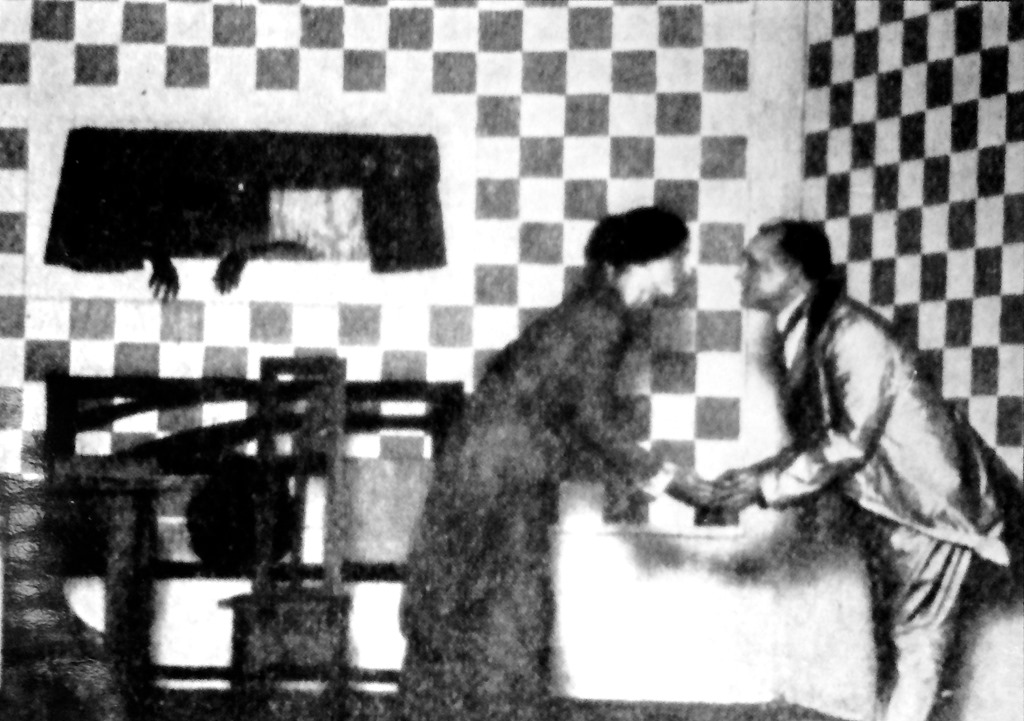
Loy and Williams in Lima Beans

Mina Loy and William Carlos Williams in Lima Beans. The set for the proudly independent Provincetown Playhouse production cost $2.50, and its set designer, William Zorach,  also played the 3rd character whose hands are hanging, Soupy Sales-like, out the window.


I toyed with the idea of trying to realize Lima Beans  here, although with music this time. But it really needs two voices, and I wasn’t sure that a short section could do justice to the structure of the piece.

In it’s place, I looked for a short poem of Kreymborg’s to use instead. This proved more difficult than I thought it would be. I read his two poetry collections from this era, but no poem grabbed my attention. As in the play, he’s looking for a new poetic language in these poems, but it’s hard to grab the emotional center of many of them for performance.

In the end I chose today’s piece: “To W.C.W. M.D.”  It’s dedicated to William Carlos Williams. This might be more of Kreymborg’s log-rolling networking skills on display, but its subject also answered a desire I have to do a piece remembering my late wife Renee Robbins in some way today. As best as I can penetrate the emotional core of this poem, it speaks of the need to separate and not separate from those that have died.

Musically, the piece is based on one stacked chord, E minor7/11, but the notes are spread out between the instruments. Besides drums there are two bass guitars, piano, two viola parts, a violin part, and a clarinet in this. To hear it, use the player below.


She is Sleeping on the Boundaries of the Night

I said I would change things up last time, and by stepping back a few years, today’s piece does that.

How much different is “She is Sleeping on the Boundaries of the Night”  from the last few posts? First off, we’ve left off from war. This is a love poem. Death appears in it only briefly passing—so fast it passes, as it can in a poem, you might not even notice it. And rather than being a piece by another poet, the words here are mine. We live here at the Parlando Project with the idea of presenting “other people’s stories,” but I also want variety, so I’ll make the exception this time, and present part of my story.
 
One of the modernist/Imagist ideas that Ernest Hemmingway liked to use in his early stories was to leave an essential detail out of story, and then to strive to write it so well that the power of that detail would become present subliminally.

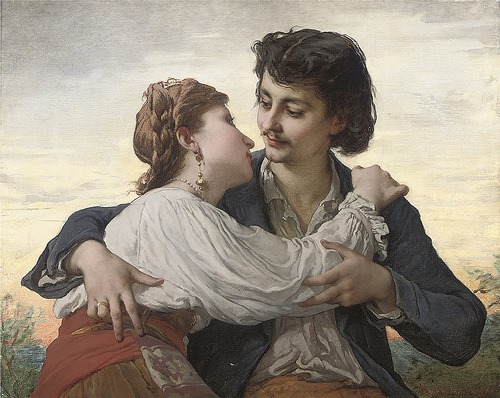
Lovers Tryst

In a classical aubade lovers are always awaking in a field and forgetting to check for contact dermatitis

“She is Sleeping on the Boundaries of the Night”  is an aubade, a traditional form of love poetry. An aubade features lovers awaking at dawn, and the poet lamenting that their night is over, so they must now part for their un-enchanted days. What do I think is different in my aubade?

Sixteen years ago, my wife died after a short and painful illness, not yet 44 years old. I cannot tell you all that means, but one thing I experienced in my grieving process was the question of where one goes from that stopped thing. After all, you are definitively stopped, you have no momentum in any direction, unlike in the normal flow of life. You can stay stopped, or move off in any direction.

I moved, and was moved, in the direction of falling in love again. There are some difficulties in that direction, knowing of love’s inescapable impermanence. Like the lover in an aubade, I knew now, deep in my soul and body, that love means that parting is intensified.

In the end, “She is Sleeping on the Boundaries of the Night”  is a love poem that hardly mentions death. I was trying to do that modernist/Imagist thing. Is death still there?

Alas, the other thing that I left out, is that other person, lying beside the speaker, stuffed with dreams no doubt with all the richness, sadness and choices of their life. My love poem fails, as some do, in that respect. Can it remain unsaid my partner chose to move, and move me, as well?

Today’s piece is musically a bit different as well—there’s an antique 20th Century beat box rhythm used for one thing. To hear the LYL Band perform “She is Sleeping on the Boundaries of the Night”  use the player gadget that should appear below.