These Fought

The lives, outside of art, of artists bear only a mysterious resemblance to their work. The concentration of time that must be brought to creating work drains many a writer’s life of incident. And so, an artist like Emily Dickinson can lead an outwardly constrained life while creating an inward empire. Or the man who would eventually be charged with the establishment of the first modern democratic republic could be, as a teenage poet, a love-struck supplicant. Nor does general good character align with artistic success—saints can write bad poetry and flawed people may write good poetry.
 
Today’s post features the words from an American who as much as any single person launched Modernist poetry in English. His associates and admirers, added to his detractors and opponents, make up an encyclopedia of 20th Century English literature. In the first part of the 20th Century, some of them would be profoundly influenced by his artistic ideas, and some would even be directly edited or personally mentored by him. One hundred years ago, in 1917, Carl Sandburg would say of him:

“All talk on modern poetry, by people who know, ends up with dragging in Ezra Pound somewhere. He may be named only to be cursed as wanton and mocker, poseur, trifler and vagrant. Or he may be classed as filling a niche today like that of Keats in a preceding epoch. The point is, he will be mentioned.”

Pound would live more than another half a century after this, his literary revolution flowing outward until few could see back to its instigator. And there’d be reasons his influence would be discounted: by the end of WWII, when Modernism, no longer insurgent, was about to become the established artistic order, Ezra Pound was a 60-year-old man confined in an outdoor steel cage open to the elements, awaiting to be charged as a war traitor with a likely sentence of execution.

Ezra Pound Booked for Treason

This guy is most responsible for English literary modernism, but that’s not what got him arrested.


The customary quiet and inward life of a writer, even an unnoticed one, looks good in comparison.

Though this treatment was inhumane, and the charge not without controversy, it was not unsubstantiated. Pound had spent the years leading up to WWII making common cause with the European Fascists that the United States eventually fought in that war, and when that war was being fought, he broadcast eccentric propaganda in his native English in service of his adopted country of Italy and Mussolini. Furthermore, his attraction to the Fascist cause was not an accident, a casual side-effect of his adopted country of residence. Pound wholehearted seemed to believe in the crackpot and yet deadly racist theories bolstering Fascism.
 
Remember earlier this month when we talked about the popular folk song celebrating Jesse James, versus the reality of James’ life as a racist terrorist?  Pound lacked the actual bloody hands of a Jesse James, but not the thought behind them.

So much more could be said on this, but that would take more room that we have today, and besides your thoughts and judgements on matters like this, as I said when talking about Jesse James, are more important than mine. Not only are they more numerous, but you are likely younger than me, and will get to use those judgements on things like this to guide your life.

Today’s audio piece, “These Fought,”  was written by Pound at the height of his fame and good influence—not after WWII, after WWI. Unlike some younger Modernists, Pound did not actually fight in WWI, but situated in England during that war, he saw the patriotic recruitment and the creation of cases for the war, a war that soon became mechanized slaughter beyond all previous imaginings, and he lost friends in that staggering slaughter. So, in “These Fought”  Pound caustically calls out the cases for the slaughter, and leads us to note that bravery in fighting WWI, or fortitude in opposing it, were in some sense equal in valor and, alas, equal in success.

To hear the LYL Band perform this, use the player below.
Clark Street Bridge

Returning now to our discussion of Modernism, that early 20th Century artistic movement that gave the artistic environment we are still grappling with. While it was a world-wide movement, reacting to world-wide changes in technology and society—for the first time, Americans were at its forefront.

But not all the Americans were residing in America.

Back in 2014, when there was a brief 50-year anniversary flurry of coverage of the Beatles “British Invasion” of the US, I played one of favorite games. So, if we were to think in 2014 of the way things have changed since 1964, what would a person in 1964 be looking back at from the same 50 year interval from their time?

Turns out they could have been looking at not a “British Invasion” of musical groups, the Beatles et al—but an “American Invasion” as Ezra Pound, T.S. Eliot, H.D., Gertrude Stein, Robert Frost, and Ernest Hemmingway all were residing in England or Europe around this time. Pound in particular, was busy making alliances and promoting his vision of Modernism, which he called “Imagist.”

Imagists, at least at the start, put a high value on concision. Pound was just as concise in Imagism’s manifesto, reducing it to three rules:

Direct treatment of the “thing”, whether subjective or objective.

To use absolutely no word that does not contribute to the presentation.

As regarding rhythm: to compose in sequence of the musical phrase, not in sequence of the metronome.

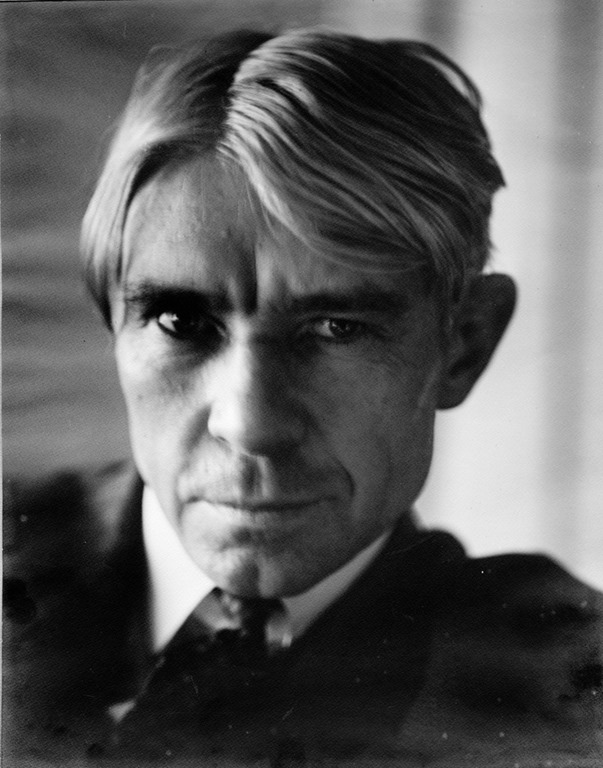
Youn SandburgEzra_Pound_by_EO_Hoppe_1920

Images of Imagists: Sandburg on the left, Pound on the right. You can say that again.

Not all the Imagists were residing overseas however. Back in the specifically American city of Chicago, Carl Sandburg was to combine these Modernist/Imagist precepts with Socialist politics and activist journalism. He worked so hard at this that he essentially split himself into different people. There was Carl Sandburg the Imagist poet who hung out at the then new Poetry Magazine offices, where the poetry discovered by their European Editor, Pound, was funneled into America. But he was also a journalist working for the legendary Chicago daily press portrayed in “The Front Page”.  At the same time, he was also associating with equally legendary American IWW radicals and anarchists, writing for their publications, sometimes under a pseudonym. Was he hiding his identity, or just saying that the agitator was a different personality?

Visualize that American comic-book secret-identify hero, say Superman. By day the “mild-mannered reporter for a great metropolitan newspaper…” by night fighting for “Truth, Justice, and the American Way…” as a crusading radical Socialist—but wait, there’s something more—he’s not just those two, he’s trying to create Modernist poetry as well. And pay the rent. Which is his true secret identity?

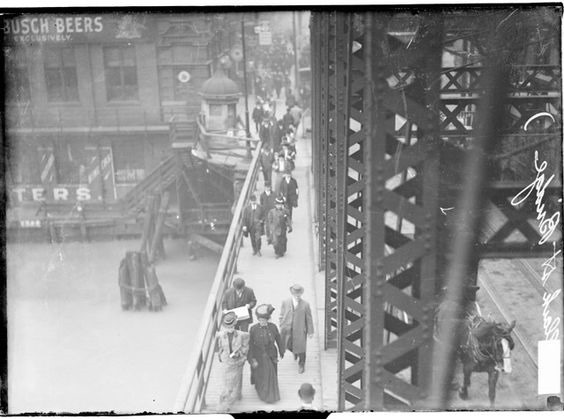
Clark Street BridgeClark Street Bridge Today

Chicago’s Clark Street Bridge, then and now: “No more dust and wagons.”  Are the voices still unheard?


Today’s audio piece, Carl Sandburg’s “Clark Street Bridge”  is an orthodox Imagist poem by this un-orthodox, tripartite man. The subject “thing” is definite as the downtown Chicago river bridge in its title. Its rhythm is as legato and singing as the absent voices singing at it’s end. It starts with its busy turn-of-the century black’n’white newsreel footage of crammed wagons and walkers, then takes us to the dog-watch night: only three scattered people interrupt the foggy mist and the brightest stars above the urban river. In this mist and shadows, reporter Sandburg takes off his double-breasted suit, but then, stay-at-home Imagist poet Sandburg takes off also his poets’ tights and doublet, and now, naked as a radical above the dark Chicago river he hears the “voices of dollars” in the city’s heartless commerce, the “drops of blood” from the men and women who animate it, and the gigantic chorus of the resulting “broken hearts,” as many as all the stars, as heavily present as the mist, and as unheard as either.

As I’ve often found with Sandburg, others have set his poetry to music, but no matter, I press on. My music for “Clark Street Bridge”  started with an un-relenting long-measure typewriter-like drum part which I hoped would stand for hoof and foot beats. I tried to pair the guitar part and the reading of the words, and finally, I laid a legato bass part underneath it all to stand for those voices softer than the stars and mist. To hear it, use the player below.

Soul Selector Blues

Sometime around the end of the 19th Century, a century that had seen accelerating change in technology and social order, new artistic movements began to flower on either side of the Atlantic. In the UK the Arts and Crafts movement and the Pre-Raphaelite Brotherhood looked backwards at things that had disappeared or were nearly gone, and revived them within a the new context of their present day. Interest in neglected folk-cultural traditions of nations began to arise. Others looked to new orders: utopianism and socialism. The seeds of what would be called Futurism began to take shape, a worship of the inherent art in technology.

Here’s a funny thing: all these things mashed-up in the ferment of the times. Some of the artists held to several or even all of these beliefs, participating in more than one of these seemingly different or even opposed movements. Call this brew “Modernism,” for the one thing that united it was a desire for something new, or at least new for the times, to be produced.

As the 20th Century got underway, American artists forged ahead in these movements. The reasons for that are multifold, but one is that they had a head start: Walt Whitman and Emily Dickinson and the Emersonian Transcendentalists had already pioneered distinctly American ways to be modern.

Let’s leave the salons and literary magazines now for a moment. Here’s something else that was happening at the same time, with only spotty distribution beyond its creators. Some African-Americans, presented with nominal freedom, economic serfdom, social repression, and what must honestly be called a sub-human classification by many learned men, continued to come to terms with European instruments and tempered scales, combining them with the already juicy stew of American music and the remembered modes of Africa. They produced their own Modernism, something that eventually got called “The Blues.”

Lyrically, this was an inherently skeptical art. As it percolated through commerce, the Blues got re-defined as a sad song of loss, and loss certainly is part of its subject matter, but the outlook of the original Blues writers was not simply that. A lot of it was satiric comment, and when the Blues dealt with the desire and farce of love and lust, as it often did, it wasn’t just about loss.

I could go on and on about the Blues, but for the moment, I’ll ask you to just absorb this: when William Butler Yeats was having a harp built to chant his poems to, as he believed the Celtic griots of old had done; and when Ezra Pound, Robert Frost, HD, Amy Lowell, William Carlos Williams, Gertrude Stein or T.S. Eliot were inventing their strain of Modernist poetry, often abroad, some other Americans were back in the States retuning guitars and looking for the notes between the keys of the piano with their own poetry that sought to “make it new.”

Emily Dickinson is a special case in so many ways, but one of those ways is that although she wrote much of work during the Civil War in the middle of the 19th Century, she was only published much later in the century. Her poems, so stripped down, so skeptical of received notions, so vivid in fresh images that didn’t map easily to conventional meaning, fit right in with work being written 50 years later by the Modernists.

Emily Dickinson Uncrowned Queen of the Blues 2

Warning: time travel plots often are ridiculous.


Today’s episode “Soul Selector Blues”  takes this time travel one step further. What if Emily Dickinson was a serf on the Dockery Plantation in Mississippi early in the 20th Century? Maybe she’d tune a guitar to “Spanish” and grab a slide to get those in-between notes, and then what would have been “The Soul Selects Her Own Society”  would come out like this.

To hear the LYL Band cover “Delta Amherst” Emily D’s classic 78 r.p.m. side “Soul Selector Blues” use the player below.


Intro to The Waste Land

Readers of these posts may recall a discussion of the theory that Emily Dickinson’s reclusive nature in later adulthood was caused by epilepsy and that her poem “I Felt a Funeral In My Brain”  may have been describing the auras experienced around epileptic seizure events.  I think it’s an interesting idea, a plausible one, but I also warned against reductionist explanations for art.

Even recognizing that danger, I’m about to risk that sort of thing again, for what I think are good reasons.

Is T.S. Eliot’s “The Waste Land” introduced to students later and less often now than it was in my youth? If so, I suspect this is because “The Waste Land”  does not present itself as a friendly introduction to poetry. It seems proudly obscure. There’s no frank self-expression in it where a recognizable author/speaker tells us about their life and outlook. Instead, there’s a flurry of voices and characters that are barely, if even that, introduced.  And there’s no interesting story, no fable or tale with a twist that carries us along. There’s a shortage of obvious similes, no “fog comes on little cat’s feet” to introduce metaphor.

In my youth, all these shortcomings of “The Waste Land”  as a teaching tool were overlooked because it was a landmark in the rise of Modernism, that defining artistic movement of the first half of the 20th Century, and because it was full of the stuff that made up a Liberal Education: foreign phrases, cosmopolitan settings, wide-ranging cultural references to other literary works from across time.

Waste Land title page

I always find that a little Latin and Greek on the title page helps perk up the reader.

And now? The odds are that if T.S. Eliot was to stand up at a Moth story-telling stage or a slam poetry event and deliver “The Waste Land”  in whole or in part, that boos, snores, or some variety of non-pleasurable puzzlement would result. We are inured to a different kind of poetry, confused enough, bothered enough, by modernity and its incessant messages that Eliot’s fragments shored up against ruins seems to offer us no balm, no pleasure of recognition.

I’ll offer two keys, two aspects of “The Waste Land”  that can allow you entry into it. The first is: it’s intensely musical. The imagery, outside of “The Waste Land’s” overriding dry vs. wet scheme, never strays far from sounds, and all those unintroduced voices are like new strains in a composition. No wonder the Parlando project is drawn to it, because we believe that one can appreciate poetry without understanding its meaning, in the same way that you can appreciate music without being able to somehow explicate it.

The second entry point, the one that risks being reductionist, is that this is a poem written by someone suffering from depression. Whatever voice is speaking in the poem, it is heard and reflected out the mouth of someone who feels it has all gone wrong, someone who cannot fully trust any other feeling other than that—other than the emotion of fear that that is the reality that any other feeling would mask. Although it must sacrifice the music, the incandescent reading of the “The Waste Land”  by Fiona Shaw illuminates this aspect.

Today’s episode is just a part of the first part of “The Waste Land,”  but it’s the part the begins in April, our National Poetry Month. I don’t know if Eliot intended to refer to Chaucer’s “Canterbury Tales” prologue (our last episode), but it sure seems to rhyme. The opening of Eliot’s series of tales has, like Chaucer’s prologue, rain, flowers, journeys and travelers; and later in the poem Eliot will in bring birdsongs and churches. And Chaucer, who begins singing in Spring merriment, introduces at the end of the prologue the promise of “Strange strands,” and tells us that the pilgrims may be taking the pilgrimage because they have been sick.

Fiona Shaw’s il miglior fabbro performance of the whole “The Waste Land” will take almost a half-hour to view. My audio piece for today will take less than 3 minutes and has music. To compare to the “Prologue to the Canterbury Tales”  check out the previous post here. If you want to hear Nobel Prize winner Bob Dylan taking a run at the same part of “The Waste Land”  as I performed—and making his own connection to Walt Whitman’s “When Lilacs Last In the Dooryard Bloomed”  in Eliot’s opening lines, you can hear that here. But give mine a try first, using the player gadget that appears at the end of this post. Thanks for the likes and shares over the past few months, and as part of April’s #npm17, feel free to link to this blog or share this post on social media.

On First Hearing Blonde On Blonde

Earlier here you’ve heard me proclaim that Bob Dylan changed how folks wrote songs. Before Bob Dylan circa 1964, no one wrote songs like Bob Dylan. Afterward, the things he did (portrayal of fragmented personal experience, florid and unlimited imagery, a questioning attitude toward accepted beliefs) were everywhere, until by today we may have forgotten (or for younger generations, never knew) that these things were once “Dylanesque.” And because songs with lyrics were the primary way late 20th century people experienced poetry, that revolution impacted the culture generally.

Of course, page-poets had already done those things. Some European poets worked with these concepts decades before Bob Dylan. American modernists of the first part of the 20th century did these things too, and in American English. And the Beats, Dylan’s slightly older siblings, knew those achievements and applied them to the post WWII American landscape.

So, take away the Nobel prize! Dylan had influences! And his revolution was maybe the fourth time around!

No. First off, the page-poets did not generally ally their words with music. Yes, I know there were exceptions to this “generally” statement—and I think those exceptions deserve more notice and listening—but that’s my point, those exceptions didn’t get much of an audience. As the Parlando project seeks to demonstrate, poetry gains resonance when paired with music. The inherent abstractness of music allows listeners to more easily accept abstractness and difficulty in words, so those producing the more difficult, abstract or hermetic writing needed music even more.  Add to that music’s ability to amplify and re-cast emotions, and Dylan’s linking of those page-poet concepts to music meant his was a new force.

So, I say the very thing that causes some to say Dylan should not be considered a literary hero: that he is a songwriter, is one very good reason he is just such an authentic hero.

And here’s another reason. We sometimes like to pride ourselves in finding what we believe are the first movers of things. In songwriting, Dylan is just such a first mover, but if we take his words or his music in separation, he is not the first mover. However, as to impact, it makes less difference who did something first compared to who got the experience to the audience, the listener, and/or the reader at the time and way they were primed to hear it. So, if we artificially separate Dylan’s words and music we can say they weren’t the first, we can even believe they were not the “best,” however we figure that out, but that combination of words and sound was a revolution that succeeded in ways that previous efforts didn’t. It’s romantic to mourn failed revolutionaries, but let’s not let our mourning obscure the power of successful ones.

While I wrote this post’s audio piece “On First Hearing Blonde on Blonde,” it is not the sort of work I usually put here. It’s a recounting of personal experience, something that is already over-represented in poetry and particularly in spoken word poetry. That can be a valid kind of poetic expression,  but there’s no lack of it elsewhere, and as a creator I’m instructed by my experience as a reader that most poems about the writer’s personal experience fail for several iatrogenic reasons, such as the writer’s inability to fully see and question their own assumptions, an approach to individualization that can cut the writer off from their connection to and balance with the rest of the world,  or even the simple ability to judge what another person will be interested in.

If I work out getting permissions for more current work by other authors, there will be more poems spoken in a personal voice here, but I believe they will gain from being selected by someone else, and spoken by someone else, not by the poet themselves. That’s one of my Parlando principles: “Other People’s Stories.”

“On First Hearing Blonde on Blonde” is published here, not because it’s a tale about myself, but because it tries to convey that listener experience that occurs when the listener is primed to hear something. Will someone who listens to Bob Dylan’s “Blonde on Blonde” record album, as suggested by the Nobel Secretary last week, hear a different album than I heard nearly 50 years ago? On one hand, surely they will. Every ear in every time is always its own. On the other hand, I could give you answers—I just typed and erased some now—but instead I leave you with wishes for more, and perhaps better, questions.

Next post we move on from Bob Dylan. Which is about right. After all, even Bob Dylan got tired of being Bob Dylan, several times in fact.

To hear the LYL Band and the audio spoken word piece “On First Hearing Blonde on Blonde,” click on the gadget that should appear below. We recorded the basic tracks the afternoon the Nobel Prize for Dylan was announced. Yes, the Dave Moore mentioned in the piece is the same Dave Moore whose voice and keyboard playing has been heard here.