October November

By title this would be the perfect piece for today, though it does not describe the axis of these months this year in the upper Midwest, which is cold, gray, blustery, and threatening sleet or snow. So, this is not the day or night for sitting on arbor-seats in some garden, and the blazon leaves have already succumbed to a snow storm last week.

But never mind the weather, it’s an early enough poem from Hart Crane to have fallen into public domain, so that I can use it here. “October-November”  shows only a little of Crane’s eventual poetic style, but that means it might be a good way to introduce him.

Hart Crane and the Bridge

Would you like to buy a poem about this bridge? Crane in Brooklyn.

Crane’s just a bit younger than the other early 20th Century modernists, but you can see similarities to some of the branches of modernism we’ve already climbed out on. Like Tzara or the Surrealists he loves extravagant images; but though he is utterly romantic, there’s a certain classicism to many of the images he uses, just as H.D. or Eliot would. On the other hand, like the Futurists, he loves to touch on what was then modern technology. Like Edna St. Vincent Millay or Yeats his music can sound older than his subjects. Crane is a master of Elizabethan-style iambic meter and he doesn’t avoid the old habits of poetic diction. You can even see links in Crane to the original American Modernists: the ecstatic pronouncement of a new world and a new version of humanity like unto Walt Whitman and the concisely packed and puzzling lines of conclusion that Emily Dickinson could use.

But what you see most in Hart Crane, although it’s only hinted at in this early poem written when he was a teenager, is extraordinary, stunning, eloquence at the phrase level, lines with heart-stopping lyricism. Like Shakespeare, Dickinson or the writer of Ecclesiastes, a Crane poem may hold gnomic and gorgeous sounding lines, even if they are as inexplicable as what they sum up. One could write dozens of books or poems with titles taken from lines in Crane poems, though few have done so.

There’s more to say about Hart Crane, perhaps another post that tells about how the Modernists he lived and worked among never fully accepted him, but let me leave that for another day.

“October-November”  is simpler than later Crane, just a pair of images of sun dappling a garden as if it’s still summer followed by a fully delirious autumn night. I sense a growing intensity as this short poem proceeds, and tried to reflect that in the music I composed and played for this one, extending that ecstatic line in the instrumental section at the end.

One last ironic Halloween tie-in: Crane’s father invented Life-Savers, a candy that are now available in a rainbow diversity of sugared flavors that one might find in a ghost’s or skeleton’s bag at the end of tonight; but when invented, Life Savers was more of a breath mint line, successfully sold to cover up the vices of drink and tobacco on the breath. The thing that remains its essence? The round shape, the hole in the center, like the floating ring made to be tossed to a drowning person.

1917_Life_Savers_ad

Like a kid in a candy store. The Crane family business.

In 1932, a 32 year-old Hart Crane vaulted over the railing of the ocean liner carrying him back to New York City. One witness says they looked after, and “saw Crane, swimming strongly, but never again.” Perhaps his leap was too far and his swimming direction away from them, but there is no account of a round, perforated life preserver being tossed in after him before he disappeared and died.

To hear my performance of “October-November,”  use the player below.

The Red Wheelbarrow

Obscurity in modernist poetry is a funny issue. What makes some writing hard to grasp, difficult to understand? Esoteric and little-known words like Wallace Stevens loved? Far-flung allusions to works in several languages like T. S. Eliot was prone to? Exploding normal written syntax and logical flow as Gertrude Stein did? Taking images into realms where direct one-to-one symbolic meaning is not only impossible, but more than likely, not the aim, as Tristan Tzara or Paul Éluard demonstrate? Presenting things “slant” in iconoclastic riddles as Emily Dickinson could? Writing works of epic length that few if any human minds can comprehend in their whole, like the Cantos of Ezra Pound?

And then there’s this poem, the basis of today’s piece, William Carlos Williams’ “The Red Wheelbarrow.”

The Red Wheelbarrow

The whole of it: 16 words, no punctuation, all lower-case

From empirical evidence you could say that it’s the very peak of the canon of modern American poetry. Remember that compiled count of the poems that appeared most often in poetry anthologies, most of which were explicitly focused on modern American poetry? “The Red Wheelbarrow”  is alone at the top of that list, included in over half of the anthologies counted.

Does that make it a “best loved poem”? Does it even assure that critics consider it great, much less the greatest? No, it does not. I think I first ran into it as a teenage student, in one of those anthologies used in some English literature class. Did my young teacher point it out as a poem of special merit? Did I view it as such? No. If I can trust my memory, if it was discussed at all, it was as if it was some kind of stunt, an intended provocation that so short and mundane a piece could be considered artful. “Now class, let’s get back to T. S. Eliot and Wallace Stevens.”

And how about critics? They largely part like the Red Sea on “The Red Wheelbarrow”.  If we look to one side, in among the mollusks and manta rays now behind the water curtain of the divided sea, we find those who care little for it. There’s nothing there demanding to be written about. No virtuosity is demonstrated to be noted and admired. And what important point is it making, other than, well, no point at all?

So, we turn to the other side, those swimming with bemused dolphins who wonder if they could leap across the band of Israelites walking on damp seabed, those critics hoping to demonstrate their microscopic perception of the hidden art in this terribly short and compressed poem. Carol Rumens is concise and representative of this when she says of Williams’ poem “This is his manifesto, surely–a poem quietly declaring how modern poetry works.” And she also warns “A naïve reading could take it as a comment about the great usefulness of wheelbarrows on small-holdings where chickens are kept.”

And then, here I am, now. No longer the teenage student who was sure someone had figured these things out, and I need only to find them. I can’t see far enough ahead where Moses and Aaron are, nor can I see far enough back how close Pharaoh and those charioteers are getting. I’ve got my hasty bread and a few grabbed things in my little cart, pushing it across the mud. I think I must be naïve. Yes, Williams is a modernist, as committed to the new way of writing as clearly as possible, a proclaimer of “No ideas except in things,” which means in retrograde, the things must be the ideas. If he had wanted to write a manifesto, he could, and did in the other poem that stated that dictum.

The obscurity in this poem is that there is no obscurity other than what we bring to it externally. There is no allusive, secret meaning, other than the secrets we’ve kept from ourselves, of our tools and our companion responsibilities.

Yes, there is art in these 16 words: the line breaks that ask us to hold our gaze, even in the middle of words, the “so much depends” warning that bids us look. The choice to look at just these simple common things, is a choice, is an idea. I think the dolphin side of the parted sea has smarter companions than the mollusks’ side; but I am looking down at my wheelbarrow, and Williams’ wheelbarrow, and saying naively, that it matters, even if I’m in the middle of the band, unable to see Pharaoh or Moses.

I’ve spent too long on the words again, but I feel I need to say a bit about the music I composed for my performance of “The Red Wheelbarrow.” I chose to use a twelve-tone row, a modernist musical idea from the same time as when Williams was writing the poem. It would be pretentious for me to say I got this from deep study of Schoenberg or Webern, though I’ve listened to a good deal of modernist music. However, “serialism” never stuck with me until I heard the prologue part of “This Town Is a Sealed Tuna Fish Sandwich” written by Frank Zappa. I’ve loved that piece from the first time I heard it.

Twelve-tone music subverts expectations of a tonal center or “important” scalar notes, so it can sound a little woozy or random, but, of course it has its pattern, by definition, which the mind’s ear can hear if you stop thinking in expectation of familiar patterns, which is the simple and profound thing it is asking you to do.

For those who’s blog readers can display it, you can click on the player to hear my performance of “The Red Wheelbarrow.”  No player visible? This highlighted hyperlink is another way to play it.

Helen Heaven

Let’s leave off those modernists of the era around WWI for a while, and move to a few songs about some midcentury mods. This is the time when popular culture mutated into something recognizable as ours, as it still is into this 21st Century.

Somewhere in this second decade of the 21st Century a new modernism is likely being born, but I do not know it yet. Back in the early 1950s people expected something new, perhaps as much or more than we expect change today in 2017. As it turns out, we may have not gotten all the change we thought we were due.

Today’s piece is the opening song in a song-cycle about one woman who had a moment in this moment of change in the early 1950s in Los Angeles/Hollywood. The woman was a second-generation Finnish-American, Malia Nurmi, who created a character that for a short time, just about a year, captivated TV audiences in Southern California with a strange take on sexuality and various horror tropes, blending in a beatnik/Dada critique of “normal” as a reaction to the unthinkable. The character was named “Vampira.”

Somewhere in the later 1960s it became a commonplace to view the 1950s as an era of calm, peace, satisfaction and complacency, and this characterization has only increased over time. But this was also the era just after a cataclysmic war ended with atom bombs, a horror that eventually moved from reality, to nightmares, to repressed acceptance, to forgetfulness and finally now again to present fears. This was the decade of a forgotten, brutal, war in Korea. This was an era when society tried to put back into the bottle the broadening social roles for women and Afro-Americans that WWII had allowed. This was the time that revealed the horrible efficiency of the extermination and slave labor camps, and the decade in which the utopian dream of Communism exposed its shames and shams. This was a deeply uneasy time when some feared everything “normal” was a dream and others saw clearly the waking hours outside the dream.

All of which makes this campy TV quipster host who created the makeup, costume and persona of Vampira seem inadequate to address this. Well, what is? As we move to celebrate Halloween, that strangest of holidays, where we make fun of our inability to escape fear, death, and too much candy, let’s reconsider her.

Helen Heaven - Aimee Semple and Maila Nurmi as Vampira

Media in black and white: Aimee Semple used religion, Maila Nurmi used Vampira

“Helen Heaven”  has words written by Dave Moore, the alternate voice and writer/musician here at the Parlando Project, along with music written and performed by myself. This piece is the first song in the Vampira song-cycle, contrasting the LA-based white-dressed pop-religious phenomenon Aimee Semple McPherson with Nurmi/Vampira’s dark negative.

To hear “Helen Heaven” use the player you should see just below this.

The Most Anthologized American Poems of the Modern Era

Here’s a list of poets and poems, along with the year they were written:

Top 20 Poems List


OK, you probably already read the title of the post, so you know what they are.

This list comes from an article I bookmarked this summer that intrigued me, and today I returned to it because I’m thinking a bit about “The Canon”—those poems and poets that are judged by some generalized panel of experts as being worthy.

The whole The Canon thing is full of controversy, with complaints that it doesn’t include enough of what some favor in terms of poetic expression, or that it’s too-much a dead white man’s club; but part of what makes that discussion worthwhile is that The Canon is how almost all of us got introduced to poetry as an adult practice. Somewhere in our school years, we will be asked to open a textbook, and there on the pages will be some “great poems” that we will be asked to grapple with. Some of us will be puzzled that we can’t figure out how to do the sums of what these poems mean; and some of us will want to emulate them, to steal a little of their vision of existence, and some will hope to someday gain for ourselves something like that esteem in the eyes of others, to be, in our words, on a page in an anthology.

Sure, we may have already encountered nursery rhymes, Dr. Seuss, and perhaps some song lyrics, but these poems are the adults, writing the adult things. Poetry sections of literature classes can be as fraught with adolescent frisson as sex ed.

The article I was intrigued by was written by Emily Temple and posted on Lithub. It’s a painstakingly counted-up list, collated from twenty anthologies of poetry. The selection of anthologies has some problematic focus: half of them were specifically focused on American poetry, and nearly half (eight) were anthologies of modern or contemporary poetry. Still, the work to make this list must have been considerable, and I don’t know any similar, but better, efforts to use instead. For this post, I’ve decided to take even more shortcuts, over and above relying on Temple’s work, so bear that in mind.

I’m going to focus on the “Top 20,” the poems that appear in nine or more of the twenty anthologies. While this doesn’t eliminate the anthology-weighting to modern Americans, I think it means that these 20 poems and their authors are safely in “The Canon” as constituted in our current century. Here are a few scattered, short, observations about these most of the most anthologized modern American poems.

I had read and/or remembered reading all but three of the poems. (“Musee des Beau Arts,” “Skunk Hour,”  and “Love Calls us to the Things of This World”).  I suspect anyone who’s been interested in American poetry for a few decades would come in around that.

I sometimes worry that I’ve concentrated here too much on works from the first quarter of the 20th Century, and particularly those connected to the “Imagist” revolution in the center of that time. From this list, I shouldn’t. Nearly half the list (nine) is from this period, and if one was to play the “Kevin Bacon game” with Ezra Pound concerning these, your number is always zero to one, or you’re Wallace Stevens. I use so much from this era because I have trouble even finding the time to seek the rights to present a piece still in copyright, but also because I happen to find that era fascinating—and it turns out as far as modern American poetry is concerned, it’s still the core of The Canon.

However, even though the Parlando Project is closing in on 140 pieces, we’ve only done two of these top twenty poems (“The River Merchant’s Wife,”  and a small portion of “The Waste Land.”)

What era other than the Teens and Twenties of the 20th Century was over-represented? The Fifties, four selections, and you could consider Gwendolyn Brooks’ 1960 “We Real Cool”  sneaking in as a fifth.

Dead White Man’s Club? Not as bad as it was when I was in school. Not Dead White Males: 7 out of 15 authors if I count William Carlos Williams’ second-generation Puerto Rican heritage and don’t count that Richard Wilbur, though white and male, and still alive. The Canon is always historical, always trailing the contemporary. It’s not 7 out of 20 because five authors had two works in the Top 20. If someone does this article in 2117, or even 2067, I wager the pale dead males will be less than 50%. This is an easy bet (I won’t be around to collect from after all) but also because if we take the short-term acclaim of literary awards for new work in the past few years, I informally believe we’re already at that level. I know some will object to even mentioning these distinctions for various reasons. That’s a big topic, another time. If one wants to make an argument for tokenism from either side of that debate, that only the white males got double selections in the Top 20 would be your data point.

UPDATE:  not to belabor the White Males count, but as I pointed out when we presented “The River Merchant’s Wife” back in July, the authorship of that poem in a complex subject. It is  a translation of classical Chinese poet Li Bai. Pound’s Chinese translations are acknowledged to be of the looser variety however. If we split that one 50/50 we’re halfsies on White Males.

Here’s one that was interesting to me as I think about another issue: how old were the authors when the wrote their “Top 20 poem?” Go ahead, guess….

You didn’t look ahead, did you?

I guessed low. I was of the impression that poetry was a young person’s game, and many of the poems I’ve used here were written by authors below the age of 30. Turns out the average was a fraction over 40 years old, with Elizabeth Bishop at 65 and Wallace Stevens for his second selection at 75 making appearances for the Medicare set. The youngsters? Eliot at 27, Pound at 28 and 30, Auden and Moore at 32, Dickinson and Plath at 33. One oddity? Despite the average of a bit over 40, no one wrote a Top 20 poem in their 50s. If you’re under 30, don’t despair, as I did, thinking “John Keats died at 25, and what have I accomplished.” If you’re a poet in your 50s, consider a career in the insurance industry and plan on being Wallace Stevens.

This is another of the posts here that I’m tagging “About” that are not occasioned by a new Parlando Project audio piece. For those who can’t wait for the next piece mixing various words (mostly poetry) with original music, here’s that “included in 10 out of 20 anthologies” hit “The River Merchant’s Wife: A Letter”  done up Parlando Project style. Use the player below to hear it.

Autumn

100 years ago, a WWI German artillery shell ended the life of T. E. Hulme, the man who sparked off what we now know as modern English poetry. I was going to say “invented,” but that’s a dodgy word in art as much as in science. Hulme borrowed ideas from several places, and adapted poetic tactics the French and some Americans had already made use of. But we can still say he started things off because he collected the tinder and cordwood in the Poet’s Club in London in the first years of the 20th Century, and the spark was applied by suggesting that everything he thought poets were doing since, well, just about the Renaissance, was wrongheaded. Too flowery. Too ornamented. Too “romantic,” an error he believed made them think of mankind as exalted and godlike.

Hulme, interested in visual art as much as he was in literature, thought the new literary direction should be visual. Cold hard images, direct and vivid, not abstract, were to be the new order, but these images could even be homey and simple (as long as they retained that vividness), not the sort of thing that signaled high culture in the British poems of the past couple of centuries. He was very certain of this, and he either made a convincing case in person or provided the theoretical underpinnings through first or second-order influence to the soon to be mighty modernists: Pound, Eliot, Yeats, H.D., and Frost.

Bust of Hulme
Bust of T. E. Hulme by Jacob Epstein, another member of the early 20th Century artistic “American Invasion” to England

Hulme illustrated his ideas with short poems. I’m not altogether sure how seriously he took these writings, but I find they have three attractive attributes. First, for all the bluster and pugnaciousness that he propounded his theories, the poems are very unassuming. In subject, they often seem to follow one of the principles I try to follow in the Parlando Project: “Other people’s stories.” Second, they are short, and I am attracted to the variety of expression that can succeed in short poetry. And lastly, they are the first. They have that charm, the same charm I might apprehend looking at a Chuck Statler music video, an Apple I or MITS Altair personal computer, an early horseless carriage, or the pictograms on a cave wall. The other beginners looked at this, and said “why not?” Ezra Pound related to Hulme’s ideas in formulating “Imagism.” T. S. Eliot either saw or was reinforced in his ideas for a new classicism in poetry in Hulme’s work.

What would be striking about today’s piece, Hulme’s “Autumn,”  in 1908 when it was published?

It’s “free verse.” No rhyme, no regular metrical scheme. Besides some French poets, American Walt Whitman had done this, but this was still rare, and rarer still in England. The last part of Hulme’s “Autumn”  is still musical however, essentially iambic, and sound echoes, if not rhyme, are present in “wistful stars with white faces.”

Hulme’s two substantial images in “Autumn”  are extraordinarily unpretentious, particularly the first one: “the ruddy moon” at sunset leaning “over a hedge/Like a red-faced farmer.” Compare this to Shelley’s “To the Moon” where the moon is “of climbing heaven” and is addressed as “Thou chosen sister of the Spirit” or Wordsworth’s “With How Sad Steps, O Moon” which is “running among the clouds a Wood-nymph’s race”—and these are examples from good poems of the 19th Century, not the more forgettable lot.

Over at the Interesting Literature blog, where I discovered Hulme, it is pointed out that Hulme, who was from a rural district, also had a ruddy complexion. Perhaps Hulme is looking at himself when he sees the ruddy moon, or his hometown in the moon, but we don’t need to know this subtext to sense the nostalgic comfort in this scene. Except for “cold” near the beginning, which is a sensation as well as an emotion, the only other emotion that is “told” rather than “shown” in the poem is the adjective “wistful” applied to the stars.

Did Hulme toss this off, just to say “Look! You can write a poem like this.” I don’t know, but that’s beside the point. As a person myself who has emigrated from a small rural town, Hulme’s “Autumn”  works as well or better than a grander poem in a more florid manner.

What would Hulme have done if he hadn’t insisted in serving his country in WWI, or if that shell had landed on some other poor soul? That, no one can tell.

Ascenseur pour l'échafaud cover

Like Pound, Eliot,  H. D., Frost, and Epstein, Miles Davis was another American making new art abroad.


For today’s performance, I was struck by rehearing a portion of Miles Davis’ soundtrack to “Ascenseur pour l’échafaud”  earlier this week when a piece of it, “L’ Assassinat de Carala,”  appeared unexpectedly in Ken Burns and Lynn Novick’s “Vietnam”  documentary series.. Performed by Davis with a mostly French pickup band over a couple of days during a short stay in France, it’s something of a radically simple first of it’s own, as Davis essays a spare style with less harmonic movement, a style that he was soon to use with a company of more experienced and exceptional improvisers in his epochal “Kind of Blue” recording. Other than Davis’ own trumpet, the featured instrument on “Ascenseur pour l’échafaud”  is Pierre Michelot’s bass. In my music for “Autumn”  I made more use of the drums as well as the bass, as the only “trumpet” I could use was a synthesized approximation of the timbre of the real thing. There’s another first here: the first drum solo on a Parlando Project piece. To hear T. E. Hulme’s “Autumn”  as I performed it, use the gadget below.


Trenches St Eloi

I was talking with my wife this weekend. She’s reading a memoir about current military deployments (and redeployments) and she said a Wilfred Owen poem was mentioned in it.

“Well, World War I was the last war to be covered by poets.” I replied. Which is not strictly true of course. World War II generated a number of poems I’d love to share here, but I have no time to try to track down the rights issues to use words that still may be under copyright. And I suspect other wars have generated other poems since then, even if I don’t know many of them. But that’s not what I meant.

World War I was the last war to be covered by poets.

What I meant was that WWI was the last war in which a considerable portion of the English-speaking public looked to poetry for meaning and consolation regarding the battles and their losses. I’m not sure if they looked to poetry more than journalism or political oratory, but I believe that poetry then still operated somewhat in the same theater as these other words when addressing current events. Longer forms of literature, such as novels, tend to lag events substantially, changing or fixing our view of things afterwards, instead of framing it while the picture is still moving. I think of two epithets, for journalism and then for poetry: “The first draft of history” and “The news that stays news.”

I think of two epithets, for journalism and then for poetry: “The first draft of history” and “The news that stays news.”

This morning, my son wanted to show me this brilliantly parsed cartoon summary of the Iliad. The narrator there has a lot of fun with the meandering and seemingly arbitrary plot of that Greek epic poem, but it struck me that it’s possible that the ur-version of the Iliad might have been written contemporaneously to the events, only to be shaped afterward like a collection of old news dispatches repurposed for later use.
 
So, this is a long tradition in Europe from Homer to the war poets of WWI, for the battles and the experience of the battles being reported in poetry.

Why has this use of poetry, to report current and crucial events, fallen away? The first explanation that occurs to me is we have other media to do this now. Film, radio, video, and now cellphones capture the moment without pretending to rely on subjective art. The Imagists who forged their poetic theory in the years around WWI, would seem to have lost their territory as their theory won the war. A cellphone or nose-cam video of the bomb exploding follows two out of the three famous Imagist rules: The “thing” is treated directly, there are no unnecessarily words (indeed there may be no discernable words at all), while more or less ignoring the less-noticed third rule (the one we at the Parlando Project keep pointing to and speaking about), the one that asks for musical phrasing.

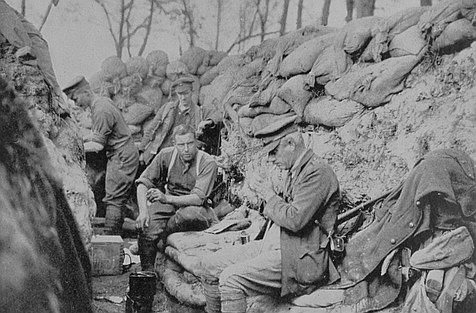
Hulme's company in the trenches at St Eloi
This photo shows men in T. E. Hulme’s Artillery company at St. Eloi in 1915

  
Poetry, like painting, is no longer necessary for reportage. Modernists often chose to respond to this by a movement into abstraction, conveying thoughts in motion and novel conceptions, seeking to demonstrate what can be meaningful without meaning.

Today’s piece “Trenches: St. Eloi”  is attributed to T. E. Hulme, a man who helped form this Modernist revolution and died before he could live in it. I say “attributed” because, like Homer, he did not write it down. The exact attribution is “Abbreviated from the Conversation of Mr TEH” when it was published by Ezra Pound, and it may have been Pound who chose what to transcribe or how to lay out the transcription. My guess is that some of the language sounds like Hulme (the unusual, but so perfect word choice of “pottering,” the homey image of trench soldiers strolling compared to the shoppers on the busy London street of Piccadilly), but the overall arrangement sounds like Pound to me.
 
We know pretty much the where and when that is being talked about, more than we know of the actual history of Troy. Hulme got a chance to relate these details while in an English hospital after being wounded in the spring of 1915 in trench warfare in St. Eloi. He recovered, returned to the war, and to his eventual meeting with a German artillery shell that ended his life.

T. E. Hulme may have said it, Ezra Pound may have edited it and written it down, but to hear me perform it with my musical accompaniment, use the player below.

Fall 2017 Parlando Project Top 10

It’s time to report the most popular audio pieces posted here over this increasingly busy summer. Before I get to this season’s Top 10 countdown, I want to thank everyone who has listened, followed, liked, or shared our posts and audio pieces on social media or on other blogs. I don’t have time (or perhaps the talents) to do all the promotion that some other blogs do, so it’s the kind words and enthusiastic work that you readers/listeners do that has spread the news about this combination of various words with various music.

Lots of changes from our last Top 10, so let’s get started. There should be a player gadget after each piece on the list, so you can easily hear the audio combining those words with music we create and perform as part of the Parlando Project.

10th place? Turns out it’s a three-way tie for 10, and since the three pieces demonstrate the variety I seek to present here, let’s just dispense with tie-breakers and list all three audio pieces that are tied at number 10..

“Sonnet 18”
  is, so far, our only Shakespeare selection. Shakespeare is, or course, inescapable, and setting Shakespeare’s sonnets to music isn’t a rare thing either, but one of the good things that comes from the Shakespeare phenomenon is that a listener can hear a lot of different takes on one text. I choose to bring out the brag in this one.

A Summer’s Night”  uses a poem by Paul Laurence Dunbar, the first widely published Afro-American poet who died tragically young in 1906. A lot of Dunbar’s success during his lifetime was with dialect pieces which he had ambiguous feelings about. He sometimes said that he wished to be known more for his poetic work in standard English, something that “A Summer’s Night”  demonstrates.


“On the Troop Ship To Gallipoli”  demonstrates a small bit of artistic courage on my part to pay tribute to the real-world courage of Rupert Brooke, who died in service to his country in WWI. The “Great War” redrew the world’s maps, overturned several empires, and it also drew a literary dividing line, as post-war poetry embraced Modernism which made the poetic stylings of Brooke seem decades old only a few years after he wrote them. Those who lived through that time often adapted to the new ideas of modern poetry, but Brooke never had that chance. So, in this piece I recast a late fragment of Brooke’s words as if it was an Imagist poem.

In 9th place, we have “Zalka Peetruza (who was christened Lucy Jane),”  which uses a poem by journalist and poet Roy Dandridge, who coincidently like Dunbar, was another Ohio Afro-American. By evidence of this poem, Dandridge deserves to be better known than he is, as it’s a tart observation of the art of getting over while Black, in this case by passing one’s self off as exotic.

8th place goes to a bit of a surprise, my slightly Beefheartian musical setting of two sections of Gertrude Stein’s “Tender Buttons.”  Don VanVliet (Capt. Beefheart) and Gertrude Stein were both uncompromising artists who hoed their own rows, so I viscerally made the connection in creating this piece.

7th is Sir Walter Raleigh’s damning litany “The Lie.”  It’s a poem I’ve loved since my youth and I don’t think one has to add much musical vengeance to amplify Raleigh’s words. 400 years old, and still pissed off.

6th slot goes to one of my translations, Rainer Maria Rilke’s “The Dark Interval.”  I did this translation a few years ago, and it was intended to be a somewhat freer variation. As I learn more, I think my assumptions on what the poem was getting at were wrong, but this looser version got 20 more listens that it’s more literal translation I also presented here this summer.

Halfway to number 1, at number 5, is Parlando Project alternative reader Dave Moore’s tale “I Was Not Yet Awake.”  Dave also plays many of the keyboard parts you hear here, including the organ part on this.  “I Was Not Yet Awake”  is short for a story, but longer than many pieces we present here. Dave’s story is so well told that it still managed to pick up a lot of listens this summer.

At number 4, dropping down from two straight appearance as number 1, is “Frances,”  a teenaged George Washington’s acrostic love poem. That’s still a marvel, as week after week I look at stats and see that it’s still getting listens, long after its appearance here last February.

Top 3 time! In position 3 is “The Death of Apollinaire,”  my translation of Dada principal Tristian Tzara’s surprisingly sincere eulogy for the multi-national poet and critic Guillaume Apollinaire, who invented the term “Surrealism” and helped weave together many of the strands of European Modernism before he died from complications of wounds he suffered in WWI.

And in position #2, up one place from 3rd in the last Top 10, is Dave Moore enigmatic song “Love and Money.”  It may offer an American answer to the question the Beatles once asked in “Can’t Buy Me Love.”

adlestrop Station

“The steam hissed. Someone cleared his throat. No one left and no one came…”

Position number 1 is another return, and an even higher rise in the chart due to the large number of listens over this summer: “Adlestrop,”  British poet Edward Thomas’ famous moment on train platform on a hot June 24th 1914, were nothing much happens, but everything palpably is.

The poem portrays the train’s stop as unscheduled, but research into train schedules (see them here in this blog post at The National Archives) says otherwise. Adding this element was a conscious choice by Thomas.

It’s a much-loved poem for many reasons. Some find extra resonance in the lines describing calmness in the tiny village train stop, the literal calm before the storm of WWI, and that’s a fine thought for those that hold it, but I believe the poem exists beyond those associations. “Adelstop’s”  closing lines are sublime even without that particular war, that particular trauma to that specific nation, and as it was, to the ending of the life of its author Thomas, who became another of the poets killed in that war.

Raleigh In the Dark Tower

Today’s post uses a very short poem about a famous doomed adventurer written by a too-little-known early modernist soldier-poet.

The words’ author, T. E. Hulme, is a name I kept running into as I read about the connections between modernist American and Irish writers in England at the beginning of the 20th Century. Many of those connections can be traced to a group of writers and artists, led by Hulme, who congregated in London beginning around 1908. It’s there that Ezra Pound, soon to be literary modernism’s greatest promoter, met Hulme, who many view as modernism’s originator. The argument for preeminence comes down to classic one:  who thought of it first vs. who practically introduced it.

So far here I’ve concentrated on Pound’s role, but as I began to look at this circle, I must consider Hulme’s impact as well. And then a few weeks ago, through the wonderful blog “Interesting Literature,” and its founder Oliver Tearle, I finally read some of Hulme’s poetry, his own practical application of his ideas.

T E Hulme

T. E. Hulme, the man whose brief poetic spark set off Imagism


If there’s a reason I hadn’t read Hulme yet, it may be that his poetry isn’t as well known, and there is very little of it—and what there is, is little twice: about 25 poems totaling about 260 lines. That’s right, as disciples of Bill James will quickly recognize, the average for a Hulme poem is shorter than a sonnet, just a bit more than 10 lines. His short poems, as much or more than other famous short Imagist poems like Pound’s “In A Station of the Metro”,  Williams’ “The Red Wheelbarrow”  or Sandburg’s “Fog”  challenge the reader to find worth and significance in a few words and a putatively mundane subject. Today’s piece uses the words of Hulme’s “Raleigh In the Dark Tower,”  and is something of an outlier in Hulme’s poems, as it’s subject is not so ordinary.

I used Sir Walter Raleigh’s The Lie  earlier this month, and in writing about this extraordinary condemnation of human failings, I told you what every English schoolkid of certain generations would have learned or known about Raleigh: that he was an Elizabethan English hero, and yet he was executed by the English government.

Raleigh Tobacco Tin

Also to blame for Duke basketball fans


Once more I’m going to have compress Raleigh’s life into shortcuts, some of which are matters of dispute. He lived in a time of brutal Christian religious wars and is said to have witnessed both the St. Bartholomew’s Day Massacre and to be captain of the troops ordered to perform the execution of prisoners after the Siege of Smerwick. He was lifetime soldier of fortune and entrepreneur, a cross between James Bond and Richard Branson. He popularized the potato and smoking tobacco, and so can be blamed for lung cancer and my spreading waistline. His expeditions pioneered European settlement of North Carolina, which means he is partially responsible for both Michael Jordon and insufferable Duke basketball fans. He twice led English expeditions into Guyana in South America, without which we would not have Davey Graham and acoustic guitars tuned to DADGAD. Oh, and he was a writer.

Even during his three separate confinements to the prison in the Tower of London, Raleigh wrote. Or perhaps he wrote because of his confinements? He wrote the first volume of a monumental attempt at a history of the world during one prison stay, but his release ended the chance of the series continuing.

To present Raleigh, Hulme in his conciseness, give us just these few lines:

Raleigh in the dark tower prisoned
Dreamed of the blue sea and beyond
Where in strange tropic paradise
Grew musk

For my music for “Raleigh In the Dark Tower”  I used acoustic guitar and a string quartet. To try to bring out the dream half of Raleigh’s prison I tried to perform a second, higher, vocal line. To represent the prison half of Raleigh’s experience, I repeated the words a second time, as a prisoned day would follow another prisoned day.

More depends on Raleigh’s life than depends on a Red Wheelbarrow, but Hulme lets that be only understood. And Hulme’s Imagist philosophy, a “dry hardness”, would urge fewer romantic dreams and more direct observation, but even in his few words, he allows this prisoner the immediacy of his dreams and voyages.

Raleigh would be executed for serving the amoral interests of his country too well, and Hulme would die a soldier on a WWI battlefield believing to the end in the causes of a war that was soon portrayed as absurd.

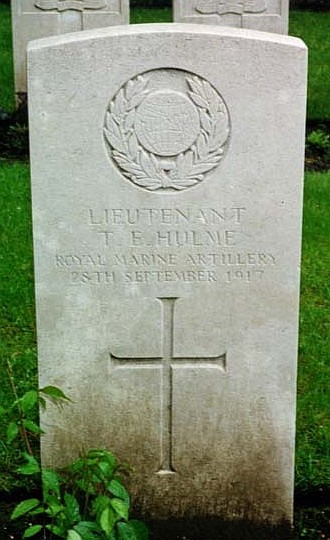
Hulme grave

Another soldier-poet whose leaf WWI cut short


To hear my music and performance of T. E. Hulme’s “Raleigh In the Dark Tower,”  use the player below.

Tender Buttons

Imagine this for the background and education for a poet. The poet is committed from a young age to see things exactly, so much so that they become fascinated with the very neurological functions that are the foundations of perception. In college, they study with the foremost psychologist in America, but they don’t stop there. They go on to study medicine at Johns Hopkins, stopping just short of a medical degree. The poet then decamps to the hottest art scene in the world where they discuss art with the painters who are revolutionizing how we depict reality in a frame, and this poet sees right away who are the great visual artists in this scene, with legendary precision. The poet’s next task was to use the ideas of this visual art revolution, along with ideas about how human thought and perception really work, to create a new kind of poetry.

You’d expect this poet would produce extraordinary work. She did. You might also expect this work to be revolutionary in its technique. It was, and still is. You might expect that you will want to seek out and hear this work, to experience what this background and conviction could bring to poetry. You might expect this writing to share with you exciting new ways of seeing. Well…

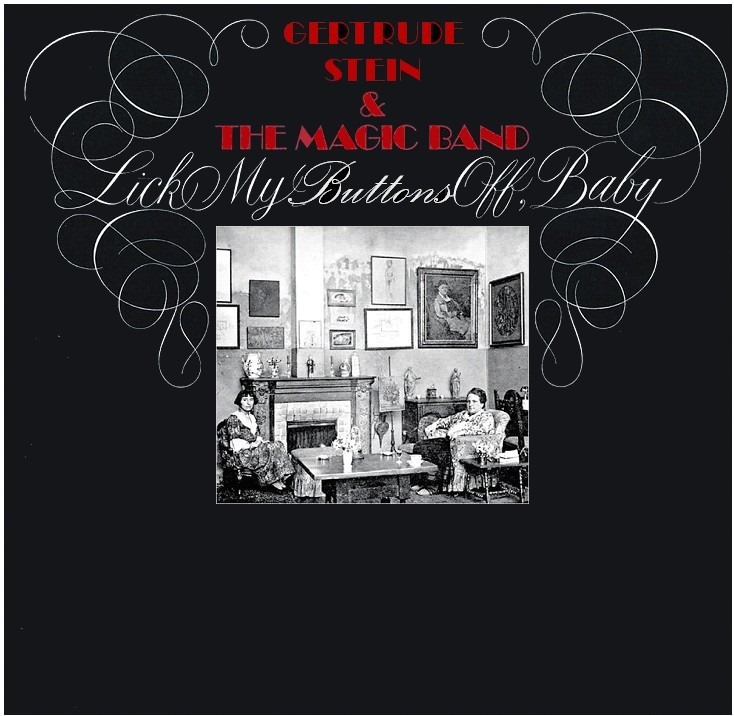
Gertrude Stein Lick My Buttons Off Baby cover

What percentage of my audience knows both who Capt. Beefheart and Gertrude Stein are?

 
Today’s piece uses the words of that poet, Gertrude Stein, from her 1914 collection “Tender Buttons.”  Even within the Modernists of her time, it was controversial, and it remains so today. Stein didn’t shock with her imagery like some of the provocative work of Dada and Surrealism. The radically condensed poems of the Imagists sometimes raised concerns that anything so seemingly simple and without the decorative rigmarole of 18th and 19th Century poetry couldn’t really be worthwhile art, but the Stein of “Tender Buttons”  was even more suspect. The imagists might withhold the complexity behind their shortest poems, but the words themselves were often plain-spoken, comprehendible on an immediate level—too quickly so, in some apprehensions, to be art. Here, the Imagists seemed to say, is the red wheelbarrow, the crowd at the Metro station, the stars above the Clark Street Bridge. I’m not giving you anything more, and you can take in these few words and shrug and say “so what?” for all I care.

Stein went further. In “Tender Buttons”  she wanted to project the messiness of real thought, real glancing perception, sticking to one thing only as repeated words that chorus and then disappear, only to appear a few poems later in the collection, but mostly moving from one atom of perception to another.
 
It’s as if, rather than speech recognition on a modern smartphone, that Stein turned herself into a human “thought recognition” device, registering in words not only the stream of consciousness but a stream of unconsciousness as well.

It’s as if, rather than speech recognition on a modern smartphone, that Stein turned herself into a human “thought recognition” device, registering in words not only the stream of consciousness but a stream of unconsciousness as well.

This is a brave idea, but what emerges from this sounds at first (and for many, at second, and then for as many times as they care to try) like nonsense. The words are plain, at the phrase or sentence level they can even seem to be intelligible, but as a whole, they seem to add up to nothing. Our brains are hard-wired to make patterns out of information, and so confronted with a chunk of “Tender Buttons”  this function may strive to make out coherence until one’s brain hurts, or it may just stop a few lines in and reject it as a failed experiment, perhaps even a fraud.

This is where I think that the Parlando Project’s secret weapon, music, can help. Music may have charms to soothe the savage beast of “I need to understand how these words fit together right now; and if I cannot, I will withhold my listening participation immediately.”

Musically I have put these two pieces from “Tender Buttons:” “Glazed Glitter”  and “Suppose an Eyes,”  against music from my memory of Capt. Beefheart, whose work helped me accept fractured non-narratives even while (perhaps because?) his were set against similarly fractured music. Alas, I lack the ability to emulate the timbre of Beefheart/Don Van Vliet’s voice as I declaim Stein’s words, but I assure you I’m hearing Don Van Vliet’s (or perhaps Kevin Coyne’s) voice in my mind as this piece nears it’s conclusion with the chant of “Little sales ladies, little sales ladies, little saddles of mutton, little sales of leather…”  The Parlando Project has always promised to surprise you with the variety of what we present, but we cannot promise you immediate delight all the time. If you like this piece combining two uncompromising artists, be sure to share us with the social media buttons you should see, and if you don’t like it, check out the other pieces already here or to come, as we use other types of music and other sets of words.

To hear “Two from Tender Buttons,”  use the player below.

The Death of Apollinaire

This is an elegy, not a love poem, but then an elegy is a love poem that replaces the focus masking the complexity of love with the common mystery of death. Even the images and incidents can have an eerie similarity, as an absence may be at the center of either.

The author of today’s piece, Tristian Tzara, is as much as anyone the founder of Dada—if that absurdist movement can structurally support a founder. Like much of the early 20th Century modernist movement, the horrors and changes of WWI accelerated Dada’s development. Proudly anarchistic and rejecting the whole lot of social norms and artistic traditions, Dada was at turns playful and bitter about a European world order that that was itself disordering everything on the continent though modern warfare.

Tristan Tzaratzara_by_picabia

When I look inside the back of my guitar amp,  do I find? Picabia’s portrait of Leo Fender, or a tube socket schematic?

As we’ve learned in earlier posts here, a whole generation was mobilized as part of The Great War. The teenage Tzara, residing in neutral Switzerland, escaped this, but he apparently tried to gain funds from both sides’ propaganda arms to fund Dada activities—which would be just the kind of audacious prank that Dada loved.

The subject of today’s piece, Guillaume Apollinaire, was a slightly older member of that WWI generation who should have gone on to even greater things after the war. As I mentioned last time, he had invented the name for Surrealism, the modernist movement that was a post-war outgrowth of Dada. Before that, he had also invented the term Cubism. In France during this time, Apollinaire seemed to know, and was admired by, everyone: composers, writers, painters, theater artists, the whole lot of this vibrant cultural scene.

Swept up into the military by the war, Apollinaire was seriously wounded at the front and weakened by his wounds, he died during the great flu outbreak of 1918.

Apollinaire with WWI head wound

Apollinaire, his war-wound bandages “pendaient avec leur couronne”

His death then leads to Tzara’s elegy, today’s piece. Given Tzara and Dada’s reputation, I was worried as I started to translate this. Translation, particularly for someone like me who is not a fluent speaker of other languages, is already fraught with issues, but doubly so with writers who can use arbitrary absurdist phrases intentionally. When is something unclear, and when is it meant to be so? That’s a question you ask a lot with these writers. I have a prejudice for vibrancy, and if I feel there’s a good image or English phrase hidden in an unfamiliar language’s idiom, I will generally seek to bring it out, but I also realize that I’m fully capable of misunderstanding the writer’s intent.

With Tzara’s “The Death of Apollinaire”  I grew to believe that this was a sincere elegy for this much-loved artist among artists, and so, translated and performed it as such. Yes, it has its absurd images, but I chose to translate them with clarity in mind. Apollinaire died in November, and so I took the mourning images as a series of late autumn images, and presented them as such. I had the most puzzlement with the line “et les arbres pendaient avec leur couronne” which can be simply left as an unusual combination: a (presumably, shiny metal) crown hanging in a tree-top.  As I looked at “couronne” it appears that it’s used also for a laurel wreath crown, and for a funeral wreath too, and for a while thought “wreath” or “funeral wreath” would be the best translation. And then I considered the botanical meaning of “crown” applied to trees, and the follow-up line “unique pleur” made me think of the last leaves in autumn, a rather conventional image—but a great deal of what makes that conventional in English is the popular song “Autumn Leaves”  written originally in French by Surrealist Jacques Prévert!  My translation: “And the trees, those still with hanging leaves” takes liberties with Tzara’s words, in hopes that I might have divined his image. I’m more confident in how I translated the last line, “un beau long voyage et la vacance illimitée de la chair des structures des os” which I proudly think is superior to other English translations.

Musically, today’s performance is a mix of 12-string guitar in Steve Tibbett’s tuning, with electric guitar and bass. As always, there’s a handy player below so that you can hear it. If you like a piece you hear here, go ahead and hit the like button, but it’s even more important in bringing this work to others attention to share it on your favored social media platform. Thanks for reading and listening, and double thanks for sharing!