Poets to Come

A month ago I began our celebration of the U. S. National Poetry Month with an audio piece using the words of Walt Whitman. Today I bring our month of music meeting poetry to a close with another piece by Whitman: “Poets to Come.”

Which is appropriate, as modern American poetry begins with Whitman.

From time to time in his work, Whitman reminds us that he knows he hasn’t fully realized his poetic project. This isn’t just false modesty. He revised and added to Leaves of Grass  throughout his lifetime, but it wasn’t because he thought perfection was one more edit away. Whitman seems to accept that it’s better to try to do what his ideals say to aim for, to make the effort to become the artist his art asks to exist. It’s better to be 80%, or even half or less, of that ideal Whitman he writes of, sounding his barbaric yawp over the roofs of the world, than for no Whitman to dare exist.

Note though that Whitman isn’t asking himself to do this for self -expression. His expression, even with the particularities of his own person being unavoidable, is cultural expression. He sought to sing into existence the culture he wanted America and the world to have.

Which is what makes this poem a great basis for the last post of this Poetry Month. He had faith for the poets who would follow his innovations and audacity. Many did come forth after him, many of which we’ve presented here. Whitman had, I might suppose, faith in the intentions of the Parlando Project—and I, if I pay attention to the spirit he wrote of, I should have faith too.

Walt Whitman in Philadelpia 1889 by Frederick Gutekunst

Good Gray Poet, Thin White Duke.. David Bowie sang “Ain’t there a pen that will write before they die?” Whitman’s caption says he was about 4 blocks from Sigma Sound studios were Bowie recorded that. TSOP!


During April I’ve created and presented 16 combinations of various words with my music, more than any other month in the year and a half of this project. I took a crack at preforming all of that “April is the cruelest month” modernist epic of T. S. Eliot’s “The Waste Land” —and only got near half-way done. I worked on the finding and understanding the words I’ve used, or composing, playing, and recording music for several hours every day this month.

And you’ve listened to these pieces, and if you’re here, you’ve even read my words about the process, for which I’m grateful. I’ll be back tomorrow with a piece by Dave Moore and the LYL Band for May Day and there may yet be more LYL Band recording before this Spring is over. I do expect to take a bit of a rest after the efforts of this April though. I have a pile of books I want and need to read, a whole lot of interesting blogs I’ve gotten behind reading too, and I’m looking forward to listening to music I didn’t have to think up first.

If you want more, I remind everyone that we have over 200 pieces here in the archives on the right. There’s lots of stuff that you may find better, worse, or at least additionally different there. If you, or someone you know would just like to hear the musical combinations we do, the Parlando Project music is available on all the major podcast services like Spotify, Google Play Music, or Apple podcasts.

Here’s Whitman’s “Poets to Come”  performed with my music. Use the player below to hear it, and if you like it, please tell other folks about the Parlando Project.


I Wandered Lonely as a Cloud (Daffodils)

It may be U. S. National Poetry Month, but one can’t deny the impact that English poets have had on poetry, particularly before the Modernists launched with significant American participation.

Modernism, as practiced by those early 20th Century Imagists sought to cleanse poetry of the rust and rot of “poetic language” and rote abstract metaphors. Strong, exact words, no more complex or numerous than necessary were to describe things that were actual things, not merely decorative analogies to describe something else. By the 1920s, that American import, T. S. Eliot, became the standard of one large stream of Modernism. Although inspired by this fresh use of language, the Eliot wing of Modernism sought to rid poetry of “romanticism,” defined as a relentlessly subjective expression of personal experience unshaped by a greater historical and cultural understanding. Poetic language might be refreshed, but the cult of the great poem returned, and said that poetry is best to be in service of great themes and elaborate—rather than elegant—structures of thought.

Early Imagist/Modernist poems were about moments. The High Modernism of Eliot allowed it to be about eras. Imagists prized images of things formerly ignored or costumed only in the rhetorical finery in 19th Century poetry. High Modernism still allowed the mundane to stand for sublime thoughts, but it often sought to display a level of knowledge and literary scholarship along with the everyday in its choice of images.

This is why it’s important to look at the early part of artistic movements. Often their best ideas become mutated as the movements develop. Their revolutions become the new orthodoxy.

Today’s piece, “I Wandered Lonely as a Cloud (Daffodils)”  is by English poet William Wordsworth, one of the founders of Romanticism. It’s a poem that can be attached to an exact (April, Poetry Month) date: April 15th, 1802, and to a walk that Wordsworth and his sister took in rural England. But that’s not how the poem was written. Wordsworth wrote it a couple of years later. He referred to his sister’s detailed journal entry about the April walk to refresh his particulars. His wife supplied two critical lines for the final stanza. This was not a spontaneous outburst of subjective personal feeling at all.

Daffodils at Kew Gardens

I couldn’t make it to the Lake District, but even a month ago, daffodils were blooming during an English Spring in Kew Gardens
In a few weeks my lawn will look like this in Minnesota—only dandelions, not daffodils.


When I performed the version you’ll hear below, I made one significant change and one minor one. The minor change? I dropped the adjective golden from his line “A host, of golden daffodils.” I suspect I did this by accident as I performed it. Not to dis Wordsworth (and by the way, Billy, what’s with that obvious pen name “Words-worth” for your poetry gig?) but I think I improved the line when I sung it as “A host, a host of daffodils.” First off, daffodils are a common flower, and they are in the wild always yellow. Strict Imagists would say the golden adjective is therefore unnecessary—and it is, well, a gilding of the lily. I can’t recall my reason for the major change, dropping the next to last stanza—I may have desired to shorten the piece for performance—but it is the weakest stanza in the poem.

The resulting “Daffodils”  I perform wouldn’t have been far from what F. S. Flint or Richard Aldington would have written a century or more later as pioneering Modernists. After all, Wordsworth said that he was trying to cleanse English poetry from special, high-flown, poetic diction too, to return it to “as far as is possible, a selection of the language really spoken by men.”

I do retain something else Wordsworth does here, something I don’t recall the Imagists doing much. “Daffodils”  is presented in a framing device, while the Imagists were all about the presentation of immediacy. Wordsworth doesn’t say merely that looking at all these wildflowers, the temporary exultation of spring, was transfixing—and he says that less with that next-to-last stanza removed. This is not a poem only about letting us see them in their wild, external multitude through his eye on an April walk in nature.

No, the poem starts, deliberately, in past tense. “I wandered lonely as a cloud.” And the poem closes even more removed. The speaker of the poem is not the energetic nature-walker strolling in Spring. In the actual, unknown, later time of the poem, he’s lying on a daybed, vacant or pensive. These daffodils are now only obtainable by the “inward eye” of recollection.

Setting something in the past can be seen as a tactic of sentimentality, something the Modernists distained, but what we have here is worth that risk. How so?

I thought it a delightful little nature poem when I read it as a teenager. Then I read it decades later, as my Eagle Scout father, the angler long accustomed to waiting perpendicular on the flat surface of lakes, the man who had bicycled across his rural state many times—while then, as I re-read, he was further and further confined to lying flat in rooms with the erasing of days. In that later time, noting the wild daffodils bliss is told to us in memory, I reversed Wordsworth’s famous dictum on the origin of poetry. In my reading, in that time, it became a poem, a song, of tranquility recollected in emotion.

Here’s my performance of “Daffodils”  as I sang and accompanied it on acoustic guitar.

Hyacinth Girl

Since April is National Poetry Month, let us return to that April epic of  High Modernism, T. S. Eliot’s “The Waste Land.”  Readers here will know that I’ve made great use of the works of the pioneering Modernists, that generation that formed itself on both sides of the Atlantic in the years before the outbreak of WWI.

We’ll continue to talk about them later, but for now I’ll point out that one thing they all shared was a commitment to shorter works with new imagery often drawn out of immediate contemporary experience. Given how I later encountered Modernism in Mid-20th Century American schools, I have been surprised at how simple, how commonplace, were the materials they used for their fresh imagery. Subtlety and ambiguity were not forgotten, but they were not belabored.

To “make it new” in this pre-WWI era, it was often to radically simplify. If traditional poetry was referred to, it was not the grand epics or the most serious verse of the past centuries, but the highly compressed Chinese and Japanese forms, Greek lyric fragments, or vernacular verse from folk traditions.

Modernism as it mutated after WWI had no such concentration. Grand themes and grand works were once more the best goal. Allusions to tradition abounded. As High Modernism marched forward toward my own Mid-Century youth, its poetry began to take an air of post-graduate knowledge as a pre-requisite to understanding or enjoyment.

Eliot’s “The Waste Land”  is a landmark for this change. I’m not an Eliot scholar. I won’t presume to psychoanalyze him accurately at the biographic point where he wrote this, with some key editorial re-shaping by Ezra Pound. As I said when I presented the opening section of “The Wasteland”  here last April, the poem is clearly informed by personal depression. Since a large percentage of contemporary people have experienced depression and grappled with it, parts of “The Waste Land”  communicate with us on an emotional, associative level even if we don’t understand it in a “pass the exam” way. This is good for the poem.

T S Eliot at the blackboard

I’ll show you fear in a handful of chalk dust! Evidence of T. S. Eliot trying to invent Sudoku.


Eliot’s complex, even maddening, use of distancing tactics in “The Waste Land:”   the rapid dislocation of location, time, speakers, and national language, along with a plan to make everything a possible reference to something else—usually something old and not mundanely immediate—is not at all like the pre-WWI Modernists. Still, that didn’t keep that sort of older Modernist style from breaking in every so often.

Today’s piece “Hyacinth Girl”  is one such part of “The Waste Land.”  If it had been presented as a standalone poem in one of the early Imagist anthologies it would have fit right in. There’s no post-graduate work necessary here, as was demonstrated by an 80s college-rock band who conceptionally used the same trope with no need for footnotes.

Not Eliot’s, nor my “Hyacinth Girl,” and not Winter Hours’ either. This is the original version by Ward 8, a predecessor band that make it sound more like the Velvet Underground.

Studied academically and considered as a part of the rest of the poem, Eliot’s “Hyacinth Girl” section needs not to be experienced this way, directly. One can consider any intended connection to the Greek myth of Apollo and Hyacinth and their tragic Frisbee accident with homoerotic overtones. I did so just yesterday, reading some papers and summaries of papers which if nothing else made me conscious of how often gender is unknown and shifting in “The Waste Land”—but I did this long after recording my performance of “Hyacinth Girl.”  I didn’t feel the need to revise it in the light of the papers or the classical reference, no more than I needed to know if it refers to Eliot’s girlfriend, or his wife, or a young man who was killed in WWI. Pound had once said that the image is “that which presents an intellectual and emotional complex in an instant of time.”  Eliot seemed unsure that it should be only that, if that was enough, which lead him and Modernist poetry to some strange places and practices, but it didn’t stop such direct poetry from breaking into “The Waste Land’s”   manifesto of High Modernism.

To hear my performance of this part of Eliot’s “The Waste Land,”  use the player below or with this highlighted hyperlink with will open a new tab window and play it. It starts out with just acoustic guitar and voice, but eventually some bass, strings and piano arrive. What would additional parts of “The Waste Land”  sound like if combined with eclectic original music? Stick around during #npm2018 as we’ll be letting you find out.


.

Vegetables dream of responding to you

OK, let’s reveal where the words from the last post, Poetry in Translation,  came from and what I know about their context—but stick around, as this is going to relate back to those 20th Century theories about how poetry works. If you haven’t listened yet read and listened to Poetry in Translation,  this would be a good time to scroll down and do so.

Earlier this month I was making some tea and talking to my son in the kitchen. He asked about what kind of tea I was making. I picked up the box to show him, Tazo Peachy Green tea. I noticed there was something more than an ingredients list and those filled-circle graphs of how much caffeine was stuck inside the individually bagged dried leaves. So, I broke into my Parlando Voice, improvising line break pauses as the early 20th Century Modernists have ingrained in me, and read it to him:

Poetry in Translation from Tazo Peach Tea

Modernist verse in the supermarket?

My son, now a teenager, is making sure that he’s nobody’s fool. “They must be smoking that tea, not drinking it.”

We both laughed.

Modernists a century ago would have liked this. “Found Objects” and use of commercial ready-mades in art and Dada japes were ingrained in Modernism during its avant garde phase. I’d have fit right in at the Cabaret Voltaire in 1916 if I was to have read this wacky and rapturous advertising copy from the tea box while Hugo Ball played piano.

picasso-bulls-head
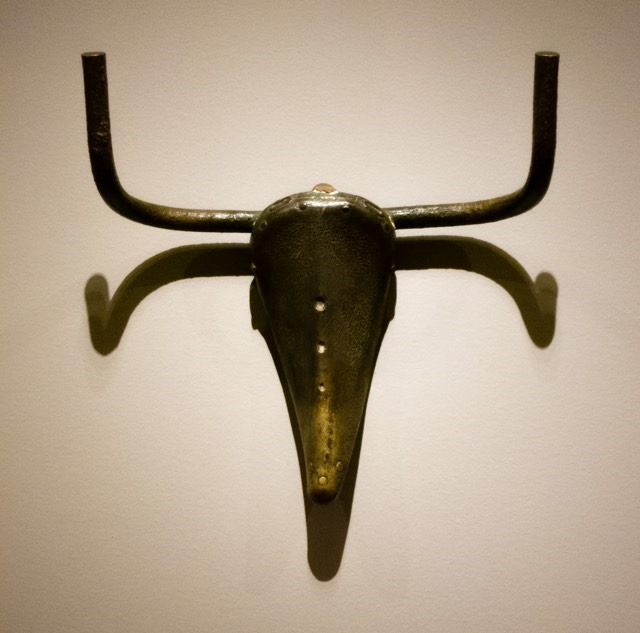
Some will see a Picasso sculpture, others will wonder if a bicyclist won’t be able to ride home

But as Modernism moved to the universities, and I. A. Richards’ and John Crowe Ransom’s “New Criticism” solution to the problem of unreliable interpretation became predominate by mid-century, things would change.

Simplifying wildly, the New Criticism suggested that the reader, not just poets and writers, needed to get under the hood and figure out what made poetry run. Inside every poem was the ideal poem, an expression of complex ideas or states of being placed there by it’s writer. The poems surface, though it may have some interest itself, was only the wrapper surrounding this more sublime poem. This bridged over the revolutions in poetic language, by making less important changes in the way poetry spoke, such as the widespread use of rhyme and free verse. John Donne, John Keats, Gerard Manley Hopkins, T. S. Eliot, Wallace Stevens—the different music of the words made no difference, the rich images portraying important thoughts could be studied side-by-side.

Imagery became poetry, more or less (yes, meter and sound were still attended to, but they dropped in importance). The original Modernists, including the Imagists, sought to kill off centuries of ingrained and tired imagery that had become merely decorative, and replace it with more integral and concrete images, palpable things. But just as when one finally cleans out a closet, time passing will clutter it again. If images contain the soul of poetry, and if deep reading is the best and proper way to encounter a poem, then complex and hermetic images will offer more of the poetic experience.

There’d been something of a cult of great poetry before, often based on important subject matter or the extent of readership, but as the New Criticism ascended to orthodoxy, the ideal of great poetry became stronger and used new criteria. Poems with densely jammed complex imagery requiring close reading and educational training to comprehend were great. Poems that didn’t do this were highly suspect—and likely harmful, in that they did not reinforce this new critical understanding of the soul of poetry.

As I said last time, this is how I was taught to understand poetry in the midcentury.

How can we return to the box of tea with its peach singing to the cucumber of its deathless desire? The midcentury New Critics presumed the supremacy of the poem and the poet’s intent. Later in the 20th Century new literary theorists arose, and the subjective experience of the reader became the place where the poem existed. The poem means what you think it means, which may be different from what another reader thinks it means. Meanings extracted from even the merest of texts could still be complex and valid. The intent of the author is not important, they could well be mistaken.

Now our singing peach isn’t a joke at the expense of exalted literature, it’s an expression of the woo of consumer culture signifying exotic essence through the appropriation of an ancient amphitheater dramatizing barely sublimated vegetable desires. Or it may be something a tired copywriter churned out on Friday afternoon before leaving work and picking up takeout on the way home to feed the kids.

As I said, I’m simplifying, but for the mid-century New Critics the poem existed objectively deep inside the poem where the poet put it. For the late 20th Century Deconstructionists and their contemporaries, the poem existed subjectively in its readers experience of it and the structures around that.

Coming up, is there a reconciliation between those two views? How will the 21st Century view what poetry is and where the poem lives? Will the cucumber and the peach find a meaningful relationship before they are dried and bagged?

Don’t worry if you’re missing the usual music and words meeting up here, we’ll return to that soon enough too. I promise variety, not predictability. To tide you over, here’s Dave Moore and the LYL Band running through his song, set in the late 19th Century, called “The Green Fairy.” 

Poetry in Translation

I remember reading about this some years back, and found it fascinating then. In my memory it was the American poet and critic John Crowe Ransom who was the teacher, but in searching this week for more detail, the perpetrator named was English poet and critic I. A. Richards. My memory still says Ransom did something similar, but let’s stay with Richards since I can verify it.

The time frame is the 1920s. The Modernists (due to painful copyright laws, the newest poets whose work can be freely used here by the Parlando Project) had begun their ascendency into the mainstream of English language poetry. But the Victorian era, including the later work of the Romantics and the whole of the William Morris/Pre-Raphaelite revival that preceded the Modernist revolution was not that long ago, within the memory of teachers and critics alive then, like the post WWII era or “The Sixties” would be today. The Romantics had been a revolution in how poetry speaks, and those that followed them took different paths from that revolution, and now the Modernists proposed a counter-revolution, once more changing how poetry speaks.

Had poetry, in some Platonic ideal state, it’s essence, changed; or had only the language and form it took to express its inner nature changed?

In such at time, the question of aesthetics, of what constitutes poetry and what are (or should be) its goals and effects, would naturally come to the fore. If one is a teacher, one might examine this by teaching, and so Richards devised an experiment. He gave students at Cambridge, a leading English university, a packet of poems which were without the names of their authors or any context about when they were written—they were even without their titles—and asked the students to write about them, to interpret them. I’m not sure if he presupposed what the results would be, but summaries of the experiment report he was surprised at the results. Their interpretations were poor, and often included what he knew to be misinterpretations. The students often resorted to personal experiences or rote sentimentality to explain the poems. As a result, the interpretations of the poems varied considerably as they missed their mark in different directions.

You might think, “Well, duh!” In subsequent theories of literature all these effects have been explained and codified in multiple ways, but at the time, in the 1920s, this was a new finding. Richards thought this showed a failure of literacy, defined as a kind of higher literacy; not the inability to read basic English, but to read and understand the kind of associative and musical language used by poetry. He spent his life trying to remedy this by teaching. In 1979, while in his eighties, he was still teaching, in China, when he fell ill and died. He wrote a book, titled “Practical Criticism”  setting out ways to properly read and derive the effects of a poem.

John Crowe Ransom and I A Richards

Know your Modernists: John Crowe Ransom, I. A. Richards, and two other blokes who don’t know from The New Criticism


But the way I heard of the experiment (and this may have been a subsequent experiment, inspired by Richards, perhaps by Ransom) the packet of unattributed poems given to students to interpret included a range of “not great poetry,” pop poetry as printed in mass-market publications as well as the work of more esteemed poets. And the result was the students couldn’t reliably distinguish the great poets from the hacks.

The challenge of the new poetic language of the Modernists, and the experience of teachers like Richards and Ransom demonstrated in this experiment with unattributed poems, lead to what was called “The New Criticism.”

When, a generation later, I began to encounter poetry in school, “The New Criticism” was by far the predominant idea of how poetry should be taught. At the end of my scattered schooling, new theories were arising, Deconstructionism and the like, and I can still recall professors muttering about its willful misunderstandings and mistaken goals as I struggled for money to pay for one more class that would fit into my work schedule.

Now in this century, I know less what happens in schools, but I sense culturally we’re concerned increasingly with the poet as the container that holds the poem and its experience. Some worry about “Identity Politics” and its correlate would be “Identity Poetry,” where the background, ethnic and otherwise, of the poet is integral to the poem. I’m too busy making art to have a coherent philosophy on this. I can easily envision problems arising from a division of poetry into ever smaller spheres where only the right combinations of ingredients can make or appreciate some work. On the other hand, I’m also suspicious of the motives of anyone who claims to hate Identity Politics or Identity Poetry, while showing no interest otherwise in smashing the walls and peeling off the labels from artists for whom those “stick to that” labels and barriers may not be self-chosen.

Oh my, what a long introduction to today’s audio piece! In honor of Richards and Ransom and their experiments, here’s a piece I call “Poetry in Translation”  for the purposes of the experiment. I’m not going to give you any more context for the poem used, the author’s name or their ethnic identity. I assure you I’m not in this for “gotcha” or obscure literary one-upmanship. It’s short, so give it a listen and see what you think. I’ll be back later this week with more.

The Wood-Pile

Robert Frost is every bit the master of word music as Yeats and Millay. What makes Frost stand out is that he was every bit the thoroughgoing early 20th Century modernist as any of his free-verse contemporaries, while retaining an ease with accentual syllabic meter.

Here’s an example of Frost handling a subject just as a free-verse Imagist would. His aims, his presentation, hold to the Imagists’ principles. He deals with the thing directly (as we shall see, two things, but still…), and there are no tacked-on metaphors, no stock comparisons, no extraneous “poetic” language. Context is shown, but not explained. He loosens and varies his meter, so the poem sings and never seems to be a shackled march. At 40 lines, it’s a bit longer than Yeats’ poem considering “The Wild Swans at Coole,”  but Frost’s extra detail is even more specific and concrete than Yeats, though both begin their poem with the poet walking in a rural wetland. Yeats slough is a well-known place to him, conditioned with 19 previous visits. Frost is far enough into his swamp to not know exactly where he is, and so experiences what he sees with a first-time immediacy. Yeats’ slough then contains tradition, Frosts’ the more Modernist “Make it new!” place.

Though presented as one simple rural scene and story, “The Wood-Pile”  is more at two poems, though each part speaks to the other. As Frost’s tale starts, we are in the midst of one of his characteristic journeys, just as we are in other famous Frost poems. There’s a need for decision (“Turn back” or “go on farther”) and his choice, also made in other Frost poems, is to go on regardless of whatever doubts brought the question. If he’s lost in the dark by a wood on a snowy evening, keep going. If you come to a fork in the road, pick one and go on. If you’re walking in a swamp in winter and your foot is sometimes falling through the frozen crust, well, keep going “and we shall see.”

And so, here he sees his bird. No Keatsian nightingale, not Millay’s elusive flying swans with their awkward dangling legs and cries, nor Yeats’ majestic 59 swans, but a small bird. This bird becomes a mirror to the poet. Frost’s bird too must make choices in direction, and the poet, sensibly, thinks the bird’s guided by fear. “Keep something between little me and the big lummox trodding through the winter swamp,” he humansplains. And there’s a bit of humor at human’s expense as the poet muses that the bird, like humans with their self-importance, may think that the only reason for Frost to be out in the swamp is to go after the little bird.

Gackle with white tail feather

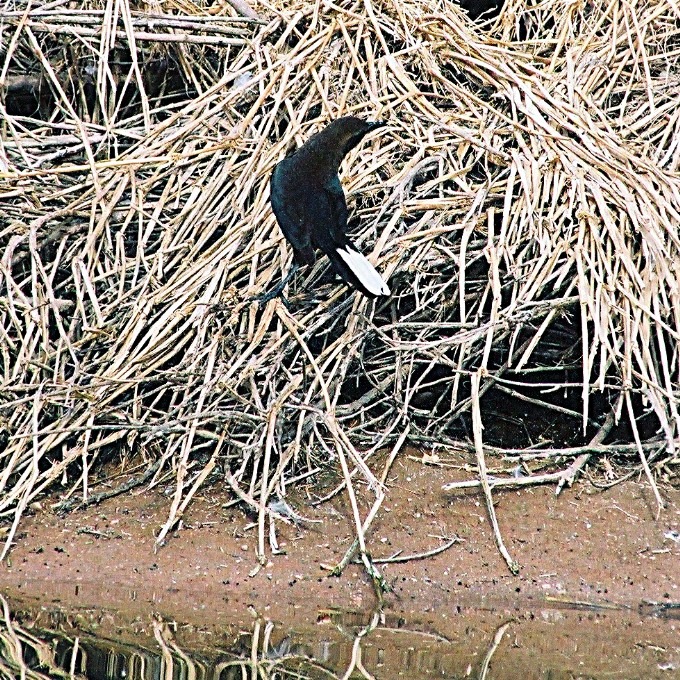
“He thought I was after him for a feather—the white one in his tail”


But, we don’t know why Frost is out in the frozen swamp explicitly. The only reason he’s given, or will give, is the Imagist poets’ reason: “and we shall see.”

The bird leads Frost to the second thing the poem wants to present: an abandoned fire-wood cache. Here Frost zooms in close. Every detail of the cut wood and the once neatly stacked and propped wood-pile is stated. Frost turns forensic, like some New England Sherlock Holmes: this pile has been abandoned for years. Mature vines have grown through it.

wood-pile

“The slow smokeless burning of decay”


Here is another context left unsaid. Why would someone abandon a purposeful wood-pile in a swamp? Frost leaves it for us to be detective and to solve the mystery. This isn’t some lot of fire-wood left temporarily to be gathered later in the day, care has been taken to stack and prop it.

The only thing I can think: someone once built a shack (now completely disappeared) on the swamp land. Frost muses, sardonically, that only someone so busy with “fresh tasks” could abandon such effort in cutting and stacking. Does he mean to say, “only a fool would be so industrious to cut and stack this wood and yet not notice he was building his shack on a swamp that would not support a homestead?”

Now, the small bird with his “little fears” and oh-so-human misapprehensions of reality—and now, the steadfast Frost of miles to keep going, even if you may be lost, are set in contrast to this choice. Your fears may lie to you—but so will your optimism.

I once heard an astringent biological statement that the length of our lives can be reduced to a slow-burning chemical reaction. Frost’s last line here is a sad and beautiful analog to that truth.

Turn back or go farther? Go on, and we shall hear my performance of Robert Frost’s “The Wood-Pile”  with my original music. Just use the player below.

God Is In the All Time

I’m continually a few days behind in the past month or so, what with Winter holidays and other appointments and responsibilities. Some of the audio pieces have been recorded especially expeditiously, and another part of this project has been neglected: the searches I take to find words (mostly poetry) I combine with original music.

Because publishers do not respond when I ask for permission to use works that may be in copyright, I am constrained to use written work outside of copyright, typically works published before 1923. Although I respond to, and use, poetry written in various eras, my desire to mix in more contemporary voices leads the Parlando Project to use a lot of poetry from the first two decades of the 20th Century. This is not altogether a bad thing. I happen to like a lot of what these pioneering Modernists did, and in some cases, what we find in the mouth of the “Post-Modern” poetry mainstream delta is worthy of reconsideration in the light of the Modernists. Have stagnant currents deposited silt and detritus at our end of Modernism, its own Mannerism that says that poetry must be written in a special poetic language and syntax, because that is the language that serious poems use? If popular poems are to be about recounting internal personal experience and serious poems are to be about hermetic personal language, what is missed?

Maybe we answer these questions by doing, as we answer other questions (even ones we never ask) by living. In my case, the doing may be by continuing this Parlando Project.

So earlier this month, returning to the research that goes on behind the scenes of this blog, I read two old anthologies of poems now in the public domain, looking for some new material. In one I was attracted to yet another piece by Carl Sandburg, a poet I believe should be reassessed in our time, but hardly an unknown, particularly to readers/listeners here. In the second one I came upon the work of Fenton Johnson for the first time. I’m willing to bet most of you haven’t heard of him.

Johnson, like Sandburg, like William Carlos Williams, wrote Modernist verse while remaining in America. Like William Butler Yeats, his career was long enough that he wrote poems that sounded like the 19th Century before transitioning to a 20th Century voice. Here’s a difference: Fenton Johnson was Afro-American.

OK, let me drop a term here: Identity Politics. I was recently reading a thoughtful blog post on Carl Sandburg compared to Post-Modernist poetry, when the author remarked that Sandburg was able to write in a time preceding Identity Politics. I don’t know enough about Left Write & Centaur’s full thought on Identity Politics, but the implication was that Identity Politics, characterized as the idea that we are silos of individual experience based on membership in social and ethnic groups, who then by implication need to be treated and considered primarily by that identity, is a bad thing.

I agree, that’s a bad thing for the most part. I also believe it’s often a real thing.

The first half: the separation, at least to some degree, of individual experience, is so self-evident I don’t feel I need to argue it. Poetry and literature is to a large part a demonstration of the things that we find unique in individual voices—yes, along with things we can find in common in our lived lives—but if our take on experience wasn’t varied, literature would soon become dull and repetitive (at least to me). Even for those things that we find in common as we read or listen, how would we know without literature or other arts letting us share this?

If we feel that separation is a bad thing, then art is where we go to heal that. The arts are simply a name we give to that sharing of experience.

The second part, that this separation can be handled and considered with bins of people labeled with ethnic origin, sexual orientation, gender, age, class, and so forth, this is where it gets real. We cannot wish away with imagination the ways the world labels and files its temporary inhabitants.

Should I care that Fenton Johnson is an Afro-American poet? Should I mention it? Does mentioning it imply some kind of special pleading? As I present a smattering of his development as a poet, will his work become “Well, it’s a Black thing”—a separation surrendered to?

Fenton Johnson

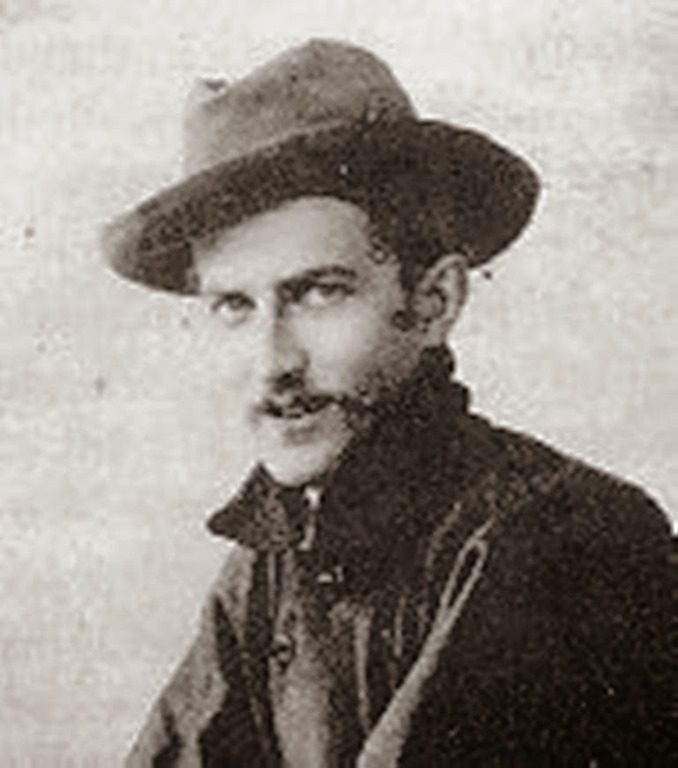
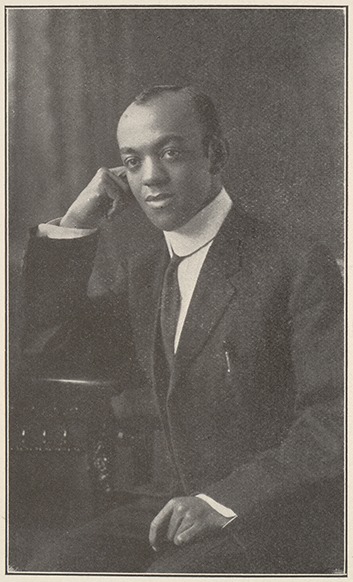
The younger Fenton Johnson. I’m unable to find any later portraits of him.

However we dream our ideal world to come, I know that Fenton Johnson had to deal in the real world of 1918 Chicago, just as he would in 1968 or 2018 Chicago, with his ethnic skin color label on a daily basis. That label doesn’t peel off. No doubt, many he encountered imaginatively filled out that label with a long list of contents, but instead, let’s look from inside Fenton Johnson out at the world.

Will it be the same and different as Frost, Tzara, Sandburg, Rossetti, Tagore, Yeats, and Dickinson? Yes.

Early Fenton Johnson poems often start from a religious theme. This one, “God Is In the All Time”  portrays things from a universalist perspective. To hear my performance, use the player below.

In Praise of Not Great Poetry

I’m about to make a point that seems to me to be nearly self-evident, yet I feel the need to make it because I sense a conflicting opinion is the premise behind some commonly made judgements about poetry.

Poetry of course is only one of many arts. In our time, it is one of the arts that feels it needs to justify itself more often. Poetry feels like it’s neglected, marginalized, underappreciated, and there are reasons for it to think so.

Does music do this? One can find defenses for the value of music, yes, but these cries are not the same. Similarly, the other arts that use words: prose of various kinds, cinema, live drama—people will defend their value, but not with the elephant of marginalized dread that advocates of poetry feel they must deal with.

Why is that? I’m going to use a loaded word to describe the cause, one that is likely not quite right, but one that I can’t find a short pithy substitute for: snobbery. There may be a better word. I mean, really, it’s more at a misapplied kind of elitism, but elitism is an even more misunderstood and misused word.

Roman Hruska

Roman Hruska. Is this is a picture of a great modern poet, or a leading voice of
“The New Criticism” who established the 20th Century ideals of great poetry?


Roman L. Hruska was a doctrinaire Midwestern conservative who served in Congress in the middle of the 20th Century. His place in history is constrained to one quote. Hruska’s infamous rhetorical thrust, meant to defend a Supreme Court appointment before the Senate for confirmation, was so mockable that it helped defeat that candidate.

I rise today knowing that what I’m about to say risks the same fate.

Here’s what Hruska said about Harold Carswell, who as candidate for the High Court, had been attacked as a mediocre jurist. “Even if he were mediocre, there are a lot of mediocre judges and people and lawyers. They are entitled to a little representation, aren’t they, and a little chance?”

That too is a misunderstanding of elitism. It is elitism to want the best leaders, the best judges. It is also elitism to desire all kinds of difficult and challenging arts. Given that elitism is sometimes thrown around as an insult in our century, let me be clear, I support that idea. It’s good to desire the best, to even take risks for the best, particularly in the arts, which have fewer direct consequences, and therefore can serve as a “research and development” department for outlooks and thoughts that we may want to experiment with a bit before we apply them to surgery or criminal law.

What does this have to do with poetry’s pervasive feeling of marginalization?

In the last century, poetry continued on an artistic and critical path that diverged from the other musical and literary arts. When any serious critical and institutional focus on the poetic arts were called for, poetry divested itself of all of it’s non-elite branches and expressions. Song lyrics? Not poetry. Popular poems, the kind once memorized by schoolchildren? Not real  poetry. Humorous poems? Humor, not poetry. Verse that is predominantly interesting because it’s musical speech? No. You don’t understand, poetry is about complex language examining difficult to express matrixes of experience. Thoughts and experiences from marginalized or particular speakers? Well, nice that they can speak up these days, but, please, it’s not poetry. Hip Hop/rap? Oh, come on! Get serious.

I can agree with what some literary critics and gatekeepers observe about these forms of expression, but not their judgement.

I too can be bored and uninterested in things that may fall into those “It’s not  poetry” bins. I can also be bored and uninterested in some page poetry which is credentialed and endorsed as serious mainstream literary poetry—you know, the stuff that’s poetry.  I can even change my mind about what I find interesting and worth my attention. I see new things in the work. I live new experiences. And sometimes when I’m listening to some musical speech, I’m seeking a pleasure or relief that’s hard to detail as criteria for greatness.

What if we considered all narrative prose that wasn’t a contender for the greatest novel ever written as, well, not prose. I enjoy a detective novel once in a while. Short stories can be sublime. Should I remind myself as I enjoy them that they are inferior in some criteria for a great novel? I find interest in some of the most austere or minimal modern serious music, but if every time I hear a good three-minute tune that makes a conventional set of chords seem inevitable all over again, should I feel ashamed that I think that’s music?

Can what is “not great” inform something greater? Many of the early Modernists seemed to think so—but it need not be applied like a newspaper clipping to a cubist collage or a folk tune to a symphony, it can be part of a vital continuum of human expression without needing elevation or even a judgment of hierarchy over all else.

I believe it’s a mistake for poetry, so concerned with it’s potential vital contribution to human culture, to feel that it can best survive by severing its cerebral head, leaving its ass and its elbow to wander around as “not poetry.”

Love Song for a Woman I Do Not Love

One joy of this project’s exploration has been coming upon poets I know nothing about and acquiring their words in my bloodless version of that conqueror on the “peak in Darien.” Writing about Frost, Pound, HD and Eliot in England early in the 20th Century lead me to T. E. Hulme, an Englishman of pugnacious artistic pronouncements and surprisingly modest and moving poetry. And T. E. Hulme led me to F. S. Flint, another British writer and literary theorist in this circle in the years just before WWI.

Last month I introduced readers here to Flint’s amazing rise from Victorian poverty. In the interim I’ve been reading more of his work, including his 1920 collection of poems (he called them “cadences”) titled “Otherworld.”  Since Flint is not commonly studied or anthologized, each poem as I encountered in the collection was a fresh experience, no different than reading a new poet’s chapbook published this year. I could start a poem of his in “Otherworld”  about a confused midnight awakening, and come to find it’s a first-hand account of a deadly London air-raid by a German Zeppelin.

Today’s piece, in the same collection, held another surprise. It tells you it’s a Love Song, but contradicts that before the end of the title. What it is instead is an unstinting examination of the corrosion class and gender inflict on the grail of love. The singer of this song lays bare a combination of disgust at how he’s judged as a poor man, with an undisguised desire to own the things he does not have, including this other human being, the woman of the title.

Bright Coloured Cretonnes!

“Bright-coloured cretonnes…” What is the erotic despair of draperies and upholstery?

I can think of dozens of popular songs that deal in some variation of this, but it’s harder to come up with 100-year-old poems, much less ones as good as this one, that talk of this. Ignore a handful of references to the interior decorating trends of Flint’s time, and this poem could have been written yesterday, except few writers of any time would be as acute as Flint is in observing this.

What new poets of the Modernist movement do I get to discover and share with you in the upcoming year? I can’t be sure, but I noted that Flint’s “Otherworld”  is dedicated to Herbert Read, and from what few poems of his I can find online, Read seems just as fresh and fascinating.

But let’s not get ahead of ourselves. Musically I’ve been telling myself I want to utilize some of the methods of hip-hop records, and yet each time I set out to do this, I get side-tracked by my own idiosyncratic musical muse. The melodic top line is my appreciation of early 1960s hard-bop organ playing. The bass part is a combination of a left-hand organ part with electric bass. Two bass lines shouldn’t work, but I think it does here. That’s not the only duality in this: the drum machine beat is augmented by some percussion which keeps the drum machine from ruling the groove “correctly.” The hip-hop rhythm flow eludes me again, though maybe I recall some predecessors like Dr. John the Night Tripper?

To hear my performance of F. S. Flint’s “Love Song to a Woman I Do Not Love,”  use the player below.

Oread

How did you spend your extra hour given to us by the Daylight Savings Time changeover? Some spent it snuggled with a loved one, or others for splendid dreams given time for extra chapters. I spent my night and hour wrestling with another poet’s poem and creating and performing music for it.

A few posts back we presented William Carlos Williams “The Red Wheelbarrow,” a widely anthologized and very short Imagist poem. My current feeling, shared in that post, was that Williams really was talking about a red wheelbarrow, a simple tool used for important tasks. Of course, he was also aware that the rain-glazed red paint of the wheelbarrow and the white chickens around it was a bold visual image, consistent with the modernist art he appreciated, and that he didn’t mind the provocation of calling attention to this without elaborate justification, any more than a classical painter or poet would think they would have been required to tell us why we should give a fig about Artemis.

Here’s another short Imagist poem, this time by Hilda Doolittle, who wrote as H. D.   H. D. knew William Carlos Williams from when Williams was a college student, but then H. D. knew or crossed paths with many of the principals of Modernism over her lifetime. Modernist poetry admitted more women creators than painting or music, or most other arts at the start of the 20th Century, but that’s a low bar to clear. H. D. cleared it however, and she continued to run her own race on her own course from the start of her career.

HD in Egypt

Another episode from HD’s remarkable life: she was present when King Tut’s tomb was opened in 1923


H. D.’s 26 word poem is much different from Williams’ 16 word one. It’s much stranger, and the internal state the external images present is more complex than even many longer poems reflect.

In some ways, the title “Oread”,  the effective 27th word, helps us. For those not up on Greek mythology, we can look it up, it’s a mountain nymph or spirit. Like many Greek nature spirits, an Oread is female.

So, from the title of the poem, we can say that it’s an Oread that’s speaking—but even if we grant that, this ain’t Tinkerbell. The supposed nymph is commanding nature, as a full-fledge god or goddess or a magician would. And the Oread is not asking it for protection, or forbearance, or even for it to put the hex on someone else, it’s asking it to do it’s best to overcome her. “Whirl” “pointed” “splash”, and “hurl” are some of those 26 words.

Another huge difference between Williams “Wheelbarrow”  and H. D.’s “Oread:”  the former is intensely visual, the later, just as intensely, tactile.

And who’s the Oread talking too? Three words in, it seems to make that clear: “sea.” Except the sea is described largely as a forest—a forest that can splash and form pools, but a forest at least as much as a sea. The sharpest readings of this is that the Oread is speaking of the sea with the images of the forested mountain (waves are like trees, water drops are like the needles of pines), but by saying it so, she is saying that the overcoming she commands is a merging of two like things.

I’m left with a conclusion that this is a spell of desire. Whether it is sensual, spiritual, or artistic desire makes no difference in the frenzied merger that is being called into being.

So, what did I do in writing music and performing “Oread?”  I repeat most of the lines at least twice, to emphasize the incantational aspect. Despite my recently expressed desire to re-explore artificial drum machine sounds, the percussion has lots of little instruments for a ceremonial air: shakers, maracas, cymbals, tambourine, even a chiming triangle. The main musical motif is a four-note synthesizer phrase that seems to be looping, but once again isn’t, as permutations occur throughout. The bass part rarely plays the same note as the synth motif, a musical effect that can be likened to “rubbing,” an apt metaphor for this sensuous poem.

To hear it, use the player below.