Adapting Michael Strange: “To Claude Debussy’s La Grotte”

I’ve long wanted to do a Parlando Project piece using the words of early 20th century American poet Michael Strange – but there was this one problem: her poetry wasn’t very good. Or perhaps I should restate that: her poetry doesn’t consistently work in the ways that I appreciate poetry. What about her poetry causes problems for me? It’s not just that it risks being ecstatic to a fault, or that it seems grandiose at times. I’ve forgiven other poets those excesses. It’s certainly not her overall poetic approach, as her verse seems to me to be highly influenced by Imagism, that early 20th century poetic movement that continues to inspire me. She also seems fond of Whitman and Nietzsche, but so were other writers of her era that I’ve presented here. So, if not those things, what? If I’d pick one term for what keeps me from enjoying her poetry it would be “over-writing.”

Here’s an example, an ekphrastic poem about an art song by composer Claude Debussy which used a text by François Tristan L’Hermite. I’m not sure if Strange is portraying L’Hermite’s French lyrics (which are quite good and bring in the myth of Narcissus) but she talks of sound and gives the musical composer the sole place in her title:

To Claude Debussy’s La Grotte

Your song
As the hale of mysterious exotic intention
Drifting in palpitating echoes
O’er the pallid oval
Of night-closed flowers -—

Your song
As the increasing shimmer
Of some exquisite nearness —
Clad in those steel-dark foils
Of sinister fancy —
And once more your song
As the moaning hush of a human soul
Receding — from the Divine Moment

.

The images here constantly suffer from the Donald Trump school of interior decorating. They’re not just curlicue ornamented, they’re coated in gold leaf. The “hale of…intention” image is a fine one, but adding both “mysterious” and “exotic” as modifiers cloaks its originality. Are “echoes” so unclear as a sound description that they need “palpitating” to clear up that they repeat at intervals? Why the somewhat archaic “O’er” when the modern “over” will chime nicely with “oval” and “flowers?” And that’s just the first stanza, first 21 words. This over-egging hurts not just the sharpness of the images, it hurts the word music too. As with Trumps White House confessions of gilde, this can be read as a lack of confidence in her own vision and place in poetry. I must include “poetic” words, I must show the specialness of each facet with modifiers and more modifiers, I must show that I’m writing.

Now I’m not writing this to dunk on Strange. I’ve committed every sin above, and more. What I write has enough faults to repel readership. Strange is not a particularly famous or widely-read poet, but more people have likely read her poem, and maybe even more people would like this poem of hers than any I’ve written. Still, I want a better poem than this one printed more than a century ago if I’m going to perform it. Yet what I did is risky ethically – that Strange is dead and her work fully in the public domain doesn’t erase the issues with what I chose to do this week with her poem. I rewrote it.

Your song,
the hale of exotic intention
drifts in echoes
Over the oval night-closed flowers.

Your song,
the shimmer comes nearer,
some steel-dark foils of sinister fancy —
And once more
your song,
the hush of a human soul
receding from the Divine Moment.

.

I tell my self-accusing self that I did this in service to what I think Strange was portraying in her original poem. Indeed, what I did there is similar to what I do when translating a poem from another language: find the images the poet was portraying and convey them in contemporary English with a word music that works in that destination language – though here I’m able to use more of her original words since she wrote in English. I’m opening myself up to a charge of patriarchal overreach, but in my defense, I’ll say I’ve done this to Robert Frost and Rupert Brooke. So, I may just be an asshole when I do this.

Before I move on to a few notes on the musical performance that prompted me to do this rewrite, let me just give the briefest outline of Strange’s fascinating life, a history that gave me such high expectations as I sought out her verse. Strange was born into a socially prominent East-Coast family, and was married (three times) to socially prominent men. Photographs and contemporary testimony portray her as exceptionally beautiful. Despite her background, she was a feminist, a left-wing social activist, and moved in bohemian circles. During the WWI years she published her first poetry collection and used the masculine pen name Michael Strange for this. Wikipedia’s summary says the name was used to shield her family from the poetry, which was claimed to be erotic and scandalous, and it’s also easy to suppose that she may have made (at least in part) a tactical choice to avoid sexist devaluation of the work. Whatever the initial reasons, she soon came to use the name generally, in subsequent writing, when she appeared on stage as an actress, on radio as a host* and, I gather, “in real life.” I’m not an expert on Strange’s life, but it appears she used feminine pronouns.

Michael Strange

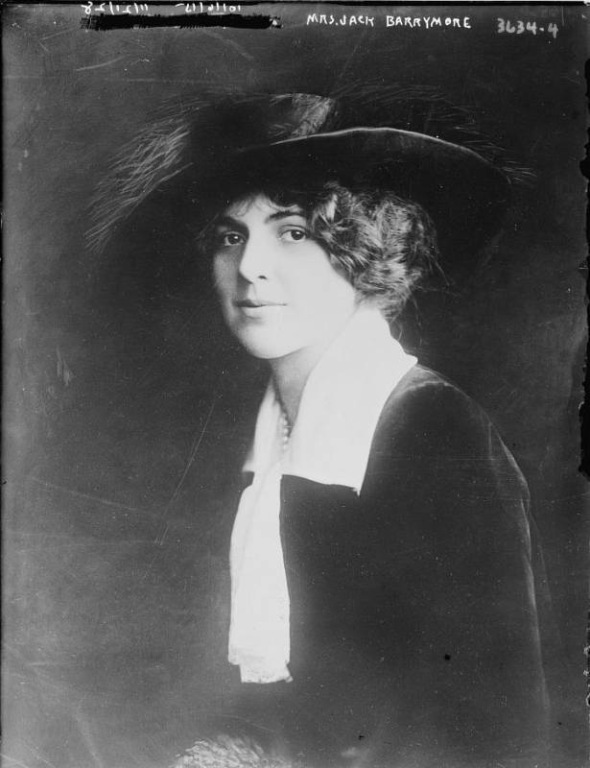
Pleased to meet you. Hope you guess my name. Born Blanche Oelrichs, became Michael Strange, was a member of the Lucy Stone League dedicated to married women keeping their own name – and this photo is labeled “Mrs, Jack Barrymore” (the name of her second husband, the famous actor).

.

It’s possible I would have run into Strange, on her own, at some time in this Project, since I enjoy examining lesser-known poets from her era here. Instead, I first encountered her because of her relationship with another author who produced popular Modernist work, Margaret Wise Brown. What? Yes, Margaret Wise Goodnight Moon  Brown. Early this century, in my fatherhood role with a then pre-literate child, I was the bard of such stories as Goodnight Moon  or The Color Kittens.  And it may not be only because this overlapped my adult reading that I heard them as part of the same world of early Modernism.** For the last decade of her life Strange lived in a committed relationship with Brown, and so it was in reading about Brown that I first read Strange’s name.

All right, on to this short musical piece using adapted words from Michael Strange. I was working on composing with the intent to use minimal motifs, ones that my minimal keyboard skills could play without using an arpeggiator or other automated extensions. I built the music using a variety of alt-techniques and “prepared” piano sounds. In the middle section there’s an organ part that does use an arpeggiator, and a percussion part that had me playing parts on some struck metal objects over a more conventional drum-set pattern. Not exactly Debussy,*** but perhaps evocative of other 20th century avant-garde musics. You can hear it with the audio player below. No audio player? It’s not gender panic, but some ways of viewing this blog suppress it, and so I offer this highlighted link that will also play the musical performance.

.

*Her radio program was titled Music and Poetry.  Just as with today’s poem – despite my problems with its prosody – Strange’s bio can’t stop being catnip to me.

**Another “could he really be serious” suggestion: if we might well include Robert Louis Stevenson and Lewis Carroll in studies of Victorian lit, should Brown be read next to H.D. and Pound as Imagist texts?

***Musically, while I’ve listened some to the Impressionist musical school of composers, I came to them largely from instrumental guitarists who were directly influenced by them. So, Dadaistically, today’s piece has no guitar whatsoever.

Beautiful Justice

This poem by the French Surrealist poet Paul Éluard wandered into my view earlier this month, and it seems like it, and my work translating it into English, slots right in between my late wife’s poem I performed last time and this Saturday’s planned #NoKings protests planned around America.

I’ve mentioned earlier this year that in my youth I became interested in the French Modernists because I had gotten the impression that they were a key force in English-language Modernism. Later, from my work for the Parlando Project, I came to learn that this is only partially so. I wasn’t far into the Project when I realized that there was in London before WWI (at that time still the center of English-language literature) a “reverse British Invasion” going on as crucial as the 1960’s British Invasion that helped revitalized rock’n’roll music. Americans: Pound, Eliot, H.D., Frost, and even the important British Imagist theorist T. E. Hulme who had spent some expanded-sky time in Canada, were all there shaping up a make-it-new freshness. Now it’s also true that Eliot and Pound were fond of some French poets,* but as I later traced those French poets with the greater resources I could obtain this century, I found that some of those French writers were taken with Whitman and Poe.

Still, the French Symbolists, and the more internationally-sourced but eventually Paris-centered Dada and Surrealist poets were  important. Having only High School French it was hard for me to absorb a great deal of French Modernist poetry, but what I was able to find in translation, or painstakingly translate myself in the 1970s was an important influence on me.

It was soon enough that I came upon Paul Éluard then, who as far as the French were concerned, was a big deal, often rated as the greatest Surrealist poet. Well, ratings are silly – ought to remain so – but his poetry had striking imagery and was often concerned with some combination of erotic love and anti-fascist politics. In the 1970s, the first attracted me primarily, while the latter seemed a noble history lesson.

Ha ha! History, it seems, has jumped out of the past, and the anti-fascist Éluard is due for a revival – and so I welcomed seeing his poem “Bonne Justice”  appear on BlueSky in its original French. I could make out enough of it (my French is even more scant than it was in my 20s) to want to do a translation and possible performance.

bonne-justice-paul-eluard-manuscrit

I don’t know why his handwritten manuscript uses a circular format. Éluard may be trying to convey the eternal in natural law. Cynics might read “circling the drain.”  Young moderns seeing this would need to start with the translation task of reading cursive.

.

Translation moved quickly. Vocabulary issues are easily handled by computer these days, and online sources help to drill down on a word’s flavors.**   Éluard’s language here is not fancy, there are no obscure or archaic words, and he seems to me to be speaking to a general audience, not artistic theorists or avant-garde cadres. I proceeded as I normally do when translating from a literal gloss: first finding the images and what word choices will most clearly illuminate them, while giving care in preserving the “music of thought” in how the poem introduces the images and sets them off in the context of each other – though then I will take a hand at using a modern English word order and sentence structure that has some new music of sound in its new language. I rarely try to make rhyming translations. This poem’s word-music retains Éluard’s original repetitions, which I think are sufficient.

Beautiful Justice

A chord sheet presented so that others can sing this fresh song created in English from Éluard’s poem.

.

So, my “Beautiful Justice”  keeps all of Éluard’s parallels, though I made one set of considered changes, both for the benefit of myself as the performer of the result, and from my reading of Éluard’s intent. This poem seems to be speaking of qualities and situations of mankind as a whole, but he uses “hommes” (men) for this, and in another case a masculine noun for brothers (“frères”) which I rendered as “family.” I decided these gendered words were outdated conventions that would benefit from translation. Yes, I was thinking too of my late wife’s poem, “In Another Language,”  performed here last time, who in those same 1970’s was dreaming a genderless language.

It’s just a single acoustic guitar and my rough-hewn voice for this performance. If one wanted to remember this poem, now song, when marching on October 18th, it could be portable that way, though I don’t think my own performance is a stirring march – it’s more a reminiscent prayer. Prayer is focused speech. Song adds intensity of breath and music to speech. Marching and standing together, as simple as that is, adds action from our bodies (even this old man’s body). There may be more going forward that we will be called to do – who can tell with accuracy – but I think it’s not a bad start to be praying in song for those laws old/yet new, those always perfecting laws that protect us, the laws that aren’t capricious decrees to persecute and sever us.

You can hear my song in English made from Paul Éluard’s French poem with the graphical audio player below. No player? This law says you’re permitted to click on the highlighted link and it will open a new tab that will have its own audio player.

.

*Core Imagist F. S. Flint, working-class-born, but a native Londoner, worked hard to promote modern French poetry in this pre-WWI era for one.

**Though an online French dictionary I use for that had a service outage while I was working, and I began to dismay that I’d given away to charity my large old French-English dictionary volume.

The Cherry Blossom Wand

Here’s a poem by a poet you may not know of. I certainly didn’t until early this year when I saw a note about the later life of Anna Wickham on Bluesky, read the linked article (which I recommend), and made a note to look into her poetry.

Well, there’s life and my disorderly path – it wasn’t until this month that I did so. As a page poet Wickham may not capture you easily, depending on your expectations. I read a 1921 American collection that combined two books of hers published earlier in England: 1915’s The Contemplative Quarry  and 1916’s The Man with a Hammer.*   She wrote almost entirely in short formats, there are quite a few 8-or-fewer line poems that can remind one of Emily Dickinson poems of similar length. Short formats can be favored by those who dash off poems in an otherwise occupied life, and this may be the case here – but at least on first read through, there’s a different general attitude from the American genius. Dickinson to my reading is often playful in her poem’s argument, and even when writing of subjugation or from inside a gothic fantasia, she generally seems in control – and she was after all a member of a family that had achieved local prominence and financial stability. Wickham’s background seems less secure and more bohemian, and from 1906-1929 she was married to a man who is reported to have viewed her poetry as a sequalae of mental illness.** This horrid situation is reflected in the poetry – there’s ample counter-punching wit and protest deployed against the patriarchy in these two collections – but that also presents a certain closed-in feeling. Some of these poems take on the manner of quickly-whispered-where-he-can’t-overhear asides to friends from a woman in an abusive relationship. From extant drafts we know Dickinson had, and took, time to revise her verse, and she often strikes me as a talented structured improviser. Wickham (so far) seems to me to be more a jotter of quick poems from the first-thought-best-thought practice – biographical scraps I’ve read reinforce that conclusion*** – and some (most?) of her papers that might show more about work in progress do not survive.

older Anna Wickham in her kitchen

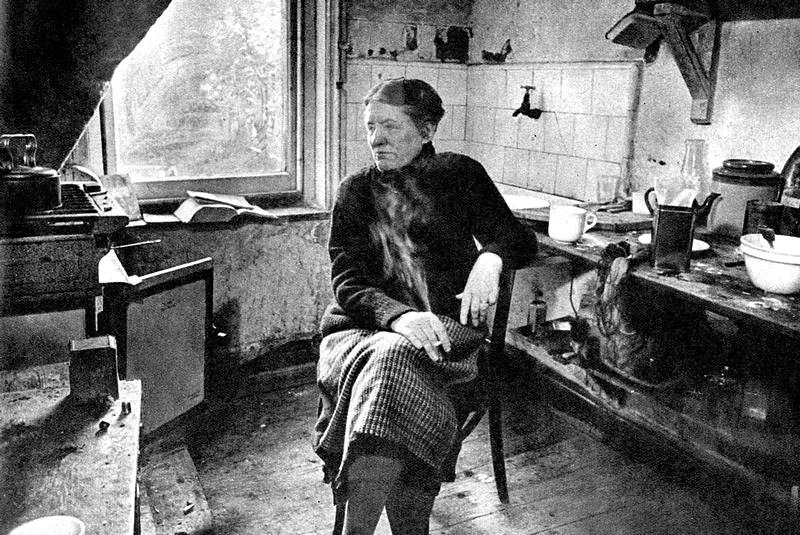
Anna Wickham in 1946. She made her living by turning her Hampstead home into a rooming house. Still asserting herself, she famously took umbrage with someone declaring: “You’d better retract, my good man. I may be a minor poet, but I’m a major woman.”

.

There’s a good chance my appreciation of her work will increase, but I also didn’t get a sense of compelling word-music on first reading, and that’s a quality that can attract me to a poem even before I understand it – which makes the first poem of hers that I’ll present today a bit of an anomaly. “The Cherry Blossom Wand” is  musical, and she even put a notation beside its title on the published page “To be sung.” I have no knowledge if she wrote music for it, or sang it,**** but that sort of thing is taunting the Parlando Project!

I see the poem as being a multifaceted account of beauty or love of beauty (and if we extend that, to love itself). The poem starts with its refrain stanza, telling us a branch of cherry blossoms is a “wand” that can do some kind of merciless bewitching magic. I like the refrain’s final line “a beautiful thing that can never grow wise.” Ambiguously: either we never wise up to the thrall of beauty, or that experience, time and wising up removes the beauty.

Blossoms are of course famously temporary, as the first non-refrained verse reminds us. On the page, Wickham only puts the refrain first and last, but since songs favor repetition, I put an extra refrain between the two verses.

The final verse before the ending refrain contrasts the merciless enchantment of the blossom wand with the “kind” removal of the bewitching beauty, and the verse then ends with its own internal refrain saying that the transience of beauty and time is eternal. There’s no change that can change that change, and the mercy is that we are not taunted long with its brevity.

As a whole then: bittersweet.

Cherry Blossom Wand

Chord sheet for the song I took as commanded by Wickham’s note on the page

.

Musically I got to play my nylon string guitar for the first time in a while. Every time I play that variety of guitar, I’m reminded of the cheap J C Penny nylon string guitar that I bought off the after-Christmas sale table in late 1974 to begin to learn how to play. Classical guitar players may be appalled, but I currently play my nylon string with a pick, which is wrong – but it’s how Willie Nelson does it.

You can hear my performance of Anna Wickham’s “The Cherry Blossom Wand”  with the audio player gadget below. Has some merciless hand removed any such player?  This highlighted link will bud a new tab with its own audio player then.

.

*Some accounts say Anna Wickham is more read and studied in the U.S., which would be the reverse of some poets I present here, most notably Welsh poet Edward Thomas who has some best-loved poems in Britain, and is hardly known in America. Influential 20th century American anthologist Louis Untermeyer thought enough of Wickham’s work to praise and include it. The Feminist-Modernist angle probably occasioned some interest too, and you can read her as a predecessor to Sylvia Plath in some of Wickham’s themes. Before she had a career as a best-selling novelist, American poet Erica Jong wrote a couple of poems dedicated in part to Wickham: this one, and this one.

**Wickham was eccentric. The linked article that sparked my interest has accounts that make that eccentricity seem charming, but depression seems to have figured in her life too. The complexities of our mental wiring and biochemicals mixed in with the stress of her life makes remote historical diagnosis chancy of course. The close publication of the two books of poetry that I read as a combined collection coincided with her husband going off to WWI, giving her some increased autonomy. Give a moment to imagine Edwin Starr singing a revised song: “War!! Uhh! What is it good for? Giving Anna Wickham a chance to see her poetry in print. Good God! Say it again!”

***The account of her reading one of her poems in public and presenting it with ““Rubbish, but there it is”” indicates this approach.

****After a childhood family sojourn to Australia, Wickham returned to England to take study in performing arts, particularly a singing career, though that doesn’t mean she composed music. The Cherry Blossom Wand”  has been set to music as Art Song before, at least this once 25 years ago.

She mentioned abandoning any search for musicality in her poetry in one of the poems I recall reading this month. This could be part of Modernist distain for frippery, or a practical act of triage for a poet without enough time. She’s a contrast to her American contemporaries Sara Teasdale, Elinor Wylie and Edna St. Vincent Millay who wrote very musical verse even as they wrote about Modernist concerns.

Meru

Poet William Butler Yeats had interests and a life that spanned times and poetic styles. His earliest poems whole-heartedly exhibit 19th century romanticism and prosody, but like the English Pre-Raphaelites he sought to vividly revive elements of the deeper past while doing so. His interests beyond poetry ranged as well. Last time I performed Yeats, I mentioned he had deep interests in esoteric magic, and yet the same man had a firm grounding in civic poetry while supporting an Irish cultural revival and independence from England. A poet with an already established style, he crossed paths with the American and British Modernists early in their revolution, and his later poetry shows that rather than getting his back up about their changes, he adapted some of their make-it-new approaches. Yeats employed influential American Modernist critic Ezra Pound during Modernism’s rise, and while he dipped his toes into fascist movements,* unlike Pound he seems to have drawn back from that.

Today’s piece, “Meru,”  is a late poem in Yeats’ career. I find it balancing the worldly and spiritual, and on no more authority than my own necessary to come to grips to perform it, I see it as commenting on the rise of rapacious authoritarians contemporary with its composition in the 1930s.**   Here’s a link to the poem as Yeats published it.

“Meru”  is a sonnet, a rather regular one structurally. Though the word we use for this lyric poetry form literally means “little song,” many sonnets are hard for me to perform with music. Their length is good, and lyric poetry in this context means that they focus on a compressed scope of time and experience — but the form rarely uses refrains, a powerful, almost indispensable, tactic for song attractiveness. Seeking a good musical structure, I divided Yeats one-stanza poem into four verses, with refrains after verses two and four.

Meru

The song form I reformed Yeats’ sonnet into. Note the chords shown are what I fretted on guitar, but I used a capo on fret 3, so the piano, bass, and the song song sound in Eb.

.

What do I think, as I chose to perform this, the poem conveys?

I like Yeats opening here, with its circular word-choice of “hooped,” for describing civilization’s shared beliefs. I’m unaware that this is any kind of established British Isles idiom, and the choice of this scene-setting word seems to invoke something like a key-ring or perhaps a wooden barrel or cask — and in the last image, that’s a construction that can fall apart. The opening statement continues to say civilization’s order is only an illusion, but the first three lines end by reminding us that such creations of the human mind are none-the-less great movers of reality and life. I’ll come back to that at the end today.

The second, four-line, group is remarkable in its ferocity, and I think it’s a description of mankind’s often perverse desire to gather more power, more wealth, and perhaps something they vaingloriously ascribe as rough justice while doing so. The ending line of this section serves as my first refrain: “The desolation of reality” that results from this.

Third segment, as I read it, brings in a distinct element of Yeats’ occult beliefs, starting by reminding us that the “desolation of reality” is a repeating motif of history and the fall of empires. But what’s with the two mountains introduced? Everest is Earth’s highest mountain, but it’s remoteness and location in Tibet links it with a late 19th century form of occultism: Theosophy. Theosophy is too large a subject to go into here,*** but its founder posited that certain Ascended Masters located in Tibet held onto ancient secret wisdom becoming super-human in the process. Mount Meru is more obscure to most readers I suspect: it’s a symbolic mountain, and like other symbols such as Mount Ararat, the Garden of Eden, or the entrance to the underworld, it is not an actual fixed map point, but is often referred to as being in some part of the Himalayan region. Some read the poem’s plural hermits as two hermits, one-per-mountain, and Theosophy holds to two current Ascended Masters.

I suspect these Theosophical details were in Yeats’ mind as he wrote his poem, but I don’t know if he ever wrote about the genesis of this sonnet. And luckily for most readers (and listeners today) you don’t need to know any of that. After a description of desolation of nations, I think the image of two or more hermits, ascetics living naked in snow and ice shelters in famously remote places stands as an image of the other-worldly mystic surviving with nothing but belief and the knowledge that the world’s disasters are part of some reoccurring process driven by human greed for power and wealth. Is this removed survival our fall-back in today’s world of raging authoritarians, blinded in their ravening?

And once more, I suspect the aged Yeats was thinking of his own age, of the rising of fascist authoritarians then, not just specifics of Theosophy — as a poet, one uses the images in one’s cupboard. This aged singer certainly thinks of those men and the desolation they cause as I sing Yeats poem this month. The poem ends — and I refrain on this — with a twist on the old saw: “it’s always darkest before the dawn.” Chillingly, naked in the snow, Yeats has as his dawn consolations that all tyrants (and alas, all mankind’s) glory and monuments are gone.****

Is this fate? Is this prophecy? Is this inevitable? I’m no Ascended Master — if you are, you tell me. I’m just a composer drafted by words and asked to sing them. But I promised I’d come back to the “manifold illusion” of peace, of some sustainable rule without unleashed tyranny. “Man’s life is thought” the poem said. A diverted American poet turned President once spoke of a conception, a particular manifold illusion, imagined on: “Liberty, and dedicated to the proposition that all men are created equal.” If enough believe, the mage’s trick works. I’d rather it be a kind trick.

You can hear my musical performance of Yeats’ “Meru”  with the audio player gadget below. Has the audio player become subject to the desolation of reality? No, just some ways of reading this blog suppress it. This highlighted link will conjure up a new tab with it’s own audio player so you can hear it.

.

*I’m not a Yeats scholar, and there are surely many who know more about the man and these political matters. While disappointing, I was not surprised to see he found some connections in fascistic groups, as trappings of cultural nationalism and nostalgia for some mythic past were widespread then, just as they remain in the fascistic nationalists now crowding under the aged wings of my country’s self-fancied mad king.

**Because of the later date of publication, this poem may not be in the Public Domain in the US, and this entirely non-commercial project almost always uses work in that class out of respect for author’s rights. I’m making an exception here out of a renewed commitment to civic poetry in the current world.

***Here’s more info on Theosophy if you want to wade in deeper. Having had some interest in esoteric beliefs as a young person, I carried some knowledge of it as I encountered this poem. As the Wiki article points out, Theosophy continues to influence various “New Age” ideas, but I’m not a believer.

****Some readers of the poem hold the “His” in the last line to be a godhead. I’m not sure why that would be. Could it be the then traditional capitol letter at the beginning of the poetic line leads to that reading? Or is it some element of Theosophical mythology? There’s another, non-cap, “his” in the poem, and I read that pronoun, along with its partner, to refer to elements of mankind.

Sitting on Top of the World: three songs and one poem lead to a new song

I woke up to economic tumult around the world this morning after finishing a mix of this song I made from a poem by Carl Sandburg last night. I’d gone back and forth on mixing this simple piece of music. At one point I thought it needed piano. I tried an arpeggiated part. Hmmm….no. I tried a coda with underlying low-register sustained intervals. Nope too. So, no piano. I was going to post the remainder yesterday when I began to wonder if the bass line was mixed too high. I told myself I’d reconsider in the morning and went to sleep.

Awaking, I found the news of international economic fears overlaying the world of our current sustained carelessness and cruelties. Well, I thought, maybe it’s not all that important how perfectly the song is recorded or mixed. It’s time to get this little bit of Carl Sandburg out to our modern world for National Poetry Month.

This Project spends a lot of time in the previous decade to be called The Twenties, a time when all the arts and poetry had to deal with a changing culture that ended with a great falling of commerce. For much of the decade it was written up as a time of fashionable Modernism, easily pilloried as a faddish, brainless rush. The label “The Jazz Age” wasn’t meant as cultured praise. Even Afro-American intellectuals were worried that Jazz was just some fast-tempo frivolity, a soundtrack for licentiousness. Luckily for us, some Black composers and songwriters kept on making their form of Modernism.

From our time, we know the plot arc of that last Twenties. A great worldwide depression began in 1929. Fascism rose in multiple countries. Poets may have started the decade engaged with new, freer verse modes, but by The Thirties they’d be charged with dealing with the IRL world of racial-nationalist authoritarians, widespread economic hardship, and war.

I believe it’s easy to forget what an early and fervent Modernist Carl Sandburg was. He was close to his brother-in-law Edward Steichen, who was thoroughly engaged in the international visual arts Modernist revolution. His poetry helped popularize English language free-verse. His collections were peppered with clean, concise poems as Imagist as any written within that vanguard. It appears to me that he may have written Jazz/Blues literary poetry even before Langston Hughes.* Like some others in his American Modernist cohort, Sandburg had early ties to political economics of a leftist kind. How would he traverse this change in the artistic climate?

He was going to go folksy.

Much of his energy would turn from poetry to a giant biography of Lincoln, who he’d portray as a canny folklore-sage. He would publish a popular landmark book of collected folk songs. He brought his guitar to poetry readings. A Robert Frost may have made much of his farmer neighbors, but his blank-verse eclogues were orchestrated with a more academic formality.**

Sandburg’s long-form poem “Good Morning America”  is a case in point. It’s a civic poem, a stock-taking set of observations of the United States, peppered with folk-wisdom admonishments uttered in Sandburg’s version of contemporary vernacular. I picked out this section of it to use here because I noticed it riffs on a phrase also used in a remarkably durable American folk song: “Sitting on top of the world.”

As a lyric refrain that phrase appears in a song by The Mississippi Sheiks, an Afro-American jug band. As members of the continuum of the folk-process (i.e., appropriating and reusing any good stuff they could grab) these non-Arabian Sheiks stole a harmonic cadence from Tampa Red, who had used it in another oft-covered Blues song: “It Hurts Me Too.”  “Sitting on Top of the World”  quickly integrated itself into American folk music. It became a country and Bluegrass standard, but it could also be done with the force of a Howlin’ Wolf or by a classic British rock power trio like Cream.

It would be a neat package for me to say that Sandburg heard the Mississippi Sheiks and shaped this poem from their music, but the timeline doesn’t work out, though it gives me more connections to mention. Sandburg published “Good Morning America”  in 1928. The Sheiks record of their song was released in 1930. Sheik Walter Vinson says he came up with it while playing a white dance. He and that audience might’ve been familiar with a 1926 hit song sung by Al Jolson which used the same phrase. The Jolson “I’m Sitting on Top of the World”  is a friendly ragtime ditty about a man who cites his tenuous status in the economic prosperity around him as beside the point because he’s about to marry his sweetheart. Vinson on that dancefloor stage is going to fuse Tampa Red’s riff from a song about a singer who confesses empathically that his sweetheart’s troubles trouble him, because “when things go wrong…it hurts me too” with some new lyrics.

We don’t know what lyrics Vinson sang on that first performance. As the song proceeded over the years, new verses were plugged in by various singers, but the Sheiks’ recording we can hear starts off with both economic and romantic losses. Objectively, the singer isn’t presenting a happy life, but still he refrains he has “no worries…because I’m sitting on top of the world.” This is an ambivalent statement. Is it a mantra of positive thinking in the face of misfortune? A call to party on the dance-floor even if the rest of life is hard times? An easily seen-through statement of questionable bravado? Is it even possibly sarcasm, an answer-record dis of the happy sap in Jolson’s song?

Two Songs Sitting on Top of the World

You can hear Jolson sing his version here, and the Mississippi Sheiks’ version here. (click the picture to enlarge)

.

In between Jolson’s Roaring Twenties white song using that title and Vinson’s post-Black-Friday Black version, Sandburg wrote his poem, closer to Vinson’s version that would follow. Sandburg’s poem is about national wealth and hegemony, but it wants to say that that’s temporary. All it takes is one mad king blind to any contradiction. So, I sang this part of Sandburg’s poem this month, with music leaning more toward the Mississippi Sheiks. You can hear that version with the audio player below. What, has a circuit-breaker stopped trading in graphical audio players? No, some way of viewing this just won’t show it, so I offer this highlighted link that will open a new tab with its own audio player.

Frank Hudsons Sitting on  Top of the World

In adapting the 14th section of Sandburg’s long poem, I doubled the number of times “I’m sitting on top of the world” is refrained and re-lineated it from the page to fit the music.

.

The audio player for my version:

.

*As I read the two of them, Hughes and Sandburg, I often feel an American kinship in their voices.

**The Southern Fugitives took another, if Copperhead, path on Modernist poetry tied to an agrarian tradition in the era between the World Wars. Sandburg would leave the urban center of Chicago, first to Michigan and then to rural North Carolina and a working goat farm in the between Wars era — but he never fell into the reductionism that the “real Americans” are Anglo-Saxon-stock farmers.

If Frost didn’t haul a guitar around like Sandburg, Edwin Ford Piper recounts that between-Wars Frost was willing to offer his own renditions of folk songs at informal poet’s after-party hootenannies.

Segregated Neighborhoods in Time, Part Three

We left off last time in my Black History Month series this year, with a crumbling scrapbook filled with mid-20th century things someone had gathered. The scrapbook compiler was concerned with entertainment, particularly Afro-American’s in that role, and the largest number of items they’d pasted in focused on a somewhat obscure musical act: The Cats and the Fiddle. Was the compiler a fan or a musician themselves? Woah, we get ahead of ourselves. Let’s stay with the musical evidence we have for a little while longer.

Once I get out of bed in the morning, I grab a newspaper from somewhere in the vicinity of my front door and read it. This is antiquated behavior. I often linger in bed before or after sleeping reading near-instant news on a large tablet connected to the Internet before I later get to the morning paper’s headlines that were written yesterday, yet still I take comfort or distress from reading them printed on paper. This is memory/habit working. I’ve read a newspaper in the morning since shortly after I learned to read. I even delivered them door to door as a youth in my little Iowa town, a place where and when the newspaper might be the only way you’d find out about some things in any detail.

Though I compose music and operate various musical instruments constantly as part of this Project, I’m somewhat removed from the general life of a musician today though I read accounts, I observe. But all of us listen to music, experience it some way. I know of no culture anywhere that for any appreciable span of time has been without music.

In the 1940s and ‘50s world the scrapbook photos, magazine clippings, and ephemera collected would have overlapped my childhood, would have been my parent’s adulthood. I experienced music some from records, some from television or movies, and largely from radio.*  Music face to face? Church music once a week, and the school’s student marching brass band a few times a year. I enjoyed rock’n’roll cover bands just twice, at the Junior and Senior proms in my high school. Concerts? I once got to travel to the large auditorium at the state capitol to hear Handel’s Messiah  oratorio. But that’s a rural, small-town story within a family that had no special connection to music, played no instruments.

For other white folks in cities, and in other areas, music could have been more central, more direct. Step back a generation to my grandparents’ youth? Recordings, perhaps some, radio not yet broadcasting, movies silent. Non-commercially, there was the parlor and folk music of those whose neighbors or families played. Music at events meant musicians playing, making the entirety of the noise right there and then. Let me repeat: that era’s connection to music was almost entirely performer in the room or performance space — and so where you lived or traveled to impacted your music heavily, and overwhelmingly your connection to your music was as fully dimensional, occupying the same space at the same time with you.

Some who read this may be two full generations younger than me. Your connection to music will likely be more removed: streaming playlists, the soundtrack to video games, concerts that could be large TV screens over a distant stage of dancers and miming singers with microphones in their hands. Or it could be a sweaty basement or a club with a small stage at one side, or something you try to record on the ubiquitous computers surrounding us, to hopefully exist elsewhere momentarily on phones, like a brief, wrong-number phone call that each connected party, embarrassed, occupies briefly, and leaves. You may think: I decide how I experience music, or how I make music! Yes, you do have choice, even if you may, out the other side of your mouth, decry that most all others are dictated by culture and capital. The in-between truth is that you, musician or listener, and the musical audience and musicians in general, are still living inside a present culture that changes things. The older ones living now still remember past cultural contexts, a diversity of time.

Because Afro-American representation lagged in mainstream American culture, representation of their music in mass media was filtered out, shown behind a screen for much of America. A Black American circa 1930-1960 is going to make and experience music because of their contemporary cultural particulars, their landscape in time. How long this post would be for me to try to even outline or list those things I think I have a smidgen of understanding of: the divide of parochial cultural ignorance from non-Black folks can fill volumes, Black History Month a pitcher of a lakeful. Demeaning white superiority, colonial European cultural hierarchies, and minstrel show comic-fool stereotypes are the proscenium for Afro-American performers. Sometimes violence lurks at the meeting edges. A well-meaning paragraph in a blog post staggers to carry that weight.

So then, if a Black American was going to use music to relax, or as a balm against the absurdities of your life and times, how much easier is it going to be to find that in Black entertainers, in Black saturated places among fellow Black audience members. But also consider: your experience of music is going to be that fully-dimensional one most often. In the room. In the same time. You can smell the music, which you can’t on Spotify.

Think back to that short movie clip from the previous post in this series,“The Harlem Yodel.”   The Cats and the Fiddle and the Dandridge Sisters are dressed up for the Alps in the roomful of mirrors that we’re to know to be an indoor ski meet. It’s 1938. I notice as the Cats enter our frame at one minute into the video clip, they drop a short series of sour, single string plucks. Is that a musical Dada expression saying: we know this is ridiculous, but we’re getting to be in the MGM movies, even if it’s a B minus, undercard short-subject? One of the producers of the short, Jack Chertok, would work on more than 30 shorts in 1938. By the early 60s he’d be the producer of My Favorite Martian,  a half-hour TV sitcom about an undocumented extraterrestrial alien living incognito on a grey-scale Earth — not exactly Ralph Ellison, but some of the strangeness is intentional. In the movie, the audience is white.

Snow Gets In Your Eyes cast picture

White folks on the right: “What, we can’t even have segregation at an indoor ski jump competition?”

.

In the second music clip, “Killin’ Jive,”  the audience is black in the film and in the producer’s movie-house intent. It’s from one of a series of Westerns made for Black audiences, and the picture’s star (unseen in the clip) is the “Sensational Singing Cowboy” who was variously billed as Herb or Herbert Jeffries or Jeffrey. Wikipedia decided on Herb Jeffries, but I don’t know if the last name varied for carelessness or branding tweaks. His Wikipedia article goes on to write about the unsettled ethnic background of the man born Umberto Valentino, but he was clearly marketed at the time as an Afro-American. The band’s performance there is intense and uninhibited — can’t-top-this showmanship. This clip, and publicity photos, would mean that the Cats would need to do this live on club stages at some point in their sets. This song (like many in the Cat’s recorded repertoire) is by a member of the band, and “Killin’ Jive”  is, full of insider Jazz/Black slang. Here’s a link to the lyrics.

Clearly, it’s a song about marijuana intoxication, and it’s performed in a let’s-get-high-and-party manner. The lyrics, which as I said are written by one of the group’s founders, Austin Powell, can be read as adding an undercurrent to that performance. A line is refrained in the song “He’s a sad man, not a bad man,” and I expect “bad man” in Thirties Jazz argot could carry the same “formidable and unrestrained” (in this case, when high) Afro-American slang meaning as well as the mainstream cultural meaning of he’s not evil, he’s just depressed. There are lines too about “darkest days” and “got no rent” (not transcribed correctly in the link) If this were a Brecht and Wiell song from say The Rise and Fall of the City of Mahagonny,  we’d read these lines and expect Modernist irony. What do I expect? That Powell had a brain and a viewpoint and meant what he wrote.

CORRECTION: The “Killin Jive” song was actually performed in another Black-audience-targeting picture called The Duke is Tops.  They did appear in Two Gun Man from Harlem  too, I just trusted my memory more than double-checking my notes,

Two-Gun_Man_from_Harlem_FilmPoster

“All Star Negro Cast” in the film from which “Killin’ Jive” appears

.

In real life and not in front of Hollywood backlot cameras? I can’t say for sure what kind of places the Cats and the Fiddle played in, but as working musicians the places they performed in would surely be physical contexts in a segregated society. Los Angeles had its own Black musical scene and audience around the Central Avenue neighborhood, and they could have played there. In a following post in the series we’ll get into what I can figure out regarding their musical career and travels from supposition, elements in the scrapbook, and some new information I was able to gather this month. More to come here soon in this series.

For a musical note, here’s a Langston Hughes poem remembering time on the other side of the tracks. There should be an audio player gadget below, but if it’s been red-lined out for you, this highlighted link will open a new tab with its own audio player.

.

*Radio was more-or-less the streaming of my era, but it had the extra dimensions that you knew that others were listening to the same music you were listening to at the same time. When “your record,” the one you made, or simply the one you cared about as a listener, was played on the radio, you may have been alone in your room or your car, but you knew also you were one of some many in a simultaneous nexus. Music on television or in the movie house was most often a generation behind. I’m nowhere near a Jazz musician in skills, but I owe it to TV and movies of my youth that when I hear a Jazz take on a “Standard” I usually know the tune.

Black History Month 2025: There is a house…

In the past few years I’ve enjoyed focusing here on Afro-American poets during the month of February. Last year, I dug in and did a bit more research on an understudied but fascinating Chicago poet Fenton Johnson, whose published work sits between the emergence and premature death of Paul Lawrence Dunbar and the Harlem Renaissance. Johnson became easily identifiable as a Modernist before his access to extant publications dried up in the 1920s, and I suggested last year that his poetry allows us to see —albeit silently on a page until I did some musical settings — into the formative years of Afro-American Gospel and Blues music before it made it onto recordings.

Here’s something I formulated for myself early in this Project as I found myself often looking at the rise of Modernism in the 20th century: a part of why Americans became highly significant innovators in Modernism has to do with Afro-Americans. Literary-only scholars might not focus on this inside their silo, but at the same time Pound, Eliot, Frost, Moore, Stevens, Millay, Williams, H.D., Sandburg, et al were reforming poetry, Afro-Americans were spearheading a revamped approach to music. Black poets like Johnson and Langston Hughes were hip to how those two things should be viewed together from the start, and after all, Modernism took root during the last decade called The Twenties under the banner of “The Jazz Age.”

That 2024 series on Fenton Johnson let me further express the musical part of the Parlando Project: “Where Music and Words Meet” — and it should also be obvious by now to regular readers that history is one of my interests. So, this February, like the Fenton Johnson series of last year, I’m going to get into the deep weeds a bit this on some lesser-known stuff.

I’m unable to schedule the Parlando Project work in a fully professional manner, so it’s likely you, if you follow along this month, will be going on a journey with me as I look into elements in real time. I may be revising myself before the finish, and if that gets awkward, let me say at the start that this isn’t some plotted-out documentary, I don’t know what all I’ll find. It’s likely going to be very first-drafty, so put on your reading sweater.

If this was an audio presentation, at this point there’d be one of those audio fades with reverb to suggest a passage of time now. From out of the echo my voice will be saying: “It all started in 1976 when I moved to Minnesota from New York…”

I was looking for a new start. It wasn’t entirely clear if I was going to continue intermittent attendance at college, which was both logistically and financially limited to me at the time. One advantage I had: doing nursing work in an Emergency Department was an easily transferable skill, I could go most anywhere that had a hospital, and maybe it would be good if where I moved also had a college. I settled on Minneapolis because I knew a couple living there from my Iowa college experience in The Sixties. One of that couple, Dave Moore has remained a friend (and contributor to the Parlando Project). Dave and his then wife had plotted out a plan for themselves. They were going to run a small mail-order used book business and needed a place to collect stock, store it, and run that business. They purchased (for an attractive low price) a large old house on Park Avenue in Minneapolis. Park Avenue was, in the last Gilded Age, a place where newly rich Minneapolitans built their mansions along a wide tree-lined street leading into the business center downtown. Now in 1976, this couple I knew were going in big on the sweat equity thing, rehabbing that house. The place, 3132 Park Avenue South, was built as a sort of a Junior-Grade Mansion. The 3rd floor, where the original owners had servant’s quarters would hold their stock of books which Dave was obtaining from aging bookstores that were beginning to close down or dump old stock. The other two floors would be their living space and nursery for the child they were planning to have. I could help a bit with the enterprise and rehab, and stay with them for a while.

It was a grand adventure. I had no builders skills, but mainly helped with the stripping of paint off the old woodwork and general lifting and toting. Work was already more than half done when I arrived. Dave told me that around mid-century the house had been turned into a set of small rentable spaces part-way between a rooming house and a set of apartments. Most of those changes had been removed already, and the book business part of things was more at my interests. For that, I’d go with Dave on trips to the basements of sole-proprietor bookstores, some closed, closing, or soon to close, to clean out old stock in their basements or back rooms. There was so much stuff from the 50s and the early 60s — before, you know, The Sixties.  From ruined books I collected a small batch of lurid pulpy covers on these expeditions. The packrat in me wished I’d grabbed more.

Pulp Joyce cover

It’s James Joyce’s birthday today. This cover from those ‘70s bookstore hauls was stuck up in my studio space for years. There’s no music directly for this essay today, but here a Joyce poem conveyed in the early years of this Project.

.

This house on Park Avenue is just a location for the drama, a set for one of the acts I want to present haphazardly this month. The whole play is not extant. It exists only in fragments, a bad quattro. How do we raise the curtain?

Dave knew I had an interest in old Blues music, and somewhere in an interval after I was staying at 3132 Park Avenue and maybe as late as when I moved into the rented part of a duplex next door a few years later, he gave me a tattered scrapbook found when they were cleaning out those rooming house remnants. I’ve learned a lot since that scrapbook came into my possession. Let’s take a look inside as this series continues.

Sandburg’s Couples

Time for me to get back on my Carl Sandburg soapbox. I’ll be brief — as today’s poem, now song, is as well. My point (again) is I think there’s more there in his poetry than is currently remembered or considered. Your impressions may be from two stalwarts of American poetry anthologies: the Whitmanesque “Chicago”  with those big shoulders and the quite contrasting short metaphoric poem “Fog”  with its cat’s feet. Not a lot for a poet who wrote so much, so early in the Modernist era, but it does point out a range of expression.

I’ve performed segments of Sandburg’s prolix mode here. I like Whitman well enough. Within limits, I like Sandburg doing Whitman’s mode too. He’s not quite the opera singer that Whitman aspires to be, he’s more of the folk-ballad, song-suite, kind of poet. America’s a big country, so I guess we need big, shouting, poems — and even if that’s not my favorite mode, either poet can move me as they traverse long distances with galloping catalogs and litanies. My point today is that this Sandburg, being bigger, overshadows another Sandburg, one that I particularly treasure, the one that reminds me more of Du Fu than Whitman: the forgotten, pioneering, ground-level reporting, American Imagist, Sandburg. Sandburg’s poems in the compressed style are not accidents, seeds of long poems that didn’t germinate, or little palate cleansers between his important work. His earliest collections are packed with sub-sonnet-length pieces.

On awaking this morning, I was thinking of a set of poems by a couple of the earliest American Modernists, Ezra Pound and Sandburg, where they each showed gratitude for their American forbearers. I paired their poems as one musical piece early in this Project, and here’s a link to that.  Pound, within his characteristic grumpy mode in “A Pact,”  makes peace with Whitman — and while casting a little shade on Walt for being the son of a house-carpenter, he claims his own finely crafted woodcarving is descended from the cross-cut and rip saw of Whitman.

Who does Sandburg say are his native 19th century inspirations? Whitman? Nope. Maybe Longfellow, with his civic-minded striving for uplift and justice? No. Who’s left? Poe? Hmm. Interesting thought, even if Poe is awfully rhymey for a free-verse poet. The other Fireside poets? Well, yes, Sandburg wanted a wide audience, but as the child of an immigrant couple and attendee of a non-descript Midwest school, he lacked their pedigree.

Sandburg in his “Letters to Dead Imagists”  is declaring his allegiance to that spear-point of English-language Modernism, but here he claims a couple of Americans as his predecessors: Emily Dickinson and Stephen Crane.

The poet he names first, Dickinson, will likely seem a more conventional choice to those reading this today than it was when Sandburg wrote his poem in the early 20th century. Dickinson’s eventual rise to genius status would still be early in its slope — she was more known then as an eccentric than as a model for poetic expression. The second, Stephen Crane, is more associated with prose, but he wrote a singular collection of gnomic, short free verse poems, The Black Riders,  in 1895. An inspiration for Crane’s unusual work: the new, first publication of the poetry of Emily Dickinson in 1890.

Sandburg was among the first to try to form a 20th century style combining the “mother and father” of American poetry: Dickinson and Whitman. And I happen to like it when he takes after dear old mom.

Today’s piece, Sandburg’s “Couples”  sounds a little like Crane, a little like Dickinson, and it has a characteristic early Imagist trope of close-focus specifics and vivid color by name. Here’s a link to the text of it.  If one thinks of Sandburg as being a clear-speaking poet, this poem should disabuse you that he’s always about some obvious point. Part of the delay in publishing my version of his poem is that I’m still not sure what he’s describing. There’s parallelism set up between six “women” dressed in green and six “men.” They’re described as dancing, likely haphazardly as the infamously strong liquor absinthe* is mentioned, they make a hissing laughter sound. They are somehow cheating or gaming each other. There’s a worn path of hard packed dirt said to be from the dancing feet. The poem closes with dewy weeds said to be as high as six little crosses, one for each couple.

I’m stumped. A graveyard? Then maybe the dancers are ghosts. But if so, why the specific detail of the dirt floor packed down if it’s a weedy, less-than-well-tended graveyard? A barn-dance? The weeds are described as “mourning veils.” Or are the six live couples dancing around six graves? Why, who are they to the buried, if it’s that? Perhaps instead, the dancers are green plants of some kind, their dance uncoordinated as random winds, and the wind through them is the hissing laughter, and they’re maybe even the weeds the poem closes with. Did Sandburg just choose their number to be six out of desire to be specific? But again, he spends two lines of a short poem on the packed down dirt floor under the “dancers,” and plants dancing in the wind wouldn’t compress the earth.

In summary: as obscure as any of Crane’s Black Riders  poems — but specific, like a closely-observed Emily Dickinson riddle poem. If Sandburg intended mystery, he achieved a stubborn dose of it in this poem of his, and the incantatory power of its spikey, inexplicable details may still carry us through. While it’s unlikely Sandburg’s model, if one was to translate this into French and say it was from Rimbaud’s “Drunken Boat”  how would we experience it?

Carl Sandburg with guitar at mic

Glad to be at the open mic. I’m going to do “Wagon Wheel” and this Oasis song “Wonderwall” now.

.

If forced to a final guess: they are  graves, and the dancers are the living as continuing life-force, not dancing on the graves as revenge, but out of the joy of continuance, and the packed dirt is the mark of our ongoing life-work and dance. The cheating? The unfaithfulness and trifling of love and desire, or they are cheating death by living and loving. The couples of the title then are not only the paired male and female dancers engendering a new generation, but the connection between the living and the dead. Why six? I don’t know.**

I performed this with just acoustic guitar, Carl Sandburg’s own instrument of choice. When assessing his guitaristic skills, Carl would sometime say he was at least one prison sentence from getting any good. You can hear my misdemeanor playing with the audio player gadget you should see below. No gadget? It was pardoned, or impounded, or deported, or took a buyout, or something. No one seems to know, because some vain fool runs things, and there’s not enough conscientious people left to make knowledge from foolishness. But I do give you this highlighted link that’ll open a new tab with its own audio player.

.

*Absinthe is colored green, doubling down on the use of that color in the poem.

**Rejected guesses why six couples and six crosses: six is sometimes used as the number of cardinal directions, sometimes shown as a six-armed cross, but Sandburg seems to be clearly saying six separate crosses. The Oklahoma state flag shows a First Nations (Ossage) shield with six separate crosses on it (the cross is a common indigenous American symbol) — but that flag was adopted a decade after the poem, and I can’t find any source of previous use of that distinct six crosses symbolism that the flag drew on.

Songs to Johannes 9 & 10

Sometimes we don’t know there are heroes in our world, for adventurers don’t always move and report themselves in the most well-seen spaces. I think of Mina Loy as I write that. Early in the 20th century this London-born young woman began an odyssey that carried her from the St. John’s Wood art school, to the Munich Künstlerinnenverein, to Paris and the left-bank Montparnasse, to the Florence of Mabel Dodge Luhan’s circle, and then into the center of the Italian Futurist movement.

And she was just getting started filling up her passport leaves. Up to this point she seemed mostly working in visual art, having started as a girl as an admirer of the Pre-Raphaelites and William Morris, but by her early 20s she was writing fierce Modernist poetry. She’d met Gertrude Stein while in Italy, and like the Pre-Raphaelites, the Futurists wrote as well as painting. After leaving Italy she moved to the extraordinarily vital 19-teens Modernist scene in New York City. If one was to survey those in the Western World’s avant-garde in their artistic hot spots in 1919, Mina Loy would likely be as prominent as any woman creator — but that’s one point in time, and far-flung doesn’t mean widely-known or lastingly famous.*  She was there at a lot of “theres,” a person on the scene when Modernism was being shaped, and then largely forgotten.

Loy had a complex love-life during this time, casting into alliances with several men. Involved for a time in a triangle with two Futurists principals, about which she wrote a series of poems that became her best-known/yet still under-known work, “Songs to Johannes.”  A version of it was first published in the landmark NYC based Modernist magazine Others**  in 1917, and subsequent editions of the poetic sequence were included in a couple of later book-bound collections of Loy’s work.

So, what’s the catch, why isn’t Loy as known as William Carlos Williams, T. S. Eliot, Carl Sandburg, Wallace Stevens, Ezra Pound, et al? Can we chalk it down to “The Patriarchy?” Yes, that’s a factor, but until recently Loy also didn’t have the footprint of Marianne Moore or Gertrude Stein — Modernist poets to whom she was compared to in her heyday.

Jane_Heap,_Mina_Loy,_and_Ezra_Pound

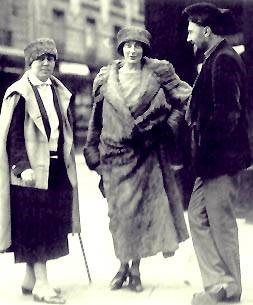
The Freewheelin’ Mina Loy standing next to Ezra Pound in Paris. The woman on the far left is Jane Heap who edited The Little Review in which Pound wrote of Loy’s Others published poems “In the verse of Marianne Moore I detect traces of emotion; in that of Mina Loy I detect no emotion whatsoever.”

.

Part of it may be a smallish corpus of work. Part of it may be due to her leaving active literary circles about 100 years ago, even though she lived until 1966. Key critic Pound thought her work however skilled was cold and without emotion.*** But more importantly, there’s this factor: her work, in particular “Songs to Johannes,”  scared people. Not just the un-hip general public (which never widely considered her, unlike Stein), but other Modernists. Harriet Monroe of the influential Poetry magazine thought Loy’s work unpublishable. The “Johannes”  poem sequence subject matter and her treatment of it was problematic.

Men for ages have been prone to “kiss and tell.”  Propriety might lead them to disguise the names of the paramours, even if insiders would know. Yet women arising from the prone to write about their experience might be on shakier ground. Edna St. Vincent Millay and Sara Teasdale were  able to do this in the 1920s with popularity and prizes, but their poems of female desire were written within conventional romantic poetic tonality. Loy? Not so much. “Songs to Johannes”  can be frankly carnal. If Modernism was to speak otherwise and often of direct treatment of the thing, of charged moments, of images depicted in all their dimensions, this wasn’t something that automatically extended to women talking about sexual relations within the fine art of poetry. Boys will be boys when they do it —  and the boys become prim fuddy-duddies when a woman adventurer writes from her perspective.

So all this. Decades passed with Loy largely forgotten.

Feminism and now the 21st century has re-opened the case of Mina Loy, and now she’s considered a rising subject for academic study and consideration. What’s my consideration? I’ve always figured if someone writes a literary poem and calls it “Song…” that the poem is challenging the Parlando Project to realize that element. I chose two short poems from the sequence to fit things to my schedule and preferences; and for instrumentation, I used an acoustic guitar challenged by some keyboard ghosts. You can hear my performance of the segments of “Songs to Johannes”   numbered IX and X with the audio player gadget below. What, has the audio player ghosted you? No, it’s just that some ways of viewing this post will suppress showing it. This highlighted link will open a new tab with its own audio player.

.

*I’d suppose H.D. would be in the running in such a mooted 1919 survey too.

Curiously, Mina Loy’s Wikipedia article mentions that the delightful and highly popular classic Hollywood actress Myrna Loy may have gotten her stage name from our poet/artist Loy. Wikipedia footnotes that claim with two books I haven’t read. Mina Loy did act on the NYC stage at least once, in a Provincetown Playhouse play where she co-starred with William Carlos Williams.

**As its name implies, Others  saw as its purpose to publish outsider Modernist work, and in its short life it was troubled as many such publications are by shaky revenue and artistic factionalism. Long-time readers might remember that three traditionalist poets contemporary with Loy pranked Others  by concocting the Spectra hoax and wheedling the magazine into a special issue dedicated to the made-up Spectra movement poets who wrote parodies that they thought might pass as real Modernist poems. One of their pseudonymic poets, Anne Knish, may have been an inside dig at Loy.

***Pound’s critical blurb where he’s pairing Loy with Marianne Moore seems a strange judgement to me, though the quote I’ve seen says he meant it as at least a mixed complement. Work like Loy’s “Songs to Johannes”  seems quite charged with feelings. Reading the whole thing in one sitting — even given its Modernist fragmentation of narrative and proto-Surrealist metaphoric freedom — can exhaust one, buffeted from the range of conflicting states of emotion being depicted. You can read one version of the entire “Songs to Johannes”  sequence here.

And in the woman-poet’s “you can’t win” department: in the post-Eliot world of High-Modernism some of Loy’s female contemporaries like Teasdale and Millay were down-rated for writing extensively about love, desire, and romance as subjects to be examined in their poetry, rather than the big-boy themes of culture and philosophy.

When the Year Grows Old

Here in Minnesota, the weather is turning, as it does at a time of its choosing in the Fall. Tomorrow morning the Fahrenheit temperature will be in the teens when I get up, and the forecast says single digits will greet me by Friday.

I began work on setting this poem by Edna St. Vincent Millay last week after seeing it at the Byron’s Muse blog. Two things grabbed me when I saw it: sitting there as silent words it begs to be sung, and it’s tantalizingly ambiguous.

This poem was from Millay’s first collection, published (1917) as Modernism was starting to find an audience in America. Americans in the last decade to be called The Twenties saw Millay as a Modern, though her prosody wasn’t like the free-versifiers, and her lyric’s narratives weren’t fragmented word-Cubism. So, a more comfortable Modernist to those whose expectations of poetry still flowed from the 19th century? Somewhat. Still, though not so much in her first book, but soon, Millay began to stand for The New Woman, a character that took up the prerogatives of independent thought, act, and agency in love and desire. A William Carlos Williams might have absorbed radical Modernist visions in Modern Art into prosody. A Carl Sandburg may have taken his Imagist eye and cast it toward workers and immigrants in his poems. But soon after this poem, Millay was using somewhat traditional verse to speak about female independence in life and desire. Cubism and Socialism were controversial, sure, but the kind of change Millay was covering in her poems was large in scope. Man Ray or Monet, Debs or Debussy, Pound or Reverdy — change was in the air — but as far as art such as poetry was concerned, the charge for change from women (and Afro-American artists) in the Last Twenties is a big deal, not something to shelve off as some sideline.

OK, so what does this early poem have to do with that? I’m not entirely certain. Yes, the overall scene of the poem is clear to any Northerner — but even as the poem starts the seemingly simple language has faceted surfaces. The poem is titled “When the Year Grows Old,”  but I’d suspect you might mistakenly remember it as “When the Year Grows Cold.”  It’s not just the rhyme, the poem is clearly about the weather getting colder, all the images intensify that. Intensities of anything old are not there directly at all. And then, I can’t say how idiomatic the opening statement (refrained at the end,) “I cannot but remember,” would be in 1917 — but it’s easy to read it (out loud, or in understanding) more than one way: “I will reflexively remember,” “I have only memory of this,” or even “I can’t do this, but I am forced to remember.”

And who’s the “she” in this poem? I had a thought in early-days with the poem it might be a pet, likely a housecat. Beside a generalized factor of love for warmth, cat owners might recognize the bird watching vocalizations — that, and a reference to “the warmth of fur” led me to that consideration. One reader’s reaction I read online this week thought “she” was a mother. I’m not sure of Millay’s mother’s (if that would be the mother here) characteristic feelings for tending a fire or even the specific kitchen task of making tea. My cursory non-scholarly thoughts are: not likely her happy place.*  Still, I could imagine that a general poetry reader in 1917 (like the Internet contemporary I came upon this week) could think that, or that the “she” is a friend of the poem’s speaker (which we might expect to be Millay), and so find this poem Millay’s predecessor to something like the young old Bob Dylan writing “Bob Dylan’s Dream”  about his remembering lost friends who’d once gather around a wood stove.

When the Year Grows Old

Simple chords for today’s piece, presented here as chord sheet  in case you’d like to sing it too.

.

Living with this poem as I set it to music and performed it, I came to think of it more at “Girl from the North Country” — a song about a lover who is longingly thought of lovingly, but who is now separated. By the time of the performance that you can hear below, that was how I was singing it. Why did I think that?

Partly from reading later Millay poetry, partly in biographic clues of Millay’s sexuality. There’s a definite undercurrent in the poem of the “she” feeling ambivalent: the sighing look at the flying birds, the melancholy chimney wind, and most directly in the abrupt “look of a scared thing/sitting in a net!” And what follows that line feels lustily sensual to me: those rubbing “bare boughs,” that fur by the fire verse.

That reading also answers the why the year being “old” is the title, not “cold,” other than just seeking variety. A once passionate attachment has been reconsidered by the other party, has grown old/cold.

Millay could have made other meanings (“cat lady,” “dear old mom.” etc,) clear with no commercial readership risks, but following my understanding, this presentation is coded so those who know will see that, and others will see a vaguer poem while recognizing late autumn weather. If I’ve misread it, or if Millay ever explained what she was intending — well, it wouldn’t be the first time — but it worked for me to find an experiential place to inhabit the poem.

You can hear my performance of Edna St. Vincent Millay’s “When the Year Grows Old”  with the audio player gadget below. No gadget? It’s nothing personal, just that some ways of viewing this blog suppress that. This highlighted link will open a new tab with its own audio player.

.

*As poetic testimony: tender as Robert Hayden’s well-loved poem “Those Winter Sundays”  is, it’s not a story of a parent finding happy beauty in loading up a household’s fire box.