Wisconsin

One thing I like about the Parlando Project is how things we present end up reflecting on each other. Some of that I plan, but some of it just comes up.

Today’s piece “Wisconsin”  completes our series of pieces by songwriters who have won the Nobel Prize for literature, starting with Bengali Rabindranath Tagore who wrote thousands of songs, many of which are still sung today; then moving on to William Butler Yeats, who believed his poetry should be chanted to music and commissioned an instrument and a touring performer, Florence Farr, to realize his conception; and now today, Bob Dylan, the Midwestern American who has written hundreds of songs and whose birthday we’ll celebrate this month.

But “Wisconsin”  and Bob Dylan continues another topic, one from the last post, where I introduce the thoughts that enjoyment of a type of music is subjective, that the experience of the same music is subject to strange mutations of context in the passage of time, and that the judgement of merit and pleasure from music are two different things.

wagner opera costumes

A jam band looking to tune their banjo in the hills and feast on milk and cream


Like the lengthy operas of Richard Wagner or the exploratory playing of jam bands, Bob Dylan has never been universally appreciated. There’s evidence from his earliest years as a performer that this was intentional on Dylan’s part: to accept the freedom to perform in ways that caused part of an audience to reject his approach. Doing this in order to endear himself to another audience that would be attracted by this difference, this freedom, and yes—to a degree—to the power of the exclusion of that other audience.

This is not an unusual artistic stance. The artist who claims that audiences of Philistines cannot understand their work—and who may also aim steadfastly to make that claim true—is common enough to have been a comic stereotype from classical times. But Dylan distinguishes himself from that not only by becoming hugely influential, changing and expanding how songs will be written in English in a matter of a few years, but also because he was willing to change the nature of what audience he was repelling and attracting regularly, almost as if he had an over-arching artistic goal to say that this repel/attract response to art was a thing that we should examine with skepticism.

So one moment you are supposed to love or hate him because he’s an earnest politically-engaged folkie rejecting pop music and hedonism; and then you are supposed to love or hate him because he’s a loud rock’n’roll hip cynic deep into drugs and pop culture; and then you are supposed to love or hate him because he’s a Nashville country-music-factory family man embracing simple truths—but wait, now he’s not only that, he’s what, a Christian!? And then he’s someone adrift, trying to make records every wrong way in an era when everyone is making bales of money making records. Then he unplugs and makes two fine acoustic guitar records in his garage with not one self-written song, which only a handful notice; and then he makes five records in the last two decades that are either embraced or rejected as he writes songs full of richly imperfect characters and anti-heroes defiant and defeated. And now he has the nerve to ask us to listen to him singing songs Frank Sinatra would have sung. And all these twists and turns leave out three wonderful records that don’t fit these scenarios: “Blood on the Tracks”, “Desire”,  and “The Basement Tapes”— any one of which could be the masterpiece of most other songwriters’ careers.

Despite all this change, and more than 50 years as a notable performer, there are those who consistently don’t like his singing, don’t think much of his musicianship, who feel that the historic influence of his writing is somehow an embarrassing overachievement. Some of those people are musicians as well, some of them are smart and perceptive people, some of them hold to the duality of Bill Nye’s great sentence, who feel that like Richard Wagner’s, “Dylan’s music is better than it sounds.” How many of these people are sincere, how many are more at envious? How many are just smarter than I am, with better or different musical taste? How many can’t absorb Bob Dylan for the same mysterious reasons some can’t digest milk or gluten? Some of each.

Now let’s take today’s Bob Dylan episode. “Wisconsin”  is a set of words, never used by Dylan, written when he was around 20. A handwritten manuscript was put up for auction last month with a minimum bid of $30,000, and I don’t think it made that minimum. Notices about the auction liked to poke fun at the unimportance and artlessness of the lyrics, particularly in the context of that songwriter getting a Nobel. Well, the Parlando Project is the place “Where Music and Words Meet,” and in this case the words are waiting for music and performance to animate them. On the scribbled page they are puppets without hands in them, so the LYL Band put their hands in.
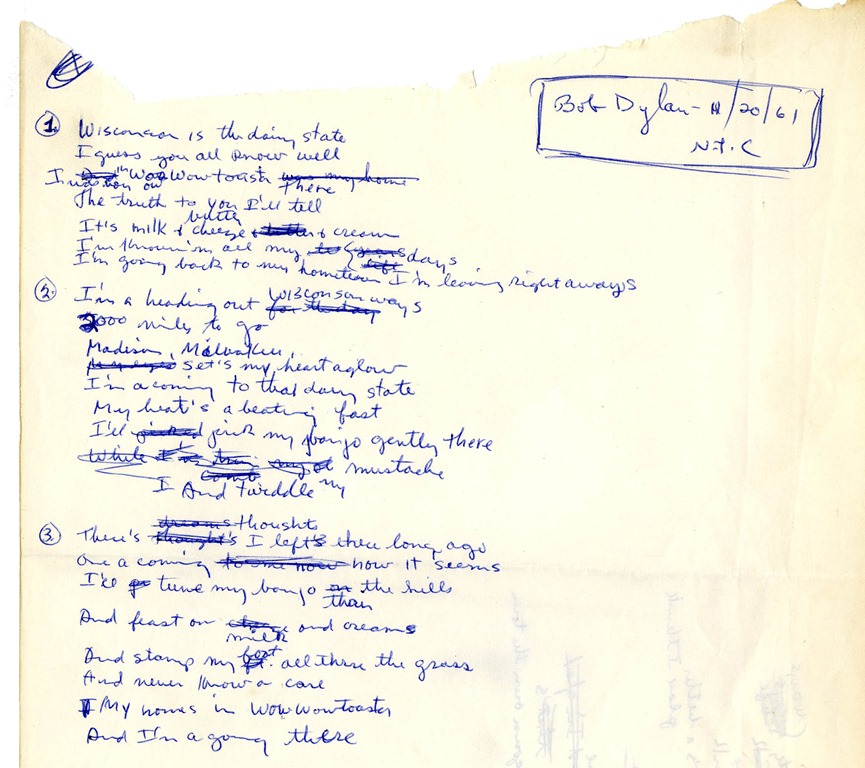
dylan_wis_song

The Nobel is a long way off, but even the 20-year-old Dylan is revising what seems like off-the-cuff stuff

It turns out that the formula of nonsense and normality, commonplace and commotion, when animated with who-the-hell cares energy makes a fine rock’n’roll song. And you don’t need $30,000 to have that, you can get it here for nothing. Just click on the player below.
Love Is Enough

I drove to Des Moines Iowa this past weekend for a wedding of a niece. The reception was in a tap room attached to a small indie brewery. My 12-year-old son asked “Why is it in a brewery?”

I asked my son if he knew what a hipster was. “Yes, it’s someone who always needs to have the latest iPhone the day it is released.” My son likes to remind me that he is not  a millennial, and that he will have no truck with their ways.

I laughed and said that it’s more than that though. I tried my best to explain, doing badly, as I usually do when speaking. What I was aiming to say was that hipsters are interested in things that are different and off-beat, that in doing so they often revive things from the past and redo them in the now different context of the present. This kind of rebellion against the too-ordinary incumbent culture eventually changes the culture, remaking cities and what they offer. “When I was a kid and went to Des Moines, there were no small breweries serving their own beer, or restaurants that serve those Asian noodles like you like. Instead I’d get to go to Bishop’s Cafeteria.”

“What did you like about Bishop’s?” my wife asked.

“I liked that you could choose your own desert. Usually something with whipped cream on top.”

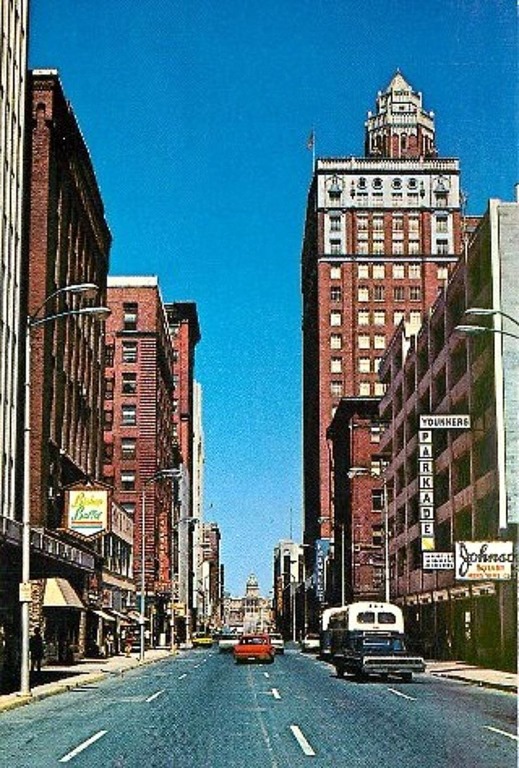
Des Moines Early 60s

News from Nowhere: Des Moines dreams of hipsters to come. Shop at Younkers, eat at Bishop’s.

Now that isn’t a complete explanation of what a hipster is either. Nor does it tell how hipsters are seen and labeled by others, or that to call someone a hipster generally has a negative connotation. If you want a hyper-precise definition with lots of reasons to be wary of being called a hipster you can read one here.

Every cultural change movement like this gets made fun of, and provides lots of rich examples of foolishness. And unlike frankly political change movements which often generate mutual veneration between generations, many cultural rebels see the next generation of young novelty seekers as a bad, devolved outcome; while the young often find and fix their cultural novelty in rejecting the enthusiasms of their immediate predecessors. Can anyone be sure that hipsters are any more or less authentic than punks, hippies, beatniks, or swing era hepcats and so on? I can’t. Is some rampant cultural appropriation going on? Yes, and that has its foolish and even harmful side-effects for all these cultural movements—but are their benefits as well? I believe there are, and anyway, rigidly contained cultural silos seem stifling.

This rejection of immediate predecessors, doesn’t mean an inevitable total rejection of the past. Small breweries were common in America a century ago. Beards, mustaches, fedoras—the clichéd markers of the male hipster, all are revivals of past fashions.

Remember with the Christina Rossetti poem last month. I mentioned her brother Dante Gabriel Rossetti’s boys club “The Pre-Raphaelite Brotherhood?” Formed by art students, they signed their paintings with a “PRB” as secret tag for their movement. They hated the classical art and design standards of their day, and even though they were living in the original Steam Punk era, instead of fetishizing brass, well-oiled gear trains, and leather, they propagated their love for Medieval art and hand-made crafts.

Dante Gabriel Rossetti - Ford Madox Brown 1867

Dante Gabriel Rossetti. Can he interest you in some beard oil?

Sound familiar? The Pre-Raphaelites seem to me to be late 19th Century versions of early 21st Century hipsters. If they were ironically enjoying Midwest beer in a can, would they have signed their paintings “PBR”?

Today’s audio piece is William Morris’ “Love Is Enough.”  Morris was intimately connected with the Pre-Raphaelites. Like them, he was fascinated with Medieval art and culture, but he was a man with many interests—many more than I can touch on this time—including writing influential fantasy and speculative fiction. In that vein, we’re going to time-travel the Englishman William Morris like we did with Americans Walt Whitman and Emily Dickinson, so that this 19th century poet can sing a nugget of garage band blues with the LYL Band.

Watts painting of William Morris

William Morris fading into the wallpaper. He did just about everything but start a brew pub.

This one is a good song for a wedding and for lovers. To hear “Love Is Enough”  use the player gadget below.

Theater of the Seasons

Monday night here in Minnesota it snowed. As I took my pre-teen son to school in the morning, he looked at the inch of fresh snow on the spring ground and said “Mother Nature is drunk. Shut her down!”

I rode my winter bike to breakfast that morning, and the trees overhanging the street were shedding overnight ice chunks that their budding branches were rejecting in the morning. As this shrugging hail fell on my ski helmet, it bounced off with a “ping!” like marbles or ping pong balls, and popped onto the icy street like broken ornaments.  A few hours later, in the late afternoon, I rode again to the grocery store in considerable sunlight. The streets were dry and I was in shorts and a T shirt.

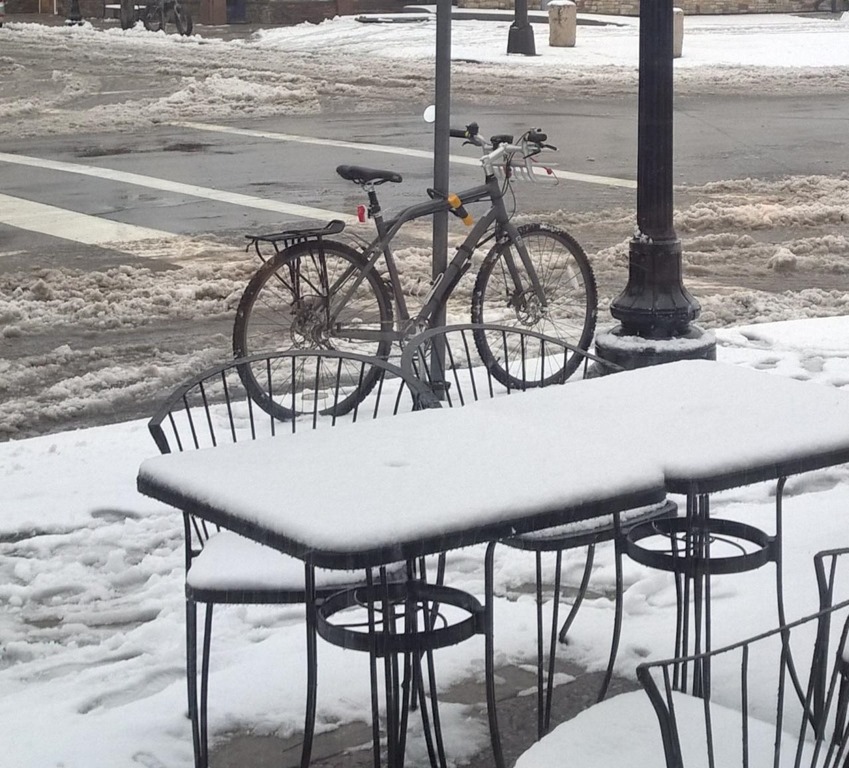
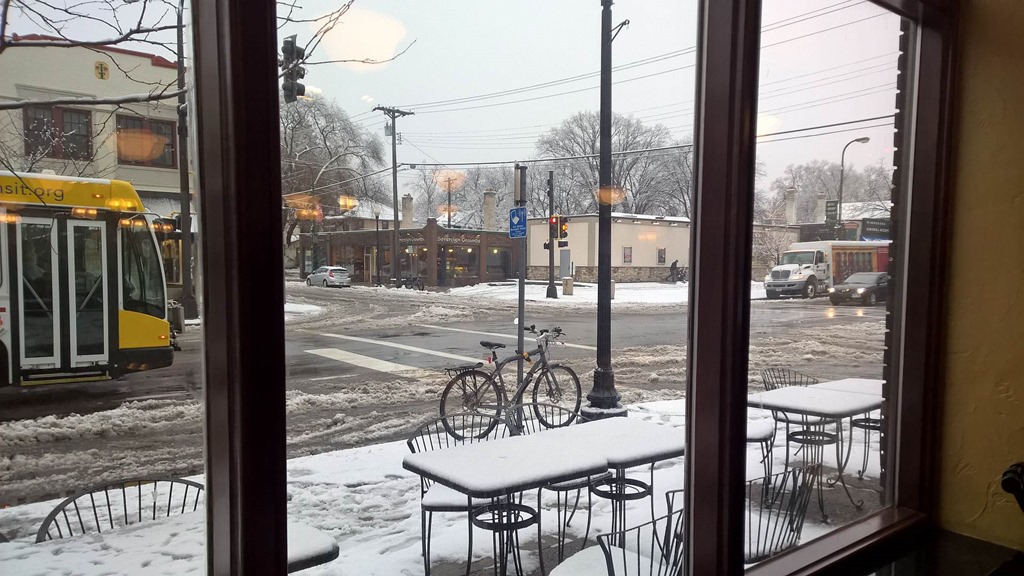
studded tires and slush on the patio tables

Plenty of patio seating available for Tuesday breakfast


Minnesotans have a well-worn phrase for our edition of the book of nature. It’s not a hand-bound collection of poems like our New Englander Emily Dickinson’s, but a play script. “The Theater of the Seasons” we call it. Famously, we try to hide emotions here, but we sure do enjoy a little drama with our weather forecasts, keeping an eye peeled for news of storms that can kill or injure you. Sitting in the upper Midwest we can receive weather sweeping up from the Gulf of Mexico or dropping down from the Northwest Territories. So, particularly in Spring and Fall, the Theater of the Seasons plays in repertory here in Minnesota.

Today’s audio piece is short, less than 2 minutes long, and it’s called“Theater of the Seasons,”  expanding on that phrase a bit. I think you’ll enjoy it. The player gadget appears at the end of the post, as usual.

As part of this blog’s participation in National Poetry Month, we’re trying to provide even more audio pieces like this that you can stream. If you know someone who might enjoy words combined with music like this, why not take this month to let them know about us and our Parlando Project, or share this or another favorite on your own blog or chosen social media site.

The Spring of Dead Things

Last night my computer news feed informed me that Chuck Berry had died. As with any 90 year old of a certain fame, the obits with their career summaries were already considered and ready. There were many elements the obits needed to include, and they did their job.

Chuck_Berry_1957

“Whenever a thing is done for the first time, it releases a little demon”


Around 40 years ago I wandered into a group of Minnesota poets who called themselves The Lake Street Writer’s Group, because they all lived, as I did then, within a few blocks of this main Twin Cities east/west commercial street—but what attracted me to them was that they had considered The Chuck Berry Writer’s Group as a leading alternative to that name.

I was then (as I am sometimes still) an obscure little poet. I like my works short, but I don’t require them to be all that clear or straightforward. I like them to play with words, both in the sense of assembling and using words in new ways; but also in the sense that they play with words in the same way that musicians play instruments. Chuck Berry was a beautiful example of that.
Tomorrow is the first day of spring.  Here’s an example of my trying to do that.  We know how to write the traditional spring poem. Spring! New beginnings! Happy blooming flowers! That’s probably the most welcome and acceptable way to write a spring song, because the world needs hope—but is it the only way?

What does spring’s beginning really look like? A few posts back I presented Boris Pasternak’s “February,” where he described a winter thaw not as a promise of Easter Bunny spring, but as a mucky, crow-ridden, rotten-fruit invocation of tears. Early spring is the cyclical end of dying, but as the wheel reaches March 20th, death is still palpably there to be ended.

For death, Spring is change—and how do we often react to change, particularly change that is imposed on us externally? I decided to tell that slant, to speak from those winter corpses at spring’s beginning. After all, we don’t choose spring, it’s decreed to us by nature and any ruler of nature we believe in, and nature is not a book only of triumphs, it’s full of predation and predestination.

Robin Eating Worms smaller

“Nature is a Haunted House – but Art – a House that tries to be haunted.”


My audio piece “The Spring of Dead Things”  is not in the musical mode of Chuck Berry—it’s more to the emo stylings of Emily Dickinson—but as players of words, these Americans had their slant bells to ring. To hear mine, use the gadget that appears below.


Boris Pasternak’s February

A couple of posts back I mentioned that we’d meet Yeats “rook-delighting heaven” again as we visit some more expressions of the month of February. Well, here’s one, Boris Pasternak’s “February.”

Coincidently, it appears that Pasternak wrote his “February” within a few months one way or another of Yeats’ “A Cold Heaven.” And both poets put ravens in these poems, though Yeats’ crows show up early, and Pasternak’s drop in near the end.  Though Yeats wrote his “A Cold Heaven”  in more temperate Ireland, it resonated with a Northern Midwesterner like me with its burning ice and unwarming sun. Pasternak, presumably familiar with a colder climate more like my own, sets the thermostat on his February to an early spring melt; but this is a muddy, sodden spring. His black spring holds cold rains, mud, and slush—more like a real early spring than a happy-butterflies-and-wildflowers May spring.

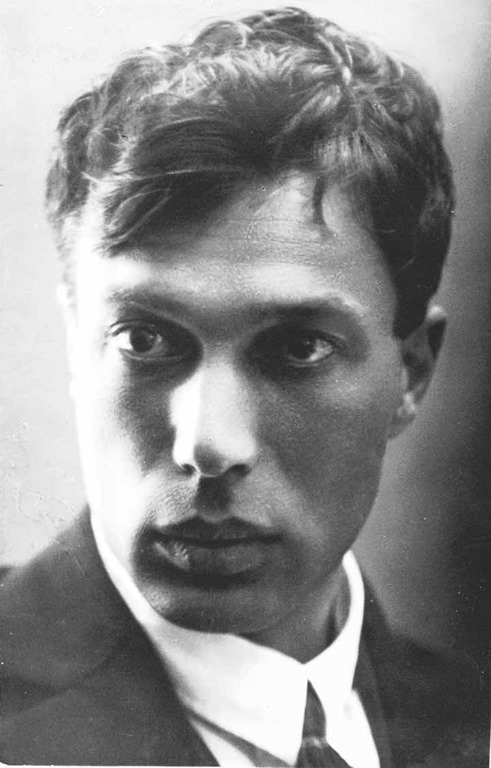
Young Boris Pasternak

Bluesman?


I’m not fluent in Russian, but the challenge of translating this lyrical poem from Russian to English has attracted many. As I recall, when I tried to put together the text for this performance, I used several of those as gloss, tempered with Internet translator apps fed the Russian. I know nothing of Russian diction, so I aimed for an informal American diction, and unlike some translators, I didn’t try to keep the original poem’s rhyme scheme in English—after all, I knew I’d be supplying music for this.

I believe the music I choose here, bluesy rock’n’roll, while American, is fitting. I hear Pasternak here singing the Russian Blues: blues like unto our great American music of endurance, and rock’n’roll that cares only to seek the state he speaks of in the last two lines:

The more haphazard, the more true, the poetry that sobs its heart out.

So I’ll be putting this post up, and then I’ll go out in our haphazard too-early spring February myself. I too will head out past the noise of city church bells, past the cars, biking to the edge of my city where I’m going to buy George Saunders sad new novel.

Renee Self Portrait in Mirror cropped

Today’s episode is dedicated Renee Robbins, who once was lost on the edge of Moscow herself, the last passenger remaining at the end of a bus route. She found her way back long enough for us to know her.

To hear the LYL Band perform Boris Pasternak’s “February” use the player that appears below.

2ebruary

I decided on my own that Yeats’ piece in the last post was about February, but I have some other pieces that say, right out, in their own words, that they are about our current month. Here is one, “2ebruary.”

Earlier this month I saw Jim Jarmusch’s film, Paterson.”  This movie succeeds, in its modest and appropriate way, to do something impossible: to film poetry, or more exactly, the composition of literary work. It does this two ways: by having a writer, its central character, portrayed as a regimented, routinized person, grounded in a particularized working-class city and job; and then by having him compose “aloud in his head” his work against this background.

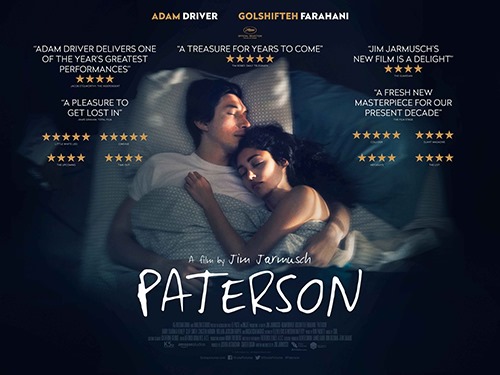
Paterson Poster

this movie has no light-sabers

This is a wonderful choice. The city, the routine clock of the days, the job, become the metrical, musical background for the flowerment of the writer’s consciousness that becomes the poems.

Though the movie is set in the New Jersey city of it’s title, the filmmaker refers often to the “New York School” of poetry, using the poems of Ron Padgett to stand-in for the work of the film’s main character.

The New York School uses a lot mid-20th Century Modern ideas, combining them into various combinations, depending on the individual writer associated with the movement. Some of it can be obscure and abstract, taking off from the same ideas that launched abstract expressionism in painting around the same time. But some also find a tenderness and wonder in the abstract patterns of urban existence, a Pop Art with a depth beneath its surface able to hold a beating heart.  At a point in the film, the main character opens his noon lunchbox to eat, and to write down the intermediate state of his morning’s writing aloud in his head, and there like a Thermos, nestled above an orange and a sandwich, is Frank O’Hara’s “Lunch Poems.” It has to be there.

Lunch Poems Cover

Don’t loose your Lunch Poems

O’Hara wrote in a great many styles, but this slim chapbook features several poems that someone once called his “I do this, I do that” poems. where O’Hara walks about, seemingly composing aloud in his head amidst daily tasks. These are my favorites, because, like “Paterson,” these poems seem to be about their own grounded creation in a city of routines, reflected inside the moist, encased, flowing mind of their writer.

Today’s piece “2ebruary” takes off from that Frank O’Hara mode, as I often like to do, though I’m an old man, writing in another century, in the Midwest, not New York City, and my old joints creak best on a bicycle.

Schwinn IG5 outside Turtle Bread in Winter slush smaller

a scene from today’s piece, breakfast not included


“2ebruary” is a short bicycle journey thinking of history, and past the events that are turning into history that we can still change. I take a pause, as every American should, to note that American culture is made from those who came here carrying something from elsewhere. And Midwestern culture? For many, those packing trunks are hardly great-grandparent’s-age-old, at the eldest.

At one point in the journey, I note those that had no trunks when they came to America, they had only their chattel bodies and souls—and even of those two things, the former had been appropriated by others for handy profit. What could they unpack? Well for one thing: the largest and grandest part of our American music. Our history is short compared to many nations, but it contains mighty things like this. We who are joining that history, already in progress, can turn it one way or another. Which way do you choose to turn?

To hear the LYL Band perform “2ebruary” use the gadget below.


A Cold Heaven

We’ve already met Irish poet William Butler Yeats with a brief poem earlier this month. Now his words return with a piece suitable for the aftermath of Valentine’s Day, for “A Cold Heaven” is the tale of a rejected valentine. It’s also fitting, because Valentine’s Day comes in the midst of late-winter. February, as Margaret Atwood put it, is a “month of despair, with a skewered heart in the centre.”

Here in the northern Midwest it was a “seasonable” 19 degrees F. this morning, and hardy ice has outlived any soft covering snow. There is a promise of a thaw this weekend, but that will only recall mud and the detritus of what the snow once remembered inside it.

Critics from more temperate climes praise Yeats for his oxymoron here of “ice burned,” but up north we know that’s just what happens to skin in the cold, with no need for poetic intercession. And my back yard, my cities’ parks, and our central greenway have been home to that “rook-delighting heaven” he speaks of as well. Strange isn’t it, that the bird of death is so smart, so intentional, so sure, and yet inscrutable.

In “A Cold Heaven,” Yeats’ winter and his death-omen birds lead to a missed and misunderstood, “crossed” love; and he takes the blame: if not for the season, for the failed love. Like so many, and without the succor of chocolate or flowers, he is left in the rejected lovers worshipful, davening stance, “rocking to and fro.”

But he is a poet still! “A Cold Heaven” breaks itself in two with an image that is also a pun: “Riddled with light.” Yes, we Northerners know that winter light. Brighter than summer, and paradoxically the sign of a piercingly cold day. He knows his love’s in vain, and yet no amount of blame that he can assign himself—even if he exhausts “all sense and reason” to catalog that blame—can account for the failure of his love. What can solve this “riddle?”

Yeats begins again, with a majestic “Ah!” only to take us on a short ghost story, the spirit of his love in purgatory, in bardo, naked as a corpse or as a lover, wandering and asking why clear skies, clear answers, seem like punishment.

So to all those whose valentines were not accepted yesterday: peace. Such riddling has no end to its depths. I know this: that hole is too deep to be plumbed, just know that it’s deep. The correct prayer for such things is unknown.

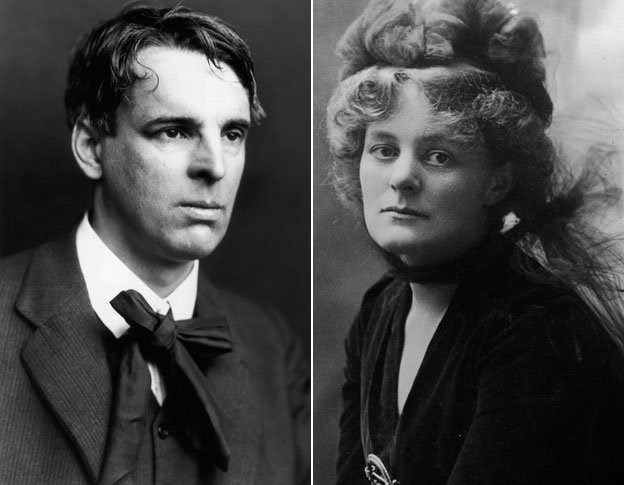
Yeats and Gonne

Look, maybe she’s just not that into you…

As a performance, “A Cold Heaven” had some challenges because Yeats makes use of enjambment, where lines break in the middle of sentences; and where the meaning too, often forks, seeming to mean one thing before the line break and another afterward. Since I like to let the lines “breathe,” so that the music can interject, and so that the words’ impact can sit a little bit before the next line, I resorted to repeating a few words. There are also a couple of other audio tricks in the piece. The string parts, particularly at the beginning have a “backwards tape” articulation where the sound swells from louder to silence, in the reverse of the normal decay of strings, which I hope signifies the drop into the past in Yeats’ text.

To hear “A Cold Heaven” use the player gadget you should see just below this.

The Garden of Trust

I feel I’ve been a bit long-winded lately with the notes for these posts. In my defense, I would say the topic of several recent posts, the relationship between art/artists and politics, is a complex subject. Today piece, “The Garden of Trust”,  is shorter, and the notes are too.

Weston Noble was a long-time conductor and choral director at Luther College in Decorah Iowa. I never met the man, but shortly after he died at the end of 2016 I heard this lovely quote from him. In a matter of a few words, he moved from vulnerability to trust through music. Thanks to the permission of the kind folks at Luther College, I am now able to share that with you. Today’s piece, so appropriate for Valentine’s Day when we think about love, lets the man himself speak those words surrounded by the music I wrote to celebrate them. Other than urging you to listen to them by clicking on the player gadget below, I can add no more than that music.

Vulnerability really is the secret to life itself. Openness…Honesty. And music allows vulnerability to come so beautifully….it’s much easier to start to talk with a greater depth….And then you go a greater depth than that. And when you reach a certain point of vulnerability…and this is what I think is so beautiful…that’s when you enter the garden of trust. Isn’t that a gorgeous thing to say? You’ve entered the garden of trust.


Winter is Good

Here in the upper Midwest we are now in the middle of winter, and so are in a various ambivalence about it. Part of us doesn’t like the burden of winter, part of us wants to taunt it, and show that we can still have the upper hand over it, and some of us, those who don’t want to stop reading the book of nature, can find a cold, white chapter to puzzle over and admire.

I’ve already spoken here about how Minneapolis was settled as something of a colonial outpost of New England. The author of the words for this episode, Emily Dickinson was a lifelong New Englander, steeped in Transcendentalist thought, so we know she’s read that Winter chapter.

Just before dawn this morning, I jumped on my winter bicycle and took a ride to my favorite breakfast café.  It was seasonable, 20 degrees Fahrenheit and snowing, the streetlight globes surrounded with particulate halos of pelting snow. My tires were crunching the snow, the big knobs of their tread like typewriter keys imprinting the blank pavement’s page. It really was quite beautiful, if obscure of meaning. Summer rain saturates us, inebriates us. Snow surrounds us, but we are never more than a transient part of it, unable to understand its dance.

Roughneck in snow closeup

Winter is good – his Hoar Delights!  Also, there is tea and a frittata involved.


Emily Dickinson’s words are featured here a lot because she’s a great lyric poet and her words fit with music almost without effort. I learned decades ago that Dickinson favored “hymn meter,” that 8,6,8,6 syllable verse that makes much of Dickinson singable to the melodies of “Amazing Grace” or the “Gilligan’s Island” theme song. For “Winter is Good” I decided to throw out that pattern, turning some lines into refrains and marrying it to a melody similar to the Christmas carol “Joy To the World” instead.

Dickinson’s second verse is a doozy. Just 17 words in her text, but it twists so wildly. “Generic as a Quarry”—there’s winter’s white page I suppose. “And hearty – as a Rose-“ not sure where we go there. Dickinson was an avid gardener, and she no doubt missed her summer plants, but my best guess is just rosy cheeks.  And finally, the concluding two lines “Invited with asperity/But welcome when he goes.” A jokey finish that seems like it’s singing the old joke about the pleasure of hitting oneself on the head with a hammer because it feels so good when you stop.

Our various ambivalence aside, that’s what the Winter chapter in the book of nature says to us Northerners, our words arise and are recovered over by the white page; our music only the spaces between silence, soon to be drifted in.

To hear the LYL Band play this hymn to winter with words by Emily Dickinson, click on the gadget below.

The Bird Dream

You can be in my dream, if I can be in yours. Bob Dylan said that.

You may have noticed that blog post frequency has fallen off a bit this month. Well besides the usual struggle of an upper Midwest winter, both alternative Parlando Project reader Dave Moore and I have had some extra tasks this month. I’ve been helping transition my mother-in-law to new living arrangements, and Dave has been working on editing a book of his father’s sermons.

Today’s post  is a piece that Dave wrote a few years back about his parents, and his father’s experience after Dave’s mother had died.  Like many good stories, it seeks to find meaningful connections in the flow of coincidental events.

And speaking of coincidence or archetypes or something, I wrote another piece myself a few years back. Though I did not mention it explicitly, my piece was also engendered by thinking of my father now living alone after my mother had died. Both pieces used the image of a bird trapped in a house.

I’ll not attach any more meaning than that to this. Today’s piece is Dave Moore’s story, read by Dave. Click on the gadget below to hear his story. Tomorrow I’ll post mine.