To not be scared of death that doesn’t understand us

I’m going to start off the new year 2024 with something I do less often, presenting a new piece that uses my own words. I give myself permission in part because it was engendered by thoughts of another poet, Robert Okaji, who I’ve considered as something of a kindred spirit to my efforts here since this Project began 8 years ago. Like most every blogger I can’t help but talk about myself, but when I do that I fear I become a spendthrift of boredom, so one of this Project’s mottos has been “Other Peoples’ Stories.” Yet, for all that, this isn’t Robert Okaji’s story in any summary — he’s his own poet, his own writer. I’m presumptuous, but I won’t go there. I don’t know him, though I’ve read his blog, his poetry, seen him read online once. Is that like knowing him in some way?

Many of us poets could admit that we see ourselves in a timeless guild. Homer, Sappho, Shakespeare, Emily Dickinson, Du Fu, Yeats — they’re our co-workers. We flatter ourselves at times that we now occupy their offices. By the same conceit, I could think of Okaji as a compatriot. We live in the same country at the same time, we’ve exchanged the customary short notes over the Internet. At least once before today, something he wrote caused me to write something myself. I think I started writing translations/adaptations of classic Chinese poetry before reading his, but his approach (we both need to start from literal English glosses) ratified mine in effect.

So we poets, at the moments our heads swell up so that poetry can burst forth,* may think it’s as if we know each other, because we think we know each other in poetry. To say then that it’s like companionship, that it’s as if, is to do that thing that’s called in poetry a simile.

Every simile when examined harshly knows it’s pathetic. Every poem is not the thing it represents — even the great poems that change how we look at the thing they represent. Let all in the poetry guild admit this to each other within the walls of the guild hall.

I started writing today’s words on one of my more-or-less daily bicycle rides. In spring there may be many kinds of birdsong in my well-forested city, but in winter it may be only crows — which, as the poem describes, are quite vocal about a solitary early morning bicyclist in their midst.

Crows, ravens, big dark birds, are a death symbol of long repute. And it struck me that while we might chide ourselves for not having sufficient knowledge or understanding about death, we could just as well say that death doesn’t understand us. Living in our consciousness as if the present continues indefinitely, we don’t understand death, but death doesn’t understand that moment either. And then, we poets think we can capture the flow of consciousness and preserve it in poems. Today’s poem carries on in a series of similes and then makes a final summation of the series.

Okaji has written a group of poems over the years featuring the character of a scarecrow. Perhaps he too is riffing on crows as the death symbol, but his scarecrow is at times a comic figure too. A scarecrow is just another simile, a sort of, an as if symbol for us — and so I speak of Okaji’s scarecrow in my poem.

Scarecrow takes a winter bike ride

Scarecrow rides a bicycle in early winter mornings, and the crows object. (a note: I begat these AI illustrations with Adobe Firefly, which claims it doesn’t use uncompensated artists’ work to train itself)

.

I said my poem isn’t Okaji’s story — it’s more mine partway — but if you’re like me in some ways, particularly if you want to consider those of us aged to where a compatriot’s death seems next door, then it might be as if it’s partway yours too. The admonition in the poem’s title is therefore not addressed impertinently to Robert, but to myself and perhaps others who might read or listen to this.

Woody Allen wrote a great line: “I don’t want to be immortal from my work. I want to be immortal by not dying.” We write poems, we make those “like a” statements by writing poetry. As if: in our minds we walk into those poetic offices, write our metaphors, our similes. And some day, we must clean out our offices, leaving on our desks a few sheets of paper, maybe enough to stuff a scarecrow.

Today’s performance started with two electric guitar lines I recorded early on New Year’s Day, following the tradition of trying to do things on that day that one would like to continue to do regularly the rest of the year. The two somewhat irregular riffs were spontaneous,** thinking that promise to myself required doing  as much as planning. The bass line was laid down almost a day later to try to hold things together, and the decoration of the keyboard parts arpeggiating the spontaneous chord changes which had started things off, were the final tracks. Those things done, I had my rock band to declaim my sonnet “To not be scared of death that doesn’t understand us” over.

You can hear that with the audio player you should see below. No player?  This highlighted link is a back-up method, as it will open a new tab with its own audio player.

.

*A metaphor that sounds more like a sneeze than Athena’s birth when I re-read this.

**I fancy the right channel line played on my Telecaster has some crow-call-like moments.

Quiet Sanctuary

I have trouble at poetry readings.  Oh, I enjoy them, but they tend to spark off ideas and associations* in my mind. When I come back from those jumps in my consciousness the poet reading in front of me may have gone off to the next poem — and I feel like I have been delinquent in my duty as an audience.

A couple of months ago at the poetry reading series I try to attend regularly,** a poet was introducing a poem, and somewhere in between that poem’s introductory material and the poem itself this connection, this metaphor, occurred strongly to me. I don’t now recall what it was the poet reading said. Was it something about an acoustic guitar? Possibly. Something about a church? Maybe. That I can’t remember says something about the utter rapidity and completeness of my leaving that room and into the germ of this poem.

Quiet Sanctuary

Here’s the poem presented as a chord-sheet with the guitar chords I used to accompany it.

.

I saw immediately the churches of my parents’ and grandparents’ generation, small Midwestern US churches. Usually wooden and white with a steeple’s neck outside, and inside largely one room, the sanctuary within the single story, filled with dark brown wooden pew benches. A basement below, small children’s bible class spaces and a kitchen that smelled of brewing coffee, the sanctum of wives, mothers, and grandmothers of the congregation after weddings, funerals, baptisms.

South Marion church

The particular church most in my memory is decades gone, but this nearby one will serve as an example.

.

When one thinks of churches, I suppose some think of grand spaces, cathedrals or those more modern large urban churches built to approach that scale and presumption. Weighty stone buildings, as unresonate as tombstones, intricate carvings and décor. Grand halls, chambers, perhaps a pipe organ, for they are the pipe organs of buildings, elaborate and encyclopedic, overwhelming anything human that would manipulate it.

The modesty of those small-town Midwest churches, the woodiness of them, has its own glory. And so it seemed natural to connect them to a instrument that is somewhat of a point of origin to me musically, the acoustic guitar.

I don’t know how well this little poem will communicate that to those who do not share my experiences with those buildings. I accept that a poem can’t be everything. There’s one detail in my poem that might not make sense or image to some readers: the attendance list. In my recall, it was common for these churches to have a board that toted up the attendance for the last service. I’m not sure that sign’s entire purpose. To remind those in the sanctuary that they were part of a continuance? Could be. The small continuances are what these churches contained.

You can hear my musical performance of “Quiet Sanctuary”  with the audio player gadget you might see below. No player to be seen? I offer this highlighted link as fall-back then. The link will open a new tab with its own audio player.

.

*It occurs to me that I rarely have ideas as such so much as I have associations, things that seem to recall other things or suggest other things yet to be connected. It’s possible to write poetry without the poems containing metaphor, that kind of association, but most poets don’t. That trait may be why I’m drawn to poetry.

**That reading series, held the second Thursday of the month in St. Paul Minnesota, is the Midstream Reading Series. I know some of my readers are from the Twin Cities area. I find this event worthwhile, and you might too. Though I’m often inarticulate in person, I would try to say hello if you were to greet me there. Next reading is this coming Thursday, October 12th.

Fog

I’m going to take a break from my Dave Moore series today, if only because I rather like this piece I’ve been working on and want to present it to you.

“Fog”  is likely the most well-known poem by Carl Sandburg without Chicago in its title, and it appears in many school textbooks where it serves as an introduction to metaphor. The Carl Sandburg who wrote it didn’t intend it to be a lesson. I think he wanted to write a Modernist, Imagist poem, the way a small group of others were writing them in the era roughly 100 years ago.

One thing I’ve learned searching out pieces for this project was that Modernism in its High Modernism guise has overtaken the work done by those preceding Imagist pioneers. As those who’ve visited here during cruel April Poetry Month will know, I enjoy somewhat those knotty, learned, collaged and college-ruled works that T. S. Eliot’s The Wasteland laid out. And World War I, we should not forget, was a terrible disaster with near untellable loss of life and loss of hope for its generation. WWI probably had to change things. The Carl Sandburg who wrote his early Imagist poems went about his pre-WWI world with an open heart and open eyes. In his poetry and in his political writing there’s a panorama of evil and survival, loneliness and stubborn love.

So, to reduce “Fog”  to a lesson on metaphor is to amputate that context, and to forget the Imagist quest to renovate entirely metaphor as it had been received by Sandburg’s generation. Imagist poems often wanted to break through the fourth wall of metaphor, to make it more than an a decorative, this stands for that, analogy. “Fog”  is fog, and the cat is a cat. Yes, they have meaning beyond that, all reality does.

You could start by asking yourself, if this is a real cat then, what kind of cat is it?

A house pet, one used to demanding the pricey wet food and best place on the dry, warm bed? No, it’s on the docks. It could be a ship’s cat, a fellow laborer, or a feral cat making do with what it can find there. It can’t call attention to itself for its prey and its own risk, and so it’s silent—and like its life and labor, obscured by the fog, by the cat’s own actions and the actions of the world. Sandburg sees his worth to see that.

Carl Sandburg at the machine of his labor

Carl Sandburg at the machine of his labor.

That’s an Imagist poem, a direct presentation of reality, with no false rhymes of conventional or show-off imagery. There’s love and respect in it too, for the working common of us, singing the insubstantial and all-covering fog of our lives and labor, that save for the notice of the poet or artist, is silent and then moves on.

That, dear readers and listeners, is why you should pay attention to Carl Sandburg, who’s nearly fallen out of the cannon of important Modernists and consideration as an important poet, who is, I tell you, as you are, more than an example of metaphor.

Remember back to the formation of the LYL Band were we self-labeled ourselves as “Punk Folk?” Given that folk music by definition doesn’t ask for certifications or approval to be performed, that was something of a tautology. It occurs to me that what I’m doing here with pieces like this, using a string quartet I play part by part along with two pianos (one electric) and a drum set could be Punk Orchestral. My string parts are extraordinarily simple, like unto a lot of downstroke strums of power chords in some Punk.

Decades back, the Pixies helped popularize the Punk soft/loud arrangement, but of course orchestral music did it OG before them, and I exploit that in this one. Some other incidental ideas that helped steer me in this piece came from reading some recent posts at the Brettworks blog, where a more trained and accomplished composer talks about some of his processes and inspirations. Specifically Brett was talking about creating a piano part that had enough space where the various notes could have enough time to express their decay trails. Musically, this piece started by exploring that idea, but then the string quartet decided to kick out their jam.

I peform Sandburg’s words like a stalking cat hunts, sliding forward and stopping, then slipping forward again before pouncing.  To hear this, use the player gadget below.

Cold Is the North Wind, and Why Did Confucius Collect a Book of Songs Anyway?

Here’s one more musical piece from the anthology of ancient Chinese poetry collected by Confucius and his school and known as the Confucian Odes  or The Book of Songs.

This one may be my favorite, though my performance of it dates to a time before I could find literal translations to check against the extant English ones. Perhaps even more so than our last piece, “Wild Plums,”  this presents itself as an expression of lover’s desire. You might find it similar to the Bible’s Song of Songs in that regard.

When I was young and looked at commentary on the Song of Songs,  I was surprised to find that some scholars believed it to be a spiritual metaphor rather than some too-hot-for-school love poetry. My take then: those scholars must be prudes.

With the Confucian Odes,  remember that the Confucians thought their collection of folk-poetry was not just a piece of cultural curation, but required reading for advanced participation in society—not just for poets or humanities majors, but also for politicians and bureaucrats, a class the Chinese Empire needed a great many of. There is commentary on “Cold Is the North Wind”  that says then that this song expresses a hardship or grievance experienced by some province or another, or that the lover’s desire is a metaphor for political concern. After you listen to “Cold Is the North Wind”  you may think that must be willfully obtuse. “What part of the ‘I’m lonely, it’s cold in this bed alone, and I want you right here, don’t they get?” you might be thinking.

In both cases, the Song of Songs  and “Cold Is the North Wind,”  I’ve come to a slightly different view. Poetry, sometimes when it’s at its best, binds the image and what it’s representing in a way that doesn’t privilege one over the other. William Carlos Williams’ Red Wheelbarrow  isn’t some symbol which we need to decode as a handy emoji for the usefulness of tools in ordinary work, and “Aha! We’ve solved the poetry puzzle for today!” it’s also a freaking red wheelbarrow in a chickenyard and it’s wet with rain in a way we can feel and see if we allow that. Separated lovers are separated lovers, and their ache we can feel, but that ache specific to that need and pleasure is something we can feel again in other intensities. And that act of listening to these words (or listening to them on the page) binds us to the poem in the way the poet binds the image to the things the image is like.

There’s something there for future bureaucrats and politicians.

There was a time, also in my youth, when we thought songs might be able to do that. Someone who listened to Bob Dylan, Aretha Franklin, John Coltrane, Patti Smith, or other Smiths and Jones would be changed not necessarily into record store clerks or musicians but into more empathetic people whose imaginations would be wider than the immediate space around them. To what degree were we wrong? One provisional answer: “not entirely.”

Chinese Throne

“So, I’m writing this tweet. What makes the best metaphor: low IQ, sick, ugly, dumb, dog, failing or FAKE? I’m a genius myself, but poetry is an elite WITCH HUNT, and I could use a little help casting this spell. What, you can use poetry to listen, not just to speak good?”

If there was a modern Confucian school sitting somewhere in the English-speaking world, what would they collect to instruct future government members and business functionaries?

The player to listen to my performance of “Cold Is the North Wind”  is below. If you’ve been checking out the archives of over 250 other combinations of various words and original music on the right, you might notice that “Cold Is the North Wind”  appeared here several years back, before the official launch of this blog. With today’s post, it will now be available to those that follow the audio pieces via Apple Podcasts, or through other podcast services.

Does the way you view this blog not show the player? Well, then this highlighted hyperlink can play the performance.

St. Francis Einstein of the Daffodils

Metaphor, that stuff that helps make the music of thought in poetry, is the linking or liking of things. This is like that. This stands for that. The sensation of this is like the sensation of that. This reminds us of something else. The way I say this recalls the way one says that. Metaphor recombines the stuff of our world even though it’s a combination that only exists in the imagination.

Metaphor can make something clearer to an audience. It’s so useful in that way that one can barely explain anything challenging to an audience, even in the most prosaic day-to-day business world, without falling into metaphor. In poetry however, the bounds of increased clarity can be stretched, broken, and abandoned. Depending on one’s mood as a reader, this can be frustrating or a pleasing play of the mind. With the Parlando Project we perform the poems with music. One hope from this is that you can relax and let the beauty or strangeness of the words carry you over gaps in meaning. Sometimes you can enjoy a poem before you understand it.

William Carlos Williams who wrote the words in today’s piece, gives us Spring weather with Spring flowers and fruit blossoms, gardens and orchards, and all under a title that combines a famous saint with his era’s most famous scientist. He gives us almost no help in combining that title with the poem, other than yoking them together. The linkage of metaphor is much strained here, even when he further explains his title by adding a sub-title: “On the first visit of Professor Einstein to the United States in the spring of 1921.”

How are we to make the connection that will construct the metaphor?

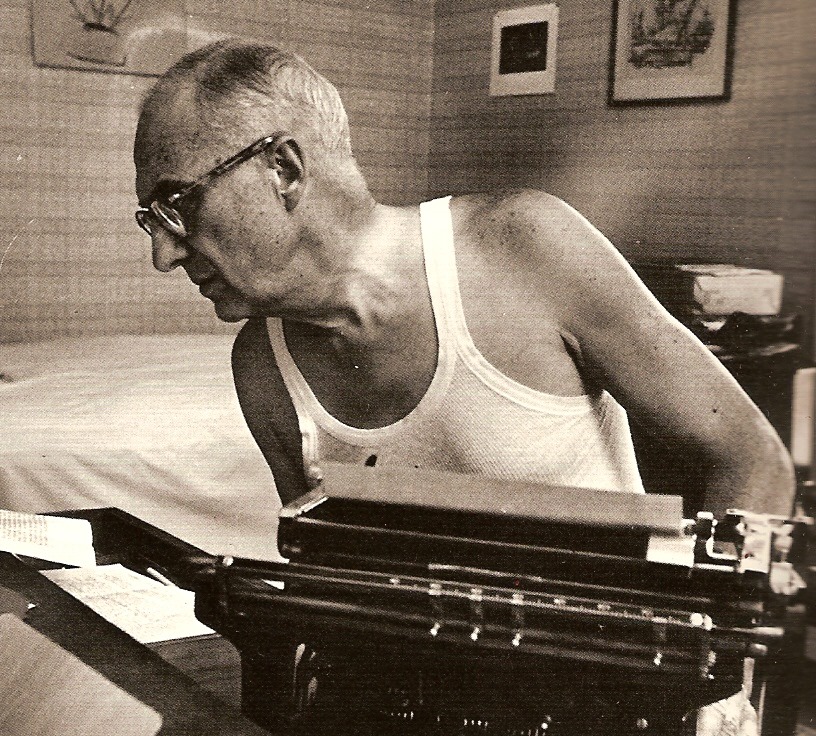
William Carlos Williams with typewriter

Just another hipster with his typewriter. William Carlos Williams throws off his covers.


My best understanding so far is that the connection is wonder and change. Recall our last post, where in his “Queen Mab”  Percy Bysshe Shelley, the Romantic early-19th Century poet, gave us a vision of the wonder of an immense cosmos, which Shelley’s own notes tell us he could also sense through the poetic/mathematical meter of the speed of light. The theoretical scientist and the visionary poet each seek to grasp some new metaphor of the world. Einstein was changing physics in the time that Williams and his fellow Modernists were seeking to change the apparatus of art. Williams elaborates on this theme mostly by vivid descriptions of the change of Spring. In the only mention of Einstein in the body of the poem, Einstein is “tall as a violet.” He is the Spring’s new growth.

There are a couple of obscure literary references in one section, the sort of thing T. S. Eliot or his imitators would have used. Who is “Samos, dead and buried?” I’m not sure, but my guess is that it’s Pythagoras of Samos, the famous classical Greek philosopher for whom science and the arts were one. And Lesbia? Catullus’ Roman poetic beloved, who we’ve met here in Elizabethan guise. It may be enough that they have ancient sounding names, and of such ancient classical modes, Williams, who is in some ways the Anti-T. S. Eliot, says “Sing of it no longer.” He moves right back into a present day of Spring. Pythagoras is dead, Catullus’ Lesbia is dead, and so is a black cat buried in a newly planted garden. Awhile later in the poem we may get one more connection to that cat part of this buried trio. A chicken-raising man who puts out poisoned fish-heads to keep the cats from his chickens. That man becomes like the Modernists, needing to kill the ancients to protect the new flock he’s raising.

As a side note, this poem’s chicken farmer, the white-haired negro, was quite likely the man whose rain-glistened red wheelbarrow sat next to the white chickens in William’s famous poem of admiration.

The poem closes with a sensuous image of Spring change, a night that grows warm as an orchard owner opens his windows and throws off the covers that were needed in the cold. In an earlier version of the poem, Williams had woven Einstein by name in and out of those Spring images explicitly, including this last one where Einstein was named as that man with the blossoming orchard, another grower of renewed things. In this later version, all these stated links to Einstein are removed (save for that one Einstein as a violet).

Professor Einstein Narcissus

Not a violet, but the “Professor Einstein Narcissus.” Has “great curb appeal” and “deer won’t eat” says this garden center.


Was that a right choice? The resulting poem is shorter and more mysterious, but it also doesn’t make it easy to see what Williams is getting at. He’s using metaphor, but he’s removed all the connections. I decided to perform the later version. I think it performs slightly better, and perhaps the music makes the obscurities less taunting.

A simple musical arrangement this time, just acoustic guitar and subdued electric bass. To hear my performance of William Carlos Williams’ “St. Francis Einstein of the Daffodils,”  use the player below.