Zeppelins

For reasons of copyrights, I’ve been focusing a fair amount here on using words from the most recent poems whose rights are in the public domain (pre-1924). One side-effect of that: during the run of this project we’ve presented a good number of poems about World War I, which I recently called “The last war covered by poets.”

So, we’ve had a poem from a man waiting to enter his battle: Rupert Brooke writing on the troopship carrying him overseas; and poems written from first-hand views in the trenches by Siegfried Sassoon, Wilfred Owen, and T. E. Hulme. We’ve had reactions to the war and its losses from Ezra Pound, Tristan Tzara and Carl Sandburg. William Butler Yeats, even in refusal, is writing a war poem of a sort, one I suspect has a hidden barb at the politicians’ war propaganda.

For the most part, the poems I’ve used so far would not pass as journalism. Owen and Sassoon use fantasy to illustrate the war’s folly. Pound, Tzara, and Sandburg tell of the subjective emotional impact of the war’s losses. But Brooke’s fragment has the power of a closely observed diary entry, and T. E. Hulme comes closest so far to a straightforward war dispatch with his compressed account of the front at St. Eloi.

Today’s piece, using words by F. S. Flint, comes closer yet. Flint, the man who urged the “School of Images” in pre-war London to hew to a cadenced free verse, felt that verse and prose existed on a smooth and unbroken continuum, that good writing was good writing, regardless of the label on the tin.

Besides being present at the birth of Modernist English poetry, Flint also was in the right place to witness another Modernist invention: aerial bombardment of cities. It’s little remembered now, but nighttime terror bombing of London was not an invention of Hitler’s air force in WWII—it was, instead, first carried out by Zeppelin airships in World War I.

Flint’s report, though artfully framed with its first-person account of being awakened from sleep in medias res, and ending with a surprising and telling conclusion, includes enough exact detail to say that it describes the first of these London raids on May 31st, 1915.
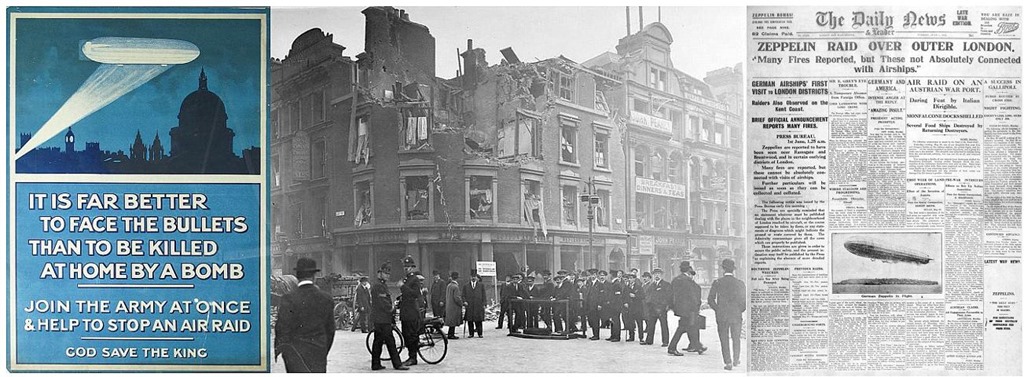
Zeppelin Raid

1915 reactions to the London Zeppelin raids of World War I

It’s a gripping account, no less than if it had been filed this year in Syria or somewhere else were bombs fall on civilians in our time. If you’d like to read “Zeppelins”  on the page, here’s a link.

Does the element in Flint’s work of mere journalism detract from its “poetic” qualities? The romantic element would say yes perhaps, there is no other “realer, now revealed” world invoked, no intense yoking of disparate images or modes of perception (although I would maintain it does just that  in a subtler way). More elaborate language, more elaborate metaphors could decorate this. Picasso’s Guernica”  is the same subject, painted decades later, but it’s also more worked out as a cubist statement.

In a sense this question is like a question I wrestle with here as I contemplate the Parlando Project which combines music with words. Does the addition of a substantial thing to something else: in the case of Flint’s “Zeppelins,”  documentary, journalistic facts to modernist poetic imagism; or in the case of my Parlando Project pieces, music and performance’s addition to what is often canonical page-poetry—are those things additive, making a greater sum—or do they, paradoxically, detract, diffusing or de-fusing the impact of the uncombined thing.

Or are these questions of art a sideline here? Do Henry and Caroline Good, dead of flames and smoke in their bedroom in that night in 1915, or Leah Lehrman, age 16 killed by a Zeppelin-dropped bomb explosion care? Do we appreciate that we live now and ponder these questions?
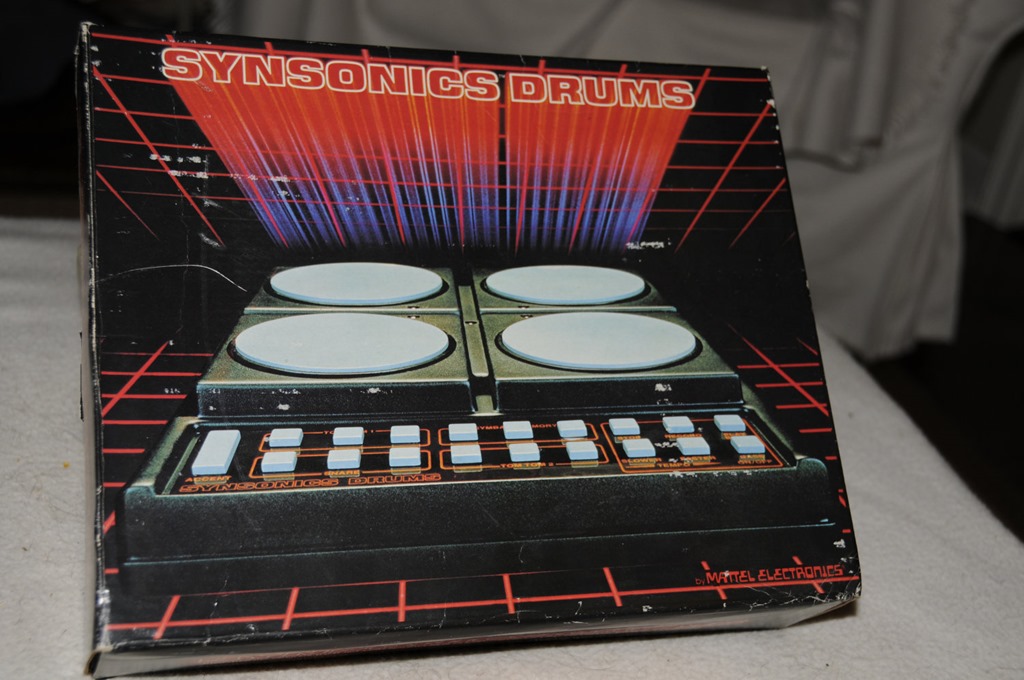
Synsonic Drums

Later that same 20th century, my first drum machine.

In writing and performing the music for Flint’s “Zeppelins,”  I wanted to lean toward Techno a bit. I avoid drum machines these days and work hard to humanize my beats on most pieces. Back in the 20th Century I used machine beats, they were all I could afford, and now in the 21st, no matter how skillfully deployed, they remind me of those crudely resolved sounds, a make-do.  My 12 year old son however enjoys them, the blippiest tracker pieces or a SID chip 8-bit beats please him with their antique charm. Then listening to Weekes new single this weekend reminded me of that charm (and made me wish I could sing better).  So I gave it a go.

You hear my performance of F. S. Flint’s “Zeppelins”  right here with the embedded player below. If you can’t see the player gadget, this highlight hyperlink will also play the performance. Something about those later 20th Century sounds just seemed right for an early 20th Century piece to me.

Poems In Unrhymed Cadence

In 1899, as the 19th Century was leaving in Victorian London, a 13-year-old boy from a large poor family left school and went to work at whatever jobs that could be found. An unremarkable story.

After several years, and some job security as a civil service typist, he could enroll at a workingman’s night school. This story too, unremarkable.

Men and women with stories like this often go on to form families, start small businesses; or slip into slightly better jobs, finding what opportunities are left unguarded or unattended by those who started further up the economic ladder (or wall). Working diligently, they sometimes become the mothers and grandfathers of poets and scholars, preachers and social reformers. That’s not the way this story goes however.

This teenager moved quick, and found out he had a talent for language, not only his own native English, but German, Spanish, Russian, Dutch, and French too—they all came under his control. He accelerated himself beyond the speed of night school, and in a matter of a couple of years, our young man became a poet and a leading proponent in his time for avant-garde French poetry. And then he began meeting with some other poets in the cafes of London.

This man was F. S. Flint. It would be easy to pair him with one of those artists he was making talk and friendship with: T. E. Hulme. Neither had privileged backgrounds, and both are too little known, read, and studied today. In 1909, ten years after this boy had left school at 13, the meetings in these cafes included not only Flint and Hulme, but Ezra Pound, H. D., Florence Farr, William Butler Yeats, and Robert Frost. What they were plotting was a poetic revolution—one that would succeed, and become the dominant strain of English poetry for the rest of their century.

Although all of them had avowed influences, often ancient ones—English and Celtic bards and Latin, classical Chinese and Greek poets—they were resolved to “make it new” in Pound’s famous motto. They all wanted to change the language and the sound of English poetry, and since words and music are what make up poetry, they wanted to change everything about it.

In terms of language, the thoughts centered around removing decades, even centuries, of encrusted dead metaphors that no longer had any meaning. The imagery in the new poems would need to be fresh, different, vital and intrinsic to the poem, not mere decoration. Extensive, romantic effusions of feelings would be replaced with palpable images.

The “School of Images” was coalescing. By some accounts it was Flint who suggested tacking the suffix“-ist”, (in French “-iste”) to “image” to brand the movement.

In terms of poetry’s music, there was less agreement. Yeats and Farr were trying to invent a new kind of chanted poetry to music. Frost and Yeats would write some of the most accomplished metrical poetry ever written in English, but with a naturalness that made it disappear into unfussy verbal music. Pound remained interested in combining music as in the days of the medieval troubadours. Hulme talked of “chords” harmonically struck in the mind when an image was right. Flint, along with Hulme, thought French vers libre, “free verse” without rhyme and strict meter, was the mode to use. Flint called his verbal music “unrhymed cadences.”

And that’s where today’s piece comes in. In these three loosely-linked and lovely London-based poems, Flint demonstrates what he means, and this sort of breath-based line has echoed in much English poetry since.

The three poems or sections that make up Flint’s “Poems in Unrhymed Cadence”  seem connected to me, though the middle (swan) section had been published previously in a much more verbose version a few years before. I’ve only been a London visitor—Flint grew up there—but I personally associated the scenes throughout with Hyde Park/Kensington Gardens, with the silver birch trees, swans, lilies, and other flowers mentioned. However, the third section specifically mentions aspen trees, which I don’t believe are in Hyde Park or Kensington Gardens.

Hyde ParkKensington Gardens

Hyde Park and Kensington Gardens in London—swans didn’t pose for me, no aspen trees in sight.


Following the three Imagist rules (which were first written down by Flint), the images are direct and exactly presented, the words are spare and free of unnecessary elaboration, and the “To compose in the sequence of the musical phrase” rule is something of a restatement of Flint’s “cadence.” Like most imagist poems—and even though these poems unmistakably reflect a mood—there is less spelling out of emotions by their abstract names that would have been customary before. It’s only at the end of the second (swan) section that the first of these, “sorrow,” is spoken, and when the third, final section unleashes “afraid,” “anguish” and “pain,” the images have set this emotional summary in a real physical, sensory place first.

F S Flint

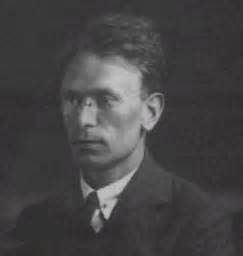
The only picture I can find of F. S. Flint


Musically, once again I don’t know what to call the music I wrote and performed for F. S. Flint’s set of poems. There are several orchestral parts and percussion, but the lead instrument that eventually emerges is a sitar. Since in the 21st Century chicken tikka masala can be said to be the British National dish, my limited skills on this instrument of virtuosos can be forgiven.

To hear it, use the player below.


Frutiger

Here at the Parlando project we say we’re where music and words meet.  Sometimes words sing without overt musical notation. Sometimes music speaks to you without speech. And since Dave and myself also play the music heard here, it gets to speak for us, we get to say this music. Every musician, whatever their level of talent, skill, and knowledge gets to experience this.

Today’s piece, “Frutiger”  is an elegy for an artist, Adrian Frutiger, a typographer who created typefaces, the shapes of letters we might use to spell out words. Typography is an unusual art in that we may invest in words a great deal of meaning but the actual ink-shapes that present them on a sign or a page may seem immaterial to that process. Like the music we sometime forget to hear in words, those little carved paintings of letters may disappear below our attention, but their legibility, and even their subtle pointilliste shadings in blocks of text, are still part of our experience of printed words.

Frutiger’s most widely used typeface design bears his own name, and it often chosen for signs because its letter forms excel in legibility during inclement weather or from a distance. For example, one of the Frutiger typeface’s  distinguishing features is use of square dot on top of the lower case i, which gives it a tiny advantage in the necessary discernable gap between the letter and the dot. In the words of the “Frutiger”  piece, I call that out as if the square dot was a diamond rotated (“diamond” just brings in more meaning) and lets me vaguely pun on the Eye of Providence.

Frutiger Sample

A line from today’s piece “Frutiger” in the like-named typeface

Three minutes in, and this little elegy’s words are over, but I start a guitar solo. At two minutes in length, that solo will be shorter than the spoken word part, and it was only indirectly called forth by those words.

That solo says what? Loss? Anger? An urgent and puzzled prayer? A man using his limited musical skills? A patient LYL Band allowing it to occur?

All I can say is that says what I was feeling that day, and today.

To hear today’s audio piece “Frutiger,”  use the player that appears below.