I had worked on setting this 1920 poem by Marianne Moore to music for a few weeks, but it wasn’t until a couple of days ago that I had a shock of recognition: the words of this poem could easily be read as a comment on our own era’s confrontation with Artificial Intelligence (“AI”).
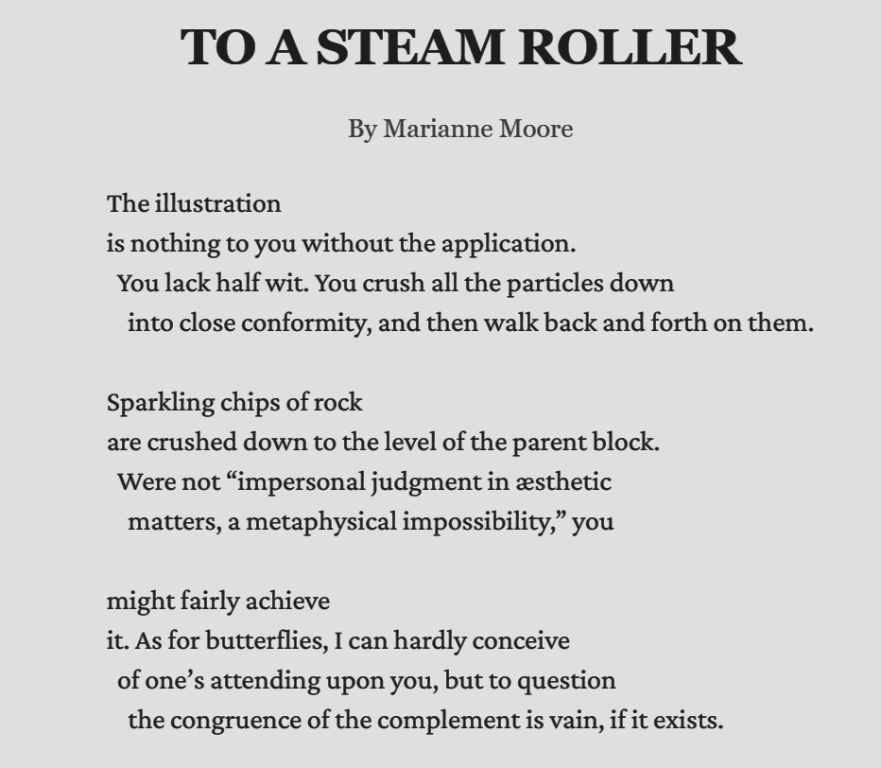
Coincidence — or evidence of Moore’s undocumented time travel? Am I starting to sound like the tease-narration on one of those facts-sort-of/conjecture-concupiscent videos? Ring the bell, like and subscribe — wait this isn’t YouTube — instead let’s go to the text of a poem:
And those “chips or rock,” Marianne — are they silicon chips?
.
Once thought of, that AI reaction reading seems solid. An AI picture, a machine-made one, cares not what’s depicted, it’s just an illustration of certain styles and tactics. And since its engine operates largely on probabilities, everything surprising about art is downgraded in the algorithm, crushed down to a level with “how it’s supposed to sound.” What if it got good through continued improvement — or even random error — at seeming original or insightful? That would only be a trick: the machine can’t “mean,” it has no experience felt to be conveyed. A matrix of connections is not metaphysics. Moore’s poem suggests an experiment at the end of the poem: what if a butterfly was to land on this machine? Inconceivable, in that AI is incorporeal software. Would this unlikely scene, this image, suggest a blessing or even something useful for the organically lovely, pollinating butterfly to do? No, to believe such would be vanity, perhaps of the owner, creator, or operator of the AI machine.

If Marianne Moore could travel back to the 18th century as evidenced by her oft-favored tricorn hat, then why couldn’t she go back and forth to the 21st century?
.
It is poetic to believe Moore could have foreseen AI and made her poem in response. In time-bound reality, I think she was more likely commenting on a trope in the emerging Modernism of her time. New machinery, and forces of industrial change give Moore her particular metaphor: the steam-powered road and construction machine.* Futurists contemporary with her would grab at such a thing and see beauty in dynamism, an evaluation extended even to highly destructive and deadly machines. Is there a link in the aether between times? I myself sometimes see echoes of the Italian Futurists in modern TechBros, up to and including a growing fondness for authoritarianism sprouting from libertarianism. Moore’s poem questioned that then – and so we might well estimate she would now.
Musically, this began as an exercise I set for myself to orchestrate something using percussion instruments (both physical and of the virtual instrument** variety). The idea became: what range of sounds could I put together using just that sort of instrument. I had a late friend who played in an Indonesian Gamelan orchestra, a percussion-forward grouping of instruments, though my piece is a naïve one created by someone who hasn’t studied the form. I was also thinking of one of the more unusual record albums of 1968, the sole LP of a group calling itself The United States of America. They used early electronic circuits and a variety of instruments, stretching their expected tonalities. Their eclecticism and emphasis on unconventional musical combinations was a complete market failure – even to the psychedelic and widely stoned acceptancing audiences of the late 60s. That may have had something to do with their eccentric deemphasis on the groove. Other experimentalists of their time: The Velvet Underground, Jimi Hendrix, and even odd-time signature loving Frank Zappa may have asked for expanded ears with their recordings, but that didn’t mean they were abandoning its rhythmic core, or however outré, elements of showmanship in live performance.
You can hear my musical presentation of Marianne Moore’s “To A Steam Roller” with the audio player below? Wait, has any such player disappeared along with a discernable Rock beat and guitars going widdley-widdley? Well, my musical piece will not be exiled to the cutout bin of some early 1970s store, next to the United States of America record with its album corner disgraced with a hole or corner clipping and a florescent under $2 price sticker. No, you can alternatively find my piece of music with this highlighted link that will open a new tab with its own audio player.
.
*Rather than 20th century Modernism, the power source here might also make Moore’s choice a late example of a 19th century style, one sometimes still revived as “Steam Punk.” As early as Dickinson and Whitman, American poets were loving steam trains.
**As I have often taken pains to explain here, virtual instruments (VI) are not AI. They are large digitally recorded sample libraries of actual instruments (or their electronic outgrowths) making their characteristic timbres, pitches, and articulations. I play a little plastic keyboard, or pluck my MIDI-interfaced guitar, call up a mark on a MIDI score, and the note produced is not a silent stroke, inaudible key press, or string vibration but the sound of a gong, clarinet, violin, grand piano, tambura, and even the cranky wire-to-wire patched oscillators and filters of an early Moog synth or the prone to warble tapes of a Mellotron.
I used a real thumb piano, a metal tongue drum, some shakers, and my size 12 foot-taps in today’s piece. The piano and the larger drums, bells, and gongs I played with VI.
The non-percussion instrument you’ll hear is also a VI: the song’s singer is a voice VI (sampled from a real – and the software company assures me – compensated, singer). I sang the notes, but then replaced the sound of my voice with the singer you’ll hear, but I had the vocal line sound an octave higher than my voice. I used the VI vocalist to sound more like the main singer in the United States of America, Dorothy Moskowitz. She’s alive, 85, still making music.

