I’ve mentioned previously that our poetic colleague Kevin FitzPatrick, who died last autumn, often wrote poems about work. Here’s one of them from his book Rush Hour. Kevin titled his poem “To Whom It May Concern,” and in performance I took a line from the poem and recast it as a refrain, which you’ll see as the subtitle today.
Dave Moore and I attended the memorial service held for Kevin at the end of last month. It was organized by Kevin’s large and talented family, many of whom I only knew as their player-shadows in Kevin’s poems, and many of his family read favorite poems of their relative at the memorial. It seems that Kevin, who was decidedly analog and offline well into this century, would often send them copies of his work in letters mailed across town. Some of them read their pieces after unfolding them from inside their original envelopes.
I’ve been online since online meant wire phone lines. I ran a BBS, I used Gopher, FTP, Usenet, but I found this charming as I listened to their stories in 2022. Typed poems sent in paper envelopes, still bearing cancelled stamps. Poems read by “civilians” recognizably about parts of their own lives. A man whose poetry was generous with “other people’s stories.”
I know many of you are in various parts of the US, or in other countries around the globe. Kevin didn’t “tour” his poetry, and though he often read publicly in the Twin Cities area, his poetry collections were not available other than by being specially ordered through a local bookstore.* You can still do that, but I’m happy to also mention that his family have recently made the books available online via their own website: kevinfitzpatrickpoetry.com. This makes it easy for you to get a copy of Still Living In Town or one of the earlier collections.
A good picture of Kevin from that web site where one can order his books.
.
Now, back to that memorial. Dave gave a fine summary of Kevin’s work on the Lake Street Review magazine at the event. I had asked the organizers to read one of Kevin’s poems. They asked me which one, and I said “Timepiece.”
“That one’s already taken…” which didn’t surprise me. It’s a touching poem, and in writing about his father’s death, Kevin wrote well about the shared underground of grief connecting all losses. No problem.** I suggested instead the short poem you’re going to get to hear a performance of today “To Whom It May Concern.”
I warned her: I sing that poem. “Warning, why?” you may ask. I was largely warning and committing myself at the same time. To say the least, I’m an inconsistent vocalist, and if one was to listen to a great many of the pieces here you’ll see how often I eschew actual singing — and some examples where perhaps I should have more consistently done that. Still, “To Whom It May Concern” is a story that askes to be sung. And in the folk music tradition that means you’re obligated to sing it regardless of your American Idol candidacy. For logical and cultural reasons*** I decided to increase my own fear factor: I would sing it unaccompanied.
I practiced singing it while riding my bicycle for a few days before the event. Then, just to see if I could at least keep to a level of performance that wouldn’t take away from the event’s focus on Kevin, I recorded two takes**** of me singing it unaccompanied in my studio space.
The day of the event, I got on stage, I softly tried to find a note by singing the phrase with the highest note under my breath and launched into Kevin’s poem. How’d I do? Folks were kind. I myself had no sense whatsoever. That’s one of my problems with live singing: I can’t really “hear myself” well while singing even with monitors or headphones. Even more oddly I had no memory at all of singing the majority of the 2nd stanza. I’d guess I did, but by that point I was thinking of the poem’s speaker and the bard that wrote down their story, and that was all I could remember.
Today’s version of “To Whom It May Concern (Carry Them Away)” starts out with that first proof-of-concept take in my studio space and then segues into a recorded live performance with Dave and some guitar accompaniment. There’s a player below to hear that, and if you don’t see the player, this highlighted link is another way to playback this audio piece.
.
*The web site’s listing of Kevin’s books include the titles and ISBN numbers of the collections that may help at a bookstore or when requesting at a library.
***Irish and British Isles singing in general has a strong tradition of unaccompanied singing of songs. The modern scheme of accompanying singing of folk songs with guitar accompaniment was actually resisted as untraditional, at least at first. Logistically it just seemed like carrying a guitar around would get in the way of the event’s focus.
****I’d actually planned to record only one take, which I thought better as the public performance would be just that: getting up and singing. Recordists get the luxury of working into the performance with several takes, and live performers don’t. The second take was no better than the first. Oddly enough, that was comforting.
“No one knows the words to the second verse of the National Anthem.”
“Sure they do.”
“Oh? What’s the second verse then?”
“Play ball!”*
We continue our celebration of National Poetry Month while tipping our hat to American Baseball’s Opening Day. Marianne Moore’s poem “Poetry” seemed fitting, not just because she was a lifelong baseball fan, but because this poem of hers always seemed to me to be American poetry’s National Anthem. Like our constitution’s “More perfect union” the overall thrust of the poem is that a real, complete poetry is still a goal, still in process, and so in the meanwhile it’s OK to snub poetry’s failures, but to pass the time, OK too to enjoy its at bats anyway.
Partway through the poem Moore explicitly calls up a baseball metaphor:
the base —
ball fan, the statistician—case after case
could be cited”
Here’s today’s lyric video. Baseball has Blue Jays, Cardinals, and Orioles. Why not Cockatoos?
.
Moore has already given us the choice to “Not admire what we cannot understand,” but my estimate of what she’s getting at there is that hitting a baseball effectively at a major league level is extraordinarily difficult. The very best players ever to play over more than a century fail to do it about two-thirds of the time over a career. Careful records have been kept. Fans know this is so. Poetry too may be a sublime effort to try to hit the implausible cleanly to land in the improbable place.
It’s become a common observation that baseball has diminished popularity because of this, because one needs to endure so much failure and not-quite to get to the aim of the game. Perhaps poetry can commiserate.
Here’s hoping my home team’s opening-day rookie pitcher can throw implausible stuff this week. Gnomic fastballs. Hermetic curves. Enjambed change-ups. Surreal sliders. Let the opposing bards wave their wands and form nothing but wind, and all their strokes come up trite and merely sentimental. Let their bats hang upside down, asleep.
This performance from our archives has vocals recorded in 2018 by the then members of the Lake Street Writers Group: Dave Moore, Ethna McKiernan, and Kevin FitzPatrick. Two-thirds of that lineup have been called up to another league since then, the one where we have no statisticians or toads — you may have read our memorial pieces to them here this winter. And now it’s spring, even if we don’t understand. How can we admire what we cannot understand?
Three strikes and you’re out, but three ways to hear this performance. There’s a graphical player below for some of you, and if you don’t see that, this highlighted link. And if you want to see the lyric video that I just made that is part of the series of those I’m doing for National Poetry Month, that’s above.
.
*Joke footnotes — they always add so much to the humor — but I know we have a lot of foreign readers. American baseball games traditionally start with a singing of the National Anthem. Yes, just the first verse. Patriotism, but in a measured dose there. After which, the head umpire announces the commencement of the game with the cry of “Play ball!”
Today let’s examine the place of hands and humor in poetry and music. Let’s start with hands, before we turn to the subject of humor and a poem about farming.*
You just heard alternate Parlando Project voice Dave Moore last time here, but besides letting you get a break from my vocals, Dave has played keyboards with me since the late 1970s as the core of The LYL Band. That’s a long piece of work, particularly in that I’ve needed him more than he’s needed me with this. Here are the basics of that: I’m a poor rhythm guitarist. I like to add color and decoration whether the song is fast and loud or quiet and moody. Groove, beat, a solid march of chords to carry you along? Not in my wheelhouse. The LYL Band has had other guitarists over the years to handle some of that, but most of the time it’s been down to Dave for the chords and groove. Back in the earliest days of recording us, when four tracks were a fresh luxury, I’d put Dave’s keys on the same track as a drum machine, sure that he’d be solid as the machine.
Now we’ve both got some mileage on our hands, and Dave has encountered some issues with both of his arms and hands. He tells me that the fingers just won’t do what he asks them to do some of the time. He’s become more like me now as a musician: able to do some things, some days, within limits. My own hands have had problems too, which currently are no worse, and many days a little better. Oddly, writing and composing can let my hands weaken. To wrangle a guitar as I often like to takes not just flexibility but also finger strength which is best approached by regular use with a gentle uptake, not a two-hour live session where I need them to work right off after weeks of musing on poetry and tapping out a sonnet. I’ve been trying to carve out more time to “just play” in order to keep my digits loose and strong.
So, when Dave and I got together this month to honor our friends who’ve recently died, I assessed that my hands were ready to rumble by current standards; but Dave, while game, wasn’t sure. During the session, he did all right, even if he wasn’t nearly as strong as he was in our little band for years.
Now on to humor. Kevin FitzPatrick was a poet we got together to honor. We both knew him for decades, and Kevin even played a little blues harmonica with us a few times in the early days. One thing that Kevin’s poetry often used was his dry sense of humor. If his poems “had other people in them” the interaction between those characters was often humorous. Humor is like that, isn’t it? With poetry one can easily fill a chapbook with solitary musings, singing philosophies, and hermit’s prayers, but humor generally requires other people, our rubs, our missed and kissed connections.
Kevin’s final collection Still Living in Town has several characters, but the central ones were his own persona, a city-living office employee and his life partner, Tina, a woman who had decided she wanted the rural life — and not a Walden cabin in the woods, but a farm growing a variety of produce and sheep.** Kevin was in his 60s, but he was a big fit guy (he boxed and taught martial arts in his youth) and however urban his life had been, his character pitched in with the farm labor.
Kevin’s farm poems are and aren’t like Robert Frost’s to compare them to a famous example. That Kevin could approach a blank verse feel in some poems would connect them — but Frost, urban-born and professionally an itinerant teacher, liked to cast his persona in his farming poems as knowledgeable and in place with farming, while Kevin portrayed himself with beginner’s mind on the farm. Given that fewer living readers have any connection with farm work, Still Living in Town invites us into that milieu wonderfully.
The poem of Kevin’s I used for today’s piece is looser metrically, but while it’s set in like weather to this current March (wheeling rain and snow and thaw) it most wants us to hear a little story about the two characters, the labor of farming, and yes, the humor in hands and their stubbornness.
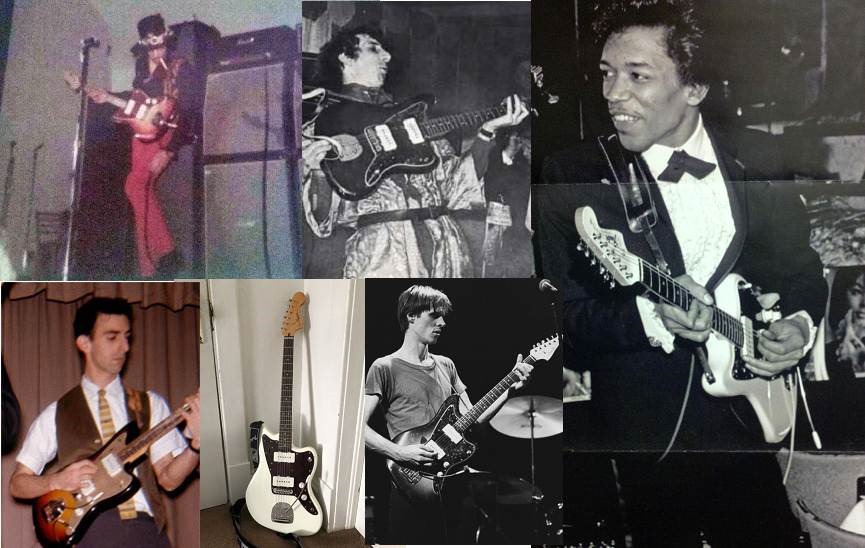
Jazzmasters! From the upper left: Jimi Hendrix without a Strat; Pete Townsend about to decrease the supply of used guitars; some guy named Jimmy James (wonder what became of him?); Frank Zappa, who didn’t say “The Jazzmaster isn’t dead, it just smells funny;” my Jazzmaster painted the homeopathic color Sonic Blue; Tom Verlaine, vanguard of the alternative nation which latched onto the bargain unwanted Jazzmaster in the 1970s.
.
A few notes on the music. I sometimes create the drum tracks for my compositions before the live session begins. And since I’m usually needed in the guitarist role, I sometimes lay down the bass parts with those tracks ahead of time too. That’s how this piece was. On the day of the session, I sang and played the wailing lead guitar*** and recorded the reading of Kevin’s words live with Dave playing a baaing/buzzing synth part live. Dave’s part, subject to his current hands, didn’t fulfill all the groove chop I thought the piece needed. So I added a second guitar part doing my best at rhythm guitar on my Telecaster, but a lot of the final groove you hear is an electric piano part that I laid down trying to imitate my friend and partner Dave’s playing as I recall it from the past.
By now I hope you’re ready to hear the musical story of Kevin FitzPatrick’s farm poem “Coyotes.” The player gadget is below for many of you. Don’t see that? This highlighted link is provided as an alternative so you can hear it that way too.
.
*I have to repeat this one, which I read in a comment thread this month regarding the upcoming Hollywood Oscar awards event: “The only Oscars I care about are Peterson and Wilde.” In the context of Dave Moore, even the young Dave wasn’t likely to stand toe to toe (finger to finger?) with Oscar Peterson on piano. On the other hand, I’ll hop on top of Oscar Wilde’s tea table in my slush-muddy Minnesota shoes and declare Dave’s poetic wit with Wilde’s.
**Other reoccurring characters weave in and out in the farm poems too — and while four-legged, the couple’s farm dog, the incongruous poodle named Katie, makes a cameo appearance in this one and others.
***The lead guitar part is played on a Jazzmaster, a famous failure in Fender’s otherwise wildly successful line of mid-century electric guitars. A couple of decades into its Edsel-hood of “what were they thinking” failure, unwanted used Jazzmasters became an affordable choice pragmatically chosen by some punk and alternative musicians. Even so, few think of a Jazzmaster for this kind of wailing lead guitar with a bit of funk flavor. As long as one is able to address the Jazzmaster’s bridge design issues, it can do that sort of thing.
Let’s celebrate our arrived spring with this LYL Band performance of another Kevin FitzPatrick poem. Here’s a link to the full text of Kevin’s poem that we used — a link which also serves as a reminder that Garrison Keillor’s old Writer’s Almanac program used this poem once too.
Not a satellite image of Antarctica, but a representation of how ice is fading and green emerging in Minnesota.
.
Like most all of Kevin’s poems this one yields a straightforward meaning to many readers or listeners without need of study or re-reading. As I mentioned last time, that was one of Kevin’s aims. You may also notice the care he takes with the word-music in this piece. In our little poet’s group, Kevin’s suggestions would often be metrical improvements, and isn’t the sound of this poem’s opening line: “Windy, sunny, and Sunday” a fine springboard into this spring poem!
If one expects, requires, or prefers a more allusive and elusive poetry, you could shrug at this poem on the page. The poem’s overall metaphor — that learning to ride a bicycle in childhood is representative of a parent and child’s task of independence and departure — is likely apparent before you complete the poem. Myself? I found the poem charming. I can come to like a poem that doesn’t charm me at first — but how many poems survive to be understood when we initially stand coldly next to them? Oh, some poems taunt you with mystery. Some ask you to be impressed with verbal richness. Some present unknown worlds you may choose to explore. “Bicycle Spring” seems simple. So, is it less good, or good only for lesser pleasures and less respect?
I’ve been writing, reading, and performing poetry for decades. I suppose I should have a valuable opinion on that matter. Sorry to disappoint, but I do not. Readers often tell me that my own poems and lyrics are too obscure and mannered. I personally prize originality in outlook and images highly, even at the risk of asking my readers/listeners to drop expectations and habitual/familiar ways of understanding a piece. Is that the best way, or do I even execute that way very well?
Way back in the 20th century I was taking a seminar class with poet Michael Dennis Browne, and in talking to the group he suggested that most of us students were writing poems that were more obscure than the ones he was writing. He asked, or at least strongly implied, that we should ask if that obscurity was necessary. I now ask you — as I continue to ask myself — to ask that. One thing should be key to your analysis: obscurity may be a way to cover up bad writing, insufficient intention, and fear — yes fear — of being understood.
Kevin FitzPatrick’s poetry was one poet’s answer to those questions. He truly wanted to speak to a broad audience, and yet at his death had achieved only a small (if appreciative) one. Dave and I are trying to enlarge that audience a little bit with this series,* as well as to memorialize our feelings after the death of our colleague.
Before I leave you with Dave Moore’s performance of Kevin FitzPatrick’s poem “Bicycle Spring,” let me point out that there are often little figures on the horizon or in the background that can add depth to the first hearing or reading of one of Kevin’s poems. In our first example this month “Blackberries,” I should have given you a link to the Seamus Heaney poem “Blackberry Picking” that serves as the distant core of FitzPatrick’s poem. FitzPatrick’s “Blackberries” is homey, humorous, even practical. Heaney’s “Blackberry Picking” is fatalistic, mildly tragic, haunted by waste. Kevin admired one poem, wrote another, and says so in “Blackberries.” To know the tragic and to choose the comic is a complex choice isn’t it? And in “Bicycle Spring” the background is there too, those concluding “blocks where he/has forbidden you to walk.” The father’s job is in part to help himself disappear.
The graphical player to hear the LYL Band’s performance of FitzPatrick’s “Bicycle Spring” is below for many. If you don’t see that, here’s a highlighted hyperlink to hear it too.
.
*Kevin’s poetry collections were published by Midwest Villages & Voices, and are not available through easily linked online booksellers or AFAIK, even directly from the publisher. “Bicycle Spring” is in his 1987 collection Down on the Corner which is ISBN 978-0935697025 and this information may help you get a copy via your library or local bookseller.
Here’s a performance of a poem in time for St. Patrick’s Day to start Dave and my celebration of the poetry of Kevin FitzPatrick. Longtime readers here may remember me speaking of Kevin late last year when he became seriously ill and then died. I even published a post then that discussed some things that FitzPatrick’s poetry did that my own poetry, or much other contemporary poetry, didn’t make enough use off. Despite that earlier post, I’m going to say a few more words about the value of his poetry you may not hear at first — even though most of his poems are clear, plain spoken, and easy enough to understand for most readers.
Right there is a first potential problem. Some readers have an “Is that all there is?” response to many of Kevin’s poems. To the degree that I knew Kevin’s internal processes I don’t think he was troubled with that “problem.” He wanted his poetry to communicate to audiences not inured to modern poetry which might communicate in a non-linear way or with great reliance on esoteric imagery. But just because FitzPatrick doesn’t “come in hot” with arresting first lines, occult mysteries, and outlandish similes or settings, doesn’t mean it can’t have some other values. In the series this post initiates, I hope to show some of those strengths.
This is the picture that seems most “Like Kevin” to me.
.
Today’s piece uses the poem that led off FitzPatrick’s final collection, Still Living In Town. And for St. Patrick’s Day? Besides Kevin’s own Irish heritage, this one is about taking a fresh look at Ireland’s Nobel Prize winning poet Seamus Heaney. Like Heaney, FitzPatrick liked to take a sly look at his subjects.
There’s a player below to hear The LYL Band’s performance of this poem by our friend and fellow poet. In our celebration of Kevin earlier this month we performed all the pieces live, one after the other, without rehearsals or preliminary run-throughs. This leaves some rough spots, sure, but perhaps we can take them as evidence of life for us left to sing against the taking from us?
There’s a fairly long intro before the words begin today, which documents how our recording session began: with Dave coming from the stairs into the studio as I am already commencing my musical part. He then needs to start almost without thought.
Oh, what if you don’t see the graphical player below? This highlighted hyperlink is another way to hear that same performance.
I started this inconstant month calling it “Unrequited March” — and I had this desire: to pay a more complete tribute to a recently departed poet I knew: Kevin FitzPatrick. In that task I wanted to see if I could rejoin with another voice and poet you’ve heard here: my friend Dave Moore.
Dave’s had some reduction in his ability to play keyboards, and he wasn’t sure how well his voice would hold up, but he was able to join me late last week as we took our usual “live in the studio” approach to doing some new pieces together, including a number of ones using FitzPatrick’s words. This requitement was doubly appropriate because Dave knew Kevin even longer than I did. Dave and I managed fine, and had a good time.
In the normal course of things those pieces would get worked on in the following week, but life has interrupted our singing back at death.
We are all racing forward and melting.
.
How? Even if one of this Project’s mottos is “Other People’s Stories,” I have qualms about telling other living persons’ events, so I don’t feel right discussing more details here today, but there have been hospitals involved, and some pretty long hours in the last two days in those places.
The outlook, best as I can predict it now, is that beyond my concerns with these other matters, my ability to work on audio pieces will be restricted for a while. If time allows, you might still hear some of the Kevin FitzPatrick related stuff yet this week.
Does it seem odd to work on art and our experience of it, even when other things must take precedence? That occurred to me too. Well, when I visited our newly hospitalized patient, they had two needs: music and Jacques Derrida. Go figure.
I ran long the last time, let me be short today. Last week after Ethna McKiernan died, Dave Moore and I talked briefly, and I said that I was going to try to write something for Winter Solstice.
“Make it a happy one” Dave requested. I’ve written at length about the losses Dave and I have had with poetic colleagues in recent posts, so for those who want more details, I’ll refer you to the last couple of posts here instead.
How far did I get to that “happy?” Not all the way. The piece I wrote and you can hear my performance of today is more at bittersweet. I’ve talked to Dave about how I’m hearing Kevin FitzPatrick’s and Ethna’s voices, very distinctly at times when I’m quiet. And since I knew them largely as poets, I’m hearing them reading their poetry. I tell you honestly I don’t find this eerie at all. I find it comforting. I expect that those voices will fade with time, but right now to hear them keeps them with me.
I suspect grieving people have heard similar departed voices since we first began to speak, and that those voices would be more sure to come on a long dark winter night. But here’s my modern variation: due to the pandemic the last few meetings of the Lake Street Writer’s group happened over Zoom Internet videoconferencing. I became accustomed to seeing Ethna’s face after she began her cancer treatment on the same home screen I’m typing this on, and so now when I’m on a Zoom conference I sometimes expect to see her face again as one of the squares on my grid — and I will allow myself to visualize my expectation. You can read all 2916 lines of “In Memoriam,” and you won’t find Alfred Tennyson having that exact image to deal with.
Here’s my own text I performed from. Due to short recording opportunities, I worked out the drums and percussion, and then rapidly laid down a bass, piano, and then an arpeggiated 12-string guitar part to further establish a harmonic flavor. I had time to quickly improvise three passes of a lead electric 12-string part, and this was the best of them.
.
Then the last time I saw Ethna McKiernan, it was her book launch reading at Celtic Junction on August 6th. I recall she wore a brightly colored headwrap on those last Zoom conferences, and for the public reading she was all in bright red. I melded those two visual memories with our seasonal gift-wrapped packages in the poem.
So those are some of the consolations the poem’s title refers to. And too, one of the fine things in winter and on winter solstice is to be inside, in our lights, at home with our partners, family, house-pets, and welcome ghosts.
Here’s what I speak of in the final line: our lakes and ponds and the still parts of rivers have ice surfaces now. Whichever side of the ice you are on: under it and in the underwaters, or over precarious ice not thick enough to securely separate yourself from those cold underwaters — laugh with more than happiness, laugh with that knowledge that that ice is a fragile and temporary division.
I fear this is going to be one of those bad elegies, one where the writer goes on too much about themselves and not about the person who has died. I’ve already mentioned that I find myself unacceptable and self-absorbed when I talk about myself, and saying that again only digs the self-dug hole I’m going to speak from today deeper.
In the mid-1970s when I moved to Minnesota from New York I connected back up with Dave Moore who I knew from a year in my aborted attempt at college. Through Dave I fell in with a literary group that varied in size and was herd-of-cats led by Kevin FitzPatrick. The group had just started a little magazine they called the Lake Street Review, Lake Street being a long commercial and industrial street that ran east/west through the center of Minneapolis: bars, gendered barber and beauty shops, warehouses, grocery stores, used car lots, a high-towered Sears linked to a rail-freight line and distribution center behind it, neighborhood movie theaters and former such theaters now grinding porn, the recording studio where “Surfin’ Bird” was recorded, a small attempt at a non-suburban shopping mall built on the tract where tractors and tanks were once factory-built, a “hardly a foot we can’t fit” shoe store whose upstairs apartments housed Robert Pirsig when he wrote Zen and the Art of Motorcycle Maintenance. Literary magazines generally preferred foreign words, or landscape landmarks like rivers, lakes, or mountains for their names. Yes, there were lakes at the west end of Lake Street, a self-improvement plan for nature dredged out from what had been swampy wetlands as part of a series of landscaped urban parks that circled Minneapolis — but let me be clear to those who aren’t from around here: calling an artistic enterprise The Lake Street Review was something of a provocation. This was a group of working-class writers with a non-academic outlook toward poetry.
The groups earliest meetings were held at a bar, and Dave noted to me that a large portion of the informal membership was made up of bartenders. Let me also set one other demographic fact: this was a group of men moving from their 20s to their 30s. Eventually the membership thinned out, and the remainder continued meeting in rotation in the members homes and apartments.
As the clan leader, Kevin was generally gentle and accepting. A high-school graduate, working in an urban ER, the again’er in me was attracted to the outsider stance, but Kevin also wanted the magazine’s public work to be acceptable to the parents and grandparents of us young men. The 1970s had still extended the “generation gap” of the 60s, so the “Seven Dirty Words You Can’t Say on Television” you also couldn’t say on the pages of the Lake Street Review. Feminism was mysterious, like women generally were to these young men, but those women were talking about it which made the mystery unsettling. Anything gender-queer was probably beyond the pale.
I liked those folks, but some of this rankled me. Kevin’s desire to speak across the generation gap as a poet was more noble than I appreciated at the time, but I wanted to go much more radically into discussions of sexuality and sexual roles than Kevin did, and what work I shared with the group privately I thought was underappreciated and misunderstood. I skipped off to two other groups sometime in the 80s, only to return to the Lake Street Writers Group after more than a decade away.
By this time the group had become smaller and more fixed in membership and was no longer concerned with the discontinued magazine. Four or five others, interesting writers and persons in their own right, were regulars, and then not; until by the last few years it became a quartet that would meet every month to share and discuss work in progress.
So when that group ended, it was Kevin FitzPatrick, Dave Moore, Ethna McKiernan, and myself. I’m not sure exactly when Ethna became one of the group as it was likely during my sojourn away from it. At one point she was one of two women generally attending, but as we contracted into the quartet, she was the only woman. As we aged it’s possible that this was less of a filter or division, even if it didn’t disappear. Another thing that happened as we condensed: the group had become predominantly Irish-American. Ethna’s father had been a force in the Irish cultural renaissance, something I was almost entirely ignorant of,* and Ethna’s speaking voice retained a distinct Irish pronunciation undertone. Kevin and Ethna took it upon themselves to establish an annual Twin Cities St. Patrick’s Day poetry reading, a reminder that non-descript leprechauns, green plastic hats, sham-shamrocks, and ever-filled and spilled red cups and flushed faces were not the sum total of Irishness.
Will I ever get to Ethna in this post? To my shame, I will speak more in silhouette, about myself. In many ways I felt the junior member of this group. Kevin and Ethna has several collections published. Ethna got arts grants, had an MFA. Kevin and Dave had degrees from fine private colleges, I was a High School graduate. I gave up trying to publish shortly after my temporary leaving of the group, and it would have been understandable if it irked Kevin and Ethna sometimes that here was this opinionated yet apparently non-professionally serious person taking up their time. I retained a close friendship and collaboration with Dave outside of the group throughout the decades, and grew to understand and appreciate Kevin’s artistic goals, but no such closening happened with Ethna. I knew much less about the details of her life, and what bits I picked up second hand, sometimes from the poetry itself and not from her own conversation, indicated a life with more than it’s share of staggering life events. I also got a not-unexpected sense that men had been part of some of those staggerings, something that she didn’t express much directly in our group of three men and herself. Here’s a statement: I know more about the life-details of Emily Dickinson than I know about the life of a poet, my own contemporary, who I shared a few hours with every month.**
Kevin’s mature poetry never seemed to aim at beauty as such. It is a beautiful thing to find beauty were it isn’t. Ethna indeed aimed for beauty, sometimes comforting and sometimes fierce, and as the saying goes, if you don’t know where you’re going, you’ll never get there. Ethna got there some of the time, which is all we artists can do. Looking through her recently published Light Rolling Slowly Backwards, New and Selected Poems it is easy to find that she was the most skilled poet in our little group, which sounds like fish-in-small-pond praise — but if you (who don’t know us) were to read her, I think you might find similar achievement to whatever other poets you read. When I read Kevin and Ethna’s last books during my yurt retreat early this fall I observed that while I had heard almost every one of Kevin’s published pieces in Still Living in Town in early draft form, I hadn’t heard many of Ethna’s. I know she attended more than one group sharing works in progress, but the amount of work new to me was surprising. I do plan to share one of her striking poems with you soon, but let’s wrap this long introduction up and get to the final part of my countdown of the most listened to and liked Parlando pieces from this past fall.
Three Irish poets: Yeats, McKiernan, and Campbell.
.
2. The Folly of Being Comforted by William Butler Yeats. Ethna never simply said something like “Read Yeats!” but before I encountered her I didn’t think much about him one way or the other. Now over the five plus years of this project you’ll have heard the fruits of that influence from her in my many well-liked presentations of Yeats. As I said when I presented it, Yeats was making a very specific point in his poem relating to his own life. I chose in my performance to stubbornly ignore what Yeats intended his poem to be about, and to instead sing it remotely to her on her hospice bed with my own intent. If I snub Ethna in this eulogy, I’ll ignore Yeats too. No respect.
It’s a challenge for me to work out my approximations of Jazz when I’m playing all the parts one pass at a time while being far from a master of any instrument. When it succeeds, as some thought here, I try to combine my simplicities (unimpressive I’m sure to a skilled musician) into something that still pleases when heard together. The highlighted title above will link to my original post on this where I discuss Yeats’ intended meaning, but you can hear my performance dedicated to Ethna with a graphical player (if you see that) or this highlighted hyperlink.
.
1. Reynardine by Joseph Campbell. Before the depths of their illnesses, I asked Kevin and Ethna if they’d heard of this early 20th century Irish poet, and they both drew a blank, which I’ve now found is generally true about this overlooked and worthy of more study poet. If Ireland is thought known for exuberant and willing to risk excessiveness expression, Campbell is never more masterful than when he’s compressing things to a handful of words.
Reynardine is a supernatural story in three short verses. From what I’ve been able to determine (see the original post on this) the supernatural element may have been introduced by Campbell, who took an existing long-winded run-of-the-outlaw ballad, and boiled it down with a shapeshifter element. After he’d done that, the resulting folk revival song, one sung by many of the best revival singers of the British Isles, always includes at least hints of that element. My presentation uses Campbell’s original lyrics, which I think are superior to those usually sung.
As far as it’s popularity here this fall, this is an odd one. The blog post presenting it wasn’t read much at all, and the likes for my explanation there of how Campbell transformed the Reynardine story were low in number. But the listens to the song (as with all the audio pieces here, available via Apple Podcasts or most other podcast directories) were easily higher than any other recent piece. To hear it now you can use the player gadget if your blog reader shows it, or this highlighted hyperlink.
.
*I once joked, confessing my cultural ignorance there, that my idea of an Irish writer was Frank O’Hara. Joke or not, someone somewhere must have addressed what connections O’Hara’s poetry had with Irishness, but I haven’t found it.
** It was only a year or two ago, after my interest in Dickinson intensified that I found out that Ethna too had a deep appreciation for that genius. Of course, I have my portion of blame for this, just as with this inappropriate eulogy, but suspect she believed that I wouldn’t understand or have any sense of her experience or sensibility. I’d estimate she was wrong, but saying that only adds to my inappropriateness here today.
Today we continue to move up the countdown to the most popular and liked piece from this autumn. I mentioned earlier in the countdown and elsewhere that during this year two poets that Dave Moore and I had grouped ourselves with over the years fell seriously ill, and this autumn they both died. Dave himself has been through a health swerve since 2020, but given that he’s alive and could tell his own story, I’ll leave that to him. I’ll just summarize that these three people were a large part of my direct and living connection to poetry, and my circumferential part of the ripples from two of them dying has been to sharply feel that human poetic-creation connection become past-tense.
Two of the pieces left in this countdown are remainder connections to those two poets.
4. Timepiece by Kevin FitzPatrick. This is one of my favorite pieces that I heard Kevin read even before it reached its final draft for publication. I believe Dave liked it too, and shortly after we heard it, the LYL Band performed it and that’s the recording you can hear below.
Kevin, like our other departed poet, Ethna McKiernan, was a consistent reviser of his work. Poets in groups like ours sometimes present work soon after it reaches a completed draft, but Kevin’s early drafts nearly always seemed close to “ready to publish.” Despite his reliance until far into this century on a typewriter and carbon paper, his drafts’ punctuation and spelling was always correct and the suggested and taken revision ideas often revolved around clarifying narrative elements that would be in the forefront of his poems.* Kevin also paid attention to meter, and when we’d see later revisions that would be another area he’d have changed.** As a group we could sometimes be brutal with each other’s work, but it was rare that Kevin would present a stick-out sore-thumb.
“Time Piece” (the title may have been a single word in the draft I performed it from) had one issue that I recall: there was discussion of the “incorrigibles” that the poem concluded hadn’t stolen the dead father’s wristwatch. At least one of us didn’t like it, perhaps thinking it an archaic, obscure or somehow too formal a word. Kevin nodded and said little as was his usual response to suggested revisions. I think I may have argued for incorrigibles, and since it was there in the draft we performed from long before the poem’s publication in Kevin’s 2017 collection Still Living In Town, that was still the word in my performance.
Well, damn it, Kevin’s dead, and it’s his poem, and he was good at writing poetry, but “incorrigibles” is the right word, and his revision for publication: “those slick boys” doesn’t have enough flavor. That Dick Tracy word-aroma is just what’s called for! “Greatest Generation” father, and a wristwatch after all! He also made one other revision on the published version: from “That he wasn’t scheduled for a boxing match at six” to “That he wasn’t scheduled to box at six.” I suspect Kevin’s ear thought the later better meter-wise. However as boxing has become a more obscure sport the shorter “box” may miss some readers.*** “Did he work in an Amazon warehouse?” some moderns may think.
“Timepiece” or “Time Piece” is a poem well worth reading or listening to. The LYL performance of the earlier draft is what the graphical player below will play, and if you don’t see the player, slug this highlighted hyperlink.
.
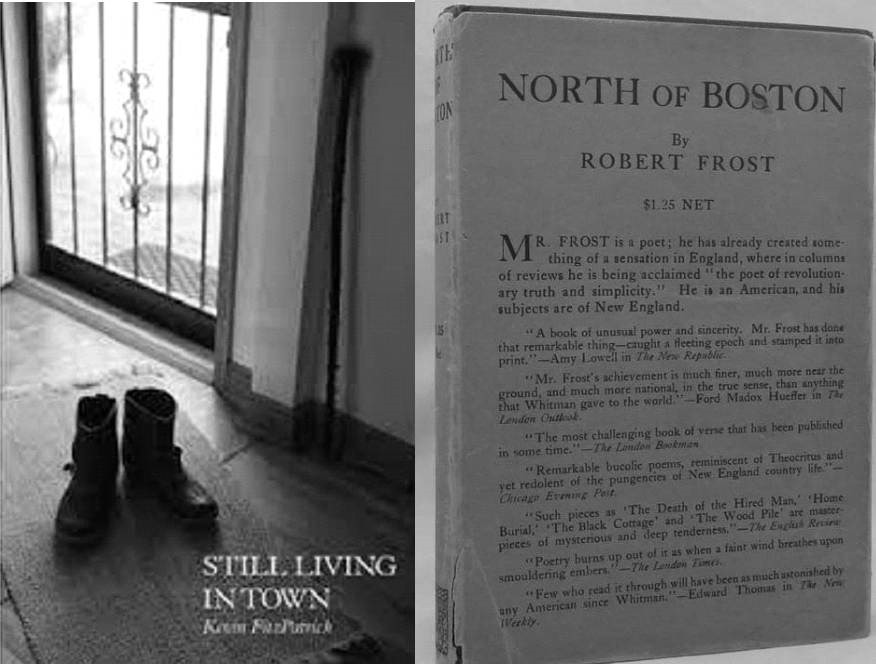
FitzPatrick’s publisher, Midwest Villages & Voices, doesn’t distribute online, but this link contains an ISBN and other info that may help you obtain a copy from your local book store or library. Then this other guy, Frost, has books available too.
.
3. After Apple Picking by Robert Frost. Unlike our other Frost poem in this autumn’s Top Ten, the metaphysical “Bond and Free,” you can feel this one. Particularly as Kevin began to spend his weekends working at his life-partner’s rural farm, I could see kinship between FitzPatrick and Frost. Both were drier than a Minnesota winter’s static humidity, both liked to observe human outlooks critically, and both of them could give you some of the tang of work tied to nature. I’m not sure if lifetime farmers are likely to write a poem like this, but someone coming to that work from something else, as Frost and FitzPatrick did, has the outsiders’ advantage of fresh observation.
When I presented this poem last month I thought about dedicating it straight out to Paul Deaton, who’s blog I’ve read for the past few years, in part to catch up on his accounts of small-format food farming, sometimes mentioning apple trees and orchards. But I wasn’t certain how well it fits anything Paul experiences. The apple trees of my youth were tall enough that ladders would be required, but the orchards I saw biking around Bayfield this fall have quite short trees, the kind where an adult would stand flat-footed to pick the fruit.
But maybe I should have gone ahead. Even though this poem has specifics, even to what aches after work, it’s about finishing a task. When another blogger I read: professor, editor, and author Lesley Wheeler wrote of getting to the final stage of a book-length manuscript, I thought of how I felt after finishing a manuscript decades ago. That same “Well, I probably missed a few, but I’m done with apple picking now.”
This post has gone long, though with things I wanted to say. Our next post will break from our usual Top Ten countdown, as it will deal with both the most popular piece, and the runner up, and I’ll talk more about poet Ethna McKiernan.
.
*More than once I’d say to Kevin “If I had had the idea to write something from this same material that you used, I’d have written a short story.” I remember once Ethna took me sharply to task for saying that, admonishing me that Kevin was writing a narrative poem. She misunderstood me, for I knew and admired that. Mixing into a short poem, with its almost unavoidable lyric immediacy and compression, with narrative elements sometimes even including a Joycean epiphany, is not easy. Once or twice, so taken with the story in one of Kevin’s poems I attempted to craft a short story from the same material, to demonstrate my point — and yet I could never complete one of those attempts. Kevin’s poetry may look unshowy, but it’s not easy to duplicate.
**Several years ago, Kevin and Minneapolis folk/blues revival pioneer Dave Ray of Koerner Ray and Glover engaged in a little side-bar about meter in Blues lyrics, with Kevin scanning their iambics. Kevin played a little blues harp, and Ray and Kevin’s dad were both in the insurance business.
***Kevin also boxed, and not in a warehouse way. He once wrote a poem which had as significant line “The boxer slugs!” Dave Moore’s punishing wit, after dealing with a lengthy group discussion about if that line would be misunderstood, was spurred to write an entire song about a garden beset by invasive…wait for it…”boxer slugs.”
It’s that time again when I present our quarterly countdown of the pieces most liked and listened to here at the Parlando Project during the past season. We’ll proceed from the 10th most popular and move up to number 1 in the next few posts. The bold-faced heading for each piece are links back to the original post that introduced the pieces here, in case you didn’t see them earlier this autumn.
10. Cobwebs, Steel, and Moonshine by Carl Sandburg. Longtime readers here will know of my admiration for American poet Carl Sandburg, and so it may be no surprise that this is actually the second time I used parts of a single Carl Sandburg poem for a Parlando Project audio piece. The Sandburg poem is “Smoke and Steel,” a poetic celebration of labor and laborers from a collection of the same name published in 1920. I used that whole poem’s title for the piece I created out of the beginning of it for May Day in 2019, but for this past American Labor Day I used the conclusion of “Smoke and Steel” and gave the result this title. I dedicated it to another American poet, Kevin FitzPatrick, who was suffering from a serious and unexpected illness that killed him later this fall. This is the first of three poems in this fall’s Top Ten dedicated to poets Dave and I knew and exchanged work with who were suffering mortal illnesses.
I’m thankful that long-time reader of the blog rmichaelroman submitted a good guess as to what the steel might be in Sandburg’s short ode to workers and work: rebar.
9. Bond and Free by Robert Frost. It’s been a while since I mentioned it, but Robert Frost bugged me when I was young. He was still alive, and omnipresent in anthologies one might find in school, which caused me to treat him like other 20th century poets and critics treated Longfellow: as a square preaching platitudes who stood in the way of younger and fresher voices who’d question all that with a more unruly poetry. I was misreading Frost of course, but through that error I did find others I thought in opposition to him that I found rewarding back then. Eventually I came around to love the word-music in his shorter lyric poems, and from that attraction found a starker and more divided meaning was there.
“Bond and Free” is Frost in his more metaphysical and frankly philosophic mode, which isn’t my favorite Frost, setting out here a cosmic stage where Love and Free Thought conflict. He sounds more like Shelley or Keats in “Bond and Free” than the more modern diction he was able to make sing in other poems, but sing the words do.
Three young poets at work. One played in the LYL Band.
.
8. They’re All Dead Now by Dave Moore. One of the most popular of my Halloween series this year, even though it’s a longer ballad form story that put my singing strength to the test. Longtime listeners here will know Dave as the most common alternate voice here at the Parlando Project as well as the keyboard player you’ve heard in the LYL Band.
He’s also a fine writer of poetry and songs. For reasons too complicated to deal with now, I fairly often sing Dave’s songs here rather than having him sing them himself. There’s a factor when someone sings another writers’ song. While they may bring a different kind of talent and musical craft, they may also somewhat misunderstand the song — or misunderstand (maybe more at “re-understand”) it in a valuable mutational way. Though I’m not a great singer, I do try to bring something to Dave’s songs when I present them here.
Every song stands to gain much more than one more life when sung by someone else. From time to time I’ve encouraged others to sing some of the Parlando Project songs. Anyone have their own cover of one of our Parlando Project pieces you’d like me to hear?