Langston Hughes’ “Cabaret”

Before we close the book on National Poetry Month and International Jazz Day, here’s a musical performance of a poem by Langston Hughes. I didn’t think I’d be able to complete it today — but the opportunity arose, and it’s more than appropriate for both observations.

Langston Hughes was one of the founders of Jazz poetry, and that style of reading poetry that interacts with a musical accompaniment (even if it’s not sung) is an influence for some of the performances you’ve heard here in this Project. I can’t say what year Hughes first performed his poetry that way, but there’s another meaning to Jazz poetry without a band: poetry that writes about the experience of Jazz music itself. And Hughes was repeatedly doing that in the early 1920s.

Decades later, a 1950s Hughes reads his 1920s poem “The Weary Blues” in front of a Jazz combo

.

This, a combination that appreciated Jazz, was not a sure thing in the early 1920s. Afro-American intellectuals and cultural critics were not universally fond of Jazz and Blues music, these great Afro-American Modernist musical forms arising right under their noses. There were reasons: it was associated with drugs, drink, criminality, and sexual promiscuity — and none of that promoted Black achievement and excellence in their minds. And some young white folks were taking an interest in Jazz for those very reasons. Tut-tut voices from both racial camps were observing their young people and thinking it was all about mindless, hedonistic partying. Let me repeat myself: when the last decade to be called “The Twenties” was called “The Jazz Age,” it wasn’t meant as a compliment.

I’d suspect this isn’t widely known to many readers. Jazz, to our 21st century Twenties, might be felt as supposed-to-be-good-for-you-but-boring-art music made up of too many weird chords and snobbish old men with a fetish for instruments you blow into. If we take it too seriously, too often now, the problem in the 1920s was they didn’t think it had a serious bone in its body.

Maybe it helped that Langston Hughes was a young man, a teenager when the 1920s began. He appreciated things in Jazz and Blues that even his Afro-American elders didn’t see. He knew it could be a balm to pain and disappointment, its expression and expiation — and he could see the art in it, an art to wrap into his poetry. This small poem of his, published in 1923 in the W.E.B Du Bois/NAACP The Crisis magazine, hears something others couldn’t: he hears a Jazz band cry — or rather his poem reports a woman heard this. Here’s a link to the full text of the poem.

Even in the shortness of his poem, note the dialectic here. The band, earlier in the night, had dancers, “vulgar dancers” it says. The older cultural gatekeepers at the Crisis would agree as they accepted this poem, “I see the young poet is aware of the dangerous moral unseriousness of the Jazz hounds.”

Why could Hughes hear what others didn’t? Well, he’s a great poet, and a poet that wrote often and empathetically of other people’s experiences. There’s another possible element. Do modern ears hear the poem’s second line differently than his readers in the last Twenties? “They say a jazz-band’s gay” he wrote. “Gay” in the 1920s would have clearly meant “happy.” As far as scholarship understands this, gay=homosexual seems to have come into use a bit later, perhaps in the 1930s, and to general readers, that meaning emerged in an even later era.

Hughes’ own sexuality is not something we know a lot about. Some say he was gay, some say he was asexual. One thing I get from reading Hughes’ early poetry is that he’s hearing and telling his stories not just from a stereotypical straight masculine viewpoint. Is it his anima that’s the she who “heard the jazz-band sob” in the poem? Or is he just listening to a woman?

Well, my performance of Langston Hughes’ “Cabaret”  is ready to be heard. Unlike the last piece, I made no pretense of Jazz music as it’s classically understood this time, but I do throw in some weird chord extensions. You can hear it with the audio player below. No player to be seen? The dancers have left, and some ways of reading this blog suppress the display of the audio player. If so, use this alternative, a link that will open a new tab with its own player.

.

Langston Hughes “Summer Night”

All too often there is someone dying that interrupts the summer. In my neighborhood, a musician* named August — even doubling the metaphors, named August Golden — was shot and killed last week. His friends speak highly of his kindness and good heart, and we don’t know exactly why he was killed when someone shot up a house concert in a backyard, wounding several and killing him. The story is the shooter came up, said nothing, fired a bunch of shots, and escaped running down an alley. There’s speculation that the attack might have something to do with the young gay and trans audience at the concert, and so — beyond the don’t-knows — that community has fears that this could be.

I’m thinking of August Golden on the anniversary of the poet Lorca’s killing in the midst of the Spanish Civil War. Revisiting Lorca’s story today to see if there was anything new — for example there have been multiple efforts this century to locate where the celebrated poet’s body was buried — I see that there’s also no agreement on who killed him in 1936 or why. It could have been Lorca’s politics, or because Lorca was gay, or even some personal dispute.

Today’s text is not by Lorca, but by his American contemporary Langston Hughes, a poem he called “Summer Night.”   You can follow along as I discuss my impressions with this link to the poem. Hughes doesn’t say what summer month this night was in, but it feels very much like August to me. In America, and its northern parts, August has endings all over it. Long daylight hours recede. The freedom of summer for the young approaches the beginning of school weeks. Autumn and cooler weather beckons, and I’ve started wearing a jacket on some early morning bike rides.

Langston Hughes in front of graphic

Young Langston Hughes, writer and poet, and one of the early proponents of “Jazz Poetry”

.

Hughes’ poem seems like that August of calendared endings, because he starts out with a litany of “lasts” in his poem. As in another Hughes poem I’ve presented here,“Railroad Avenue,”  what he sees is as much what he hears, and it’s full of music of his turn of the century youth: “last” pianos, a “last” wind-up Victrola record player playing Jazz, and the cries of others — or their absence — with a “last” crying baby ceasing to silence. This section ends with the whispers of a heartbeat.

Hughes’ poem continues with its speaker (for simplicity, let’s assume it’s Hughes) now refraining on the word “empty.” What’s this night empty of?**  Music and the companionship of voices. Hughes could have spent the entire poem describing tossing alone at night, but he doesn’t. He spends almost as much time on those things that depart in the poem. Maybe mechanical pianos don’t play in your neighborhood. Maybe it’s break-beats leaking from cars or punk rock not Victrolas, or the house on my corner that plays Mexican music on the weekend as folks gather under an awning on the front yard. This is what we miss when dying interrupts August. This noise that keeps us up, keeps us living.

For my noise tonight, I wanted to summon remote, leaking, night music. I decided to take a cue from the poem and use piano, but as I worked on the piece with my limited keyboard skills I chose to depend on sound design more than other musical ideas. The piano parts are simple triads, but mixed in the grand piano sound is a subtle melding of electric piano. And for the bass part, which was the musical line I followed when speaking Hughes’ words, I decided to mic my Epiphone Jack Casady hollow-body bass as if it was an acoustic instrument and to mix that with the electric pickup output the bass was designed to use. You can hear the result with the audio player below. No player?  This highlighted link will open a new tab with its own audio player.

.

*The stories told about August Golden make him out as an embodiment of DIY punk, the whole idea that you learn to make what you want to have happen by making it happen. I recently wrote of the same spirit as a large part of what animates this project.

**Expanding on that final section where Hughes also talks of desire and “Needing someone, something.” Hughes sexuality is something of a mystery. There are some who believe he was gay, and others who thought he was largely asexual. This poem was included in his first poetry collection published while Hughes was in his twenties, and we do know that in his Victrola-era youth he yearned to be a writer, while this was strongly discouraged by his father.

Completing my National Poetry Month daily posting with two beautiful pieces

It’s been quite the job of work to do daily posts with new lyric videos here this April in celebration of National Poetry Month, and I haven’t taken the time yet to see what impact those extra efforts have had. Though I was re-releasing already recorded audio pieces from the earliest years of this six-year Project this month, even the fairly simple lyric videos took more time than you might think — and then there was the selection of which pieces to present, as well as writing a few hundred words on what I currently thought of each of them.

Well, not only is today the last day of National Poetry Month, it’s International Jazz Day, and I felt I needed to make a nod to that today. So, let’s play two!

The first piece is, I think, one of the prettiest of the more than 600 performances we’ve presented: Carl Sandburg’s “Autumn Movement.”   Sandburg gets tagged as an urban poet, and of course he broke into the scene with Chicago Poems in 1914. But he grew up in a more downstate Illinois town, and traveled around the less urban areas of the country before spending the majority of his “now you’re famous” years on a small goat farm. “Autumn Movement”  is from his 1918 Cornhuskers collection, which as you might expect from its title is not all city living.*

Here’s Sandburg with farmland not skyscrapers

.

While “Autumn Movement”  is short in word-count, I did get to playing a bit as I tried my best to approximate in this piece the stylings of Bill Frisell with my Telecaster and fretless bass. Frisell, who can play more contexts more better than I can properly imagine, is usually labeled a Jazz guitarist. I’m not, labels or otherwise. I just have a lot of guts — but the result is  pretty.

As per our April thing, you have three ways to hear “Autumn Movement.”  You can use the player gadget just below. No gadget?  This highlighted hyperlink will do it too. And the lyric video is above.


.

And the bonus second piece? “Sonny Rollins, The Bridge, 1959”  is not an early performance (I performed and presented it earlier this year) but for International Jazz Day I thought it’d be good to have another piece that not only uses Jazz musical flavorings but actually deals with being a Jazz artist — or by easy extension, an American artist in any medium. If I’m not a proper Jazz composer or musician, I take great strength just from considering their achievements, their dedication, their originality. Given that most of the giants are Afro-Americans who’ve had a whole ‘nother level of obstacles and expectations to get over as serious artists — well, the mind boggles and the heart swells considering them.

And one more chorus: three ways to hear it: the graphical player just below this, the backup highlighted hyperlink, and the lyric video just a bit lower down on the page.

.

I hope this experiment has been enjoyable for the regulars here who may have joined the Parlando Project already in progress and who perhaps haven’t heard the earlier pieces — and it was my hope that it would also bring some new readers and listeners into the fold. If you’re one of those: welcome! I’m not predictable in what kind of poetry or music I’ll use, but I do consistently try to keep it interesting and varied, and I’d sure like to have you come along with me as I do that.

And here’s my ode to the inspiring Sonny Rollins in lyric video form

.

*I’ve always enjoyed the story of Bob Dylan seeking out Sandburg as the younger singer was just starting to reach a level of national fame in 1964. While trying to locate Sandburg, Dylan was unable to get the locals to recognize a “Sandburg the poet” he was seeking, but then they asked back if he was looking instead for “Sandburg the goat farmer.”

Robert Frost wrote a lot of poems about rural life, including many of his best and best remembered, but his contemporary Sandburg, Mr. City of the Big Shoulders, probably spent more time around actual farms and farming.

O My Darling Troubles Heaven

When we last left-off Kenneth Patchen he was beginning his career as a proletarian poet in the 1930s, writing a strikingly prophetic (in both senses of the word) poem about what the middle of the 20th century was holding in store. I’ll leave it to you to decide if that poem also speaks of our 21st century’s future.

Kenneth_Patchen_1952

I didn’t have time to discuss that Patchen’s 1952 Wikipedia picture looks like Thurston Howell from Gilligan’s Island.


Patchen never left his concerns with society’s dangers and constraints, it remained part of his poetry throughout his career until his death in 1972, but that’s not all or even much of what he became known for. Here are some of those things:

He was a significant influence on the post-WWII independent, largely non-academic Beat explosion. The bohemian aspects of his life and outlook, as well as the ways his writing expressed itself was a key living American model for the Beats.

And speaking of the Beats, he and his friend and fellow Kenneth, Kenneth Rexroth, were enthusiastic pioneers in the tradition of performing their poetry with musical accompaniment. Though many Beat Generation poems still live on the page, I’m not alone in hearing many of them, even when read in silence, as spoken voices, a jazz group cooling it behind. Patchen was more committed to this combination than most he influenced, touring his “Poetry-Jazz” in the late ‘50s.

Obviously, that style is part of what’s led to the Parlando Project, though I wish to expand on it. Patchen too seemed open to other musical genres with his writing: for example, a longer piece for radio performance with a musique concrete score by John Cage, “The City Wears a Slouch Hat.”

American bohemian arts flowed out from the Beat era, and Beat’s immediate predecessors like Patchen, in a series of connections and mutations. Diverted poet Jim Morrison used his psychedelic ballroom singer money to help Patchen publish one of his final books. And a figure as singular-seeming as Leonard Cohen has links in his expression that seem to connect closely with some of Patchen.*

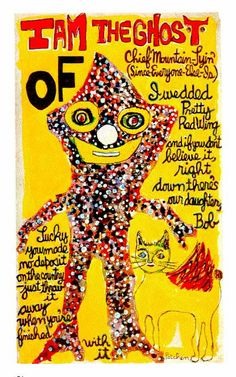
It wasn’t just music that Patchen combined his poetry with, but visual art—drawing and painting pages that were as much pictures as poems. While this has precedent in medieval illuminated manuscripts, the painter/poet/engraver William Blake, and some of Dada’s work, Patchen’s style of combining his own naïve art with epigrammatic text connects with some of the poster art of the Sixties.

I Am the Ghost art by Kenneth Patchen

Closer to Pedro Bell than William Blake? Art by Kenneth Patchen.


One of the reasons I so like presenting figures like Patchen or Blake is their “get in the van” indie spirit. Art does not need to ask permission, it perpetrates itself anyway, figuring out a way to use the resources it can scrounge together.

And lastly, another thing Patchen became known for, even if it wasn’t as widely imitated in the Beat era, was his love poetry. It would be restrictive to think of him as just a love poet, but it was a substantial part of his writing and audience. As the billboards changed from “The Beat Generation” to “The Love Generation,” Patchen was already there with his poetry. A case in point, today’s poem “O My Darling Troubles Heaven”  performed here by Dave Moore and the LYL Band.

So, enough talking without a band. Go ahead and click on the player below to hear Dave’s performance of Patchen’s poem.


*Like what? The love poetry combined with the prophetic social dread is a recognizable Patchen trope. The combinations of art and writing, such as in Cohen’s Book of Longing  can be similar. And while Cohen’s typical poetry plus music style isn’t often reminiscent of Patchen’s, the two obviously didn’t mind mixing those arts.