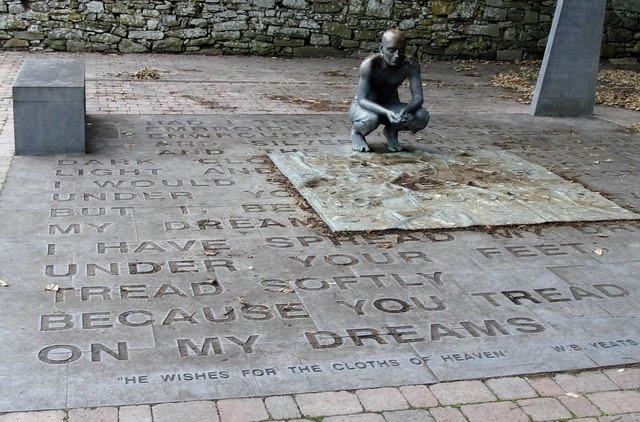
The Fisherman

Complaints about the size of the audience for poetry are far from new. So too, complaints about the quality of its audience. Throughout the course of the 20th Century, one increasingly common theory was to assume that a quality audience for poetry is likely incompatible with a quantity audience for the art.

We’ve just about used up two decades of our century, and that theory is still around. This quantity/quality audience-linkage belief is not always stated plainly, but it’s not hard to see its presence. Poets that rise to modest or surprising audience size will sometimes face some degree of backlash from critics. It may naturally be so that their poetry is less worthy by some criteria. This could be coincidental, honest criticism. It may be that it’s hard to find an audience for poetry criticism, as it is for poetry, so writing about better-known practitioners who have failed in some way helps grow the audience for the critic.

Another way to hold to this theory is to limit what poetry is allowed to do, to narrow its practice or even its definition. Spoken word or slam poetry? Not really poetry, or it encourages a poor selection of poetry’s virtues. Song lyrics? Self-evidently a different art, though given that the consensus canon of poetry is so different among itself, surely difference alone cannot be the criteria. Mix those two as rap or hip-hop and risk both  explanations of why it’s not poetry. Short, aphoristic poems? Too insubstantial. Long poetic forms once much in evidence, like the poetic epic or verse drama? No longer living forms of the art for the most part, if for no other reason than the type of poetic techniques the modern academic poet often uses can wear out an audience in a matter of minutes.

Myself, I don’t disagree or agree with those judgements in particular cases, and they could even be theoretically correct, I just viscerally dislike the idea that this thing poetry is so small and limited, that it’s a desert island disc for a few scattered islands, deeply loved by solitary coconut eaters with a very constricted shoreline.

When I break out of those narrow roles and rules for poetry, I will fail, and I do get discouraged. My limitations are bothering me two years into this project; and now 240 published audio pieces later, I may be running out of rules to break and the motivating pleasures of audacity.

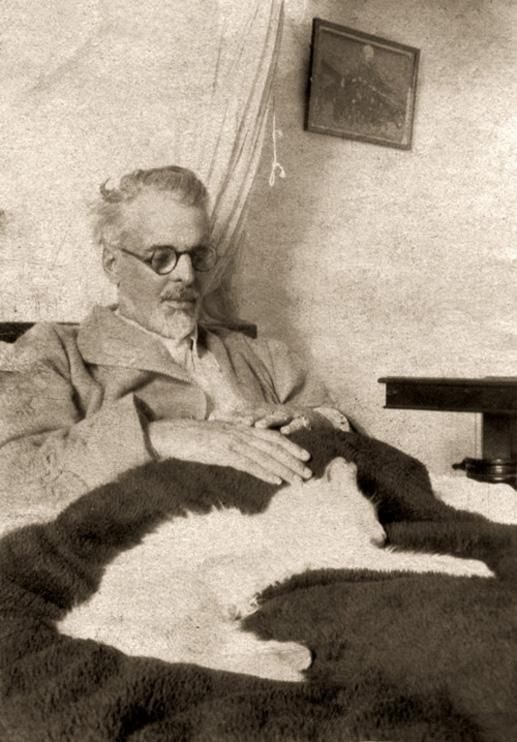
William Butler Yeats with cat

Also dreaming of catching fish. Are cat pictures the secret to gathering an Internet audience for poetry?


Here’s a piece today using a poem by someone who somewhat agrees with me: William Butler Yeats. In one way it’s specific to him, and his time. I’ve recently honored two working-class sport fishermen in one of my favorite pieces so far this year, but the fisherman in Yeats’ title, the simple man working his craft on nature to help feed himself rather than for hobbyist enjoyment—well, he, even in a much poorer Ireland of 1916, is admitted as imaginary.

Otherwise, how about those folks listed in the middle section of today’s piece that are harshing Yeats’ mellow? How little imagination is needed to see them today?

I admire Yeats in this poem, embracing his failure, even though he brought immense poetic talents to his work, so much so that I should be embarrassed to admit to that admiration. In one way, the fisherman here is Yeats, casting with deft wrist or verse, but not in the course of the poem catching anything. There’s a saying with the fishermen in my family, “It’s called fishing, not catching.”

But the imagined fisherman is also that audience Yeats seeks. Maybe once, Yeats says at the end, maybe once,  he can please an audience correctly, with a single valid poem and valiant audience—even if he can only see that audience in his imagination. I surely hope (and Yeats’ life helps me here) that the singular fisherman is an image for a possible greater audience, and not a headcount. After all, to write for something as large as “his race” (by which he means Ireland), is too small a target to hit, while that tweedy imagined fly-fisher inside his jacket might possibly expand to more countries, more times, more genders. In Yeats’ case, as with all artists, he failed; but he failed reaching for a larger audience with a larger poetry, a poetry which he risked allying with other arts. Many of us will not be able to accomplish that failure, but I’m glad Yeats tried.

You can hear my try to alloy William Butler Yeats “The Fisherman”  with a rock band by using the gadget below.


I Hear an Army

Metaphors, implied or direct, are a form of an equation. If E=mc2 or 2+2=4 then should fog=little cats feet? Well, not exactly. But for some poems the metaphor, the image and “what it means,” is surprisingly equal at each side of the equals sign.

Here’s a poem that Ezra Pound included in the first Imagist anthology in 1914, written by someone we don’t normally think of as an Imagist, or even as a poet: James Joyce. While Joyce didn’t consider himself a member of the Imagist movement, his fellow Modernist Pound considered this work consistent with its principles.

Oddly, the case for Joyce as poet instead of the instigator of the modern literary short story form and the creator of increasingly avant-garde novels has been largely carried forward by folks (like me) who wish to combine words with music. The James Joyce poem I first knew, “Golden Hair,”  came to me from Pink Floyd founder Syd Barrett’s lovely setting written in the 1960s and used beautifully a decade or so ago to begin Tom Stoppard’s play “Rock’n’Roll.” Today’s words from Joyce, “I Hear an Army”  was set to a complex piano accompaniment by famed 20th Century composer Samuel Barber along with two other Joyce poems as his 1939 Three Songs” (Op. 10).”

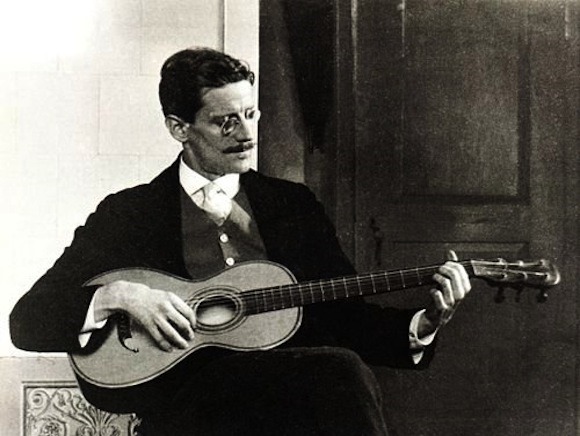
James_Joyce_Kicks_out_the_Jams

James “Blind Boy”Joyce kicks out the jams


As words, “I Hear an Army”  is very musical (the consonance of “whirling laughter” alone is exquisite!), but that element wasn’t rated as highly by mid-20th Century critics who redefined poetry as a literature of complex and hermetic language. Still, its central image shows a bilateralism that I’d like to point out. I think most will see this first as a love song with a strong and strange metaphor of loneliness and separation from one’s beloved as feeling like the invasion of a grotesque and threatening army. Loneliness=as oppressive and overwhelming as an invading army.

But what if we reverse the equation? Is an invading army, this oncoming hoard, this force of arrogance, also like the absence of love, the sundered heart and the steeled will? Invasion, war=separation from love and our beloved—separation for not only the invaded but the invaders.

When an image can sustain this kind of bilateralism, it gains tremendous power. Maybe not mass times the speed of light squared, the force that hung over my youth, cleaving dreams, and whose blinding flame is seeking to haunt us again, but power none-the-less.

Vase or Faces

Vase or faces? Bilateralism in imagery.


Not to dis Barber, a giant, but I think there’s room for a different way to present “I Hear an Army”  combined with music. If you use the player below, you’ll hear my original music for this, not Barber’s. Some take the Barber at rapid tempo, horses at full gallop. I don’t have a score to say what guidance Barber gave for that, but there’s a power in slowing dread—after all it’s a cinematic cliché to show an onrushing threat in slow-motion.

My predominant accompaniment for “I Hear an Army”  is a vocal chorus using different vocal timbres, including a low part using Himalayan Tuvan throat singing where two pitches are sung simultaneously. Other than the two short rock band interludes, the only “instrument” used is electric bass.


London between rain showers

Last night I saw the London production of “The Girl from the North Country.”  The play’s production illustrates well how context can change a work of art.

I traveled 4,000 miles to see a play in London written by an Irishman integrating work by a Jewish iron-ranger with a British cast portraying a multi-racial rooming house in what was once Minnesota’s second largest city in the 1930s. The Irish playwright is Conor McPherson and the integrated work was 20-some songs by Bob Dylan.

How much went wrong in such an enterprise? I suppose plenty. I could see seams, but it seamed not to matter much. The core idea, of placing Dylan’s songs in the context of the 1930s worked well. Songs you believed needed to be set in the beatnik early 60s or the cultural turmoil of the around 10 years we don’t name as a decade after that, or  against the Reagan/Thatcher or Christian fundamentalist revival and so on, lived inside different lives anachronistically.

Is it a Dylan musical? Not really. Minutes taken out of context could look like that somewhat new form, the Jukebox Musical, but the dramatic material is darker and more substantial than the kind of utilitarian connective material in a Jukebox Musical’s book. This is play with music, not music connected by play. The songs are all sung by the actors, and the musicians are all on stage, sometimes mingling in tableau. In one brilliant little piece of business, a drum set placed upstage has various actors in the cast sitting at it and banging out simple but effective Basement Tapes backing.

In the best moments, the songs (or portions of songs, few are sung in anything close to their entirety) function like an ancient Greek chorus, or at least as I read those classic Greek plays in English translation. The play (or book if you must) reminded me of Eugene O’Neill, someone I have not read or seen in performance  in decades. Poetic dialog was uttered often, but character context kept this from being overly artificial (it’s a very unusual cast of  characters).

The parts are well sung, and the all-acoustic band with period-correct instruments does well. Same with the acting, which ranged from excellent to good, in a performance that demands a lot from it’s cast. As an evening of theater my wife and I thought it was transcendent, as theater should be. At the end of the performance, about a third of the audience jumped up in standing ovation, followed slowly by another portion, perhaps a third again. As we walked out we heard the reaction of some of that sitting third, disappointed at what has been a very well-reviewed production. I have no idea what the London-usual is for ovations, but in the Twin Cities, everyone stands almost all the time.

My wife doubts it will ever have a U.S. production. She thinks the material is too dark to appeal to audiences seeking uplift for their expensive theater tickets. I’d add that the play’s plot is very indirect with lots and lots of dead ends and shaggy dog story elements. If one is open to that (as I am) this doesn’t hurt anything, but some will miss the comfort of standard story through-lines. By chance I saw “Three Billboards Outside Ebbing Missouri”  on the plane trip over, and its Irish screenwriter, Martin McDonagh, also setting his story in America, has a similar shaggy storyline, and asks for similar emotional commitment for unexpected sharp plot turns. McDonagh’s screenplay however, treats  most of its characters, most of the time, as morons. This is not a metaphorical epithet. I found it puzzling and ultimately disrespectful for no good effect that so many in “Three Billboards”  were played as being so dumb.

By contrast, in “Girl from the North Country” McPherson has two characters who frankly have mental disabilities, and yet even they are offered more discernment and respect from their author creator in his play.

You do not have to be a Dylan fan to enjoy this play, but you do have to accept a tale that starts with all in trouble  and finishes with things worse for almost all, and with a singing of “Forever Young” that could cause you to never hear the song the same way again.

 Keats Pharmacy crop

Actual storefront in Hampstead. A sour joke:
vaccination against consumption was not available to apothecary/surgeon John Keats

Today we paired my wife’s love of nature with my love of Keats by visiting the Keats House near Hampstead Heath. Keats House is the duplex that was Keats last rental home, and the place where he wrote many of his best poems. There are few real Keats artifacts, but the house contains some of them and replicas of others. Seeing Keats marked-up Milton books, covered with underlined passages and marginalia in Keats own cramped hand was one highlight. I’m no expert on early 19th Century English living standards, but the  living quarters seemed surprisingly middle class adjusted for the time considering what I knew of Keats struggles with money.

My wife caught a break in the grey gloom and rain showers to spend some time roaming the heath while I nursed a cup of tea and started some blog posts and people watching. I have no Bob Dylan to share today, but here’s a version of John Keats “In the Drear-Nighted December” performed by the LYL Band.

March 2018 Parlando Top 10 Part 3

We return with the next three in the count-down of the most listened to and liked audio pieces of last Winter. Like last time, all poets who worked in the 19th Century, but in this group, all men.

Two out of the three today are from the British Isles. In may be no surprise, given its head start in English literature, that Britain is an outsized contributor both in words to be used and the Parlando Project’s reader/listenership.

I’ll be taking my second, short low-budget trip to London this month, and I’m frankly not sure what I will find this time, other than planning a side-trip to Margate to see the Turner art museum there and its small exhibition commemorating Eliot’s “The Wasteland” which was partially written in Margate. I’ll no doubt re-visit the Blake room at the V&A, and who knows, maybe I should try to find that alley beside the Savoy Hotel?

JMW Turner Waves Breaking on a Lee Shore at Margate

The London forecast calls for rain, hopefully not JMW Turner stormy though!

4. Ring out Wild Bells

When I posted this for New Year’s I noted Tennyson’s level of fame when alive, something that even the most popular Instagram poet cannot reach now. What I found out afterward was even more intriguing, that this section of his long poem “In Memoriam A.H. H.”  has become a tradition in Sweden to be read at the turn of the year, sort of how the Times Square ball-drop is ceremoniously repeated in New York, or how Guy Lombardo would once appear with his Royal Canadians near the top of the hour on TV to play a Scottish tune.

As evidence of Tennyson’s fame, I noted that my little Iowa hometown had a major street named for him when it was platted back in the 19th Century. Eventually the town and it surrounding farms were settled largely by Swedish immigrants. The Tennyson and bell-ringing tradition in Sweden started in 1927, long after the town was founded and settled, but wouldn’t it have been good in the town’s heyday if the farmers, shopkeepers, and schoolchildren had gathered on the sides of the street on New Years Eve to hear a poem?

Instagram poets get knocked for the shortness of their verse and it’s focus more on remediation than demonstrating literary skill. Tennyson built “In Memoriam”  into a book length series of poems, but his focus too was on remediation, in his case, of grief.


3. The Wild Swans at Coole

Yeats was Irish, and for decades I’ve met monthly with a group of poets the majority of whom were Irish-Americans. Yeats seems to have seamlessly transported himself between the 19th and 20th Centuries, changing so smoothly that he could not be observed changing. Somewhere around the turn of those centuries he decided that poetry should be chanted (not sung) to music, and yet we seem to know little about how exactly that sounded. Contemporary reports (and that’s what we have, there are no recordings I’m aware of) were decidedly mixed, even derisive, and Yeats eventually set that quest aside. The recordings of Yeats reading that we do have are from decades later, and in them there may still be traces of that concept audible in his, by then unaccompanied, reading style.

Yeats warns listeners that his chant may not necessarily enchant.

Reports also tell us that Yeats suffered from a difficulty carrying a tune, much as I do. His chanted, not sung, idea did not come from that he tells us, rather it came because conventional art song had too much ornament and melodic elaboration, deducting from the inherent music in the words.

In the course of the Parlando Project I take various stabs at what Yeats was trying to do, recreation in the literal sense, trying to create from the ancient and natural connection between music and poetry some combination that doesn’t privilege one over the other. Sometimes it’s spoken word, sometimes it’s “talk-singing,” and sometimes I think it necessary to sing.

I avoid apologizing for my musical shortcomings. It never mitigates anything anyway, and I’ve always found the humble-brag distasteful. I’ve hesitated at—and decided against—releasing performances most often because of failures of my singing voice. This performance came close to staying in the can. At times it works, not from my skills, but because there’s a certain match in the failings in the voice and the meaning of the poem.


2. My Childhood Home I See Again

One last 19th Century poet, an American. Long-time readers here will know that US President George Washington’s teenage love poem “Frances”  has been a surprisingly persistent “hit” with listeners here. It didn’t make the Top 10 this season, but we now have another Presidential/Poetical contender in Abraham Lincoln. If Washington was all youthful alt-rock persistence, Lincoln is more goth, with a downcast you-can’t-go-home-again tale of all he finds missing when he re-visits his hometown in his thirties.

Lincoln’s “My Childhood Home I See Again”  was very close to the popularity of the Number 1 this season. If didn’t count the substantial Spotify plays the Number 1 received, Lincoln would have topped this season’s list.

I posted this for what was once a common U.S. holiday, Lincoln’s Birthday. Also on this season’s Top 10 are the Tennyson New Year’s post and Rossetti’s Christmas song posted on Christmas Eve. Not sure if this is a trend, but listeners did like the holiday poems this winter.


Tomorrow, the most popular audio piece.

The Wild Swans at Coole

Let us for a moment consider length in English language poetry. Despite the customary inclusion of one or two very short poems in most American poetry anthologies (“The Red Wheelbarrow   or “In A Station of the Metro”  typically), one can easily derive from them an accumulated mainstream judgement that poems shorter than a sonnet’s 14 lines are judged slighter expressions of less merit.

Similarly, in music, for all the glories of the mid-20th Century’s two minute and forty second 45 RPM single, serious composed music demonstrates greater regard for pieces of at least middling length, and the 20 to 70-minute symphony is still regarded with reverence. And so on with improvised music practice, which seem to find the five-minute mark as a minimum. Even the later 20th Century movement that got called “Minimalism” worked the idea of fewer motifs considered at greater length.

And so it is when we consider swans, the largest waterfowl, in words. Our last post and audio piece used Edna St. Vincent Millay’s “Wild Swans,”   a fine poem, but if one looks at the accumulated attention gathered in the roughly 100 years since each was written, Millay’s “Wild Swans”  is overshadowed by William Butler Yeats’ “The Wild Swans at Coole.”

Yeats’ poem is worthy of this attention, and he does pack a lot into his mid-length 30-line poem, written by a late middle-aged poet as his colonized country has experienced a failed revolution and his world has seen the shocking mechanized slaughter of the original World War. All that violence is subtext—not once is it mentioned—and as we read or listen to it now, that violence may no longer be apparent, though the background of disappointment remains.

Millay presents the swans as something she cannot comprehend as they fly over her, with her disappointment, her heart at present “a house without air.” Yeats on the other hand presents an almost OCD-level attention with the swimming swans at the beginning of his poem. He has apparently been counting them on each visit for 19 years. He’s going to count them again. And then they fly off in clamor before he can finish his count even though he reports an exact number.

The specificity of those two numbers is curious. Is the 19 years of visits to Coole in Ireland a mere biographical fact? Are the “nine-and-fifty swans” he’s counted an actual census he took regularly? I do not know. Given that Yeats had a long interest in occultism, there may be some occult significance in one or both of those numbers. They are both large numbers for the things they measure: anything one has done for 19 years has a resonance for that long a duration, and given how magnificent the sight of a few swans gliding on the water are, the idea of 59 of them viewed together is an image of overwhelming swan-ishness.

What strikes me most about the two numbers subliminal effect is that both end in 9, and so, seem to be almost at an ending. As the poem develops, Yeats returns to that effect.

These details, written in Yeats typical lyrical fluency, accumulate throughout the poem. The lake and sky repeating each other. 59 swans. The “bell-beat” weight of their wings as they heavily swing them into flight, equally straining, equally coalescing into aerial rings. Their companionable swimming on the cold water “lover by lover”—ah, there’s that 59 again, an odd number—at least one swan has no mate.

But he doesn’t say that. The poem is all its music, the image after image, the beauty after beauty mixed with the undercurrent of impossibility of its permanency. The world will change, the poet or the swans will not return.

19 years of repetition does not mean 19 years of repetition to come. 59 swans is all but too much beauty, but one swan is without a partner.

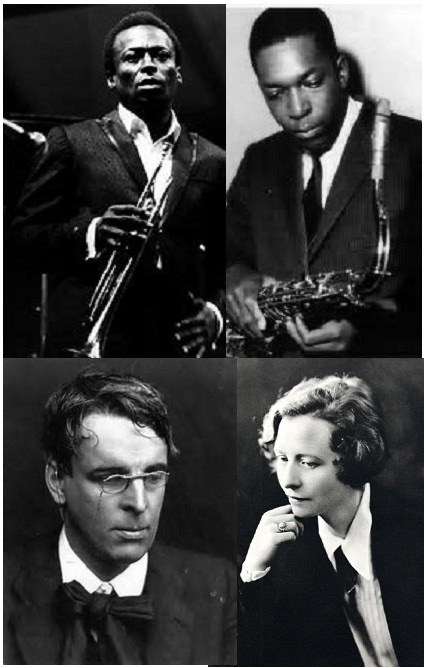
Davis Coltrane Yeats Millay

John Coltrane: “Sometimes when I’m playing there are always new sounds to imagine, new feelings to get at. There’s never any end.”

Miles Davis: “Try taking the f’ing horn out of your mouth”


So, do the 30 lines of Yeats mean it’s a greater poem than the 8 lines of Millay, an objective judgement causing its greater fame?

Why do I have to choose? If Yeats had written 60 or 6,000 lines would “The Wild Swans at Coole”  be better? If Millay had written 80 lines, would her “Wild Swans”  have shown greater skill? We can derive from how anthologists, poetry critics and audiences respond what their preferences are, even those they never articulate explicitly, but in the end it is the longer poems that make the short poems concise and the short poems that make the longer poems seem overwhelming.

How many times have I listened toKind of Blue?”  Does Miles Davis need to play more notes? Does John Coltrane need to play fewer? Looking at these two poems about swans, they illuminate each other.

The gadget below will play my performance of Yeats’ “The Wild Swans at Coole.”


The Return of the Exiles

It’s been too long since we featured one of the looser live performances of the LYL Band here at the Parlando Project, and with the interval, it’s also been too long since alternate voice Dave Moore has been featured. Given that we’re running up to Halloween, and that Dave has a long-standing interest in fantasy and scifi, it’s time to redress that.

Today’s piece is Dave’s adaptation of a short story by Anglo-Irish writer Lord Dunsay from Dunsay’s fantasy collection “The Book of Wonder”. The story is called “The Return of the Exiles.”

Avebury stone circle

Yes, it’s Avebury, not Stonehenge. Poetic license applied for.


Lord Dunsay is one of those writers who had a long successful career during the first half of the 20th Century, but who now gets mentioned more as an inspiration than read as a writer. His Wikipedia entry has one of the longest lists of writers who’ve acknowledged him as an influence that I’ve run across. Everyone from Tolkien to Gaiman has tipped their hat to Dunsay.

Lord Dunsay

Dunsay served in both World Wars and the Boer War.


Besides writing, Dunsay appears to have served in three wars. One hopes that future soldier-writers will be able to avoid reaching that achievement.

Dave adapted the short story to make it more musical, but his telling is generally faithful to the original. One detail retained, that I personally liked, is that our narrator is on a bicycle journey as the story begins.

To hear “The Return of the Exiles” use the player that should appear below.

The Heart of the Woman

There’s two things that attracted me to T. E. Hulme, the lesser-known Modernist poet and theoretician that I’ve featured a few times this summer. The first is the sense in his poetry and critical writings of the limits of humankind. The other is his poetry’s surprising modesty and restraint, something embodied in the very brevity of its poetic expression and his images linking the mundane and the cosmic.
 
This was a man who wanted to overthrow hundreds of years of poetic tradition, and a person whose stubbornness kept him in trouble with authority figures throughout his youth, and yet Hulme expresses himself in these spare lines, as if the first lesson he’s teaching himself is to know his own limits. This seems to be Hulme’s problem with Romanticism as he saw and opposed it: humankind is not limitless, though our imagination says otherwise.
 
Today’s piece, William Butler Yeats’ “The Heart of the Woman”  moves in opposition to that outlook, but not in opposition to that expression.
 
Here in North America, many in the southern region are spending this week either cleaning up from a massive hurricane or clenching their jaws in anticipation of an even larger one due to strike this weekend. Peaceful, Rousseauean nature this ain’t. Hobbes is is a weatherman.

Hurricaine Irma

“Come in she said, I’ll give you, shelter from the storm.”

Yeats’ poem is as measured and modest as one of Hulme’s, though it is rhymed and metrical. When one is a good as Yeats is at that, one hardly notices the form. 12 lines, not even a sonnet in length. Like Hulme, this is no great ode of endless argument. On the face of it, it’s a love song, a basic trope of Romanticism, the reason we talk about human attraction and pairing as “romantic.” Its images are centered on a couple embracing.

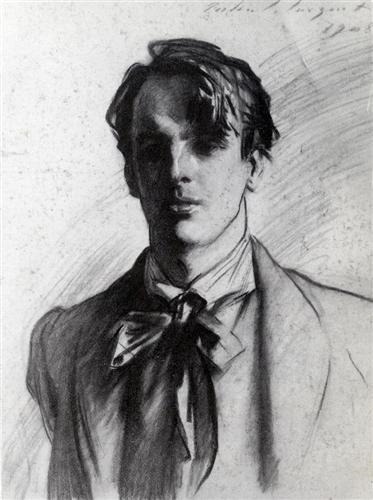
Yeats by Sargent
Why Mr. Yeats, I didn’t realize you were, well, dreamy, without your glasses

But look closely in those dozen lines. The woman who’s singing it, has left religion (“prayer and rest”) and family, and has followed a lover’s invitation into what is introduced as “gloom”. Merely the dark of night?

No, in Yeats’ lovely line, darkness is found inside the “Shadowy blossom” of her hair which will hide the lovers from the “bitter storm.” Now we are fully in the Romantic world, where our own darkness may be willful, wishful, blissful, ignorance of the “hiding hair and dewy (blurry) eyes.”

Are there any more Romantic and romantic three lines as Yeats’ final three that conclude this piece? If there are, I can’t recall any at the moment. That the simple murmurs of human breath can seem to equal a hurricane’s—is that glorious or folly or both?
 
In the spirit of defying human limits, this is the first time you’re going to hear me sing a Parlando Project piece acapella. And though Yeats’ poem doesn’t rule out the same romantic faith on the part of the “he” in this poem, I’m somewhat troubled by the idea that romantic devotion is presented here as female, from the poem’s title onward, so I’ll undercut that by singing this. My less-able singing voice is one reason that we chant or speak-sing a lot of Parlando Project material, but my young son’s carefree acapella singing is reminding me of the value in the singing voice. To hear “The Heart of the Woman,”  use the player gadget below.

To A Friend Whose Work Has Come To Nothing

Given that poetry contributes the great majority of the words to the half of the  Parlando Project “Where Music and Words Meet,” it’s reasonable to suspect, if you are reading this, that you like poetry. That’s too bad. Even during the National Poetry Month and #npm17 that were are talking about this April.

You see, poetry is often a frustrating thing. That high-flown language may be artful, but it’s an earful too. If you were seeking directions to escape some emergency, would you want your rescuer to choose the most precise and beautiful words, words that say more about what a clever speaker your rescuer is than about which way you must turn and where the dangers are?

Do you love the dense allusions and surprising metaphors of poetry? Do you admire the narrative fracturing and careful examination of the shattered facets that expose the common lie of ordered stories? The next time you are searching for how to work some complex gadget or system, do you want your tutorial or manual to scatter its tale in novel ways?

Speaking of too simple statements, here’s one: that there are people who simply like poetry. No, most people who like poetry sometimes, hate poetry sometimes; just as most people who like music, hate music sometimes. The intensity of the like times does not decrease the intensity of the hate times. I think it’s important that poetry tries to capture the allusiveness of things. I continue to admire some poems I don’t really understand—that’s what the music is for, both the poem’s own music and the external music we apply to the words here at the Parlando Project. But there are times when you just want a poet to come out and say what they’re getting at.

The words to today’s episode, by William Butler Yeats, are clear in their meaning. “To A Friend Whose Work Has Come To Nothing”  is an example of “occasional verse,” a poem written in response to an event. In this case, almost everyone has forgotten the event, but the sentiments of the poem apply broadly anyway. Yeats has such a musical way of expressing himself, he could have flown off on some obscure path and we might have followed him anyway. As it turns out, the things he leaves out here, the particulars of the dispute, probably help the poem survive as a general piece of council.

Still, I’m a curious and literal sort. Who was the “Friend Whose Work Has Come To Nothing,” and what was the work? It was written about and perhaps to a man named Hugh Lane who wanted to donate his substantial modern art collection to a museum he proposed that Ireland should fund. And the man who would lie unashamed to oppose this? A newspaper publisher who opposed the gallery.

Hugh Lane

Yeats gave him good advice, but he didn’t tell him to not get on that boat.

What happened to Hugh Lane, whose work had come to nothing? About a year after Yeats wrote this poem, Lane went down when the Lusitania  was torpedoed during WWI. And his art collection? His will seemed to leave it to the British National Gallery after his proposal to fund the Irish museum failed, but Ireland disputed this will, and later in the 20th Century, after Lane’s and Yeats’ deaths, Lane’s collection was again on display in Dublin Ireland. So eventually, in prosaic history and after the work of some lean solicitors, Lane’s work succeeded.

Dublin City Gallery

The Dublin City Gallery where most of Hugh Lane’s collection ended up

Today’s audio piece is brief, so take a listen to the LYL Band performing “To A Friend Whose Work Has Come To Nothing” by clicking on the player below or with this highlighted hyperlink.

.

Song of the Wondering Aengus

William Butler Yeats, when he spoke admiringly about the ubiquity that songwriters like Rabindranath Tagore could achieve, had already made his forays into setting his poems to music. As a sometime playwright, and a founder of the Abbey Theater in Ireland, he was already familiar with the dimensions performers can bring to words. Around the turn to the 20th Century he began to forthrightly seek to combine his poetry with music. Working in collaboration with musicologist and luthier Arnold Dolmetsch and performer Florence Farr he had a psaltery (a stringed instrument like a lyre or small harp) constructed, and Farr (a fascinating figure in her own right) then performed Yeats poems with it.

FarrPsaltry

Farr with the psaltery showing Joanna Newsom how to rock it

Yeats and Farr’s performance style was not a conventional art song setting of the poet’s words sung to a melody. Yeats explicitly rejected that (even though his words have often been set to melodies in the years since). Rather he thought the words were best chanted or intoned in a rhythmic and somewhat elongated speech.  Such performances are controversial then, and I would suppose they would be controversial now as well. George Bernard Shaw called Farr’s chanting “A nerve-destroying crooning,” but Ezra Pound and other early 20th century modernists took note, and they were influenced by these performances to add a more incantatory and musical element to their poetry.

Now let us break in our story for about half a century.

In the late 1950s an actor and folk singer Burl Ives recorded an album of Irish songs, and one of them was “The Wondering of Old Angus”, a Yeats poem sung to melody that Ives claimed he learned from Sara Allgood, another actor who had performed with the Abbey Theater group and would have likely known of the Farr performances. Around the same time, another folk singer, Will Holt began singing the Yeats poem to a very similar melody, using Yeats’ title “The Song of the Wandering Aengus.”  Then in 1962, Judy Collins, having learned the song from Holt, made it the title song of her album “Golden Apples of the Sun,”  which is where I first heard it.

No one seemed to know where the tune Ives, Holt, and Collins used came from. Those knowledgeable in traditional Irish tunes do not recognize it. Some credited Holt for it. However, early in the 21st Century a man named Bill Kennedy writing in the folk-song forum mudcat.org linked the tune to a transcription made by Dolmetsch accompanying a Yeats essay “Speaking to the Psaltery”  re-published in the Saturday Evening Post in 1907. The tune there of course was not meant to be sung, as Yeats discussed in this essay, but it is recognizably the one used by Ives, Holt, and Collins in their singing renditions.

So the tune may well be Yeats’ own, or perhaps it was composed by Farr or even Dolmetsch. Since the words are Yeats’, I’m going to call it, and make him the composer; and if so, that makes Yeats yet another singer-songwriter (along with Tagore and Dylan) to have won the Nobel prize.

But he didn’t sing it, nor did he intend the words to be sung. Since we at the Parlando project are working in something like the same vein, here’s a version, using more or less that tune, but chanted not sung as Yeats suggested. Instead of the psaltery, I used fretless electric bass, some bowed strings and Mellotron to elaborate the tune. To hear it, use the player below, though neither Bernard Shaw nor I will be responsible for any nerve destruction.


NOTE: I just noticed that I miss-typed “The Song of the Wandering Aengus” into “The Song of the Wondering Aengus” here. Oh my. This could be nerve destruction, or my hurry to get ready for a recording session this afternoon. Well, he is wondering after all!

He Hit Me First

John Renbourn, the English guitarist, and the subject of our last episode, once introduced a song in concert by saying he was now going to play an English song, “It’s a nice little melody—alas, there are just not that many good English ones.” As we said last episode, John’s repertoire was vast, so he had many musical traditions to draw from and could pick and choose. I mention this only in passing today, because when it comes to music, musicians accept no borders.

In the US today we have an odd holiday, St. Patrick’s Day, where we broadly and vaguely celebrate—well, not missionary saints. Instead many engage in an approximate celebration of Irishness, where amongst the dyed green rivers and dyed green beers, the “Kiss me I’m Irish” T-shirts, and the saucy leprechauns on everything, there is some occasional notice given to Celtic culture.

Saint Patrick

Indiana Jones : “Snakes. Why’d it have to be snakes?”

Alas, I have nothing prepared to be dyed green. I expect we’ll revisit Irish writers’ words soon enough though.

Instead I have a piece by the LYL Band’s keyboard player and alternate reader Dave Moore titled “He Hit Me First.” I think his words speak well enough for themselves, so I’m not going to add much here to them. When I asked him if the words were written about a particular incident, he told me that it was inspired by working on a book

Lester Moore

Lester Moore: preacher, Dave’s father

collecting some of his father’s sermons. Looking over a pre-publication proof of that book, and the sermons Dave decided to include there, I don’t see where Dave used any exact words from his father, Lester Moore, in He Hit Me First;  but I do see how Lester Moore’s inclination and approach informed it. Here’s a few words from a sermon Lester Moore delivered in 1981:

Christianity conquered an empire that was more cruel than Hitler’s Auschwitz.  And it was done by Christians who were willing to live the love that God gave them in the model of Jesus.

I sometimes wonder why it is that we still fail to see this. Christians who offer love in today’s world are called ‘soft-headed.’ But what happens when we bluster and threaten in today’s world? Are we nearer peace today because we speak in militant tones?

Psychologists tell us that we get a REACTION equal to the ACTION in the emotional world just as we do in the physical world. When we shake our fist at someone, we get a fist right back. So, who is soft-headed?

Love does not turn its back on evil. It does not pretend that evil does not exist.  Love stands firm and insistent. It is disciplined and ready to sacrifice. It cares about what happens to people, whether it has to do with freedom or hunger or health or hope.”

This is a complex subject, and I’ve only given Lester Moore a few words for his position. Knowing the action/reaction pair he speaks of, I anticipate one response, something I could summarize as “That’s all very nice, but in the real world, you may want those fists, that military, those soldiers to protect your music, poetry, and preachers.”

I will note only that Lester Moore earned a Purple Heart, Bronze Star and Silver Star serving in WWII, before he took up the ministry and eventually gave this sermon.

To hear Dave Moore’s He Hit Me First, use the player gadget below.