Here’s a poem that I’ve turned into a song for my second post honoring two Irish-American poets who led a St. Patrick’s Day poetry reading in Minnesota for several years before their death. Of the two, Ethna McKiernan had more direct ties to Ireland, having spent some time living in Dublin, and then in Minnesota running an Irish book and music arts store in the Twin Cities for many years.
For a part of those years I was acquainted with Ethna through the Lake Street Writer’s Group,* where a small group of poets shared works in progress and discussed on the side our lives and outlooks. When I look back on those years, I miss those writers, but I also fear I was inappropriate in critiquing their work, particularly Ethna. My style in that sort of thing tended to be highly detailed (picky might be a word), and even if I would lengthen my responses to their work in progress with “you could consider this or that alternative” because I believed in an honest “test reader” response without claiming to having some reliable recipe for a successful poem, or authority to ask them to change anything. That claim, that belief, should have opened me up to considering “so why then bother them (or myself) with these suggestions or reactions?” I have no academic training in poetry (Ethna did) and in my late twenties I gave up working at submitting for publication. Ethna did publish. She and Kevin each had several book-length collections as well as the usual small-press acceptances. All this would testify that whatever I thought about poetry’s workings, those ideas were unlikely to be commercially helpful.
Well, you can’t apologize to the dead. They either know better or not at all. I meant well, and I could be amazed by Ethna’s best poems. So, here’s to letting you know about their work here, which I hope is a pleasure for you. And if you would like more of that pleasure, Ethna’s last book, a new and selected collection finished as she was in her final illness, is available here from her Irish publisher.
I think I heard Ethna read today’s poem selection, “The Day My Mother Gave Me Away to the Tinkers,” more than once, including at one of those annual St. Patrick’s Day public readings, where it’s an apt choice, what with its Dublin setting. Before reading it, Ethna would instruct the listeners that, just as with many people of our shared generation,** her mother had issued the threat inside the poem’s title in jest, at worst during momentary frustration; and that the subject of her poem was but her teenage mind thinking in response “Well, I’ll take her up and that, and then she’ll be sorry.”
What else do I want you to know before you hear my song performance of this poem? First, for practicalities sake, there’s a man singing this mother-daughter poem. That might be a detriment. Otherwise? I made a mistake singing the name of a baker mentioned in the poem, Johnston Mooney and O’Brien. I dropped the “Johnston,” but at first figured no one would care, that it must be just some immaterial tiny particular bakery – but it turns out that firm is a famous and long-standing Irish baking concern, Oh well. I hope you enjoy the song anyway.
Forgot the “Johnston?” Never darken (or spread jam on) my doorsteps again!
.
You can hear it with the audio player gadget below. Has any such audio player disappeared? No, the gadget’s mother hasn’t given it away, it’s just that some ways of viewing the blog must want the audio player to not be seen (or heard) – and so I offer this highlighted link that’ll open a new tab with its own audio player.
.
*Alternative voice here Dave Moore, and our other St. Patrick’s Day poet Kevin FitzPatrick, were principals of the Lake Street Writers Group.
**My own mid-century mother had her variation of this “give you away” phrase, and but seven kids to test her patience.
Today’s piece was created from a poem written by the Irish poet Padraic Colum. Colum was born in the 19th century, then traveled through the world of 20th Century Modernism, and lived on long enough to overlap my lifetime. Looking at the outlines of his life I am pleased to report that Colum connects a favorite of this Project, the undercelebrated Irish poet Joseph Campbell* and the American mythological theorist of the “Heroes’ Journey” also named Joseph Campbell. With the American Campbell, Colum connected because he was a folklorist as well as a poet, and he wrote several young adult and children’s collections of folk tales and retold myths which I’ve not yet read. With the former Campbell, besides being Irish literary revival contemporaries, he collected folk-songs.** Like that Irish Campbell, Colum’s best-known work today is arguably a folk song.
Long-time readers here may recall that the poet Campbell is likely responsible for the song “Reynardine” being sung in a version featuring a supernatural, shape-shifting lover. At around the same time, and for the same publisher of Irish folk songs, Colum collected/wrote the lyrics to the song “She Moved Through the Fair.” Why the slash notation on the authorship? There’s some controversy if Colum closely adapted a traditional set of lyrics, or largely wrote original lyrics to an existing tune. Colum claimed he wrote the lyrics, making use of only a few floating lines that are folk song ready-mades. The challenge to Colum’s authorship strikes me as highly suspect: it’s based on another collector writing in 1970 that he came across an old man who told him he’d learned it as a traditional song before Colum’s version was published in 1909.
I suspect there’s someone out there who can do a better job singing this song I created from Colum’s poem.
.
“She Moved Through the Fair” was included as a poem in Colum’s first poetry collection “The Wild Earth”*** which also includes today’s poem. I note that “Old Soldier” has some similarities with the lyrical methods of SMTtF: both use spare details and leave out a great deal. Some of what is implied in the two lyrics may have become more obscure to modern listeners. SMTtF very early on speaks of the singer’s “lack of kind” which uses a now archaic meaning of “kind,” meaning family. “Old Soldier” opens with the titular old soldier going door to door. Since “hawking” (a hawker is a street-seller) is used as a verb in the second line I thought at first he was peddling, but from what I can find, no one sold flour that way. I think he’s begging for bran, which was then the discarded part of the milling of flour. That waste part after the wheat was milled or boulted, was thrown out or used as animal feed, though apparently the poor sometimes made use of it for human consumption.**** In the second stanza we meet the old soldier’s only companion, a dog, and the bran the soldier has garnered may have gathered mold.
I don’t know if “Old Soldier” has been set to music before this, but it seems every bit as singable as “She Moved Through the Fair,” and as soon as I read it, I wanted to sing it. I decided to use an arrangement soaked in South Asian musical influences, perhaps due to the wonderous extended version of the SMTtF tune played by Davy Graham. That link above includes one of Graham’s recordings of it, as well as Anne Briggs wonderous acapella version. Oh, hell, here’s that link again, click it indeed if you haven’t heard the song Colum made. Last week I recorded the basic tracks singing and playing a tune I created for Colum’s poem using my guitar in an alternate tuning driving a sitar virtual instrument though a MIDI pickup. To this first pass, I added harmonium, tanpura, tabla drums, acoustic guitar, and a final vocal.
Every one of those overdubbed passes felt good as I played them (save for my vocals, I’m never happy with my vocals) but the result was a whole bunch of tracks that would require careful mixing so that the instruments blended well. I set about doing that, working until midnight when I figured I might have a piece to present and saved a complete mix down. Awaking the next morning, I listened again, and the result wasn’t just flawed, it was a mess. A useful question for one mixing a piece of music with various instruments in an ensemble like this is “What track is the focus of the piece?” My putative mix had no good answer for that. The voicings of the chords on the sitar and the guitar didn’t mesh well. The harmonium and the tanpura were fighting over the same part of the sonic spectrum despite my efforts to give them their own sonic space. The tablas didn’t mesh with the acoustic guitar’s rhythm.
The wise solution would be to just re-track the piece. Maybe I should have more particularly considered that Davy Graham had made his impressive version of a Colum poem/song with only a solo acoustic guitar. But I would not have another opportunity to record with a sensitive open mic until this week, too late for Veteran’s Day. So last night I went to work stripping back the crud of my failed mix, leaving mostly the acoustic guitar and the vocal, with the tanpura and then the harmonium coming in for later parts of the song in turn. It’s not an ideal recording, but it’s my hope it lets one consider “Old Soldier” as song today.
The more palatable version can be heard with the audio player below. The song itself is simple, and the remixed arrangement that builds a bit as the song continues serves it better. You don’t see any audio player gadget? No, I didn’t remove that, it’s a side-effect of some ways of viewing this blog. I have a plan B for that too: this highlighted link that will open a new tab with its own audio player.
.
*Joseph Campbell, who also wrote under the name Seosamh MacCathmhaoil, was acquainted with the original London Imagist circle, and wrote what I think is some excellent short verse in the form. His life and literary career were brought low by siding with the losing side in the Irish Civil War.
**Given that I’ve been doing this project for a decade, the folklorest/singer/collector and poet is a combination near to my heart. Besides Colum and Campbell, two American poets from the same era, Carl Sandburg and Edwin Ford Piper did both things, and I’ve tried to briefly make the case that Sandburg should be more often cited as instrumental in connecting folk song with progressive politics and literary poetry in the United States, which eventually leads to the case of a Nobel laureate in Bob Dylan. Around the same time as all these others, elements of the “Harlem Renaissance” in Afro-American literature were open to melding folk song with high literature too (Fenton Johnson, Langston Hughes, Jean Toomer, Waring Cuney, Zora Neale Hurston).
I’m going to jump far afield before leaving this footnote: I’m writing this on the 50th anniversary of the release of the Patti Smith Group’s glorious debut LP Horses. The Patti Smith Group started because Smith, a poet personally immersed in colloquial music, a paramour of Fugs-adjacent musician/actor/playwright Sam Shepard, joined up with a guitarist/rock critic/crucial anthologist of garage bands Lenny Kaye, wanting to make unexpected poetry combined with electric guitar.
***Just when Colum’s The Wild Earth was published is unclear to me. My copy has a 1927 American printing of a 1922 edition. Wikipedia says “She Moved Through the Fair” was in a 1916 edition of the book, and then in their entry for Padraic Colum gives a 1907 date for the book.
****What, that’s the healthy part! Whole wheat! At the time the milled pure white flower was prized from making lighter baked goods and for a longer shelf life. The city I live in was growing rapidly at the time of this poem by finely milling the “Best” and the “Gold Medal” flour that had absolutely no bran or wheat germ at all.
I will not write much about the Yeats poem I present today. Unlike some others I’ve performed here, it’s quite well-known. Phrases in the poem like “things fall apart; the centre cannot hold,” “the ceremony of innocence,” “the best lack all conviction, while the worst are full of passionate intensity,” and “what rough beast…slouches towards Bethlehem to be born” have been quoted, reused, and brought out as touchstones and summaries alongside distressing events. Still, if you’d like to see the entire poem “The Second Coming” as it appears on the page, here’s a link.
Where folks do explainers for this 1919 poem, it’s usually pointed out that the Irish poet William Butler Yeats studied mysticism and magic, and alongside this short poem, he wrote other texts explaining his esoteric theories of the rise and fall of epochs. This was more than colorful stuff for poetry for him, he believed it, and believed that the 20th Century was some kind of end-times. Now that we’re a quarter of the way into the 21st Century, we seem to be running a little late — but Yeats was writing of millennia, so being off a hundred years or so might be a rounding error. And as he starts off writing of the cycles, the widening gyres of history, his sonorous phrases of dread keep coming back to us.
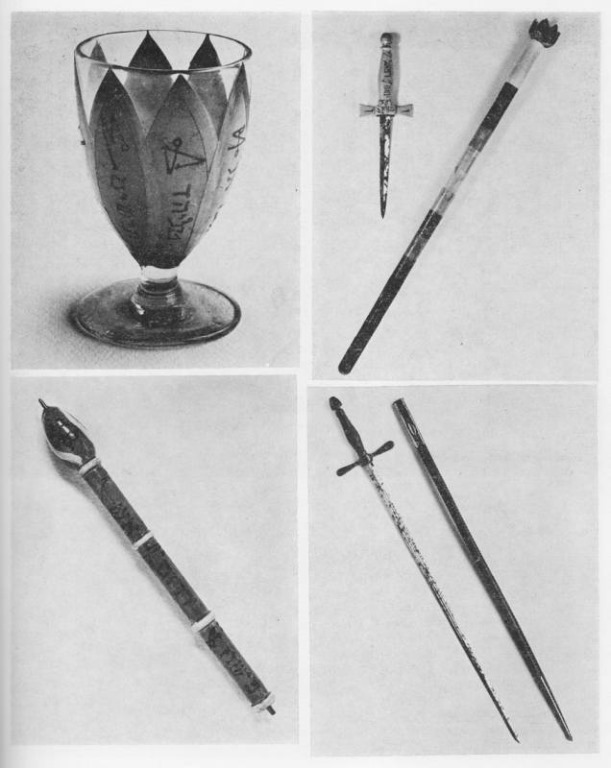
Yeats as wizard. Here are some of Yeats magical weapons. Photos from “Yeats, The Tarot and the Golden Dawn by Kathleen Raine” which I found at this web page.
.
Even ignoring all the mystical back-story, this is a poem about the breaking of nations. Therefore,“The Second Coming” fits with the theme of civic poetry, and I put this poem down on a short list of poems to consider combining with music for this April’s National Poetry Month, but we’re nearly half-way into the month before I could complete a version that I felt was presentable.* Given its grand scope it called for some big music, and my orchestral scoring skills have atrophied from where they had developed earlier in this project. Another way to make a large noise is to perform it with a full rock band, and I have been trying to recover my skills in that kind of ensemble playing this Spring. But there was another obstacle: I found that, unlike other Yeats’ poems, this one isn’t easy to fall into singing. The blank verse here tends stentorian, and I’m not a big-voiced powerful singer. For one stubborn section of the poem, I felt I needed to break into chant rather than try to keep the lyrical lift of singing. This sort of thing is a consequence of a composer needing to rely on a limited singer to realize the work.
The raw tracks I recorded for today’s song were somewhat messy due to the number of instruments: three guitars, organ, piano, bass, and drums, It was quite the operation to mix them even to my “good enough” level. You can hear that musical performance of W. B. Yeats’ “The Second Coming” with the audio player you should see below. What, has that rough beast not slouched onto your screen? It’s not the end of the world — some ways of reading this blog suppress showing the player gadget. Here’s an alternative, a highlighted link that will open a new tab with its own audio player.
.
*As I write this sentence, I take stock and consider that since this Project began 9 years ago, I’ve been composing and recording the more than 800 pieces presented here at a rapid pace. To create a single album’s worth of music in a month is considered a challenge — since 2006 there has been an “RPM challenge” to write and record an album of songs during the month of February. I’ve been doing something like that, nearly every month, for nearly 9 years!
Has that been good for the quality of the work? I don’t think the answer is a straightforward “Of course not.” While there are times when I wonder about some months-long work focused on a single composition, at my age I figure anything I want to explore or express needs to be a matter of getting down to it and getting it done as well as my current skills allow.
As our Halloween series continues, let me advocate today for an element of the fantastical: the goblin. Some fantasy creatures are, by definition, not fully alive: your vampires, zombies, golem, all animated undead meat; your ghosts “spirited” in some way, but incorporeal. The goblin, like all the variations in the fairy realm, seems akin to the human, but not in the beautified, glammed-up way that many fairies are depicted; and also, like the human, goblins seem subject to motivations and whims, not driven by some designed in need.
Puca is a goblin name of uncertain etymology, and specifics of their appearance and nature are like the word’s origin, broad-ranging. That non-specific appearance is baked into many accounts: they are shapeshifters. Some accounts link them to taking on animal forms: rabbits, red-eyed horses, and so on.* Today’s puca is related in a poem by Irish poet Joseph Campbell.** While Campbell is attuned to shapeshifters, his puca doesn’t change species or form in his poem: he starts and remains a hairy creature of the forest, human-enough to mirror human behavior, which becomes the signal incident in the poem.
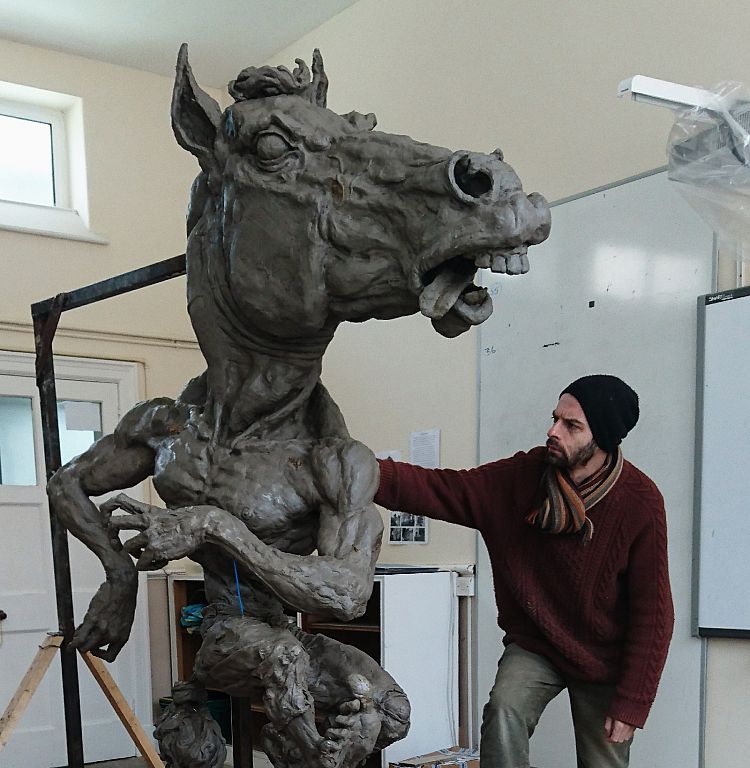
Shapes of pucas. I don’t know the artists for the two on the sides, but the sculptor in the middle is Aidian Harte and his mid-transformation depiction caused a commotion in the Irish town it was to be displayed in.
.
If goblins are unpredictable, portrayed as helpful and troublesome, this puca does in a way transform. In my reading of the poem, I sensed it describes something of a turn-about: rather than a human encountering a magical creature and then by elfin spell or trickery the human is changed, Campbell describes the opposite: a shy creature emerges, is observed laughing, dancing, poetry on his lips. And then a stanza later, his mood is sad, distressed, bitter. What causes this change?
The poem doesn’t say, but another creature, the poem’s voice is observing the puca. Let us assume he’s human, even that he may be the poet himself. The unhappy puca is said to have become “the double of distress.” Does “double” just mean equal to the happiness of the second stanza? Or does it mean the puca has taken on, mirrored, the human who has revealed that he envies the puca’s “sunny mood” in the happy verse before?
The poem ends by telling us this human/goblin encounter has caused the puca to retreat back into its cave, hiding itself. The puca may have been enchanted by the human’s sadness, and thus fled from the human’s thrall.
Unsaid in the poem, but I’ll ask: is the human changed by this encounter? While the puca instinctively flees the dissatisfied human, it’s the poet that’s telling us this story, and I think they’ve concisely explained that their bitterness has an effect, causing the happy fantastic to leave. Did the poet learn something from this?
I’ll add this biographic note on the author: Campbell’s involvement with the Irish Civil War that followed independence broke him. He was imprisoned, faced at least some danger of execution — and once released, he fled the Ireland whose culture had fed his art. His literary efforts tailed off sharply and the “gall and bitterness” that the puca demonstrates was Campbell’s lot in the last part of his life.
But this is a poem of Campbell’s early career, first published in 1913. Mute on the page, it set out a spell for me to set it to music. I think “The Puca” shows one of Campbell’s strengths: concision. A great many literary balladeers want to write epics. While I admire those that can vivify a 10-minute ballad in performance, I also observe that that endurance is beyond me — and Campbell, fresh from rubbing shoulders with the concise Imagists, has packed a charged moment in time into four stanzas — and if my reading is valid, more is evoked in the incident described than might be explicated in extra verses.
I tried for the eerie in the music I composed and recorded here: a certain wildness in the keyboard line’s contour and oddness in their timbre. You can hear my performance with the graphical audio player below. What? Such player has crept away into a cave or twilight glen? This highlighted link is an alternative, as it will open a new tab with its own audio player.
.
*Articles on the puca I read this month relate this creature to the Easter Bunny and the invisible friend in Harvey, generally benign creatures — but then, the red-eyed horse is said to offer rides home to the inebriated, the acceptance of which will lead to a wild, bucking, bramble-scratched ride, ending with the rider being bucked off in a field far from home. Unmentioned in the pieces I read would be the animated cartoon character of Bugs Bunny, the gender-fluid trickster that I’d see as in this tradition too.
**Obligatory footnote every time I bring Joseph Campbell up — no, not the Power of Myth guy. This Campbell is a deserving-of-more-interest writer of the turn of the century Irish cultural revival. Like many others of his generation, he was caught up in the Irish independence struggle, used Celtic folklore material, and dabbled in writing for performance (plays and song-lyrics) — but he was also connected with the Imagists and early English language poetic Modernism that emerged in London before WWI.
The Parlando Project’s thing: taking a literary poem and combining it with a piece of music isn’t a new thing. If poetry exists in every language, poetry combined with music exists in every language too, and such casual melding typically pre-dates the culture’s written poetry. We have just kept on doing it as a practical and immediate art.
This is National Poetry Month here in the U. S., but I don’t think I’m overly nationalist in the words I use here. Still, just as poetry and music go together, national and ethnic pride often takes poetry and song onto itself. W. H. Auden notably stated that “poetry makes nothing happen” but if we examine it the other way around, it’s unlikely that any great movement for change or nationhood ever has had no poetry and song associated with it.
As a poem “The Minstrel Boy” was first published in 1813 as part of the author’s collection titled Irish Melodies, and its central image is a harp carried by a “warrior bard.” It’s therefore apt that Moore combined it with music forthwith, using what he named as a traditional Irish tune.* Harps and lyres etc. are an extraordinarily large family of instruments, but Moore seems clearly to be writing of Ireland, where the Celtic harp has become a national symbol. At the time of its writing, Ireland was still under the long-standing, often cruel and exploitative, rule of England. Classmates of Moore had recently died in one of the periodic Irish rebellions.
The song also became popular in America, though I’m not certain how rapidly it took root here — but in the year of its publication America was at war with Britain for the second time after its revolution. And by later in the 19th century, the song had currency among Irish-American immigrants.
Ironically, Moore received a British diplomatic post to Bermuda, and in 1803 he not only visited the United States but met President Thomas Jefferson. The tale I read online says the two did not hit it off, and that Moore was not impressed with American chattel slavery. **
Since those times the song (or sometimes just the tune associated with it) has been closely associated with the armed forces, police, and firefighters — folks whose sense of professional duty includes risk of death. I find that ironic too, for the song’s minstrel boy is the definition of an untrained irregular, possibly underage, untrained (he has to borrow a weapon), and more of a singer-songwriter than a SEAL Team professional. *** This is one of those cases where tradition overwhelms close reading.
I’m performing this song as part of my NPM series looking at poems from a pair of 1920’s anthologies of verse for children: The Girls Book of Verse andThe Boys Book of Verse, and “The Minstrel Boy” appears in one of this gendered pair of books. In each instance this month I’ve asked you to guess which one: Boys or Girls. Today’s poem is a free square in that game, as one would easily guess this military service theme would be in the boy’s book — as it is. Indeed, The Boys Book of Verse has an entire section, Songs of Peace and War dealing with poems about battles and military service. The editors, both women, would have had recent experience of WWI, and whatever their feeling about warfare, they must have felt that subject was something their readers or purchasers would want included for the boys.
I stop to think here — as I do as I consider the entirety of this pair of “the last Twenties” books — that the first audience for these books would go on to experience a much greater and deadlier world war.
I’m likely not one of the best singers to have sung this well-loved song, but I performed it with a full rough’n’ready rock-band arrangement as best as I could peel off in this month’s accelerated schedule. My inspiration for singing this song? A similarly not-ready-for-the-most skilled-singer-contest one, Joe Strummer, who also recorded this song. You can hear me tear through those chords asunder with the audio player you should see below. If no audio player sullies your screen, it’s because some ways of reading this blog won’t show it. This highlighted link is your alternative — it will open a new tab with an audio player.
.
*The tune Moore selected, named as “The Moreen,” was said to be a traditional tune. Wikipedia says that no one has independently found a source of this tune from before its pairing with “The Minstrel Boy’’ — so it could be that it would have disappeared forever if Moore hadn’t tapped it for his poem about a doomed harper. That adds an air of mystery to the song, doesn’t it.
**The stirring final line stating the harpers fight was against slavery does and doesn’t require an explanation. Servitude in general, even government duties and tributes required from monarchs or tyrants, was often rhetorically called out as slavery, while American chattel slavery was totalitarian: humans — and with added cruelty, any families of those enslaved — owned in perpetuity like animals without rights of any kind. I read that this song was sung by both sides of the American Civil War — the “slavery” on one side rhetorical, the slavery on the other total and abject. When I started this post talking about the widespread tradition of nationalist poetry and song, take note: a corollary from Auden’s dictum may be that poetry and song prove nothing.
***This might be a fair poetic description of the Irish rebels that the teenage Moore knew, those who died in an ineffective rebellion. The long fight for Irish independence seems to have had an outsized portion of “warrior bards,” folks with less military experience and tactical acumen than literary and musical bona fides.
Did T. S. Eliot for Halloween* suffocate our audience with too much of the musty air of the classroom? I hoped those loud synth fanfares would set such terrors to run. Maybe not. Well, I’m ready to tempt you back with a bit of love and seduction, a song set away from graveyards and into castles. Our Halloween series continues, and this time with 100% wooden music I played on an acoustic guitar.
So, ladies in nightclothes flaunting impossibly flowing but still in good array hair, running through the forest under a moon over the branches kind of stuff? Maybe. First some literary history. Don’t worry, I won’t take long with that, and there’s a good creature-feature song at the end.
We started our Halloween series with Frost and Eliot, poets that many will know even if poetry isn’t an interest. Today’s piece uses words from a well-known name that when applied to a poet isn’t well-known: Belfast writer Joseph Campbell is that name. Yes, every cursèd time I mention his name here I’m required to say “No, not the Power of Myth guy.” Poet Campbell was a contemporary of Yeats. And like Yeats he visited London when F. S. Flint, T. E. Hulme, and the “What’s with the initials guys?” Yank-transplant Ezra Pound were taking up their make-it-new idea to be called Imagism. Several years before Pound and Flint published their famous essay on the tenants of Imagism, Campbell published some of the earliest Imagist poems.
Campbell’s relationship with Yeats is complex. They both were heavily into valorizing Irish culture. Campbell was even more so into Ireland throwing off its exploitative English colonial status. Both seemed to have an interest in the faerie and spirit realms, though Yeats had an interest in practicing wizardry, while Campbell, AFAIK, didn’t. Both had interest in music, but Yeats was specifically resistant to having his poems sung conventionally, while what of Campbell’s work survives (underrecognized) is as a lyricist** for songs better-known than he is.
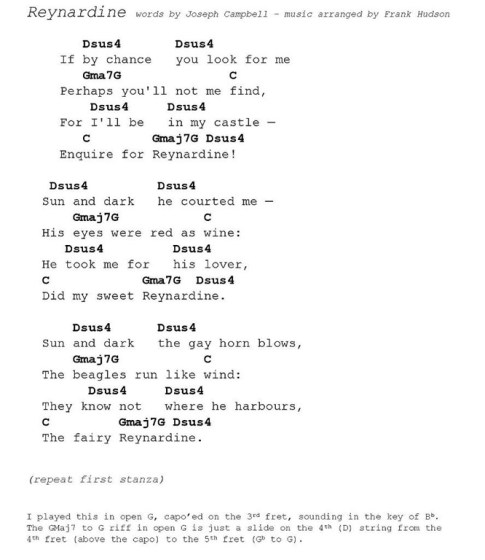
As a song, today’s piece, “Reynardine,” became oft-performed in the British 20th century folk revival. When those performers would present it, they would introduce it as an old song — which is true in part. Its melody is largely based on an old air. The name of its main character, and something in the general trope of “I’m in love with a mysterious bad boy” did have old ballad antecedents. But those revivalist performers would usually want their audiences to know that the main character, the haunting love interest the singer knows but society doesn’t, is a shape-shifter, a were-fox.
Campbell’s words as printed in “The Mountainy Singer” are better, more direct, than the lyrics usually used for performing this song. I made one change: Campbell has “took me for his leman” in his, and I translated this to “lover” for clarity.
.
As I discussed briefly when I first presented this one a couple of years ago: that doesn’t seem to be so in the extant pre-20th century versions of this song. In 1909, our “Reynardine,” now a were-fox eluding the patriarchy and foxhound driving hunters, was published in two books: as a collected Irish folk song from Belfast, and as a page poem in Campbell’s poetry collection The Mountainy Singer. This idea of the song’s dark hero emerged that recently, and I have every reason to believe it was the little remembered Joseph Campbell who cast him that way.
I did my best with my performance of this one, thinking I was emulating those folk revivalists whose work I greatly admire. The one special thing I did was use Campbell’s set of words as printed in his poetry collection. With one small alteration, I think they work well to sing to modern audiences, and his version has the compression and specific mystery that can make Imagist poems and short lyrical songs compelling when contrasted with lengthy poems and discursive sung ballads. Audio player to hear the performance below. No player? This highlighted link will open a tab with a player.
.
*Unlike the other pieces I’ll present in this series, my settings of Eliot are not listener favorites. I watch the stats here while not spending much time trying to maximize them. Eliot draws some interest outside the U.S., and very, very little from here in the States.
I also want to say that I want to celebrate Halloween this year (more about why later in this series) and I want to do it as Emily Dickinson once wrote she did in approaching some topics in her poetry “I sing, as the Boy does by the Burying Ground — because I am afraid.” But writing as Eliot did of his unreal city of corpses that can’t be hidden, and casting it as a song of fantasy, vision, or delusion, can be offensive in a time where real corpses are piling up not from natural death, but from human intention.
If I offend you, you likely aren’t reading this far. I assure you I offend myself in doing so. “You! hypocrite lecteur! — mon semblable, — mon frère!” “You! Hypocrite reader! — my fellow, — my brother!” quoted Eliot, quoting Baudelaire, quote I.
**Even as the composer part of most of the Parlando Project, I want to say that a pet peeve of mine is folks crediting a song solely to the music composer. I hear this all the time with contemporary songs, particularly when the melodist has sung the piece: Brian Wilson, Carole King, Elton John, and so on. Besides his unacknowledged work in recasting “Reynardine,” Campbell is the lyricist for “The Garten Mother’s Lullaby” and “My Lagan Love.”
Scrolling news and social media is how I misspend a lot of my time now, since the larger blocks when I can really bare down on artistic work are scarcer and less predictable in my life. Every so often someone famous in the 20th century will start to pop up unexpectedly in news article headings and post streams, a dreadful event. What is it this time, the back of mind thinks, nostalgia or death?
So yesterday it was Sinéad O’Connor that trended. One heading said the tense: “…she was….”
I was a little surprised at the building response, but shouldn’t have been. I have been aware, despite her shortish career in popular music, that her performances had a capacity to deeply touch people. There was a pure dialectic in many of those performances: fierceness and vulnerability simultaneously in an unstable state. When those two things exist at once, like flame and water, it’s dark and warm, bright and reflective, quenched and fueled.
When that combination resonates, it resonates deep with the listener. I myself have only the most inconsistent fierceness. There is an element of self-righteousness taken on as an armor that frightens me, no matter how just the cause, because I have seen the same armor worn on evil as often as good. But then, approaching injustice, as I may do with only questions and pain, seems to equivocate.
There was a pure dialectic in many of those performances: fierceness and vulnerability simultaneously in an unstable state.
My own oddest combination? I am something of a spiritual seeker deeply distrustful of every other pilgrim and certain that any mystical explanation obfuscates reality. This part of me may make me like and unlike O’Connor. As a human being I feel foolish and pretentious discussing any of this, though I hold my nose and type on today.
Yet, O’Connor, with her unstable and uncommon combination, should have taught me the insight that many are sharing in the past day: that there’s a human inside the armor. I knew that — but didn’t know that well enough. Art may be persistent in showing us that deeper knowing.
A person I know as a poet told me at a reading that he was playing with his Jazz combo on Sunday, assuming (rightly) that there would be some interest on my part. I told him I wasn’t sure if I could attend, since I live in a household with two distressed persons. They nodded as if they understood.
If you’ve noticed that this Project has been more intermittent, that’s much of the reason. The typical post here starts with looking for interesting texts, researching a bit about their context, composing, playing and recording the music, and then finally these blog entries about my encounters with the poems and the process of presenting them. The order of these events isn’t set in stone, occasionally there are gaps between steps, but it’s also common for each step to take an open-ended block of concentration. My desires to support those I love, their needs for quiet, and frankly, my unease held in common with theirs, has made that kind of focus rare for several months, wearing down what storehouse of steps I have for new pieces of work.
In place of that, I’ve taken up two things that more easily fill the odd-lots moments of time that come to me. I’ve increased Twitter promotion of the over 650 pieces in our Parlando Project archives found here.* I’m doing that enough that I’m probably seen by some as an ignorable nag by now, and the results so far in drawing traffic are only slightly better than my attempts on Twitter made during last National Poetry Month. Still this substitute effort to promote the various ways that music and words can combine makes me feel like I’m not abandoning this Project’s goals.
The other activity is reading, which of course has always been part of the Project, but I speak of reading that isn’t directly tied to finding a new piece or understanding its contexts. I’m mostly reading books about musicians, music, or poets for pleasure and as a reset from life stress.
But enough about me and troubles that aren’t yours. This post is getting tardy in getting to today’s work by William Butler Yeats. His “A Fairy Song” comes from a fairy story told in a verse play from early in Yeats career. Most recently we’ve presented a later Yeats poem “A Coat”in which Yeats is looking askance at this sort of earlier work and at those who chose to copy his early style. “A Fairy Song” is very pretty, and you could enjoy it just as fantasy word-music — decoration not declaration or anything much. I enjoyed the poem from first reading on that basis. In times of trouble, why not some dancing fantasy?
Easy chords & simple arrangement, and like many of my Parlando Project pieces, offered here in case other singers want to sing it.
.
However, after waking in the middle of the night last night I read the play The Land of Hearts Desire that this poem appears in twice, introduced inside the play by a fairy child. Let me quickly summarize the plot: a young bride is beguiled to take in a beautiful child who comes upon their rural poor Irish cottage at night. She gives the child food and warmth, and in return the child reminds her that her loving marriage means bondage to grinding tasks of life and family duties that will have no release until death — but if the young bride comes away with the beautiful child to the otherland of the faery, they will have nothing but carefree joy.
It’s a commonplace that fairy stories have psychological depth, and so to my mind in the middle of my night, I was ready to take this one in beyond idle fantasy. I hold for the loving marriage. I hold for duty. Ever the freedom and fate for breakage, ever the poverty or wealth of what we can give and bring — beside and knowing that — I’m for that above music and magic. And readers, I love music and poetry a great deal.
That poet who plays saxophone in his jazz combo? I waited until an hour before the show started, things were clear, I went off and saw them play. I was worried: jazz plus poetry is a formula that might each reduce the additive audience, but an appreciative 50 or so showed up scattered about the theater. A stranger a couple of seats over thought the keyboard player sang like Chet Baker — and yes he did. The playing was fine, and at my age I might have danced, but the fixed theater seat aisles would have kept a dancing ring from forming.
The next day I had what turned out to be a bit over an hour to find music from “The wind that blows out the gates of the day.”** I did so and quickly recorded this simple setting with acoustic guitar of Yeats’ “A Fairy Song.” You can hear it with the player gadget below. No gadget seen? This highlighted link will play it too.
.
*If you’re following the Elon-Musk-takes-Twitter farce of Internet doors opening and closing amid much bumbling, you may be curious about my take on this. No time today. There are some interesting people there, including a small poetry community — that size like all poetry communities. Twitter’s design, which long predates Musk, is conducive to folks like me with unknown blocks of time from a few minutes to sleepless doomscrolling hours. I personally find it impossible to keep up with WordPress on my phone, even though I treasure the blogs I follow when I can find time at a larger computer screen.
**If you’re interested in a deep dive into the Irish faery mythology that Yeats was using in his play and poem, this web page will give you quite a bit to go on.
Let me briefly slip, Wordsworth-like, into reverie, and note that “Oft, when on my couch I lie in vacant or in pensive mood…” I turn to the vast daffodilian array of scanned material available from a brief Internet search. I’d been thinking about Irish poets after reading this exchange between poets Ann Grá and Sean Thomas Dougherty. Grá asked “What’s the best way to improve one’s active writing vocabulary?” Dougherty’s answer? “Read Irish poets. Everything will improve. Including life.” Irish poets mentioned — and William Butler Yeats enters the chat. You may have noticed that I led-off last time by remembering a Yeats poem about a friend whose work has come to nothing. This all entered into seeking another Yeats poem to perform this week. I came upon this one. Poetry workshop devotees, note that I read it even though it has just about the most generic title imaginable: “A Coat.”
Then, as often now, what sits on the page as if it’s an objective bit of selected poetic criticism is really an insider comment from those who already know each other in some way.** Pound reviews “A Coat” specifically in his piece, just a few pages past the poem’s American unveiling. “Is Mr. Yeats an Imagiste?” Pound is rhetorically asked. “No,” Pound answers himself, “but he has written des Images as have many good poets before him.” In writing here about Yeats then current poetry Pound praises the directness of style and unfussy language and syntax the Irish poet is now using. He mentions that Yeats’ earlier poetry with a more 19th century music and setting has attracted followers and imitators in their now 20th century, but perhaps the imitators miss some of its vitality — so much so that Pound wonders if the reader would “Rather read Yeats in the original” than these bad copies. Pound’s conclusion? “I’ve not a word against the glamour as it appears in Yeats’ early poems, but we have had so many other pseudo-glamours and glamourlets and mists and fogs since the nineties that one is about ready for a hard light.”
So, why do Irish writers have something to teach us other English speakers about using our language. First off, as a colonized and exploited country, they may look at the language from a critical parallax. If it’s the language of your colonizer, your oppressor, you may want to ask what English words should do, and you have reasons to be warry of what they can do.*** And I have a second idea, less fully-formed, that the whole mists and fogs of Celtic folklore, to which Yeats added his own caldrons of turn-of-the-20th-century magic and occult stuff, offer a conscientious poetic distiller a chance to speak the shades of the ineffable vividly in their poetry because their folkloric traditions and magikal folderol have already saturated their personal needs for glamorous elaboration. Other poets embroidered robes, either traditional or ceremonial, will get caught in such, but if one can escape, you have the contrast of a new clarity. This clarity is different — you have the experience of having worn the long robe, and now the new Eden.
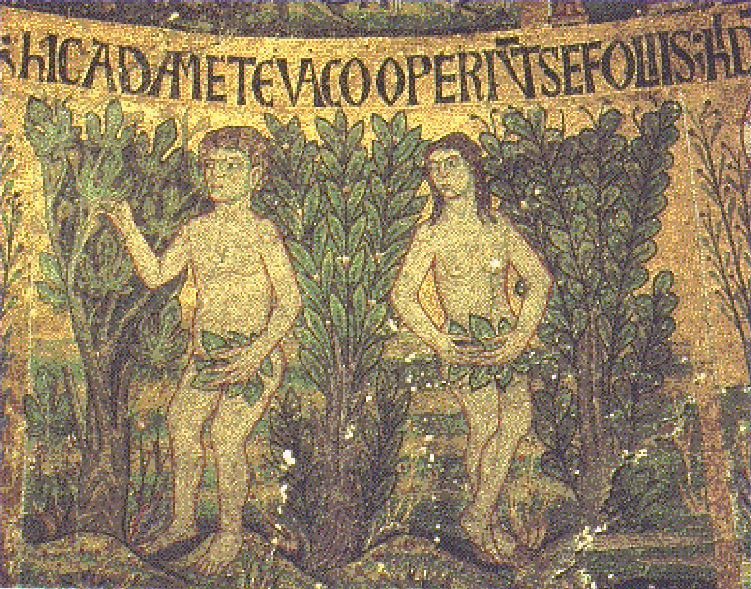
Eve ate from the tree of knowledge, then Adam explained plant-based couture Eve wonders why she suddenly knows the Latin genus Toxicodendron.
.
Today’s performance of Yeats’ “A Coat” has music for solo acoustic guitar, something that I’ve fallen back to often this past summer. The final guitar performance turned out to be an exercise in the various timbres I could pull from the guitar. The tuning and chord voicings used had several two and even three-string unisons which resonate and sustain, and then some contrasting pizzicato muted notes. You can hear it with a player gadget below — or if you don’t see that, with this backup highlighted link.
.
*Reading Monroe’s 1914 account reminds me of just how alien Sandburg’s poetry must have seemed to an early 20th century ear. To my 21st century ear and mind, I can more easily find the music in it, and I treasure now his Imagist “direct treatment of the thing” being applied to ordinary life, workers, immigrants, and the cultural powers that obfuscated that with elaborate English language.
**The American Pound and the Irish Yeats were both in London at this time. It’s likely that Pound himself was the conduit by which the new Yeats poems found their way into Monroe’s magazine. London then was the locus of the new Imagist ideals which stressed simplicity. Poets who wrote primarily in metrical and rhymed forms then, such as Yeats, Frost, Hardy, and Edward Thomas absorbed or resonated with this new, fresh, directness as a poetic effect.
***Though for various reasons this project has limitations on using modern English-language poetry, it strikes me that contemporary American poetry benefits from similar parallaxes. I was going to supply a catalog of those groups who know English as having been used as the language of an oppression, but it occurs that anyone who’d go with this thought can already supply their own catalog.
One unusual thing I did this spring to celebrate National Poetry Month was to re-release 31 pieces from the early years of this project. This was a way, despite reduced time and opportunities to create new pieces, to still celebrate and demonstrate the various poems and music combinations of the Parlando Project.
As part of this April celebration, I spent more time that I thought I would creating “lyric videos.” I figured I would just put in a couple of pictures in a video file and place the words to the poems on the screen in time with their appearance in the music, but they got a little more elaborate.
How popular were they? It doesn’t look like YouTube counts as views any plays of those videos from the inside-the-blog-posts thumbnail images, but it does count those who found them on YouTube itself. Given that sub-set it does count, the most popular of the April Poetry Month videos was our Parlando version of Yeats’ “He Wishes for the Cloths of Heaven.”No surprise there: William Butler Yeats’ poetry is welcome to so many ears around the English-speaking world. If I was to look at most viewed posts (a metric I don’t use in these Top Ten lists) four out of the top ten most viewed posts so far this year are concerning Yeats’ poems. Yeats is a Poetry’s Greatest Hits poet.
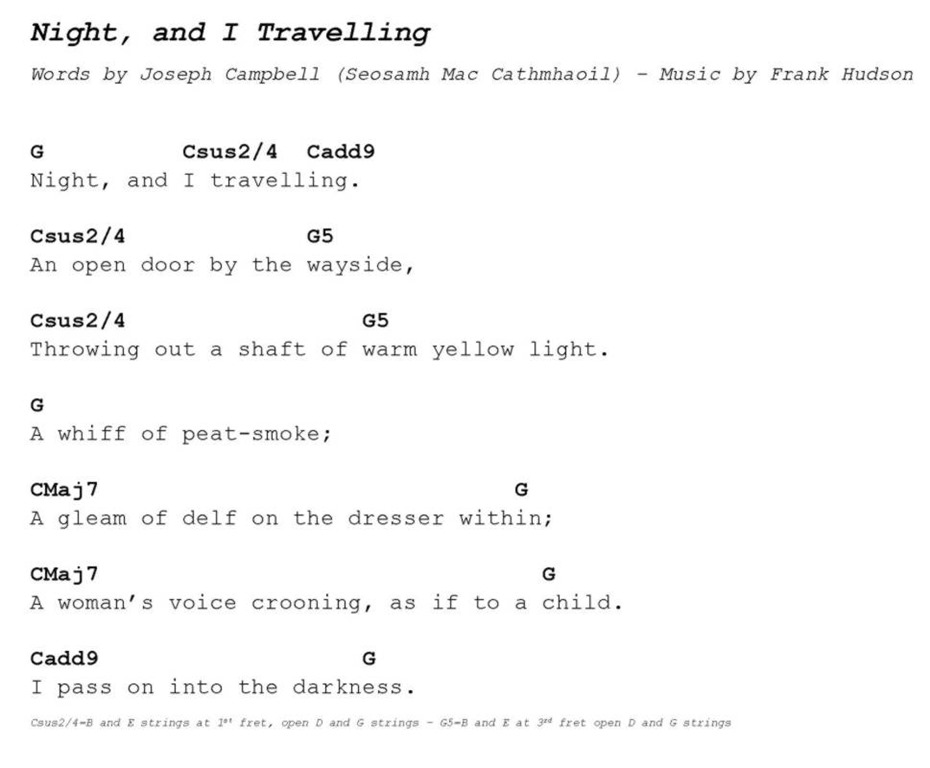
The most listened to and liked piece this past spring was an Irish poem, but it wasn’t by Yeats. It was one of the April Poetry Month re-releases though, “Night, and I Traveling” by too-little-known Belfast-born poet Joseph Campbell (who also published under the name Seosamh MacCathmhaoil).
I’m partway through a biography of Campbell that was an Anniversary gift from my wife. From it I’m getting more of a sense of the young man who wrote this poem — a poem which is remarkable not just for its tightly compressed and effecting scene, but for being published in 1909 so that it might be counted not just as the work of the first Irish poet to use free verse, but also as one of the earliest published examples of Imagism. It wasn’t until 1913 that F. S. Flint and Ezra Pound published their “A few Don’ts by an Imagiste” and laid out the three famous Imagist suggestions/rules, but before that in London Flint, Pound, and T. E. Hulme had been working out how to radically strip back poetry to a fresh, precise, and direct essence in the months before Campbell published “Night, and I Traveling.”
The chord voicings I used for the 12-string guitar part here are bit unusual.
.
I now know that Campbell was in London and meeting with those incipit Imagists in that first decade of the 20th century. Alas I don’t know how junior a partner he was in their meetings, but “Night, And I Traveling” is to my judgement as fine an early Imagist poem as the more famous and anthologized ones, arguably a more worthy example because of its empathetic attention to the isolated rural woman in a still-colonialized Irish hut in place of Pound’s damp impressionistic leaf-faced Paris Metro riders published four years later.* The biography, Joseph Cambell Poet & Nationalist by Norah Saunders and A. A. Kelly, reminds us that Campbell liked country walks at night. Campbell wrote: “Night walking — all my best thoughts, I find, come to me that way. Poetry, like devilry, loves darkness.” Devilry? Campbell did write some of the supernatural, and would mix Christian and pagan mythologies —but in this one, this night, he stays in our earthly plane. Am I reading too much into the poem to note the poem’s only simile has the lone woman crooning “as if to child” when there is no child depicted? Is that child dead? Or perhaps emigrated to America?
Not as popular as Yeats on YouTube, but here’s the “lyric video” I did for this piece
.
You can hear my performance three ways. The “lyric video” is above, an audio player gadget should be below, and this highlighted link is a backup for those ways of viewing this blog that won’t show the player. Thanks again for reading about these encounters and listening to our combinations of music and words.
.
*Make of this connection what you will: Pound and Campbell would both eventually be imprisoned by their own countrymen for acts during wartime.




 Frank Hudson