I’ve been a bit long-winded in the past few posts, so a short-winded post about today’s piece. The words are another poem from Carl Sandburg, this time from his 1919 collection “Cornhuskers.” There’s not very many words to it, a warning that there are not many leaves left here in the upper Midwest.
They were listening in London, and Sandburg’s “Cornhuskers” won him the Pulitzer prize.
Many of the Sandburg poems I’ve used previously have been from his landmark “Chicago Poems” collection, but Sandburg, a child of middle, rural Illinois, spent time across the Midwest in his youth, from urban centers to the farms and small towns. The poem I use today, “Autumn Movement,” is from that rural setting.
Images for autumn and fall foliage have been mined forever, which makes Sandburg’s key image here as unusual, even a century later, as T. E. Hulme’s red-faced farmer appearing as the harvest moon in his British autumn poem. Sandburg has the red and yellow of autumn leaves in a farm field vista as a yellow scarf with the copper color of a literally red-necked woman. So nearly has this skin color become an epithet, that few would think of using it today, as honest an image as it is.
Today’s audio piece is musically ars longa to the vita brevis of the words. I’ve been telling myself to allow space compositionally, and then going ahead anyway and filling things up like a compulsive cluttered room with only paths between piles of old newspapers. So, for this one, the drums (which are often quiet and spare) are the densest element. I added a simple bass line played on my fretless bass, a theme played on a Telecaster, and a digital synthesizer part that is a mix of four different patches played together rather than filling up the space with multiple synth parts. Give it a listen with the player below. Or if you don’t see the player, you can use this highlighted hyperlink to play it.
In 1899, as the 19th Century was leaving in Victorian London, a 13-year-old boy from a large poor family left school and went to work at whatever jobs that could be found. An unremarkable story.
After several years, and some job security as a civil service typist, he could enroll at a workingman’s night school. This story too, unremarkable.
Men and women with stories like this often go on to form families, start small businesses; or slip into slightly better jobs, finding what opportunities are left unguarded or unattended by those who started further up the economic ladder (or wall). Working diligently, they sometimes become the mothers and grandfathers of poets and scholars, preachers and social reformers. That’s not the way this story goes however.
This teenager moved quick, and found out he had a talent for language, not only his own native English, but German, Spanish, Russian, Dutch, and French too—they all came under his control. He accelerated himself beyond the speed of night school, and in a matter of a couple of years, our young man became a poet and a leading proponent in his time for avant-garde French poetry. And then he began meeting with some other poets in the cafes of London.
This man was F. S. Flint. It would be easy to pair him with one of those artists he was making talk and friendship with: T. E. Hulme. Neither had privileged backgrounds, and both are too little known, read, and studied today. In 1909, ten years after this boy had left school at 13, the meetings in these cafes included not only Flint and Hulme, but Ezra Pound, H. D., Florence Farr, William Butler Yeats, and Robert Frost. What they were plotting was a poetic revolution—one that would succeed, and become the dominant strain of English poetry for the rest of their century.
Although all of them had avowed influences, often ancient ones—English and Celtic bards and Latin, classical Chinese and Greek poets—they were resolved to “make it new” in Pound’s famous motto. They all wanted to change the language and the sound of English poetry, and since words and music are what make up poetry, they wanted to change everything about it.
In terms of language, the thoughts centered around removing decades, even centuries, of encrusted dead metaphors that no longer had any meaning. The imagery in the new poems would need to be fresh, different, vital and intrinsic to the poem, not mere decoration. Extensive, romantic effusions of feelings would be replaced with palpable images.
The “School of Images” was coalescing. By some accounts it was Flint who suggested tacking the suffix“-ist”, (in French “-iste”) to “image” to brand the movement.
In terms of poetry’s music, there was less agreement. Yeats and Farr were trying to invent a new kind of chanted poetry to music. Frost and Yeats would write some of the most accomplished metrical poetry ever written in English, but with a naturalness that made it disappear into unfussy verbal music. Pound remained interested in combining music as in the days of the medieval troubadours. Hulme talked of “chords” harmonically struck in the mind when an image was right. Flint, along with Hulme, thought French vers libre, “free verse” without rhyme and strict meter, was the mode to use. Flint called his verbal music “unrhymed cadences.”
And that’s where today’s piece comes in. In these three loosely-linked and lovely London-based poems, Flint demonstrates what he means, and this sort of breath-based line has echoed in much English poetry since.
The three poems or sections that make up Flint’s “Poems in Unrhymed Cadence” seem connected to me, though the middle (swan) section had been published previously in a much more verbose version a few years before. I’ve only been a London visitor—Flint grew up there—but I personally associated the scenes throughout with Hyde Park/Kensington Gardens, with the silver birch trees, swans, lilies, and other flowers mentioned. However, the third section specifically mentions aspen trees, which I don’t believe are in Hyde Park or Kensington Gardens.
Hyde Park and Kensington Gardens in London—swans didn’t pose for me, no aspen trees in sight.
Following the three Imagist rules (which were first written down by Flint), the images are direct and exactly presented, the words are spare and free of unnecessary elaboration, and the “To compose in the sequence of the musical phrase” rule is something of a restatement of Flint’s “cadence.” Like most imagist poems—and even though these poems unmistakably reflect a mood—there is less spelling out of emotions by their abstract names that would have been customary before. It’s only at the end of the second (swan) section that the first of these, “sorrow,” is spoken, and when the third, final section unleashes “afraid,” “anguish” and “pain,” the images have set this emotional summary in a real physical, sensory place first.
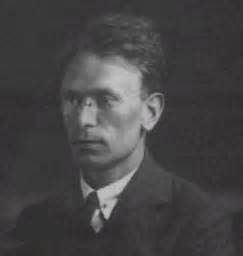
The only picture I can find of F. S. Flint
Musically, once again I don’t know what to call the music I wrote and performed for F. S. Flint’s set of poems. There are several orchestral parts and percussion, but the lead instrument that eventually emerges is a sitar. Since in the 21st Century chicken tikka masala can be said to be the British National dish, my limited skills on this instrument of virtuosos can be forgiven.
I was talking with my wife this weekend. She’s reading a memoir about current military deployments (and redeployments) and she said a Wilfred Owen poem was mentioned in it.
“Well, World War I was the last war to be covered by poets.” I replied. Which is not strictly true of course. World War II generated a number of poems I’d love to share here, but I have no time to try to track down the rights issues to use words that still may be under copyright. And I suspect other wars have generated other poems since then, even if I don’t know many of them. But that’s not what I meant.
World War I was the last war to be covered by poets.
What I meant was that WWI was the last war in which a considerable portion of the English-speaking public looked to poetry for meaning and consolation regarding the battles and their losses. I’m not sure if they looked to poetry more than journalism or political oratory, but I believe that poetry then still operated somewhat in the same theater as these other words when addressing current events. Longer forms of literature, such as novels, tend to lag events substantially, changing or fixing our view of things afterwards, instead of framing it while the picture is still moving. I think of two epithets, for journalism and then for poetry: “The first draft of history” and “The news that stays news.”
I think of two epithets, for journalism and then for poetry: “The first draft of history” and “The news that stays news.”
This morning, my son wanted to show me this brilliantly parsed cartoon summary of the Iliad. The narrator there has a lot of fun with the meandering and seemingly arbitrary plot of that Greek epic poem, but it struck me that it’s possible that the ur-version of the Iliad might have been written contemporaneously to the events, only to be shaped afterward like a collection of old news dispatches repurposed for later use.
So, this is a long tradition in Europe from Homer to the war poets of WWI, for the battles and the experience of the battles being reported in poetry.
Why has this use of poetry, to report current and crucial events, fallen away? The first explanation that occurs to me is we have other media to do this now. Film, radio, video, and now cellphones capture the moment without pretending to rely on subjective art. The Imagists who forged their poetic theory in the years around WWI, would seem to have lost their territory as their theory won the war. A cellphone or nose-cam video of the bomb exploding follows two out of the three famous Imagist rules: The “thing” is treated directly, there are no unnecessarily words (indeed there may be no discernable words at all), while more or less ignoring the less-noticed third rule (the one we at the Parlando Project keep pointing to and speaking about), the one that asks for musical phrasing.
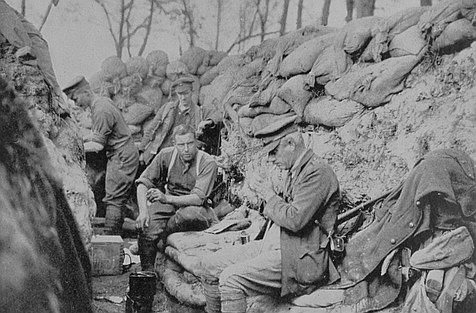
This photo shows men in T. E. Hulme’s Artillery company at St. Eloi in 1915
Poetry, like painting, is no longer necessary for reportage. Modernists often chose to respond to this by a movement into abstraction, conveying thoughts in motion and novel conceptions, seeking to demonstrate what can be meaningful without meaning.
Today’s piece “Trenches: St. Eloi” is attributed to T. E. Hulme, a man who helped form this Modernist revolution and died before he could live in it. I say “attributed” because, like Homer, he did not write it down. The exact attribution is “Abbreviated from the Conversation of Mr TEH” when it was published by Ezra Pound, and it may have been Pound who chose what to transcribe or how to lay out the transcription. My guess is that some of the language sounds like Hulme (the unusual, but so perfect word choice of “pottering,” the homey image of trench soldiers strolling compared to the shoppers on the busy London street of Piccadilly), but the overall arrangement sounds like Pound to me.
We know pretty much the where and when that is being talked about, more than we know of the actual history of Troy. Hulme got a chance to relate these details while in an English hospital after being wounded in the spring of 1915 in trench warfare in St. Eloi. He recovered, returned to the war, and to his eventual meeting with a German artillery shell that ended his life.
T. E. Hulme may have said it, Ezra Pound may have edited it and written it down, but to hear me perform it with my musical accompaniment, use the player below.
Imagine this for the background and education for a poet. The poet is committed from a young age to see things exactly, so much so that they become fascinated with the very neurological functions that are the foundations of perception. In college, they study with the foremost psychologist in America, but they don’t stop there. They go on to study medicine at Johns Hopkins, stopping just short of a medical degree. The poet then decamps to the hottest art scene in the world where they discuss art with the painters who are revolutionizing how we depict reality in a frame, and this poet sees right away who are the great visual artists in this scene, with legendary precision. The poet’s next task was to use the ideas of this visual art revolution, along with ideas about how human thought and perception really work, to create a new kind of poetry.
You’d expect this poet would produce extraordinary work. She did. You might also expect this work to be revolutionary in its technique. It was, and still is. You might expect that you will want to seek out and hear this work, to experience what this background and conviction could bring to poetry. You might expect this writing to share with you exciting new ways of seeing. Well…
What percentage of my audience knows both who Capt. Beefheart and Gertrude Stein are?
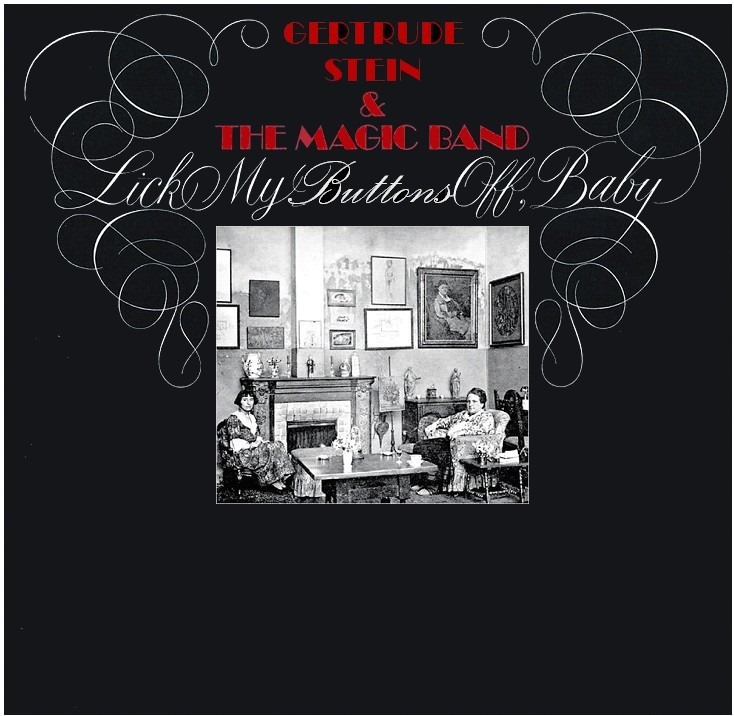
Today’s piece uses the words of that poet, Gertrude Stein, from her 1914 collection “Tender Buttons.” Even within the Modernists of her time, it was controversial, and it remains so today. Stein didn’t shock with her imagery like some of the provocative work of Dada and Surrealism. The radically condensed poems of the Imagists sometimes raised concerns that anything so seemingly simple and without the decorative rigmarole of 18th and 19th Century poetry couldn’t really be worthwhile art, but the Stein of “Tender Buttons” was even more suspect. The imagists might withhold the complexity behind their shortest poems, but the words themselves were often plain-spoken, comprehendible on an immediate level—too quickly so, in some apprehensions, to be art. Here, the Imagists seemed to say, is the red wheelbarrow, the crowd at the Metro station, the stars above the Clark Street Bridge. I’m not giving you anything more, and you can take in these few words and shrug and say “so what?” for all I care.
Stein went further. In “Tender Buttons” she wanted to project the messiness of real thought, real glancing perception, sticking to one thing only as repeated words that chorus and then disappear, only to appear a few poems later in the collection, but mostly moving from one atom of perception to another.
It’s as if, rather than speech recognition on a modern smartphone, that Stein turned herself into a human “thought recognition” device, registering in words not only the stream of consciousness but a stream of unconsciousness as well.
It’s as if, rather than speech recognition on a modern smartphone, that Stein turned herself into a human “thought recognition” device, registering in words not only the stream of consciousness but a stream of unconsciousness as well.
This is a brave idea, but what emerges from this sounds at first (and for many, at second, and then for as many times as they care to try) like nonsense. The words are plain, at the phrase or sentence level they can even seem to be intelligible, but as a whole, they seem to add up to nothing. Our brains are hard-wired to make patterns out of information, and so confronted with a chunk of “Tender Buttons” this function may strive to make out coherence until one’s brain hurts, or it may just stop a few lines in and reject it as a failed experiment, perhaps even a fraud.
This is where I think that the Parlando Project’s secret weapon, music, can help. Music may have charms to soothe the savage beast of “I need to understand how these words fit together right now; and if I cannot, I will withhold my listening participation immediately.”
Musically I have put these two pieces from “Tender Buttons:” “Glazed Glitter” and “Suppose an Eyes,” against music from my memory of Capt. Beefheart, whose work helped me accept fractured non-narratives even while (perhaps because?) his were set against similarly fractured music. Alas, I lack the ability to emulate the timbre of Beefheart/Don Van Vliet’s voice as I declaim Stein’s words, but I assure you I’m hearing Don Van Vliet’s (or perhaps Kevin Coyne’s) voice in my mind as this piece nears it’s conclusion with the chant of “Little sales ladies, little sales ladies, little saddles of mutton, little sales of leather…” The Parlando Project has always promised to surprise you with the variety of what we present, but we cannot promise you immediate delight all the time. If you like this piece combining two uncompromising artists, be sure to share us with the social media buttons you should see, and if you don’t like it, check out the other pieces already here or to come, as we use other types of music and other sets of words.
To hear “Two from Tender Buttons,” use the player below.
Returning now to our discussion of Modernism, that early 20th Century artistic movement that gave the artistic environment we are still grappling with. While it was a world-wide movement, reacting to world-wide changes in technology and society—for the first time, Americans were at its forefront.
But not all the Americans were residing in America.
Back in 2014, when there was a brief 50-year anniversary flurry of coverage of the Beatles “British Invasion” of the US, I played one of favorite games. So, if we were to think in 2014 of the way things have changed since 1964, what would a person in 1964 be looking back at from the same 50 year interval from their time?
Turns out they could have been looking at not a “British Invasion” of musical groups, the Beatles et al—but an “American Invasion” as Ezra Pound, T.S. Eliot, H.D., Gertrude Stein, Robert Frost, and Ernest Hemmingway all were residing in England or Europe around this time. Pound in particular, was busy making alliances and promoting his vision of Modernism, which he called “Imagist.”
Imagists, at least at the start, put a high value on concision. Pound was just as concise in Imagism’s manifesto, reducing it to three rules:
Direct treatment of the “thing”, whether subjective or objective.
To use absolutely no word that does not contribute to the presentation.
As regarding rhythm: to compose in sequence of the musical phrase, not in sequence of the metronome.
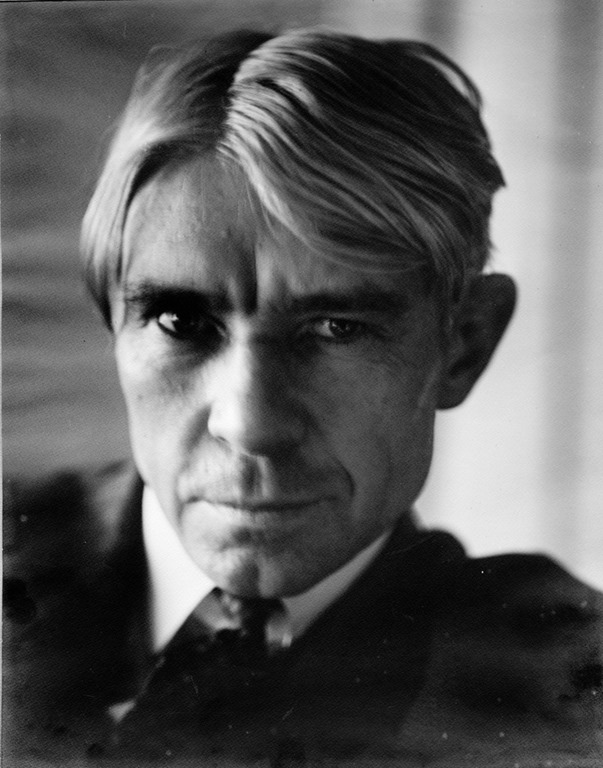
Images of Imagists: Sandburg on the left, Pound on the right. You can say that again.
Not all the Imagists were residing overseas however. Back in the specifically American city of Chicago, Carl Sandburg was to combine these Modernist/Imagist precepts with Socialist politics and activist journalism. He worked so hard at this that he essentially split himself into different people. There was Carl Sandburg the Imagist poet who hung out at the then new Poetry Magazine offices, where the poetry discovered by their European Editor, Pound, was funneled into America. But he was also a journalist working for the legendary Chicago daily press portrayed in “The Front Page”. At the same time, he was also associating with equally legendary American IWW radicals and anarchists, writing for their publications, sometimes under a pseudonym. Was he hiding his identity, or just saying that the agitator was a different personality?
Visualize that American comic-book secret-identify hero, say Superman. By day the “mild-mannered reporter for a great metropolitan newspaper…” by night fighting for “Truth, Justice, and the American Way…” as a crusading radical Socialist—but wait, there’s something more—he’s not just those two, he’s trying to create Modernist poetry as well. And pay the rent. Which is his true secret identity?
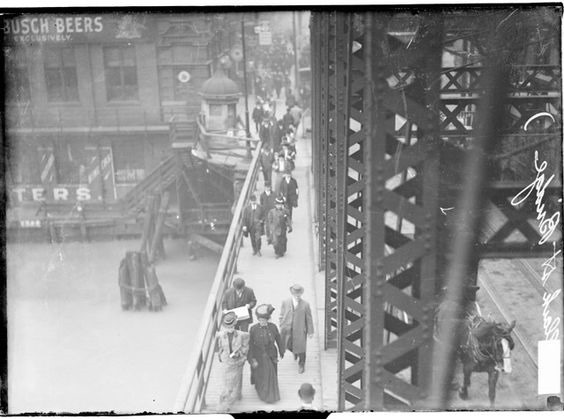
Chicago’s Clark Street Bridge, then and now: “No more dust and wagons.” Are the voices still unheard?
Today’s audio piece, Carl Sandburg’s “Clark Street Bridge” is an orthodox Imagist poem by this un-orthodox, tripartite man. The subject “thing” is definite as the downtown Chicago river bridge in its title. Its rhythm is as legato and singing as the absent voices singing at it’s end. It starts with its busy turn-of-the century black’n’white newsreel footage of crammed wagons and walkers, then takes us to the dog-watch night: only three scattered people interrupt the foggy mist and the brightest stars above the urban river. In this mist and shadows, reporter Sandburg takes off his double-breasted suit, but then, stay-at-home Imagist poet Sandburg takes off also his poets’ tights and doublet, and now, naked as a radical above the dark Chicago river he hears the “voices of dollars” in the city’s heartless commerce, the “drops of blood” from the men and women who animate it, and the gigantic chorus of the resulting “broken hearts,” as many as all the stars, as heavily present as the mist, and as unheard as either.
As I’ve often found with Sandburg, others have set his poetry to music, but no matter, I press on. My music for “Clark Street Bridge” started with an un-relenting long-measure typewriter-like drum part which I hoped would stand for hoof and foot beats. I tried to pair the guitar part and the reading of the words, and finally, I laid a legato bass part underneath it all to stand for those voices softer than the stars and mist. To hear it, use the player below.




 Frank Hudson
