Adapting Michael Strange: “To Claude Debussy’s La Grotte”

I’ve long wanted to do a Parlando Project piece using the words of early 20th century American poet Michael Strange – but there was this one problem: her poetry wasn’t very good. Or perhaps I should restate that: her poetry doesn’t consistently work in the ways that I appreciate poetry. What about her poetry causes problems for me? It’s not just that it risks being ecstatic to a fault, or that it seems grandiose at times. I’ve forgiven other poets those excesses. It’s certainly not her overall poetic approach, as her verse seems to me to be highly influenced by Imagism, that early 20th century poetic movement that continues to inspire me. She also seems fond of Whitman and Nietzsche, but so were other writers of her era that I’ve presented here. So, if not those things, what? If I’d pick one term for what keeps me from enjoying her poetry it would be “over-writing.”

Here’s an example, an ekphrastic poem about an art song by composer Claude Debussy which used a text by François Tristan L’Hermite. I’m not sure if Strange is portraying L’Hermite’s French lyrics (which are quite good and bring in the myth of Narcissus) but she talks of sound and gives the musical composer the sole place in her title:

To Claude Debussy’s La Grotte

Your song
As the hale of mysterious exotic intention
Drifting in palpitating echoes
O’er the pallid oval
Of night-closed flowers -—

Your song
As the increasing shimmer
Of some exquisite nearness —
Clad in those steel-dark foils
Of sinister fancy —
And once more your song
As the moaning hush of a human soul
Receding — from the Divine Moment

.

The images here constantly suffer from the Donald Trump school of interior decorating. They’re not just curlicue ornamented, they’re coated in gold leaf. The “hale of…intention” image is a fine one, but adding both “mysterious” and “exotic” as modifiers cloaks its originality. Are “echoes” so unclear as a sound description that they need “palpitating” to clear up that they repeat at intervals? Why the somewhat archaic “O’er” when the modern “over” will chime nicely with “oval” and “flowers?” And that’s just the first stanza, first 21 words. This over-egging hurts not just the sharpness of the images, it hurts the word music too. As with Trumps White House confessions of gilde, this can be read as a lack of confidence in her own vision and place in poetry. I must include “poetic” words, I must show the specialness of each facet with modifiers and more modifiers, I must show that I’m writing.

Now I’m not writing this to dunk on Strange. I’ve committed every sin above, and more. What I write has enough faults to repel readership. Strange is not a particularly famous or widely-read poet, but more people have likely read her poem, and maybe even more people would like this poem of hers than any I’ve written. Still, I want a better poem than this one printed more than a century ago if I’m going to perform it. Yet what I did is risky ethically – that Strange is dead and her work fully in the public domain doesn’t erase the issues with what I chose to do this week with her poem. I rewrote it.

Your song,
the hale of exotic intention
drifts in echoes
Over the oval night-closed flowers.

Your song,
the shimmer comes nearer,
some steel-dark foils of sinister fancy —
And once more
your song,
the hush of a human soul
receding from the Divine Moment.

.

I tell my self-accusing self that I did this in service to what I think Strange was portraying in her original poem. Indeed, what I did there is similar to what I do when translating a poem from another language: find the images the poet was portraying and convey them in contemporary English with a word music that works in that destination language – though here I’m able to use more of her original words since she wrote in English. I’m opening myself up to a charge of patriarchal overreach, but in my defense, I’ll say I’ve done this to Robert Frost and Rupert Brooke. So, I may just be an asshole when I do this.

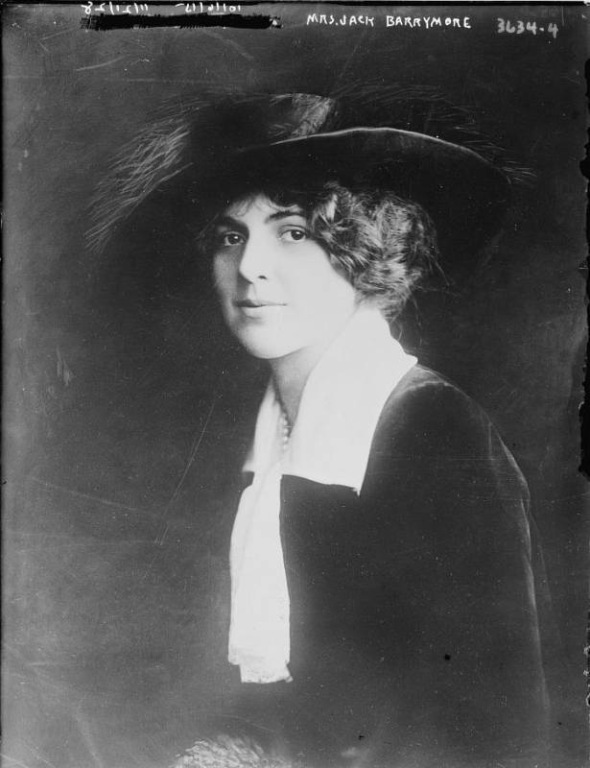
Before I move on to a few notes on the musical performance that prompted me to do this rewrite, let me just give the briefest outline of Strange’s fascinating life, a history that gave me such high expectations as I sought out her verse. Strange was born into a socially prominent East-Coast family, and was married (three times) to socially prominent men. Photographs and contemporary testimony portray her as exceptionally beautiful. Despite her background, she was a feminist, a left-wing social activist, and moved in bohemian circles. During the WWI years she published her first poetry collection and used the masculine pen name Michael Strange for this. Wikipedia’s summary says the name was used to shield her family from the poetry, which was claimed to be erotic and scandalous, and it’s also easy to suppose that she may have made (at least in part) a tactical choice to avoid sexist devaluation of the work. Whatever the initial reasons, she soon came to use the name generally, in subsequent writing, when she appeared on stage as an actress, on radio as a host* and, I gather, “in real life.” I’m not an expert on Strange’s life, but it appears she used feminine pronouns.
Michael Strange

Pleased to meet you. Hope you guess my name. Born Blanche Oelrichs, became Michael Strange, was a member of the Lucy Stone League dedicated to married women keeping their own name – and this photo is labeled “Mrs, Jack Barrymore” (the name of her second husband, the famous actor).

.

It’s possible I would have run into Strange, on her own, at some time in this Project, since I enjoy examining lesser-known poets from her era here. Instead, I first encountered her because of her relationship with another author who produced popular Modernist work, Margaret Wise Brown. What? Yes, Margaret Wise Goodnight Moon  Brown. Early this century, in my fatherhood role with a then pre-literate child, I was the bard of such stories as Goodnight Moon  or The Color Kittens.  And it may not be only because this overlapped my adult reading that I heard them as part of the same world of early Modernism.** For the last decade of her life Strange lived in a committed relationship with Brown, and so it was in reading about Brown that I first read Strange’s name.

All right, on to this short musical piece using adapted words from Michael Strange. I was working on composing with the intent to use minimal motifs, ones that my minimal keyboard skills could play without using an arpeggiator or other automated extensions. I built the music using a variety of alt-techniques and “prepared” piano sounds. In the middle section there’s an organ part that does use an arpeggiator, and a percussion part that had me playing parts on some struck metal objects over a more conventional drum-set pattern. Not exactly Debussy,*** but perhaps evocative of other 20th century avant-garde musics. You can hear it with the audio player below. No audio player? It’s not gender panic, but some ways of viewing this blog suppress it, and so I offer this highlighted link that will also play the musical performance.

.

*Her radio program was titled Music and Poetry.  Just as with today’s poem – despite my problems with its prosody – Strange’s bio can’t stop being catnip to me.

**Another “could he really be serious” suggestion: if we might well include Robert Louis Stevenson and Lewis Carroll in studies of Victorian lit, should Brown be read next to H.D. and Pound as Imagist texts?

***Musically, while I’ve listened some to the Impressionist musical school of composers, I came to them largely from instrumental guitarists who were directly influenced by them. So, Dadaistically, today’s piece has no guitar whatsoever.

Sandburg’s Couples

Time for me to get back on my Carl Sandburg soapbox. I’ll be brief — as today’s poem, now song, is as well. My point (again) is I think there’s more there in his poetry than is currently remembered or considered. Your impressions may be from two stalwarts of American poetry anthologies: the Whitmanesque “Chicago”  with those big shoulders and the quite contrasting short metaphoric poem “Fog”  with its cat’s feet. Not a lot for a poet who wrote so much, so early in the Modernist era, but it does point out a range of expression.

I’ve performed segments of Sandburg’s prolix mode here. I like Whitman well enough. Within limits, I like Sandburg doing Whitman’s mode too. He’s not quite the opera singer that Whitman aspires to be, he’s more of the folk-ballad, song-suite, kind of poet. America’s a big country, so I guess we need big, shouting, poems — and even if that’s not my favorite mode, either poet can move me as they traverse long distances with galloping catalogs and litanies. My point today is that this Sandburg, being bigger, overshadows another Sandburg, one that I particularly treasure, the one that reminds me more of Du Fu than Whitman: the forgotten, pioneering, ground-level reporting, American Imagist, Sandburg. Sandburg’s poems in the compressed style are not accidents, seeds of long poems that didn’t germinate, or little palate cleansers between his important work. His earliest collections are packed with sub-sonnet-length pieces.

On awaking this morning, I was thinking of a set of poems by a couple of the earliest American Modernists, Ezra Pound and Sandburg, where they each showed gratitude for their American forbearers. I paired their poems as one musical piece early in this Project, and here’s a link to that.  Pound, within his characteristic grumpy mode in “A Pact,”  makes peace with Whitman — and while casting a little shade on Walt for being the son of a house-carpenter, he claims his own finely crafted woodcarving is descended from the cross-cut and rip saw of Whitman.

Who does Sandburg say are his native 19th century inspirations? Whitman? Nope. Maybe Longfellow, with his civic-minded striving for uplift and justice? No. Who’s left? Poe? Hmm. Interesting thought, even if Poe is awfully rhymey for a free-verse poet. The other Fireside poets? Well, yes, Sandburg wanted a wide audience, but as the child of an immigrant couple and attendee of a non-descript Midwest school, he lacked their pedigree.

Sandburg in his “Letters to Dead Imagists”  is declaring his allegiance to that spear-point of English-language Modernism, but here he claims a couple of Americans as his predecessors: Emily Dickinson and Stephen Crane.

The poet he names first, Dickinson, will likely seem a more conventional choice to those reading this today than it was when Sandburg wrote his poem in the early 20th century. Dickinson’s eventual rise to genius status would still be early in its slope — she was more known then as an eccentric than as a model for poetic expression. The second, Stephen Crane, is more associated with prose, but he wrote a singular collection of gnomic, short free verse poems, The Black Riders,  in 1895. An inspiration for Crane’s unusual work: the new, first publication of the poetry of Emily Dickinson in 1890.

Sandburg was among the first to try to form a 20th century style combining the “mother and father” of American poetry: Dickinson and Whitman. And I happen to like it when he takes after dear old mom.

Today’s piece, Sandburg’s “Couples”  sounds a little like Crane, a little like Dickinson, and it has a characteristic early Imagist trope of close-focus specifics and vivid color by name. Here’s a link to the text of it.  If one thinks of Sandburg as being a clear-speaking poet, this poem should disabuse you that he’s always about some obvious point. Part of the delay in publishing my version of his poem is that I’m still not sure what he’s describing. There’s parallelism set up between six “women” dressed in green and six “men.” They’re described as dancing, likely haphazardly as the infamously strong liquor absinthe* is mentioned, they make a hissing laughter sound. They are somehow cheating or gaming each other. There’s a worn path of hard packed dirt said to be from the dancing feet. The poem closes with dewy weeds said to be as high as six little crosses, one for each couple.

I’m stumped. A graveyard? Then maybe the dancers are ghosts. But if so, why the specific detail of the dirt floor packed down if it’s a weedy, less-than-well-tended graveyard? A barn-dance? The weeds are described as “mourning veils.” Or are the six live couples dancing around six graves? Why, who are they to the buried, if it’s that? Perhaps instead, the dancers are green plants of some kind, their dance uncoordinated as random winds, and the wind through them is the hissing laughter, and they’re maybe even the weeds the poem closes with. Did Sandburg just choose their number to be six out of desire to be specific? But again, he spends two lines of a short poem on the packed down dirt floor under the “dancers,” and plants dancing in the wind wouldn’t compress the earth.

In summary: as obscure as any of Crane’s Black Riders  poems — but specific, like a closely-observed Emily Dickinson riddle poem. If Sandburg intended mystery, he achieved a stubborn dose of it in this poem of his, and the incantatory power of its spikey, inexplicable details may still carry us through. While it’s unlikely Sandburg’s model, if one was to translate this into French and say it was from Rimbaud’s “Drunken Boat”  how would we experience it?

Carl Sandburg with guitar at mic

Glad to be at the open mic. I’m going to do “Wagon Wheel” and this Oasis song “Wonderwall” now.

.

If forced to a final guess: they are  graves, and the dancers are the living as continuing life-force, not dancing on the graves as revenge, but out of the joy of continuance, and the packed dirt is the mark of our ongoing life-work and dance. The cheating? The unfaithfulness and trifling of love and desire, or they are cheating death by living and loving. The couples of the title then are not only the paired male and female dancers engendering a new generation, but the connection between the living and the dead. Why six? I don’t know.**

I performed this with just acoustic guitar, Carl Sandburg’s own instrument of choice. When assessing his guitaristic skills, Carl would sometime say he was at least one prison sentence from getting any good. You can hear my misdemeanor playing with the audio player gadget you should see below. No gadget? It was pardoned, or impounded, or deported, or took a buyout, or something. No one seems to know, because some vain fool runs things, and there’s not enough conscientious people left to make knowledge from foolishness. But I do give you this highlighted link that’ll open a new tab with its own audio player.

.

*Absinthe is colored green, doubling down on the use of that color in the poem.

**Rejected guesses why six couples and six crosses: six is sometimes used as the number of cardinal directions, sometimes shown as a six-armed cross, but Sandburg seems to be clearly saying six separate crosses. The Oklahoma state flag shows a First Nations (Ossage) shield with six separate crosses on it (the cross is a common indigenous American symbol) — but that flag was adopted a decade after the poem, and I can’t find any source of previous use of that distinct six crosses symbolism that the flag drew on.

William Carlos Williams “The Birds” and what nature sounds

Something about the Spring I noticed this year — oddly, this year as an old man who has had a full lifetime of Springs — is the intensity of natural sounds in my city. There’s a tendency, demonstrated in many poetic tropes, to make nature a portrait or a silent movie, putting nature in contrast to the noise of our civilization’s hum and bark.

I ride my bicycle nearly every day off to a café to have a breakfast, sometimes early enough to feel like the single soul on the street, but by the return trip certainly part of the city waking and doing: kids on their school bus stops, sometimes with a parent, sometimes waiting with their own cohort only, folks holding coffee flasks unlocking their car doors to go to work, a few other bicyclists, including those on big front basket bakfiets or long-tail rear-seat-shelf bikes holding small kids, this observant cargo watching whatever in the morning beneath their pastel helmets. The human noise is slight and clicking. In such mornings we are more like crickets rubbing their wings.

But the birds! When most of those humans are making only accidental noise this early, and the kids waiting for the yellow bus aren’t always talking, perhaps practicing quiet for the ordered schoolroom, the birds are singing at the tops of their voices in the morning. Like miniature feathered fiddles, their song cuts through larger sounds, it insists on being heard. “Ladies, I got your genetic material here!” “This is my and my kind’s tree!” “Whatever this is, this Spring, I am here, and I’ll use my breath to say it!”

Like us bipeds lacking much fur, other mammals aren’t sounding much. Yard bunnies are suspicious and quiet. The squirrels don’t chirp, and their little feet make quiet footfalls. The dogs on leashes: all nose-leading in an alternate sensory dimension. But the frogs and toads are singing out too — whole amazing choirs of them, all wanting to contest Emily Dickinson’s Nobody with a harrumph and high whistle of who they are.

So, it is this Project’s nature to add sound to page poetry. Today’s audio piece is just me alone with a Telecaster electric guitar during a hurried session early this Spring to put down some musical ideas. In the poem that I’m combining with my music, “The Birds,”  William Carlos Williams follows Imagist principles, melding a moment into concrete images. Given that we’ve just had a set of rainy days throughout the long holiday weekend in my city, I resonate as Williams poetically paints the bird-morning wet as undried paint.

Is the world not “wholly insufflated” as he says at the start? The bird song is breathing into our world — nature is not silence, but poetry aloud.

Strange Powers Magnetic Fields photo by Heidi Randen 600

My wife found these* stapled to poles around our neighborhood on Sunday.

.

You can hear my performance of Williams’ “The Birds”  with the player gadget below. No gadget to be seen? This highlighted link is an alternative that will open a new tab with its own audio player. Want to follow along with the text of the poem? Here’s a link to that.

.

*This bird couple’s heads are superimposed over a human pair of heads from the cover of The Magnetic Fields Holiday  album. The quatrain quoted below is from a song found there “Strange Powers.”   Despite being a substantial Magnetic Fields admirer myself, I had never seen this album cover.

Hills: children’s poetry, but written by a child

It’s 1914. A single mother is listening to her 4-year-old talk to her imaginary playmate. Has this always happened? Did children in pharaonic Egypt or ancient Ur exercise their fresh language skills and nascent social skills with such fancies while being buckled into their camel child-seats? There was no Mesopotamian Facebook — the only way we’d know this would be if someone wrote it down. No such accounts survive.

This mother was a professor of English at Smith College, associated with artists: visual artists, writers, musicians. She wrote poetry, and I’ve read she knew Robert Frost and Walter De La Mare. She chose, as an artist might do, as a mother might do, to write down some of the things that her child was saying.

At some later point, the daughter was asked if she knew what her mother was doing. “No, she was always scribbling” the daughter replied, she made nothing of it. Eventually, her mother revealed that she was writing down what the child was saying as poetry. What the child invented and spoke — at first to her imaginary friend, and now to her mother — was transcribed by the mother into lines and stanzas. The mother’s name was Grace Conkling, her child/poet was Hilda Conkling.

Short, compressed, Modernist free-verse was becoming a thing in America. Ezra Pound’s first Imagist anthology and Carl Sandburg’s Chicago Poems  were published in 1914. Edgar Lee Masters’ The Spoon River Anthology was released on New Years Day in 1915. The child’s mother was savvy enough to know that a few lines with fresh, direct imagery could be a poem even without strict meter or rhyme.

Over the next few years the mother and child produced poetry this way: the child speaking it, the mother writing it down. Some of the poems were sent to magazines by the mother, and they were published.*  In 1920, a book-length volume of the poetry, Poems of a Little Girl,  was published. It was successful enough that two other Hilda Conkling collections soon followed. Amy Lowell wrote a preface to the first Conkling book. I read this week that Louis Untermeyer called Hilda “the most gifted of all” child geniuses. Rimbaud, dead for 30 years, couldn’t complain. When the editors of our pair of 1922/1923 poetry anthologies for kids made their choices, they included four of Hilda Conkling’s poems, an unusually high number. Only Wordsworth and De La Mare had five selections in the volume that included Conkling — Shakespeare or Robert Louis Stevenson only warranted 3 each.

As I revealed earlier this month, Conkling’s poems are the only Modernist poetry in the Girls and Boys Book of Verse.**   That may somewhat account for that level of representation. The first two sentences in that book’s foreword say:

“Because real lovers of poetry know that time and place are of little importance, the poems in this book are brought together with no sense of the period in which they were written. From “The Song of Solomon” to Hilda Conkling’s “Spring Song” they are here because they are beautiful, with a beauty that neither years nor events can change.”

So, Conkling is there to represent the here and now, a representative not only for being the most recently published, but because she still hadn’t reached the age of 12 when those words were written — she wasn’t just content for an audience of boys or girls, she was still a young girl, plausibly a future as much as a present.

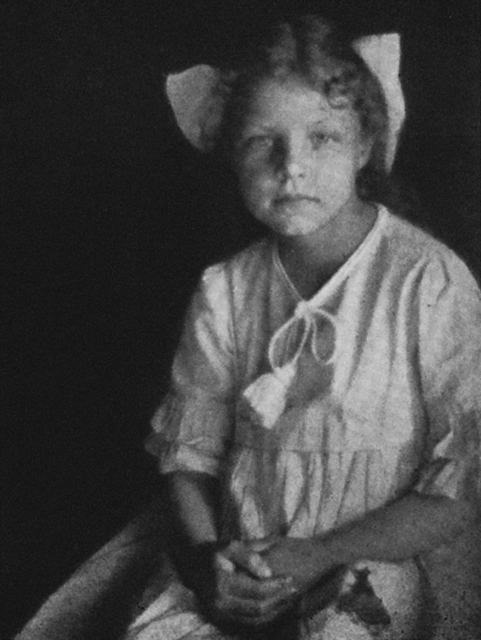
HildaConkling

Verse for children? I’m children, and a Modernist too!

.

Those who’ve been reading along this month know that since our anthologists decided to produce a gendered pair of books, The Girls Book of Verse  and The Boys Book of Verse,  I’m asking readers here this National Poetry Month to guess which book included the poem of this little girl. Answer below.

Hilda Conkling is now largely forgotten. When one looks at the published poems today, they still have their charms. When I’ve tired of reading so much derivative and rote late 19th century poetry and those 20th century poets who didn’t even try to “make it new” Conkling’s poems can be refreshingly free of the dead hand of influence or fears of being scored on exacting verse-craft. There are still effective lines in many of them. Unpretentious but striking images pop out. Professor/mother Grace Conkling was adamant that she didn’t edit the poems, that as their process developed she would read the transcribed poems to Hilda and that she would always obey Hilda’s corrections of anything she got wrong. What’s unsaid is how much selection or excision Grace did, what poems never were transcribed as unremarkable or if any lines were never transferred from scribbled notes to manuscript. Young Hilda Conkling wouldn’t be the first artist whose work was magnified by a sharp blue pencil and a shortening scissor wielded by a skilled editor.

Somewhere around the time the Hilda Conkling books were published, mother Grace, perhaps wanting Hilda to try her wings as a now literate adolescent, suggested that Hilda start writing down her poems herself. This seemed to break the spell. Some of Hilda’s published poems show a clear desire to not only emulate her mother, but to please her in doing so, so a motivation might have been stilled. Another factor: Grace may not have realized that like a “cold reader” charlatan can fake mind reading by picking up subtle clues from someone as they try to construct a convincing tale of reading the thoughts of a mark, that the very act of being the transcriptionist and first audience for Hilda’s poems might be part of their authorship.***

As far as anyone knows, Hilda stopped creating poems just as she became a teenager. If there were any later-life discarded drafts from adult revisiting of her childhood inspirations, they are unknown. She lived with her mother Grace until Grace died, and made her living working in bookstores in Boston, two things indicating that Hilda could have continued to connect with literary culture if she’d wanted to. Hilda’s story, her poetry, once held as so remarkable, became a literary curiosity that only attracts folks like me who want to think about art and Modernism thoroughly.****

Hills poem

.

I haven’t read anyone claiming that Hilda wrote her poems because she remembered past lives, because she was an “old soul” — but then or now, that sort of woo thing might have come up. Today, as I was finishing this post, days after completing the musical arrangement I used for her poem “Hills”  that you can hear below, I wondered how to explain the musical choices I made for that original music. The music is sorta-kinda South Asian, based slightly on my appreciation for those World Pacific Ravi Shankar LPs that entranced me as a young man and the Indian physicians I worked with in New York in the 70s. Specifically though, it’s more at the cod-raga experiments that many Western folk/rock musicians took to in the 60s. I always liked that stuff, and it’s more approachable with my musicianship than the real thing. Was something  asking me to musically express a reincarnation theory?

To hear my musical performance of the 8-year-old Hilda Conkling’s poem “Hills”  use the graphical audio player below. No player manifesting? The skepticism of your way of reading this post may be blocking the ectoplasm! Knocking on this highlighted spirit-table link will open a new tab with its own audio player.

.

*Poetry Magazine  published Conkling’s poems alongside a great many of the formative Modernist poets. But she also appeared in Good Housekeeping.

**As a fan of early Modernist poetry, I tell myself that I could have easily found a dozen or more suitable Modernist poems published before 1922 to include in their books.

***I’m also reminded of the curious case of acclaimed poet James Merrill and his partner David Jackson using a Ouija board in the creation of poems in the 1970s.

****I think of the work of New York School poet Kenneth Koch, who in the 1970’s started teaching poetry and creative writing to grade school children by reading them Modernist poetry (including poems that our 1920s anthologist overlooked) and then prompting them to create their own poems. A short web search revealed nothing so far, but the brief phenomenon of Hilda Conkling might easily have come up alongside Koch’s teaching ideas.

I have some hopes of finding the energy and audacity to write about a new attempt this year by a contemporary poet to inspire children to write poetry, but only time will tell on that one. Girls or boys book of verse for this poem of genderless camel-hills bearing the world on their backs? Girls.

Mistah Witch: Pioneering Blues Poetry

Enjoy the Valentine’s candy if you have it, but this is a longer post, and we’re going to get into some uncomfortable stuff with this one. Yes racism, but then I’ll deal today with musicology and Modernist poetry too. The first is deadly in spirit and body, but then the latter two may often bring on the little death of boredom and indifference. This is why I respect you as an audience: poetry is a minority interest, mixing in the variety of musical styles I use here to the best of my subjective abilities will confound some of that audience, and then to discuss oppression — even the resistance to oppression which should be heartening — well, welcome rare, broad, and appreciated readers and listeners. Let us continue.

I said earlier in this year’s Black History Month series where I’m examining the early work of Chicago poet Fenton Johnson, that it may help us to orient ourselves into the time in which this young Black man in his twenties started writing and publishing. If we look at poetry and music, three big things are happening. They’re going to change how the 20th century, and even our own current century, approaches things.

The Fenton Johnson poetry I’ve presented so far this February has been in the 19th century tradition. It’s a style of poetry his school teachers would have taught him,* and like his chief model Paul Laurence Dunbar, he can speak for and about his fellow Afro-Americans using that mode of poetry. However, at this time something new is brewing in poetry. Over in England a small group of ex-pat Americans are joining forces with a couple of British poets/critics and a man from Belfast to create the first Modernist English poetry.** Few are noticing this yet, it takes a couple of years for it to get a foothold, but in 1909 the first poem in a style that would soon take to calling itself “Imagist” was published: “Autumn”  by British writer T. E. Hulme.

What makes that poem and the Imagist poems that follow Modernist? First off, it’s concise, it gets to the point. The language may combine things in unexpected ways, but it uses much more ordinary and day-to-day language to do it. Indeed, it revels in that — part of its freshness is that it wants to render sublime moments in the same way of speaking that something utterly mundane might be expressed. Its commitment to this is so strong that those mundane moments, the “unpoetic” ones, can be charged with a power. It doesn’t care to have the people in its poetry seem high-flown, they don’t have to be different more “poetic” creatures. Yet these same poems often have an important core of distrust for common or worn-out appreciations of reality. Emotions may be stated, yes, but many of the most vivid poems portray the landscape and the palpable things surrounding an emotion rather than hang signposts or explanatory placards of their feelings. Rhyme and meter could be used, but they aren’t the main point if they lead the poet to ignore these new things to emphasize.

While this is going on, Black Americans are forging a couple of new musical forms that are going to overthrow their nation’s music — and from there, impact the world’s. Because this happened before the full emergence of commercial music recording, some of this is literally un-recorded. Buddy Bolden and his like are playing instrumental music largely sounded on brass-band instruments along with pianos, where access to those instruments is available. Eventually that will be called Jazz. Many mark the first Jazz record as being issued in 1917, though Jazz existed before the recording.

At roughly the same time various strains of music with lyrics made by Afro-Americans are being extracted and refined from the ore of American folk music. I would maintain that the lyrical part of this sung music can be viewed as Afro-American Modernism. The songs love to get to the point of things, stripping away hypocrisy and pretense. They deal with disappointment and sadness, yes, but they most often deal with it in resiliency and wry resistance. Taking from the preexisting tactics of folk musics, they will borrow and reference each other’s individual songs — and like Modernism will soon take to doing, they will collage together unlike things and verses to jump from incident to incident. That sung music will eventually be called Blues, and because it’s a sung music, any instrument can be used for accompaniment, including cheap and portable ones. No Blues? No rock’n’roll, no country music as we came to know it, no rap.*** The first Blues recordings were done in the 1920s, but the first sheet music which might be classed as Blues dates to 1912, though again we know it existed unrecorded and off the books before this.

So, three things — all big, culture shaping stuff. In 1900 there’s no general cultural knowledge that these three things exist: English-language Literary Modernism, Jazz, and Blues. By the 1920s they all become part of the mainstream culture, however misinterpreted and misrepresented they may be. Modernist poetry might be thought of as self-consciously crude esoteric nonsense sticking its thumb into the eye of real poetic verse, while Jazz was thought of as hopped-up fast-tempo music to deaden the mind as rapidly as cheap liquor might, and Blues? That’s merely sad and sentimental music of resignation to fate.

This is Fenton Johnson’s world as a young man. The Harlem Renaissance writers that would come a decade or so later would still be dealing with this world. As we’ve seen in previous Black History Month series here, the Black cultural leaders of the first part of the 20th century were not yet fully on-board with Jazz or Blues, which they often felt reflected badly on their race. They did briefly note Fenton Johnson as a Black Modernist free-verse poet, but this happened in the Twenties as Johnson was withdrawing from writing new verse.

I was thinking of this as I read Johnson’s first collection of poems, no doubt written in the years before the book’s publication in 1913, and I come upon this short poem, “Mistah Witch”  printed in the phonetic dialect meant to represent unlettered Afro-American speech.

Mistah Witch as it appeared in A Little Dreaming

Here’s how it appeared published in Fenton Johnson’s “A Little Dreaming” in 1913

.

What matter of word music is this? I used my musicological knowledge along with literary thoughts as I examined it. It could be a folk-origin nursery rhyme or play song.***  It could just be a short supernatural poem, for we’ve seen last time that fantasy poems were a genre Johnson touched on in his more conventional verse. It may just be me, but I couldn’t help but read it as Blues Poetry — and a very early example of it too.

No, as printed it doesn’t use the Blues’ 12-bar structure or the three-line (two refrained or near refrained lines, and a response in the third line) stanza. Blues has never been purist about that, and early Blues often didn’t fit into regular musical forms. But I got a Blues sensibility from it. Mistah Witch may be mythologically, potentially, or actually, frightening, but the poem’s speaker seems to know Mistah Witch’s game, how he operates. I thought the poem’s sharpest line was (translated from the phonetic dialect) “Ain’t you tired of scaring me?” That implies Mistah Witch’s “magic” terror is weakening out of boredom and the rote nature of it for the speaker!

If Blues, like other Modernist poetry, likes to get to the point of things, it can also enjoy encoding its statements. The tactic is often: I’m going to speak something publicly, and part of the audience (the ones I want to let know we share an outlook) will get what I’m saying — while at the same time those that might not approve of my statement will be in the dark about what I’m talking about. The latter will just be puzzled or indifferent to what they don’t understand.

What could be encoded in “Mistah Witch?”

In plain talk: from the days of Fenton Johnson’s youth, through the years he began publishing his poetry, and continuing after his poetic work faded away, there was beside the slow incremental wear-and-tear of stereotypes and “civilized” discrimination an active and brutal threat of terroristic violence against Black Americans. Threats, attacks, lynching and (white) race riots are a part of American history that wasn’t talked about broadly out of a mixture of shame and “politeness.” *****   Blues doesn’t play that game, but a Blues singer (or a poet looking to find a broader audience) might encode a protest against that terror metaphorically. I did note that the poem concludes with telling us that Mistah Witch (“Mistah” signifying the frightener is someone the singer feels they must make a show of social respect to) has eyes like the sea — the bluest eye perhaps.

I’m not certain if that’s what Fenton Johnson is doing in “Mistah Witch,”  perhaps even unconsciously. I am planning to try to include some information that I have recently learned about Johnson’s political views later in this series. Musically I took Johnson’s original poem, and for this performance turned it more toward an irregular folk-Blues structure to reflect the Blues sensibility I saw in the poem.

And for those who want a little time-machine technical magic to travel back to those early Blues recordings often pressed cheaply for the “race records” market and worn with dust and the needles of heavy-armed Victrolas, I’ve included a Bonus Track today: a simulation of how the recording would sound in that context.

Here’s my rough’n’ready musical performance of Fenton Johnson’s “Mistah Witch” recorded with inexpensive modern equipment.

.

Here’s the simulated worn 78 RPM shellac record version.

.

*Johnson, unlike most Americans and even more so, most non-white Americans, had a first-rate college education, attending Northwestern and the University of Chicago.

**This group coalescing before the start of WWI included T. E. Hulme, from the less fashionable north of England who’d been expelled from Cambridge, F. S. Flint a self-made man of letters who risen from Victorian poverty, the Americans T. S. Eliot, Ezra Pound, and Pound’s former college sweetheart Hilda Doolittle, as well as Robert Frost, and the somewhat forgotten man from Belfast was Joseph Campbell. I count Frost as a Modernist, as I see his poetry aligning in its outlook with Hulme’s theories, differences in prosody aside. Remaining in America, William Carlos Williams, Carl Sandburg, and Edgar Lee Masters would also be early Modernists.

***Jazz musicians will often maintain that the Blues is essential to Jazz as well. In that sense, my reading is that they aren’t just talking about Blues musical structures and vocal inflections portrayed by instruments, but the Blues sensibility.

****Blues could and did use lines shared with those folk music forms.

*****In 1919 Johnson’s Chicago suffered a mass racially motivated riot. In 1909 downstate Illinois had a similar incident in Springfield. Smaller acts of terrorism against Afro-Americans were continuous in Johnson’s time. Black History Month isn’t just about that, history shouldn’t be a flat picture. That stuff is ugly — it was meant to be so — and that ugliness is part of the reason it was suppressed and untaught. But. But. But — you can’t fully comprehend the beauty of resistance to that without knowing the ugliness it opposed.

“Mistah Witch”  in my reading is racism, or white-supremacist terror in general, and it could be specifically referencing the original Klan terrorists who fancied themselves in their costumes as representing murderous ghosts and spirits.

The Route of Evanescence

Here’s another little mystery, a riddle inside a riddle, which makes up a new song using the words of Emily Dickinson — but first a little of me sounding like a regular blog that talks about itself.

As assured time to work on this project has largely disappeared, I’ve been turning to simpler compositions and quicker realizations of them to cope with this, but over the past few months a number of pieces have sat in limbo, waiting to be rediscovered, waiting for decisions to be finished or abandoned. In going through some of these this month and I came upon a recording session for “A Route of Evanescence”  from last August.

I recall the session. It was just me and a couple of acoustic guitars, with access to my quiet studio space. I had some advance notice, maybe a day or so, that I’d have that time. On the hurry-up, I prepared a number of compositions to record, and when the day came, I set about laying down tracks singing and playing that pair of acoustic guitars. I’m not an exact or exacting guitar player by temperament, but when I haven’t played as much, my old hands produce more imperfections. None-the-less the limited time meant that I pressed on. I think I may have recorded basic tracks for at least two or three tunes that day. It’s likely that I’ve already presented at least one of the others here, but not this one. Why?

I might have blanched at releasing too many acoustic guitar tunes in a row. Despite my limitations I like what I can do with that instrument, but “like” means that I could fall into doing that over and over, and my temperament also doesn’t like doing that. I might frustrate you a little* by jumping around musical goals and genres, but a bored artist won’t interest an audience either. Or maybe I had some songs more distinctly about summer that I wanted to get out before the end of the season, and so this one was set aside?

Listening again to the raw tracks I thought it sounded pretty good. It’s harmonically different from some ruts I fall into, and the playing and singing is at a level that represents what the composition is. I may have thought I’d record some additional tracks, build out a more elaborate arrangement back then — but it stood by itself when I listened this month. Therefore, I mixed it and made it ready for distribution. **

route of evanescence

Here the chord sheet for today’s Chimera. That 2nd inversion G is a neat sound.

.

And then, as I went to prepare this blog post, there was one additional surprise. I thought it was one Dickinson poem that I performed back in August, the one named in the recording files, but the song was made from two: “A Route of Evanescence”  (F. 1489) and “Ferocious as a Bee without a wing”  (F. 1492).

Why did I combine them? I don’t remember. They sound good as a combined piece, though doing so may confuse Dickinson’s intended mystery, because both appear to be riddle poems. As a poetic or sung genre, the riddle has a long tradition (folk music, going back to the Middle Ages, has a bunch of them). The lyric gives you hints that don’t exactly make sense until you figure out, or are told, what the subject or answer of the riddle is. “A Route of Evanescence’s”  answer/subject is the ruby-throated hummingbird. “Furious as a Bee without a wing’s”  may be a honeypot ant.***  The riddle poem, and Dickinson’s examples of that, are antecedents of the early-20th century Imagist poem, where the moments details are exact, but inference or the title may be necessary to interpret the details meaning. Evanescence, as in the charged moment, is part of that Imagist creed.

Both of these are later Dickinson poems, written in the late 1870s more than a decade after the vast majority of her work written in the 1860s. Dickinson by then may have been like me, writing shorter and shorter — sometimes on scraps of envelopes or the back of food packaging in her case — trying to find autumn creation in the midst of life.

To hear this Chimera song combining a hummingbird and a honey ant, use the audio player gadget you may see below. No player to be found?  This highlighted link will open a new window with an audio player.

.

*Those I frustrate more than a little likely aren’t reading this. I keep thinking there are a goodly number of listeners who’ve heard one to a few of the Parlando Project audio pieces, but finding even a single ill-tasting example, leave off listening here for something elsewhere where they expect consistent rewards.

**I use an audio streaming service that is designed for podcasters, who are typically long-form talkers about their subjects. I could do a talking podcast, more or less replacing these written posts about the exploration that makes up this Project, but I don’t see the demand. So, the Parlando Project podcast is just these musical performances you see at the bottom of the blog posts. You can subscribe to or browse the last 100 or so Parlando audio pieces on most places you can get podcasts — except for Spotify, which for some reason they never shared with me, dropped the Parlando podcast distribution from their podcast section a few years back.

***A fascinating class of creatures that I knew nothing about. I’m not yet even sure if a species of it was found in Dickinson’s 19th century Massachusetts, or if Dickinson knew of this insect. This poem seems to use many similar words to another very short Dickinson poem (F. 1788) that is the penultimate poem in the Franklin listing of the complete Dickinson poems. However mysterious, it’s an image Dickinson returned to.

John Gould Fletcher’s weird “America”

It appears that no one reads or is concerned with American Modernist poet John Gould Fletcher these days. I came upon him in a passing mention that he was associated with Imagism, a pioneering English-language Modernist style that I find worthy of sustaining. Turns out this was only the half of it: in Fletcher’s “associated with” resume, later in the first part of the 20th century Fletcher was associated with a southern American ruralism movement known as The Agrarians which then morphed into The Fugitives who furthermore helped birth — not sheep or lambs — but the monastic New Criticism that reigned supreme when I was in school as a young man. I’ve learned only a little about Fletcher, so don’t make me out to be an expert on him, but this linked short bio is much better than his sparse Wikipedia entry for flavor and detail, and it makes it sound like sometimes Fletcher’s “associated with” was a brief prelude to a falling out.*

John Gould Fletcher by Edward McKnight Kauffer 1024
“Tell you ma, tell your pa, gonna send you back to Arkansas!” Fletcher traveled and lived overseas early in the Modernist era, but spent the last part of his life back in his home state of Arkansas. Here in 1924 he could pass for “Remain in Light” era Brian Eno don’t you think.

.

Thanks to the wonderful collection of scanned books at the Internet Archive I’ve spent this month looking through two of the nine books that Fletcher published in the era surrounding WWI. My impressions are early and will be subject to change, but he seems to be writing in a different mode than other early American Modernists that I admire and have presented here.

Like early Pound you can see elements of Victorian era poetry remaining in his verse. He’s generally less interested in short poems of specifically observed moments than many Imagists. His free-verse often has a definite beat and attention to sound — using, a century ago, word-music techniques that a skilled modern slam poet might select today. Reading poems like today’s selection, I could imagine a live in-you-face-off between Vachel Lindsay and Fletcher in their primes in front of a raucous audience.

He’s a more genteel poet than Lindsay, and among the 19th century influences I see in what I’ve read so far are Whitman, Rimbaud, and William Blake, and today’s selection will help illustrate that I think.

Fletcher’s “America, 1916”  comes in near the end of his 1921 Breaker and Granite  poetry collection. This “America”  is a six-page prose poem that, like the poems that precede it in the collection, attempts to sum up the state of America in 1916, but ends, in the final section that I performed, rhetorically like one of Blake’s prophetic books sung to the word-music of Rimbaud’s The Drunken Boat.**   There are no good online sources for the full text of this poem, but I’ll link here to a Google Books result that may allow you to read the whole thing.

Is there a prosaic political point to this poem? In the context of the rest of the poem it could be reduced to a call for America to enter World War I — which though the war had been raging for two years in 1916, was something that wouldn’t happen until a year after the poem’s date. But like Blake’s America, a Prophecy  (which after all includes specific contemporary references of the American Revolution) Fletcher’s poem is doing so by making a more esoteric call for an elusive greater spiritual body of America to be born.

Is America still in an extended, excruciating, labor toward that birth? I’m no prophet, I won’t tell you, but I’ll do my best to give voice to Fletcher’s 100-year-old-words. The final sentence of the poem is one place where I made a slight change in Fletcher’s text. Weirdly, in a way I can’t quite pick out the intended significance, Fletcher ends his piece with “thou shalt arise, perhaps in vain shalt seek, to rule the earth!” As a prophecy of the subsequent “American Century” this could be counted as a palpable hit. Here in 2022, I sought to echo the internal subtlety of Bob Dylan’s opening line to his “License to Kill:”***  “Man thinks ‘cause he rules the earth he can do with it as he pleases — and if things don’t change soon, he will.” With Fletcher’s last line I did it mostly by repeating the “in vain” twice more to add weight to the dangers of vanity.

I performed only the closing section of Fletcher’s “America, 1916”  today because composition and recording time are hard to come by right now. Lots of drums and I was able to play my own horn section this time thanks to getting short-term access to a better set of virtual instruments than I previously had at my disposal. You can hear my performance below either with a graphical player many will see, or with this backup highlighted link provided for those who won’t see a player.

.

*The bio mentions bipolar disorder, which might help to explain the bursts of output and the periods of disengagement.

**Stop the presses, ah, blog post — whatever. I’ve just discovered that the prose-poem style used in this and some other pieces in Fletcher’s collection are “Polyphonic Prose,” a term most associated with Amy Lowell, who Fletcher was specifically aligned with at the time. This short notice of Lowell’s use of the form in Poetry Magazine,  November 1918 shows Fletcher highly praising that poetic form two years after the date of “America, 1916,”  but before the publication of the collection in which I found Fletcher’s poem. Lowell (and to a lesser degree, Fletcher) credit a contemporary French poet Paul Fort as the inspiration of this form. At least in the Wikipedia article on Fort, Rimbaud is not mentioned as a direct influence on Fort, even though I heard Rimbaud word-music in Fletcher’s expression of the form.

***While there are few live-take liberties with the lyrics, this version of that song by Richie Havens is definitive to me.

H. D.’s “The Pool” for National Poetry Month

Ever wanted to visit an old school flame? Maybe not even for romance, just to catch up on what they’re doing, or to let them know what you’ve been up to? Well, in 1911 24-year-old Hilda Doolittle visited London to meet up with Ezra Pound who she knew from the University of Pennsylvania.

Pound was up to something alright. Along with a small group of men including F. S. Flint and T. E. Hulme, he was planning to tear down and repave English language poetry. No more stentorian Victorian third-generation copies of Romantic verse. No. No extra words. No dusty ornaments. Metaphors as decoration? No. Instead: direct treatment of the thing! Incongruous emotional language in tired verse? No. Strict rhythms and forced rhymes? No.

The group were poets, not just theorists, and they were trying to create yes poems to those no ideals.

Hilda showed Ezra some poems and asked what he thought of them. Pound was cat on mouse with that sort of offer, because there was no larger reserve of literary opinions in London at that time than Pounds’.

He liked them. He said Doolittle was already doing what they were formulating. And then with his characteristic audacity, he took his blue pencil to the bottom of Doolittle’s poems and wrote “HD, Imagiste.”

Branding!

Oh, and Pound was the overseas conduit for new poetry to Harriet Monroe’s Chicago-based Poetry magazine. Off he sent some of Doolittle’s poems with her new pen name applied.

Doolittle never liked her family name anyway. She kept the shortened name but dropped the French addition.

“The Pool”  is one of the most anthologized of H. D.’s early short Imagist poems. One can think of it as a just as short, just as spare, contrast to William Carlos Williams’* “The Red Wheelbarrow.”  “The Red Wheelbarrow”  wants us to clearly see something mundane as meaningful, as beautiful. “The Pool”  wants us to impressionistically see something mysterious obscured by water, never framed sharply. WCW seems comforted by and comfortable with the wheelbarrow and chickens. H.D. seems at least a little taken aback by what she sees in the pool, as does what she sees there (it “trembles.”) That it’s the subject of a poem tells us she’s fascinated by it, but we’re not sure she likes what she’s seeing. WCW’s rainwater on the wheelbarrow seems like magnifying-glass raindrops. H.D.’s pool water applies an obscuring filter.


What’s in the pool? Is it some alien-looking sea creature? See below for another possibility. And here’s a third.

.

Is this poem a riddle to be solved? If you like, it can be. One reading has it that what she sees is her own reflection, and the strings of the net she dips into the reflection make it “banded.” She can’t catch her reflection or fully understand herself, so the ending without naming the thing in the pool “reflects” that.

We’re still celebrating National Poetry Month, so three ways again to hear my musical setting and performance of H. D.’s “The Pool”  today. There’s a graphical player below for some, and a brand-new lyric video above. Just want the audio, but don’t see a player?  This highlighted link will open a new tab with its own audio player.

.

*It just so happens that there was a young medical student at that university too: William Carlos Williams. Yes, they all knew each other in college. And they continued to spar with each other afterward.

Night, and I Traveling for National Poetry Month

A little contrast here in poetic fame from Shakespeare to a poet who’s equally unknown under each of his names: Joseph Campbell/Seosamh MacCathmhaoil. Most of his poetry was published under that first name, not the Gaelic version, and so I’ll use it today, even though I’m always obligated to say “No, not that Power of Myth guy.”  Over the years this project has promoted the idea that Campbell deserves wider recognition. Here’s a brief version of that case.

Belfast born, Campbell was active in the Irish cultural revival at the beginning of the 20th century, and like Yeats, he seems to have crossed paths with the London-based Modernist poets circle of T. E. Hulme, F. S. Flint, and Ezra Pound in the years before WWI. His involvement with the militant wing of Irish revolutionaries also grew during this time.*  After Irish independence he lived in America for more than a decade, while continuing to promote Irish culture; but he seems to have stopped publishing his poetry after the establishment of the Irish Republic. Late in his life he returned to Ireland and died there in 1944 where his ghost continues the task of becoming largely forgotten — at best a footnote, and often not even that.

Well, most poets are forgotten, even in a country like Ireland that does a better job of revering them than most, but here are some things that attracted me to Campbell: he worked effectively in the folk-song part of the Irish cultural revival, collecting, writing, and adapting song lyrics.** And his take on page poetry included both that folk song tradition — and uniquely among his Irish generation — a handful of very early poems in the pioneering English-language Modernist style that would be called Imagism.

In fact, I’ll put today’s piece up against any of the more famous short Imagist poems widely anthologized, I think it’s a masterpiece of the form.


Here’s the lyric video of the performance.

.

I find “Night, and I Traveling”  a hugely affecting example of direct presentation of a thing and a charged moment in time. Like Imagist poetry in general it does expect the reader to pay attention, as the poet did, and to supply from within themselves the emotional charge the presentation represents.

Campbell was a country walker in Ireland, and the door he observes while walking in the night is likely of a small rural dwelling, plausibly little more than a hut. The door is open. Perhaps the peat fire inside has gathered smoke. Perhaps the occupant is expecting someone to return. Let us also remember, this is more-than-a-hundred-year-old rural night. The ambient light he’s sees in the dark has a landscape context of moonlight at best. There’s a gleam of some porcelain dinnerware inside, perhaps the most valued possession in the hut, perhaps a dowry or wedding item. The poet hears the only occupant, a woman, singing, in the ambiguous, but I think rich phrase, “as if to a child.” Note this single simile in the poem. He could have written “to a child.” He did not, leaving the implication that I take: that there is no child — the child is dead or gone. Campbell passes on “into the darkness” and the poem ends.

Seven lines, and this poem slays me. How much is packed in there to an attentive reader: the poverty of the colonized Irish, the depopulation of those who needed to leave to survive, their meager treasure (part of which is song), the closely-held personal losses.

Yes, poetry such as this requires your attention to work. I ask for your attention to this poem and to Joseph Cambell.

There’s three ways to hear my performance of “Night, and I Traveling.”   There’s an audio player below for many of you, and this highlighted hyperlink that will open a new tab with an alternative audio player is provided if you don’t see that. As part of our National Poetry Month observation, there’s a new lyric video above for those who’d like to see the words while the performance plays.

.

*This revolutionary involvement seems to have been the proximate cause of Campbell’s literary career stalling. In the aftermath of Irish Independence, the Irish Civil war broke out between factions of the new Irish state. Campbell ended up on the losing side and was imprisoned for a while. Despite my admiration for Campbell’s poetry, I’m not an expert on his life or the political issues of the Irish Civil war. But these events seemed to traumatize the writer, and it’s not hard to imagine that politics and associations from a sectarian war might have caused him to be written off by some in Ireland.

**Sort of like Eleanor Farjeon from earlier in this April’s National Poetry Month series, Campbell may be “best-known” in the quasi-anonymous role of the lyricist of a song, “My Lagan Love.”   Campbell’s lyrics in this song include a more elaborated variation of a woman’s lonesome singing heard through a doorway with a “bogwood fire” and the singer ending the song “From out the dark of night.”

In a popular post last fall, I also revealed that Campbell likely originated making the subject of the song “Reynardine”   a supernatural creature.

On the Troop Ship to Gallipoli for National Poetry Month

Though an often-puzzling poem, Eliot’s “The Waste Land”  is tightly written. I’m not talking about some raw stat like its number of lines, but that the language itself works in its sentences and small phrases directly and without much waste. That’s not a Modernist-only tactic, but early Modernism did make it a goal.

And a large amount of that vividness came not just from the sharpness of the experiences of grief, depression, and failure that Eliot had experienced, but from revision and re-writing, a process famously aided by Ezra Pound suggestions — most often excisions.

Back in this blog’s first year or so I decided to try an exercise based on those Modernist principles. I took this poem, or rather a fragment, written by British poet Rupert Brooke* while he was steaming on his way to the same disastrous Gallipoli landing in World War I that killed Eliot’s friend Verdenal.

My goal wasn’t just to do what Brooke himself might have done if he’d had time to polish up further drafts of his fragment, but to do what Ezra Pound would have done with his blue pencil. Even though I started with a 19-line fragment, I removed over a hundred words, including many that seemed uselessly archaic and flavorlessly formal. This wasn’t just a Readers Digest-style abridgment, I worked to remove the crud and bring forth the images as an Imagist would have.

Here’s the lyric video.

.

I maybe favoring myself, but I thought the result increased the power of the remainders considerably,** and once I composed and performed the eventual musical setting, I titled my adaptation“On the Troop Ship to Gallipoli.”   It remains one of my favorite pieces that I’ve presented here for the past six years, and it easily became one of my candidates for this National Poetry Month series where I’m re-releasing some of the earlier pieces from this project along with new lyric videos. You can hear it three ways. The graphical player is below for some, but if you don’t see that, this highlighted link will also play it.  And you’ve seen the thumbnail picture above that will play the lyric video.

.

*Brooke was — let’s not put too fine a point on it — a very good-looking young man, with full access to the class-bound academic and social circles of early 20th century Britain. Yeats called him “the handsomest young man in England.” He was considered promising as a poet, or certainly something, even before the war. Frances Cornford, a concise poet who counted Charles Darwin and William Wordsworth as her ancestors, wrote of Brooke “A young Apollo, golden-haired/Stands dreaming on the verge of strife/Magnificently unprepared/For the long littleness of life.”

So, when Byronically larger-than-life Brooke saw WWI’s outbreak, he saw a way to join in something big and heroic. He wrote an instantly famous sonnet about the honor of dying for one’s country in battle. That poem was read by the Dean of St. Paul’s Cathedral on Easter Sunday — and then less than a month later Brooke was dead. Back in 1915, an editor/fate blue-penciled this: Brooke never reached the doomed landing at Gallipoli. He was bitten by an insect which led to a generalized infection, which killed him three days before the battle.

**Perhaps I shouldn’t have left this for a footnote: you might want to try a similar exercise on some other person’s poem or two yourself, and then try what you learn on your own work. Yes, one can add lines and words in a revision, but what this exercise usually does is show how much you can add in power by excision.