I hope you’ve been enjoying the bountiful crop of new musical pieces presented here this National Poetry Month.* Each of the dozen I’ve presented were based on poems found in Louis Untermeyer’s between-the-wars literary anthology Modern American Poetry. Here’s another of the poets that Untermeyer noted then, but that time has forgotten: a Pennsylvania school-teacher named Roy Helton.**
This won’t be a long post today: there’s not much easily accessible information about Helton. Combining Untermeyer’s modest introduction of him in his anthology and the absence of much else surviving online even makes me wonder how Helton came to be included in the anthology. Others in the “haven’t heard of” class I’ve already presented this month seemed to be substantial poets in their era – prize winners or prominent in other ways – but Helton has only a handful of collections to be noted, and there’s a passing mention that he had things published in Atlantic Monthly magazine.***
One “dog that hasn’t barked” I see is that he attended the University of Pennsylvania and graduated there in 1908. He may well then have overlapped the early-20th century presence there of poets H.D., William Carlos Williams, Marianne Moore, and maybe even Ezra Pound. Did one of them recommend Helton? Another possible vector: while I have no information on Helton’s politics, there’s the possibility that he may have had lefty connections in circles that overlapped Untermeyer or someone else.
What’s remarkable about the small amount of his poetry that I’ve seen? Today’s piece “Lonesome Water” impresses me when seen on the pages of Untermeyer’s anthology as a folk-song lyric. Again, no evidence, but it’s difficult to take in the words of it and not imagine that Helton didn’t sing it.**** Assuming one is OK with the dialect, it’s an attractive piece melding herb-doctor mysticism with plaintive rural hermitage. Untermeyer says Helton spent time in Kentucky and North Carolina, but given that he seems to have been based occupationally in Philadelphia the choice of writing in Appalachian mountain dialect seems to be a poetic diction (or folklorist) choice as deliberate as Hart Crane’s King James Version portrait from last time.
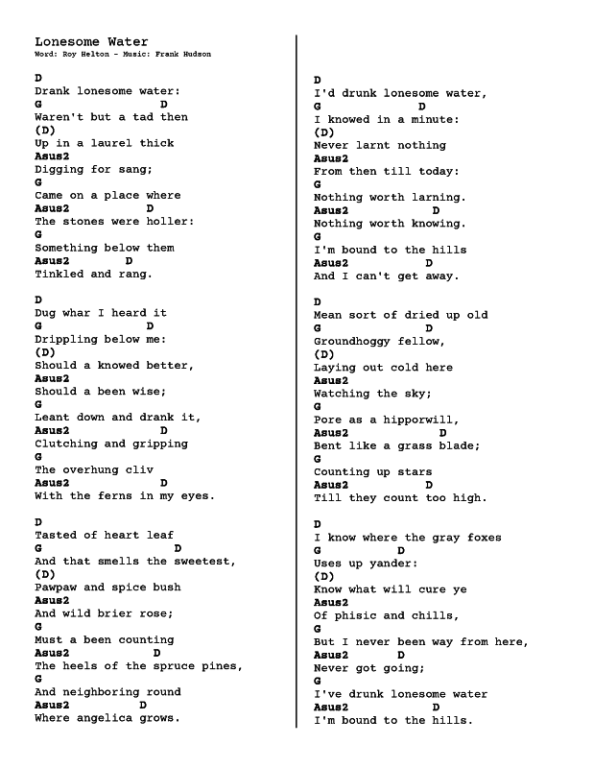
Some dialect vocabulary here challenges me. “Sang” is ginseng. Is “cliv” a regional pronunciation of cliff?
.
Well, we don’t know if Helton sang, but the recording below says I sang it, best I could, to some music I had to supply to make that happen. I usually have trouble performing accents and dialect, but this one caused me fewer issues – maybe the spirit of Tennessee ancestor Susan Partain helped me out? Besides guitar, the other instrument I played on this track is the distinctive Appalachian regional instrument, the mountain dulcimer. You should be able to hear my performance with the audio player gadget below. Huh? Wasn’t some plant-enchantment hasn’t made that audio player invisible, you’re just are reading this in a manner that won’t show it. This highlighted link will open a new tab with its own audio player.
.
*I also worry I may have oversaturated even the huge and avid market for rough-voiced singers doing presentations of literary poetry. It could have been even more bountiful, or overwhelming here, but #NPM2026 is coming to a close and I think I’ll only get one more musical presentation of a literary poem out by tomorrow – but I hope that’ll be a good one: a lesser-known Langston Hughes poem for Poem in Your Pocket Day. Three or four other pieces from Untermeyer’s anthology remain in various states of completion, and they may appear later this year.
**Helton taught at the Pennsylvania Friends Central School, a K-12 institution. I don’t have info on what he taught at that school. Imagist H.D. (Hilda Doolittle) attended this school, but that would have been before Helton’s time as a teacher.
***I can find nothing online searching at the Atlantic’s site, or generally, as to what kinds of things Helton published in that magazine. One short piece of light verse is quoted redundantly in the stub-entries that turn up in most web searches, something which may have been printed in the Atlantic: “Oaks are the true conservatives;/They hold old leaves till summer gives/A green exchange.”
****In case you wonder, the folk-song collector/singer/poet was a thing by the between-world-wars era. Carl Sandburg blazed that trail. Foundational creative writing professor and poet Edwin Ford Piper was another (and he supplied testimony that Robert Frost could be coaxed into singing a rowdy sea-shanty).
A note in the unreleased “talk” section of Helton’s Wikipedia stub says that he played Walt Whitman on stage in 1927, so one cite of performing.
Of course, the “literary ballad” has a long page-poetry tradition too. When the dialect or setting is some misty British Isles locale, Celtic fairyland, or ancient days it’s easier to accept its high culture bonafides. Helton’s narrator is an American lower-class contemporary and lacks any such exotic cache. Myself, I find poetry in this poem, but in American academic culture it must have been a harder lift to romanticize a speaker sounding like Pa Kettle or Jed Clampett.