Here’s one more piece from Ezra Pound’s 1915 breakthrough collection “Cathay,” a war story he called “South Folk in Cold Country.”
At the time Pound was working from Ernest Fenollosa’s, and Fenollosa’s Japanese teachers,’ notes to translate classic Chinese poetry, World War I had broken out, and England, where Pound was living, had mobilized to fight this war. Like William Butler Yeats (with whom Pound was staying for part of this time) Pound did not want to take a side in the war. Not only skeptical of the war’s patriotic rationales, Pound also wanted to continue to focus on his modernist artistic revolution.
Earlier in the Parlando Project, we’ve seen how Yeats responded at the beginning of the war. His “On Being Asked For a War Poem”cloaked his disdain for statesmen’s’ rhetoric while seeming to take a aesthete’s stance of artistic superiority and inferiority.
Robert Frost needed to get to W. B. Yeats house,
so a helpful Ezra Pound drew him this map.
Pound felt similarly. He may not have been sure, at first, of the what he would eventually call lies by the politicians by the end of the war, but his poetic BS meter was immediately sure that the patriotic verse being produced to ennoble the war was false ethically and artistically. But Pound also recognized that any poetry he would write in such a charged environment would be inescapably seen in the context of the war.
Still, he was wary of writing about war as a civilian who had never fought in battle. At one point, he reported he had tried to enlist, but was turned down due to his (then neutral) American citizenship. At another point, he wrote a review critical of Rupert Brooke’s war poetry, only to have Brooke, who was serving in the British armed forces, die while in service, leading Pound to qualify that he was only criticizing the poetry, not the citizenship.
So as Pound created and promoted Imagism, his vision of new modernist poetry by recreating classical Chinese poetry in English, he came upon a solution. He would use the Chinese poets, both as the model for his new kind of verse and as a way to comment on the war.
Today’s audio piece is an example of how Pound went about those two things, once again translating and transforming the work of 9th Century Chinese poet Li Bai.
“South Folk in Cold Country” is an account by Li Bai of a military campaign in the north of China that had occurred almost a thousand years before he wrote. Pound, taking this for his modernism, has the soldiers who speak of their war experience say nothing of what they are feeling. There is not a word of them saying they are tired, confused, frustrated, or suffering, but their world is described by them as the image of all these things. While Li Bai/Pound’s “River Merchant’s Wife” reads musically off the page, despite being “free verse” in English, “South Folk in a Cold Country” has a more abrupt and doubtful music. Pound was trusting Li Bai and his own artistic sensibilities so that he might get some of the war experience right.
When I first read “South Folk in Cold Country” this year I thought: this sounds like a bag of fortune cookies mixed in with Ernest Hemingway. Either or both of those comparisons may sound dismissive to you, but I suspect the best fortune cookie aphorisms have some relationship, however strained, to the concision of classic Chinese poetry, and Hemingway, however familiar he may seem to us now, was using Pound’s ideas as part of what was to be Hemingway’s revolution in prose. Thanks to Hemingway, and in turn, to Pound who directly influenced and taught him, we now are not surprised by representations of war, violence, and death that assume concise description and charged observation can be truer than superfluous remarks by the author.
Hemingway, who did serve in WWI, sought out Ezra Pound to shape his writing about it
I did wonder about the General Rishogu mentioned at the end the piece. His Chinese name (remember, Pound was working from notes of Japanese scholars, not Chinese ones) was Li Guang, and his story is here. I like this as an ending. I’m not sure if Li Bai’s soldiers who speak in this piece are using Rishogu/Guang as an example of the hard fate of soldiers; or if they are saying, after what we’ve been through, making all those rapid marches to make Rishogu/Guang’s name, who among them will care about the general’s death. On the odds, I’ll take the later.
Musically I used some relentless vibes over electric piano and bass to stand for the rapid marches that the “swift moving” general kept ordering, and then some neighing winds from a synthesizer patch. To hear me perform “South Folk in Cold Country” with that music, use the player gadget below.
Just after the start of the 20th Century two teenagers met at the University of Pennsylvania. One was 16 years old, a smart and cocky boy without much in the way of money, who had somehow managed admission to the University at such a young age. The other was 15 and the only daughter of an astronomer and professor at the college. So devoted was the girl’s father to his astronomy, that it’s told that his wife needed to come by during the colder months with a kettle of hot water to unfreeze his eyelashes from the eyepiece of his telescope. This professor was the enlightened sort of early 20th century father who believed in women’s intellectual equality. He dreamed that his daughter would become another Marie Curie.
However, the two teenagers soon fell in with each other, and science was not in their bond. Poetry and the arts were. A year or so later, a new freshman arrived at the University to study medicine. That freshman was William Carlos Williams, and he would complete his studies and become a pediatrician and family doctor who practiced for decades in Patterson New Jersey while writing purely modern poetry. The boy and the girl fell in love, and were secretly engaged, knowing that the boy’s lack of money and established career would prevent the girl’s father from giving permission of them to marry.
The 1985 movie “Real Genius” is a documentary of this meeting between two teenagers in college.
The girl grew up and was sent to Bryn Mawr, a woman’s college that was known for having a tough “men’s curriculum,” following her father’s hope that she would become a scientist. There she met Marianne Moore, who also became a noted modernist American poet, but at Bryn Mawr she failed in her studies. The American oracle Barbie would later proclaim: “Math is hard!” and a career in science was out.
But wait. What of that cocky boy? Oh no, he’s gone to England! And double oh no, he now engaged to another woman there. After all this, we can now begin our story again.
This now young woman who had already met and befriended William Carlos Williams and Marianne Moore, went to England to meet back up with the young man she had fallen in love with as a teenager. The young man was Ezra Pound, and the young woman was Hilda Doolittle—but she wouldn’t be much longer.
Sorry, “Real Genius” its really about how Tears for Fears was uncool, but now is kinda cool.
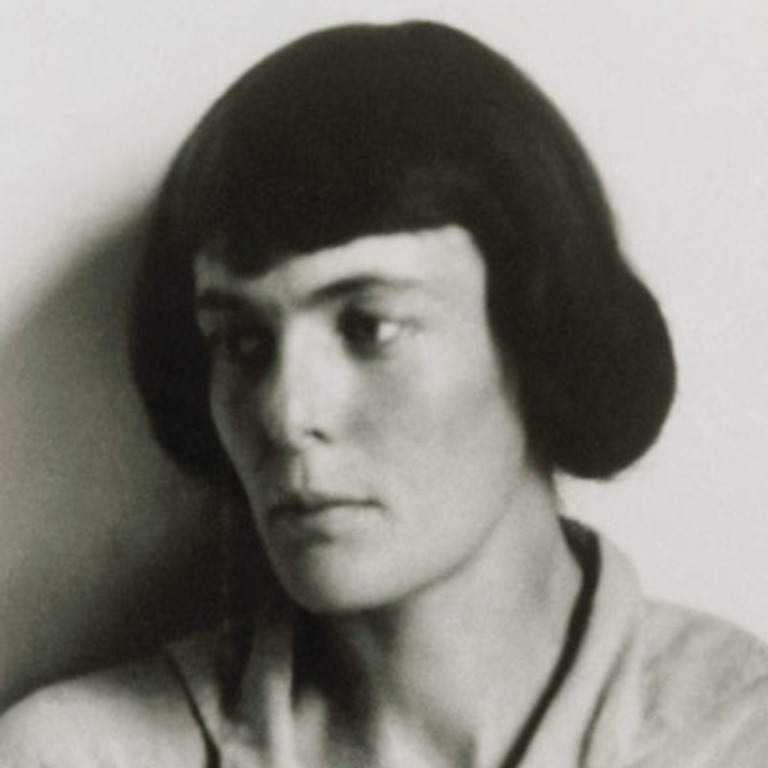
And here are the real and young Ezra and Hilda.
Pound was in England trying to stir up a poetic revolution, something that would forge past the reformation of William Morris and the Pre-Raphaelites and give poetry a fully modern cast. Hilda showed Ezra some of her new poems, and Ezra did three things that he would do repeatedly for other poets in the next couple of decades.
He immediately recognized that Hilda was writing the kind of fresh, spare, honest poetry that he thought necessary to break the grip of the past. He would see to it being published.
After admiring it, it took his pencil to it, and slashed out parts of the already concise poems. I can hear some of you drawing a breath on that, considering the sexual politics, ready to cry “Asshat!”—but that’s Pound, even with poets of genius: cut it, pare it down, make it new, not one extra word. A few years later he’d do the same thing to T.S. Eliot, and the surviving variorum manuscripts show why Eliot called Pound “The Better Maker” of “The Wasteland.” Pound’s editing pencil seemed to teach like the sensei’s stick, and once shown, poets like Hilda Doolittle and Eliot understood how to do the same thing themselves.
And then he took that editing pencil and signed Hilda’s poems “H.D. Imagisite.”
That last move was another part of Pound’s talents. He was probably more successful in launching other poet’s careers than he was his own. He had a shrewd promoter’s eye. “Imagiste” or “Imagist” was the name Pound would give to the modernist poetic movement that would during the years of WWI as radically reshape English poetry as the war would reshape the maps of the world, and here he was saying, rightly, that H.D.’s poems would be the ne plus ultra of that movement. As a name, H.D. was as pared down as the new poetry would be. If he’d lived long enough to see video screens with 1024 lines, he could have said calling them HD for “High Definition” was a tribute to his call for seeing things truly. And H.D. masked Hilda’s gender, still important in a world where women were widely thought to be incapable of great art. The former Hilda Doolittle didn’t object. She’d never liked the family name (“Do-Little” she thought it scanned) and besides, her sexual identity and friendship affinities were at least HD.
Let me admit that this post is unfair to H.D., the writer of the words of today’s piece. We’ve gone past my customary length limits and we’ve only barely touched on H.D.’s talents and extraordinary life. I’ll need to revisit her work soon and give H.D. her due.
What can I say about today’s piece “Heat?” Well it’s an appropriate July poem, and the titular heat, in true Imagist fashion is both a closely observed thing: actual summer heat, and an image that, without simile or extra framing, is imbued with complexity. Last episode we had Pound/Li Bai, two men, showing desire and longing in the “River Merchant’s Wife” with only a few actual named emotions or feelings. H.D., the better Imagist, shows female desire with not a single named emotion. The poem’s final phrase:
that presses up and blunts
the points of pears
and rounds the grapes.
is sensuous beyond words—it’s only 13 words to be beyond after all—and with four p and s sounds it holds four kisses.
To hear my performance of H.D.’s “Heat,” use the player below. And thanks again for the likes and the social media shares!
“The River Merchant’s Wife: A Letter” has a very complicated history. I can’t even say “Ezra Pound’s ‘The River Merchant’s Wife”— though he’s often listed as the author.
Let’s begin, as a river or a journey might, at the beginning. Back in the 9th Century in China there were two great poets. One of them we’ve already met there: Du Fu. He was known for his wisdom and level-headedness. The other was Li Bai (his name is also written in western letters as Li Po and Li Bo, and in Japan as Rihaku) who was known for his more excessive existence. In China both have been continually revered, but in early 20th Century Europe or America, they were nearly unknown. Only scholars interested in off-beat subjects knew of these men’s work.
One such scholar was an American, Ernest Fenollosa, who had traveled to Japan and become deeply immersed in Japanese culture, and as a sidelight to that, he also was exposed to Chinese culture. Early in the 20th Century, Fenollosa was one of a group of Americans living in England. We’ve met others here who were part of this “reverse British Invasion” of Americans: Ezra Pound, Robert Frost, T.S. Eliot—and you’ll soon get to meet another, H.D. Fenollosa then died in 1908, still in London.
Here’s were something fateful happened. Fenollosa’s widow, for some reason, gave Ezra Pound a bunch of her late husband’s papers. Pound was a young man who was trying his damnedest to start some kind of artistic movement in London. In the papers were scholarly prose translations of Li Bai’s poems done by Fenollosa and two of his Japanese associates, Mori and Ariga.
Ernest Fenollosa, deeply attracted to fur; and Li Bai, more into silk
Pound fell upon these scholar’s notes. He’d already sought out other old poetry for inspiration for his revolution (much as the Pre-Raphaelites had looked backwards for something fresh), but in this old Chinese poetry he found what he was looking for. It was concise. It was free of centuries of cruft that English poetry had accumulated. And Pound naïvely felt that the poems themselves grew out of the ideograms for their words, Chinese characters which had evolved from drawings of objects. He had found his poetic revolution. Poems should be constructed of little more than images. Not images in the sense of elaborate similes or strained allegories, images in the sense of a presentation of the direct observation of the poet, unadorned. Pound published what he created out of those scholars’ notes as a ground-breaking poetry collection “Cathay,” and he quickly began to compose his own modernist poems using his epiphany.
If Fenollosa hadn’t died in London, and if his widow hadn’t given this tranche of papers to an artistic provocateur such as Pound, it’s possible that Li Bai would be no better known in English today than he was in 1908, and it’s even more likely that poetry in English from that point on would have evolved differently.
If Fenollosa hadn’t died in London, and if his widow hadn’t given this tranche of papers to an artistic provocateur such as Pound, it’s possible that Li Bai would be no better known in English today than he was in 1908, and it’s even more likely that poetry in English from that point on would have evolved differently.
Seems like a miracle when such things line up, doesn’t it? Well, here’s something as miraculous: though “The River Merchant’s Wife’s” source was written over 1200 years ago in a culture so far removed from America that the childhood legend was that one would need to dig a hole through the center of the Earth to get there, even though it comes to us filtered through non-Chinese scholars, and even though the particular words I’ll use today to express it were written by an avant-garde poet whose work remains little-read and understood today, many people have an immediate deep emotional response to this poem the first time they hear it.
Isn’t that odd? All that strangeness in customs, place-names, time, provenance—and yet more: it’s a poem of female desire written in the voice of young woman by a man, and translated and transformed by men. And yet, woman and men, young and old, hear it, and they feel the pangs of desire and separation just as much as any 8th Century resident of China—even though the poem, following the tenants of what Pound would call “Imagism,” barely mentions the speaker’s emotions (“bashful,” “desired,” and the only present-tense one, “hurt.”)
I know I felt those things when I first heard it, aged perhaps 21 on a sad journey with a young woman. I hear it now as an old man too, and think once again of my friend John, and of China. The place, Cho-fu-Sa, that the river merchant’s wife says she will go out to meet her husband is, I’m told, hundreds of miles from her village in the poem. What is such distance to the heart?
To hear my performance of “The River Merchant’s Wife: A Letter” use the player gadget at the bottom here. Since this post is already long, I’m not going to talk much about the music today. The higher-pitched string instrument you’ll hear is my approximation of the pipa, a traditional Chinese lute. There are many moving recitations of this poem available online, but to see an entirely light-hearted modern translation of “The River Merchant’s Wife” after listening to mine, view this one.
The subtitle of the Parlando Project is “The Place Where Music and Words Meet”. As I mentioned last night, this project, which combines words sourced from a variety of sources with a variety of music, has now reached 100 available audio pieces since it’s official launch 11 months ago. Note that stress on variety. In terms of writers, I have my favorites, and the short format of our audio pieces strongly favors poetry, but the Parlando Project has featured words taken from other sources as well, and some of the poets featured were unknown to me until I ran across them looking for material, and I’m trying to vary the music as much as I can. Sometimes our pieces are as simple as acoustic guitar and voice, as in our most recent post The Oven Bird. Some pieces have full arrangements with multiple instruments, and some feature spontaneous performances by the LYL Band, a folk-rock band that’s been playing a rough and ready mix of electric instruments and literate lyrics since the early days of Minneapolis punk rock.
We’ve gotten thousands of downloads and streams so far, and though I don’t have the time to thank everyone personally for the likes and the shares, it’s been your passing on the existence of our audio pieces that has grown our audience from a few hundred downloads to thousands. I don’t have time for a social media presence myself. Researching, writing the majority of the music, as well as arranging, producing and recording these 100 pieces has taken an untold number of fascinating hours, but it leaves me little time to promote this work myself. So I’m very grateful for you, the readers/listeners who have done so.
Since we last did did a Top 10 in the spring, that growth in listenership has meant that there is only one returning piece since that list a few months ago. Which piece has the staying power? Lets start off the countdown in the traditional order, with #10.
10. Adlestrop – a late surge brought this piece with words by fateful British poet Edward Thomas into the top 10, just beating out Zalka Peetruza and Spring Grass as the final slot shifted back and forth this week. Adlestop’s download rate is noteworthy too in that its the newest post to make this list. Listening to this hazy slide guitar piece I still recall my own muggy summer unscheduled lay-over in Kingham a year ago, but that’s a private moment, though I feel somehow I’ve shared it with Thomas thanks to his words. In a more public way, this poem gains resonance from it’s connection to Robert Frost’s The Road Not Taken and to the Centenary of WWI.
9. Grass – speaking of WWI, here’s the first of two placings of a Carl Sandburg piece on this Summer’s Top 10. My private memory is performing this with the LYL Band, spontaneously as usual, with no rehearsal or warning as I read Sandburg’s words, and having us stop on a dime for line that starts “What place is this…” as Grass approaches Sandburg’s ending. For other listeners, particularly those with friends, families, and even ancestors lost to war, Sandburg’s piece asks a powerful question of forgetfulness.
8. Intro to The Waste Land – One could say this continues our WWI Centenary theme, as T.S. Eliot deals with his personal depression in the context of the aftermath of The Great War in this poem, but it was instead intended as part of our April “National Poetry Month” celebration, which I will always link to the poem’s famous opening line “April is the cruelest month.” This is one of my composed pieces musically, were I get to write and perform all the parts myself, which means I get to fully realize my personal “vision” of the music (something the listener needs to care not a bit about) and to therefore be responsible for all my own mistakes. My personal memories of The Waste Land are two-fold, one a memory of reading it for the first time in college, and though mystified, feeling an intense musical thrust in what Eliot wrote, and then to a time more than a decade ago when I felt just past my lowest ebb emotionally and then performed the last sections of The Waste Land spontaneously with the LYL Band, and found it as musical as I expected it would be, but also was surprised at how it expiational performing it was. Publically, the downloads of this have been steady, and have continued long past #NPM in April, so it’s either due to your sharing of it, or the poem’s continued fame.
7. To A Friend Whose Work Has Come To Nothing – Irish poet William Butler Yeats is another writer whose work we’ve mined for more than one piece here. One thing I learned while looking at material for this blog was that Yeats too believed that poetry performed with music was a necessary combination. Another investigation, brought on specifically by this piece, was to find out just who the friend was whose work had been thwarted, and what that work was. This has been another piece with a steady listening rate since posted. My guess is that the experience Yeats was telling us about is common to many, and whenever it is encountered it is not easily forgotten. Weeks after this was posted, I watched the former FBI director James Comey testify before Congress, and thought if Yeats was his friend, he would have said the same things in verse to him.
6. Clark Street Bridge – Carl Sandburg gets his second appearance on this Top 10 with this wistful story of day and night on this busy downtown Chicago river bridge. As a personal experience I got to see the Clark Street Bridge this spring on a visit to Chicago, and though the current bridge is almost 100 years old, it’s not the one Sandburg watched and wrote of. Another thing I learned during my trip: his night scene with silver singing stars equal in number to all the broken hearts in Chicago contained a larger number than I would have estimated from modern urban nights, as the poem was written before the widespread adoption of all-night electric lights. What are, or could, the listeners be attracted to? Well, broken hearts remain as numerous as the stars in a dark sky for sure, and Chicago has taken Sandburg to it’s heart; despite, or because, he says that that heart is broken.
5. The Death of Col. Bruce Hampton – I’ve written a number of direct tributes to musicians that I’ve featured here, but this is the most popular. Particularly now as the main lot of musicians fall back into the lower levels of the “gig economy” they gave their name to without additional payment, I see them as retaining the heroism of artists in general, who do what they do to general indifference, but now with a much lower chance of professional earnings. This is the only piece in this Top 10 where I wrote the words and the music, but that’s about the right amount, as the Parlando Project is about appreciating “Other People’s Stories” after all. The defensive shells and double-ended poison stingers that artists grow don’t always lead to happy lives, but those who knew Bruce Hampton have grateful things to say about him as a person and collaborator. And by chance, he got to come to the end his life with some of those folks thanking him, while he encouraged the creation of even more spontaneous art. I assume that’s the reason for so many people listening to this piece.
4. These Fought – Here’s one I’m a little surprised about. Ezra Pound may have done more than any other person to create modern poetry, but he’s less read today than many he influenced and championed. And though other modernists dabbled in between-the-wars nationalism and racial theories, Pound became America’s most notorious fascist apologist. And this piece, posted around Memorial Day is an uncompromising denial of the honor in the sacrifices of WWI. If you like your poetry feel-good and inspirational, if you like your poets cuddly and full of civic pride, this piece is not your choice. The LYL Band tries to equal Pound’s fierceness in this performance.
3. Love and Money – Unlike many other poetry and spoken word blogs, we feature other people’s words almost all the time in the Parlando Project. Of course, there’s nothing wrong with self-expression, but in following the Project’s dictum “Other People’s Stories,” we don’t do that often. Perhaps in consolidating that stated aim with the catalog of thought-provoking words that Dave has written over the years, many of the Dave Moore pieces I’ve posted so far have been performances where I perform Dave’s words–a mixed blessing that–because, to steal an old Columbia Records ad from the 1960s “No one sings Dave Moore like Dave Moore.” I was sold on this one the moment I heard Dave sing the first line of this piece as we spontaneously performed it, and there’s no way I could do it justice. The popularity of “Love and Money” probably has the same private and public reasons, it’s just a good song. Oh, and Dave’s pounding electric clavichord performance might have something to do with it too.
2. Up-Hill – Here’s an example of a poet I knew close to nothing about before looking for material in the public domain to adopt for Parlando performance. Having a long time love of the Pre-Raphaelite painters and knowing that poetry and poets were part of their artistic circle, I went looking for Pre-Raphaelite poems that I could relate to musically. I kept striking out. I really wanted to find something by Algernon Charles Swinburne, because, well, “Algernon Charles Swinburne”. Is there any name that says more clearly that you don’t give a damn about sounding cleanly modern and approachable? Only Ezra Pound’s invented persona “Hugh Selwyn Mauberley” comes close. Alas, I could find nothing I felt I could inhabit–and then I came upon some of Christina Rossetti’s shorter poems. Read this on the page just once, and you know it’s crying out to be sung. Perhaps Up-Hill draws listeners because it’s a Christian religious poem, but Rossetti’s writing personally connects with me because it’s imagery and expression is so non-abstract and modest.
1. Frances – Here’s the only repeat from last Spring, and it’s still on top, with almost double the total listens since released of the any of the others on this list. I released Frances on a lark to mark US President’s Day last February. I suspect it got picked up and linked somewhere more popular than other pieces that have been linked from here, but I haven’t been able to find out where. Here’s an example of how relatively popular it’s remained, long after it’s author’s, the first US President George Washington’s, birthday this winter: it was the 8th most listened to piece from the Parlando Project in May, still 19th in June, and currently it’s the 13th most listened to song in July, with a hundred alternatives competing with it. What accounts for this? Well it’s a love song for one thing. Maybe it’s the pared back Pixies soft/loud arrangement? It’s a mystery.
So that completes the Summer 2017 Top 10. I plan to do another one next Fall. If you’ve got a favorite you’ve found here, do what someone must have done with Frances, and go ahead a link to it to see if it can get more listeners.
In the last post, I presented Ezra Pound’s rant about the society that lead so many to their deaths in WWI, deaths that included several of his own modernist artistic circle. Taking it personally, Pound exclaims that their “fortitude as never before” for change and their “frankness as never before,” lead only to equally great “disillusions”. He sees lies and liars leading others into the war and their sacrifices, and only liars as triumphing.
Speaking repeatedly about liars and lies and illusions, Pound’s “These Fought” would not be a very popular choice for a Memorial Day speech then, just as it probably would not be one now. If you agreed with him, you might enjoy his precise inventory of folly. If you didn’t, you’d say he was unappreciative of his friends (and so many others) sacrifice, and that his disbelief in the stated high motives for the war could be mere cynicism. I can hear what some voices must have said then (and would say now): “You can complain about what is imperfect, perhaps even foolish, but what’s your solution, other than to stand to the side and write poems?”
Alas for Pound, he did propose a solution. It was a solution chosen by many others disappointed after WWI, a fresh modernist conflation of race hate, nationalism, technology and authoritarianism, the fascism that lead to WWII.
What place is this? Where are we know?
Today’s episode: “Grass” by Carl Sandburg is just as pure a modernist, imagist poem as any by Pound, but it’s statement about the sacrifices of war is more indirect.
Sandburg has a reputation as a clear-spoken poet who makes his points straightforwardly, as if plain words mean simple thought. I believe this is mistaken. Sandburg’s mind was not a simple, unicameral mind. Sandburg was leading multiple lives at once during the WWI era. He was writing, sometimes under a pseudonym, for radical leftist/labor IWW publications, while writing for the mainstream Chicago dailies, while writing modernist poems. When Sandburg was protesting the jailing of IWW antiwar activists, and writing today’s compressed, Imagist, “Grass,” Sandburg had also published a long, Whitmanesque populist and blood-thirsty poem “Four Brothers” lauding the urge of Americans to go overseas and put the German Kaiser’s head on a pike. “Grass” too has its echoes of Whitman—not the martial revolutionary Whitman, but the Whitman who wrote of grass as “the beautiful, uncut hair of graves.”
So, this is a complicated and perhaps self-conflicted man who is writing this, and when we move in “Grass” from the catalog of history’s deadly battles, ending with two great battles of WWI, Sandburg’s poem takes a turn.
In two years or ten years, what is this sacrifice? In“Grass” the places of these battles become nowhere. Is this a hopeful statement, that after this “War to End All Wars,” we will now be able to forget war? Is this an anti-war statement that would say, as the radical Sandburg or Ezra Pound would have said: that after all such strife, the liars and those that run things will continue to run things anyway, as if the war settled nothing? Is it a statement of reconciliation to come, when elderly soldiers from opposing sides meet and speak of their common experience and equally lost comrades? Is this a statement of the democratic socialist Sandburg, that the forces of inevitable Marxist proletarian revolution will come and obsolete all that was before? Or is it a cool and detached statement that all human efforts are transient?
I don’t think it’s an accident that this divided man wrote a poem about the sacrifice of war that lets it be all those things.
To hear the LYL Band present Carl Sandburg’s “Grass,” use the player below.
The lives, outside of art, of artists bear only a mysterious resemblance to their work. The concentration of time that must be brought to creating work drains many a writer’s life of incident. And so, an artist like Emily Dickinson can lead an outwardly constrained life while creating an inward empire. Or the man who would eventually be charged with the establishment of the first modern democratic republic could be, as a teenage poet, a love-struck supplicant. Nor does general good character align with artistic success—saints can write bad poetry and flawed people may write good poetry.
Today’s post features the words from an American who as much as any single person launched Modernist poetry in English. His associates and admirers, added to his detractors and opponents, make up an encyclopedia of 20th Century English literature. In the first part of the 20th Century, some of them would be profoundly influenced by his artistic ideas, and some would even be directly edited or personally mentored by him. One hundred years ago, in 1917, Carl Sandburg would say of him:
“All talk on modern poetry, by people who know, ends up with dragging in Ezra Pound somewhere. He may be named only to be cursed as wanton and mocker, poseur, trifler and vagrant. Or he may be classed as filling a niche today like that of Keats in a preceding epoch. The point is, he will be mentioned.”
Pound would live more than another half a century after this, his literary revolution flowing outward until few could see back to its instigator. And there’d be reasons his influence would be discounted: by the end of WWII, when Modernism, no longer insurgent, was about to become the established artistic order, Ezra Pound was a 60-year-old man confined in an outdoor steel cage open to the elements, awaiting to be charged as a war traitor with a likely sentence of execution.
This guy is most responsible for English literary modernism, but that’s not what got him arrested.
The customary quiet and inward life of a writer, even an unnoticed one, looks good in comparison.
Though this treatment was inhumane, and the charge not without controversy, it was not unsubstantiated. Pound had spent the years leading up to WWII making common cause with the European Fascists that the United States eventually fought in that war, and when that war was being fought, he broadcast eccentric propaganda in his native English in service of his adopted country of Italy and Mussolini. Furthermore, his attraction to the Fascist cause was not an accident, a casual side-effect of his adopted country of residence. Pound wholehearted seemed to believe in the crackpot and yet deadly racist theories bolstering Fascism.
So much more could be said on this, but that would take more room that we have today, and besides your thoughts and judgements on matters like this, as I said when talking about Jesse James, are more important than mine. Not only are they more numerous, but you are likely younger than me, and will get to use those judgements on things like this to guide your life.
Today’s audio piece, “These Fought,” was written by Pound at the height of his fame and good influence—not after WWII, after WWI. Unlike some younger Modernists, Pound did not actually fight in WWI, but situated in England during that war, he saw the patriotic recruitment and the creation of cases for the war, a war that soon became mechanized slaughter beyond all previous imaginings, and he lost friends in that staggering slaughter. So, in “These Fought” Pound caustically calls out the cases for the slaughter, and leads us to note that bravery in fighting WWI, or fortitude in opposing it, were in some sense equal in valor and, alas, equal in success.
To hear the LYL Band perform this, use the player below.
Returning now to our discussion of Modernism, that early 20th Century artistic movement that gave the artistic environment we are still grappling with. While it was a world-wide movement, reacting to world-wide changes in technology and society—for the first time, Americans were at its forefront.
But not all the Americans were residing in America.
Back in 2014, when there was a brief 50-year anniversary flurry of coverage of the Beatles “British Invasion” of the US, I played one of favorite games. So, if we were to think in 2014 of the way things have changed since 1964, what would a person in 1964 be looking back at from the same 50 year interval from their time?
Turns out they could have been looking at not a “British Invasion” of musical groups, the Beatles et al—but an “American Invasion” as Ezra Pound, T.S. Eliot, H.D., Gertrude Stein, Robert Frost, and Ernest Hemmingway all were residing in England or Europe around this time. Pound in particular, was busy making alliances and promoting his vision of Modernism, which he called “Imagist.”
Imagists, at least at the start, put a high value on concision. Pound was just as concise in Imagism’s manifesto, reducing it to three rules:
Direct treatment of the “thing”, whether subjective or objective.
To use absolutely no word that does not contribute to the presentation.
As regarding rhythm: to compose in sequence of the musical phrase, not in sequence of the metronome.
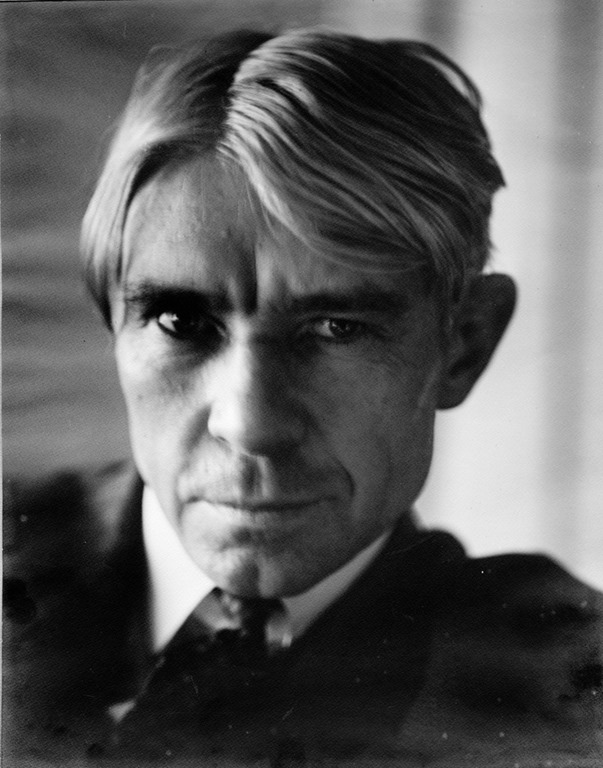
Images of Imagists: Sandburg on the left, Pound on the right. You can say that again.
Not all the Imagists were residing overseas however. Back in the specifically American city of Chicago, Carl Sandburg was to combine these Modernist/Imagist precepts with Socialist politics and activist journalism. He worked so hard at this that he essentially split himself into different people. There was Carl Sandburg the Imagist poet who hung out at the then new Poetry Magazine offices, where the poetry discovered by their European Editor, Pound, was funneled into America. But he was also a journalist working for the legendary Chicago daily press portrayed in “The Front Page”. At the same time, he was also associating with equally legendary American IWW radicals and anarchists, writing for their publications, sometimes under a pseudonym. Was he hiding his identity, or just saying that the agitator was a different personality?
Visualize that American comic-book secret-identify hero, say Superman. By day the “mild-mannered reporter for a great metropolitan newspaper…” by night fighting for “Truth, Justice, and the American Way…” as a crusading radical Socialist—but wait, there’s something more—he’s not just those two, he’s trying to create Modernist poetry as well. And pay the rent. Which is his true secret identity?
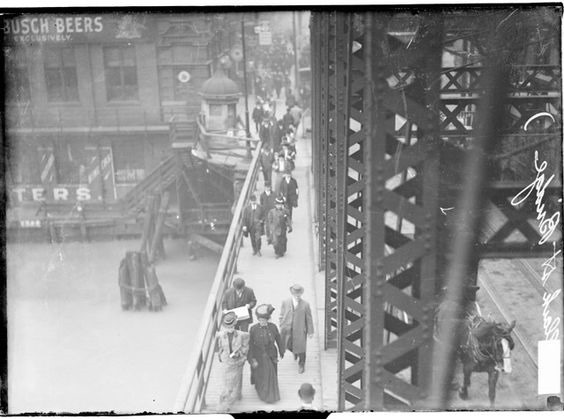
Chicago’s Clark Street Bridge, then and now: “No more dust and wagons.” Are the voices still unheard?
Today’s audio piece, Carl Sandburg’s “Clark Street Bridge” is an orthodox Imagist poem by this un-orthodox, tripartite man. The subject “thing” is definite as the downtown Chicago river bridge in its title. Its rhythm is as legato and singing as the absent voices singing at it’s end. It starts with its busy turn-of-the century black’n’white newsreel footage of crammed wagons and walkers, then takes us to the dog-watch night: only three scattered people interrupt the foggy mist and the brightest stars above the urban river. In this mist and shadows, reporter Sandburg takes off his double-breasted suit, but then, stay-at-home Imagist poet Sandburg takes off also his poets’ tights and doublet, and now, naked as a radical above the dark Chicago river he hears the “voices of dollars” in the city’s heartless commerce, the “drops of blood” from the men and women who animate it, and the gigantic chorus of the resulting “broken hearts,” as many as all the stars, as heavily present as the mist, and as unheard as either.
As I’ve often found with Sandburg, others have set his poetry to music, but no matter, I press on. My music for “Clark Street Bridge” started with an un-relenting long-measure typewriter-like drum part which I hoped would stand for hoof and foot beats. I tried to pair the guitar part and the reading of the words, and finally, I laid a legato bass part underneath it all to stand for those voices softer than the stars and mist. To hear it, use the player below.
Sometime around the end of the 19th Century, a century that had seen accelerating change in technology and social order, new artistic movements began to flower on either side of the Atlantic. In the UK the Arts and Crafts movement and the Pre-Raphaelite Brotherhood looked backwards at things that had disappeared or were nearly gone, and revived them within a the new context of their present day. Interest in neglected folk-cultural traditions of nations began to arise. Others looked to new orders: utopianism and socialism. The seeds of what would be called Futurism began to take shape, a worship of the inherent art in technology.
Here’s a funny thing: all these things mashed-up in the ferment of the times. Some of the artists held to several or even all of these beliefs, participating in more than one of these seemingly different or even opposed movements. Call this brew “Modernism,” for the one thing that united it was a desire for something new, or at least new for the times, to be produced.
As the 20th Century got underway, American artists forged ahead in these movements. The reasons for that are multifold, but one is that they had a head start: Walt Whitman and Emily Dickinson and the Emersonian Transcendentalists had already pioneered distinctly American ways to be modern.
Let’s leave the salons and literary magazines now for a moment. Here’s something else that was happening at the same time, with only spotty distribution beyond its creators. Some African-Americans, presented with nominal freedom, economic serfdom, social repression, and what must honestly be called a sub-human classification by many learned men, continued to come to terms with European instruments and tempered scales, combining them with the already juicy stew of American music and the remembered modes of Africa. They produced their own Modernism, something that eventually got called “The Blues.”
Lyrically, this was an inherently skeptical art. As it percolated through commerce, the Blues got re-defined as a sad song of loss, and loss certainly is part of its subject matter, but the outlook of the original Blues writers was not simply that. A lot of it was satiric comment, and when the Blues dealt with the desire and farce of love and lust, as it often did, it wasn’t just about loss.
I could go on and on about the Blues, but for the moment, I’ll ask you to just absorb this: when William Butler Yeats was having a harp built to chant his poems to, as he believed the Celtic griots of old had done; and when Ezra Pound, Robert Frost, HD, Amy Lowell, William Carlos Williams, Gertrude Stein or T.S. Eliot were inventing their strain of Modernist poetry, often abroad, some other Americans were back in the States retuning guitars and looking for the notes between the keys of the piano with their own poetry that sought to “make it new.”
Emily Dickinson is a special case in so many ways, but one of those ways is that although she wrote much of work during the Civil War in the middle of the 19th Century, she was only published much later in the century. Her poems, so stripped down, so skeptical of received notions, so vivid in fresh images that didn’t map easily to conventional meaning, fit right in with work being written 50 years later by the Modernists.
Warning: time travel plots often are ridiculous.
Today’s episode “Soul Selector Blues” takes this time travel one step further. What if Emily Dickinson was a serf on the Dockery Plantation in Mississippi early in the 20th Century? Maybe she’d tune a guitar to “Spanish” and grab a slide to get those in-between notes, and then what would have been “The Soul Selects Her Own Society” would come out like this.
To hear the LYL Band cover “Delta Amherst” Emily D’s classic 78 r.p.m. side “Soul Selector Blues” use the player below.
Imagine a world where what you thought was poetry was entirely different. A world where short poems could be as celebrated as longer literary works. A world where the most admired poems could be clear as can be about what is happening in the poem (the poem’s plot) with no elaborate obfuscation in the language; and yet the meaning, the thought and feelings the author means to convey, may remain allusive enough that the poem’s meaning seems to change over time as your experience grows. Imagine a world where poems can seem to have no metaphors at all, poems that don’t so much interpret the book of nature, but seem to be a page from that book itself.
That’s what Chinese poetry seems like to me.
It’s a refreshing change from the Western canon. I can see why a grumpy modernist like Ezra Pound, who wanted to sweep away the rot of his culture, would find it influential. Or why the forefathers of the “beat generation” in the western United States looked further west than California for a way to apprehend reality on the page.
I’m no scholar of Chinese poetry. These are the feelings of someone who likes what he reads and finds lessons in translating it.
For today’s post, I’m going to go over how I work on these translations with the aim of stripping away the mystery. I’ll use a short poem by Tang Dynasty poet Meng Haoran “A Spring Morning.” It seems to be a good first task for Chinese translation, and the original poem is apparently known almost to the level of a nursery rhyme in Chinese.
Texas guitarist Billy Gibbons…whoops, no, this is Meng Haoran
I do not read Chinese, however, it’s now possible to find glosses of many poems literally translated from the original ideograms. Here’s what “A Spring Morning” looks like when each of its lines five characters is translated into an English word :
Spring sleep not wake dawn
Everywhere hear cry bird
Night come wind rain sound
Flower fall know how many
The first problem is there is no punctuation, nor anything like English syntax. Still that’s an interesting way to approach a poem, where in English we are often trying to find the word to fit our flow of thoughts and music, but in working from this gloss we have the words, or at least “a word,” but need to find the flow instead.
I decided to render the first line as: “I slept late this spring morning, awaking just after dawn.” keeping the season (spring) and the more specific time of past the daybreak moment. I added late, which is not in the glosses’ words, because I thought the poem needed some reason why past the dawn was significant when I connect it with the third line.
The second line required less thought: “From everywhere I hear birds calling out.” The main choice here was the word I’d use for the sound of the birds. “Cry” used in the gloss has connotations of sorrow in English (not always, for example “war cry”) and I didn’t want to tip my hand toward sorrow in this line. And in Spring I know these bird calls, they are in fact just that: birds calling out for potential mates, birds setting up their territories, birds that want to say something to other birds.
The third line I write as: “Last night I tossed and turned in the sound of the wind and the rain.” This gives a reason for why the poet slept late, adds a note of drama and, in a particularly personal choice I made, alludes to a traditional English song refrain “Oh no, the wind and the rain.”
Now the final line: “Who knows how many petals have fallen?” Here seeing other people’s English translations helped, as it otherwise might not be clear that this is a question. In a vacuum one might render this as “I know how many flowers fell.” And that ending has validity, essentially saying “(in such a storm as last night) I know for sure how much my lovely spring blooms are going to be damaged.” Others who know more about Chinese idiom have chosen to make this a question, so I’ll trust that, and this makes the concluding thought more like “(I’m worried about the damage of Spring storms. but it was night and I was asleep) and no one can change the way Spring does this, blooming and storming, so it’s a mystery to you and me.”
Overall, notice how this modest four-line poem, suitable for children, encapsulates a sophisticated thought, one that young children wouldn’t need to understand yet. It shows us Spring, as a sleeper sleeps past the now earlier dawn, through a rain storm that grows and destroys (compare our nursery rhyme “April showers bring may flowers” meaning “you might get wet, but it’s good for flowers” vs. this Chinese storm), alludes subtlety to the love and war of birds, and concludes with a wise line that says our ability to comprehend this cycle of growth and destruction, change and renewal, is limited. To a child, that last line may mean no more than the thrust vectors that allow that “a cow jumped over the moon;” but to an older adult, it reminds us more, that we will never know.
For the music to accompany “A Spring View”, I used some drums playing an odd rhythmic figure, fretless electric bass, electric guitar, and two soft synthesizer voices: a washed out horn and another which is supposed to suggest a Chinese flute, which unlike Bob Dylan I did not take from a dancing child. Today’s audio piece is very short, and to play it use the gadget below.







 Frank Hudson