Barn, Burning

Here is a piece based on a poem by a second Irish-American poet, Ethna McKiernan, who before her death in 2021 would host a reading every St. Patrick’s Day. I can’t say I knew her very well as a person, though as mentioned last time she was a long-time participant in the Lake Street Writer’s Group with myself, Parlando contributor Dave Moore, and the poet featured last time, Kevin FitzPatrick. I’ll next be going off on a short tangent, as is my nature, but it any of this writing displeases or tires you, just skip to the bottom. I quite like the piece that is the occasion for writing this today, and you are excused to go there and just listen to it.

I don’t think Ethna liked me much as a person, and I can imagine any number of reasons why that might be so. Let me leave most of those guesses behind for today’s purposes. In my old age I’ve come to the realization that I am often a careless and inappropriate person. I suspect that’s for neurological reasons, but who can say, it may be a defect in my soul as would have been said in the old ways.

One peculiarity that I had in writing groups is that I was prone to writing long responses to drafts shared by other members. I’d often get quite detailed with noticing what works, and at least as much so with what I thought didn’t or had alternatives to be considered. The audience of this Project know that I have a broad appreciation for styles and approaches. I don’t hold to a narrow poetic style and down-rank anything that doesn’t follow it, but just as I do with editing audio or trying out compositional ideas in music, I tend to look closely, and over the years of doing this, I’d notice how zoomed in and nit-picky some of my responses were — and I wasn’t at all sure my suggestions for alternative approaches were actually improvements. It’s been a few years since I’ve done that, but I still cringe at some of the things I wrote, particularly in response to Ethna’s poems. After all, here was a poet with several published collections, a grant-winner with a distinct cultural connection to a great poetic culture, and who had taken advanced academic creative writing study. Me? I’m a high-school graduate from nowhere, who has no distinct poetic style to trumpet, who last was published in the 20th century. And need I add one more kicker — I would be in Etna’s case a man writing to a woman poet. Women poets reading this know how that often goes.

So in summary: matters of technique and poetic tactics vs. being emotionally myopic. A lot of the first only emphasizes the second.

My reactions to Ethna’s poems continue to trouble me because, at her best I considered her to be an excellent writer, but one that left me tantalized by another poet within her — a far stranger one, one that only materialized from time to time, and seemed to be constrained by her internal editor and self-anthologist.* Yes, it’s a writer’s prerogative to choose what to present or emphasize, but I wonder if other writer’s group respondents, creative-writing seminars, or outside editorial preferences/fashions kept that element down in McKiernan’s writing. Those things have standing, and it may be me who’s out of step, whose taste is questionable or unlikely. But that’s how I felt when reading the poem “Barn Burning” used to make today’s musical piece. I was compelled to do something that may be regrettable. I strongly thought that a developed image just past the midpoint of the poem was not quite as vivid as possible, and that the poem’s ending was short of how sharply spoken it could be.**

Light Rolling Slowly Backwards front cover

Want the author’s final selected poems collection without my blather? Ethna McKiernan’s “Light Rolling Slowly Backwards”  is available here.

.

Ethna is some years dead now. Poets have trouble finding audiences when alive, and once they cross the Lethe, our forgetting often matches the dead’s. Improper, inappropriate, imperious, presumptuous — convict me of the lot. I’m taking the risk that I’m damaging the poem, though that’s not my intent. It’s done out of love for the poem and in hopes of bringing forth this element of the poet who might be condemning me from the other side.

If the worst is the case, take the performance below as damaged, counterfeit goods. If the best of the case is so, enjoy this poem’s mystical experience with my best efforts at adding music to it. I’m not Irish, I just hung out with some Irish-American poets, and it seems consistent to make this offense out of admiration.

You can hear the resulting “Barn, Burning”  with the audio player below. What, has the player been incinerated and not even ash remains? Well then, your listening can be reborn with this highlighted link that will open a new tab with its own audio player.

.

*I remain puzzled why her poem “Letting Go the Wolves”  was not included in her own final new and selected collection Light Rolling Slowly Backwards.  While it’s a fine collection, well worth reading, to my tastes that’s a pluperfect anthology piece, one I’d say any poet could be proud of having be the one poem others know of their work. Of the poems included there, poems as strange as “Stones”  and “Barn Burning”  display moods not widely indulged in, even though her other poems have their virtues too.

**Should be? Let me say again, I don’t know. I’m just one reader, but one who chose to perform it, and who wants to maximize its impact. Here are the last six lines of “Barn Burning”  as McKiernan had them in her final collection: “The outline of the lit barn/and its lean bones;/the world changed suddenly/as baptism, my life changed/forever with the knowledge/of fire.” Here is what I performed: “The outline of the barn,/the eager edges of its light/surrounding reluctant bones./The world, now sudden as baptism./My life forever with fire knowledge.” And as evidence of how zoomed in my suggestions sometimes were: I think the poem’s title is stronger with a comma in the middle.

“Stones,” rolling slowly and backwards

Nine days ago I started this Halloween Series with my sung adaptation of a graveyard poem by Robert Frost. Now we’re nearing the end of the series, and today I’m going to present another graveyard poem that sits with my sense of Halloween, Ethna McKiernan’s “Stones.”

I also promised in the beginning of the series that I would say why I’ve decided to make an extra effort to note Halloween. Decades ago, I met a young man (we were both young then) who had many interests, John Brower. The immediate bond: we both loved unusual music, not just strange or adventurous Rock that one could find in many a large record store back then, but harder to find Modernist orchestral music, and the even harder to find musics from other cultures around the globe. John also had a strong interest, much stronger than mine, in fantasy and horror genre fiction and film. What links those two groupings? For one thing, they were outsider-ish things then. If you want direct evidence of this mysterious connection you only need to investigate the trope of using the musics of the first of John’s interests with the movies and TV shows within his second one. The first signals the second: dread, tension, and the unknown. Scary movie, unknown planet, unsettled minds, eldritch times and places, it was a good chance that the less tonal string sections, the theremins and early electronica, the gongs or tuned percussion, the swooping vibratos and strange timbres of otherwise unheard avant-garde or exotic musics would emerge in the soundtrack. In the obverse, can anyone think of a well-known happy or loving scene similarly soundtracked with odd music? I can’t.*

But that doesn’t explain John. He gathered about him an eclectic mix of folks interested in these things, many of whom would be loners by inclination or classification. And every Halloween he would take them into the dark autumn north woods to his family’s cabin for a celebration of the holiday of the things less -heard than feared, we all in this group lit by the light of frightening movies until deep into the night.**

John grew up, continued to be engaged in many things, keeping those core interests and working to foster them. Then he died suddenly, while still young by the way I’d measure lifetimes from my current age.

There so much more to his story, and I’m sure parts I don’t really know, but within the briefness I prefer for these posts I want to say that I learned things from John and his enthusiasms, and in the scattered pre-Internet age he was a rare ear interested in some of the things that I spent my time thinking about and seeking out. Two decades after his death, I still will hear a piece of music, see a movie referred to, or encounter a piece of dark fantasy, and I’ll think of John, remembering some of what he thought of it, or I’ll be occasioned to consider what he might say about it today,

John had this spirit of Halloween, the old spirit of the things we repress and shush-up the rest of the year. Now, long after his death, and the death of others who so graciously tolerated and helped inform my interests in music and poetry, I have this personal graveyard in my head that I’m tending. As the Blues Poet Bo Diddley sang, I find “I’ve got a tombstone hand and a graveyard mind…”

Stones Illustration 800

One of the most striking and effecting poems in my Halloween Series, Ethna McKiernan’s Stones. If you want more, and I’m thinking some of you will, buy her book, linked below.

..

Which brings me to today’s poem I set to music. Regular readers may recall Ethna McKiernan from earlier posts. She was part of a small poet’s group alternate Parlando voice Dave Moore and I were part of — and unlike Dave or I, she published her poetry regularly both locally and via her connection with Ireland.***  She died nearly two years ago now, but in my head she has a mind’s gravestone like my late wife, like John Brower, like Ethna’s friend and poet compatriot Kevin FitzPatrick.

Poets, musicians — we play in our heads all the time. We look back at inscribed dates inside there, and compose in that dark using beats and sounds strung over time. Those beats come to rests, those sounds fade to silence. When I set Ethna’s poem “Stones”  to music I chose to refrain a line from her beautiful poem so that it won’t end before you pay attention to it: “I am watching over all of you.” In Ethna’s poem that line is hauntingly unclear by design. We the living are charged with watching over our personal graveyards. We hope, transparently and by wisps of sight, that their residents are also watching over us.

Happy, yes, Happy Halloween that we knew them. The audio player to hear me trying to do justice to Ethna McKiernan’s poem “Stones”  with my own music and performance is below. No player on your screen? This highlighted link will open a new tab which will supply you with an audio player.

.

*While the avant-garde or the exotic was only used for terror and unrest, for some reason the foundational composer of western classical music, Johan Sebastian Bach was the other go-to music for frightening undercurrents. Why? As young children, did filmmakers sit under towering pipe organ tubes fearing that wolves would appear out of that forest, or that teetering from low notes, that they would fall over and crush them?

**John was one of the first folks I knew with a home VCR, and even as video rental stores started to emerge he proudly purchased movies he admired, just has he collected esoteric avant-garde records, and small-press books. Neither of these things were inexpensive to his income level then, but he considered this his form of patronage of artists and their art.

***As she was dying, Ethna finished her final new and collected book, and it’s very very good. You can order Light Rolling Slowly Backwards  from your local bookstore or from the publisher at this link.

Marianne Moore’s “Poetry” for National Poetry Month

Here’s an old American joke I recall.

“No one knows the words to the second verse of the National Anthem.”

“Sure they do.”

“Oh? What’s the second verse then?”

“Play ball!”*

We continue our celebration of National Poetry Month while tipping our hat to American Baseball’s Opening Day. Marianne Moore’s poem “Poetry”  seemed fitting, not just because she was a lifelong baseball fan, but because this poem of hers always seemed to me to be American poetry’s National Anthem. Like our constitution’s “More perfect union” the overall thrust of the poem is that a real, complete poetry is still a goal, still in process, and so in the meanwhile it’s OK to snub poetry’s failures, but to pass the time, OK too to enjoy its at bats anyway.

Partway through the poem Moore explicitly calls up a baseball metaphor:

the base —
ball fan, the statistician—case after case
could be cited”

Here’s today’s lyric video. Baseball has Blue Jays, Cardinals, and Orioles. Why not Cockatoos?

.

Moore has already given us the choice to “Not admire what we cannot understand,” but my estimate of what she’s getting at there is that hitting a baseball effectively at a major league level is extraordinarily difficult. The very best players ever to play over more than a century fail to do it about two-thirds of the time over a career. Careful records have been kept. Fans know this is so. Poetry too may be a sublime effort to try to hit the implausible cleanly to land in the improbable place.

It’s become a common observation that baseball has diminished popularity because of this, because one needs to endure so much failure and not-quite to get to the aim of the game. Perhaps poetry can commiserate.

Here’s hoping my home team’s opening-day rookie pitcher can throw implausible stuff this week. Gnomic fastballs. Hermetic curves. Enjambed change-ups. Surreal sliders. Let the opposing bards wave their wands and form nothing but wind, and all their strokes come up trite and merely sentimental. Let their bats hang upside down, asleep.

This performance from our archives has vocals recorded in 2018 by the then members of the Lake Street Writers Group: Dave Moore, Ethna McKiernan, and Kevin FitzPatrick. Two-thirds of that lineup have been called up to another league since then, the one where we have no statisticians or toads — you may have read our memorial pieces to them here this winter. And now it’s spring, even if we don’t understand. How can we admire what we cannot understand?

Three strikes and you’re out, but three ways to hear this performance. There’s a graphical player below for some of you, and if you don’t see that, this highlighted link. And if you want to see the lyric video that I just made that is part of the series of those I’m doing for National Poetry Month, that’s above.

.

*Joke footnotes — they always add so much to the humor — but I know we have a lot of foreign readers. American baseball games traditionally start with a singing of the National Anthem. Yes, just the first verse. Patriotism, but in a measured dose there. After which, the head umpire announces the commencement of the game with the cry of “Play ball!”

Winter 2020-21 Parlando Top Ten (abbreviated edition)

Given the everything I’d rate between losses, troubles, and mere distractions I’ve gone through since late last autumn, I’m not in a mood this week to do the traditional Parlando Top Ten list for the past season. These are the same issues in repertory that have reduced the number of new pieces I was able to present here during that time. You, the audience for this Project, have stayed with this: readership to this blog is growing, overall listenership to the audio pieces is slightly up. Thank you. Thank you. Thank you. There’s more than three of you — I mean to thank all of you three times.

I know some of you do like these quarterly Top Tens, and I enjoy them myself — if only just to see what pieces from the variety presented here got the most response. That said, let’s rush through the numbers 10 up to 6 for the record:

10. Song to the Dark Virgin by Langston Hughes

9. Winter Solstice Consolations by Frank Hudson

8. I died for Beauty —  but was scarce by Emily Dickinson

7. Oh, Maria by Ethna McKiernan

6. Letting Go the Wolves by Ethna McKiernan

You can see in those five pieces two from my memorial observance for the Irish-American poet McKiernan who I had the privilege to know and examine poetry with, and one from my February Black History Month celebration of Langston Hughes’ first poetry collection The Weary Blues.  There in the middle, there’s one by long-time Parlando Project favorite Emily Dickinson. And my own piece in that group talks about the loss of Ethna and also my March memorial subject who Dave Moore and I also knew and worked with: Kevin FitzPatrick. If you missed any of these, each of that above list is a link to my original blog posting and the audio performance of it, just as the following ones bolded titles are.

We join the countdown to the most listened to and liked piece then at number 5.

Tommy Thaw card 800

Spring, a rebuttal.

.

5. Velvet Shoes by Elinor Wylie. A lovely, graceful winter poem by a too-often-overlooked poet from “The Last Twenties” in our previous century. I like the music and performance I created for this one just as much as I did when I created it back around the beginning of 2022.

One would think I’d be through with snow experiences this far into spring, but my morning bike ride today was in big wet flakes and a cold enough north wind. Wylie’s velvet snow is more the dry January sort, but then appreciating snow for its beauty qualities may be best done in past-tense. If so, you may enjoy listening to this one in what I hope is a pleasant spring.

.

4. Lenox Avenue: Midnight by Langston Hughes. “The rhythm of life is a Jazz rhythm” says the first line of Hughes’ poem. I did my best to honor that injunction from one of the first Afro-American poets to unabashedly celebrate that musical form. Although I’m a vary unskilled keyboard player I was able to compose a satisfying two-handed part using MIDI as a scoring tool. I wanted a saxophone solo too, which you can hear a bit of in this performance, but I just couldn’t score or execute enough articulation to “make it.” The piece’s final horn section flourish is one of my rare surrenders to using a sampled musical phrase.

Of course, motif sampling is now an oft honored tactic in the ongoing Afro-American musical tradition, so perhaps I shouldn’t view it as a failure on my part. On the audacity front: I decided to extend Hughes’ lyric which ended with “And the Gods are laughing at us” with a newly written affirmation from after the poem’s time of 1926, one that says that the young art of Jazz and of young writer Langston Hughes’ has answered those gods.

.

3. Sonny Rollins, The Bridge 1959. Staying with Jazz for this one, though with my own words straight through. There are beliefs — some sincere, some insincere — that Afro-American history is but a sorrowful tale, a grievance and a pandering response. If you can heartily do so, I ask you to improvise your own expletive response to the call of that fearful theory, one with as much eloquence and melodic force as you can deliver. Now our response may not be Sonny Rollins level improvisation. That’s not a reason not to — after all, Sonny Rollins wasn’t sure his improvisations were Sonny Rollins’ level improvisations. That’s the story in this piece.

.

2. After Apple Picking by Robert Frost. I made my pitch that Robert Frost was verging on being a bluesman elsewhere this winter, but that piece didn’t make the Top Ten as this one did. His Black American contemporary Langston Hughes called his first book and a featured poem in it The Weary Blues,  but this poem of Frost’s could have that name too. Both Hughes’ Weary Blues and Frost’s end in sleep.

I seem to lack the concentration, or the assured concentration of blocks of time, to do arrangements as full as the one I created for Frost’s poem right now. But you can still enjoy this one.

.

1. Stones by Ethna McKiernan. One answer to lack of compositional time is to write solo instrument pieces, which for me usually means acoustic guitar. Of the several pieces I did to introduce more of you to McKiernan’s range of poetry, this was the one that by far got the most listens this winter — in fact, more listens than any piece has received for more than a year during its first season after posting.

Before I leave you to listen to it, I want to say that beyond soothing my grief at Ethna’s death, that performing those pieces which used her words this winter made her seem closer than our too casual life connection sometimes had us. Wherever we voyage, the same waves lap the same sounds on the walls of our boats.

.

Sonnet To Beauty — Two Women Who Wrote Poetry While Working with the Economically Desperate

I’m posting a bit late in the day, but it’s International Women’s Day, and so today’s audio piece uses as a text a poem by a very international woman, Lola Ridge. Ridge’s poetry is perhaps best known for a fierce commitment to social justice and the situation of the poor in early 20th century America; but she was born in Ireland, left with her parents for New Zealand as a child, emigrated from there to Australia to attend college, and then to America, eventually New York City, where she mixed with most of the political and artistic radicals of the early Modernist era, including on the arts side: Marianne Moore, Edna St. Vincent Millay, Hart Crane, and William Carlos Williams and the rest of the circle around the NYC Modernist magazine The Others.  Over at the Midwestern anchor of Modernist American poetry, it’s editor/founder Harriet Monroe was said to have called Ridge a genius, and she won awards and some favorable reviews in the years between the two World Wars.

Late in the 1930’s she apparently fell from the scene politically and artistically, and when she died in 1941 she was as poor as the people she wrote about, and then seemingly the subject of a rapid and rather complete forgetting for the rest of the 20th century.

Luckily our 21st century has become interested in reassessing the women who were on the scene a century ago along with the male Modernists, and there’s now a revival in considering her work.

Unlike some of Ridge’s poetry, today’s piece is not formally Modernist. It’s not only a sonnet, it attempts to present a passionate if conventional poetic argument regarding the abstract ideal of artistic beauty. Taken by itself it’s more Percy Bysshe Shelley than William Carlos Williams, but if we look just a little beyond its surface we can be reminded that Shelley was a thoroughgoing political and social radical as well as a Romantic era poet. Here’s a link to the text of Ridge’s “Sonnet to Beauty,”   from a blog that does a great job of presenting sonnets and similar shorter poems, FourteenLines.blog.

Ridge’s poem starts by worshiping beauty almost as an awed acolyte unable to face the godhead. But in the midst of the poem, something strange starts to manifest itself: a buzzard (an ugly, carrion-eating bird) appears gussied up by “The wizardry of light” to appear “All but lovely as the swan.” I read this as Ridge saying that artists and society can fail, can deceive, can fake beauty.

A musical metaphor follows this that says despite the diversity of artistic endeavor — including false beauties or injustice like unto our buzzard — that beyond the dissonance and the harmonic stress of this dialectic, that the chords can resolve. The poem ends avowing that true beauty can still chime through ugliness, falsehood, and strife.

Beyond sonnets, I will now make a turn in this post before giving you a chance to hear my performance of Ridge’s poem. Let me quickly summarize the event I attended this past Sunday remembering Irish-American poet Ethna McKiernan. There may be more than coincidence that Lola Ridge started this off.

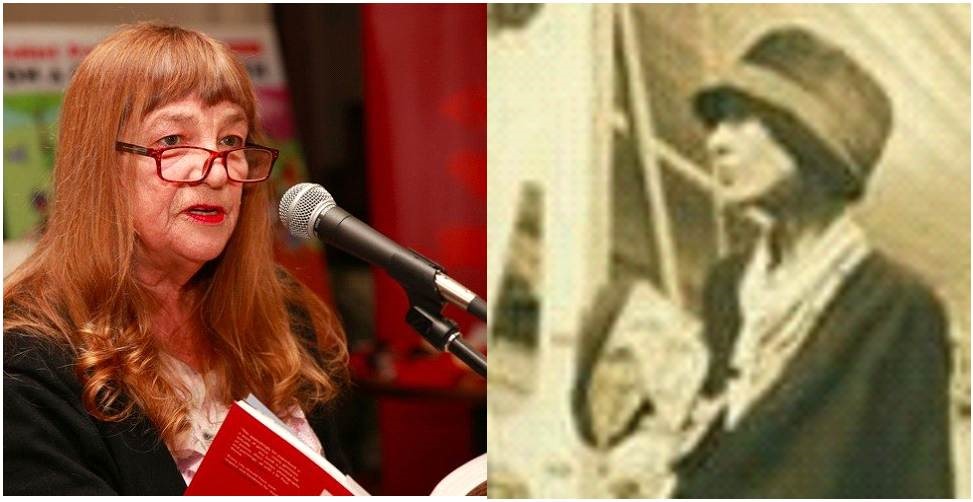
Ethna McKeirnan - Lola Ridge

Ethna McKiernan reading, with lipstick, and Lola Ridge, I’m not sure.

.

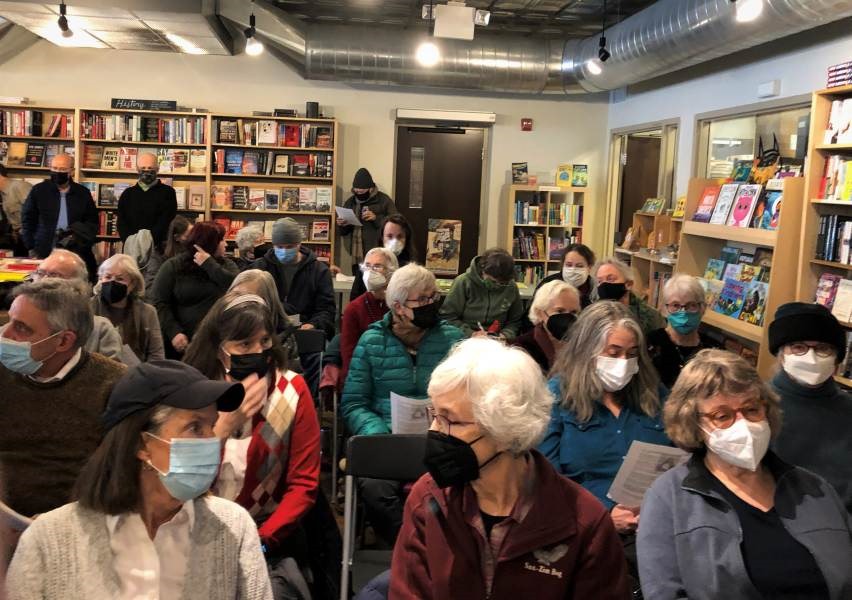
Minnesota weather and continued Covid-19 concerns might have conspired to reduce attendance, as the side streets were still full of sloppy snow from Saturday’s snowfall.*  I arrived early and helped the bookstore staff setup chairs. They seemed to be expecting maybe a couple of dozen, which may be par for a Twin Cities local-writer poetry reading, but both the event organizer and myself the bystander suspected we’d need to maximize the amount of chairs the space could hold. I think we were able to get nearly 40 folding chairs into the designated space, but as the crowd started to assemble, extra chairs needed to be rounded up and put in the various aisles between the bookstore shelves to handle those that kept coming in, and we had a few standees who fit in where they could.

More than typical bookstore poetry readings, I suspect most of the crowd knew Ethna for a long time. And that may have given a boost to the eight poets who read poems of Ethna’s, a smattering of their own, and gave short thoughts about her as a writer and a person. So less a usual public reading where some poets might be nervously trying to consider how they would come off presenting their work to an audience which might not know it, and more like an experienced and informal poetry group of long-time colleagues.

Several of the readers were members of other periodically-meeting writer’s groups that included Ethna, like unto the Lake Street Writer’s group that Dave Moore, Kevin FitzPatrick, Ethna, and I were decades-long members of. I’m sure that if Kevin had lived, he would have been a valued part of this event, as Ethna often credited Kevin as an influence on her writing — but he died a few weeks ahead of Ethna. I tried to make myself useful by playing stagehand and raising and lowering the mic stand for the variety of readers.

Many of the readers spoke of Ethna’s work with homeless outreach, and read some of her poems that dealt with that work, something that echoes today’s poet Ridge. Though the audience was entirely masked, a few noted that Ethna was a stickler for always putting on lipstick when out in public. For all anyone knew, what with our Covid era masks, we all were wearing lipstick! Who could see — but I believe all of us were remembering Ethna.

Backpart of the crowd at the Remembering Ethna Event March 2022

Covid-era ambiguity: “Lipstick? We were supposed to wear lipstick?” A portion of the crowd at the “Remembering Ethna” event last Sunday.

.

So, as I speak of a woman who promoted culture, wrote beautiful poetry, and was committed to helping the economically desperate, I will now leave you with a piece using the words of another woman who a century before us did the same. You can hear Lola Ridge’s “Sonnet to Beauty”  with a graphical player below if you see that, or if you don’t, with this highlighted link.

.

*My friend and participant here in the Parlando Project Dave Moore was unable to attend due to concerns with the street conditions. I’ve attended two other book-launch poetry readings given by Ethna herself, and this Sunday’s was the smallest crowd of the three. Consider though that most of those who knew Ethna are “senior citizens,” and some are frail as well.

Honoring Ethna event scheduled for Sunday March 6th

This winter readers of this blog got to follow my own celebration of the work of Irish-American poet Ethna McKiernan. That was my memorial to her fine work, by which some of you now can know her. I realize that the Parlando Project has a world-wide readership, but for those of you that are in the Minneapolis-St. Paul area there’ll be a live event to celebrate her and her work featuring a number of her Twin Cities area poetic peers.

Here’s a link to the event listing.

This will be a bittersweet occasion for me and some others, as Ethna and Kevin FitzPatrick used to do a poetry reading around every St. Patrick’s Day in March, and now of course both of them have died., turning them into memories and their words.

I assume McKiernan’s selected poems collection Light Rolling Slowly Backwards will be available at the event. If you’re not local, here’s the publisher’s listing.

.

Here’s one of those pieces I did this winter with Ethna’s words and my music. Player gadget below for some ways you may be reading this, or this alternative highlighted hyperlink if you don’t see that graphical player.

.

Letting Go the Wolves: I praise Ethna’s wolves

I’ve promised one more piece using texts taken from Irish-American poet Ethna McKiernan, and here it is. There are a couple of reasons why I left this one to the end of this series memorializing her work. The first reason: the poem’s persona seems to speak of her approaching death. The second reason: I don’t know if McKiernan actually liked or rated it as highly as I do. Let me make this plain at the start: I think this is a great poem, and I’ll go into why in just a bit.

I believe I encountered “Wolves”  at the same writer’s group where I heard other work Ethna was working on in draft form.*  These things make my performance today particularly fraught with issues. I only take this step of releasing this performance today because of my admiration for the poem, and my feeling that some out there in the rare and appreciated audience for this Project will welcome it. “Wolves”  has what poetry often hopes for: it is beautiful and yet harrowing, and its experience is vivid while not guarded inside defined borders.

I hear the snow crust crack
into spider-fine antenna lines
with every thudded footbeat. It is so still
that their light scratch of nails on ice
rasps the air like flakes of metal filings.

Let’s grab this text as it grabbed me, even on first hearing, with the opening statement: “I hear the snow crust crack / into spider-fine antenna lines…” The meter has a lope of accents that appeals, the internal rhyme of “fine” and “lines” separated by the chime of the assonant “antenna.” The three strong accents together in “snow crust crack” which allow “crust” to not get the full stress it would normally get appeals and announces. “…with every thudded footbeat. It is so still / that their light scratch of nails on ice / rasps the air like flakes of metal filings.” follows — and if you’re not captured yet by this poem’s story, I can’t think of what language can do to do that.

This opening almost registers as synesthesia, as the sense invoking words rush in. “Snow-crust crack” is visual and auditory together — and for a winter clime resident, you feel that texture in your own feet too. Besides the word-music the visual of “spider-fine antenna lines” has the sense of the spreading broadcast of the wolves’ approach. The ordinary snow-surface footfall of a “thudded footbeat” made by the furry pads of the wolf would be only present in an unnatural silence — and then the quiet but more plausibly audible sound of talons on ice. The shivers of it, nails on blackboard-like, invokes the winter.

ice pond

Listen carefully for those claws on the ice.

.

I could go on, but I think any listener who is pulled in by this opening will sense equally strong lines and images as McKiernan’s poem proceeds. The creative writers in my audience may benefit from analyzing for themselves why they work their attraction on us. There’s an overall effect of intimacy with nature in the midst of this poem: not a passive, uncomplicated, and easily beautiful nature, but one close enough to be (prematurely) incorporated with the poem’s speaker.

The cave mentioned in the poem means that this is almost certainly a persona poem. The voice we hear telling this story is not the literal biography of a modern Irish-American woman who normally lived in cities, yet the astonishingly vivid images lets us doubt this just enough to not judge that outright. Even the most personal and revealing poetry can benefit from real and fantastical lies.

I’ll not explicate the ending outright, for I want you to experience it in the course of the poem’s story. I’ll only say that it could possibly be why McKiernan did not select this poem for wider distribution while she lived. “Twist endings” can cloy or leave a reader/listener feeling tricked, but my judgement says this one only enriches what’s sensed as the description of the poem’s scene has unfolded. Like many a good ending of a great short poem, it may make us want to read/listen to it again immediately.

Before I direct you to my performance of Ethna McKIernan’s masterful “Wolves,”  I’ll leave you with one thought the context of this poem leaves with me beyond the poem’s own effects: what might your art do that you don’t necessarily realize that it can do? For it’s a mystery to me why this wasn’t in a final selected poems. The poem seems to me to be fearless and exact, but the self-editor may have been frightened or dissatisfied.**

A player gadget to play this performance appears below in some ways this blog is read. Others will need to use this highlighted hyperlink to hear it.

.

*Just before I published this post I thought to do a final string-search for the opening lines of this poem — and found that it had indeed been published in The Poetry Ireland Review  of January 1984! This published version uses exactly the text used for this performance, and you can find that text via this online link. That publication date is much earlier than I would have expected it to be. Did I somehow run across it — not as a draft as I recalled inside the Lake Street Writer’s Group — but in a publication that might have been shared with the group?

On publication it was titled “Letting Go the Wolves.”   I had recorded the performance you can hear above  a decade ago thinking the title was only “Wolves.”

Did McKiernan feel it was too immature a work when making final judgements for her final “New &Selected” collection Light Rolling Slowly Backwards  compiled a few months before her death? I don’t judge it so.

**Another, if unlikely, possibility: Ethna may not have secured rights to secondary publication, though the grant of such is traditional within small-press poetry. As much as the wolves in the poem, I may be clambering on top of thin ice in presenting this poem, even though I only want to point out its value. If I haven’t made it clear recently: The Parlando Project is not even a non-profit organization — it’s a no-profit organization.

Oh, Maria

Here’s my performance of another poem from Irish-American poet Ethna McKiernan’s final collection Light Rolling Slowly Backwards.  In McKiernan’s later years of life she did social work with people who were homeless, and she dedicated Light Rolling Slowly Backwards  to “the hundreds of homeless clients I’ve worked with through the years — to their resilience, courage and care for each other.” Given that Ethna was somewhat frail even before her final illness, I marveled at her strength in taking that work on.

I recommend this collection, a fine summation of McKiernan’s poetry and its range. Here’s that link again to the Irish publisher of this book.

Why this one to start reading McKiernan? She herself created this “New & Selected Poems” book before she died late last year.

.

When I first encountered “Oh, Maria”  in draft form as a member of the Lake Street Writers’ Group I couldn’t help but flashback to my time working in Emergency Departments as a young man. As one side-point Ethna’s poem tries to convey the feeling of being next to someone experiencing a sudden, and unexpected death. I’d summarize those memories of mine as being full of intense experience, intent action, and if stabilization isn’t achieved, a solemn ceasing. Ethna’s account adds poignancy because it’s missing that middle part. I ached with her both as she feels guilt for not immediately recognizing the mortal nature of Maria’s incident — and then comes the line as she considers if she should have performed CPR: “If I remembered, God help me, how.”

I probably did my usual awkwardness in responding to that first hearing, perhaps mentioning how it reminded me of my experiences — something which was likely no help in her revision process. I think I did express that her missing the initial diagnosis of what was happening was not only forgivable, but par for the course. Could that have been worthwhile?

Indeed, my experience was that most people, even people who are otherwise medically trained, are likely to get this wrong in some way. Although my experience is now decades ago, I’ve seen CPR being performed on breathing people with a pulse — which is not a good thing. And effective CPR requires a degree of skill and frankly cold intent that is hard to practice outside of repeated actual events. Given that I last worked in an Emergency Department more than 30 years ago, and last went through the practice-with-dummies certification around a dozen years ago, I myself would likely not be the best person to be next to you if you were to experience a cardiac arrest.

If you ever take, or have taken CPR training, pay attention to that first step of assessment.   It’s important.*

So, besides the imperfectly empathic personal reaction I had, this poem’s core matter is Ethna’s continued sharing of the experience of those without homes, which exceeds even my old ER experience with our un or underhoused “regulars.” Notice the subtle point Ethna weaves into this poem: she expects that Maria is severely intoxicated when she collapses, and then she concludes her memories of this person dealing with complex problems imperfectly in the telling line “I laughed at your antics weekly.” What were the antics? Maria might have had a sense of humor, that could be part of it. It’s also possible, even probable, that Maria’s human attempts to deal with the difficult state of homelessness and its context were at times comically imperfect or ineffective.**   Ethna knows this from her intimacy with Maria, just as you know it with those you have in your lives. Intimacy isn’t just the experience of joyous connection, it’s the experience of our misapprehensions too.

Same with poetry. We write it imperfectly, read it imperfectly. That is part of our human experience of it.

To hear my performance of Ethna McKiernan’s “Oh, Maria”  you can use a player gadget if you see it below, or this highlighted hyperlink which will work if you don’t see the player.

.

*Several decades ago a book called The House of God  by Samuel Shem was written that was like unto a modern Machiavelli’s The Prince,  only about practical hospital medical training instead of statecraft. In Shem’s book there is a list of “laws,” one of which is “At a cardiac arrest, the first procedure is to take your own pulse.”

**Dealing with homelessness either as one who has reached that state or, as McKiernan did, as someone trying to mitigate it, is much more difficult than dealing with cardiac arrest. In my couple of decades in Emergency Rooms, I’ll admit that in the course of a shift or two dealing with intractable problems and complexly impossible situations, the “break” of dealing with a crash-cart severe trauma case or a cardiac arrest with their steps of immediate choose/act instants was, strange as it might seem, a relief.

Stones

I’m going to write here a bit, but if you’re in a hurry, I urge you to do two things. The first is to simply listen to today’s audio piece. I think that will reward you. You’ll find a way to play that near the bottom of this post along with my second suggestion.

To a large extent this project adapts other people’s poetry in the process of combining it with music I write and record. Occasionally when I mention this, or when the more general topic of a difference between poetry and song lyrics comes up, there will be objections or distinctions brought forward: those two things (poetry found on the page and words designed to be combined with music) aren’t the same, they’re different.

I’ve written about this here in the past. My conclusions in summary: the thing we call poetry includes a great deal of unlike expressions,*  and many are comfortable with that. Why chop off “song lyrics” as an appendix of non-poetry or not-quite-good-enough poetry? Well, if we do that are we forgetting that poetry across multiple cultures began as an oral presentation almost certainly combined with music? Why would that precedent not mean that literary poetry, however prized and skilled, has failed to sing or express its music explicitly?

So, if I move past those differences between poetry meant for the page and poetry meant for performance with music, and seek to test literary poetry in that context, what do I find? Well, a number of things that seem like problems with musical performance of Modernist page poetry are often less difficult than they seem. Poem doesn’t rhyme? That doesn’t help one memorize for unaided performance, but it’s not really a big deal. Uneven meter or line lengths? Modern musical expression has long slipped the bonds of straight beats or fixed length of melodic lines. One can even up shorter lines with musical elements too.

What is challenging? There are auditory challenges. Texts designed for performance often take into account pronunciation obstacles and allow space for breath. At least for myself there is a general difference in attention between words heard and words read in terms of attention. If a word or image requires one to pause for consideration on the silent page, there is an automatic “pause button” in our consciousness, and this is not so in the ear. The richest literary poetry may overwhelm us when listened to, though performance itself may also illuminate things we would never hear on the page, even after multiple readings.

In the context of today’s piece, let me speak of another issue. Work for performance, such a song lyrics, thrives on repetition, or refrains. Rhyme itself is one of those matters of repetition, even if it’s not required. Refrain draws our attention as it combines with the rest of the performed text, allows us to more fully absorb one part of what is expressed, and combines naturally with musical motifs that also repeat.

When I look through a poetry collection looking for Parlando candidates, the poems that use repetition will often be the ones that seem most suitable for performance — but that said, many pieces I’ve performed here have no refrain, no repeating chorus. Particularly with shorter texts this can still work, but piece after piece of poetry performed without repeating elements seems too much of avoiding that useful thing.

More than 50 years ago, a pioneering rock critic Richard Goldstein, published a book, The Poetry of Rock,  examining the possibility that rock lyrics of that era could be considered as poetry. Despite the title, the book did not wholesale advocate for the conclusion that they were simply poetry. Instead Goldstein noted, as I’ll admit, that these two ways of encountering words lend themselves to different experiences.** One tactic Goldstein decided on when dealing with song refrains in his printed examples to be experienced as literary poetry was to not completely transcribe the refrains in his versions of the lyrics. Instead he might just put them once at the end of the set of words. Making them the final statement on the page gave them emphasis, as repetition in a chorus would, without overwhelming the expression of the verses.

Working the other way, as I will do today, one can reverse this tactic. One can simply repeat a stanza, perhaps the first one, as a chorus, or at the end. Or one can take a line and make it a refrain, as I did with Sheng-Yu’s “Lament”  this fall.

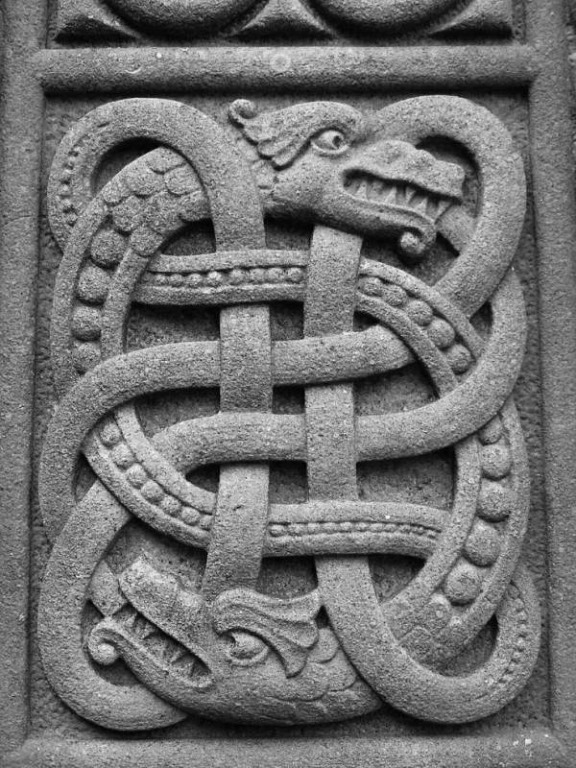
Celtic Ouroboros

The Poetry of Rock? A Celtic representation of the ouroboros. This is a mystical symbol beloved by Jung and alchemists that is often used in graveyards. What does it mean? Thoughts differ, so may I offer one: Death can go kiss its own ass.

.

Did you skip to here? That’s fine.

OK, let’s get to the good stuff: this poem “Stones”  appears in the new poems section of Ethna McKiernan’s Light Rolling Slowly Backwards.  It’s a fine poem on the page, and I highly encourage you to experience more of McKiernan’s work there by buying her book or seeking it out via a library. Here’s the publisher’s link.  That’s the other “ask” I have for you today. But “Stones”  is also a poem of lyric experiences, it calls out to be performed with the context of its implied emotions shared in your ear.

And this I did. Besides presuming unilaterally to do that, I made one other adaptation in the piece for performance’s sake: I took a line in the final stanza and made it a refrain. Because that line is repeated now six extra times, I’m bringing it forward for you to make sure you notice it and its possible meanings.***  I could throw in some more paragraphs about what I considered those possible meanings to be as I performed this beautiful poem, but I’ll not do that today. May your ear link to your heart, and listen with the player gadget below —if your way of viewing this blog shows that — or this highlighted hyperlink otherwise.

.

*”Paradise Lost,” “Tyger,” “We grow accustomed to the dark,”  and “The Red Wheelbarrow”  are all worthy poems we might agree. Are they less different from each other than some random literary poem is from some song lyric?

**I may be repeating myself to say this here in a footnote — but that’s part of why I do the Parlando Project: because I expect you’ll experience the texts differently when you hear them performed with music.

***Did Ethna intend that line, now a refrain, to reflect itself in those meanings? I can’t say, but perhaps not. I, who performed it, intend for those extra meanings to come forward. I completely subverted William Butler Yeats intended meaning in one of his poems this fall. Judge me as you will.

The Men in the Basement

Late last year I promised you’d get to hear some pieces based on the poetry of Ethna McKiernan. I thought about which one to start off with, and decided I’d perform this one for you first. Why? Because it may make you smile.

Regular readers here recently will have caught up with my connection with Ethna: how I heard her read work in progress in a small group of other writers who cycled through each other’s homes each month to do that. You’ll also know that the rest of the group was usually men in its later years.

When we met in Ethna’s our meeting would always start in her little kitchen. We’d stand near her sink and stove and brew up some tea and talk a bit about what happened since we last met, until our remaining writer’s group members accumulated. On one side of that room was the clipping and photo-decorated refrigerator door, a generalized cultural artifact, and on the other side a small table and chair. Her house was a modest South Minneapolis bungalow probably built in the last Twenties, a couple of blocks off of East Lake Street. Comfortable and reasonably roomy with the usual shelves of books in its main-floor rooms and a couple of wandering cats as one might find in a poet’s house. I never saw more than the main floor, but there was a second story up a wooden staircase, and as we shall shortly hear, a basement below. That all said, it seems Ethna wrote and revised mostly in that small kitchen.

Kitchens are a physical metaphor, the site of drudgery and giving, sustenance and routine. If I may gender a floorplan: the most female part of most houses.

South Minneapolis is Tough on Barbies by Heidi Randen

Approximately how some of us feel on winter days. If only there was some help…

.

I remember hearing “The Men in the Basement”  at one of those meetings. Everyone enjoyed it, got it, right off the bat, which was far from a universal reaction to the work we shared. I heard her read it at least once at a public reading, and since it was included in her New and Selected  collection* published just before her death late last year, we can be sure that Ethna herself liked this poem and expected audiences to do so too.

Do women understand this poem more than men do? How the hell should I know, though I suppose some raise themselves to opinions on such matters. I myself found it easy enough for my anima to perform it, though maybe some listeners will find that strange. Again, how the hell should I know? Anyway, given that we all bruise, want, wonder, live together and alone — and sorry, buzzkill for this entertainingly arch poem, we all sicken and die — I don’t find it worthwhile to predict or expect right now.

Musically I made this one an assortment of sounds, and I even worried that I may have over-egged it with the variety, but I’ll limit my predictions to that you’ll enjoy meeting Ethna’s text today. There’s a player gadget below for many of you, but you can also use this highlighted hyperlink where the player isn’t shown to hear it.

.

*That book, Light Rolling Slowly Backwards: New and Selected Poems  is a great summary of McKiernan’s poetry. Here’s a link to the publisher’s listing.