I do make something of an effort to look for other folks doing something interesting with poetry and music online, and to check out the blogs of folks who’ve commented or otherwise contributed here. I really should be more consistent in doing this, but particularly this month as I’ve attempted to ramp up production of Parlando Project pieces as part of the National Poetry Month celebration, I’ve fallen behind. Come May I’ll have a lot of blog reading to catch up on!
But this one caught my ear just after posting my own attempt at presenting a Wordsworth nature poem. A group of Keswick School students working with Durham University in England have posted a couple of audio pieces connected with William Wordsworth and his sister and collaborator Dorothy Wordsworth’s Lake District observation of nature and the resulting landmark poems. This one has the students speaking about the book of nature and some of Dorothy’s journal entries on the siblings walks. There some nice, spare music added to this one as well.
As we read over the poems composed by the students, it was fascinating to see how many of them – the majority of the group, in fact – had fixated on the idea of more modern distractions from nature, and in particular, the role of smartphones in quite literally ‘filtering’ nature for us. While William’s poem admonishes its addressee to abandon books and ‘hear the woodland linnet’, the year ten pupils from Keswick School used their poems as a chance to reflect on the need to abandon their phones and enjoy nature in its own right.
I keep asking my middle-school aged son what his generation has decided the rapidly aging Millennials don’t understand and that his generation will have to fix. He looked at me funny when I asked him again this week
. “Is that some kind of Dad joke?”
Perhaps he just doesn’t want to divulge yet his generations secret plans to fix the worst mistakes of those who came before, or maybe he’s still formulating the answer. But one of the time-tested ways to look for answers or better questions is to skip back a few generations and see what someone observed and thought before those now running things made their decisions.
One more post where we slide the Parlando Project and “other people’s stories” to the side and become more like a conventional blog. Last night in London was a blustery snow squall, but as Minnesotans who know that the Theater of the Seasons plays in Repertory, we were up and around throughout the day. Our target was the area around the Strand and Trafalgar Square to hit the National Gallery. We really only struck Trafalgar Square a glancing blow, though it seems an impressive urban plaza. As we approached through the flakes and gusts, I pointed to the back of the column and asked my wife why they had a monument to Captain Crunch here.
Nelson’s Column in Trafalgar Square, and close up of the statue at the top
Faux-naïve humor aside, some of the best parts of the day were the little things. As we passed a small library I saw a poster in the window about Sylvia Pankhurst, the most radical of that suffragette clan. Inside was a small exhibit detailing the middle of her career in anarcho-syndicalist circles which lead her to a steadfast effort to warn against the rise of Italian Fascism in the years between the wars. Some of the exhibit showed the efforts to extend Fascism to Britain through local London groups, which included the information that the library building itself had been formerly the headquarters hall of the Italian Fascist organization.
Shortly after entering the National Gallery we noticed these mock Roman mosaics on the floor leading into the central gallery. At first glance, one assumed they’d be the sort of stolid decoration museums are known for—but wait, is that Bertram Russell? Winston Churchill? Turns out they are a set of witty between-the-wars comments on the modern virtues. “Don’t tread on Gretta Garbo…” sings Ray Davies in my mind.
Lucidity on the ground in mosaics
We’d come for a Pre-Raphaelite exhibit which showed how much these original hipsters loved to put mirrors, particularly convex mirrors, in their paintings. At the exhibit I learned that the art Academy the PRB bros rebelled against had been in a wing of the National Gallery building, a museum then full of the lush late Renaissance paintings loved by the 19th Century. As young rebels are wont to do, they instead looked to the earlier painters with their sharp Colorforms palette.
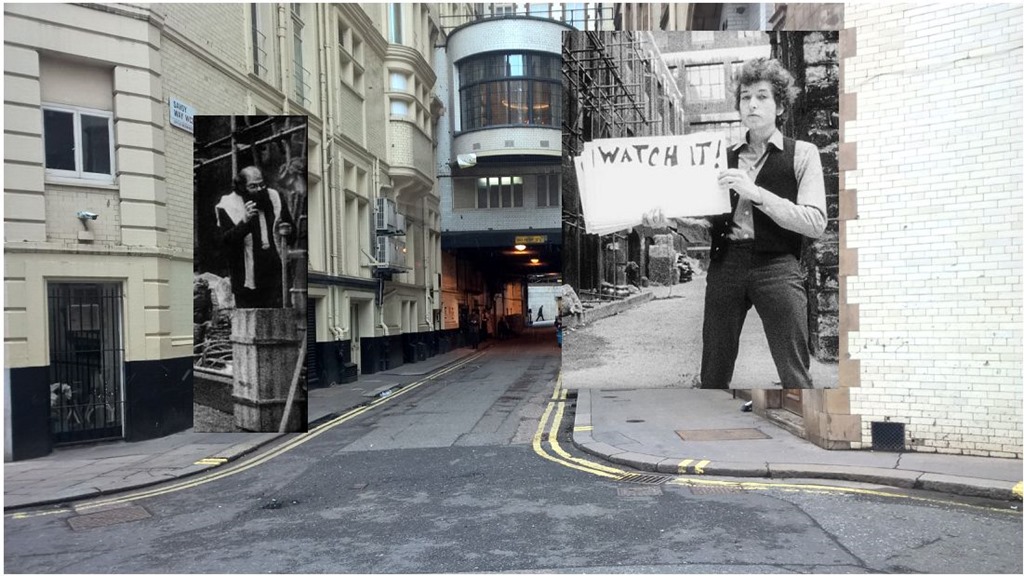
We took a side-trip down the Strand until we came upon the Savoy Theater and then the grand Savoy Hotel. Our bootheels had to do some wandering, but, sure enough, we found the alley where the “Don’t Look Back”-“Subterranean Homesick Blues” was filmed, and where more than a hundred years earlier William Blake had lived and worked on his Dante “Divine Comedy” etchings as he lay dying. We couldn’t see the Thames to confirm if flowed like gold, what with all the buildings the years put there between Blake’s place and the river, but you could still see Dylan and Allen Ginsberg standing in that alley.
Click the link in this caption to learn more about Angels in the Alley by the Savoy Hotel
That evening we went to a mostly Mozart concert at Saint Martins in the Field, which was fine. Now that I actually try to write string parts and play them via virtual instruments, it was nice to see hands play the articulations from a front-row seat. But, before the concert, we ate at “The Crypt” beneath the church, which is not just a goth-sounding marketing name, but the actual crypt, complete with grave markers. My wife wandered about the area, reading the grave markers, noting one for a five-year-old child.
Everything in the past is beneath and beside us. Everything in the future is too, but we cannot see nor feel it yet.
Last night I saw the London production of “The Girl from the North Country.” The play’s production illustrates well how context can change a work of art.
I traveled 4,000 miles to see a play in London written by an Irishman integrating work by a Jewish iron-ranger with a British cast portraying a multi-racial rooming house in what was once Minnesota’s second largest city in the 1930s. The Irish playwright is Conor McPherson and the integrated work was 20-some songs by Bob Dylan.
How much went wrong in such an enterprise? I suppose plenty. I could see seams, but it seamed not to matter much. The core idea, of placing Dylan’s songs in the context of the 1930s worked well. Songs you believed needed to be set in the beatnik early 60s or the cultural turmoil of the around 10 years we don’t name as a decade after that, or against the Reagan/Thatcher or Christian fundamentalist revival and so on, lived inside different lives anachronistically.
Is it a Dylan musical? Not really. Minutes taken out of context could look like that somewhat new form, the Jukebox Musical, but the dramatic material is darker and more substantial than the kind of utilitarian connective material in a Jukebox Musical’s book. This is play with music, not music connected by play. The songs are all sung by the actors, and the musicians are all on stage, sometimes mingling in tableau. In one brilliant little piece of business, a drum set placed upstage has various actors in the cast sitting at it and banging out simple but effective Basement Tapes backing.
In the best moments, the songs (or portions of songs, few are sung in anything close to their entirety) function like an ancient Greek chorus, or at least as I read those classic Greek plays in English translation. The play (or book if you must) reminded me of Eugene O’Neill, someone I have not read or seen in performance in decades. Poetic dialog was uttered often, but character context kept this from being overly artificial (it’s a very unusual cast of characters).
The parts are well sung, and the all-acoustic band with period-correct instruments does well. Same with the acting, which ranged from excellent to good, in a performance that demands a lot from it’s cast. As an evening of theater my wife and I thought it was transcendent, as theater should be. At the end of the performance, about a third of the audience jumped up in standing ovation, followed slowly by another portion, perhaps a third again. As we walked out we heard the reaction of some of that sitting third, disappointed at what has been a very well-reviewed production. I have no idea what the London-usual is for ovations, but in the Twin Cities, everyone stands almost all the time.
My wife doubts it will ever have a U.S. production. She thinks the material is too dark to appeal to audiences seeking uplift for their expensive theater tickets. I’d add that the play’s plot is very indirect with lots and lots of dead ends and shaggy dog story elements. If one is open to that (as I am) this doesn’t hurt anything, but some will miss the comfort of standard story through-lines. By chance I saw “Three Billboards Outside Ebbing Missouri” on the plane trip over, and its Irish screenwriter, Martin McDonagh, also setting his story in America, has a similar shaggy storyline, and asks for similar emotional commitment for unexpected sharp plot turns. McDonagh’s screenplay however, treats most of its characters, most of the time, as morons. This is not a metaphorical epithet. I found it puzzling and ultimately disrespectful for no good effect that so many in “Three Billboards” were played as being so dumb.
By contrast, in “Girl from the North Country” McPherson has two characters who frankly have mental disabilities, and yet even they are offered more discernment and respect from their author creator in his play.
You do not have to be a Dylan fan to enjoy this play, but you do have to accept a tale that starts with all in trouble and finishes with things worse for almost all, and with a singing of “Forever Young” that could cause you to never hear the song the same way again.
Actual storefront in Hampstead. A sour joke:
vaccination against consumption was not available to apothecary/surgeon John Keats
Today we paired my wife’s love of nature with my love of Keats by visiting the Keats House near Hampstead Heath. Keats House is the duplex that was Keats last rental home, and the place where he wrote many of his best poems. There are few real Keats artifacts, but the house contains some of them and replicas of others. Seeing Keats marked-up Milton books, covered with underlined passages and marginalia in Keats own cramped hand was one highlight. I’m no expert on early 19th Century English living standards, but the living quarters seemed surprisingly middle class adjusted for the time considering what I knew of Keats struggles with money.
My wife caught a break in the grey gloom and rain showers to spend some time roaming the heath while I nursed a cup of tea and started some blog posts and people watching. I have no Bob Dylan to share today, but here’s a version of John Keats “In the Drear-Nighted December” performed by the LYL Band.
We return with the next three in the count-down of the most listened to and liked audio pieces of last Winter. Like last time, all poets who worked in the 19th Century, but in this group, all men.
Two out of the three today are from the British Isles. In may be no surprise, given its head start in English literature, that Britain is an outsized contributor both in words to be used and the Parlando Project’s reader/listenership.
I’ll be taking my second, short low-budget trip to London this month, and I’m frankly not sure what I will find this time, other than planning a side-trip to Margate to see the Turner art museum there and its small exhibition commemorating Eliot’s “The Wasteland” which was partially written in Margate. I’ll no doubt re-visit the Blake room at the V&A, and who knows, maybe I should try to find that alley beside the Savoy Hotel?
The London forecast calls for rain, hopefully not JMW Turner stormy though!
4. Ring out Wild Bells
When I posted this for New Year’s I noted Tennyson’s level of fame when alive, something that even the most popular Instagram poet cannot reach now. What I found out afterward was even more intriguing, that this section of his long poem “In Memoriam A.H. H.” has become a tradition in Sweden to be read at the turn of the year, sort of how the Times Square ball-drop is ceremoniously repeated in New York, or how Guy Lombardo would once appear with his Royal Canadians near the top of the hour on TV to play a Scottish tune.
As evidence of Tennyson’s fame, I noted that my little Iowa hometown had a major street named for him when it was platted back in the 19th Century. Eventually the town and it surrounding farms were settled largely by Swedish immigrants. The Tennyson and bell-ringing tradition in Sweden started in 1927, long after the town was founded and settled, but wouldn’t it have been good in the town’s heyday if the farmers, shopkeepers, and schoolchildren had gathered on the sides of the street on New Years Eve to hear a poem?
Instagram poets get knocked for the shortness of their verse and it’s focus more on remediation than demonstrating literary skill. Tennyson built “In Memoriam” into a book length series of poems, but his focus too was on remediation, in his case, of grief.
3. The Wild Swans at Coole
Yeats was Irish, and for decades I’ve met monthly with a group of poets the majority of whom were Irish-Americans. Yeats seems to have seamlessly transported himself between the 19th and 20th Centuries, changing so smoothly that he could not be observed changing. Somewhere around the turn of those centuries he decided that poetry should be chanted (not sung) to music, and yet we seem to know little about how exactly that sounded. Contemporary reports (and that’s what we have, there are no recordings I’m aware of) were decidedly mixed, even derisive, and Yeats eventually set that quest aside. The recordings of Yeats reading that we do have are from decades later, and in them there may still be traces of that concept audible in his, by then unaccompanied, reading style.
Yeats warns listeners that his chant may not necessarily enchant.
Reports also tell us that Yeats suffered from a difficulty carrying a tune, much as I do. His chanted, not sung, idea did not come from that he tells us, rather it came because conventional art song had too much ornament and melodic elaboration, deducting from the inherent music in the words.
In the course of the Parlando Project I take various stabs at what Yeats was trying to do, recreation in the literal sense, trying to create from the ancient and natural connection between music and poetry some combination that doesn’t privilege one over the other. Sometimes it’s spoken word, sometimes it’s “talk-singing,” and sometimes I think it necessary to sing.
I avoid apologizing for my musical shortcomings. It never mitigates anything anyway, and I’ve always found the humble-brag distasteful. I’ve hesitated at—and decided against—releasing performances most often because of failures of my singing voice. This performance came close to staying in the can. At times it works, not from my skills, but because there’s a certain match in the failings in the voice and the meaning of the poem.
2. My Childhood Home I See Again
One last 19th Century poet, an American. Long-time readers here will know that US President George Washington’s teenage love poem “Frances” has been a surprisingly persistent “hit” with listeners here. It didn’t make the Top 10 this season, but we now have another Presidential/Poetical contender in Abraham Lincoln. If Washington was all youthful alt-rock persistence, Lincoln is more goth, with a downcast you-can’t-go-home-again tale of all he finds missing when he re-visits his hometown in his thirties.
Lincoln’s “My Childhood Home I See Again” was very close to the popularity of the Number 1 this season. If didn’t count the substantial Spotify plays the Number 1 received, Lincoln would have topped this season’s list.
I posted this for what was once a common U.S. holiday, Lincoln’s Birthday. Also on this season’s Top 10 are the Tennyson New Year’s post and Rossetti’s Christmas song posted on Christmas Eve. Not sure if this is a trend, but listeners did like the holiday poems this winter.
• Thank the person who nominated you for the blog post and link back to their blog.
• Answer the questions the blogger asked you.
• Nominate other new blogs to receive the award and compose new questions for them to answer.
• List the rules and display the Sunshine Blogger Award logo in your post and/or on your blog.
Here are the questions five from Daze & Weekes:
What inspired you to start blogging?
What is your favourite post on your blog?
Who are the top 3 bands/musicians that most inspire and influence you as a musician?
If you could have a drink with any poet (alive or dead), who would it be?
If you could go back in time, when and where would you travel?
Oh my! Asking me questions is dangerous, as I assume someone is interested in the answers and I tend to go on and on, until I find myself embarrassed. Though I value brevity in expression as a reader (thus, poetry), I am so ready to violate that value when talking. So I wrote answers and then tried to make them shorter. And tried again. Music, poetry, they value concision. With effort, I can honor that. But the past, well, it only gets bigger, and men and women become souls confined there, where we can only visit, were we must visit.
Answers to the questions and my nomination business tomorrow. Thanks for reading (no listening today) and thanks once again to Daze & Weekes for the kind words.
In the past few posts I’ve mentioned how Ezra Pound was more than an exemplary writer, theorist, and promoter for the early 20th Century modernist poetic movement that he called Imagism. He was also an excellent editor.
His most famous blue pencil job remains T. S. Eliot’s “The Wasteland,” but he also worked with H.D. and Ernest Hemingway, teaching with his editing how to pare away extra words, overused similes, and extraneous authorial sentiment. And once shown, those writers we able to use Pound’s insights to do the create their own pared down, modern styles.
In the last episode, I noted that Pound had been critical of some WWI poems written by Rupert Brooke. Here for example is the first part of Brooke’s most famous war poem “The Soldier:”
If I should die, think only this of me:
That there’s some corner of a foreign field
That is forever England. There shall be
In that rich earth a richer dust concealed;
A dust whom England bore, shaped, made aware,
Gave, once, her flowers to love, her ways to roam,
A body of England’s, breathing English air,
Washed by the rivers, blest by suns of home.
Written as England entered into WWI, and as Brooke himself rushed to enlist, this poem was embraced by a patriotic public almost immediately. If one shares it’s sentiments, the actual technique of the poetry probably admits no impediments to a reader, even today—but ask yourself, does it have a sense of actual immediacy? As you read, do you share with a fellow human, feeling, seeing, smelling, this experience? What I get as I read it is a thought, where a soldier thinks that if he dies in battle and his body rots overseas, that his body will homeopathically retain its English birth and experience, and that experience, it is inferred, is worth dying for. Why? Well because the poet says so, and he says it with rather polite poetical words. “Die” and “dust” are perfectly good, simple words, but as a description of death and decomposition, they are surrounded by forevers, flowers, air, rivers, and sun—all presumably sweet and genteel.
Rupert Brooke died at age 27 of an illness he contracted while on his way to the Gallipoli campaign in his war, but what if he, like Yeats, had continued to live and react to the developments of his young century? And what if Ezra Pound had gotten a hold of him and showed him how to punch up his verse?
Today’s piece shows what could have happened. One of the last things Brooke wrote was this fragment written on the troop ship in the month he died. Here’s the original:
I strayed about the deck, an hour, to-night
Under a cloudy moonless sky; and peeped
In at the windows, watched my friends at table,
Or playing cards, or standing in the doorway,
Or coming out into the darkness. Still
No one could see me.
I would have thought of them
–Heedless, within a week of battle–in pity,
Pride in their strength and in the weight and firmness
And link’d beauty of bodies, and pity that
This gay machine of splendour ‘ld soon be broken,
Thought little of, pashed, scattered. . . .
Only, always,
I could but see them—against the lamplight–pass
Like coloured shadows, thinner than filmy glass,
Slight bubbles, fainter than the wave’s faint light,
That broke to phosphorous out in the night,
Perishing things and strange ghosts–soon to die
To other ghosts–this one, or that, or I.
What can I, acting as Pound might have, do with this? Well first I can locate the charged images in it, hidden as they are inside Brooke’s extraneous comment. What are they? The soldier pacing at night on his troop ship. He’s staring back inside the ship, looking at his fellow recruits on the way to their first battle. If we have any empathy as readers, we don’t need to be told anything about what he’s feeling if it can be conveyed by what he’s seeing. What are our charged images? The troops are playing cards, games of soldier’s chances. They can’t see the poet, and he can see them only imperfectly, backlit by uneven lighting, “coloured shadows,” which is a great image obscured by all the muck about it. And he sees the faint light of a wave’s phosphorescence as bioluminescent plankton are sweep aside by the wake of the ship. The soldiers, and the poet himself, are already in the course of war, like ghosts, fleetingly seen, or only partially and incorporeally seen.
Have you tried the exercise where you make a poem by taking a marker and blacking out most of page of text, revealing a poem could be in what remains? That’s like what I did with Brooke’s fragment:
On the Troop Ship to Gallipoli
I strayed about the deck, an hour,
Under a cloudy moonless sky.
Peeped in at the windows,
Watched my friends
At table, playing cards,
Standing in the doorway,
Out into the darkness.
No one could see me.
I could but see them
Against the lamplight,
Coloured shadows,
Thinner than glass.
A wave’s faint light,
Broken to phosphorous.
Perishing things and strange ghosts
Steaming to other ghosts,
Only, always.
I removed over a hundred words that didn’t need to be there, which covered up what did need to be there. I don’t need to say that these things relate to each other, putting them in a short poem together makes that clear. I added only one word, choosing to add “steaming” instead of just “to other ghosts” because it’s an action word, and because “steam,” though active and industrious, is another thing that dissipates and disappears.
I have two unfair advantages over Rupert Brooke as I transformed his words. First, he died in service to his country shortly after writing this, so he didn’t have the chance to revise his fragment. Secondly, the place he was going, Gallipoli, and the outcome for so many British and Commonwealth soldiers who were deployed there is now infamous for poor tactics and horrendous casualties. I can simply use “Gallipoli” in the title and magnify the dread of soldiers on their way to battle.
Today’s episode is dedicated to Julie Shapiro, who introduced me to Eric Bogle’s “The Band Played Waltzing Matilda.” This is a song about Australian troops at Gallipoli, and though I can link to one of my favorite singers, June Tabor’s, version of it, there is nothing but my memory to testify to the devastating version Julie used to perform.
My first guitar, purchased for $40 in 1974, and played on today’s audio piece
Long post again, no time to talk much about the music for this performance. Perhaps I don’t need to tell, you just need to hear it. Use the player below then for my performance of a revised fragment by Rupert Brooke.
Remember that “Reverse British Invasion” that happened 50 years before the Beatles landed in New York in 1964, when American modernist poets landed in London just before the outbreak of WWI?
One of those American poets was Robert Frost, and he soon struck up a friendship with an British writer Edward Thomas. Thomas was in his mid-30s by then, and he was writing this and that for whoever would pay, but he was not writing poetry. Frost and Thomas enjoyed walks about the Cotswolds together. Frost was encouraging Thomas to write poetry. On his part, on the walks Thomas would often puzzle at which country lane to take a crossroads, and Frost noted that.
Last summer I had the opportunity to take my own ramble about the Cotswolds with my wife. My itinerary was mixture of bicycling with some linkages between sections via train. During the biking part of the journey we often found ourselves lost. Just as with Thomas and Frost back in 1914, there seemed to be few straightforward crossroads and few road makers on the country lanes. It was the hottest summer week in recent record in England that year, and at one train station stop the arrival of our train kept falling farther and farther back off-schedule as the trains were slowed and sometimes stopped by the fear that the heat would buckle the rails.
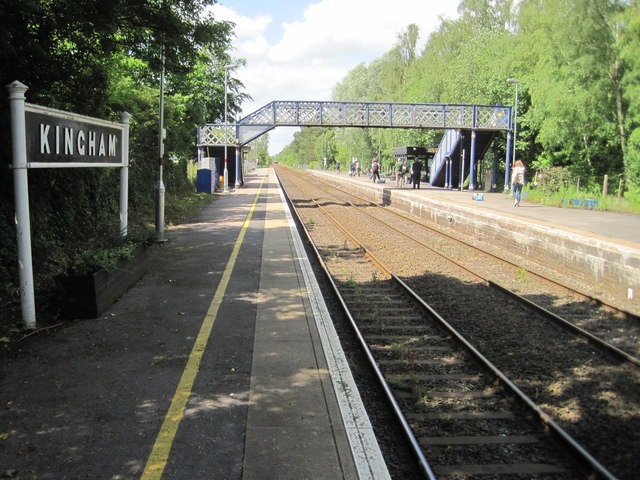
Well there was nothing we could do about it. We spent the next hours just sitting in the Kingham railway station in the heat we were somewhat accustomed to, watching the wind play with the trees and foliage, listening to the birds.
A few hours listening to the trees, breeze and birds at Kingham
This month in 1914, Edward Thomas had a train ride that stopped “unwontedly” in at the small Cotswold village of Adlestrop. Despite being a beginner at poetry, Thomas seemed to immediately grasp the modernist concepts, perhaps because he had no outmoded Georgian and Victorian habits to break. His June experience lead him to write today’s piece, named after this village rail stop: “Adlestrop.”
No rail stop in Adlestrop today, just this sign and bench remain. The present stop in Kingham is 3 miles away.
Thomas’ “Adelstrop” has most of the markers of a modernist poem as Frost was writing them. It’s metrical, but not so strictly as to call to much attention to that. It’s rhymed, but again, the rhymes are not showy. There are no “hey look at me, I’m a clever simile or metaphor for something” tropes. In the place of that is the clean presentation of an exactly observed moment in time, peaceful, off the clock, yet clearly set in a time when the countryside’s nature and the train were in equilibrium. Thomas didn’t know it, but the moment in the poem gathered context after he wrote it, his village train-stop happened only a few weeks before WWI broke out, and England and Europe would be changed forever.
Robert Frost had returned to America, but he sent his friend a poem he had just written, one that was inspired by their Cotswold walks together, “The Road Not Taken.” Frost’s poem famously ends with the lines:
Two roads diverged in a wood, and I—
I took the one less traveled by,
And that has made all the difference.
It’s been Frost’s fate that his irony and dry wit, as well as his uncompromising assessment of human nature, has often been missed by his readers. I first read “The Road Not Taken” and thought, as do many to this day, that this was a simple homily— a boast that taking one’s own, perhaps less popular path, is the road to success and happiness. But read again, more closely, Frost was gently making fun of his friend’s indecision, Thomas’ puzzling at if there are meaningful differences between the two choices in their rambles.
Thomas, though himself a discerning poet, missed Frost’s intent as well. He thought it was reminder of the necessity of making correct decisions, and he warned his friend that readers would misunderstand it. At the same time, Thomas was mulling his decision regarding enlistment in the British army, which was grinding up men at a prodigious rate against the weapons of modernist war. He enlisted, and within a few weeks of deployment in France, he was killed by a bullet through the chest.
Sometimes when I compose music for one of these pieces, I find at the end that I have written something that reminds me of another piece of music, one I can’t quite place. Often when I solve this internal puzzle there is a mysterious connection revealed. The music I played and recorded for Edward Thomas’ “Adlestrop” reminds me a bit of the Edgar Broughton Band song “Evening Over Rooftops”—and the hidden connection for all that (different but shared) flanged and phased melody over an insistent strum, is that like Thomas’ fine poem, they both are hymns to the eternal moment.
To hear my performance of “Adelstrop,” use the player below. And another reminder that you can use the social media share buttons here to let other people know what the LYL Band and myself are doing here at the Parlando Project.
I’m going to tell you a very sad and very wondrous story. A little over 250 years ago, when America was still a colony of England, a young girl about 7 years old was abducted in West Africa by men who took and sold human beings for profit. This enterprise then shipped her across the ocean along with other abductees. This business, a very profitable and respectable business of the time, was slavery.
The way this business worked then, those who were deemed useful for labor would be shipped to the West Indies. There some were put to work as slaves, and others were—to use the term sometimes applied to the harnessing of wild horses—“broken,” so that they could be more useful as laboring slaves. In this case, with this ship, it took those that were not figured to be the good laborers— the odd lots and freight salvage of their cargo—and carried them on to Boston in the American colonies.
Our 7 year old girl was one of those less valuable pieces of cargo. And when she arrived in Boston, she was also sick, and so she was sold to a family for a very low price, because the ships master figured that if he didn’t sell her quickly she would die and there would be no profit in her.
The family that bought this girl treated her unusually. They named her Phillis, as that was the name of the ship that carried her away to America, and as was the custom, used the family’s last name Wheatley for her as well. They taught Phillis Wheatley to read and write English, and then as she showed extra facility with language, they allowed her to extend her learning. By the time she was teenager she was reading not just the Bible, but Greek and Latin classics and the works of the leading English classical writers of the time. And something even more remarkable happened: she started writing like these men.
Nothing like this had ever been seen. An American, in the far-off colonies, writing like an educated Englishman. No, an American woman—wait, not just a woman, an African-American woman, a slave, someone’s property, writing like an educated Englishman!
Did the business of enslavement of Africans, the thing that brought this girl to America, arise because of a belief in the inferiority of black Africans? Or did the widespread belief that black Africans were mentally and spiritually inferior become widespread because it allowed otherwise moral human beings to take part in this repulsive practice? Whichever, Phillis Wheatley, this young girl, had become a wondrous rebuke to those ideas of racial superiority.
First book of poems written by an African-American
In 1773, only 20 years old, Phillis Wheatley once more crossed the ocean and traveled to England, met Lords, Ladies, Counts and Countesses. A book of her poems was published there, the first book of poems by an African-American ever published. She was even going to meet King George, but she had to return to Boston before a date could be arranged. Back in America, as the foment leading to the American Revolution began, she wrote a poem to King George, reminding him that she was his loyal subject, but it might be wise to reconsider things like the Stamp Act that were riling up the colonies.
Yesterday, February 22nd was George Washington’s birthday, and three days ago I celebrated the holiday that replaced Washington’s Birthday with a piece based on a poem written by the teenaged Washington. After the Revolutionary War broke out, and Washington became the commander of the American forces, Phillis Wheatley wrote a poem and sent it to General Washington. Washington wrote back that he was impressed by her “great poetical talents” and suggested that if it could be worked out, he would “be happy to see a person so favoured by the Muses.” Alas, as with the King George, this meeting with the General (and slaveholder) never happened.
So here is Phillis Wheatley, a person who was abducted, torn from her family and home, sold for a pittance as damaged property, shipped across an ocean to a new land that speaks another language. She owns nothing, she herself is owned. And what then does she obtain? Poetry. The ability to speak fluently in the voice and art of this land of exile, and for a time, a measure of fame for this accomplishment. Is that enough?
I look at her words now, over 250 years later, and the style she wrote in is so mannered, often encrusted with the gilded and blushed Georgian portraits of Roman myths. I told you at the start: this story is sad and wondrous. We know, it is our obligation to know, the sadness of slavery, committed by humans on other humans. The wonder of what Phillis Wheatley was able to accomplish fades somewhat with time. As a small gesture to that wonder, today’s piece “Hymn to Evening” uses a lyrical pastoral Phillis Wheatley wrote, wrapped in some music I composed and performed.
A few words about the music in this piece. The first line of Wheatley’s poem “Soon as the sun forsook the eastern main” somehow reminded me of an excellent if little-known Joni Mitchell song “Eastern Rain,” perhaps best known in an elaborate arrangement performed by Fairport Convention. I find that having an inexact memory is a benefit to composition, as my musical result has nothing in common with Mitchell’s, and the only thing I took from Fairport Convention’s version was a vaguely East Indian musical feel. To hear my music and Phillis Wheatley’s “Hymn to Evening,” use the player below.







 Frank Hudson