Today is World Poetry Day, and if I want to represent the United States poetically to the world, one of my first thoughts for a representative poet would be Emily Dickinson. Dickinson has many “Greatest Hits,” poems remembered, poems anthologized, poems that literary critics have generated essays from.
Today’s poem isn’t one of those, for whatever reasons. I suspect it seems too playful, even child-like. The Dickinson I was taught in my youth, when she was considered a less important poet than she is today, was at least eccentric, often gothic. But here there’s no death in a carriage, no fly-funerals — there seems no novel slant of light or truth being told. It’s just the wind, an ordinary thing — or that’s the first impression.
The other immediate impression the poem might give is from its sound. This is Dickinson’s prosody at its most exuberant. No stern march of iambs here, and the use of unpredictable rhyme, end and internal, near, imperfect, and perfect. I love the loosening of rhyme personally, though I know there are others for whom imperfect rhyme grates. But this poem is so rich with the rhyme and pararhyme: today, hay, hat, very; bur, door, fir, where, declare, ever, there; odors, clovers, ours, mowers, hours; pebble, stubble, steeple; hay, day, say, stay.
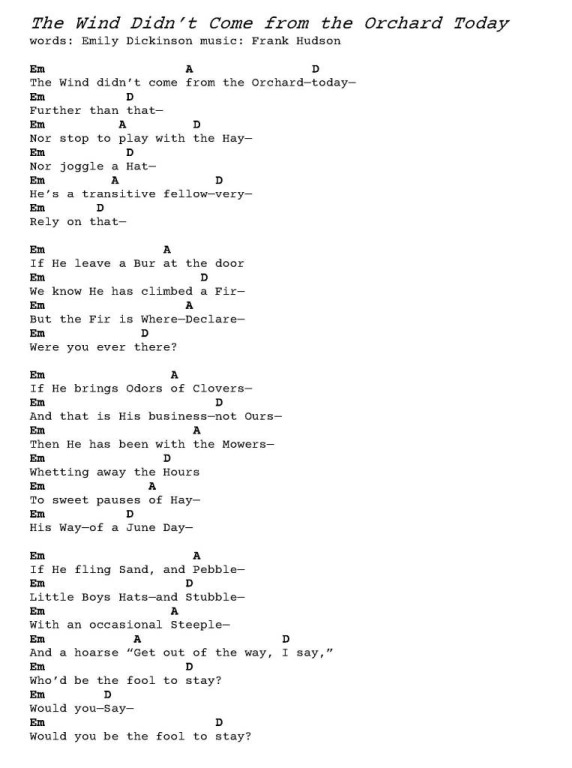
A chord sheet in case you want to celebrate World Poetry Day by singing it yourself. For performance I broke-apart Dickinson’s text, which is all one stanza — indeed, a single onrushing sentence!
.
America is a big country, a big culture. We certainly have our perfect formalists. But we have artists, like Dickinson, for whom form, and perfection in duplicating the form, is but an armature on which to improvise variations. While I’m one small ear compared to American Culture, I’ll take Dickinson’s side and place this poem in evidence.
Another thing to love in this one: the asides, set off with famous Dickinson dashes. “He’s a transitive fellow — very — rely on that” for example.
OK, so is this a musical slight-and-light poem about a playful wind we might meet in Spring?
Maybe.
Note that the poem starts off with a difference. The wind doesn’t come from the fruitful orchard.* It’s from somewhere distant. When I performed the poem, I began with the sense this must be an important fact to lead the poem off with it, but I didn’t know more. A playful breeze is mentioned, but again in the negative, this wind is too much in a hurry, that “transitive fellow — very,” and we can rely only on its capriciousness.
The sound of the “fir/where/declare” is so delightful, but what has happened here? Is the fir tree gone, uprooted, now out of place? Or is it just branches and seed-cones carried away from the location of the tree?
The sound of the mowers section is also delightful — and the work of hand mowing is so poetic one could create a whole suite of poems mentioning that kind of work — but it’s also the decapitation of anything above a height, and that’s always been part of the metaphor.
The final segment of the poem suggests a fiercer wind. An unremarkable wind might raise a little sand, but pebbles are being flung.** A playful March wind might dislodge a hat, but here it’s a steeple that has toppled off its head and the thing is like a run-away carriage.
In my Midwest, tornadoes are a common and feared storm with extraordinarily intense, though localized, winds. Dickinson’s New England has few of these. However, in the fall of 1861 during Dickinson’s most active years as a poet, two hurricanes, storms that can have high winds spread over a larger area, hit New England. Detailed contemporary meteorological measurements for that sort of thing don’t seem to exist, but sustained 60 mph winds are estimated. Ships were damaged, a ship was lost only a mile from the Boston harbor light, there were storm-driven high tides, and so forth. How far inland to Dickinson’s Amherst and at what force level it reached there I can’t say, but Dickinson could have been writing from regional news reports.***
In the many decades since Dickinson wrote her poem, we might not at first be able to hear the runaway roar of storm winds when we brush up against this poem — just the rush and song of Dickinson. So today, I will prod you to sense the mystery of the weather and the wind which we do not control.
For those of you who may have noticed a bit of a break in posts this month, it was not due to anything bad, more at a lot of effort toward new composing and recording. For the first time since last fall, The LYL Band reconvened last week, and you can hear their full folk-rock band performance of my song made from Dickinson’s poem with the audio player below. Has that audio player gadget seemingly blown away? Some ways of viewing this blog suppress showing it, so I provide this highlighted link as a backup.
.
*The Dickinson household was engaged in raising some of its own food, with Emily and her mother being known as experts in that field. The landscaping has changed at the Dickinson Homestead, but I understand that fruit trees were part of their domestic garden in Emily’s time.
**An incident from my own life. After a tornado at a branch radio network studio a few decades ago, I got a box containing the studio’s Macintosh tower audio computer to see what could be done for it. I took the computer out of its carton, and opened it to see what I could see, and the interior was packed with pea-sized landscaping gravel that had surrounded the building that housed our branch.
We’ll get to a remarkable short Emily Dickinson poem today, but first a few words about the music.
One of the things I like about this Project is not caring about what style of music I make to combine with the poetry. You see, I don’t like “silos” — those ways of viewing music as having borders, types, genres, labels. Some days I want to make acoustic music, some days I go inside computers to see what I can score and program to happen, other days I want to take an electric guitar and lean into the amp so that I can hear that guitar respond to its own screaming. Then I’ll be so audacious as to fake music that I have no right nor sufficient understanding to make. Jazz and orchestral music are fields where extraordinary musical knowledge is required — or it would be if I paid attention to the rules. When delving into those kinds of ensembles and approaches I make do with quite simple ideas.
In the music for this Project I’ve become dependent on acting as the musicians that work with my composing self, and the composer knows the musician’s limitations intimately. At least the musicians in me can depend on the composer to keep them from being bored with the same challenges all the time.
Does this variety succeed or fail? I don’t know. Perhaps I am steeled in this effort by writing poetry for years before composing music. Poets in our age generally don’t know if they’ve succeeded. Poetry’s audiences are small and what audiences poetry has may be too cowed by the pretentions of the art to allow us mere listeners footing to talk about it.
Today’s audio piece combines unlike things even before it gets to combining with Emily Dickinson’s striking short poem. I took some very old things: A Telecaster (a 1950 design, meant for bar-room and dancehall cowboy music*) and a small Fender Princeton electric guitar amp I’ve had for more than 40 years. But instead of playing birth-spanking music for dancing and carousing, I played slow, spare music, exactly stumbling though while still keeping itself upright. That part of the piece’s musical approach has a label within the catch-all of indie rock: the sub-genre is called slowcore. To this I decided to add (or perhaps preserve is a better word) some artifacts of its making that you, I, or the next recordist might think defects. The mic was picking up a lot of the pick strikes on the guitar’s strings —well sobeit, they are the crickets or the tapping implements of this soundscape. And to this I decided to mic the floor beneath me as I performed this to capture my foot stomping time as I played.**
I believe this combining pairs well with the difference of Emily Dickinson. I’m not entirely sure what Dickinson meant to achieve in the short poem we title with it’s first line “If all the griefs I am to have.” What was her internal intent in writing this, what did it mean to its author? Was she writing something to herself? Or was it expected to be a little greeting card epigram to thank someone else for the gift of joy? The first line we use out of need for a title leads us to think it’s about grief, and a recipient of this might think it awfully strange to think this a thankyou message — yet one through-line of the poem’s two stanzas is that the poet’s present mood is so joyful that a lifetime’s accumulation of grief wouldn’t phase her at the poem’s moment, and that any imagined accumulation of a lifetime’s joys would only measure the same as what she says “happens to me now.” We might assume the poem’s occasion is some joy then, yet this poem doesn’t say that outright.
Emily often enclosed poems in letters or gifts to others. I don’t know if this was one, but can one imagine being an acquaintance or family member of Emily and receiving these 8 lines? Others might be jotting down “I thoroughly enjoyed your visit/garden party/whatnot” in bread & butter notes. You open Emily’s and it’s “If all the griefs I am to have would only come today…” Awkward. But to her mind the thought of all that grief, all the sadness, all that pain, all taken at once — it’s something to envision and grapple with. And your cherries jubilee was scrumptious.
A goth who loves dessert? Emily was a dessert maker of some note to her friends and family.
.
If you follow the logic, that’s what the poem could be saying. But the way of saying it, the framing of saying it*** causes one to see grief in an equivalent measure to joy. I see this poem as a Taoist statement, that there is one unified, effortless, way in things.
Is that Taoist reading an accident, an illusion I’m imposing? I’m frankly not sure. One thing I’ve learned as I’ve leaned into Dickinson this century is that her mind had within it a mode of trying to express vast philosophical points in tiny poems, and that the central thoughts that are embedded in just a few words in these poems can be difficult. She was reading Emerson and the Transcendentalists, and they were among the first Americans to try to come to grips with East Asian philosophy. Her poem does explicitly say grief may seem an illusion to joy, which can flow around it; and that nothing (including joy) is so large that something else cannot be larger.
Well, that’s my awkwardness for today — but you can hear it with music if you use the audio player below. And if the audio player isn’t giving you a RSVP, this highlighted link is supplied for those ways of reading this that suppress showing the player, as it will open a new tab with its own audio player.
.
*A great many musicians discovered that it was good for things well beyond what it was designed for. One side-effect of Leo Fender’s guitar design was that its bridge pickup was to deliver bright, clear notes which meant that no matter how much you smeared it with reverb and ambient effects or applied fuzztones and distorted murk, it still let its intent cut through. For today’s guitar part the Telecaster had things that went against this bright, clear nature: I tuned it down a full step (D to D instead of the conventional E to E) and the motifs tend to be played on the lower strings here. And the guitar was strung with flat-wound strings. Almost all modern guitarists use round-wound strings, which let the lowest pitched 2 or 3 strings have a brighter sound and bring out more of the harmonic series above the root frequency of a note. Flat-wound strings are wrapped with a tight flat layer of wire that suppresses that, which makes them contrast with the ringing plain, un-wound top 2 strings all the more. This timbral contrast can make the single guitar sound almost like two differing instruments.
**I had intent there, even though the sound and rhythms of today’s piece were unlike its model: John Lee Hooker’s early records were often just Hooker’s voice and electric guitar, and his work-boot stomps were clearly audible as percussion on some of them. When I listen to exemplary slowcore band Low’s spare drumming I sometimes think it has the same effect as Hooker’s sole-music.
*** In poetry, unlike say the essay or expository writing, the way of saying is brought forward to be as important as the message of what is said.
I’d hoped to have some more new musical pieces ready this month, but as I’ve reached the eve of the American Thanksgiving holiday I thought I’d mention a previous Parlando Project piece that has gotten attention this month as people on the Internet look for poetry about that holiday.
The post, the one people seek, presents this little marvel from Emily Dickinson:
One day is there of the series
Termed “Thanksgiving Day”
Celebrated part at table
Part in memory —
Neither Ancestor nor Urchin
I review the Play —
Seems it to my Hooded thinking
Reflex Holiday
Had There been no sharp subtraction
From the early Sum —
Not an acre or a Caption
Where was once a Room
Not a mention whose small Pebble
Wrinkled any Sea,
Unto such, were such Assembly,
‘Twere “Thanksgiving day” —
Though silent on the page, I can hear Dickinson’s voice start out examining this holiday at arm’s length. It has claims to be a historical commemoration (the landing of English colonialists in her home state of Massachusetts in 1620) but its observance, then as well as now, is basically a big meal, often with extended family in attendance. Many folks reading this today recognize or remember being in that in-between state of age at a Thanksgiving gathering, no longer a child, but not one of the family elders — neither urchin nor ancestor. Similarly, the Thanksgiving holiday in Dickinson’s time was of unclear seniority: it claimed to represent those 17th century English settlers and their harvest feast, yet the promotion of a U.S. holiday that became the one we celebrate now was a new movement of the mid-19th century.
Dickinson at first reviews it as if a pageant, and then as she starts to become a little harder to follow, with “Hooded thinking.” My guess is she’s meditating on it as if a monk or a nun wearing a habit. Her resulting take: “Reflex Holiday.” Fair — most holidays, most of the time, have elements of reflex: they are set celebrations, dates on a calendar. Sincere thanks-giving requires no excuse or appointment. If Dickinson had ended there, we’d have a poem in a predominate style of our age: a sharing of an observation from one sensibility to any and all, not unlike an Internet post.
“Celebrated part at table/Part in memory —”
.
Dickinson however also has an abstract mode where our less agile minds may not follow as rapidly as her poem jumps away in the next lines. Have we subtracted from the piety of the Pilgrim settlers? And then the most obscure set of lines in the poem: “Not an acre or a Caption/Where was once a Room.” Huh?
I may not understand those lines. I certainly didn’t when I performed the poem a few years back, but this occurs to me: talk of acres as if in a deed, and the use of the curious word “Caption,” reminds me that she was a smart woman in a family where the men were lawyers. Caption is a legal term, it means, I find out, “that part of a legal instrument such as indictment, commission etc., which shows where, when and by what authority that legal instrument is taken, found, or executed.” Understanding that usage I think it highly likely she’s saying that the holiday celebration may not be on firm legal standing. Is she just commenting on the holiday not yet being a national holiday as it eventually became in the U.S.? Or does she have — or do we, her readers today, have — a reading outside the borders and celebration of the poem drawn by a culture of colonizers whose small settlement was under the forbearance of those already there?*
Dickinson closes by saying the original Thanksgiving assembly was like the proverbial pebble that spreads ever widening ripples in the water. Yes, big circles long past the pebbles. History is an unending cycle of theft and accumulation, deliverance and conquest. Kindness and fellowship are short in comparison. Oh, so short. And so sweet. Thanks for the sweetness is what I’ll celebrate.
Here’s an audio player below to the musical piece I performed using Dickinson’s words. Don’t see it? This highlighted link is a backup.
.
*A native American summary statement on this Thanksgiving matter comes to mind, considering the indigenous population brought food to that first harvest feast: “We did the giving. We got no thanks.” Could these matters have been on Dickinson’s mind? I don’t have the scholarship to support that. Should that injustice be our only thought as we celebrate our families and give thanks? No, I’m not saying that, but even as a “reflex,” a required simple thought and remembrance, that thought seems due on this day.
Here’s another little mystery, a riddle inside a riddle, which makes up a new song using the words of Emily Dickinson — but first a little of me sounding like a regular blog that talks about itself.
As assured time to work on this project has largely disappeared, I’ve been turning to simpler compositions and quicker realizations of them to cope with this, but over the past few months a number of pieces have sat in limbo, waiting to be rediscovered, waiting for decisions to be finished or abandoned. In going through some of these this month and I came upon a recording session for “A Route of Evanescence” from last August.
I recall the session. It was just me and a couple of acoustic guitars, with access to my quiet studio space. I had some advance notice, maybe a day or so, that I’d have that time. On the hurry-up, I prepared a number of compositions to record, and when the day came, I set about laying down tracks singing and playing that pair of acoustic guitars. I’m not an exact or exacting guitar player by temperament, but when I haven’t played as much, my old hands produce more imperfections. None-the-less the limited time meant that I pressed on. I think I may have recorded basic tracks for at least two or three tunes that day. It’s likely that I’ve already presented at least one of the others here, but not this one. Why?
I might have blanched at releasing too many acoustic guitar tunes in a row. Despite my limitations I like what I can do with that instrument, but “like” means that I could fall into doing that over and over, and my temperament also doesn’t like doing that. I might frustrate you a little* by jumping around musical goals and genres, but a bored artist won’t interest an audience either. Or maybe I had some songs more distinctly about summer that I wanted to get out before the end of the season, and so this one was set aside?
Listening again to the raw tracks I thought it sounded pretty good. It’s harmonically different from some ruts I fall into, and the playing and singing is at a level that represents what the composition is. I may have thought I’d record some additional tracks, build out a more elaborate arrangement back then — but it stood by itself when I listened this month. Therefore, I mixed it and made it ready for distribution. **
Here the chord sheet for today’s Chimera. That 2nd inversion G is a neat sound.
.
And then, as I went to prepare this blog post, there was one additional surprise. I thought it was one Dickinson poem that I performed back in August, the one named in the recording files, but the song was made from two: “A Route of Evanescence” (F. 1489) and “Ferocious as a Bee without a wing” (F. 1492).
Why did I combine them? I don’t remember. They sound good as a combined piece, though doing so may confuse Dickinson’s intended mystery, because both appear to be riddle poems. As a poetic or sung genre, the riddle has a long tradition (folk music, going back to the Middle Ages, has a bunch of them). The lyric gives you hints that don’t exactly make sense until you figure out, or are told, what the subject or answer of the riddle is. “A Route of Evanescence’s” answer/subject is the ruby-throated hummingbird.“Furious as a Bee without a wing’s” may be a honeypot ant.*** The riddle poem, and Dickinson’s examples of that, are antecedents of the early-20th century Imagist poem, where the moments details are exact, but inference or the title may be necessary to interpret the details meaning. Evanescence, as in the charged moment, is part of that Imagist creed.
Both of these are later Dickinson poems, written in the late 1870s more than a decade after the vast majority of her work written in the 1860s. Dickinson by then may have been like me, writing shorter and shorter — sometimes on scraps of envelopes or the back of food packaging in her case — trying to find autumn creation in the midst of life.
To hear this Chimera song combining a hummingbird and a honey ant, use the audio player gadget you may see below. No player to be found? This highlighted link will open a new window with an audio player.
.
*Those I frustrate more than a little likely aren’t reading this. I keep thinking there are a goodly number of listeners who’ve heard one to a few of the Parlando Project audio pieces, but finding even a single ill-tasting example, leave off listening here for something elsewhere where they expect consistent rewards.
**I use an audio streaming service that is designed for podcasters, who are typically long-form talkers about their subjects. I could do a talking podcast, more or less replacing these written posts about the exploration that makes up this Project, but I don’t see the demand. So, the Parlando Project podcast is just these musical performances you see at the bottom of the blog posts. You can subscribe to or browse the last 100 or so Parlando audio pieces on most places you can get podcasts — except for Spotify, which for some reason they never shared with me, dropped the Parlando podcast distribution from their podcast section a few years back.
***A fascinating class of creatures that I knew nothing about. I’m not yet even sure if a species of it was found in Dickinson’s 19th century Massachusetts, or if Dickinson knew of this insect. This poem seems to use many similar words to another very short Dickinson poem (F. 1788) that is the penultimate poem in the Franklin listing of the complete Dickinson poems. However mysterious, it’s an image Dickinson returned to.
This week while attending the online reading of all 1789 Emily Dickinson poems as part of the yearly Tell It Slant Festival, I have been noticing how many Dickinson poems use music as a metaphor. I know she played the piano herself, but I know little about what her personal musical aesthetic was, or if there were other musical instruments played in her home. Piano could be then, as it still was in my mid-century lifetime, a home entertainment device — provided that the family could afford the space and the cost.
For whatever reason though, Dickinson chose to use guitar in this poem, and seeing my “home” instrument in it attracted me.
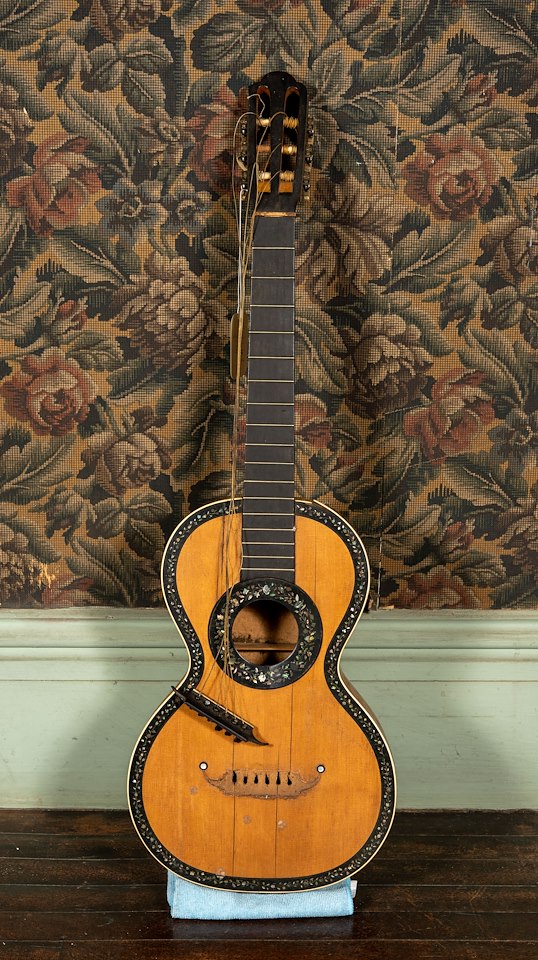
In Emily’s 19th century, guitar also played such a home entertainment role. I have a somewhat worn-out, very small bodied six-string that I sometimes play, and in today’s guitar marketplace such guitars are often called “parlor guitars.” The historic usage that name honors was that with less cost in space than a keyboard instrument, a home player could entertain themselves or their housemates with a guitar. These small guitars easily suited smaller-bodied women* and many of the players in the home were women.
A parlor guitar from the Emily Dickinson Museum’s collection**
.
When it came to realize my music for this poem, I didn’t play my parlor guitar — I played an electric model — but as I continued to go over the words in the process of creating the audio piece I’m not sure that Dickinson had an actual guitar in mind either.
Touch lightly Nature’s sweet Guitar
Unless thou know’st the Tune
Or every Bird will point at thee
Because a Bard too soon —
The opening line, used in place of a title as we do with Dickinson’s untitled poems, has somewhat conventional words for playing a guitar: “touch” “lightly” and “sweet.” Indeed, a parlor guitar like mine responds sweetly to a lighter touch and isn’t designed for driving picking such as used in some later American guitar styles. But Dickinson is a master at choosing the unusual word, the one you or I might never come up with. Her opening line calls it “Nature’s…guitar.”
Given that she moves over to bird’s opinions by the poem’s third line, I think this guitar may be figurative. Its wood and strings might be tree branches, and the Bard too soon, a too early storm. Still, the final line might be speaking of prerequisites for musicianship or songcraft, seeming to warn that a player should be cautious until they know their “song well before I start singing” as another songwriter once stipulated.***
I left a middle section open for an additional top line when Dave and I recorded the basic tracks last week. Afterward I wasn’t sure what should go there, but I decided to score one of my simple orchestral instrument parts for this featuring a violin. You can hear the result with the audio player below. No player seen? Touch lightly this highlighted link and it will open a new tab with its own audio player.
.
*They weren’t made especially small, the petite size was normal for guitars in that time. The current standard size acoustic guitar in our era, often called a “dreadnaught” (because it was seen on arrival between the World Wars as big and formidable as a battleship) is much larger in dimensions: deeper, longer, and wider, and often with a longer-scaled neck.
**The Museum has only recently been able to digitally document the artifacts in its collection. Perhaps due to the difficulties in provenance because the houses of Emily Dickinson and her brother and important friend and sister-in-law Susan Gilbert Dickinson did not pass immediately into museum curation, there is no online information as to who may have owned it, or even if it was played in Emily’s presence. I’m somewhat knowledgeable, though not a professional appraiser, and think this guitar could be a 19th century instrument. The collection’s picture of the back of the guitar shows a blacksmith-quality repair at the headstock joint. A common guitar injury, then as now, is for the neck to fracture at that place. My somewhat-informed-amateur’s opinion is that the headstock may be later than the rest of the guitar and was grafted onto it.
***A stipulation I disregarded, as the first song I learned to play was the Dylan song containing that line, “A Hard Rain’s A-Gonna Fall.” I did not touch it lightly.
Later this month I’m hoping to attend remote online sessions of the Tell It Slant Poetry Festival run by the Emily Dickinson Museum in Amherst, perhaps as many as I did last year. Something they do that I enjoyed was listening to all the sessions where a range of readers read all of Dickinson’s 1789 poems.
Now was I sitting in rapt, solitary devotion for every hour of that multi-day marathon? No, though I was paying some attention throughout. I restrung some guitars, reduced the clutter in my office and studio space, put away laundry, and tended to the dishes. If I gardened or cooked, I could pretend I was work-a-day Emily herself.
What makes the marathon meaningful, even if one does it only in part? The multiple voices for one thing. A group of several people read the poems in rotation each session, so there was no careful preparation from foreknowledge of which poems exactly each reader would read. A prepared reading might be powerful — having trained actors or voice artists read the whole corpus would bring something to it. This is not that, yet worthwhile.
I’ve heard a lot of folks read poetry over the years. Several of the readers struck me as better than most, even given that they might be reading the poems that came up in rotation for their turn essentially cold.* Of course, every so often one of the readers in their turn would get one of ED’s greatest hits, and all of us: the reader, the other readers, and the attendant listeners would perk up. If one pays attention to this, that happenstance, it “dazzles gradually.”
But then too the ordinary readers, the times when someone stumbled on a word, the lesser-known poems, the small ones that might be no more than a quatrain or two — they two are part of the fullness of Emily Dickinson. She may have been a genius, but she produced these hundreds of poems among a more-or-less ordinary life, infusing them with worthwhile attention. With this many poems it’s unlikely anyone (certainly not I) can really hold all of Emily Dickinson’s work in memory. And so it is, in such a complete reading, that some poems will spark with my attention as if they were just written and never before read or heard. With the smaller poems especially, it may be not much more than a glimpse we share in real-time with Dickinson’s ability to see and think differently. Yet, those small visions add up over the hours, grander from their numbers of unique takes.
Which are the poems she drafted while baking, head full of the hymnal meter, hands dusted with flour? Which while in the garden? Which while caring for her sick mother?
Virtual attendance is planned for many of the Tell It Slant sessions that run from September 25th through October 1st. You can sign up for them at no cost at this link. No one’s taking attendance — see or not see any of the sessions as they fit into your life or level of interest. Given the uncertainties in my life, I’m not sure how many I will be able to fit in.
One game I played during the readings — where I eventually jumped into the chat window with exclamations — was whenever the poem cycle came upon a bee. Dickinson closely observes many plants and animals, but she seems to have had a particular affinity for the bee. Is it a symbol of the Puritan work ethic? A chunkier, easier to observe bug? A symbol of fertility? A flying rose with sweetness and a sting? A coworker the knowledgeable horticulturalist knows is essential to pollination?
Billy Strayhorn and Duke Ellington aside, sometimes the muse takes the bee train,
.
Here’s one of her short bee poems, particularly extravagant in its imagination. And here’s a link to what I believe to be the authoritative text.** That opening image alone should astound. Bees as a railroad train, with the plush flowers as directive as train-tracks —yet soft, not iron.*** “A jar” in the second line is ambiguous. A jar as in a container for the pollen it collects? Possibly, but I’m suspecting more at ajar’s meaning as apart or out of harmony. Bees as locomotives and their train of cars makes them outsized from reality’s proportions. They may move the petals on close examination, their industry is harder and heavier than the plants.
In the second stanza, the metaphor shifts. Now the bee is a knight, the flower a fortress or castle they assault. The bee-knight seems a strangely chivalrous marauder, if inconstant and ready to move off to the next bloom.
As an Imagist poem, this then can be apprehended as simply a picture, an observation of a charged moment of attention. How strange to see the tiny bee as a train or even a knight — but yes, it must travel in appointed commerce on its compelled track, and yes, like a wandering knight-errant it must move on.
But this bee could be a muse too, couldn’t it? It knows its schedule, even if we don’t. It arrives, shakes us like a passing train, assails our walls, then bids a courtly adieu and passes on to another artist, writer, musician.
You can hear my musical performance of this short Emily Dickinson poem “Like trains of cars on tracks of plush” below with the audio player gadget you should see there. No player? This highlighted link is another way to hear it, as it will open a new tab with its own audio player.
.
*I once worked for a radio network. Watching the on-air folks, I was reminded that the ability to cold read text is a skill. It sounds easy to do — when it’s done right.
**There’s a twice as long version out there which I think is derived from the 19th century Mabel Loomis Todd and Thomas W. Higginson posthumous collections. These were straightened up for easier public assimilation and were given, by the editors, their ideas of meaningful titles. Did they append two fragments thinking them connected? My apologies for not researching this issue further.
***As striking as Dickinson’s image is here, railroads were as essential to 19th century American commerce as bees are. Towns grew and shrunk based on their routes. Another plausible reason for the train image: one of Dickinson’s father’s commercial achievements for Amherst was assuring that it’d get a railroad line.
I can’t help it — actually I do try to help it, but sometimes I can’t. I was in a movie with my wife, the polemical Emily Dickinson biopic Wild Nights with Emily,* and they introduced Thomas W. Higginson as this nincompoop who couldn’t discern the poetic genius of Dickinson compared to the kind of poetry he preferred. For an example of the latter, the filmmakers briefly gave us Helen Hunt Jackson as a prim, forgettable, mediocrity.
I nudged my wife, “Jackson was better than that” I murmured.
This is what happens when you’re married to someone who likes to look in the odd, unswept-out corners of poetry’s storage shed. Jackson was a childhood classmate of Emily Dickinson. Jackson left for marriage to a brilliant engineer, who Emily then met and sorta-kinda-maybe had a crush on. Jackson’s husband was killed in an explosion working on a secret torpedo weapon during the Civil War, and widow-Jackson went on to a substantial literary career of her own with poems, novels, and early activism for Native American rights.
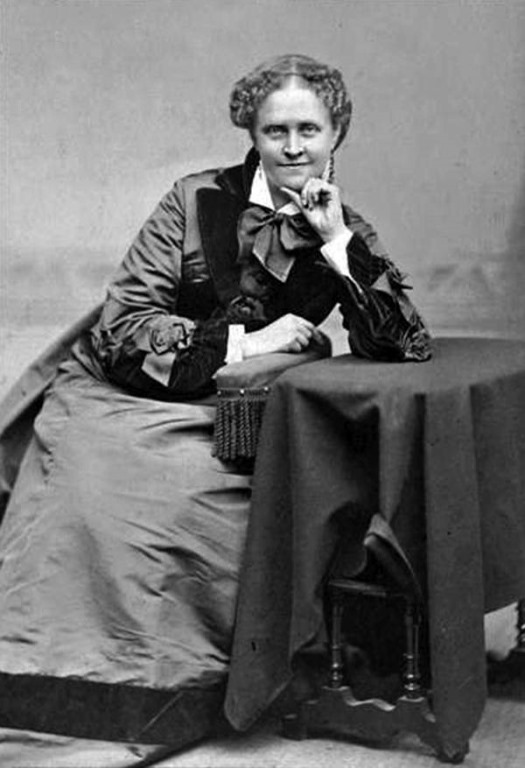
mid-19th century photographs often conceal their subject’s personality, which makes this one of Helen Hunt Jackson a bit special I think.
.
No, she’s not as original as Emily Dickinson, but the congress of poets who could claim that level is small even now. She understood Dickenson’s worth enough to plead with her childhood friend to publish — and though it appeared anonymously, she did include the only Dickinson poem to be published between hard-covers during Emily’s lifetime within an international anthology she produced.
Like Dickinson, these poems include a close examination of nature, though I don’t sense here the notes of humor often found in Dickinson’s nature. In Jackson’s July example, the flowers mentioned are in danger from heat and drought, something that seems contemporary in my own midwestern summer. Only the poem’s water lily seems immune from the danger.
You can hear my musical performance of Helen Hunt Jackson’s “July” with the audio player gadget below. Don’t see the player? This highlighted linkwill open a new tab with a player for you. Want to see the text of the poem? Here’s a link to that too.
.
*Released between the more scrupulous A Quiet Passion and the joyously anachronistic Apple TV series Dickinson, Wild Nights with Emily was the less fully realized, perhaps due to a lower budget. Its broad characterizations were intended in the service of satiric exaggeration. The film’s central point is to portray the often-suspected erotic bond between Dickinson and another childhood friend and confidant, Susan Gilbert.
It’d be possible to do something like this Project using only the poetry of the great American poet Emily Dickinson. While we’re approaching publishing our 700th piece of original music combined with various words (mostly literary poetry) — there are nearly 1800 poems that Dickinson wrote. That’s a lot of material.
The Parlando Project has featured poets all the way from classical antiquity through the first quarter or so of the 20th century,* and I like to vary moods and poetic approaches in the pieces I set to music here — but Dickinson has enough different modes that just her work alone might suffice for variety. Would I miss some of the freshness I find in early poetic Modernism? A woman of the middle of the 19th century, Dickinson was present in an America that is both like and unlike our present country, but like all poetic geniuses she has the power to make time and place fade in importance. As it happens, I was looking for and reading early 20th century poetry when this poem came across my screen, and I found it as immediately fresh and vivid as one of those newer poems. Dickinson’s poem here uses the title of convenience taken from the poem’s first line: “Those cattle smaller than the Bee,” and you can read the text at this link. Rather than a grand poem about important life points, specific social conditions, intense feelings, existential issues, or majestic nature, this is a poem about a prosaic insect, the fly. Dickinson starts out very much like a Surrealist here, imagining as if the fly was a useful domestic animal, like a cow or the honey-producing bee, but the poem then goes on describing what could be a bothersome number of flies inside the Dickinson Homestead house.
“Well Lavina, I’m thinking I’ll go for prize houseflies at the next town fair.” Surrealism manufactured by the AI art program that claims it’s trained on art work that the artists have been paid for.
.
I may be paying too much attention to detail in this playful poem, but I wondered what kinds of flies she’s observing. The season of winter is mentioned, and houseflies generally lay their eggs inside in colder parts of America to hatch during winter. Since Emily cooked for the family, I can imagine that hatching would not make for a pleasant kitchen. Noting Dickinson’s choice of an unusual word “odiouser” in the poem, that may be what that strong language is about.
The final stanza admits that the chapter of the Transcendentalist book of nature describing the worth and meaning of flies is one that Emily hasn’t yet read. Also note: she chose “remand,” a courtroom term, in that final verse — more evidence that Emily picked up some lawyerly ideas from her male family members’ line of business. The Bee mentioned in the first line is something of an Emily Dickinson touchstone, the word and animal appearing often in her poems. In contrast, the fly is quite rare in Dickinson compared to the bee or the butterfly. There is another Dickinson poem that begins “If you were coming in the fall” that mentions a housewife brushing away a fly — but by far the most famous fly in Dickinson is inside “I heard a fly buzz when I died,” one of her strangest and most gothic poems.
I tried to keep the music today reasonably light to go with the mode of today’s poem. You can hear my performance of Dickinson’s “Those cattle smaller than a Bee” with the audio player below. No player to be seen? This highlighted link will open a new tab with a player then.
.
*I rather like the early Modernist era of poetry, but another reason that I generally cut things off at 1927 is that such works clearly in the public domain are free to modify and use however I wish.
It’s been said of poets that they go out into a perfectly good morning only to think of glum existential thoughts. When I read something like that and look at the pieces this Project does, reflection is called forth. That certainly calls out a lot of subject matter I deal with here.
There’s a rebuttal, songwriter Townes Van Zandt said “There’s only two kinds of music: the blues and zippety doo-dah.” Poetry of course is music’s sister muse, but despite Steve Earle’s cowboy boots,* Van Zandt isn’t likely to be recognized as the world’s best songwriter. A dialectic of “blues and zippety doo-dah” risks falsely reducing Blues to a synonym for “sad songs.” One reason that Van Zandt, who was an excellent songwriter, won’t get the World’s Best award is that his songs vary between sad, sadder, and saddest. Doesn’t make them less perfect for what they are, just makes them suitable for certain moods while other songwriters might portray a range of outlooks and characters. I like Townes Van Zandt, I think “Flyin’ Shoes” is as near a perfect song as ever written, but a playlist of 20 to 30 Van Zandt songs would not carry my attention as well as a similar-length selection of Bob Dylan, B. B. King, Joni Mitchell, or Mose Allison.
An Emily Dickinson playlist would be equally as varied as anyone in that latter quartet. There’s the goth-girl Dickinson, the satirist of religion Dickinson, the legalistic philosopher, the altered-states psychedelic Dickinson, the secret bisexual passion Dickinson, and then there’s the Dickinson I’ll perform today: the botany nerd Dickinson. Part of what makes Dickinson such a fascinating writer is that all those personas talk to each other, seem to know each other.
I’ll not go into thousand-words territory on today’s Dickinson piece — I’ve been too long-winded lately for that. I’m going to treat her poem as a simple delight in the oddities of fungi. I have every reason to estimate that that was Dickinson’s intent, and we can enjoy that intent’s achievement. Here’s a link to the full text of the poem if you’d like to read it. To briefly brag about my restraint, there’s a possible deeper, subconscious, reading of the sporocarp fruiting body — but let’s be done with that. All the other Dickinsons may have been there when this poem was written, but we can simply enjoy one of them today.
Apostate mushroom, pleased grass, surreptitious summer. Emily Dickinson not pictured.
*A famous quote by fellow Texas songwriter Steve Earle was plastered on a Van Zandt album cover: “Townes Van Zandt is the best songwriter in the whole world, and I’ll stand on Bob Dylan’s coffee table in my cowboy boots and say that.” Wikipedia reports Van Zandt had a comeback when asked about that blurb too.
I’m going to share a musical performance of an Emily Dickinson poem, but before I get to that, I’m going to continue my memoir-of-influences series on things that formed the idea of the Parlando Project earlier in my life. I’m going to try to keep it short, which will force some amputations, but I feel embarrassed spending much time on the small events of my single life. Those in a hurry, or only interested in the new audio piece and what I have to say about that, can skip down to the second section of this post.
At the end of the last post I had moved to Newburgh, a town on the Hudson river about 60 miles north of New York City. I don’t know if the town knew what to do with The Seventies, it seemed between eras; and in some larger sense I might not have known what to do either, but like the town I had a daily job to do, and kept doing it. Can we say that had some value?
I liked many of the people I worked and lived with during my five years there. I still think of some of them from time to time, and they were often kind to me. The folks who worked with me at St. Luke’s Hospital, particularly those in the Emergency Department, worked hard under significant limitations trying to do things that we could only address partway. I could say much of that under-addressed were systematic issues — and I’d be right — and the levers of those systems were outside our direct grasp. Another part of those limitations were closer to us, internal. I said I’d try to be brief. I said there would be amputations. Newburgh had a racism problem. The town, the region, was populated by stratums of immigrants, with the original European WASP colonials to Irish, Italian, and Puerto Rican waves following on. Mixed in there were Afro-Americans who were there, as they were everywhere in the United States. I don’t know the exact demographic details, and I said I’d try to keep this concise, but I’d guess the Black Americans were first in the region from servant and slavery times, and then there was some low-paid and otherwise undesirable work that still may have seemed better than some parts of America for Black folks. Few poor people ever emigrate for marginal gains from acceptable situations.
That work had shriveled over the years, and what jobs there were, those other immigrant waves got some of the employment from the white folks who did the hiring. Again, I’m no expert, I may have some of this wrong, but when I think of the Irish and Italian Americans who can recount the derogatory tropes employed against their ancestors,* I still suspect that even within the cruel othering they received, they sometimes got, in practice, hiring preferences over Afro-Americans.
This led to the town, in the time I was there, with an underclass of underemployed Black folks viewed by too many of the white population as shiftless, ungrateful and unenterprising wards of the state. Think I’m amputating too much to say this was a prominent white attitude? Ten years before I arrived there was a controversy that was called “The Battle of Newburgh.” I didn’t know much of this specific history in 1971, but the attitudes were still easy to hear and feel while I lived there. Here’s a link to a 30 minute podcast on the 1971 controversy. Wonder what happened later? Here’s an article that updates things to 2015.
Back in my Emergency Room, The Seventies, we were the place anyone came when things broke down. Folks needing medical care that couldn’t pay. Victims of violence. Stressed out or addicted people. Worn-out old workers and beneath the working-class people. I worked the 3-11 shift, the busiest one in the ER. We’d typically get 50-70 such situations every shift. What could we do for them, right now, in our imminent place? Patch’em up. Give them a preliminary diagnosis and maybe a shot or some pills. Hand off a referral card to a medical system already fragmenting and requiring insurance levels of payment from various payers. Witness their deaths.
So those folks I worked with, who did this, were they racists? I’m not saying that. I can’t see into the hearts of them — not then, and not with any level of magnification now. I know we were frustrated with the people in and around the treatment beds at times, thinking that what’s close and in front of us was the most significant thing in what was going on. No, no, we’d no doubt say, that thought wasn’t from the color of their skin, that was what they did, or were doing, or weren’t doing. From what some of my coworkers said talking among our tired selves, I could hear racism, hear pat rationalizations. I’d be hearing this from folks on a modest paycheck given the responsibility of a past that isn’t even the past as Faulkner put it. Our actions were mostly care — yes I saw kindness too, even when our philosophies and capacities could not fully appreciate the lives of our patients and their families. Perhaps it was good that we were too busy to think about that incongruity. Would our care have been better if we — speaking now of the whole group of us, including myself — were less ignorant and more broadly empathetic? That’s certain. But such wiser folks weren’t there then, we were. Imperfection trying to heal what could be treated directly.
A couple of years before this, a songwriter was 40 miles to the north of me, goofing off with his Canadian R&B band buddies in a big pink house. Sing heavenly muse, he sang these lines:
Remember when you’re out there
Tryin’ to heal the sick
That you must always
First forgive them.”
To this day, when someone, almost always a white person, concludes some confession to me with a variety of the phrase “You might think I’m a racist because I said that.” I reply “You said it, and you might well be to some degree. So, what are you going to do about that, and about the situation that is before us?” Ignorance and prejudice may not guide us well in trying to solve things, to remedy faulty systems — so what efforts can reduce that so we can see more clearly? But beyond that, even though our thoughts and prejudices can make us work blindly or in the wrong direction, the injured and endangered may be more in need of helpful actions than faultless inner wisdom.
Is writing and performing poetry a helpful action? Well, it’s not clearly so as is binding wounds or performing CPR. Poetry is in the calling-attention business, including part I normally celebrate here as “Other People’s Stories.” With that focus, I feel conflicted in writing so much within this series which touches on individual and sometimes trivial things in my life. What good will calling those things to attention do? Perhaps it helps make you aware of the “unimportant” things in your life, or the dependencies we have in others who have broadened or deadened what we’ve seen and felt. It can be someone else’s story that helps you see the contours of your own story.
And then too, poetry is full of little, trivial things that poets write down to stand for the ineffable larger things. Can our lives stand for the larger things? They do I believe, or they can, in ways we never fully know.
Once more a chord sheet if you’d like to sing this too.
.
The Emily Dickinson Poem
Emily Dickinson has many poems where the small things stand for larger, and then she has others using more philosophical language — yet I was still struck by the first line of today’s Emily Dickinson poem. Poems sometime seek to grab your attention right at the beginning, and this one does that with a trinity: “Color — Caste — Denomination.” These things rule so much of our lives. We may think we don’t let them rule us, but then we see the next person is using them to guide them — or perhaps guide them in how they view us. How can that not affect us. How many next persons can there be without us sometimes being one of those next persons, or yielding to the next person in our lives?
A couple of short notes on things to mention in the poem since we’re running too long. Who’s a “Circassian?” It’s a Middle-Eastern Muslim-believing ethnic group largely exiled from their homeland by the old Russian Empire. “Caste” is a word given by Portuguese colonialists to a hereditary hierarchy they found in South Asia, but it has taken on new usage in modern America to describe the intertwined prejudices and discriminations based on skin color, ethnic background, religion, and economic class. Both terms show a breath in Dickinson’s reading and education. Even though Dickinson’s America was approaching or undergoing a war around race-based chattel slavery when this poem was written, Dickinson seems to give religious prejudice equal or greater weight in the “minuter intuitions” her poem holds that we use to obscure our common humanity. Some scholars have pointed to this poem as a comment on Irish-Catholic immigration in Dickinson’s region at this time which led to a substantial reaction from the existing Protestant settlers.**
My musical setting for it is simple, just guitar and voice, as I’m somewhat rushed for time — and then wanting to use what gifted time I find available when I can record acoustic guitar with open microphones that would otherwise pickup other noise. Though that may have been a practical reason, I think the simplicity works for this hymn from Dickinson’s alternative hymnal. You can hear my performance with the audio player below, or with this alternative, a highlighted link that will open a new tab with an audio player.
.
*Not doubting those stories — see the next note as we see that connect to Emily Dickinson. And I haven’t mentioned anti-Semitism in its Jewish and Muslim varieties. Or the ugly anti-Chinese laws and hate. Oh, and First Nations? I could go on. And that’s just America. I know I have an international readership. Other countries have their own varieties of this, as we’ll see too in Dickinson’s poem. We had all kinds of supposed levels of intelligence and moral fitness that bedeviled us then and now.
**As I mentioned in one of my favorite posts on the roots of Emily Dickinson, her mid-19th century Amherst Massachusetts region had Afro-Americans, mostly in her time in servant class jobs. As she grew into adulthood, the Irish immigrant wave started to displace them, and anti-Irish sentiment ran high. Emily’s brother Austin, who she was close to, at least dabbled with the notorious anti-immigrant Know-Nothings. When young Austin was assigned to teach Irish immigrant kids in Boston, he found the job stressful. There’s a letter from his sister Emily where she jokes that it sounds so bad for him that he ought just as well to go and kill some of them, referencing in the same letter a notorious Boston murder case with anti-Catholic connections. Generously, I sense Emily the satirist there, but this kind of edge-lord humor, then as now, can just be “just joking” license as well. I think: Dickinson, for all her independence of mind, was part of systems, just as you and I are. Even Transcendentalism, the time’s new thought movement that sought to open up cultural enquiry, was not without racism and prejudice. Emerson’s “American Civilization”which I presented part of earlier here, and which is contemporary with this poem, contained portions with racist ethnography.
The most remarkable thing I can think of regarding Emily Dickinson and Irish-Catholic prejudice is that she ended up working elbow to elbow with Irish maids on her rural homestead that retained elements of its former farmhouse work-load carried with other poor first generation Irish immigrants as the hired help. The longest serving maid, Margaret “Maggie” Maher — did she recall Irish poetic bards and song? When Emily’s precious packets of her remarkable poems, overran a portion of a bureau drawer, Maggie offered up her immigrant’s trunk, in which she’d carried her all to America. When the Dickinsons decided they didn’t like the likeness in the oft-seen daguerreotype of Emily we rely on now, they tossed it out, and Maggie rescued it and kept it. Maggie worked beside Emily as she cared for her invalid mother during her prolonged illness, and she then cared for Emily as she lay dying. She was a loyal worker, but it’s said Emily told her to burn the poems. Then, she didn’t obey. When Mabel Loomis Todd was given the task of arranging the poems for posthumous publication, I read that Maggie did housework for Todd to free up her time for the editorial efforts.
And here’s the final thing, as final as death’s equivalence that today’s poem recounts. When Emily Dickinson died, she, this descendant of one of the town old-guard WASP leaders, asked that her coffin be carried by the Irish workers of her homestead. Aren’t you glad you read footnotes, patient reader? You can read a summary account I relied on for much of this in this academic paper available via JSTOR. It’s author Aife Murray expanded her research into this book, which I read a few years back.