Wild Nights with Emily

I’ve been looking forward to this Emily Dickinson biopic since I first heard of it a few months back. I acknowledge the difficulty of making a film about writers, particularly if the film wants to give due weight to their writing, the least cinematic of art forms—but just because it’s difficult doesn’t mean it shouldn’t be tried.

From indications I was expecting Wild Nights with Emily to be irreverent, but I often like some irreverence, even about things I admire. The advance publicity used the hook that it was going to go strong on the theory that Emily Dickinson and Susan Gilbert were lovers. That’s a legitimate theory, with evidence to support it, but the trailer and the promo clip I saw indicated it was going to be one of those “Hey, famous artists go through all the wacky and awkward stuff we do, especially when they fall in love.”

Does that sort of thing diminish art or the people that make it? We should laugh at both devils and angels some of the time (just not all the time). For an example of literary irreverence that worked for me, I’ll point out Upstart Crow,  a series that turned Shakespeare into something between the Dick Van Dyke Show  and 30 Rock  using a passel of modern critical theories as comic premises.

Wild Night with Emily Poster

What’s with all the black. More Emily Dickinson goth moves?


As it turns out, Wild Nights with Emily  didn’t consistently work for me, though I’m glad I saw it and I admire the effort. It’s awkward in ways that alternately charm, puzzle, and just seem off. It tries for a complex structure that jumbles time-lines back and forth and the individual scenes seem very separate. There’s little character development, little sense of change or dynamics of Character A’s actions changing the course of Character B’s life outlook, even in the central love story. We see a scene or two of Susan and Emily falling in love as teenagers, but there’s no attempt to explain why Susan or Emily were attracted to each other instead of someone else, they just are. Nor is this attempted for any of the other relationships—some kind of lust/attraction spark occurs and bang they go off. It’s consistent enough that I think the writer/director Madeleine Olnek is making a point of this. Oddly, these connections go badly for the couples other than Susan and Emily. It’s kind of a bokeh effect thing: our lead couple just want each other, and that sort of works out, and everyone else is just mindlessly and brainlessly lusting.

Indeed, my impression was that the writer/director really was interested in making a point, or series of points. The film isn’t a biographical narrative* or love story or sex-positive comedy or an exploration of creativity, it’s more an illustrated lecture with actors given to illustrate those points. The disconnection of the scenes is just a new slide in the deck being shown. The points are all worthy ones, most of which I’d agree with. Dickinson was a mocker and questioner, not a conventional sentimentalist. No one understood how revolutionary her poetry was. Families are weird, and their secrets show that. The Patriarchy is blind to a whole lot of things.

Some of the scenes work well as illustrations for me. Some don’t. Your mileage may vary. Many scenes use humor to make their point. A couple of the scenes were Dada-weird (e.g. Lavinia and her fake cat). Others are very much “see the broadly underlined point.” Some are emotionally riveting in the same way that actors doing single scene can be as they instantly inhabit a character, but again, the film isn’t really a narrative. Nor does it go out of its way to say “I’m not a narrative” like other attempts to subvert the artist biopic genre like 32 Short Films about Glenn Gould  or  I’m Not There.  If you go to see it, go with that expectation and I think you’ll be more primed to absorb what it’s trying to do.

A couple of Olnek’s points I’m less sure of (she may be right, I’m no Dickinson scholar). She seems to be overcorrecting on the Dickinson was a hermit, always sequestered in her room thing. As far as her film shows it, it’s all a misunderstanding, and she just didn’t like Mabel Todd. The impression I get from my Dickinson biography research is that a much more sociable person did become increasingly withdrawn as she aged. And she seems to be saying that Dickinson directly sought publication, only to be rebuffed by the Philistines. Maybe there’s an earlier period I’m unaware of, but the testimony of among others, Susan Gilbert Dickenson herself included, was that the scattered publication of 11 or so poems in her lifetime was largely due to the efforts of others which Dickinson did not encourage.

A few times in the movie they use Dickinson’s poetry, spoken and with subtitles with scenes portraying something they relate to the poems. I’m favorable to that tactic—after all, the Parlando Project is doing that with music instead of film. I think that works in the film. The “Hope’ is a thing with feathers”  and “I died for beauty but was scarce”  examples were particularly memorable for me.

That’s my reaction to the film. I appreciate the effort that went into it, and the task it set out for itself isn’t easy.  Is it the best possible way to spread greater, deeper appreciation of Dickinson? Hell if I know. Worth a try.


*Maybe it’s just me, but has anyone done a straightforward Emily Dickinson timeline that says what Emily Dickinson was thought to be doing year to year? A good one would include links to the various theories regarding people that came and went in her life. I find some of this hard to keep straight and the non-linear choice of this movie obviously didn’t aim to help me. For example, the Mabel Todd/Austin Dickinson affair that started in 1882 happened very late in Emily’s life, more than a decade after she’s thought to have written the vast majority of her poems. And the first meeting with Thomas Wentworth Higginson in 1862 was when her amazing productivity was accelerating.

By the way the film’s bokeh effect makes Higginson and Helen Hunt Jackson look like comic idiots. Given the heroic things they tried to do in their time, I give them a little more credit than that.
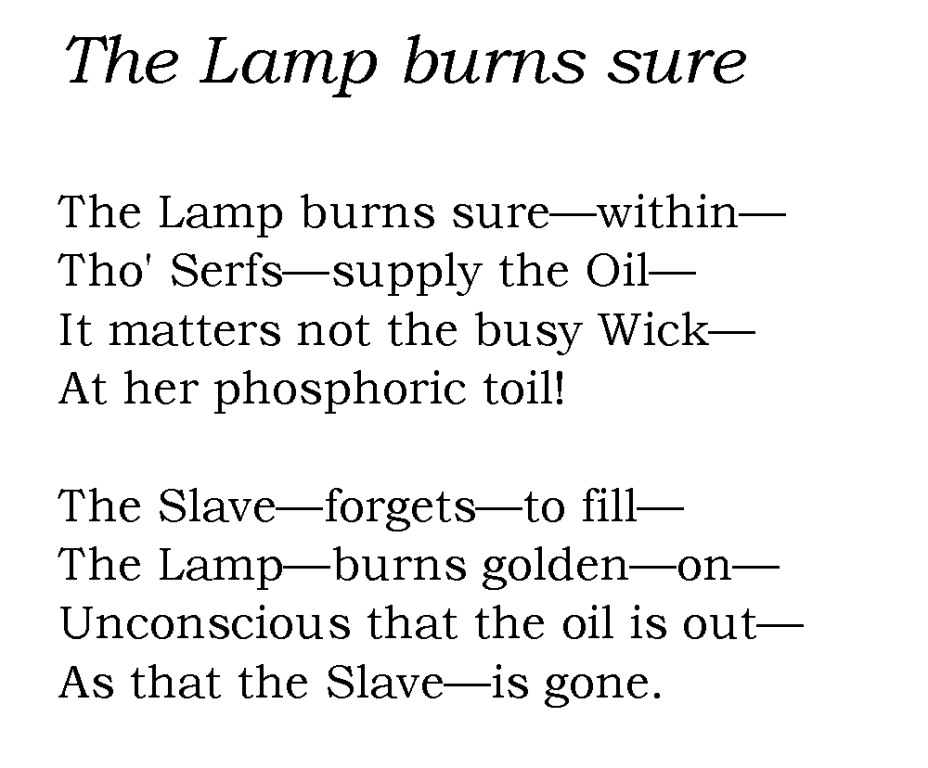
The Lamp burns sure

What did Emily Dickinson think about the American Civil War, that great national trauma that occurred during her most productive time as a poet? And what did she think about the great national sin that was the cause of that war, slavery?

Emily Dickinson often writes puzzling poems, compressed like a set of speaker’s reminder notes on an index card. Despite occasional antique words and references to obsolete technology, Dickinson’s poems don’t really seem to dwell in a particular time or have any anchors in a time’s signature events. Instead we are left with the multiple capitalized idealized concepts that in the hands of most poets would doom a poem to vapid incorporeality—but the speed and brio of a Dickinson poem seems like the rush of thoughts, and that and they carry us along. All of this lets us see a remarkable mind thinking, but it doesn’t necessarily tell us the conclusions, only the methods by which it tries to reach them.

With many other American poets of her day we can tell what they thought of the Civil War and where they stood on the issues of slavery. Of course, we no longer read most of them, and we continue to read Dickinson. Even though my curiosity about these matters is personal, and in the end it doesn’t significantly change the originality and attraction of Dickinson’s work, I’ve still looked to see what I could find.

Dickinson’s father, Edward, was a politician, a member of the short-lived Whig party, and so there are political stands associated with him. The American Whig party, particularly for northern Whigs, was a “free soil” party. This meant that they did not stand for the abolition of existing slavery but wished to limit any expansion of the practice. Southern slaveholder interests were not content with that as a compromise. In an era when new territories and states were being added to the Union, they feared that they would eventually be too small a minority in a growing United States. In the 19th century before the Civil War, time and again these interests would come into conflict, and it was generally the Whigs who worked out some compromise that put off the Civil War. Edward Dickinson seems to have been an orthodox Whig, he supported those compromises, including voting for one of the last and most fateful of them, the Compromise of 1850 that gave the slave holders a Federal Fugitive Slave Act, giving license for bounty hunters of dubious ethics to haul escaped slaves back to the South (and financial rewards if they over-reached and just grabbed a free black person “by mistake”) and requiring local state authorities to assist in their efforts.

The injustices of the Fugitive Slave Act enraged Afro-Americans and energized abolitionist sentiments. And in the slave states who would secede at the start of the Civil War one of their chief complaints was that the Federal Government wasn’t doing enough to enforce this Fugitive Slave law against individual states that were hampering rather than aiding these “slave catcher” bounty hunters.

The Whig parties balancing act fell off the high wire shortly after that. It essentially split into two parties, the new Republican Party which was more adamant about free soil with no compromises, and eventually became the “party of Lincoln” and slavery’s abolition. The other part was the Constitutional Unionist Party which wanted to continue the Whig-style balancing act. Edward Dickinson seems to have aligned with the Constitutional Unionist faction, which completed the rapidly increasing progression to irrelevance for the Whigs.

On the other hand, both Edward and Emily Dickinson were on friendly terms with those who went the Republican route and even the more radical abolitionist bent. If yesterday’s story of Angeline Palmer might lead you to see a 19th century Massachusetts casting of To Kill a Mockingbird  with Edward as Atticus Finch and the young Emily as Scout, the reality of the Dickinsons is much more ambiguous.

I’ve found various critics and commentators who have sought to answer my questions about what Emily Dickinson thought on these things. Some point to Dickinson poems and have suggested readings of them, but these are most often unconvincing to me. She does have poems mentioning warrior courage, duty and loss, but none of them seem to say anything about the causes or necessity of the pressing war in her time. Even more rare are references to slavery or people of color in the poems.

The Lamp burns sure

Mysterious and burning. Dickinson’s mind by lamplight

The poem I use for today’s piece is one of those rare ones. “The Lamp burns sure”  is Dickinson at her most compressed and ambiguous. The poem’s plot is clear enough, an oil lamp whose oil is supplied by slaves or serfs (the poem says both at first, muddying the waters if it’s talking about slavery) runs out of oil because they have stopped filling the reservoir. The lamp’s wick is so busy burning that it doesn’t notice that it’s out of fuel and would in the normal course of events burn itself out shortly. The poem does not proceed to that end however. It leaves us only with the wick’s obliviousness, and then breaking the tie between the oil bringer’s role as being a serf or a slave, leaves us with the final statement that the busily burning wick is also unaware that the oil is out because “the Slave —  is gone.” We don’t get to find out if the lamp is some Hanukkah mystery that will go on burning longer miraculously.

So, what does it mean, if it indeed means one thing? Some read it as a parable of creativity, that we’ll work ourselves past our resources in our passion. A key word there would be “within” indicating some imaginary inner lamp and the slave is just our body and emotional resources.

Some read it as a comment on the base labors that support a civilization that in turn supports arts, science or spiritual pursuits, and in that reading it’s an acknowledgment of the necessity of those labors—take them away, no light! The confusion of serf and slaves is a necessary confusion as it’s talking generally about civilizations.

And then some think, since this is a poem written in 1861 as the Civil War has broken out, and all the slave labor that has supported a large portion of the agricultural economy of the nation is now in question along with that nation itself, that this is not a generalized metaphor. The slave who’s gone, is an American slave, the light is an American light that will burn golden on.

Emily Dickinson's desk

Emily Dickinson’s desk with a whale oil lamp, a little luxury that could extend her writing hours

That last one would make it the closest to an Emily Dickinson statement on slavery and the Civil War. As I burn my own midnight oil tonight and I think of Emily Dickinson who wrote at night by the light of an oil lamp, I lean to the first reading. But some other day I might see something else and read it another way. I’d like to be surprised and to find out that Emily Dickinson’s keen and questioning mind could see what only some in her time could see about people of color and slavery, but that might not be the case. But here’s what I do find when I go to the music of that mind: a mind unafraid to be original and like Frederick Douglass in Robert Hayden’s poem, to believe freedom thought to be as needful as a heartbeat. Even if she didn’t free anyone from slavery like Lewis Frazier and his fellow servants in our last post, or agitate and orate like Douglass, I find there’s liberation there that burns sure.

Here’s my performance of Emily Dickinson’s “The Lamp burns sure.”  You can use the player below to hear it if you can see one. No player? Then use this highlighted hyperlink.

Emerson’s Water

Here’s another post in one of our National Poetry Month series: The Roots of Emily Dickinson. We’ve already touched on Emily Bronte, who’s fierceness inspired the American Emily; and Helen Hunt Jackson, a childhood classmate who encouraged Dickinson to publish her work.*  Today we look at a poem from the foremost public intellectual of her region and era, Ralph Waldo Emerson. We’ll see how it connects to Dickinson, and you may be surprised at how current Emerson’s thoughts about water are.

It’s difficult to think of a modern analog to Emerson. It’s not an exact fit, but Oprah Winfrey could be put forward—but that understates the level of Emerson’s pioneering in the mid-19th century when America was still seen as a backwater. Like Winfrey, Emerson’s approval or endorsement could do much to help a new writer come to the fore. Emerson’s opinions, not just on the arts, but on public culture in general, about how best to live and shape one’s own life, were widely distributed and read by a broad readership. But even if similar in fame and broad impact, Winfrey has never pretended to be a philosopher herself, while Emerson was viewed as a central figure in a movement called Transcendentalism. What is Transcendentalism is a book-length subject, but there are, within its core, beliefs in the powers of individual insight over religious authority and the desirability of a close reading of the book of nature.

Winfrey-Emerson

If it was the middle of the 19th century, the guy on the right might be your Oprah.


When I would read Transcendentalist writings more than a hundred years after they were written, in my 1960s, I would be struck with how often (if one gave some allowances for language changes) they sounded like a hippie critique of 20th century culture,** and in the half-century and more since, if I dip back into them, I find some of their focus surprisingly contemporary.

Was Emily Dickinson a Transcendentalist? I can’t say for sure, but it’s near certain that Transcendentalist ideas, particularly as expressed by Emerson, were familiar to her. His thoughts were in the newspapers and magazines she read in her lifetime. We know she had been given a book of his poems by a friend, and we know she read them, and even copied at least one of them in her own handwriting. It’s possible that she attended one of Emerson’s popular public lectures.

Emerson Poem Sacrifice copied by Dickinson2

Part of Emerson’s poem “Sacrifice” copied in Emily Dickinson’s own hand.


Emerson’s poetry rarely works well, and Dickinson is a great poet, yet in poems like today’s Emerson selection “Water”  I can see similarities between them. Emerson punctuated his poem as one purported sentence, but its syntax is impossible to follow, and so “Water”  is as fragmented as one of Dickinson’s heavily dashed poems. Incredible leaps occur from line to line with no attempt to bridge them with explanatory connections in either poet’s work. Emerson begins his poem with a striking phrase, similar to many of Dickinson’s great first lines: “The water understands/Civilization well;” but we soon meet a strange homey image of sticking a toe (or foot) in it, and Dickinson too loved to mix the universal and the mundane. Emerson’s poem develops with water personified as not having or having certain feelings, and then with little preparation we’re warned it can be the destroyer.

I think Emerson is making a very modern point here, one that he expressed also in his essay “Civilization.”   When water is respected and harnessed appropriately for its utility *** we are in harmony with nature’s nature. But, if we ill-use nature, we literally go against the tide, and water will be our destroyer.

If Dickinson was influenced by Emerson’s ideas and outlook, and if she picked up his individualist style that dares to be somewhat obscure to stay true to the individual’s perceptions, why is she so often a great poet while Emerson isn’t?

I think Dickinson makes better word choices both for sound and impact. Having “decketh,” “adoreth,” and “doubleth” as three wet dish-rags in a four-word stretch is enough to make Emerson’s poem soggy. And Dickinson has a talent for intriguing mystery that pulls us along even to places we don’t fully understand. She does that partly with her hymn/ballad rhythms which Emerson doesn’t use. Dickinson is usually more immediate too. A few posts back I stated that a poem is not about ideas, but the experience of ideas. In an Emily Dickinson poem, I’m more often able to feel I’m experiencing those ideas as the are perceived, where I feel Emerson is summarizing his thoughts after the fact.

Unafraid, I waded through the -eth words and performed Emerson’s “Water”  with my own music, and you can hear it with the player below. And here’s the text of Emerson’s poem if you’d like to follow along on the page.


*With the exception of one poem, which was published anonymously while Dickinson was alive, Jackson failed at that. Still, I think it possible that having some knowledge of her friend selecting poems for publication could have been motivation for Dickinson to create her hand-written booklets of poems which were found after her death.

**This is for good and ill. Idealistic critiques of society are important, but adventurers often take wrong turns. And idealists have a hard time figuring out viable new structures.

***Emerson’s Massachusetts led the nation in using water power for small to large industry in the 19th century. So, when the city of Minneapolis was founded largely due to it’s exploitable water power, a good portion of the city fathers had New England backgrounds. Many Minneapolis streets still bear the name of 19th century New England luminaries, including Emerson. Alas there’s no Dickinson Avenue, as Dickinson’s poems were not published until close to the end of the century.

“Hope” is the thing with feathers

We don’t usually associate Emily Dickinson with metapoetry or with the widespread sampling and recontextualizing such as found in T. S. Eliot’s “The Waste Land.”  But this poem from Dickinson, one of her best-known, could be engaging in something we could call that.

The poem starts off with a clear indication of reference, by putting its first word in quotes. Based on Emily’s unusual but internally consistent style, I don’t believe that she’s using quotes to indicate hope as concept, as an ideal (she capitalized words to indicate that sort of thing). If it’s a quote, she’s referencing someone else. Who said this “Hope?”

My chief candidate would be the poet and poem from our last post, Emily Bronte and Bronte’s poem “Hope.”  If you read and listened to “Hope”  in our last post you’ll know that “Hope”  isn’t a hopeful poem at all. Dickinson’s poem, on the other hand, is often viewed as praising hope, but if you read/listen to them together, Bronte’s poem sheds a different light on the much better-known “thing with feathers” poem.*

Dickinson seems to start where Bronte ended. Bronte’s hope has feathered wings, and it uses them to soar to heaven to never return. Dickinson starts with “hope” only specifically given the potential for flying away, but Dickinson has “hope” sticking around. Some read the feathered aspect of Dickinson’s image as cute, like a pet songbird, a friendly image, but I don’t think Dickinson does cute much, and I’m not sure she’s doing it here.

Punk Monk Emily

My wife sent me this and I believe the illustration is by Wendy MacNaughton.

.

What Dickinson says about hope in the rest of the poem has been read as outright praise, but if we take that fly-away-and-feathers link between Bronte and Dickinson, we should be alerted that there may be more shading the situation.

Hope and Hope is a thing with feathers

For those who’d like to read along, here’s today’s text and the Bronte poem it may be referencing

.

Dickinson’s hope sings without words, which is a statement of great ambiguity from a poet. Abstract sound that goes beyond meaning is part of poetry’s power, yes, but “without words” may also say that, for good or ill, hope is generalized and not realized by the specifics of the situation. A song without words could be like advice that things will always get better, always turn out fine. A friend or advisor that always tells you that; whose non-specific hope is constant and never relenting can be a “not today please!” thing after all.

The second stanza is an extended metaphor of the hope-birds sweet song in a storm. “Plucky little bird! Good for it!” Is one reading. But there’s an odd line in there that must be weighed too. If the storm is bad enough the bird might be abashed, embarrassed, Dickinson says. Why would that be? Is the hope-bird, shy, timid? Bronte’s hope is said to be in her poem’s first line, and that turns out to be a very severe flaw as Bronte develops it. Could it be even darker? Did the hope-bird say listen to my hope-song in the storm and not fear—oh, how embarrassing—category 5, your town is wiped out by the tornado or hurricane?

Am I being Debbie-downer here? Could be. But how else does one explain the “abash” in that line?**

The last stanza begins still carrying over that metaphor: hey New Englanders (and Minnesotans!) if it’s cold, the frozen center of winter, you can still hear the magical hope-bird. Out way beyond land on the strangest sea? You can hear it. The hope-bird is operational in any and all conditions!

More won’t-shut-up testimony about the hope-bird there. Is this fulsome praise? Recall Dickinson’s famous definition of poetry: “If I read a book and it makes my whole body so cold no fire can warm me I know that is poetry.” And in Wild Nights Wild Nights  she speaks about adventuring on chartless wild oceans. Not to paint Dickinson as an inner stone-cold Goth here, but cold and strange are not what she seeks to avoid. Dickinson says the hope-bird keeps “so many warm.” She doesn’t say everybody or herself.

What do I make of Dickinson’s concluding couplet? Many readings see it as a comment that hope isn’t self-serving, the crumb being reward for a pet or a tamed or otherwise human-habituated bird. Dickinson (unlike Bronte, whose hope is portrayed as fickle and even cruel) has just made much of hope’s seeming ubiquity. If we take it that she’s commenting ambiguously on someone else’s hope or Bronte’s portrayal of a fickle hope, she could have undercurrents in those last two lines. She may be saying “My hope is wild and unpredictable, maybe not as specifically feral and cruel as Bronte’s, but my hope is not my pet, not at my beck and call.”

Of course, a great deal of this reading depends on thinking that when Dickinson put hope in quotes she meant to refer to the title of Bronte’s poem whose protagonist is highly skeptical about hope. There’s another thing she might be quoting, a special use of the word. When Dickinson entered Mount Holyoke the students there were highly encouraged to make a sincere profession of religious faith. At the end of her single year there, Emily Dickinson was still in a small group that refused to make that profession. The school had a classification for those hard-cases. They were put down as “Without hope.”

Here’s my performance of Dickinson’s “Hope’ is a thing with feathers.”  Use the player below to hear it if you see that, or if you don’t, this highlighted hyperlink can play it.

.

*Somewhere in my reading this spring someone tipped me off to consider Bronte’s “Hope”  as an influence on this poem of Dickinson’s. I did, and this is what I found following that tip. However, I can’t find any note I made about where I first read that there might be a connection. I owe someone.

UPDATE: Thanks to another blog’s discussion of this poem, I think I’ve rediscovered where I may have read of this connection between poetic Emilys and “hope.” It could have been this post by Nuala O’Connor.

**I’m truly hesitant in this regard. I do believe in the intractable nature of the human condition, and I think Dickinson does too, but I don’t want to discount hope or “the peace that passeth all understanding” as a necessary part of dealing with those things.

Emily Bronte’s Hope

If Emily Dickinson had no real models for the revolutionary poetry she developed, she did have other poets she could look to. We know from her letters that one of them was Emily Bronte.

English author Emily Bronte and her two sisters Charlotte and Anne all wrote poetry and then novels, but Emily seems to have been the most avid poet of the trio. Starting in childhood Emily Bronte created along with her sister Anne a fantasy world they named Gondal in which they spun tales of adventure. At least some of Emily’s poetry was connected to that world, and so it’s possible that today’s hopeless piece titled “Hope”  is part of some fully imagined plot and isn’t autobiographical.

Emily Bronte

Emily Bronte. Plotting what to do to that useless hope when she’s uncaged?

One of America’s great contributions, an Afro-American contribution in large part, is The Blues. The Blues reaction to misfortune is almost inevitably to battle that misfortune in some way: to mock it, to hip others to it, to talk back to it and tell it that the speaker knows the score and may even settle that score with it some day. Most American Blues aren’t “woe is me, I’ve got it bad, and I’d rather be dead” it’s “I can tell you how much trouble I’ve encountered, but I’m still here.”

Emily Bronte is mocking too, but she’s mocking hope itself, not the unspecified troubles that have figuratively imprisoned the poem’s speaker. Hope is portrayed throughout as an external character, and that character is a pious creep, totally uninterested in easing the pain of the imprisoned speaker.

Still you have to hand it to Emily Bronte here. This is a rather impious poem from a preacher’s kid, even if it’s a character from her imagined world and this is only a momentary lament. Perhaps that’s part of what attracted Emily Dickinson to this fellow Emily. Dickinson is also a great mocker.

Does today’s Emily Bronte poem remind you of a well-known Emily Dickinson poem? Check back later this week and we’ll try to follow up on that—but until then, here’s today’s audio piece Emily Bronte’s “Hope.”  The player gadget is below for some of you, but if your blog reading software doesn’t show it, this highlighted hyperlink will also workFull text of Bronte’s poem for those who would like to read along is here.

.

Increased Posting Frequency for National Poetry Month

How is everyone finding the increased frequency of posts so far this April?

It’s been extra effort for me, but I’m enjoying what I’m finding out as I encounter these poems and poets. and I hope that comes across to you the listeners and readers.

I’ve got a lot more planned for National Poetry Month 2019. We’ll return to our serialized performance of T. S. Eliot’s “The Waste Land” soon, and I’ve got additional stuff in what’s turning out to be a “Roots of Emily Dickinson” series as we look at another poet who inspired this Founding Mother of modern American poetry.

Besides looking at Poetry’s Greatest Hits and poets like Eliot and Dickinson that are too large to ever get around, we’re also going to look at some more of the unusual, lesser-known, and should be better-known works again. If we have time, there may even be something new that Dave Moore or I wrote ourselves.

The Thing at the Window

Scenes of winter past: what is that thing bleeding some vital fluid outside my window?

What else? Some things I don’t know yet. This project is about exploration, and when you find one thing it often leads to another surprise. But you don’t have to wait, as there’s probably something to surprise you in the over 300 pieces available in our archives.

I’ll leave you today with the most listened too and liked audio piece of 2018, Emily Dickinson’s “We Grow Accustomed to the Dark.”  first released here last February.

Poppies on the Wheat. Before 1890 the most famous woman writer from Amherst wasn’t Emily Dickinson.

I once thought that one of the marvels of Emily Dickinson is that she was able to create such revolutionary poetry without any supporting circle of fellow writers. She had poetic heroes: Shakespeare, Emily Bronte, Elizabeth Barrett Browning, but she never met them. Well, it turns out there’s a bit more to her story.

Last year I followed a thread that her sister-in-law, neighbor, and friend Susan Dickinson wrote poetry, and as a result performed one of Susan’s poemsCrushed Before the Moth.”  Interestingly, it sounds a bit like an Emily Dickinson poem. This year, I’m reading Genevieve Taggard’s biography of Emily Dickinson, one of the earliest written—researched in the 1920s when people in Amherst who knew Dickinson and her family were still living. And it’s inside that book that I met up with Helen Hunt Jackson.

Helen_Hunt_Jackson_NYPL

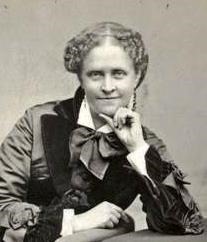
Helen Hunt Jackson: poet, novelist, activist.


Helen was the same age and a childhood classmate of Emily Dickinson, but she married a brilliant military engineer and left town.*  Taggard’s biography tells me that she returned to Amherst and visited Dickinson several times. By the 1860s Helen too was writing poetry. Like Emily Dickinson, Helen Hunt Jackson was connected with Thomas Higginson, the editor/abolitionist/feminist who Dickinson famously reached out to and corresponded with, and who helped edit the first collection of Dickinson’s poetry after Emily died.

Helen and Emily exchanged work and discussed writing. Genevieve Taggard even says that Jackson was selecting work for her first collection of poetry while visiting with Dickinson. Unlike Dickinson, Jackson aimed to be published, and did so not only in magazines but eventually in over 20 books.**  While Thomas Higginson discouraged Dickinson from publishing, Helen Hunt Jackson adamantly urged her to. Jackson midwifed the publication in an anthology of one of Dickinson’s poems “Success is counted sweetest”  the only poem of Dickinson’s published in a book during Dickinson’s lifetime.

Did their writing influence each other? It’s hard to say. Jackson certainly didn’t convince Dickinson to become a publishing professional author, but another woman of the same age and town selecting and publishing books of poetry had to encourage Dickinson at least as much as the far-away Bronte and Browning. On the other hand, it seems that Dickinson had already written a great deal of her now famous work before she renewed her childhood friendship with Helen.

I was intrigued to find out that Jackson wrote a novel in 1876 Mercy Philbrick’s Choice  which featured a heroine who was socially reclusive, wore white and wrote poetry that some think might be a novelized tale of Emily Dickinson. I skimmed through it this week. At one point in the novel, a friend of the poet character sends two of her poems to a noted editor who responds favorably, and my heart leapt up, as this sounded like a description of Dickinson’s famous letter to Higginson. There seem to be other tantalizing passages that could be a friend roman à clef’ing Emily Dickinson. But one has to remember that the novel’s author herself, Jackson, is a poet, from the same age and home town. Mercy Philbrick  could also contain elements of her own life and character. That certainly seems so of the title character’s poetry quoted in the book—it doesn’t sound at all like Dickinson.

So, here’s today’s piece, a poem written by Helen Hunt Jackson about an Italian wheat field. It’s kind of a revoicing of Wordsworth’s famous “Daffodils”  poem, but it has its own charm and details. We celebrate National Poetry Month here the same way we present poetry the rest of the year, a mix of the well-known and the forgotten. To hear my performance of Helen Hunt Jackson’s “Poppies on the Wheat,”  use the player below. Want to follow along with the text while listening? Here’s the full text of the poem.


*Emily met Helen’s husband Edward Bissell Hunt when the couple visited Amherst and Emily noted that he was one of the most fascinating men she’d ever met. Edward Hunt was killed at the Brooklyn Navy Yard during the Civil War while leading the testing of a top-secret weapon of his own design, a self-propelled torpedo. Helen remarried after Edward’s death extending her formal name to Helen Hunt Jackson, though she often published using the non-gendered pen name H. H.

**While her poetry is not well known today, Helen Hunt Jackson became a campaigner for Native American rights starting in 1879. In 1881 she published her first book under her own name, a book setting out the reasons for her cause A Century of Dishonor which she sent to every member of congress. Three years later she novelized about Native American issues and wrote a best-seller Ramona  which has been characterized as Uncle Tom’s Cabin,  only dealing with Native American mistreatment.

Fall 2018 Parlando Project Top 10 Numbers 4-2

4. Tell All the Truth but Tell It Slant words by Emily Dickinson. It should be no surprise that Dickinson turns up often here. I’m attracted to short poems that have a word music of sound or thought, and Dickinson has both in abundance in this, another very short text: 41 words.

This poem is often read as Dickinson’s private artistic credo. In summary paraphrase: “I’m going to write about things obliquely, because you people can’t handle the truth.” Still, I think there are other elements here, other harmonic overtones. One is the human tendency to slant the truth. In the poem’s one simile, she likens this slanting to the pleasant myths told to children threatened by lightning, and I don’t believe that’s Dickinson’s goal in her writing.

Another aspect, reflected in another Dickinson poem, There’s a Certain Slant of Light,”  is the Transcendentalist outlook, one that she seems to have been aware of. In that other poem there’s that word “slant” again, but here we are to know it’s nature itself that’s slanting reality. The transcendence in Transcendentalism is the belief that the surface of reality is not all there is, that study and insight and a visionary approach can reveal a deeper reality.

In that harmony, Dickinson isn’t saying “Hey poets, just do what I do! Obscure your real thoughts and insights so the non-hip won’t gather what you’re talking about until someone takes a post-graduate course a hundred years from now.” Rather she’s saying “Reality will seem to tell you children’s-story myths. Get around them. Keep looking, and gradually the blinding surprise will come.”


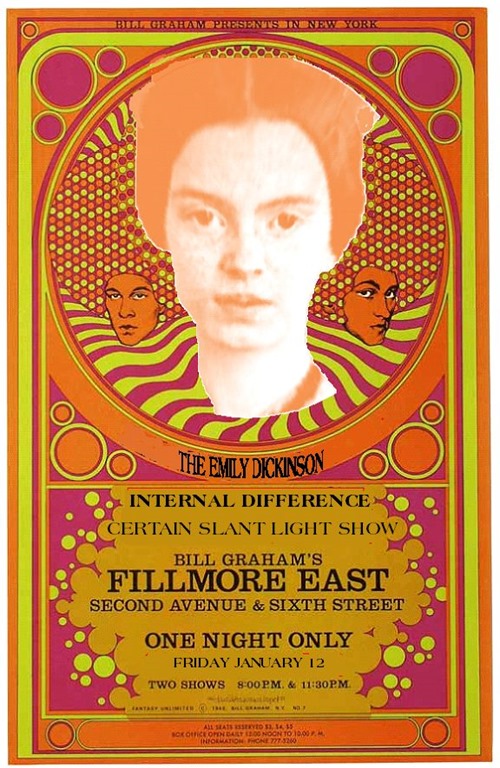
The Emily DIckinson Internal Difference

My soul’s been Transcendentalized!


3. Crepuscule (I Will Wade Out) words by E. E. Cummings. More slanted light here, as Cummings meditates on the arrival of a sensuous night. If the 19th Century American Transcendentalists were the ancestors of the 20th Century American beats and hippies, Cummings here seems to be heralding the Surrealists that would soon emerge within a decade in the dreams of a European night.

With much extravagance of language, Cummings risks ridicule without a care.

I’m quite fond of the music I wrote and played for this one. The acoustic guitar is tuned in “Pelican tuning” which is named after a piece by John Renbourn that used it.


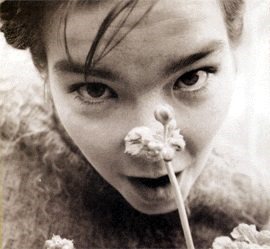
Bjork Lipping Flowers

“I will rise after a thousand years lipping flowers.” No, I’m not covering Björk Guðmundsdóttir, I don’t have enough diacritical marks or musical genius.


2. Cold Is the North Wind words by unknown. This is a piece taken from the Confucian anthology of ancient Chinese poetry titled variously in English The Book of Odes, The Classic of Poetry, the Book of Songs,  or just Poetry.  Since the collection’s poems date from deep antiquity, perhaps as far back as 1000 B. C., authorship is unknown, though not a few of them are written in a woman’s voice, and the subjects of the first section, The Airs of the States, are often everyday people and everyday activities, not Emperors or scholars, not heroes and their great battles.

The reason for collecting the poems and making them required reading is also hard for history to remember. The consensus over time was that in studying these poems an understanding of the Chinese empire’s subjects and concerns would be engendered. In England and its colonies, it was contrastingly once assumed that its future leaders would study ancient Latin and Greek poetry as a core subject.

Weighing something as large as history is hard, and I can’t say if either of these two traditions helped much. Evil and ignorance, mendacity and violence—how far can we range in history without running into lengthy annals and imposing monuments to those things? We can’t avoid these monsters, and yes, and so, we must study them. Yet, yet, what if our leaders were expected to study a song such as this? I can’t believe it would help most. I also believe it would help some.


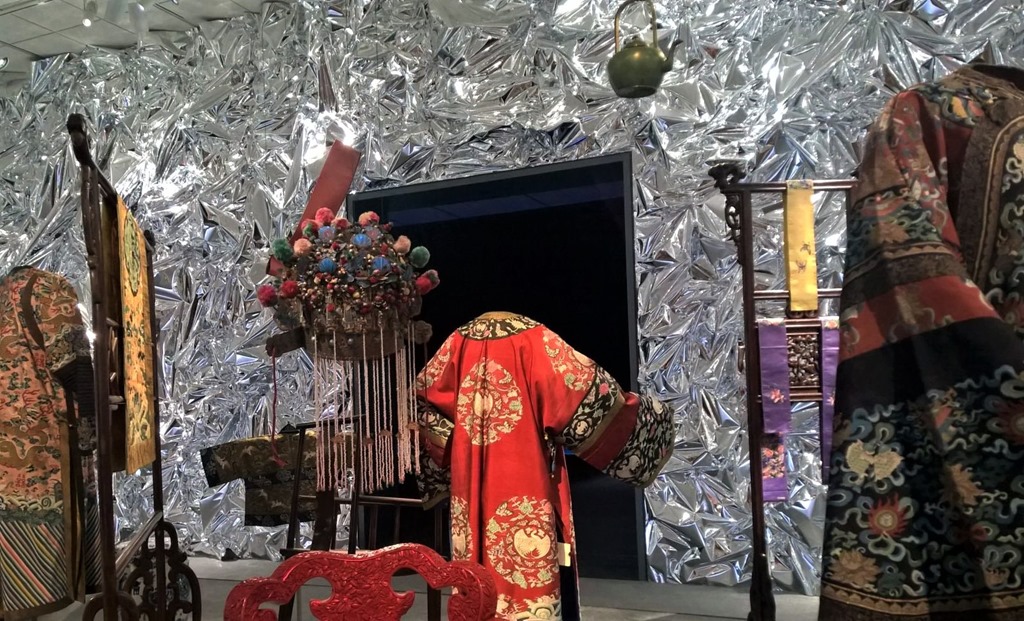
Chinese  flying Teapot

Cold enough that some hot tea would be good, but Gong have flown off with the teapot.

We have just one more number in our countdown of the most liked and listened to audio pieces this past Fall. We’ll be revealing Number One in our next post.

I’m Nobody Who Are You?

Last time I talked about how hard it is to be sure how Emily Dickinson meant her poems to be read. Some poems seem gentle, some fierce. She sent some to her more conventional friends enclosed in letters or gifts—but some she never shared, and puzzle even hard-core literary critics to this day. When is she applying a clarifying simplicity to complex or profound subjects and when is she undermining simple statements or homey images with subtle side-glances? She’s a small-town 19th Century person, a stalwart reader of the book of nature—and yet she sometimes reminds me of later 20th century urban wits, like Frank O’Hara or even Dorothy Parker as much as she reminds me of Ralph Waldo Emerson. Am I reading this into Dickinson, or is it already there?

Emily D the T Shirt

Been there, done that, got the T-Shirt.


Well, I take today’s Dickinson piece pretty much as it seems, a humorous conspiracy with someone, perhaps the reader, wherein lack of credentials or claims to the podium/lily pad are brushed aside. This is a good place to begin observation and then art, or the circle back from art to observation of it, perhaps the best place.

So here’s Emily Dickinson’s “I’m Nobody Who Are You?”  as I performed it, available through the player below. And not to shout from the lily pad, but the only reward I get for the time and effort of doing this is you, the audience who listens to these various words from past nobodies who want to talk to us. Thanks for doing so, and if you find something here you like, please let others know about it.


Tell All the Truth but Tell it Slant

What was Emily Dickinson’s personality like? Biographers have tried to line that question out from the available evidence filled in with supposition; but then none of us present exactly the same face, the same sensibility to all people and at all times. And any of us who are writers may also know that what we write and how we live can differ, even if only in expression.

This is partly why we have so many Emily Dickinsons, not just over time since her emergence on the page in 1890, but now in the present days, depending on reader’s framing. Today’s piece, “Tell All the Truth, but Tell it Slant”  can be read as a playful and humorous observation, as a serious artistic credo, as a secret diary of non-conformity, or as a dark observation of human fearfulness. How many Emily Dickinsons had how many intents as she worked out this little poem?

Charles-Temple-Emily-Dickinson-silhouette

Her dark materials. A silhouette of the teenaged Emily Dickinson.


As I often do with Dickinson performances, I leaned a bit more to a serious mode of expression, which doesn’t preclude the thought that Dickinson would be internally chuckling. I tell myself I’m just trying to channel something I feel as I experience the poem, but I may be also trying to overcompensate for the Dickinson widely assessed in my youth as an eccentric dealer in homilies, a naïve artist without the depth of metaphysical thought that mid-20th Century High Modernism adored. It seemed then to have been an unspoken assumption that Emily suffered from “lady brain,” that imagined biologically-stunted inferior organ with sentiment where exploratory thought would be. Sure, her syntax and imagery had some originality, so we’ll allow her into the anthologies with the serious poets.

My model of humanity is more androgynous than most, but let us allow female associated elements in her artistry, just as we should be sure that there are experiences from gender and class roles in her time and place. But let’s not overdetermine what she did, what she can still do, when we read, perform or listen to her poetry.

As I said, “Tell All the Truth but Tell it Slant”  can be read as a light-hearted jape. I even remembered the first line taken for the title on publication as “Tell the truth but tell it slant,” forgetting the “all.” Is that “all” there just for metrical reasons? Because, if that “all” is meant, it changes things doesn’t it. It goes from a reading of “Well, it’s not polite or advisable to go around spouting the whole truth at every occasion” to a more general statement, that the truth is never  told directly. And then the second line and its “lies”—surely one of the most punned-on words in English. It that just an easy rhyme? The next line, “Too bright for our infirm Delight” could have been in a William Blake poem.

The second stanza* starts with some inverted order poetic diction, but it may be forgiven, as we finally get to a physical image: lightning and frightened children. Dickinson appears to be siding with the filters, the myths, the accepted consolations of fibs and filigree we buffer the truth with. And perhaps she is. It may come down to how much or how often Dickinson, or you yourself, look away from the truth, how often the wisdom of your fears can help you survive.

In the end in this performance, I thought it might be key to consider who is charged with—or to—“Tell all the truth but tell it slant.” Is it society, or those who speechify to us as if we’re frightened children, who slant the truth? Or is it us, who should tell all  the truth, even if we need to put it indirectly so that our audience can discover it, as the world gradually discovered further Emily Dickinsons, for ourselves, in our own time?

Musically, I return to my weird folk-rock sound and I choose to make Dickinson’s first line into a refrain to stress its ambiguity and centralness to the poem. Hear it with the player below.


*One joy of the poem comes in the end of this stanza’s third line: “dazzle gradually” where the meter and consonance of the chiming d and l sounds enchants.