When I Was a Young Girl

When I look at a more well-known poet or poem, I often find someone else less well-remembered connected with them. This sort of thing naturally intrigues me. Are we overlooking something of interest? Does this lesser-known person change our understanding of the more well-known poet?

I’ve noted earlier this month that Carl Sandburg won the Pulitzer Prize for his 1918 collection Cornhuskers—but that’s not the full story. For some reason, they decided to give out two awards for poetry that year, and another poet’s 1918 work was the co-recipient: Margaret Widdemer’s Old Road to Paradise.

Huh? Who?

I don’t aim this project to literary scholars, who likely know more than I do about the poets whose words I use, but there are indications that Widdemer’s name would stump them too, even those whose field includes the Modernist era. From a look through Widdemer’s Old Road to Paradise  this can be partly ascribed to Widdemer not writing in the Modernist style that triumphed as the century continued. Furthermore, Widdemer’s outlook, though feminist, is middle-class and lacks the bohemian allure of Millay or even Sara Teasdale (the poetry winner the previous year). As time passes, rebels and poètes maudite often retain their outsider excitement while losing their air of present danger, and Widdemer offers none of that. And while I’m hesitant to judge from a skim through one book, a further issue is that she may not be very good.

pre-war-lady-by-margaret-widdemer

Widdemer also had a successful career as a popular novelist between the wars.


Particularly for me, and for the Parlando Project, Millay and Teasdale’s words just want to sing off the page. Widdemer’s, though rhymed and following metrical schemes, generally don’t. There is a flatness to subject matter and a conventionality of imagery that fails to grab me as well. I would have loved to have picked up Old Road to Paradise  and found something as interesting as Fenton Johnson, Edward Thomas, or Anne Spencer; but not this time.

Margaret-Widdemer
Margaret Widdemer


That doesn’t mean there’s nothing there. Widdemer seems a level-headed person, and she is writing from a woman’s point of view that has fewer representations in the literary cannon of her era. What little I know of her biography says she worked to advance poetry and literary efforts. Could I find something to use? As I paged through Old Road to Paradise   I marked “When I Was a Young Girl”  as a possibility.

Why did this one stand out? It seems based on a folk song, but while it takes lines and tropes from folk songs, it presents an alternative viewpoint to the songs it borrows from. Since the post-WWII folk song revival, folk song has been even further associated with bohemianism and adventuresome living, even though the traditional texts used most often tell of sad ends.

From its title and often refrained first line, the folk song we can most easily connect with Widdemer’s poem is the female version of “The Unfortunate Rake”  a 17th Century song with dozens of popular folk song variations, including the American cowboy song “The Streets of Laredo.”  With the “When I Was a Young Girl”  title it’s been sung by Feist and Marlon Williams, and back in the 20th Century by Julie Driscoll and Nina Simone. The general plot of these variations is that a young person is dying after a short, intense life of drink and venereal disease. The too short life of pleasure is valorized even if the song’s singer often remarks that they know they are doomed to hell. No wonder this song has remained popular—both sinners and saints, and listeners on a journey from either pole to the other, can find something in the tale!

Widdemer starts as some of these folk songs do, by telling of the excitement of their youth before the song’s present moment, though in her more circumspect telling, the young girl’s adventures are in daydreams and fantasies, including (in another folk song reference), a longing to run off with the “raggle-taggle gypsies.”

I used a minor key melody for this, not unlike that used in the folk song. I won’t spoil the ending Widdemer puts on her version of this story by foretelling it here, but it’s not where that folk song and its variations take you. To hear it, use the player below.


Union Square

Last month when I dropped Sara Teasdale’s “I Shall Not Care”  hurriedly, I promised I’d return to Teasdale and say a bit more about her.

I’m not sure where Teasdale is in “The Canon” of modern verse now, but back when I was in college, she was even more left-out than Edna St. Vincent Millay, and for similar reasons. Teasdale and Millay were both contemporaries of the pioneering early 20th Century Modernists, both were published in their little magazines, received prestigious literary awards, and achieved a considerable readership in an era when page poetry had a more general readership.

But such status didn’t hold. As the 20th Century wore on, and High Modernism and academic-informed writing became the predominant style, Teasdale, like Millay didn’t seem to have the gravitas High Modernism required—after all, both wrote often about love and desire, a subject that if treated directly wasn’t thought serious enough. You know, “women’s stuff.”

If you’re getting the idea that by mid-century, Modernism was a bit of a boy’s club—well, yes, it was.

Teasdale had all of Millay’s problems with the curators of Modernism, and then some. Millay could write in the more modern style as well as engaging in somewhat old-fashioned-sounding sonnets. Teasdale was more adamantly a writer of metrical, rhymed lyrics that increasingly didn’t sound modern enough. Millay herself was a fiercely modern woman whose persona contrasted against any Victorian trappings in her poetic music, while Teasdale seemed less sure of herself. A typical no-win-situation for female poets by mid-century: assertiveness or originality couldn’t overcome the patriarchal attitudes—while submissiveness and reticence guaranteed its victory.

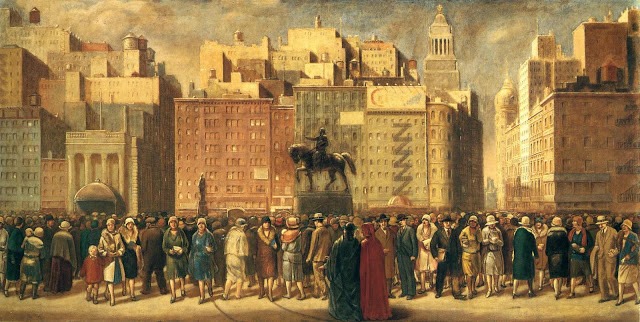
We’re decades past all that now, and we have a new century well underway. Today, it may seem like less of a crime for Teasdale to use the poetic music of 1875 instead of 1925 in this poem written around 1911. Publishing a poem like “Union Square”  would have not caused Millay any second thoughts, but Teasdale went back and forth on that. In a fascinating run-down of Teasdale’s own doubts about the poem, Melissa Girard recounts early readers giving feedback like “Perhaps it is better, after all, to pursue the lovelier side of existence, and only give expression to what is unmarred in the realm of beauty.” And bizarrely, even after publishing it, Teasdale suggested “If the idea at the end of ‘Union Square’  had not been an accident suggested by rhyme, I should never have said what I said.” Say what? One of the beneficial side-effects of rhyme is that the search for it can work like Surrealist and automatic-writing techniques to jolt the mind’s search for language in directions it might not otherwise go—but none of the lines in “Union Square”  where the poem’s speaker compares herself to the streetwalking prostitutes are rhyming lines.

isabel-bishop-virgil-and-dante-in-union-square-1932

Looking for early 20th Century pictures of Union Square I discovered a remarkable painter Isabel Bishop

I found it impossible not to sing this poem when presenting it, the poetry just demands it, even if the poem’s persona is expressing constraint. I think that contrast is what makes this poem, and Teasdale, worth considering. To hear my performance of Sara Teasdale’s “Union Square,”  use the player gadget below.

Millay’s Spring

Yesterday’s Edward Thomas poem “Thaw”  had an irony, he had rooks, a bird used symbolically to represent death, as messengers of Spring’s arrival. Walt Whitman ironically used early spring flowers to start his Lincoln elegy, and T. S. Eliot in “The Waste Land,”  a long poem that we’ve been performing this April for National Poetry Month, followed flowered suit. Here’s a poem by Edna St. Vincent Millay that tackles some of the same tensions that Eliot put in in his longer poem, but in just a few lines.

“Spring”  is Millay at her most Modernist. It’s free-verse, not the metrical verse, often in traditional forms, that she used elsewhere. Is she copying Eliot’s landmark poem, as many would try to later? No, “Spring”  was published in 1921, a year before “The Waste Land.”

One of the good things about doing this project is moving from looking for poems to use, selecting them, and then one-by-one grappling with how to perform and accompany them with music. This poem is so full of complex, multivalent perceptions that I think I could perform it many different ways. Because of the production schedule I’ve set for myself here, I almost never spend more than a week on the production of any one piece. That means I must decide things about the composition and presentation fast. In the absence of limits, this piece could have gone on in search of a more perfect version. I’m comfortable with many of the choices I made here, but one bothers me still.

I decided early on I would sing this one. That decision came from the text itself, it wants to express a variety of things intensely. Good actors (something I’m not, or not yet) can put great shading on a speaking voice, but the singing voice has more tools to bring to the expression of a text. I am under no illusion that my singing voice is strong or skilled, and I think a better singer could improve this. What you hear here is simply my honest attempt to do the best I could with a text that I grew to admire considerably as I worked with it.

Musically I once more found myself using several tracks of Mellotron, the primitive 1960s tape-sample “virtual instrument” before it’s time. The topline melody is carried by violins and the famous Mellotron flute samples that are an audio madeleine for anyone who listened to certain English bands in the age of groovy. Each note played on a Mellotron keyboard sets running a short length of tape playing that pitch recorded from the “real” instrument.


Some random dude shows off the cheesy rhythm machine no one used before playing something you may recognize.


I can’t afford the cost and complexity of an actual Mellotron, but I use a good approximation issued by MOTU a few years back. One thing I perversely appreciate about it is that, just like the real thing, any note just stops after 8 seconds, when the strip of tape in an actual Mellotron would come to its end. Avoiding this can force you into some odd playing techniques when used in a slower tempo piece. If you listen very closely in “Spring”,  I just let that abrupt tape end-stop happen for effect several times. For a sustaining note to end like that gives it a catch-in-the breath gasp effect.


For electro-mechanical nerds: the low down on how the real Mellotron worked, mostly.


One image in Millay’s poem puzzled me over the week I worked on it. “Life in itself is nothing…a flight of uncarpeted stairs.” I can find no one who has made any sense of it. The best I can figure out, knowing houses from Millay’s time first hand, is that while any stairs between floors of a properly furnished home would have likely had carpet runners, utilitarian stairs, such as ones to the basement would not be carpeted. I took that understanding, and had the melody fall down as the word “stairs” is sung.

Anyway, after all this talk about the utilitarian work of making these pieces, please take time to listen to Edna St. Vincent Millay’s “Spring,”  using the player below.


March 2018 Parlando Top 10 Part 1

It’s time for that quarterly exercise where we look back for the most popular audio pieces here at the Parlando Project over the past season. I’m going to follow the format we used last time, and break the countdown into four episodes. I base the popularity on the number of likes following their posting here, and the streams the audio pieces received directly from the blog, or on iTunes, Spotify, or other podcast sources. Let’s start the count from the 10th most popular as we move up the list to number 1:

10. Rosemary

Even though these pieces were listened to in the Winter for most of our listeners*, Edna St. Vincent Millay’s words have a kind of spring-cleaning of the heart vibe, and so may be apropos for opening the windows and letting the curtains blow around—or at least they will in a few weeks when it warms up here in the northern part of the northern hemisphere. I awoke to 10 degrees Fahrenheit and snow and polished ice myself today.

I rather liked the music I wrote and performed for this one, just as I have liked going back to Millay to reassess the strengths she brought to poetry. Millay’s popular reading audience, once substantial, hasn’t completely disappeared, and there’s a welcome re-assessment of her poetry starting in academic circles.


9. Stopping by a Woods On a Snowy Evening

I’ve featured Robert Frost’s words quite a bit here, perhaps to atone for my dismissal of him when I was a teenager as the kind of worthy poetry in our schoolbooks that we needed to move beyond. Two things were key to my learning to love Frost: his uncanny ability to write lyrical verse that sounds natural, and my finally noticing the dry wit and stoicism that underlies most of his work.

Frost, alone of his American generation, has retained a level of popular appeal and critical approval. He’s double-edged in maintaining that. Some are captured by the surface of his poetry, hearing and maintaining in their memory the catchy moral-of-the-story “big choruses” of Frost. In this poem, it’s the “I have promises to keep, and miles to go before I sleep” at the ending. Others listen carefully to the verses, the parts other than the lines we most remember, the parts we can come back to and find that we’ve forgotten were there. When I came to work musically with this poem, I’d forgotten those. There’s no lovely woods to see in this dark night. He may be lost. He’s so dark and alone that he can hear snowflakes sweeping across snowbanks between the jingle of his rig’s harness bells.

Musically, I was obligated to add shaker bells percussion to stand for those harness bells, but then, more obscurely, I decided to add a South-Asian tambura drone for the sweep of snow.


amedeo-modigliani-pierre-reverdy

Modigliani’s portrait of Pierre Reverdy


8. Clear Winter

I was a terrible French student in my little Iowa high school and my little Iowa college. I seem to have no ability with languages, and less than no ability to handle those accents and the reforming of the mouth that makes speaking a foreign language possible. But I love poetry translation. I feel like a paleontologist removing the clods of sediment from a skeleton. Slowly, painstakingly, there it is, just as it was in its moment of sudden! But then my task shifts, and I must become the process of fossilization, to find the minerals of English that can fill in for the sinew and feathers of it’s original language.

I had a great time with the challenge of Pierre Reverdy’s “Clair Hiver.” I’m unsure of the accuracy of the “tea-kettle” section of my translation, but I fell in love with it, and could not abandon it, even if the light behind Pierre Reverdy’s eyes cannot reach the little anteroom behind mine.


*web stats I get for the streams tell me I have as many recent listeners in Australia as I have in Texas—and one listener in New Zealand. Bret, please tell Jemaine that there’s a lot of good stuff to read and listen to in the archives you’ll see listed by months on the right.

The Wood-Pile

Robert Frost is every bit the master of word music as Yeats and Millay. What makes Frost stand out is that he was every bit the thoroughgoing early 20th Century modernist as any of his free-verse contemporaries, while retaining an ease with accentual syllabic meter.

Here’s an example of Frost handling a subject just as a free-verse Imagist would. His aims, his presentation, hold to the Imagists’ principles. He deals with the thing directly (as we shall see, two things, but still…), and there are no tacked-on metaphors, no stock comparisons, no extraneous “poetic” language. Context is shown, but not explained. He loosens and varies his meter, so the poem sings and never seems to be a shackled march. At 40 lines, it’s a bit longer than Yeats’ poem considering “The Wild Swans at Coole,”  but Frost’s extra detail is even more specific and concrete than Yeats, though both begin their poem with the poet walking in a rural wetland. Yeats slough is a well-known place to him, conditioned with 19 previous visits. Frost is far enough into his swamp to not know exactly where he is, and so experiences what he sees with a first-time immediacy. Yeats’ slough then contains tradition, Frosts’ the more Modernist “Make it new!” place.

Though presented as one simple rural scene and story, “The Wood-Pile”  is more at two poems, though each part speaks to the other. As Frost’s tale starts, we are in the midst of one of his characteristic journeys, just as we are in other famous Frost poems. There’s a need for decision (“Turn back” or “go on farther”) and his choice, also made in other Frost poems, is to go on regardless of whatever doubts brought the question. If he’s lost in the dark by a wood on a snowy evening, keep going. If you come to a fork in the road, pick one and go on. If you’re walking in a swamp in winter and your foot is sometimes falling through the frozen crust, well, keep going “and we shall see.”

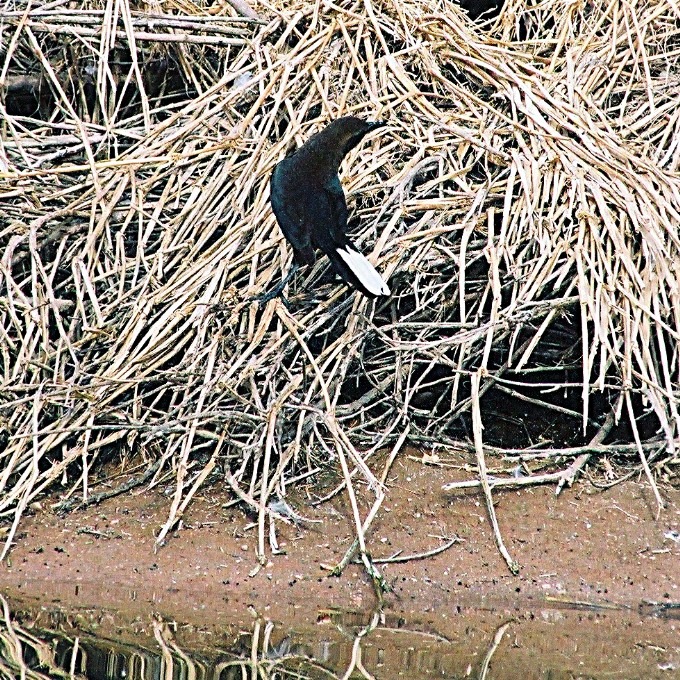
And so, here he sees his bird. No Keatsian nightingale, not Millay’s elusive flying swans with their awkward dangling legs and cries, nor Yeats’ majestic 59 swans, but a small bird. This bird becomes a mirror to the poet. Frost’s bird too must make choices in direction, and the poet, sensibly, thinks the bird’s guided by fear. “Keep something between little me and the big lummox trodding through the winter swamp,” he humansplains. And there’s a bit of humor at human’s expense as the poet muses that the bird, like humans with their self-importance, may think that the only reason for Frost to be out in the swamp is to go after the little bird.

Gackle with white tail feather

“He thought I was after him for a feather—the white one in his tail”


But, we don’t know why Frost is out in the frozen swamp explicitly. The only reason he’s given, or will give, is the Imagist poets’ reason: “and we shall see.”

The bird leads Frost to the second thing the poem wants to present: an abandoned fire-wood cache. Here Frost zooms in close. Every detail of the cut wood and the once neatly stacked and propped wood-pile is stated. Frost turns forensic, like some New England Sherlock Holmes: this pile has been abandoned for years. Mature vines have grown through it.

wood-pile

“The slow smokeless burning of decay”


Here is another context left unsaid. Why would someone abandon a purposeful wood-pile in a swamp? Frost leaves it for us to be detective and to solve the mystery. This isn’t some lot of fire-wood left temporarily to be gathered later in the day, care has been taken to stack and prop it.

The only thing I can think: someone once built a shack (now completely disappeared) on the swamp land. Frost muses, sardonically, that only someone so busy with “fresh tasks” could abandon such effort in cutting and stacking. Does he mean to say, “only a fool would be so industrious to cut and stack this wood and yet not notice he was building his shack on a swamp that would not support a homestead?”

Now, the small bird with his “little fears” and oh-so-human misapprehensions of reality—and now, the steadfast Frost of miles to keep going, even if you may be lost, are set in contrast to this choice. Your fears may lie to you—but so will your optimism.

I once heard an astringent biological statement that the length of our lives can be reduced to a slow-burning chemical reaction. Frost’s last line here is a sad and beautiful analog to that truth.

Turn back or go farther? Go on, and we shall hear my performance of Robert Frost’s “The Wood-Pile”  with my original music. Just use the player below.

The Wild Swans at Coole

Let us for a moment consider length in English language poetry. Despite the customary inclusion of one or two very short poems in most American poetry anthologies (“The Red Wheelbarrow   or “In A Station of the Metro”  typically), one can easily derive from them an accumulated mainstream judgement that poems shorter than a sonnet’s 14 lines are judged slighter expressions of less merit.

Similarly, in music, for all the glories of the mid-20th Century’s two minute and forty second 45 RPM single, serious composed music demonstrates greater regard for pieces of at least middling length, and the 20 to 70-minute symphony is still regarded with reverence. And so on with improvised music practice, which seem to find the five-minute mark as a minimum. Even the later 20th Century movement that got called “Minimalism” worked the idea of fewer motifs considered at greater length.

And so it is when we consider swans, the largest waterfowl, in words. Our last post and audio piece used Edna St. Vincent Millay’s “Wild Swans,”   a fine poem, but if one looks at the accumulated attention gathered in the roughly 100 years since each was written, Millay’s “Wild Swans”  is overshadowed by William Butler Yeats’ “The Wild Swans at Coole.”

Yeats’ poem is worthy of this attention, and he does pack a lot into his mid-length 30-line poem, written by a late middle-aged poet as his colonized country has experienced a failed revolution and his world has seen the shocking mechanized slaughter of the original World War. All that violence is subtext—not once is it mentioned—and as we read or listen to it now, that violence may no longer be apparent, though the background of disappointment remains.

Millay presents the swans as something she cannot comprehend as they fly over her, with her disappointment, her heart at present “a house without air.” Yeats on the other hand presents an almost OCD-level attention with the swimming swans at the beginning of his poem. He has apparently been counting them on each visit for 19 years. He’s going to count them again. And then they fly off in clamor before he can finish his count even though he reports an exact number.

The specificity of those two numbers is curious. Is the 19 years of visits to Coole in Ireland a mere biographical fact? Are the “nine-and-fifty swans” he’s counted an actual census he took regularly? I do not know. Given that Yeats had a long interest in occultism, there may be some occult significance in one or both of those numbers. They are both large numbers for the things they measure: anything one has done for 19 years has a resonance for that long a duration, and given how magnificent the sight of a few swans gliding on the water are, the idea of 59 of them viewed together is an image of overwhelming swan-ishness.

What strikes me most about the two numbers subliminal effect is that both end in 9, and so, seem to be almost at an ending. As the poem develops, Yeats returns to that effect.

These details, written in Yeats typical lyrical fluency, accumulate throughout the poem. The lake and sky repeating each other. 59 swans. The “bell-beat” weight of their wings as they heavily swing them into flight, equally straining, equally coalescing into aerial rings. Their companionable swimming on the cold water “lover by lover”—ah, there’s that 59 again, an odd number—at least one swan has no mate.

But he doesn’t say that. The poem is all its music, the image after image, the beauty after beauty mixed with the undercurrent of impossibility of its permanency. The world will change, the poet or the swans will not return.

19 years of repetition does not mean 19 years of repetition to come. 59 swans is all but too much beauty, but one swan is without a partner.

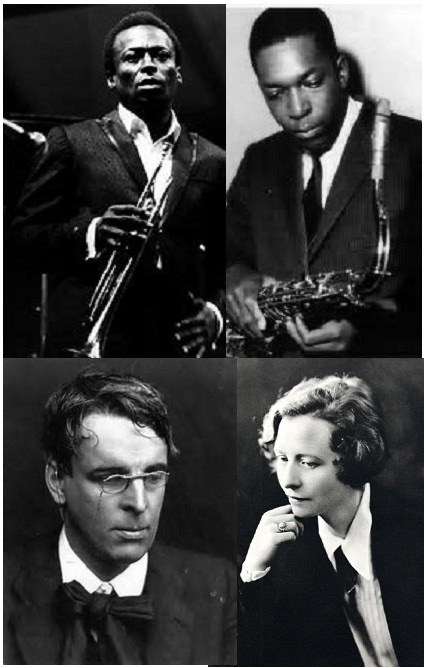
Davis Coltrane Yeats Millay

John Coltrane: “Sometimes when I’m playing there are always new sounds to imagine, new feelings to get at. There’s never any end.”

Miles Davis: “Try taking the f’ing horn out of your mouth”


So, do the 30 lines of Yeats mean it’s a greater poem than the 8 lines of Millay, an objective judgement causing its greater fame?

Why do I have to choose? If Yeats had written 60 or 6,000 lines would “The Wild Swans at Coole”  be better? If Millay had written 80 lines, would her “Wild Swans”  have shown greater skill? We can derive from how anthologists, poetry critics and audiences respond what their preferences are, even those they never articulate explicitly, but in the end it is the longer poems that make the short poems concise and the short poems that make the longer poems seem overwhelming.

How many times have I listened toKind of Blue?”  Does Miles Davis need to play more notes? Does John Coltrane need to play fewer? Looking at these two poems about swans, they illuminate each other.

The gadget below will play my performance of Yeats’ “The Wild Swans at Coole.”


Wild Swans

Let’s return again to Edna St. Vincent Millay as I start a short series of pieces using words by more well-known poets, each of whom considers the book of nature as played out by birds.

Millay’s “Wild Swans”  may be somewhat overshadowed in the Cygnet Committee by William Butler Yeats’ “The Wild Swans at Coole,”  published only a few years earlier than Millay’s poem. The birds of these poems’ central image, the largest waterfowl, are known for white and graceful beauty while at rest or swimming on the water, which contrasts with their somewhat overburdened flight and strangled hinge-in-need-of-oil song.

Other than their pure color and size, it may be the swan in flight that makes them something of the ornithological model for angels, as for such a large bird to have enough strength and wingspan to fly is practically miraculous.

an_angel_playing_a_flageolet-Burne-Jones

No matter how hard you blow on that horn, not enough wingspread to get airborne


In “Wild Swans”  Millay presents that miracle in flight, but by misdirection or misapprehension. The swans are flying as the poem opens, but Millay is instead looking inward—and furthermore, the poet thinks this introspection is bringing no insight.

Swan taking off

Headlong effort transcends grace


But in this short poem’s second part, the images and insights come anyway. In an apostrophe to her heart, Millay addresses it as a “house without air”—an acute metaphor there for despair—and she now asks for the swans to fly over us again, trailing their ungainly legs, crying unselfconsciously their sad and awkward calls.

Wildness, movement, flight beyond bounds, the miraculous after grace, the next day flying over the weeks, then the months and the years.

This is a surprising poem, it’s titular image, those wild swans, are missing, until they are called for in the last five words; not to be beautiful, but straining to be possible.

To hear my performance of Edna St. Vincent Millay’s “Wild Swans”,  use the player below. And remember I rely greatly on readers/listeners helping spread the word about the combination of various words and music here. Tweeting, linking, including in Facebook posts and on other social media, helps this project reach it’s audience. If you don’t do social media, that’s fine too, the amount of work it takes to do this makes that a practical impossibility for me; but if you like this, hitting the Like button for this post helps keep me going.


The Parlando Project Winter 2017 Top 10 Part 2

Picking up from where we left off yesterday, here are the next three most popular audio pieces based on readers here hitting the like button along with the number of streams and downloads counted during this past fall.

Number 7 is Edna St. Vincent Millay’s “”Sonnet 43”.  I seem to be coming to a greater appreciation for Millay as I do this project. Like my long time favorite Carl Sandburg, Millay “suffered” from too much popularity in her heyday, and like Sandburg I believe that her popularity in non-academic circles at the least caused critics to feel that they need not bother to examine her work more closely.

I’ll admit, I was one of those that thought she sounded like someone trying to be a 19th Century poet when the 20th Century was well and truly underway. Now in the 21st Century, I find this less of a crime, and when I let go of that, I find I like this sonnet’s complex appreciation of love’s limits.

Musically I love that I was able to play a convincing arco bass using a MIDI-controlled virtual instrument for this one. Bowed string bass is like the snoring of the bear mother in a winter den to me, immense, and yet sweet and comforting.


Speaking of Carl Sandburg, his “Autumn Movement”  made it all the way to number 6, and that’s remarkable because it was only released on October 20th and thus had less than half of the Fall interval to pickup likes and listeners. I love the central autumn image in this one from Sandburg’s “Cornhuskers”  collection, and it reminds us that Sandburg, known also for his acutely observed Chicago poems and journalism, was from the very start of his career interested in conveying rural life as well.

Musically, this piece demonstrates how recently I had seen Bill Frisell in concert—and seeing him, and the musicians he plays with, is something I try to keep always recent in my experience. Of course, Bill Frisell has an immense amount of musical vocabulary under his fingers, and I don’t; but I tried to make the best of mine, which is all any musician can do.


Bill Frissell with books

Besides his music, I admire Bill Frisell’s interior decorating sense and, alas, his sartorial style.


Our number 5 piece in popularity this fall was T. E. Hulme’s report from “Trenches St. Eloi.”   Many of the Modernist soldier/poets who served in WWI grew not only to  hate war, but to distrust their country’s cause and justifications for their particular war. Hulme is something of a exception. As far as I can tell, he remained supportive of the British war effort in which he eventually lost his life. That doesn’t make “Trenches St. Eloi”  propaganda, for it’s far from blind to the horrors and difficulties of extended conflict. Hulme’s death shortened his career and helped mask his seminal contribution to modernizing British poetry.

Since starting this blog, I’ve been following the centenary of World War I off and on in the background, which meshes well with much of the material I can present here without running into rights issues, since modern public domain status cuts off at 1924. The material from the poets who served in the war or were otherwise touched by it, is, not unexpectedly, downbeat. Just as the Modernist revolution changed poetry, WWI changed how war was written about, breaking millenniums-long Homeric traditions of war heroes, that however flawed, were able to shape battles by their character, into stories of endurance like this one.

This is another one where the bass guitar gets to carry a lot of weight.


Thanks again for reading and listening. It’s been a huge amount of work this past year to bring you the Parlando Project pieces, hundreds of hours of reading, studying, translating, composing, playing, and recording these unique combinations of various words (mostly poetry) with various original music (as varied as Dave and I can make it). That wasn’t drudgery—far from it—it’s brought joy and amazement to me to see what’s out there that I haven’t heard or imagined before, and I hope some of that wonder and discovery comes through to the readers and listeners here, because it’s our goal to surprise and delight you, to show you new facets of poems or poets you thought you knew and to introduce you to some writers that didn’t get included in your textbooks.

Here’s what I ask you to do if we’ve succeeded in that, even if only for a piece or two out of the more than 160 pieces we’ve presented so far: let others know about it. Tap them on the shoulder, show them the URL, link us on your blog or on social media, stick an earbud in their ear. Every like, listen, link and comment helps me keep doing this. I know I should be a better promoter of this work, but frankly, I’m too engaged in the work itself to do as much as is needed.

And standby, the next three most popular pieces from the past fall will be posted soon.

Rosemary

It’s been awhile since a new post, what with holidays and family occasions, but here’s another piece, “Rosemary,”  using the words by Edna St. Vincent Millay.

Millay was one of the most popular, most often read, poets of the first part of the 20th Century, but the later part of the century gave her less consideration. A contemporary of the Imagists and other poetic Modernists that we’ve featured a lot this year here, and while connected to their world, she didn’t sustain favor with the rise of the “New Criticism” that became the dominant academy in the English-speaking world after WWII.

Reasons? Well, there’s gender. One must assume that played a role. And popularity of the general-readership sort would not have been an asset either, as perhaps only Robert Frost and Emily Dickinson survived being read by a general readership in the mid-century without losing their high-art cred. Why couldn’t Millay have joined Frost and Dickinson in these critics’ esteem?

Millay with books

Millay at work. Other than the lack of guitars, just about the perfect décor.

I think it’s largely a case of her poetry not seeming to have the subject of their criticism: fresh, complex, allusive and illusive, imagery. Frost and Dickinson may have used homey sounding language, but in the end those funerals in the brain and snow, roads and woods added up to something to talk about in critical prose.

The New Critics were an inflection point. Before them, poetry was largely considered musical speech, a container that could hold a variety of subjects, after the New Critics, poetry was about the imagery, how you portrayed things with it. And unless one aimed for satire, such complex rhetorical structures must be in service to serious matters.

And so, there’s subject matter too. Millay’s great subject was love and affection, it’s presence, absence and all the shades in-between. In doing so, she addresses much of life and its condition, but did she receive enough credit for that? Is a heartbroken man a tragic philosopher of fate, and a woman merely a spurned lover? Narrow-mindedness can’t be ruled out.

“Rosemary”  allows us to examine these issues. This looks to be a poem about the death of a passionate love or the death of a dear one. I’m not sure which of those two possibilities is standing for the other, but for an audience, it does not matter as both events are common to our hearts.

I think there is an intent here to conjure a complex world of timeless folk magic. Though written in the 20th Century, it could have been written anywhere up to five centuries earlier. In the title we have rosemary, an herb associated with remembrance even in Shakespeare’s time (Ophelia’s mad speech in Hamlet for example), and in the first stanza we have rushes being scattered on a room’s floor, a custom from medieval times to hide the stink and mess of a less hygienic age, a strewing of reeds that may have included rosemary because it was thought to be something of an insecticide. Bergamot is another fragrant plant. Stink, rot and pestilence are all inferred subtly in this verse that on the face of it seems only a short catalog of flowers.

The second verse adds a rain barrel to catch rain, or is it tears? And what’s with that iron pot. Is it a cauldron? The poems last two lines are in quotes on the page. I was suspicious that the “An it please you, gentle sirs,” line was a quote, and finding out what it was from might be important, but I can’t place that line—if any reader knows, please clue me in.

And at the end of this timeless lament: “well-a-day,” which might sound to you or me like “have a nice day,” but is instead a word that harkens back to Old English, meaning woe-is-me.

What I think we have here is a poem, that read quickly, seems to be a trivial verse about some flowers with a bit of a kitchen scene, but it’s stated with deliberately archaic specifics so that the attentive modern reader might notice that time cannot heal this loss. And each thing in it is an image, though they don’t loudly announce themselves as such.

I’m reminded of my distant relative Susan Glaspell’s famous play “Trifles,”  where the domestic clues hide all the information the dense men seeking important information miss.

The Pentangle

The Pentangle. It’s not fair to compare. There’s 5 of them, and only 1 of me. Oh, and talent.

Musically, I went with bass, drums, two acoustic guitars and my voice for this. I was aiming for an impression of the sort of thing The Pentangle did many years ago. They were better at it, but it was good to try. Use the player below to hear my performance of Millay’s “Rosemary” or failing that, this highlighted link.

Millay’s Sonnet 43

Edna St. Vincent Millay was another poet who offered little to the “New Criticism” critics who largely set the canon for the 20th Century, even though her career, which covered the first half of the 20th Century, ran almost exactly through the same time as Eliot, Frost, Pound, William Carlos Williams, and Wallace Stevens, and even though she achieved significant readership and a level of awards and accolades while living.

What was their problem with Edna St. Vincent Millay? Well her popularity would be a negative in some lights. In this regard, critics are often no different than the record store clerks of my own day, whose estimation of any indie band would inevitably drop as soon as they achieved a widely-played record. And there’s the “her” and “she” problem. The level of disbelief of the idea of a woman artist probably varied among these critics, but literature was still a very male world at that time and unconscious prejudices are a given. But even if we skip those two, frankly illegitimate, factors, there is the issue of Millay’s plainspokenness.

St Vincent

Annie Clark performs as “St. Vincent,” Edna St. Vincent Millay is on the right. Google carefully!
Clark has said the stage name came from a NYC hospital, but if that’s so, it’s a remarkable coincidence.

Odd isn’t that? This value that you might rate highly in friend was held as low regard by the New Critics, who likely thought it common and unremarkable. A Millay poem typically says exactly what it means, right out. There may be images, but they might not pass Imagist muster. They aren’t stark omens whose meaning is felt and then deciphered, they may be more like the illustrative images the Imagists wanted to leave behind. Millay’s all tell and too little show for them.

And Millay’s language often seems stuck in the 19th Century too. Some lyrical poets like Yeats and Frost adopted Modernist tropes and were able to make their rhymed and metrical poems sound more like contemporary speech. Millay sometimes seemed to be reading from a somewhat musty library book when composing her poems.

The most extended image in “Sonnet 43”  is a bare winter tree, which could be a borrowed image, or a homage, and I choose to manifest the later in this performance.

Can our modern (post-modern) age free up some respect for Edna St. Vincent Millay? I think so. With contemporary poets, we now sometimes value plainspokenness. And the cluster of things that Millay spoke plainly and honestly about include love, sex, and desire.

This sonnet was published in 1920, it’s nearing a century old. If we slide over some of the 19th Century “poetic diction” (something I found easy enough to do when performing this) it’s as honest and as nuanced report on the state of a heart as anything written then or now.

And if one must have ambiguities for art’s sake, honesty can contain that too. Some read this poem as bitter, or a lonely-hearts club statement, or as regret for a life that Millay’s time would’ve called promiscuous. That’s not how I understood it to perform it. I think the speaker is recalling an active love life they rather enjoyed. They reveal themselves (honestly) as something of a sensualist. As the Petrarchan sonnet wraps up its octet, the speaker allows a touch of regret about those lovers who turned to the speaker at midnight “with a cry.” What did the speaker offer them? I think the closing lines say some “summer,” a summer that “sang in me”—that is, that summer is not something the speaker intentionally gave or offered, and the speaker doubts that the muses of that summer offering will still speak through her. William Carlos Williams—unlike Millay, following all the Imagist rules—touches also on the caprices of summer and fulfilled desires in It Is a Small Plant,”  but some are more accustomed to a male author speaking ambiguously about the honest incursions and boundaries of desire.

Perhaps this poem benefits with some listeners in being heard performed in a male voice? I can’t say for sure on that.

Among the 20th Century admirers of Millay’s verse were my father (who grew up on the 19th Century Longfellow and the like, so Millay’s 19th Century diction was no bar) and a distant cousinoid of mine, the modern American theater pioneer Susan Glaspell.

I rather like the musical accompaniment for this one. I worked quite a bit on the drum part trying to bring out different colors, and for the bass I was able to supplement the electric bass with some bowed contra-bass, which is one one of my favorite sounds in the world. Ironically, Millay started out wanting to be a concert pianist, and the top line here is one of my naïve piano parts. To hear me perform Edna St. Vincent Millay’s “Sonnet 43”  aka “What lips my lips have kissed…”  use the player below.