The Parlando Project Winter 2017 Top 10 Part 2

Picking up from where we left off yesterday, here are the next three most popular audio pieces based on readers here hitting the like button along with the number of streams and downloads counted during this past fall.

Number 7 is Edna St. Vincent Millay’s “”Sonnet 43”.  I seem to be coming to a greater appreciation for Millay as I do this project. Like my long time favorite Carl Sandburg, Millay “suffered” from too much popularity in her heyday, and like Sandburg I believe that her popularity in non-academic circles at the least caused critics to feel that they need not bother to examine her work more closely.

I’ll admit, I was one of those that thought she sounded like someone trying to be a 19th Century poet when the 20th Century was well and truly underway. Now in the 21st Century, I find this less of a crime, and when I let go of that, I find I like this sonnet’s complex appreciation of love’s limits.

Musically I love that I was able to play a convincing arco bass using a MIDI-controlled virtual instrument for this one. Bowed string bass is like the snoring of the bear mother in a winter den to me, immense, and yet sweet and comforting.


Speaking of Carl Sandburg, his “Autumn Movement”  made it all the way to number 6, and that’s remarkable because it was only released on October 20th and thus had less than half of the Fall interval to pickup likes and listeners. I love the central autumn image in this one from Sandburg’s “Cornhuskers”  collection, and it reminds us that Sandburg, known also for his acutely observed Chicago poems and journalism, was from the very start of his career interested in conveying rural life as well.

Musically, this piece demonstrates how recently I had seen Bill Frisell in concert—and seeing him, and the musicians he plays with, is something I try to keep always recent in my experience. Of course, Bill Frisell has an immense amount of musical vocabulary under his fingers, and I don’t; but I tried to make the best of mine, which is all any musician can do.


Bill Frissell with books

Besides his music, I admire Bill Frisell’s interior decorating sense and, alas, his sartorial style.


Our number 5 piece in popularity this fall was T. E. Hulme’s report from “Trenches St. Eloi.”   Many of the Modernist soldier/poets who served in WWI grew not only to  hate war, but to distrust their country’s cause and justifications for their particular war. Hulme is something of a exception. As far as I can tell, he remained supportive of the British war effort in which he eventually lost his life. That doesn’t make “Trenches St. Eloi”  propaganda, for it’s far from blind to the horrors and difficulties of extended conflict. Hulme’s death shortened his career and helped mask his seminal contribution to modernizing British poetry.

Since starting this blog, I’ve been following the centenary of World War I off and on in the background, which meshes well with much of the material I can present here without running into rights issues, since modern public domain status cuts off at 1924. The material from the poets who served in the war or were otherwise touched by it, is, not unexpectedly, downbeat. Just as the Modernist revolution changed poetry, WWI changed how war was written about, breaking millenniums-long Homeric traditions of war heroes, that however flawed, were able to shape battles by their character, into stories of endurance like this one.

This is another one where the bass guitar gets to carry a lot of weight.


Thanks again for reading and listening. It’s been a huge amount of work this past year to bring you the Parlando Project pieces, hundreds of hours of reading, studying, translating, composing, playing, and recording these unique combinations of various words (mostly poetry) with various original music (as varied as Dave and I can make it). That wasn’t drudgery—far from it—it’s brought joy and amazement to me to see what’s out there that I haven’t heard or imagined before, and I hope some of that wonder and discovery comes through to the readers and listeners here, because it’s our goal to surprise and delight you, to show you new facets of poems or poets you thought you knew and to introduce you to some writers that didn’t get included in your textbooks.

Here’s what I ask you to do if we’ve succeeded in that, even if only for a piece or two out of the more than 160 pieces we’ve presented so far: let others know about it. Tap them on the shoulder, show them the URL, link us on your blog or on social media, stick an earbud in their ear. Every like, listen, link and comment helps me keep doing this. I know I should be a better promoter of this work, but frankly, I’m too engaged in the work itself to do as much as is needed.

And standby, the next three most popular pieces from the past fall will be posted soon.

Rosemary

It’s been awhile since a new post, what with holidays and family occasions, but here’s another piece, “Rosemary,”  using the words by Edna St. Vincent Millay.

Millay was one of the most popular, most often read, poets of the first part of the 20th Century, but the later part of the century gave her less consideration. A contemporary of the Imagists and other poetic Modernists that we’ve featured a lot this year here, and while connected to their world, she didn’t sustain favor with the rise of the “New Criticism” that became the dominant academy in the English-speaking world after WWII.

Reasons? Well, there’s gender. One must assume that played a role. And popularity of the general-readership sort would not have been an asset either, as perhaps only Robert Frost and Emily Dickinson survived being read by a general readership in the mid-century without losing their high-art cred. Why couldn’t Millay have joined Frost and Dickinson in these critics’ esteem?

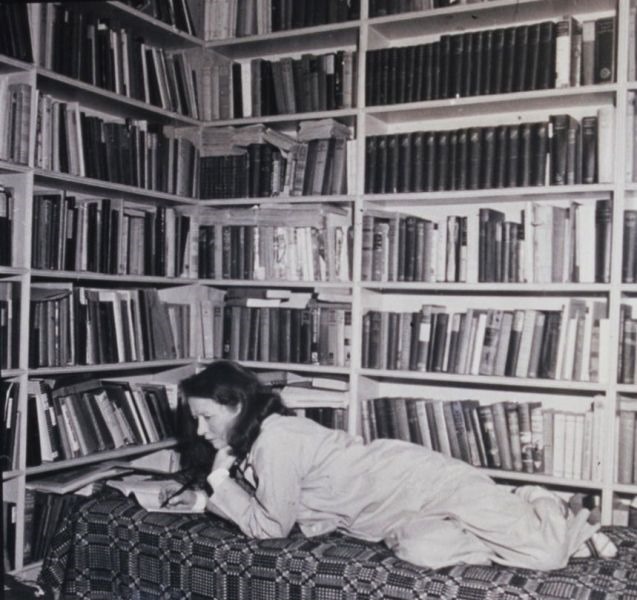
Millay with books

Millay at work. Other than the lack of guitars, just about the perfect décor.

I think it’s largely a case of her poetry not seeming to have the subject of their criticism: fresh, complex, allusive and illusive, imagery. Frost and Dickinson may have used homey sounding language, but in the end those funerals in the brain and snow, roads and woods added up to something to talk about in critical prose.

The New Critics were an inflection point. Before them, poetry was largely considered musical speech, a container that could hold a variety of subjects, after the New Critics, poetry was about the imagery, how you portrayed things with it. And unless one aimed for satire, such complex rhetorical structures must be in service to serious matters.

And so, there’s subject matter too. Millay’s great subject was love and affection, it’s presence, absence and all the shades in-between. In doing so, she addresses much of life and its condition, but did she receive enough credit for that? Is a heartbroken man a tragic philosopher of fate, and a woman merely a spurned lover? Narrow-mindedness can’t be ruled out.

“Rosemary”  allows us to examine these issues. This looks to be a poem about the death of a passionate love or the death of a dear one. I’m not sure which of those two possibilities is standing for the other, but for an audience, it does not matter as both events are common to our hearts.

I think there is an intent here to conjure a complex world of timeless folk magic. Though written in the 20th Century, it could have been written anywhere up to five centuries earlier. In the title we have rosemary, an herb associated with remembrance even in Shakespeare’s time (Ophelia’s mad speech in Hamlet for example), and in the first stanza we have rushes being scattered on a room’s floor, a custom from medieval times to hide the stink and mess of a less hygienic age, a strewing of reeds that may have included rosemary because it was thought to be something of an insecticide. Bergamot is another fragrant plant. Stink, rot and pestilence are all inferred subtly in this verse that on the face of it seems only a short catalog of flowers.

The second verse adds a rain barrel to catch rain, or is it tears? And what’s with that iron pot. Is it a cauldron? The poems last two lines are in quotes on the page. I was suspicious that the “An it please you, gentle sirs,” line was a quote, and finding out what it was from might be important, but I can’t place that line—if any reader knows, please clue me in.

And at the end of this timeless lament: “well-a-day,” which might sound to you or me like “have a nice day,” but is instead a word that harkens back to Old English, meaning woe-is-me.

What I think we have here is a poem, that read quickly, seems to be a trivial verse about some flowers with a bit of a kitchen scene, but it’s stated with deliberately archaic specifics so that the attentive modern reader might notice that time cannot heal this loss. And each thing in it is an image, though they don’t loudly announce themselves as such.

I’m reminded of my distant relative Susan Glaspell’s famous play “Trifles,”  where the domestic clues hide all the information the dense men seeking important information miss.

The Pentangle

The Pentangle. It’s not fair to compare. There’s 5 of them, and only 1 of me. Oh, and talent.

Musically, I went with bass, drums, two acoustic guitars and my voice for this. I was aiming for an impression of the sort of thing The Pentangle did many years ago. They were better at it, but it was good to try. Use the player below to hear my performance of Millay’s “Rosemary” or failing that, this highlighted link.

Millay’s Sonnet 43

Edna St. Vincent Millay was another poet who offered little to the “New Criticism” critics who largely set the canon for the 20th Century, even though her career, which covered the first half of the 20th Century, ran almost exactly through the same time as Eliot, Frost, Pound, William Carlos Williams, and Wallace Stevens, and even though she achieved significant readership and a level of awards and accolades while living.

What was their problem with Edna St. Vincent Millay? Well her popularity would be a negative in some lights. In this regard, critics are often no different than the record store clerks of my own day, whose estimation of any indie band would inevitably drop as soon as they achieved a widely-played record. And there’s the “her” and “she” problem. The level of disbelief of the idea of a woman artist probably varied among these critics, but literature was still a very male world at that time and unconscious prejudices are a given. But even if we skip those two, frankly illegitimate, factors, there is the issue of Millay’s plainspokenness.

St Vincent

Annie Clark performs as “St. Vincent,” Edna St. Vincent Millay is on the right. Google carefully!
Clark has said the stage name came from a NYC hospital, but if that’s so, it’s a remarkable coincidence.

Odd isn’t that? This value that you might rate highly in friend was held as low regard by the New Critics, who likely thought it common and unremarkable. A Millay poem typically says exactly what it means, right out. There may be images, but they might not pass Imagist muster. They aren’t stark omens whose meaning is felt and then deciphered, they may be more like the illustrative images the Imagists wanted to leave behind. Millay’s all tell and too little show for them.

And Millay’s language often seems stuck in the 19th Century too. Some lyrical poets like Yeats and Frost adopted Modernist tropes and were able to make their rhymed and metrical poems sound more like contemporary speech. Millay sometimes seemed to be reading from a somewhat musty library book when composing her poems.

The most extended image in “Sonnet 43”  is a bare winter tree, which could be a borrowed image, or a homage, and I choose to manifest the later in this performance.

Can our modern (post-modern) age free up some respect for Edna St. Vincent Millay? I think so. With contemporary poets, we now sometimes value plainspokenness. And the cluster of things that Millay spoke plainly and honestly about include love, sex, and desire.

This sonnet was published in 1920, it’s nearing a century old. If we slide over some of the 19th Century “poetic diction” (something I found easy enough to do when performing this) it’s as honest and as nuanced report on the state of a heart as anything written then or now.

And if one must have ambiguities for art’s sake, honesty can contain that too. Some read this poem as bitter, or a lonely-hearts club statement, or as regret for a life that Millay’s time would’ve called promiscuous. That’s not how I understood it to perform it. I think the speaker is recalling an active love life they rather enjoyed. They reveal themselves (honestly) as something of a sensualist. As the Petrarchan sonnet wraps up its octet, the speaker allows a touch of regret about those lovers who turned to the speaker at midnight “with a cry.” What did the speaker offer them? I think the closing lines say some “summer,” a summer that “sang in me”—that is, that summer is not something the speaker intentionally gave or offered, and the speaker doubts that the muses of that summer offering will still speak through her. William Carlos Williams—unlike Millay, following all the Imagist rules—touches also on the caprices of summer and fulfilled desires in It Is a Small Plant,”  but some are more accustomed to a male author speaking ambiguously about the honest incursions and boundaries of desire.

Perhaps this poem benefits with some listeners in being heard performed in a male voice? I can’t say for sure on that.

Among the 20th Century admirers of Millay’s verse were my father (who grew up on the 19th Century Longfellow and the like, so Millay’s 19th Century diction was no bar) and a distant cousinoid of mine, the modern American theater pioneer Susan Glaspell.

I rather like the musical accompaniment for this one. I worked quite a bit on the drum part trying to bring out different colors, and for the bass I was able to supplement the electric bass with some bowed contra-bass, which is one one of my favorite sounds in the world. Ironically, Millay started out wanting to be a concert pianist, and the top line here is one of my naïve piano parts. To hear me perform Edna St. Vincent Millay’s “Sonnet 43”  aka “What lips my lips have kissed…”  use the player below.