O Let Me Be Alone Awhile

I’m going to take a walk around to get to a good small poem by Emily Bronte today. It won’t be a walk about the English moors, alas, but it’ll have to do in this otherwise wild and windy place we call the Internet.

My spouse and I have a worthwhile understanding that we are both a sort of introvert. Definitions vary between peoples and time, but one short definition of an introvert is that they are the people that gain strength and restoration from solitude rather than from gatherings of people. One can easily suspect that writers and their close allies, the readers, may be more likely introverts, but of course that’s not always so. That indispensable pioneer French Modernist Apollinaire*  was famously sociable within his element, a joyous bohemian boulevardier. Other writers, even while writing, seek out crowded places filled with voices and humanity to concentrate on their silent work. August Wilson, the great 20th century American dramatist, liked to write in cafes and coffee shops, places where other peoples’ voices were staging their own improvised plays.

But we can’t be sure that those two, or others like them, still aren’t introverts. My wife is good in typical social situations. I’m not. I’m so bad at social interactions that I’m sure I often leave a bad first, second, or last impression.**  Still, one thing that joins most introverts is that however well we perform the social whirl, it tires us out—and when we need to recharge it’s not a different self-selected group, even a group of friends or family, that we seek in order to recharge, instead it’s solitude.

So, I have a phrase that I use with my wife when she needs to recharge: “Oh, have a good time at your Introverts’ Support Group.” Which of course isn’t a group—it’s time alone.

I have a phrase that I use with my wife when she needs to recharge: “Oh, have a good time at your Introverts’ Support Group.” Which of course isn’t a group—it’s time alone.

This sort of time alone is particularly hard for non-wealthy women to find. In Bronte’s time a great deal of domestic and family labor was assumed to be their unquestionable duty, something that modern times and insufficient good intentions haven’t eliminated. I have some idea of the particular domestic duties of Emily Bronte admirer and like-named Emily, Emily Dickinson, but less of Bronte’s own family obligations, but I assume they were considerable.***

In our current Covid-19 age of shelter in place recommendations, the pressures of everyone at home may make more and more of us like unto residents of an isolated parsonage in the North of England like the Bronte’s. If so, today’s Emily Bronte poem, written it says in her collected poems on Sunday December 13th, 1840, may still speak to us. Arithmetic tells me Bronte would have been 22 when she wrote this. Here’s a link to the complete text in case you’d like to follow along.

Emily_Brontë_by_Patrick_Branwell_Brontë

Introvert Irony: the only image we have of Emily Bronte is a group portrait painted by her brother of her with her sisters.

.

On publication this poem bore the title “Retirement,”  but I’ve chosen not to use it as I don’t think Bronte is using the word in the sense most of us use it today. I believe the sense she intends is more at a wish to retire (as one would “retire to bed”) to rest and refresh oneself after a day of labor.

Indeed, the scene she wishes for and describes may be staged in sleep and dreams—though if so, her dreams are outside, alone, and in God’s nature. My wife’s most favored respite spots are walking in parks, nature reserves, and around wild lake shores. For introverts like Emily Bronte, my wife, and I, a concertedly apprehended nature is the other that somehow comforts us.

When we last did an Emily Bronte poem as part of this project, it was her spooky poem “Spellbound”  in which the poem’s speaker seems to be suspended in the air figuratively or in imaginative actuality. Interestingly, in today’s joyous poem, the speaker speaks poetically of “wings,” and a wish to “quit this joyless sod,” and so is again in “mental flight” somewhere between heaven and earth. Just as if I wondered if A. E. Housman’s spell-caster’s poem and Bronte’s were in conversation, and if Emily Dickinson’s bird and hope poem was reacting to an Emily Bronte bird and hope poem, Bronte herself returns to an airborne state in today’s poem.

Wishing all the readers and listeners here the companionship and solitude they need and desire, and, and but, in the proper mixture!  The player gadget to hear my performance of Emily Bronte’s “O Let Me Be Alone Awhile”  is below.

.

*102 years ago this month, Apollinaire died of the 1918 great influenza pandemic while still weakened from a wound he suffered in combat during the final days of WWI. The flu virus got him before he could see the end of that war, as noted in Tristan Tzara’s moving poem that I translated and presented here three years ago.

**I have something of the novelist’s eye for how those interactions can go wrong, but the social klutziness to do it all wrong anyway.

***Wikipedia says she did “most of the cooking, ironing, and cleaning” for her family.

A Dream Within A Dream

I don’t know if this is still so, but in my mid-20th century youth it wasn’t unusual for children to read some of the American 19th century worthies in ways not unlike the Young Adult books of today. So before I was old enough to take drivers ed, I’d read Tom Sawyer and a smattering of other Twain, some shorter Longfellow poems (the epics didn’t attract), and lots of Edgar Allan Poe. In a year or so I would start to read Keats and Blake and move on to literature as school assignments.

Other than availability, I’m not sure what drew me to the Poe. The gothic stuff may have attracted me for its examination of human oddness, and I recall the hyper-rational side of the detectives or adventure stories like “The Descent into the Maelstrom”  pleased me. His poetry worked well enough, though I was not yet committed to poetry.

Did the antiqueness of the settings and language bother me? I don’t remember that being an issue. No, the world of Poe or Twain wasn’t the world of colorful tailfins and gray TV, but it seemed tolerably close to my own.

My Poe phase didn’t last long, and even finding out that some of the French poets who would intrigue me in my 20s had first or second-order influence from Poe didn’t make me want to re-read him. My casual judgement that I’d rather read something else has continued, and so today’s piece, “A Dream Within A Dream”  is Poe’s first appearance in this project.

Edgar Allan Poe

Mad, bad, and daguerreotype to know. Edgar Allan Poe.

.

“A Dream Within A Dream”  is not overly florid nor is it chained to a too-simplistic, toe-tapping rhythm. Grains of sand and tormented seashores may be over-used tropes, but this poem doesn’t pass these off as priceless revelation, only handy counters to make the poems stark point: that since life is transitory itself, those things that one creates within it, however placed in the scale from practical to fanciful while alive, are in a final judgement as substantial as dreams. It’s implied that—like many a poet, writer, or artist—the poem’s speaker’s life work was judged while alive pretty close to the not-useful, fanciful side. The poem’s tone seems sad about that, but then it has that subtle valedictory dig: the same holds true for those who think they are doing more important things.

This poem was first published in the last year of Poe’s life, and as Poe struggled to earn enough as a professional writer, it’s ironic that the Wikipedia article on this poem says that the next month the owner of the publication ceased paying writers.

This Wednesday, October 7th is the anniversary of Edgar Allan Poe’s death under mysterious circumstances where he was found dazed and confused in Baltimore and died after a short hospitalization there. Oddly, I didn’t know that I would be writing this on the eve of that anniversary, so maybe some of Poe’s sand grains have washed up here?

Poe still attracts musical settings, so maybe it’s time for me to weigh in with my efforts. It’s been awhile since I ventured into the world of synth created sounds, which are the dream created inside the dream of music. So, today’s piece let me use some weirder analog synth sounds that make no claim to reality. Though the featured sounds today are entirely digital, created inside a modern computer,  they are imitating analog synthesis waves with grains of ones and zeros, and I got to wiggle knobs to control parameters in real time just as the early analog synth players did.

Silicon music, like Poe’s grains of beach sand, the anonymous Internet sea will take almost as quickly as they are made. So before they slip away, you can use the player below to hear my performance of Edgar Allan Poe’s “A Dream Within A Dream.”

He Wishes for the Cloths of Heaven

Here’s a romantic poem by William Butler Yeats, in both senses of that word. “He Wishes for the Cloths of Heaven”  is Romantic in the literary and artistic sense in that it seeks to reconcile personal emotional experience with some sublime otherness through imagination, and it’s romantic in the sense that the poem takes a courting stance, that it’s an expression of love for another.

Yeats is one of those “bridge” poets who did substantial work in both the 19th and the 20th centuries. Always fiercely lyrical, he was able to recast his poetry so it continued to be read into the Modernist era. This poem, though written in the 19th century—and proving it by using an entirely antique word “Enwrought” to start off its second line—remains in circulation as some lovers still recall its ending.

It’s a short poem, only eight lines, so it can’t waste time.*  The first four lines are devoted to a nicely rendered image of the sky and a richly embroidered cloth, the sort of thing that would indicate high fashion when it was written. Of course, this is self-consciously an image on the poet’s part, he acknowledges that he’s made it as poets make images, as a new way to apprehend reality.

Oliver Tearle, over at the always Interesting Literature  blog, points out that prime English Modernist T. E. Hulme made his own version of this sky/cloth image only a few years after Yeats when he wrote his “The Embankment.”  Hulme saw himself as setting out to overthrow Romanticism, and I’d suppose it’s possible that he could even have been thinking of Yeats’ poem as he created his different one. Considering the two poems together makes for an interesting contrast.**

After those first four lines, Yeats goes on to reference something that was once a widely-known tale—just as untrue, but just as commonly known as Washington copping to chopping down the cherry tree. In the English mythical tale, Walter Raleigh, acting as a paradigm of Elizabethan courtly love and devotion was said to have taken off his expensive cloak and laid it over a muddy spot on the road so that Queen Elizabeth wouldn’t soil her royal footwear. And so it is that Yeats says he’d make this beautiful image and then allow his beloved to trod all over it.

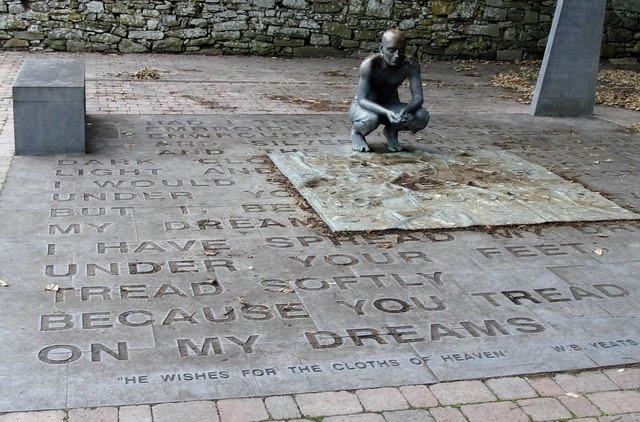
Yeats monument at Drumcliff

Yeats’ poem enwrought by sculptor Jackie McKenna in Drumcliff Ireland. Photo by Eric Jones.


There’s also something more here than just self-abasement or Yeats’ confidence in his brand of detergent: by saying he could put the plane of the heavens underneath his beloved, he’s also saying his poetry could take her to Heaven. But blink and you’d miss that implication.

Yes, the closing three lines are the poem’s best remembered, still quoted by those who have put themselves in the danger of love, or the danger of love refused. Romantic and romantic, and like most anything by Yeats, it just sounds so good! I performed it with acoustic guitar, electric bass, and a bevy of woozy keyboards, and you can hear it with the gadget I have spread below under your feet (or finger or mouse). Click softly.


*Here’s the text of the poem for those who like to read along. When the poem was originally published, Yeats used a persona as the poem’s speaker. Aedh was a kind of John-Keats-besotted nebbish character from what I read, and in doing so, Yeats is hedging his bets on the poem’s Romanticism, kind of a “I’m just asking for a friend” deal. When he included the poem in later collections, he dropped the persona.

**Here’s Tearle’s run-down of how Yeats’ does it in this poem, which also has links to his post about Hulme’s “The Embankment.” To hear my performance of Hulme’s “The Embankment,” you can click here. Beside producing one of the best daily literature blogs, I owe Dr. Tearle for introducing me to the work of T. E. Hulme, the pioneering Modernist poet and theorist who I’ve often featured here.

Crepuscule (I Will Wade Out)

Another short break in the Dave Moore series to present an unabashedly ecstatic poem by E. E. Cummings.

The kind of Modernist poetry we often use here rarely presents itself like this, as the early 20th Century pioneers tended to be a downbeat and skeptical lot, even before the great tribulation of the First World War. Cummings isn’t the only exception, but a poem like this is so extraordinary in its exuberance that it will always stand out.

E E Cummings self-portrait

Lipping flowers…the ecstatic poet’s self-portrait in pencil

As a page poem, “Crepuscule”  is laid out on the page in staggered lines sans punctuation, something Cummings may have picked up from Apollinaire, but the syntax isn’t as jumbled as some E. E. Cummings poems. It actually reads fairly easily once I lined-out the dismembered sentences. The images are surreal, though written before official Surrealism, and paradoxical sensations and states come one after another. Can one gather what is happening in the poem beyond the welcoming of sensation and exploration?

Crepuscule as a page poem

Cummings’ “Crepuscule” as a page-poem.

The title is “Crepuscule,”  an antique word for twilight, and so the poem is set in that proverbial border time. The poem goes on to either explore sleeplessly and fearlessly in the unknown darkness, or launch itself into the imagination of dreams, which surreally complete and supersede the “mystery of my flesh”—at night exploration, or dreams, at once, indistinguishable.

I didn’t see this until after I finished performing it, but I suspect the poem may have bookended images near the start and at the end, the twilight beginning with the swallowing of the sun, the ending with the moon setting the teeth (on edge) with the metallic bite-taste of the moon.

As sometimes happens when I compose the music for these pieces I find out or remember that others have done this before me. As soon as I saw the title I thought immediately of Thelonious Monk’s instrumental compositionCrepuscule with Nellie  and the idea was planted to use piano in my music for this. I did end up with some piano, but I reverted to guitar, my home instrument, to express the unrelenting long line of this poem that leaps into the bothness moment of twilight.

Embarrassingly, I had forgotten that Björk had performed all but the last part of Cummings’ poem as Sun in my Mouth  on her album Vespertine.  Björk brings big time sensuality to Cummings’ words, bringing out the eroticism that was always there, not just by her commitment to the performance, but by ending on and repeating the “Will I complete the mystery of my flesh” line, bringing fleshiness to the mystery. But this is a poem of the borderline, and the flesh is also hymned to complete a change to something else.

My fearless borderline tonight is presenting this music which would have difficulty reaching the level of originality of Monk or Björk. To hear my performance of E. E. Cummings’ “Crepuscule,”  leap into the ripe air by clicking on the player below or click this highlighted hyperlink to open a new tab window that’ll play it.

The Apotheosis of Harlan Ellison

I’m not a fully-qualified Science/Speculative Fiction fan, though I did read it when I ran into it as a young man. Dave Moore, whose voice, songs and keyboard playing you’ll hear from time to time here, read more of it. I’m not sure if Dave introduced me to Harlan Ellison’s work, but my memory is that he did loan me a copy of Dangerous Visions  back in the Sixties. In that 1967 anthology, Ellison made the case that SF was the heir to a Modernist tradition of fiction using outrageous and unique situations—he was claiming SF could be more Kafka than L. Sprague de Camp.

It’s unlikely he was the only person thinking along those lines, but he certainly helped to popularize the idea at a time when an aging generation of SF writers, steeped in pulp magazines and cents-per-word paychecks were in danger of losing touch with the younger post-WWII generation who were more likely to be college educated and experienced in some chemically enhanced inner-space traveling.

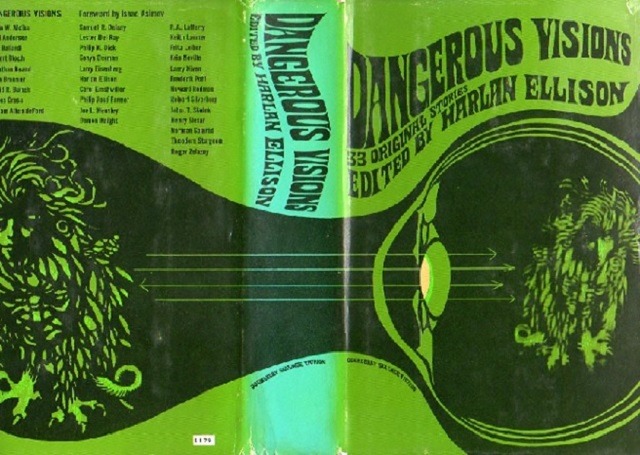
Dangerous Visions cover

Used copies may have slight foxing (or are they cannabis stains?)


Ellison was an any-world-class curmudgeon. His non-fiction writing is full of enthusiasms and invective, with almost no middle ground. At times he reminds me of another late 20th Century artist/social critic: Frank Zappa. Both of them liked to remark that “The two most common elements in the universe are hydrogen and stupidity.” Over the course of his career Ellison seemed to transform from a US-born angry young man punching mostly up to a more generalized misanthropy, where at appearances he would sometimes riff like an insult comic. He once called my late wife who he had just met at an event, “Cathy Carbohydrate.”

These two things worked together. SF had always had a darker side, and the border between it and the gothic strain of fantasy or noir-ish mystery was crossed back and forth often. I believe a utopian, Transcendentalist wing of SF remains, but the terms SF and dystopia now seem to follow one another almost automatically.

Is this the artists’ fault or ours? A large question that.

Thursday night I read that Harlan Ellison had died. Friday I was booked to record with Dave. Friday morning, as I slept, I dreamed that Dave was showing me a binder full of typed manuscripts of stories he had written. As he flipped the pages I read parts of the stories. In style, they were the sort of thing a teenager just starting out would have written, so in the dream’s timeline they would have been written in the Sixties. In the dream, Dave, after learning of Ellison’s death, was telling me that Harlan Ellison had looked over these stories, and that Ellison didn’t like them very much, though he thought the last one had some promise. There was a short, encouraging note from Ellison scrawled in the margin on a page in the story. As I glanced up toward the middle of the page, I saw some dialog in which a character in the story was saying something. The character in this non-existent dream-story was named Octavia Butler.

Now I remind you: this is a dream. Dave never had Ellison critique any early stories he wrote. In the dream, these stories existed, in the waking world they don’t. But here’s the funny thing. I told you at the start that I’m not a fully-qualified SF fan. If you had mentioned Octavia Butler to me on Friday, the only impression I would have was that she was a writer. I wouldn’t have been able to name any of her work or have been able to place her in a genre. In the dream, I just thought it odd that Dave was using a writer’s name as a character in a story that the dream had had him writing 50 years ago. I was about to ask him why, when I woke up.

octavia-butler

Octavia Butler, before or after she was in my dream


I biked off for breakfast and hurriedly came back to write the piece you can listen to below.  Looking for info I might use in my song, I searched on Octavia Butler. In the Sixties, Butler was a young, unsure author, fearing that she was too “ugly and stupid, clumsy, and socially hopeless.” While she was still in school, Harlan Ellison, this man with a reputation as a scouring critic, had told her she had promise and should go to the Clarion Conference and present her work there, a suggestion that lead to her first publication in 1971.

Nothing there I could use in the song as it turns out, but strangely this was also nothing I knew when I had dreamed that dream early in the morning. I did use one bit I found in my searching: an interview with my former co-worker John Rabe that revealed that Ellison was still using a typewriter as his writing machine in the 21st Century. I thought of those older generation pulp writers and their per-word paychecks.

That afternoon, Dave and I recorded “The Apotheosis of Harlan Ellison.”  It turned out that in the waking world, Dave had not heard yet that Ellison had died. The player gadget below will let you hear it—though not on your typewriter.