Memory of Lake Superior vs. Donald Hall’s Law

April is U.S. National Poetry Month, and this year I’m going to focus on poems found within an in-between-the-World-Wars anthology titled Modern American Poetry, edited by Louis Untermeyer. It’s a book that might have been assigned when my parents were in college, filled largely with poets that were born in the vicinity of the turn of the 20th century. I don’t know enough to comment on Untermeyer’s taste in selecting his early 20th century poets, but he seems to have interests in some areas that overlap my own: early Modernism,* humor, and poetry with proletarian and gothic themes. I assume there’s at least a trace of literary log-rolling in the selection of some of the less-well-known poets in the book, but in the short essays that he writes to introduce each poet Untermeyer often finds room for sharp critical comments – this to me is evidence of a fair-minded attempt to get his time’s consensus consideration of American poetry since Whitman and Dickinson.

My plan (to the degree that my life allows plans, which is arguable) is to present around 10 poems from the hundreds in Untermeyer’s thick book. I expect one or two will be “poetry’s greatest hits” that I haven’t otherwise gotten around to, and others will be unknown poems by little-known poets. Long time readers may recall a statement I’ve taken to calling Donald Hall’s Law. That poet, a prize-winner, once wrote: “Most poets, even prize-winning ones, will be forgotten 40 years after they die.”  Modern American Poetry  went through 6 editions between 1919 and 1942, and from a quick look, the last of the included authors died in the 1980s, and so are subject and evidence to that law. Will my efforts and your attention amend Donald Hall’s Law? Slim chance, but I enjoy sporting with its iron rule. Once some pressman ran these pages through their oily machinery, they pressed a democracy between the boards – and so, next to your Wallace Stevens and Robert Frosts, there’s the someone elses who led a life, observed it, did their best to craft some poem to convey that.

And here’s the first of those: George Dillon. Know the name? Know their poetry? This isn’t a test – I didn’t. Some reading this are likely living poets,** and you might have careerist moments in some early AM hours once the muse has worn off. Are you submitting enough, and to the right places? Did you do enough to promote your collection? Are you behind in your social media or correspondence? And while you never think this one yourself, you might still think someone else is thinking “Who do I have to sleep with to gain some traction?”

I’ve reached a age. I look at Donald Hall’s Law and am strangely comforted. I don’t need to be encouraged in dream-stoking stories about poets who achieved lasting fame. I seek out instead stories that say someone else was once here, wrote a little, and I can find them, find some pleasure in a poem or two, and say: that’s enough, or better than some other human clap trap we had no choice in hearing.

And so we have George Dillon. He made it into Untermeyer’s anthology, slotted between Robert Penn Warren and Kenneth Patchen. He was an editor at Poetry Magazine for over a decade! He won a Pulitzer Prize for his 1931 poetry collection! He and Edna St. Vincent Millay were lovers!
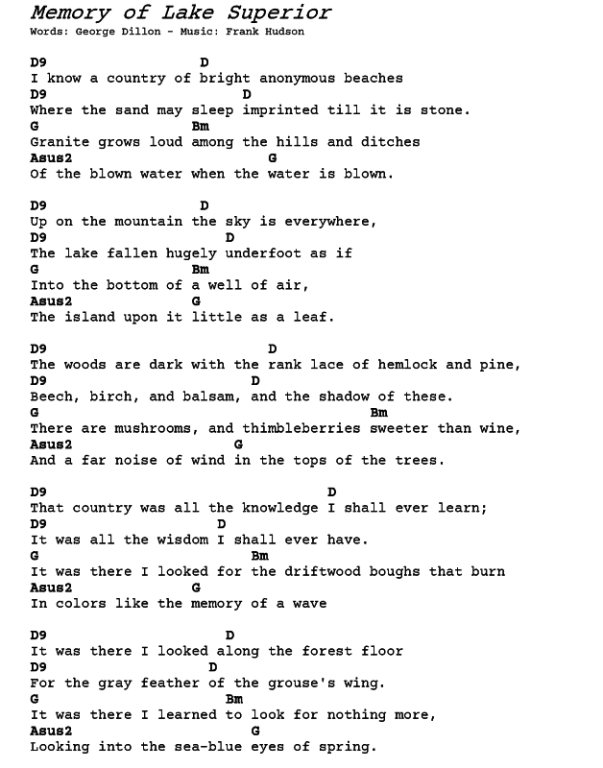
Memory of Lake Superior

Chord sheets like this one might encourage you to sing this poem too.

.

I said Untermeyer could be toughly critical even of those he included. Here’s the end of his introduction to the selections of Dillon’s poetry in the anthology:

His defect is his fluency; he is sure of his craftsmanship, a little too sure. The subject-matter is conventional to the point of being stereotyped and the tone in the sonnets is a shade too pompous. Yet the verse is unusually flexible and few will question his gift of song.”

Fair enough. When I look through a collection seeking something to use here “gift of song” is going to attract me. And there’s another factor. The title of the poem I set to music is “Memory of Lake Superior.”   My late wife lived in Duluth for a while; we both loved the north shore of that Greatest Lake. My living wife too hikes there even as I’ve become too old for long walks. Besides the “words that want to break into a song” effect, Dillon’s poem is well observed: the famous red-brown sandstone, the fungal debris on the forest floors. My wife tells me*** that the thimbleberries there that Dillon mentions “have larger flowers than razzberries.” It’s National  Poetry Month, sure, but I thought leading off with a Spring poem with home field advantage would be appropriate.
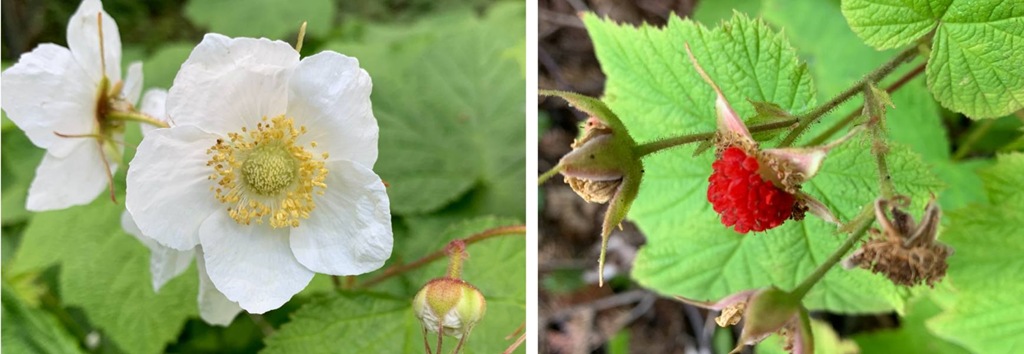
Thimbleberries by Heidi Randen

Thimbleberries, their flower, their berry.

.

You can hear Dillon’s “Memory of Lake Superior”  with the audio player below. Are you asking, “Has Donald Hall hidden the player to enforce his law?” No, just some ways of viewing the blog won’t show the player gadget, and so I offer this highlighted link that will open a new tab with its own audio player.


.
 

National Poetry Month 2026 logo

.


*My initial interest in the early American Modernist era was fed by having a relative (Susan Glaspell) who was part of it, but the practical aspect of having work from 1930 back being in public domain and free for unrestrained reuse makes this era primary for poetic texts to combine with music here. Though the bulk of Untermeyer’s anthology republishes work from before 1930, I am using a later edition, and it’s possible a few of the works may be borderline: e.g. Dillon’s poem is obscure enough to not have an easily findable date of first publication.

**Dead poets reading here have damnably low engagement scores, and Ouija board planchettes never click links or hit “like.”

***Again, living wife – though a ghostly partner who whispers woodland lore to me from the undiscovered country would have a certain gothic charm.

Whispering Often

Perhaps we should remind ourselves in this pre-AI age that every poem, any poem, is written by another human being. I did the math with the years, and this is a poem published and likely written about a hundred years ago by a 40-something Midwestern American.

I’m decades past that age, as was Donald Hall when Hall gave us his law that states that most poets, even prize-winning ones, will be forgotten 40 years after they die. This may sound callous, but that process is likely necessary. How many poets can we hold as a culture, as a reader? Dozens? Certainly more. Hundreds? Whatever, there’s a limit. The poet who wrote today’s piece? Who would we give up in the pantheon to let him in?

I came upon the poet who wrote today’s poem, Edwin Ford Piper, by reading a striking poem he wrote of the closing American wilderness that I’ve already presented earlier this year. I know little about him as a person.*  I almost worry to find out more, since human beings are full of all kinds of faults, deleterious opinions, vanities, and misapprehension. Did he write this poem in this time of the year, in the Spring? Who can say. Writers are full of memories, and imagination that can redress any cold or baren place, but it feels like he did. The poem’s trope of Spring’s reincarnation of driving/seeking life paired with the Christian holiday of Easter is far from unique — but the poem’s not, in feeling, much of a Sunday-dress observance — it’s luxuriously pantheistic. “Whispering Often”  was written in a past era we still call Modernism, published in a journal that put forward many of the great English Language Modernist poets, Chicago’s Poetry Magazine, and it was included in Poetry’s  founder’s anthology shortly afterward that had Modern American Poetry  imprinted on its end-boards — but I can’t call it an example of Modernism.

Whispering Often song

If you can un-embarrass yourself, you could sing this Spring poem too.

.

It’s not end-rhymed. It does sing on the page, despite having a meter that I can’t easily chart out. There’s a familiar iambic rise to many of the phrases, but I don’t think I can call it blank verse, a form that Piper used elsewhere. Oh, but does this rite of Spring want to sing! The title says whispering, so maybe the poet is abashed at the voice that is called forth. Not a lot of today’s poetry sings like this. Instead, we’re more often interested in a poem showing us a particular apprehension the poet has uncovered, an apprehension we are to recognize and share. We are want to pause and recognize the matter of typical 21st century poems, like a friend speaking with us. A wise friend perhaps, a little better with language than we normally are — but still, we wouldn’t want them to break out into a song over shared teacups or beer glasses. How gauche that’d be!

And so, I think of this poem now, as Spring is rebeginning here in my Midwest, as the Abrahamic religions are celebrating holidays of freedom, rebirth, and revelation — but more so as the northern half of earth is celebrating something that Abraham could have seen in a place outside Ur. In this case, a man in his 40s, a Midwestern American like myself, stopped and wrote this down.

What an odd act! If he paused to think about it, he would know that by all odds this poem will be soon forgotten. Yes, Piper was a professor of literature, but he was an adult, someone who knows the comings and goings, the correct way to behave, the agreed worth of this and that. Yet the poem will appear as something as outrageous as an unbidden public song, one with a crush of erotic desire for life. Religion can shape and seek to make that solemn — and perhaps such a transformation teaches wisdom, brings thoughtful ethics to our roots and melting eddies — but that Spring is older than wisdom.

It’s enough to make a grown man break out into song after all.

So I did. Earlier this month I hurriedly sang a bunch of pieces I had written that I feared wouldn’t have time to shape and improve into full arrangements in an interrupted life. Long-time listeners will know my voice isn’t going to be polite, though maybe it should be. You can hear that quick, short, performance with the graphical audio player below. No player? You don’t have to rush past, you can use this alternative highlighted link that will open a new tab with its own audio player.

.

*It’s not certain, but there’s a fair chance that later this year I will make another trip to pay respects to one of my poetic heroes, Carl Sandburg, and on the way tarry awhile to see if I can learn more about Edwin Ford Piper.

Timepiece

Here’s another elegy, but this time by modern American poet Kevin FitzPatrick. Dave and I are keeping Kevin in our memory, which is one place to store someone one knew who has died. Writers like Kevin get another keeping location, one that can be accessed by those that didn’t run into Kevin while he was alive, and that’s in their work.

I won’t sugar-coat this, even in this grief time. I’ve talked here before about what I call “Donald Hall’s Law.” It’s a cold assertion, made by poet Hall in one of his late-life essays, that the majority of poets who receive prizes, notice and ample publication in their time, will be unread 20 years after their death. Is this judgement of time clarifying and correct?

Well, we mere readers of poetry too will generally be forgotten. Forgotten is time’s henchman. Perhaps having only a few “immortals” allows us to focus on those whose work remains in front of us — the heroes who survive the cannonades to become included in the canon. Utility is one part of the argument here. How many poets can one teach in one survey course? How many pages of poets can an anthology’s binding hold? How many names can we contain in our own personal “poetry contacts” memory storage as we pause at a bookshelf? It may seem cruel that this is a rough process taken so casually by time.

So, let me pause here and ask myself, a person who knew the poet Kevin FitzPatrick to some degree, what did Kevin think of this process, this fate?

I never asked him. He never spoke of this matter in my presence. I did get to observe how he carried himself in life, the way he honored poetry and the people in it when he had the direct, living way to do so. That was perhaps his primary concern more than the matters to be observed by a ghost. And there is  a scholarship fund to express some concern for legacy, a fine idea. Here’s a link to that. And here’s a link to Kevin’s obituary in our local newspaper published today.

Kevin FitzPatrick and book

A more recent photo of Kevin FitzPatrick. All grief connects, so I’ll use Kevin’s elegy for his father today to elegize Kevin.

.

But then I recalled that Dave and I had another performance of one of Kevin’s poems stored away somewhere. I found and listened again to this elegy written by Kevin about his father. “Timepiece”  is about something Kevin felt about the work of a parent and the work of time’s henchman, but now too I think it says something about Kevin’s work.

It’s a good poem to remember of Kevin’s. You can help me remember it by listening to the LYL Band performing it over a decade ago with this highlighted hyperlink, or if your way of reading this blog displays it, with a player gadget below.

.

Here’s a link to a site where you can purchase Kevin’s poetry collections.

.