Because I Could Not Stop for Death

One of the harder things to do when performing a song or a poem—or in talking about what either means—is to tackle a well-known piece. As far as American poetry goes, Emily Dickinson’s “Because I Could Not Stop for Death” qualifies as such a case. It’s one of those “most anthologized” poems. I’m certain I ran into it in high school, and it is like a lot of great and popular poems: it can be about three-quarters understood by a schoolchild being introduced to poetry scholastically.

Is there anything new and fresh that can be brought to it? And what may still be there in that other quarter of the poem beyond what one first understood as a teenager?

When I write and play the music or perform the words here I need to make choices. One of the most important of those choices is what is the mood? What is the overall outlook of the poem’s speaker? You can use educated guesses to what the author intended, or you can just make a wild guess, even a perverse one. For example, you take most any song that was written as a party anthem, and then slow it down and sing it with some doubt in one’s voice, you will completely undercut the swagger and good times vibe (as Aztec Camera’s cover of Van Halen’s “Jump”  proved years ago).

With “Because I Could Not Stop for Death”  I decided the mode I would use is sardonic. This is a good ground choice for any Dickinson poem in my mind. This is a poem about death, sure, but it’s a poem mocking death, or rather our appreciation of that subject.

That starts from the start: like death is a social appointment we don’t have time to schedule, but then also, a slow passage of the entire trip of life at a fine and boring pace is appropriate too, as it’s a trip to the graveyard in the metaphor of the 3rd verse.

In the sublime 4th stanza, when the speaker has passed the days of her life (the slow carriage ride of life so stately that the sun transit of a day outraces it) she finds herself unprepared for the cold weather of death, dressed only in useless, ladylike garments that may reference a bridal dress, a burial shroud or a nightgown.

The afterlife presented in the last two stanzas is not any heaven, but an eternity of nothingness. As a final irony, the speaker says the centuries of eternity seem like less of an experience than even a day of a slow life.
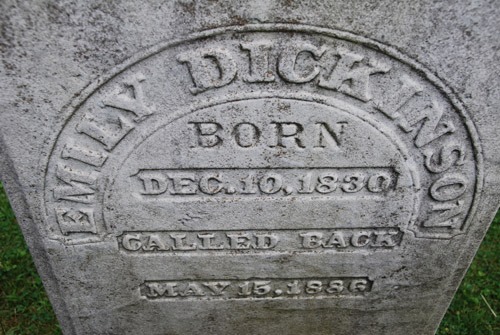
Emily Dickinson Gravestone
Emily’s family held more conventional views of heaven reflected on her gravestone

So, on one hand this is a mock solemn poem about death, spoken in a mode not that far from what Maila Nurmi/Vampira might have vamped on TV a century later. But it’s also a carpe diem poem, written this time by a woman, one whose artistic life is not giving her time to stop for death, nor the daily deaths of an unexamined, uncreative life. When Thomas Higginson was editing the first collection of Dickinson poems, he may have appreciated that aspect when he added the title “The Chariot”  to it. “The Chariot” as in “Time’s wingèd chariot” in Marvell’s poem.

At least that’s what I think is there. I could be wrong. You have to make choices.

Dickinson poems, which are largely written with her internalized Protestant hymn tune rhythms, can be set to music easily. And the basic track in my performance would have demonstrated that, as played on just a 12-string guitar, even though I undercut its simple three chord progression with some chord alterations. The piano part brings the strangeness in by playing simple arpeggiated chords, but in an insistent cross-rhythm.

So hop in the carriage, we’ve got the clip-clop of the hooves and the jangle of the harness to accompany us when you use the player below to listen to my performance of Emily Dickinson’s “Because I Could Not Stop for Death.”

The Dark Interval Version 1

How faithful should a translation be? I can hear your first answer even over the silence of the Internet: “As faithful as it can be, of course.”

And there are many times when I wish it could be so. One has to accept the translation loses when the devices of one language can’t make it over to the new one. Then, often there is the decay of time and the distances of cultures, and this can make meaning murky and less vibrant—but even between two people, of the same time and culture, native speakers of the same language, misunderstanding and misinterpretations of poetry occurs, as you can see with some pieces here where I perform words written by alternative reader and LYL Band keyboardist Dave Moore, which I didn’t fully grasp.

In the next two episodes of the Parlando Project, I’m going to demonstrate two different paths I’ve taken with the same poem, Rainer Maria Rilke’s “The Dark Interval.”  Today’s version is an attempt at a faithful translation.

rainer-maria-rilke

Looks like kind of the intense sort: Rainer Maria Rilke


Rilke, like Tristan Tzara or Apollinaire is another one of those WWI area European artists who exact nationality is hard to pin down. Is he Czech, Bohemian, Austrian, German, Swiss? It’s doesn’t help that the maps of Europe were being redrawn during his lifetime by the outcome of the WWI.

Nor does it help our translation task that he wrote “The Dark Interval”  in German, the language that one set of my grandparents spoke in their youth, and that even my mother was somewhat fluent in as a child, because I know even less German than French.

And Rilke is philosophically dense. His poems are full of compressed thoughts about the inexplicable, and he has a strong spiritualist bent. The former makes it hard for anyone to marshal his thoughts into another language while impressing on you the need to do so; the later makes it harder for me in particular, as I have come to believe that a philosophical spirituality is (at least for me) an impediment to approaching the mysteries.

It may help that I first encountered Rilke’s “The Dark Interval”  in a way deeply integrated into life. I, along with my friend John, was watching a band, The New Standards, perform in 2006, and during an interval in their show a man (who name I should remember, but can’t) read this poem. He did a good job of it, transmitting something of Rilke and himself in his reading. The translation he read was somewhat like the one I made later, and perform for today’s piece.

Just to give you a flavor of that concert, here’s the first piece they played. They did not pre-announce the song they were covering, leaving us in the audience to recognize it as their very different version unfolded:


I heard the Rilke poem immediately then as a meditation on the hurried mid-lives that John, I, and perhaps many of the audience were living at that time. Perhaps he—or the band performers, largely composed of veterans of locally famous indie rock bands of the 1980s and ‘90s—selected it for just that reason.

That’s not the version I perform here today. I did not change the words of this first translation, which sought to be faithful as I could understand it to be to the original German words, but circumstances changed how I hear it. John died, unexpectedly, way too young, a short time after we attended that concert. I learned later that Rilke composed it as he began to suffer from his final fatal illness. I can now see this not as a work about the busyness of middle age, but a work about the busyness of living nearer to dying. Different poem.

Here’s my performance of Rilke’s “The Dark Interval.” Just use the player that appears below to hear it. Tomorrow, my second translation of the same poem, with a different performance.


Her Final Summer Was It

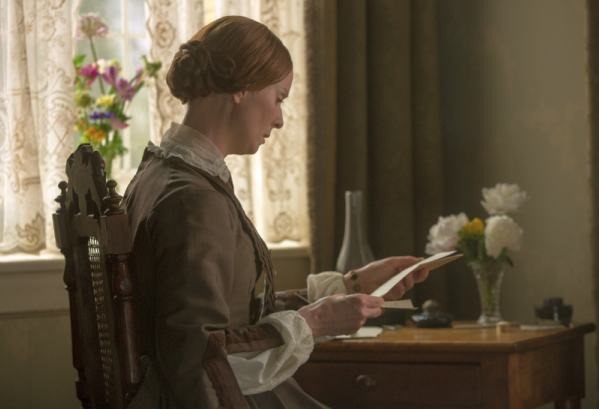
I got to see the Emily Dickenson biopic A Quiet Passion”  this month. I can recommend it with a warning: this is not a work that intends to be friendly or easy to digest. It does present a reasonable estimation of what may have made up Dickinson’s life experience, showing it with enough detail to be (for me) very moving. However, it also tries to show the intellectual ferment of Dickinson’s time in a very strange way, by spending a fair amount of the movie’s running time having people converse with each other in an extended series of Oscar Wildean epigrams.

A-Quiet-Passion

This movie has no car chases or flying magician CGI battles

 
Of course, I have no way of knowing how people spoke in 1860 Amherst Massachusetts, but I doubt they spoke like this: epigram after epigram, back and forth like a free-style 19th-Century rap battle. What I guess the director/screenwriter is trying to do is give us some sense of Dickinson’s mind and the minds of others she paid attention to—Dickinson’s poetry is full of epigrams and busted epigrams after all. What he does is artificial, but then having folks read Emerson or other Transcendentalists out loud would be artificial too.
 
Another part that is harrowing is the time spent on the routines of death and dying in her time. Given Dickinson’s own gothic tendencies, this is not only defensible, it may be indispensable in conveying her outlook. And Cynthia Nixon’s performance as Dickinson is very very good.

So go see “A Quiet Passion”  if you would be interested in a portrayal of a what Dickinson may have been like as a person and what drove her as an artist. But do not go to see it if you want a friendly, straightforward introductory film biography that would introduce you a writer you have not yet committed your interest to.
 
For once I’m happy that this is a long preamble to today’s piece, Emily Dickinson’s “Her Final Summer Was It,”  because I do not really want to talk much about the work itself, as I don’t think I can speak a well as Dickinson’s own sparse words. I found in it great resonance to my own experience, particularly a summer 16 years ago—but as with all things we present here, the intent is not to dwell on my own life, but to connect to and impact yours. I hope I do the work justice.

Her Final Summer was it MS

Dickinson’s own hand-written manuscript of “Her final Summer was it”

You can hear my performance of “Her Final Summer Was It”  by using the player below. If you’d like to hear other Emily Dickinson pieces interpreted by the Parlando Project, we have done four other Dickinson poems with music here.

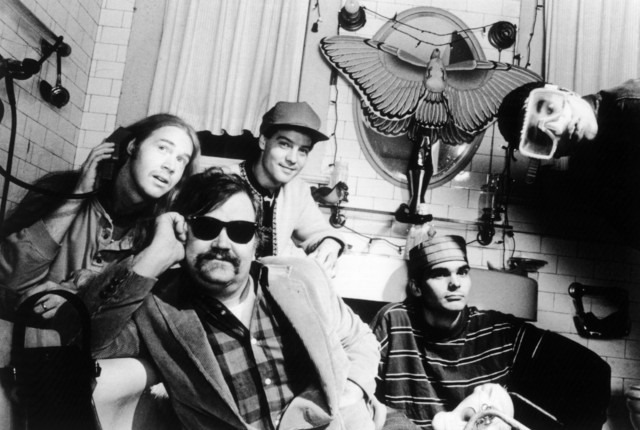
The Death of Col Bruce Hampton

It’s probably one of the best quotes in the history of music criticism: “I’ve heard that Wagner’s music is better than it sounds.” The man who said it was a 19th Century American humorist Bill Nye. No, not the Science Guy, the other Bill Nye.

Bill Nye SG greyscaleEdgarwbillnye

The Nye on the right summed up challenging music in a sentence.


Nye’s great one-liner points out that unfamiliar music may gather approval of those who appreciate its novel approach while leaving a puzzlement as to what pleasure may be derived from it. In the late 19th Century, Richard Wagner’s music was radical. It was heard by many as having stretched the harmonic bonds of symphonic music past enjoyable boundaries. Nowadays Wagner is more in danger of seeming preposterously old-fashioned. He’s just the thing to let you know that Elmer Fudd is a fuddy-duddy when he breaks out into re-purposed Wagner and sings “I Shooot a Waaabittt!” in cartoons. Wagner’s music hasn’t changed, but fashions, expectations and experience have changed.
 
Back around 1970 a band from Atlanta Georgia called “Hampton’s Grease Band” released their only album. The story is told that it sold the second fewest copies ever in the history of their record label, who dropped them right after its release. There are reasons for that. Most cuts were over 10 minutes long. The music was eclectic and the beats eccentric—but what really unsold the record to many audiences were the vocals and lyrics by Bruce Hampton, who rasped like a southern Captain Beefheart with an outlook that mixed Dixie and Dada in quantities you didn’t want to get near enough to the caldron to measure.

This stuff still sounds avant-garde, but Hampton kept evolving after this band’s failure. He self-applied the conventional southern honorific “Col.” to his name, but he always kept a big streak of weird in his music, and by the 90’s another musical movement he helped form made odd music with obscure lyrics and long improvised instrumental passages commercially viable. The usual label for the groups who played this music was “jam bands.”

I could write more about jam bands, but since I need to move on, I’ll say that they were an attempt to invent jazz as if jazz had never existed before. By this I don’t mean to say they were wholly ignorant of jazz or prejudiced against it; what I mean to say is that they created as if they were starting the idea of jazz all over, more or less from scratch. Just as the Pre-Raphaelite Brotherhood thought they could start medieval religious paining all over again or William Morris’ Art and Crafts movement sought to start an artisan practical crafts industry out of nothing, they didn’t seek to learn from and extend the existing practices so much as to do a complete reboot.

Bruce Hampton and band

Everything but the kitchen sink—ah, maybe we need to include that too.


Now we’re back in the hipster territory that I’ve been discussing in the last few posts. Depending on which generation and which sub-cultural alignment you have, jam bands can be an example of an ignorable genre of music that can only be endured for extra-musical reasons, or an organic expression of music that refuses to be contained and regimented by the formulas of other commercial music. It’s that double-edged nature of the hipster label people throw around as if a label was an analysis. Are they “hip” to something novel that has unconventional value, or are they bogus “-sters” consumed by useless difference for its own sake? And if you’ve read the other posts this month, you’ll realize I’m not just talking about one generation or one sub-culture here.

My guess is that’s it’s always some of both, and the exact proportions cannot be discovered while it’s happening.  Perhaps, like improvised music itself, it has to happen for sober judgements to be made later.

And how can one tell who’s the poser and who’s the sculptor of something new? Persistence is one test. Remember William Blake’s great proverb on persistence: “If a fool would persist in their folly, they would become wise?” Here’s Bruce Hampton on patience and persistence:

I’ve gotten everything I’ve ever wanted – 20 years after I wanted it. And that’s been perfect for me to not get things when I want them because I’m not ready for them when I want them.

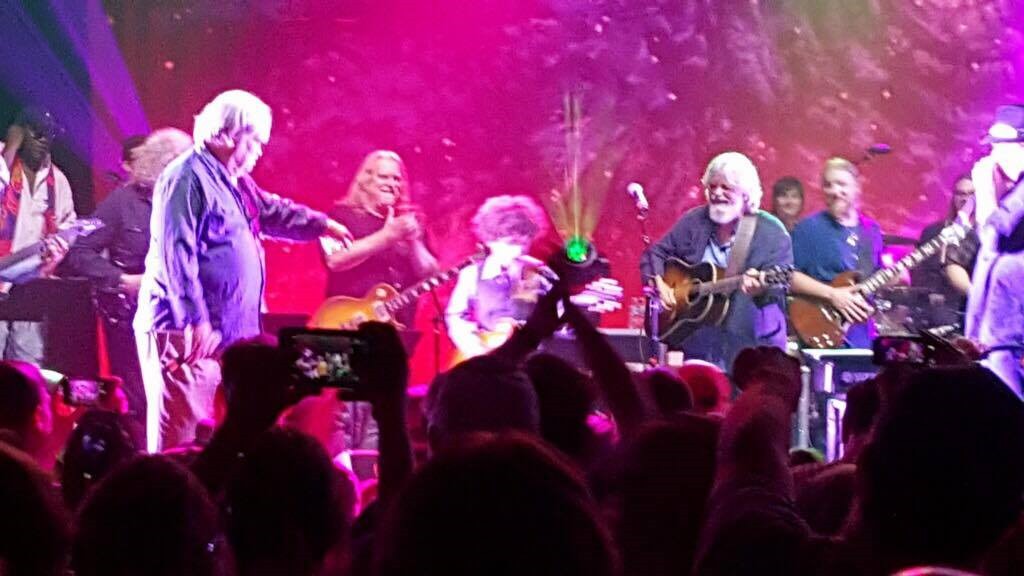
Today’s audio post, “The Death of Col. Bruce Hampton”  presents an sincere account of the unusual death of Bruce Hampton earlier this month: on stage, performing at a tribute to his 50 years of making adventurous music, surrounded by scores of other musicians who learned from him. You may still find his music better than it sounds. He played and sang a lot notes over a lot of time. Some of them were right, and some of them were wrong for the right reasons.

bruce-hampton last jam

Col. Bruce Hampton at his last concert says keep playing


To hear my audio piece “The Death of Col. Bruce Hampton”  use the player below.

The Spring of Dead Things

Last night my computer news feed informed me that Chuck Berry had died. As with any 90 year old of a certain fame, the obits with their career summaries were already considered and ready. There were many elements the obits needed to include, and they did their job.

Chuck_Berry_1957

“Whenever a thing is done for the first time, it releases a little demon”


Around 40 years ago I wandered into a group of Minnesota poets who called themselves The Lake Street Writer’s Group, because they all lived, as I did then, within a few blocks of this main Twin Cities east/west commercial street—but what attracted me to them was that they had considered The Chuck Berry Writer’s Group as a leading alternative to that name.

I was then (as I am sometimes still) an obscure little poet. I like my works short, but I don’t require them to be all that clear or straightforward. I like them to play with words, both in the sense of assembling and using words in new ways; but also in the sense that they play with words in the same way that musicians play instruments. Chuck Berry was a beautiful example of that.
Tomorrow is the first day of spring.  Here’s an example of my trying to do that.  We know how to write the traditional spring poem. Spring! New beginnings! Happy blooming flowers! That’s probably the most welcome and acceptable way to write a spring song, because the world needs hope—but is it the only way?

What does spring’s beginning really look like? A few posts back I presented Boris Pasternak’s “February,” where he described a winter thaw not as a promise of Easter Bunny spring, but as a mucky, crow-ridden, rotten-fruit invocation of tears. Early spring is the cyclical end of dying, but as the wheel reaches March 20th, death is still palpably there to be ended.

For death, Spring is change—and how do we often react to change, particularly change that is imposed on us externally? I decided to tell that slant, to speak from those winter corpses at spring’s beginning. After all, we don’t choose spring, it’s decreed to us by nature and any ruler of nature we believe in, and nature is not a book only of triumphs, it’s full of predation and predestination.

Robin Eating Worms smaller

“Nature is a Haunted House – but Art – a House that tries to be haunted.”


My audio piece “The Spring of Dead Things”  is not in the musical mode of Chuck Berry—it’s more to the emo stylings of Emily Dickinson—but as players of words, these Americans had their slant bells to ring. To hear mine, use the gadget that appears below.


To John Renbourn Dying Alone

A perennial question asked of songwriters is “Which comes first, the music or the words?” Here with the Parlando Project, the words often were written centuries before the music; but with the pieces where I write both the words and music, the method is for the music to come first with the words.

By that I mean, I tend to compose the words first, but the words emerge for me as melodies do, as a series of sounds that may precede any idea of their meaning. And even when I sit down to write “about” something, the improvisation of their melody can lead me to change what I am writing, even in the end, change what I believe I think about something.

While it’s a good assumption that my methods may come from my visceral attraction to music and poetry, this sense that the act of writing shapes, even reshapes, the thought is a common finding among writers. Have you ever thought yourself, “I didn’t know what I thought about this until I wrote about it?”

So where do melodies come from, whether they are melodies played on a string or melodies played on words? The answer, after millennia of human thought and knowledge gathering, is “We don’t know.” That area of knowing that it is, but not knowing why, is the genesis of myth.

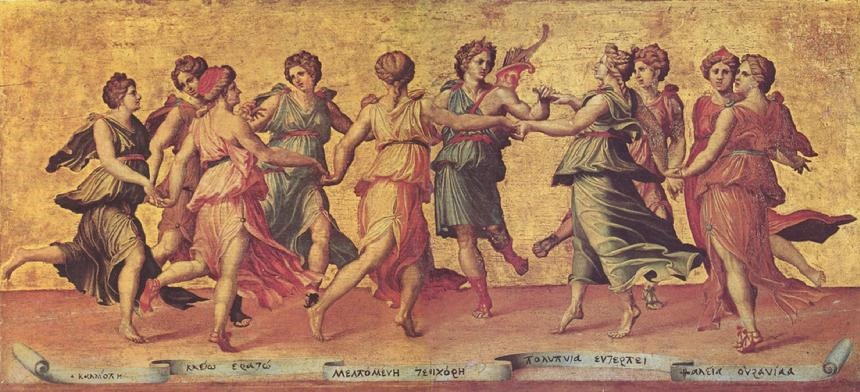
The classical Greeks and their Roman inheritors ascribed these creative incidents to “the muses”—nine goddesses that could engender music or poetry in humans. Their stories told of the bad ends that would come to those who would mock the muses by claiming they could practice the arts without them.
This sort of thing gradually fell out of favor. Shakespeare in his 38th sonnet claims his beloved is as good or better a muse as one of the nine classical muses, and by the 19th century his humanistic idea that another human could serve as a muse to an artist became the common myth.

Nine Muses and Apollo

No, you didn’t count wrong. I think the 10th dancer is Apollo, wearing the knee-length number.


So, what use then is this old myth, the idea of an inexplicable outside source that informs artistic expression? Here’s one use I’m attracted to: it lets the artist relax a little bit about their efforts. Ever try to be inspired? That rarely works. Even the inspiration tricks that worked once, twice or twenty times may wear out and bring nothing. Have you ever been impelled with an idea, shape, thought, or melody when it’s inconvenient and unexpected? Ever beat yourself up when the ideas and expression just won’t come? Using the myth, the metaphor, of the muses you can get a handle on these things. This does not mean you don’t work at art. This doesn’t mean that discipline isn’t a valuable artistic trait. This doesn’t mean you sit on the mountain top and dawdle. Worshiping and honoring the muses just means if you sit on the mountaintop and nothing comes up, you might try the valley next time, but that “nothing” is not your fault. If you look for inspiration 365 days a year and it only comes around a dozen times, that’s a dozen more times than it would come if you never looked. If you look for inspiration only a dozen times a year, it will take 30 years to do what you could have done in one.

That is a long introduction to today’s piece “To John Renbourn, Dying Alone.”  John Renbourn was very good British guitarist and singer. Beginning in the 1960s, and with a small and wondrous circle of his contemporaries, he was fearlessly eclectic: blues, jazz, traditional British Isles folk music, American Appalachian ballads, 19th century broadsides, Asian music, modern singer-songwriters, or Renaissance tunes—all that could show up at a John Renbourn concert, or on one of his recordings.

John Renbourn

John Renbourn. The picture is silent because he could be playing anything on that guitar.

 
Two years ago this month, he didn’t show up to demonstrate once again his amalgamation of music at a scheduled date in a Scottish club. He was not mocking the muses—it was soon found that he had died alone in his modest home.

The day I heard the news, I hoped his suffering had been brief, or if not brief, useful. I thought of him like Frost’s solitary man in “An Old Man’s Winter’s Night,”  or my father imagined in “A Rustle of Feathers,”  or my own dear friend John who had died alone at home a few years earlier. I thought of John Renbourn and wished to apply this myth, this lie, of the muses to this man. An artist like John Renbourn, who informed us with his art, listened better to the muses than most any of us.

You can listen to my audio piece “To John Renbourn, Dying Alone”  by using the player below.

A Rustle of Feathers

As promised, here’s my “bird in the house” piece presented as a companion to Dave Moore’s episode from yesterday.

I wrote this about a decade ago. I was going through a bit of a rough spot in my life then, and just as the words place the narrator in the piece, I was alone in a house in the wintertime, acutely aware of the sounds in winter.  In that house, with no other human sounds but my own, I found myself thinking of my aged father, now widowed, living alone as well. In a somewhat morbid, gloomy mood I thought of unwitnessed death, of my father, or myself, dying alone.

Just as in the dream reported in Dave’s piece “The Bird Dream,” the trapped bird image came to me as I wrote the words for “A Rustle of Feathers.”

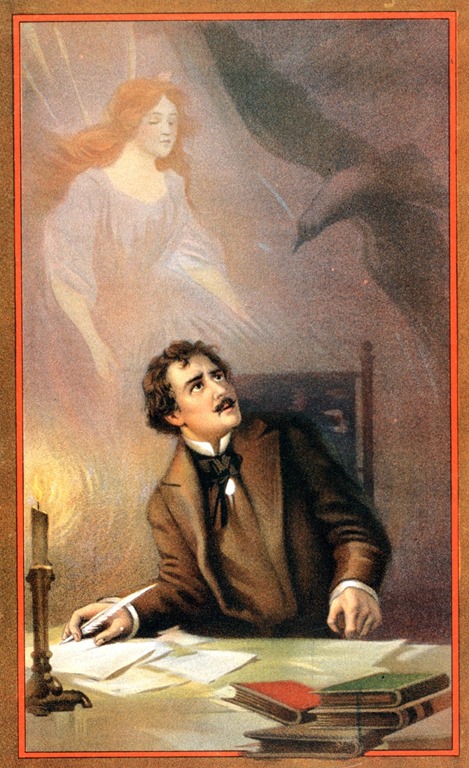
Odd that that trapped bird image occurred to both of us thinking of our aged parents. I don’t know if this is a common image or archetype, something that waits in our common human unconsciousness, waiting for a writer’s words to awaken. “A Rustle of Feathers,” with it’s aged narrator in an otherwise empty house acutely alert to sounds, shares a bit of the mise-en-scène of Robert Frost’s A Old Man’s Winters Night”  that was presented here earlier this month. Possibly I had read the Frost poem somewhere in my youth, but I don’t believe it was present in my unconscious as I wrote this; but shortly after I wrote “A Rustle of Feathers,” I did think that Edgar Allan Poe’s The Raven”a poem widely known to Americans of my generation—might have been a subliminal influence.

The Raven and Poe

Yes, I am using a plucked feather as a pen—but it’s a goose’s quill—so get out of my house!

Musically I was thinking a bit of a Johnny Cash feel as I composed the music, but I’m not sure that much of that came through in the final result. The guitar sound is a lovely example of a Fender Telecaster using both it’s pickups.

Well the muses keep dancing, and they are hard to keep in our narrow field of vision. The piece got written, and now it’s here for you to listen to. Just click on the gadget that appears below to hear it.

I Felt a Funeral in My Brain

Before leaving our Transcendental Trio of Emerson, Whitman and Dickinson, we should feature another set of words from Emily Dickinson, particularly since today is her birthday.

Besides the poems themselves, Emily Dickinson is a series of cracking good stories. One story is similar to guitar poets Robert Johnson, Nick Drake, or Rodriguez, all artists who never made it during their prime, but who get discovered later and find greater distribution and acclaim. In Dickinson’s case, she wrote most of her work in the middle of the 19th Century. After her death in 1886 over 1700 poems were discovered in her papers, and a selection of her work was published in the 1890s. As fortuitous as this discovery was, the process was fraught with complex family dynamics and a decision by the editors to edit the work to make it more conventional for print. All this was not sorted out until the last 60 years or so when readers could finally read the poems Dickinson wrote as she wrote them. So, there’s one good story—one every little-published author can envy.

Then there’s the legend of Dickinson’s life itself, which was in the forefront as I was introduced to Dickinson as young man: Poor Emily, naïve and unlucky in love with a mystery man in her youth, she secludes herself in an attic and spends the rest of her life cloistered like a nun, the patron saint of introverts everywhere. This turns out, like most myths, to be a misleading account.

I’m not a Dickinson scholar, no more than I’m an expert on Blake, Sandburg, Frost, Whitman, or Emerson. I’m a poet who’s worked at that for 50 years, a musician who’s done what he can for 40 years, and for about 20 years I worked in hospitals, mostly in emergency departments. I’ve got my theories, like those that have spent more time on Dickenson. She’s clearly whip smart and no more naïve than Frank O’Hara or Margaret Atwood. When she presents herself as naïve, she’s role-playing. She’s as stubborn about her own theology and philosophy as William Blake, and she’s just as stubborn and original about her musical tactics as Joni Mitchell. She can be as mordantly funny about the human condition as Leonard Cohen.

On one Dickinson question, I wonder about neurological matters. As an introvert myself, I suspect introversion, perhaps even something “on the spectrum” as they say these days. One thing non-introverts don’t understand is that it takes a whole lot of energy for introverts to do what others think of as little things.  Add to that the burden of being an intelligent, free thinking woman with a talent for writing in the 19th Century—well then, choosing to restrict one’s social obligations makes a lot of sense.

A few years back, a Dickinson biography was published that suggested that Dickinson may have been an epileptic. Another theory is that she suffered from migraines. There may be something there, and either could explain her choice in reducing her social interaction. In poems like I Felt a Funeral in My Brain, one can easily see metaphors that could be framed as reports of the pre-event auras that suffers experience, as well as post-ictal, after the event states—but let’s show some respect here. I remember reading as a youth that Monet may have painted his impressionist water lilies because he became near-sighted as he aged, and those ponds just looked blurry to him. Well, I’m nearsighted, and I can’t paint like Monet; and if Monet’s art includes elements of a medical condition, “explaining” it that way is reductionist. Monet would still have to choose to paint those water lilies blending and floating, and if Emily Dickinson had migraine auras and dreadful headache episodes, she’s still have to choose to write so originally and vitally as she does in I Felt a Funeral in My Brain.

Biographical mysteries echo the mystery of the poems, but there are plenty of poets with plain lives and mysterious poems. Dickinson is a master of first lines, as this one has. That first line/title might lead one to expect a Roger Corman directed Edgar Allen Poe pulp movie—and you can enjoy the poem as that. Others see it as a statement of desperation, as a statement of sincere anguish at potential unrealized, “a mind is a terrible thing to waste.”  If one wants to take the migraine approach—or for non-suffers, those who’ve had a really bad hangover—you can read it sardonically, “Hey, stop with that clomping around in your boots. You know what kind of night I had!”  You can read it as a meditation on a death foretold.

To the degree I had to choose as a reader I somewhat favored that last one, but with a bit dark humor underlying it, “Get the damn obligatory service over will you, I’m ready to contemplate oblivion.”  That last stanza may be a change in mood. I was reminded of Roger McGuinn’s fine song 5D as I was reading Dickinson’s poem this time, “And never hit bottom and keep falling through just relaxed and paying attention.”

Musically, I started by aiming for something like John Cale’s arrangements for Nico.  I played all the instruments, and the syth part came out something like that. The piano part was an adventure in that I’m not a piano player, and keeping with the John Cale idea, I tried to channel Cale’s part on Nick Drake’s Northern Sky, though the result is something else. Now if I could just dream of translating a bit of Danny Thompson on bass! Well never mind, no one can listen to intentions, but you can hear the results by clicking the gadget that will appear below.