The Greatest Generation, or Thomas W. Higginson lands on Omaha Beach

I appreciate the attention readers here give to what I present, and so I’m going to warn you: this is a longer piece covering some historical topics that have not been as popular here as others. I plan to be back soon with a shorter post and  I promise a love poem set to music. Thanks for your attention and spreading the word about the Parlando Project. I value that!

Today is the anniversary of the WWII allies’ D-Day invasion of Northern Europe, and as each anniversary gets later the tributes to the sacrifices and courage of those who waded onto the beach amid the gun and cannon fire grow more glowing.

As one of America’s diverted poets once said, it is “altogether fitting and proper that we should do this.” And I say this knowing that this will likely be one of the least-read posts here. The audience for a blog about encounters with poetry and music is not a martial audience by and large. Even a poem like Slessor’s “Beach Burial”  recently presented here—a poem that is about war, though not really about battle or courage or warrior feats—will end up being one of the least noticed, read, liked, and listened to.

I speculatively assign that response—and the lessor response other stark war poems have received—to a number of things: that old battles are yesterday’s newspapers—or as we might say these days, just newspapers; that one of the things we might look for in the arts is a respite from, or at least a beautiful decoration for violent and horrific events. I’m casting no shade on you who have paid with your attention to what we do here for that—or your other judgements on the work we present. After all, I make those judgments myself all the time for my own reasons.

So now, having sincerely bowed to both those who were in the water on June 6th 1944 and you, dear reader and listener, I will diverge.

There is no Greatest Generation,* never was. Too much is assigned to generations, and if widely shared experiences and common events current to lifetimes has some glue to hold an aggregate together, extending “generations” to inner character and intrinsic resources of their membership, virtues and vices conferred merely from birth years is simplistic nonsense that should never be relied on.

I suspect wiser users of the term would correct me and say they do not mean that when they use the term, they mean the great things the WWII generation endured and did. Yes, I join them, there is value in noting that.

But one thing that literature teaches us, by doing its basic trick of letting us experience someone else’s life, is that the good and bad in human character and the challenges brought to bear on us are not unique to time and place. Are the challenges of WWII greater than the challenges of those of the trench soldiers of WWI that this project has featured? Are the privations of the Great Depression, followed by another World War and the following challenges of nuclear peace after great destruction worse than the challenges of 19th century American slavery followed by a Civil War followed by the continuing existence of a continent-wide republic after such trauma?

An Internet discussion mentioning these things often leads to claims and counter-claims of greatest evil: slavery, colonialism (which should include our “internal” American colonialism inflicted on our indigenous population), The Holocaust, Stalinism’s mismanagement, gulags and secret police, Pol Pot, and other evils whose incidental lack of notoriety should give them no cover. I’m sure there are appreciable differences in them, things philosophers could construct evaluative frameworks on. Don’t bother to comment or look for a poll feature to vote on the Greatest Evil or any generation associated with it. This will not be my point.

My point is: you, particularly the younger of those that read this, are the only generation that matters. If I need a silly name for you, a souvenir hat to show that you belong to this, then I’ll swallow my pendant’s pride and call you “The Greatest Generation.”

Do I want my own son, or you, to advance into shore batteries over an open beach or to try to hold Little Round Top without ammunition left? Do I wish it to be necessary to risk mobs, the bullies of privilege, or jail to secure basic freedoms? No, of course not. Nor can I be sure you will figure out what level of forgiveness and generosity vs. justice and retribution will succeed in the peace that all wars fail into. I would rather you figure out how to secure the things warriors were putting their lives in bond for without the war.

So why do I include these poems about war here? Here’s one reason, a personal one: I too often hear that arts and poetry in particular are a trivial activity, the first thing to be dispensed with when “reality” comes to call. And the arts in general, it’s said, aren’t they about vanity? Well, some of those warriors wrote, made and listened to songs. There were readers in foxholes. Call it pleasure, hope or need, some will hold onto poetry and music in any extremis.

And even the arts skeptics give us this: they pull those things out, music and poetry, for the funerals and anniversaries. Can we also realize that some of us hold to these things in life as well?

And here’s the more general reason: reading and listening to literature may remind you that those who pushed forward and those who opposed every good and bad thing are not historical figures, they have no powers or weaknesses because of the year they were born, no more than you do. They lived and died in their Imagist instant, just as you do, weighing duty, possibility, weakness, strength, love, hate, pretense, modesty, anger, resolve, justice and mercy. Seeing, doing, maybe not knowing. Literature shows us that all these things existed in each generation, gives us the evidence of what they feel like, how they exist, side-by-side.

That’s sort of like a poem may be. Those soldiers heading for the beach, like the words alone in a poem could not know fully what they meant. I do not mean by this a romantic claim that art or poetry equals their indominable authorial intent. There’s no measure of their last full measure, something we use art to teach ourselves. And anyway, as a working method our diverted poet settled that issue in his Gettysburg Address too, but chose to do it in his orated poem.

That said, now let me justify the post’s title. I’ve continued to read Thomas Wentworth Higginson’s writing this week, particularly his 1899 memoir, Cheerful Yesterdays.  Higginson is mostly known today as a footnote—kind of like the record company guy who passed on signing the Beatles—as the man in publishing who Emily Dickinson reached out to with a handful of poems and who then corresponded with her over a period of years when she was writing her groundbreaking poetry. Why didn’t he know right away what was on offer literature-wise with Dickinson?

I’ll confess I started his memoir in the middle, and I will now go back and read the start. From its “cheerful” title you may not have a good handle on its matter. It’s both breezy and polite and gripping and harrowing, a strange mix. I knew Higginson was (among other things) a slavery Abolitionist, and because of what he calls “The Sisterhood of Reforms” that he was involved in other social movements, including Feminism/Women’s rights. It’s in the middle, where I came in, that I learned about just what kind of Abolitionist he was.

Abolition included Fabian elements that sought to corral this basic evil legally and eventually end it, non-violent radicals and self-described “agitators” who put their lives on the line but would not morally take another’s life, and the “by any means necessary” crowd. The later was were Higginson lived, at least after 1850 and the Fugitive Slave Act. He was part of (seems to have been a principle in, though he characteristically refrains from claiming leadership) the Boston Vigilance Committee that sought to prevent captured slaves from being returned to their masters as that law required, and he grippingly relates his first hand participation in trying to prevent the last government-assisted attempt in Boston to do that, which includes his plan for a lightning strike by a cadre including himself on the city jail, where the enslaved man was held. The plan counted on an agitated mob in the streets as cover—a crowd who would be motivated to cause a ruckus by his own rable-rousing speech at Faneuil Hall, from where he would dash to the jail to lead the break-in!

Following chapters detail his organizing and gun-running during the “bloody Kansas” guerilla war fought around a plebiscite to decide if the new state would allow slavery, and his joining the John Brown/Harper’s Ferry conspiracy that he says was portrayed to him at first as an armed extension of the Underground Railroad, where a coordinated “jailbreak” of slaves would be accomplished, but which due to lack of funds and organizational ability became what was to be the opening battle in a general slave rebellion which disastrously failed. Particularly in the Brown story, Higginson’s quick-moving/hit the highlights narrative style seems an odd fit with the material. He’s sometimes ambiguous about Brown, and from his vantage point decades after the Civil War and Brown’s execution, he remarks that Brown’s outlook and mental state may have been compromised by Brown’s years in the struggle—but the events say that at the time he was putting himself at risk of felony imprisonment or even a charge of treason with only the surety of his faith in Brown and the necessity of his cause. During much of these activities, Higginson mentions that he was armed, and though he never mentions firing at anyone, presumably he wasn’t carrying pistols for sport.

If your vision when you have read the tale of Higginson in the Dickinson saga is of a rarefied literary critic whose wars were “laid away in books” you’ve understood him too quickly.

When the Civil War breaks out in 1861, the 38-year-old Higginson is raring to serve. He begins working to recruit soldiers almost immediately.* Within a year, he’s tasked with leading the first Afro-American regiment in the U.S. Army, which he takes up gladly.

This explains the oddest part of his rambling, Polonius-like  1862 “Letter to a Young Contributor”  magazine article that is often thought to have inspired Emily Dickinson to write Higginson. Near the end Higginson launches into a discussion of war as a subject for writing and a vocation for writers.

No doubt, war brings out grand and unexpected qualities, and there is a perennial fascination in the Elizabethan Raleighs and Sidneys, alike heroes of pen and sword. But the fact is patent, that there is scarcely any art whose rudiments are so easy to acquire as the military; the manuals of tactics have no difficulties comparable to those of the ordinary professional text-books; and any one who can drill a boat’s crew or a ball-club can learn in a very few weeks to drill a company or even a regiment.”

This seems like a combination of distain for the difficulties of military command (from a man who had already risked his own life and engaged in concerted acts which led to the death of others) and a bit of a backhanded and Americanized version of “The battle of Waterloo was won on the fields of Eton” line. But at the time this article was published, that was what Higginson was preparing to do. He was heading to South Carolina to take over that regiment of freed slaves.** Read in that knowledge it seems a bit like he’s trying to psych himself up for the task, or that someone has told him those things to convince him to go forward with the commission.

So, the first thing my wife asks when I tell her I’m reading Higginson’s memoir, is one you may be asking too. “Does he mention Emily Dickinson?” In this 1899 memoir, he does not. Due in some part to Higginson himself, the posthumous 1890 original edition of a large chunk of Dickinson poetry was an unexpected, multi-printing success, but this didn’t make Dickinson what she is today: one of the giants of American poetry. The “unexploded bomb” of Emily Dickinson took almost a century to explode slowly. She’s just one author he worked with, and since he knew many of the literary figures of the day, Dickinson wouldn’t be the only notable to mention. He knew Longfellow and Emerson, spent a day with the reclusive Tennyson, all persons of unfathomable fame then.

Suppose a 20th century music figure who knew Bob Dylan, had met all the Beatles, and worked with Stevie Wonder, while also having run with the Weathermen, the Panthers, fought with Che Guevara and was a co-founder of Ms. Magazine, was to write a memoir in 1999. How assuredly must there be a paragraph in that imaginary book that started. “Oh, by the way, one time, Joni Mitchell*** wrote me some letters. I wrote back asking if all those open-tunings were really necessary?”

But even without hypothetical metaphors, it does say something about the attention Higginson spent on an unknown woman poet’s poems in 1862. We might say, with hindsight: too little. But with the above context, we may be surprised at the attention he did  pay.

Back to metaphor: instead of taking the usual story of the boneheaded critic and the revolutionary artist, we might ask if someone was training to parachute into occupied France in 1944 to work with partisans,**** why would he care about poetry? Higginson apparently did.

If you’re a buff about 19th Century American history and culture, particularly the Abolitionist circle around Boston, Cheerful Days  is a brisk read and is available in the books section of archive.org. As I mentioned in introducing it, its tone is somewhat incongruous considering the deadly American crisis at its center, but no matter how much Higginson may be trying to shape his story modestly and discretely, it still gives insight to the times. I say that even though if you don’t have a basic understanding of the events leading up to the Civil War if may be confusing to you in places, as Higginson assumes some common knowledge of things his cohort lived through.


*Military recruitment at the start of the American Civil War was a much more localized and “free-enterprisey” kind of thing, and his connections with armed slavery resistance and the Kansas war meant he already knew who was ready to take up arms.

**Not yet citizens, not yet even really “freed” as the compromise taken at this point in the war before the Emancipation Proclamation was to treat slaves who crossed the lines as “contraband of war,” a term, however dehumanizing, that prevented them from being returned to their masters.

***I use Joni Michell pointedly here. Like Dickinson, she was considered a niche artist held in limited esteem in the 1990s. and only decades later is she more fully recognized for the level of originality and effectiveness in her work.

****Once more, I’m making a considered point here. Officers of Afro-American troops were not to be treated as prisoners of war, but to be summarily executed by decree of the Confederate government. In his memoir Higginson says he didn’t think they’d really do that.
Higginson’s June

Here’s another post in our informal series “The Roots of Emily Dickinson.” Now a title like that may lead some to think I’m some sort of Dickinson scholar—which would be a fine thing to be, but I’m not. Frankly, when I started this project a few years back I assumed I’d present some Emily Dickinson poems. After all, not only do they famously fit well to music, but she was part of the poetry canon that I was raised on. Then something unexpected happened.

When I started to dig into Dickinson poems they grew mysterious, not just the elusive mystery of their intent or even their true subject, but the somewhat more external mystery of how they came to be written in the mid-19th century in a town in rural Massachusetts without any sure models for Dickinson’s new kind of poetry.

We know how many other writers assembled their machines and what fueled them. Shakespeare and Bob Dylan worked within successful entertainment enterprises, even if they were to reshape them. T. S. Eliot had a scholar’s interest in a wide range of art and spirituality across history, and after the trauma of WWI a significant part of the culture was waiting for someone to reassemble it however dolefully, even if it was in his Cubist collage. The Surrealists were crystal-clear about their influences and the impact of Freud and psychoanalysis. The G.I. Bill after WWII and the following post-war American prosperity introduced large numbers to colleges and college towns, including some who would likely not have attended before the war. This fueled not only the Beats, but the more academic-associated American poets of my youth. The 20th Century urban migration of Afro-Americans and the Talented Tenth tactics of the early 20th century U.S. Civil Rights movement encouraged the Harlem Renaissance and similar artists.

Emily Dickinson? It’s just not so clear to me. My best guess remains that she was a Transcendentalist of some sort in a household dominated by a father that wasn’t. Transcendentalism, staunchly individualist in it’s outlook has no mandatory dogma, but the sense that the intense, even visionary study of nature reveals the deepest spiritual truths seem to me to be its core. Received truths, any established customs and traditions, are to fall before this apprehension.

However individualist in philosophy, the Transcendentalists and the Boston publishing and cultural nexus were intimately connected socially in a way that Dickinson was not.

One incident, often judged as a quasi-accident* closed this circuit. In 1862 as the 31-year-old Dickinson had begun her extraordinary five years or so of white-hot poetic composition, she wrote Thomas Wentworth Higginson and enclosed a few of her poems. A string of correspondence ensues, and eventually the two met in person.

Dickinson’s letter is conventionally seen as a “cold call” prompted by Higginson writing a magazine article in The Atlantic “A Letter to a Young Contributor.”  That article is largely unremarkable if sensible, the subject one that is covered over and over wherever there are editors who accept written submissions. Submit clean, legible copy. Re-writing is as important as writing. Remember your audience and take pity on them. Hey, the editor is on your side—they, like the writer, want to produce good work.

And here we come to the next beat in the story as it’s usually told. Higginson is often portrayed as something of a doofus, the archetypal mansplainer who can’t understand Dickinson’s greatness. He suggests Dickinson write more conventionally and doesn’t think her work is suitable for publication. Presented with one of the founding geniuses of Modern poetry, he’s blind and hesitant.

Is that so? Well, there’s a lot we don’t know. First, we only have letters from Dickinson’s side of the correspondence. I’ve delayed this post so that I could at least read some of Higginson’s writing on other contemporaries of his and Dickinson, and one thing stands out from his later 19th century accounts of his life and times: he’s the soul of discretion (obscuring names for embarrassing incidents), generous even to his opponents, and extraordinarily hesitant in claiming credit for any of the things he may have been instrumental in. As an editor and literary critic, he seems to have a fairly good and objective eye, and he does not shy from pointing out shortcomings in writers he admires. I read his essay on Emerson written shortly after Emerson’s death, and his admiration for the man and his intellect does not keep him from agreeing with judgements about the faults of Emerson’s poetry. It therefore seems likely he could have suggested changes to Dickinson in his correspondence.

How artistically wrong would those suggestions have been? How harmful might they have been to the isolated Dickinson? Even if he was “wrong” could he have been tactically right about what mid-19th century audiences would tolerate? Here we don’t know the devilish details, but we know some things otherwise: Dickinson wrote most of her nearly two thousand revolutionary highly condensed poems as this correspondence was initiated. If Higginson squelched her or convinced her to temper her individuality, he must have been bad at it. If, on the other hand, what he said encouraged and kept her going, that would be consistent with what occurred.

Here’s something else we know objectively: in 1890 he was instrumental in getting Dickinson’s posthumous-published-career off the ground.**  He did not prevent and may have agreed with the conventionalizing of Dickinson’s punctuation, adding of titles to title-less poems, and so on—but historically those editions sold well right from the start and gained Dickinson a reading public. He added his prestige to the launch with the book’s introduction where he framed her (not yet knowing how well Dickinson would sell) as a sort of art brut phenomenon:

“In many cases these verses will seem to the reader like poetry torn up by the roots, with rain and dew and earth still clinging to them, giving a freshness and a fragrance not otherwise to be conveyed.”

This may be false, even if it’s an accurate advertisement for the impact reading Dickinson for the first time may have on a reader. Yes, Dickinson was likely a more conscious and careful artist than this impression leaves us with. But it worked! Remember, there was no Dickinson tradition to be misinterpreted when he did this. To a large degree, the reason we have an on-going debate about Dickinson that more than a handful of graduate students and eccentrics like me care about is because of his work in insuring that original edition.

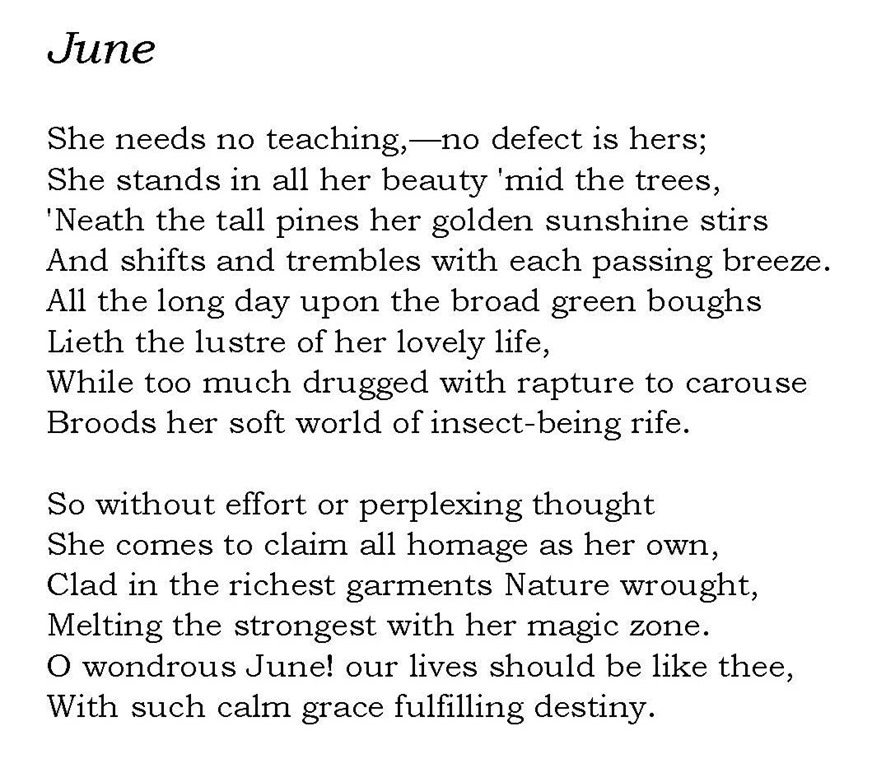
Now for a surprise. I did not know that Higginson had written poetry until I came upon this poem by accident while looking for June poems. I can find nothing about it, but in the absence of knowledge I’ll speculate it might be from Higginson’s college-age youth. Here it is:

June

I may be full of perplexing thought even if this June day isn’t


It’s a graceful sonnet. I’m not in love with the slightly over-egged consonance of the “Lieth the lustre of her lovely life” line, but I’d suspect other readers would point it out with appreciation. On the other hand, the vowels of the preceding line “All the long day upon the broad green boughs” are pleasing to me. And the poem’s fine opening line, referring to June’s summer overture, “She needs no teaching,—no defect is hers” is hard for me to not read, whenever it was written, as the proper way to approach Emily Dickinson’s genius. The ending of the octet “While too much drugged with rapture to carouse/Broods her soft world of insect-being rife” is a truly strange one, half awkward “poetic diction” perhaps necessary to make the rhyme, and half a striking William Burroughs a-century-too-early image of June on the narcotic nod as summer’s insect-being is partly suppressed for the moment.

The sestet is not as distinctive, and I wonder if “zone” was chosen for its rhyme rather than being the best word at the end of the 12th line, but overall more interesting than most 19th century American sonnets. In his “Young Contributor”  article Higginson sagely notes that duality of the critic who’ll offer criticism when they themselves are not accomplished in the arts they criticize. “People criticize higher than they attain” he says.

After all that, here’s Thomas Wentworth Higginson’s sonnet “June”  and my performance of it. The player gadget to hear it is below.


*The writer of the standard Dickinson biography Richard Sewell believed that regular Atlantic  reader Emily Dickinson was attracted to Higginson’s nature articles which he’d published in The Atlantic  prior to the “Young Contributor.”  Early Dickinson biographer Genevieve Taggard speculates that George Gould (which she identifies as Dickinson’s ex-fiancé) may have suggested Dickinson write Higginson.

**I’m still underinformed on all the details of how we got to the 1890 publication of the first large batch of Dickinson poems. Originally, Dickinson’s sister looked to Sister-in-Law and intimate friend Susan Gilbert Dickinson to shepherd the publication. Susan Dickinson said (after the successful Higginson-introduced 1890 edition) that she had a big idea for presenting Dickinson in a fuller way from the start, but the project didn’t seem to get off the ground in the mind of Dickinson’s sister who was legally the rights holder. In an example of the multivalent family dynamics of the Dickinson family, the mistress of Susan Gilbert Dickinson’s husband (Emily’s brother, Austin) Mabel Todd Loomis, was then brought in as well as Higginson to edit and arrange for the first publication of Emily Dickinson’s work. Where Higginson comes in within this series of connections and who selected who, I don’t know, but seeing the book to completion and getting it published and launched with notice and eventual surprising sales has to be presumed to be largely Higginson’s work. He was the man with the connections, track record and prestige after all.

The Life and Mind of Emily Dickinson by Genevieve Taggard

I’ve mentioned in passing that I was reading Genevieve Taggard’s 1930 The Life and Mind of Emily Dickinson  this spring. The busy schedule of this project, and life in general, slowed my reading-rate, but I thought I’d share a few brief thoughts about it after I finished it.

Once I read about this book, I immediately wanted to read it. First, because I was so struck by Taggard’s poem “Everyday Alchemy”  I presented here, and because as one of the first (if not the first*) full-length biographies of Dickinson, Taggard had access to people who had first and second-hand experience of Dickinson while Dickinson was still alive. I’m not sure if journalistic style interviews were considered appropriate for literary biographies written in the 1920s, but despite Taggard’s limited use of some personal testimony in the book, I can’t help but mourn what could have been documented by a talented journalistic writer early in the 20th century investigating Dickinson and her milieu. Taggard as a feminist and as a person working in Amherst for awhile as a professor, writes in her book about the society of 19th Century Amherst, but she does not write this in a first person “walk with the reporter” kind of way were you could directly share how she evaluates and comes upon her information.

Such an imagined book would have been much longer, and Taggard’s shorter work was not a best-seller in 1930 either, but now that Dickinson’s stature as an American literary icon is established, such a longer form examination of her times from an intelligent reporter would be so illuminating.

Taggard-Dickinson Title Page

One of the lovely things about holding this copy were the “Minneapolis Athenaeum” stamps reflecting the history of this public library


If The Life and Mind of Emily Dickinson  was launched today the big PR hook would be that, from local testimony, Taggard believed she had identified the main male love** of Emily Dickinson’s life as George Gould, and that they were engaged, but Dickinson’s father forbid their marriage. Taggard’s detail on Gould’s life and its possible illumination of Dickinson’s interests via letters—an important way that Dickinson expanded her world and emotional circle—was fascinating to me, even when it was speculative.

Taggard seems to be using a Freudian outlook at times in her analysis of Dickinson’s life, and the other main relationship that she develops throughout her book is that between Emily and her father Edward, an attorney and major figure in the town of Amherst who served in both the national and state legislature. One doesn’t have to have the 1920’s intellectuals’ belief in Freud to agree that this is likely a key relationship, particularly considering that Emily speaks of her mother as being less significant to her (and there’s likely a story there too). I’m sometimes struck by how much some of Emily Dickinson’s poetic expression has an exact but slant-wise way about it that reminds me of some legal writing, such as in contract law. I see the same thing at times in Wallace Stevens (a lawyer/poet).***

In her concluding chapters, Taggard makes the case of Dickinson’s literary greatness, which the ensuing decades have continued to expand and endorse.

It’s a shame, but Taggard’s book is not easily available. It’s not been kept in print, and as far as I know, it’s still in copyright. At least when I looked, used copies are not inexpensively and plentifully available. I was able to read an original edition of The Life and Mind of Emily Dickinson  from my public library—a little bit worn, brittle and brown. I looked at the ink stamps on the checkout slip from the ‘30s and ‘40s, and wondered a bit about those readers and what they thought of it, but this reader found it well worth reading.

Taggard Check Out

Some of the readers added light pencil marks throughout the book too. I couldn’t help but ask each time I saw one what led to that mark, slowing my reading of Taggard’s book even more.


No new audio piece today, but maybe you haven’t listened to my performance of Emily Dickinson’s “This World is Not Conclusion”  yet. It’s another of Dickinson’s skeptical hymns, this time full of abstractions and twists of that active mind that she charms us to follow anyway. Here’s the player gadget to hear it.


*Susan Dickinson’s daughter, Martha Bianchi published  The Life and Letters of Emily Dickinson  in 1924, and I haven’t read it. I’m unsure how much of it is biography and how much is a letters collection, but Taggard politely notes in an appendix that Bianchi got a number of dates wrong.

**There’s a lot of modern interest in Dickinson’s sexuality, with attention being paid to the idea that she was lesbian or bi. Given the lack of the kind of deep contemporaneous social investigation of 19th century Massachusetts society, this may be impossible to determine to the modern gossip level of who engaged in what sex acts with whom. Even at the non-Dickinson-scholar level where I live, it’s apparent to me that Dickinson had a very active mind and was highly attracted to other minds that were similarly energized regardless of if the minds were in male or female noggins.

***I’m not sure how large that group, lawyer/poet, is. The only other one that comes to mind is Tom Rapp, the less-known-than-he-should-be songwriter of “The Sixties.”

Much more dour than Stevens and Dickinson, but I could even see a bit of that “Tell me what it is by telling me what it isn’t” expressive mode in Robert Mueller’s little farewell speech yesterday—but has anyone tried singing that to the tune of “The Yellow Rose of Texas?”  I’ll bet Nancy Pelosi and William Barr could both read Dickinson’s “The World Is Not Conclusion”  and differ on what it says!

I Saw a Peacock

There’s not much to say about the author of today’s words, as they are anonymous and somewhat older than I am—“I Saw a Peacock”  dates to sometime before 1655. Somewhat like Emily Dickinson’s “May-Flower”  poem, this poem is on the face of it a chronicle of wonders and mystery, but it can also be read as a puzzle. Here’s the text of it:

I Saw a Peacock, with a fiery tail,
I saw a Blazing Comet, drop down hail,
I saw a Cloud, with Ivy circled round,
I saw a sturdy Oak, creep on the ground,
I saw a Pismire, swallow up a Whale,
I saw a raging Sea, brim full of Ale,
I saw a Venice Glass, Sixteen foot deep,
I saw a well, full of mens’ tears that weep,
I saw their eyes, all in a flame of fire,
I saw a House, as big as the Moon and higher,
I saw the Sun, even in the midst of night,
I saw the man, that saw this wondrous sight.


The key to the puzzle is to read the lines starting at the middle and continuing to the middle of the next line. Read this way the things connected seem more commonplace and less mysterious. Given it’s age, there not a lot of out-dated words in it. A “pismire” is an ant.

Coppa_decorata_con_scene_di_carnevale

A Venice glass, not actual size.


This is a fairly sophisticated play with the powers of enjambment in a line of poetry, where the stop of the line makes one pause and consider (if only for a moment) the thought contained within the line, even if the thought is not actually completed yet. But I’ve chosen (as I did with Dickinson’s “May-Flower”)  to not perform it as just a riddle or exercise. Emily Dickinson’s poetry for her flower riddle was too mysterious and sensuous for me not to play to the mystery. Similarly, “I Saw a Peacock’s”  surface of surreal combinations of the like/unlike is too strong to not go with that side of the Mobius strip.

Although I just ran into “I Saw a Peacock”  this month, the poem has collected its fans over the centuries. I saw it at the Interesting Literature blog (which is, by the way). Writer Margaret Atwood once wrote that it was “The first poem I can remember that opened up the possibility of poetry for me.”

There is at least one other setting of this poem to music, a choral setting where the composer, Caroline Mallonee, uses a double choir to present both ways of reading the lines. That’s another artistic solution, different from my decision to present it “unsolved.”

My musical setting uses double instrumentation too. There’s a standard rock trio, albeit playing quietly (drum-set, electric bass, and electric guitar) and a quintet of double-bass, two cellos, violin and tuba.

You may have noticed I’ve been away from this blog for an interval of a few days as I work on another project this spring. I’ve noticed that folks are looking at the nearly 350 audio pieces we have here in our archives more and more, which is a great way to get your fix of music and words combining. To hear today’s piece, “I Saw a Peacock,”  use the player gadget below.


It Is Not Always May

I cannot start any presentation of a Longfellow poem here without noting his extraordinary fall from esteem and fame. Once, through a combination of the historical moment in the growth of the United States, his talents, and a desire to write earnestly meaningful poems, Longfellow seemed our national poet. Did it seem, when that was so, that this would be for all time—or at least for an age longer than a decade or two short of a century?

Any reading across this project’s nearly three years will show that I find worth in the less-well-known, the overlooked. But nothing that is honestly popular can be unworthy of examination—after all, even manifold problems and failures of art in that which drew a large audience tell us something about that audience, our fellow human beings. Which case now, overlooked or popular, is Longfellow?

Choice Thoughts from Longfellow

Imagine a current poet whose rep could generate a board game where one wins quotes from their poems (image from Maine Historical Society collection)


If Whitman, Dickinson and Frost—or their unseen ghosts in our zeitgeist—still motivate our inner singing muses, can we understand that trio—our current national poets—as reactions to Longfellow, making him still a prime-mover of some interest?

So, let’s listen to “It Is Not Always May”  today. Rhymed metrical English language lyric is not easy to do, and harder to do if you want it to sound easy, and this one is pretty good. Yes there’s a bit of “poetic diction” here, words and word-order that we’d never say in actual speech, and I suspect that would be true even in 1842 when this poem was published, but it doesn’t greatly harm the poem.

The imagery is largely conventional, though as a seasonal poem we may expect some of these ready-mades to be checked off: birds, bird-song, budding trees, the young, the frolic. Can one do a winter poem without snow and stasis, an autumn poem without colored falling leaves, and so on? Yes, this is possible, and originality can be a great strength—but there’s a certain resonance with the choir of poets to sing those ancient notes in one’s own song. Conventional and outdated it may be, but I rather liked the clouds as sailing vessels in a river-fed harbor awaiting a west wind to up-anchor from New England for the “Old World.” And the poem’s refrain: “There are no birds in last year’s nest,” which Longfellow identifies as a Spanish proverb, has its vividness too.

Oh in my soul, I think the Imagists were right, that too many poems use conventional images as mere counters, pro-forma symbols, not real vivid objects we can consider as existing outside the poetic line. But I could just see Longfellow and the sea-side clouds as an actual charged moment.

And how about this poem’s sentiment? Well many acceptable modern poems have opinions, outlooks, sentiments, and so the charge against Longfellow isn’t really that, rather it’s sentimentality, the idea that he has no original outlook, no fresh take. What would his readers in the days of his fame have thought? A feature, not a bug? Longfellow was the premier “Fireside Poet,” suitable for reading to the family, suitable for school-books and children’s illustrated early readers. Did they view this poem as a basic truth to be reminded of, or did they view this as sufficient in itself? I assume some thought each.

Yes, I want more than that from poetry. Reassurance and singular conventional answers aren’t even what children want and need exclusively. But this poem is balanced in a way that I can admire. It’s a carpe diem poem without a smarmy pickup line, a song of the life-death cycle that plays the undertones, a poem that asks subtly for youth to be irresponsible, or responsible to their youth not earned wisdom (“to some good angel leave the rest”).

Do we need a new Longfellow today? I’m not sure. I would be pleased if more people appreciated poetry more widely, and as I’ve argued elsewhere here, that “not great poetry” does no harm, and might even do some good for more unusual or challenging poetry. I think I forgot to say clearly enough in my recent series on “Are Song Lyrics Poetry” that to a large degree we’ve asked song-lyrics to fill this role of poetry in my lifetime. But I do believe we needed a Longfellow at least once to establish the ground on which our foundational modern poets erected their structures.

So, it’s fitting that I chose to sing this May poem of Longfellow’s, even given the limitations of my singing voice. Once more I was drawn to using the less and more than realistic Mellotron flute and cello sounds to signify a pastoral scene. Even with my limitations, “It Is Not Always May”  sings well and easily, and I urge you to hear it with the player below. The poem’s text is available here if you’d like to read along.


Ollendorf’s Wife

I’m going to do something this time that I’ve done before but is rarely done.

I’m going to revise someone else’s poem without their permission—which I would feel bound to obtain, but the author Orrick Johns is long dead. The last time I did this, it was Rupert Brooke’s work I used, and my excuse was that his fragment that I presented here as On the Troop Ship to Gallipoli”  was likely an early draft left unpolished due to Brooke’s death.

Orrick Johns published “Ollendorf’s Wife”  in his first book-length 1917 collection Asphalt and Other Poems.  There’s little online to help me make sense of Johns’ life, but it’s probable that Asphalt and Other Poems  collected early work Johns had written in his twenties. While most of the poems are short lyrics, Johns works there in several styles. The poems are rhymed, not the free verse of “Blue Undershirts”  that made such an impression on William Carlos Williams. The opening section, “Asphalt” is an odd set of doggerel poems in dialect. I have trouble reading dialect poems, and from my vantage point as a mid-20th century man I can’t make out what ethnicity Johns is representing in these poems. There’s a lot of dropped consonants and dere’s, dem’s and de’s. I assume these poems are intended to be proletarian poetry and demonstrate John’s solidarity.

Another section “The City”  has other poems dealing with social issues of the day, but without the distraction of dialect. It includes one of the book’s longer poems, “Second Avenue,”  infamous in its moment of possible fame for being the poem that beat out Edna St. Vincent Millay’s “Renascence”  in The Lyric Year’s  poetry contest.

Almost nothing in Asphalt and Other Poems  grabbed me. Nothing passed the Emily Dickinson test, there was no spectral cold and the top of my head remained attached throughout. While it was trying to depict its modern world, the music was awkward for me, with some forced poetic diction and conventional sentiments that made it more similar to Margaret Widdemer than Millay or Sara Teasdale, contemporaries that were writing prize-winning short rhymed lyrics at the same time as Johns. Like Widdemer, and unlike Millay or Teasdale, the poetry in this book of Orrick John’s is understandably forgotten.

There was one poem in a section titled “Country Rhymes”  that did seem to have a germ of something though.

Ollendorfs Wife 1 Page final

Johns’ poem as it appeared in “Asphalt and Other Poems”


Like T. S. Eliot, Johns grew up in St. Louis, but unlike Eliot he stayed in the Midwest for college. The “Country Rhymes”  section reflects that longer experience, and nowhere better than in “Ollendorf’s Wife.”  First off, the poem is generally free verse, with uneven line lengths and sparse rhymes. And it has some vivid images. Ollendorf’s wife significantly has no name of her own in the poem. She works her farm plot assiduously, with no love showing in her face, but also as if it’s her last child. How many children, like her name, go significantly unmentioned? The fields she works, and the farm wife are “drawn together” by a “knowledge…greater” than “each other’s best.”

At its core, this poem works by the things it leaves out, fulfilling Hemmingway’s Modernist theory that you can remove the most important things in a story correctly, and by doing so depict them all the more intensely.

So out of care for “Ollendorf’s Wife,”  I revised it, intensifying that paring away of the unneeded, leaving only the cutout cameo around the farm-wife’s charged day in a life. I added nothing really, but took away words that restated something otherwise established, and rewrote lines aiming to make connections stronger. I made one additional repeat of the “day after day” phrase, because there the repetition is  the image. Though I intended to perform my revision, I generally wasn’t thinking of making the poem more “sing-able” as I changed things, but I suspect that factor worked its way in as well.

Ollendorfs Wife revised

Here’s my revised version of Orrick John’s poem


As I said at the beginning, this is not something that is commonly done. There are poems that use the subscript of “after a poem by…” but those poems that are revised and re-voiced are usually much older or in a different language than the new version. Obviously, such an act could fail as well as succeed. You are the judge in this case. The gadget to hear my performance of my revised version of Orrick John’s “Ollendorf’s Wife” is below.


They Say Life is Precious

Creativity is escape and sticking-with-it, avoidance and attention. Routine can take you to your place reserved for freedom, you may believe you’re going to the same place, and then something else happens.

Every so often I present a set of words I wrote here rather than following my usual practice of using other people’s words and “other people’s stories.” I didn’t plan to do a piece of mine here, though I did plan to revise this poem from 2016 yesterday. Sticking-with-it.

But first, I thought I should take the opportunity to play a little acoustic guitar in a quiet house on a cold grey day. Avoidance.

This is one of the good things about my multisided creative life. If I put off or am outright avoiding one side, for example, writing or rewriting my own poetry, I may flee to my music side, to the shear tactile pleasure of playing an instrument. Or to the poetry written by others and this project. Escape.

So there I was at the guitar. I tuned it to “double drop D,” and because the guitar that was at hand has too narrow a neck width at the nut to suit my less flexible older fingers, I capoed up to the second fret which gave me a little more room. From there, by ear I started to work on some chord forms that sounded interesting together in this alternate tuning. This is one of the virtues of altered tunings on the guitar. I have some understanding of the guitar’s conventional tuning, but an altered tuning requires new exploration.

None of the chords I ended up playing would have been difficult to find or fret in standard tuning, but the altered tuning I was using has three strings tuned to the same note (though one’s an octave lower than the other two) and that not only makes it easy to get a drone going while playing other notes on top, but that trio of strings resonates sympathetically.*

I was quite receptive to the sound that was developing, and next to me as I played was the manuscript of the poem I planned to revise. Could the resonating chords be fit to it? Yes, it looked like they could. Attention.

Performing a written piece can be an aid to revision. As I worked on the music I was cycling through sections of the poem, and some lines began to volunteer themselves for deletion. The poem lost five lines, and it was the better for it. The ending wasn’t strong enough, so I added a couple of sensuous verbs which I think made it better. The line deletions happened almost without attention. I was years separated from when I thought they were a good idea to be included, and the repetition while thinking mostly about the music and its flow simply made them seem unimportant. The revision of the ending was a more literary endeavor, but by that point the music was coming together, and I came up with choices sharply focused on getting that ending “fixed” so I could record a finished version.

That piece I ended up working on, today’s piece “They Say Life is Precious,”  was intended as a page poem, but the process I went through with it on Thursday made me think it works better as a performance piece—but even on the page I think it works better now because of the time I spent performing it as I composed and recorded the music.

They Say Life is Precious
We pay for life by filling it’s container, time, with attention. You can put money in there, but it can’t read what’s on the currency.


The acoustic guitar part didn’t turn out to be difficult. I recorded it and my vocal. The chords of the piece are E5, E minor 7, and two voicings of Bsus4.**  To fill out the sound I added Mellotron violins and flute, a simple contra-bass part, and an upper-register fretless electric bass line.

Escape and sticking-with-it, avoidance and attention. By avoiding the revision and choosing to play guitar first, I accomplished the revision—and when I thought I was just going to play guitar, my composition routine refused to relinquish itself and drew my attention.

To hear my piece “They Say Life is Precious”  use the player gadget below.


*Many musical cultures have instruments that use drones or sympathetic vibrations. South Asian music is full of them, but so to are Celtic pipes, Norwegian hardanger and any number of African stringed instruments. Even something as common as the piano when played undampened pulls up resonances.

**If there are any guitarists who want to try to play this, it’s a good introduction to altered tunes as the fingerings are easy. First drop your high and low E strings one whole step to D. To match the recording, capo the guitar at the second fret. The following fret-hand fingering positions are used: Chord E5 = 3rd string at 4th fret, 2nd string at 5th fret. Chord Em7 = 4th string at 5th fret, 3rd string at 4th fret and 2nd string at 3rd fret. The higher sounding Bsus4 = 4th string at 11th fret, 3rd string at 11th fret. The lower sounding Bsus4 = 4th string at 4th fret, 3rd string at 4th fret. Technically this Bsus4 also has the C# that makes it a Bsus2 as well.

The Aim Was Song

Let’s give the lyrical reins over to Robert Frost one more time for another electric guitar driven piece. “The Aim Was Song”  is a poem from Frost’s 1923 Mountain Interval  collection, and not only is it a reasonably straightforward poetic credo from Frost, it speaks a little to Parlando’s goals too.

I put forward a definition of poetry as I was starting the Parlando Project as “Words that want to break into song.” I don’t recall where I read that definition, but when I searched this afternoon, all I can find is myself, so the source of that phrase may remain a mystery.

Careful with that axe Eugene. Robert Frost prepares to kick out the jams.

Unlike Sandburg and Yeats, Frost himself had no desire to sing or perform to music that I’m aware of, but his desire to use metrical/rhyming verse goads me to use him often here. And Frost had his own theory about how meter and language worked in poetry. He called it “The sound of sense,” and he once described it in a letter as akin to what comes through if you listen to talk in another room from the other side of a door. I don’t think he’s writing there about meter as commonly scanned in metrical poetry, I think instead he’s talking about human vitality that arrives through the panels of a door, the rise and fall, the breath and repetition. Frost’s theory was that you then laid that over the structure of metrical/syllabic prosody, so that each side pushes and pulls on each other. Too much evenness and it’s a motorik machine. Too little and you have only thoughts scattered on the page where only a silent and uncycling eye can gather them. You find that balance with one’s ear and heart.

Perhaps what Frost is aiming for here is the thing musicians call phrasing, but one thing that’s sure is that Frost believes poetry, even poetry of complex meaning or subtle rhetoric, is received through the ear and not the eye. So, even if Frost was not thinking directly of his poetry in association with music as we present things here, he is thinking of poetry as suffused with orality.

In “The Aim Was Song”  Frost develops one image throughout: how the human being captures breath, moving air in waves, the essence of that natural force of the fierce spring wind, and shapes it into a smaller but more intimate thing. That is the work of musicians and poets. I could almost hear Lord Buckley read this one, as Frost repeats some words in his short poem that seem to pun on musical terms, to “blow,” “how it ought to go,” and “measures.” I didn’t go that route (if I could) but consider that an undercurrent in this.

To hear my performance of Frost’s “The Aim Was Song,”  use the player below if you see it. Don’t see a player? This highlighted hyperlink will also play it.  U. S. National Poetry Month is coming up in a few days, and I’m hoping to have a good number of encounters between music and words here in April. Please check back or subscribe, and spread the word.

.