Poem 1 from Twenty Love Poems

Last post I said that Pablo Neruda’s departed lover was by definition absent by the time we got to the final love poem in his Twenty Love Poems and a Song of Despair.  I’ve now read the entire collection in an English translation, and I’d have to say that the lover is to a large degree absent throughout—not just in the sense that elements of a doomed romance are woven into the whole series, but in the sense that she isn’t really given a living presence.

Still, quiet, and dark are all attributes Neruda sees or applies to her.*  Erotic attention is  given, moments of apparent mutual intimacy are sketched, and most importantly to us as readers (as opposed to actual partners of Neruda) a range of striking imagery is used to represent her and the poem’s apprehension of his experience with her.

This last point may be crucial. Without it, this poetic series would be only another example of the syndrome of “The Male Gaze.” If that sort of thing, and the patriarchal power dynamics associated are a point of pain, this series of poems by the eventually Nobel Prize winning poet may not be for you.

Sexuality and its expressions, its inescapable intertwining with the rest of society’s hierarchies and prejudices, is not a simple thing. Twenty Love Poems’  popularity testifies that not everyone in the past 100 years sees it this way or is equally bothered by that element.

I’m willing to put Neruda on the stand, but only in our moot court, since he is now long dead, and no one now living likely had to try to negotiate an erotic relationship with him. He’s now become his writings, and his youthful lovers too have become the imagery that he preserved them as. Take that in the balance as we weigh the once living beings and their kindnesses, cravings and blindspots against the art that one of them has left.

“Poem 20”  in the series began by launching one last extravagant image about the love affair as it writes that there can be no more, but as I now turn to the opening of the series, the 19 year old Neruda is going to try numerous audacious images to describe his beloved and their relationship. They’re all going to be one-sided. She never speaks. Her emotions can be sometimes made out if one reads the poems in an Imagist manner (where emotional words are not used, but depicted with external description) but they are not the point of the series which is focused on the male speaker’s suffering, confusion, and dissatisfaction.

I’ve mentioned before that I fear that I may ere in my translations because my prime goal is to make vivid the images I discern in a poem. In Neruda’s “Poem 1,”  I differ from other translations I’ve read of it in that I see some images they have muted or made more abstract and “prettified.” I worried about my tendency here so much that I pulled back from some rawer translations I considered. This may be cowardice on my part—but the most noble explanation I can give is that to make a sure judgement on that level of tone I would need to be a fluent speaker of the source language and more familiar with the entirety of Neruda’s work.

Poem 1

Here’s the translation I mined from Neruda. “It’s much cheaper down in the South American towns where the miners work almost for nothing.”

.

Here are some brief notes on my experience of “Poem 1”  in making my fresh translation of it from the original Spanish.

The poem opens with an audacious image: the beloved is portrayed as an immense (if inhuman—not even animal, but mineral!) landscape. My reading is that Neruda is making an extended metaphor that erotically he’s engaged in mining his lover’s body. Are there subtexts here (I assume unintentional, but who knows) to foreign corporate exploitation of Chilean resources?

The first quatrain ends with what I read as a brag that lover-man Neruda is so potent that his lover could only conceive a son from his mining operation. See what I warned about? Either Neruda or I—or both of us—is risking risibility here.

In the second quatrain, Neruda recovers. This is flat-out marvelous and mysterious writing. Perhaps it benefits in that Neruda is no longer trying to describe his beloved, only himself here. In my translation task I worked a bit on what word to use for “túnel.” “Tunnel” is the obvious choice, but I never liked it as word-music when I tried it. I chose “cave” instead, preserving the anima subtext I sensed.

The third stanza, problematic again. It opens well, and as word-music compels. The “de leche ávida y firme” phrase is rendered by all the other translators in whatever their best Surrealistic/poetic manner finds. I’m more base it seems, and was struck by secondary Spanish meanings for “leche.” I could also have chosen the idiomatic meaning of smacking or bumping, even though other translators haven’t. Third line? If she was to speak: “Neruda, my absent eyes are up here!”   Fourth line. “Rosey pubis” is just bad, and I couldn’t justify linguistically my alternative.

OK, you in the back row. Stop snickering. Or otherwise we’ll stop with erotic poetry and go back to Longfellow right now!

Last stanza. How self-aware was Neruda when he wrote this?** As he refrains on woman and body, he goes and drops in the “my woman” formulation with it. Given that in the course of this series of poems or even the rest of this stanza, this isn’t going to be a long-term commitment, I’m not sure how he gets the deed and mineral rights on his beloved’s mortal corpus, but if you like you can just say that I’m 2020 anachronistically considering 1924. The final three lines make plain, even if it’s lovely verse, that, well: a man’s gotta ramble, I can’t be satisfied, and the problems of us little people don’t amount to a hill of beans in this crazy world.

Am I being unfair to Neruda? Even here as a 19-year-old he’s an accomplished poet who found an avid audience that bonded with what they received in his art. When reading his Twenty Love Poems and Song of Despair   I came across as many “wow!” lines as problematic ones, and I wasn’t bored. Not everyone looking for a lover, much less a love poet, is going to ask for the correct dialectic to get them through the night.

A possible defense is that this isn’t poetry as memoir (a common form today) and that the woman in the poem seems soul-less and silent because she is intentionally an abstracted metaphor. As I said when we started—whatever, she is now.

For my performance I chose not to go romantic for this as I did with “Poem 20”  last time. While there is a tender cello present, the main music is carried by pianos playing astringently. I performed it more as if it was a Browning-like dramatic monolog—for monolog it is. Feel free to hiss or sigh with the character of this very young dramatis personae.***  The text in Neruda’s original Spanish alongside another English translation is here. The player gadget to hear my performance is below. If you’re reading this in some blog reading software you may not see the player gadget, but this highlighted hyperlink should alternatively play the the performance.

.

*In “Poem 15”  the poet says to her “I like for you to be still: it is as though you were absent,/distant and full of sorrow as though you had died.” This may be taking a Goth stance a bit too far.

**In “Poem 14”  he shows a moment of sympathy, “How you must have suffered getting accustomed to me.”

***Former REM frontman Michael Stipe had one of those interviews via a standardized questionnaire recently. To the question “To whom would you most like to say sorry, and why?” he answered:

“Anyone I slept with before the age of 27…”

Poem 20 from Twenty Love Poems

This should be embarrassing to admit, but I’m not that familiar with Pablo Neruda’s poetry. This project is a great motivator to fill in such gaps. English translations from Chilean Neruda’s Spanish exist, but there may be no better way to become truly familiar with a poet than to translate them yourself.

As 2020 began, I saw a list of some works that came into public domain status on January 1st. Neruda’s Veinte poemas de amor y una canción desesperada (Twenty Love Poems and a Song of Despair)  was one of those 1924 books that are now free to perform and use.

Published when Neruda was 19, it has reached a large audience for a poetry collection: the Wikipedia article says it’s the “Best selling poetry book in the Spanish language ever” and gives overall sales as 20 million copies. These are poems of erotic love and desire, and that subject no doubt helps its popularity. I think it’s safe to assume that some of the sales would be love-token gifts.

Veinte Poemas Title Page

“If you see her, say hello. She might be in Tangier…” Pablo Neruda’s 1924 “Blood on the Tracks”


I’ve only translated one poem in the series completely: the final love poem. But on a cursory examination this collection of poems is an example of a genre that if presented as a sung recording would be called “a break-up album.” That is, it’s an expression of the author’s experience of a romantic relationship that has come to an end. It’s a common enough trope that many singer-songwriters have one in their catalog, and most of the rest could support a playlist to create one in effect.

A problematic element in the break-up album, sung or printed, is that the hard-end of a relationship tends to leave the writer who gets to document it a number of not always elevated states: self-pity, anger, hopelessness, revenge, grief, confusion, sorrow. By definition, the singer is “working through this.”

The former beloved likely appears, but they often don’t get a very well-rounded portrayal—the author’s pain is the side that gets sung. Sometimes you get Blood on the Tracks, and other times you get “Ballad in Plain D”  from Another Side of Bob Dylan. Where’s Neruda, who was a few months younger than the Dylan of Another Side when Twenty Love Poems was written, in this continuum? The poet’s beloved here is referred to mostly in the sense of her absence in this final poem. Not much is said about who did who wrong and in what ways, and by this it’s a universal poem.

Universal can risk banality. Against this danger Neruda arrays considerable musicality in his poem. It’s not a strict form like a villanelle, but repeating lines and phrases work like that form and remind us of the stuck-ness and the self-mantras at the end of a relationship. From my start at a couple of other poems in the series, the whole collection seems to be full of sensual imagery, but this last poem, so full of loss and lack, challenges this tactic.

Neruda wrestles with that right from the start, saying in one of the refrains that the dissolution has caused him to be able to write “the saddest lines” and he then immediately launches into some of the most elaborate images in this poem:

‘…The night is full of stars
And the dark stars on the horizon are shivering’
The night wind swirls the sky, singing.”


Yet the rest of the poem is not consistently in this voice. Alternating with the more striking images are lines you, I, or the next person might say at the end of a relationship. This may make the poem more inviting to those not ready for a full-on array of Surrealist images.

This also made it easier for me as a translator. I feel my task as a translator of surreal images is to make them vivid for speakers of contemporary English, and that leads me to feel I should understand even the most hermetic image to render it as well as I can. I’ll often spend a long time on just one phrase, one image. What is the poet’s mind, however disassociated from convention, sensing, seeing, in this?

As a performer, my other task was to invest this poem about the end of a passionate state with appropriate emotion. How much to understate? How much to state with extra conviction or extra doubt? What I lack in skills there I can try to shore up with music. The composition’s core is an acoustic guitar part that while it isn’t exactly based on a drone tone, doesn’t have the kind of progression that takes the listener on an irresistible linear route. I let my strings sing with the bass guitar part, an instrument that can portray a heart-sob better than most. Standing in for the stars, the night winds pushing clouds, the distant singer, and the lost beloved is a high melody part off in the right-channel distance.

The player gadget to hear this performance in English is below. If you’d like to hear the poem read in the original Spanish, you can find that here. Normally I’d provide the full text of the poem—in this case, my fresh English translation—but this one is rather long on the page. I’ll post it separately if I get some requests for it.


Thanks as always for reading and listening.

The Times Are Nightfall

There’s a musical theme in today’s audio piece: things that pretend to be another instrument, and while they don’t quite get there, are still something else.

That low bowed-string sound that opens today’s piece? It should be no surprise to long time followers here that it’s a Mellotron,* the primitive magnetic tape ancestor to today’s computer-based virtual instruments. It doesn’t really sound like a cello as it lacks any variation of articulation, but it does have a sound of its own.

There’s no bass guitar (the cello part is solidly in the bass register anyway), but to add a little punch I added an emulation of the Fender Rhodes Piano Bass most famously used by The Doors. Used as The Doors did, it can do a fair job of sounding like the plunk of an electric string bass, but I filtered it here so that it sounds less like a real bass. And yes, there’s an old-style electric piano in there too, an instrument that doesn’t really sound like a piano, having more of a bell-like timbre. I love the sound of a real piano, but there’s something else in the electric piano that I like too.

And finally, there’s the instrument I wrote the song on: electric guitar. I don’t know that we still think of the electric guitar as a “not quite” approximation of a “real” acoustic guitar, but one can define it so. There was more than the usual unamplified leakage of the electric guitar’s strings into the vocal microphone when I recorded the live take of the guitar and vocals for this. Normally I’d consider that a fault and record a clean pass of the vocal without that extraneous noise, but I kind of liked the accident and decided to keep it.

A little past half-way a pair of “real” violins doubling a new melody line come in, but since I don’t play real violin once more it’s a virtual instrument played on my MIDI guitar. Even in this simple section you can probably hear the difference in articulation from a modern VI instead of the Mellotron.**

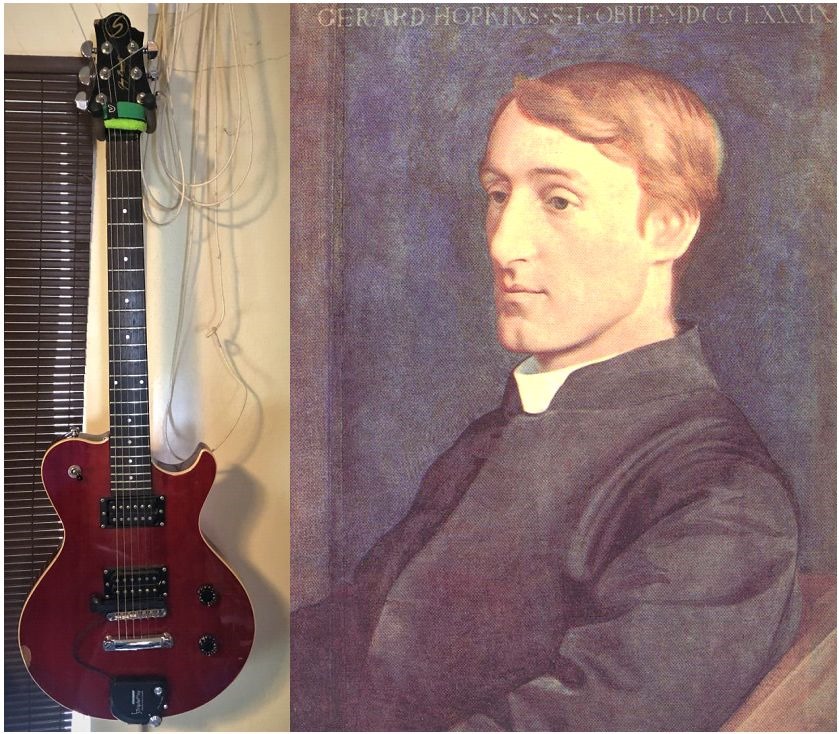
My Red MIDI Guitar and G M Hopkins

“I see only the basic material I may use…you may ask me why do I fail” I put a MIDI pickup on a cheap battered guitar that found in a used shop. David Sylvian lacks Hopkins fierce collision of images, but shares a sensibility with Hopkins in his song.


Well, all this is backward from the usual post here, were we talk about the encounter with the text used*** and then have only a line or two about the musical process, but the Parlando Project isn’t about consistency—it’s more about its opposite. Which is part of why you, the listeners and readers here are different. If you were someone who likes but one kind of music or one kind of poetry, we could disappoint you here. Our way is not the way to do it for maximum audience size, but if you’re a writer or musician—and even if wise council may be to find your style and consistently present it—an experience of alternatives can enrich that.

And then too, think of all those failed, not-quite instruments that don’t actually sound like the real thing. They sound like the exact and different failures they are.

To hear the performance of Hopkins’ poem, use the player gadget below. The full text of “The Times are Nightfall”  is here if you want to read along.


*It’s not actually a Mellotron: a rare, complicated and maintenance-requiring electro-mechanical instrument. The technology that greatly extended that concept, the modern “virtual instrument,” can more than handily represent it. Unlike the Mellotron’s single tape strips for each note, a virtual instrument can (all in software) represent different articulations and the various electrical subtleties of how the Mellotron was amplified and recorded back in the day. Even the peculiarity of the Mellotron’s notes being stored on strips of tape (not loops) that meant that after a few seconds the note would just end abruptly can be emulated or bypassed.

Music geek section: The Mellotron “VI” I used today is the M-Tron, who pioneered the idea of a software Mellotron. So far, I’m not quite grasping all its options, and I think I still prefer the Mellotron that’s part of MOTU’s Electric Keys collection.

**If you listen to “Endless Circle”  from late last month here you’ll hear how today’s piece might sound with more realistic instruments: cello, violin, piano, acoustic guitar, and vibraphone. It’s very much the same palette as today’s piece. My frank opinion today? I prefer the musical accompaniment of “Endless Circle”  and could never get a mix I was entirely happy with of “The Times are Nightfall.”  But I much prefer the vocal performance on “The Times are Nightfall”  and was unhappy with the vocals on “Endless Circle.”  In each case, I settled for the best I could do that week so that Genevieve Taggard and Hopkins’ poems could get presented.

***Hopkins’ most famous series of poems are called The Terrible Sonnets  not because they’re failed works, but because they are saturated with terror at failure and imperfection in human life. This poem has that too, but in its final section it seems to draft, in a New Year’s Resolution sort of way, a hope that personal discipline can lead one out of that state. The poem ends with ellipses, and I believe the poem may have been left unfinished by its author. My dictionary tells me that “ellipses” comes from the Greek for “falling short.” Even if unintentional, those things add meaning to the poem for me.

Though human discipline can do mighty things, it will  fall short. Whether divine or personal, some grace, some mercy, some beauty in imperfection is necessary. Thus that blessing I give: “All Artists Fail.”

Ghost Blues

The story this time is failure, diversion, randomness, and Dada. Some of it’s mine.

After the largely pleasant interruptions of the holidays, I’ve been finding it hard to concentrate extensively on new pieces. This hurts the more intricate musical compositions, research on the context of their original creation and reception, and my fresh translations of poetry not originally in English.

I’m fairly good at limiting one scourge of the modern artist: social media. I get behind on responding to comments here (bad form!), I usually put off reading the blogs I follow to once every week or so. I’ve never dived into Twitter much and have entirely avoided Facebook and the rest. Other artists have other types of engagement with these things, I wouldn’t call myself a model in that regard. Indeed, I’m sure I’ve done this project no favors with my avoidance of these things. I ascribe a great deal of the growth of this audience to random searches and the intentional work some of you have done spreading the word about the Parlando Project. Thank you. Thank you. Thank you.

So, I’ve carved out the precious time for this. And then, I get to work, a blessing many never get. And sometimes, it just doesn’t happen.

I’ve started and broken off three or four translations this month. I’m often drawn to the more hermetic poets with translation: the ones with wilder syntax, unusual metaphor, elusive meanings. I think what draws me is the same that causes one to open the most mysterious wrapped gift first. What could it be? Sure, it could turn out to be the wrong size or color, or a complete misreading of your interests, but that desire to jump into mysteries is undeniable.

But this predilection does lead to issues with my translations. My goal as a translator is to make vivid to a contemporary audience the images in the original poem. I will not usually make any attempt at carrying over the sound-music to English, but I do like to honor the thinking-music of it, the order and cadence of the original poet experiencing the matter of the poem. This intellectual melody is a great deal of the pleasure I get out of a poem that works for me: that the poet would think and express this first, then this, and finish with that. If each of those is a surprise that I can share, art has happened.

But when taking on a Surrealist or Dada poem, or a poem that claims to be based on disordered sensations,* how can I be sure enough that I grasp the metaphor, divided as always by time, language, culture, but in addition with an aesthetic that seeks to confuse or confound the reader, at least at first.

That sort of thing takes a lot of attention, more than most close readings, even before the task of finding the new English words comes in. And this month, I get only partway in and then feel lost or discouraged—and something interrupts, or my energy flags, and the house of cards doesn’t necessarily fall down, it just remains a bunch of playing cards with no architectural reason to exist.

The closest I got to completing a new translation was this poem by Hugo Ball, one of the original Dadaists. It was the fifth in his series 7 Schizophrene Sonette.

Here’s the original:

Das Gespenst

Gewöhnlich kommt es, wenn die Lichter brennen.
Es poltert mit den Tellern und den Tassen.
Auf roten Schuhen schlurrt es in den nassen
Geschwenkten Nächten und man hört sein Flennen.

Von Zeit zu Zeit scheint es umherzurennen
Mit Trumpf, Atout und ausgespielten Assen.
Auf Seil und Räder scheint es aufzupassen
Und ist an seinem Lärmen zu erkennen.

Es ist beschäftigt in der Gängelschwemme
Und hochweis weht dann seine erzene Haube,
Auf seinen Fingern zittern Hahnenkämme,

Mit schrillen Glocken kugelt es im Staube.
Dann reißen plötzlich alle wehen Dämme
Und aus der Kuckucksuhr tritt eine Taube.

At the point I set aside the translation, here’s what I had tentatively and incompletely rendered in English:

The Ghost

It usually happens when the lights are on.
It rattles the plates and the cups.
On red shoes it slides in the damp
Swaying nights, and you hear its flames.

It seems to run around from time to time
With trumps, likely to play the ace.
It’s careful with the ropes and pulleys
And is recognizable by its noise.

It is busy in the Gängelschwemme
And then its white crown wavers in the wind,
Its tines tremble like cockscombs

With shrill bells it spins in the dust.
Sudden exploding dams are torn apart
And a dove emerges from the cuckoo clock.

Almost done, but I couldn’t figure out that word “Gängelschwemme.” Any reader here have a good solution for that?**  It seems a compound word, the start having some sense of walk or lane I’m thinking and the last part may have some water connection, but as it became hard to continue my focus, the meaning seemed to tumble further away.

And so there I was, days have past, and there’s no new audio piece to post here. It was then that it was like someone spread butter on all the fine points of the stars, and things started to slip.

The image of that exploding dam. I thought of Kansas Joe McCoy and Memphis Minnie’s “When the Levee Breaks,”  a song about impending disaster. The Blues have their own Dadaist streak,*** but this song is one of those that has a fairly easy to follow plot: a singer who tells us that no matter what he (and others do) to hold back an impending flood, when it comes he will be driven from his home, child, and spouse. There’s an undercurrent to that story if you look at it a second time. He says he has a “happy home.” And surely this great flood (the song is likely a reference to a significant and damaging 1927 American flood) will be destructive. But why is he not taking his spouse and child and fleeing with them at the point when there is nothing else that can be done to stop the flood? Because he can’t? Is he an imprisoned worker forced to work on the last defenses against the flood, or is he racially or economically constrained to leave the area? Is it because even if he knows there’s little chance that his labor on the levees will keep the flood in check, he must try to his upmost anyway? Could it even be possible that he has absorbed the impending disaster in his soul and he’s ready to leave that all behind as the flood has “intended.” Maybe his happiness isn’t as certain as the awesome disaster is.

One could write a novel or short story from that song. In one’s imagination one might link that specific situation to other things. But let’s stay with the lyric impulse, the exultation of the moment.

My new diversion was to turn Ball’s sonnet into a blues. This freed me up to make some more audacious adaptations as I merged the feeling of the lyric of “When the Levee Breaks”  into another re-visioning of Ball’s poem. Doing this in a week of loud yet underexplained**** international explosions creeped into the resulting lyric too. Ball was writing his poem in 1924, but this week it seemed that a “a dove emerged from the cuckoo clock.”

Here’s the blues interpretation inspired by Ball’s sonnet:

Ghost Blues

The lights is on people, but it happens just the same.
The lights is on, happens just the same.
In the swaying nights, you can hear the flames.

Seems to run around, sometimes you see its face.
You see it time to time, see it face to face.
But when it’s got its trumps, likely to play the ace.

It’s careful with the ropes and pulleys, I can tell you boys.
It’s careful with those ropes and pulleys, I can tell you boys.
But no matter how careful, you can recognize it by its noise.

It’s busy at the spillway, white crown wavers in the wind.
Peaks are trembling like a rooster’s comb when it begins.

I heard those shrill bells, there was spinning in the dust.
When I heard those shrill bells, there was spinning in the dust.
When the levee breaks, the dams is torn apart.

When the levee breaks, the ghosts begin to walk.
When the levee breaks, and the ghosts begin to walk,
I dreamed a dove emerged from the cuckoo clock.

You can hear me take it on with a quick musical interpretation using the player gadget below. If you don’t see a player gadget (some readers don’t) you can use this highlighted hyperlink instead. In another week, it might be better performed, but it felt good to get it out during this one.

.

*Yes, some of my translation failures this month have been with Rimbaud.

**Even though my draft had a tentative idea for “erzene Haube,” I really couldn’t figure that one out either, even if I had put something down in English that I could develop as a comprehensible image. But what comprehensibility did Dadaist Ball intend?

***Part of Bob Dylan’s genius was to not only borrow from Modernist page-poetry but from the Modernist Afro-Americans and some strange folk-songs to create his revolution in song lyrics. Don Van Vliet (Captain Beefheart) also did this extensively.

If one wonders where are the Afro-Americans doing what Pound, Eliot, W. C. Williams, Sandburg, H. D. etc. were doing in the first part of the 20th century—well, the bards of Blues and the creators of Jazz were making their own revolution we are still incorporating and absorbing.

In terms of page-poetry, much of the Harlem Renaissance is still to come into public domain availability, but this insight was one I share and partially derive from them. Also, see literary figures like Fenton Johnson.

****Could it have been a poltergeist that Ball’s poem seems to be referencing?

Song from Love’s Labour’s Lost

When I select which texts to present here it’s most often an informal, beneath the consciousness, process. This week I thought I’d follow on from my last post and continue on the theme of a poet’s experience of age, but instead the events and times we live in overcame me.

Earlier I was beginning to translate a French poet, but I couldn’t concentrate on that task. Thrashing about, I eventually found myself working on this song from a Shakespeare play. After all, songs in his plays are usually diversions: a little light variety to help entertain the audience or something to help bridge a scene change. So OK, a diversion—but when I check for the context of this song in the play that uses it, Love’s Labour’s Lost, I find that it comes at the very end of the play.  Could it be a diversion then, or is it an unusual summation?

On one hand it’s a very simple song isn’t it? A short nostalgic seasonal scene, though in Tudor-England times perhaps not so old-fashioned. Winter. Log hearth fires. Warm milk from the cow freezes in the pail. Icicles. The way-paths all fouled-up with snow and ruts.

But to throw it in at the very end of a play—a comedy yes, but one that I’m told is full of reference to all kinds of political events of Tudor times—that makes me ask if more attention is required.

One thing I notice is that although written centuries before the early 20th century Imagists, it operates just like an Imagist poem: it’s short, nothing is an elaborate metaphor developed over many lines. If it’s about winter and the cold, it never says “I’m sick of this lousy winter” or “It’s so cold!” Though a sense of palpable cold and wintertime stress pervades the poem, it’s only through physical images that this is portrayed.

A few minor language tweaks and it could have been written in 1915 not 1595 or so. Robert Frost could have hauled those logs. Ted Hughes could have witnessed the herdsman blow on his hands for warmth. The song could’ve appeared in Thornton Wilder’s The Skin of Our Teeth.

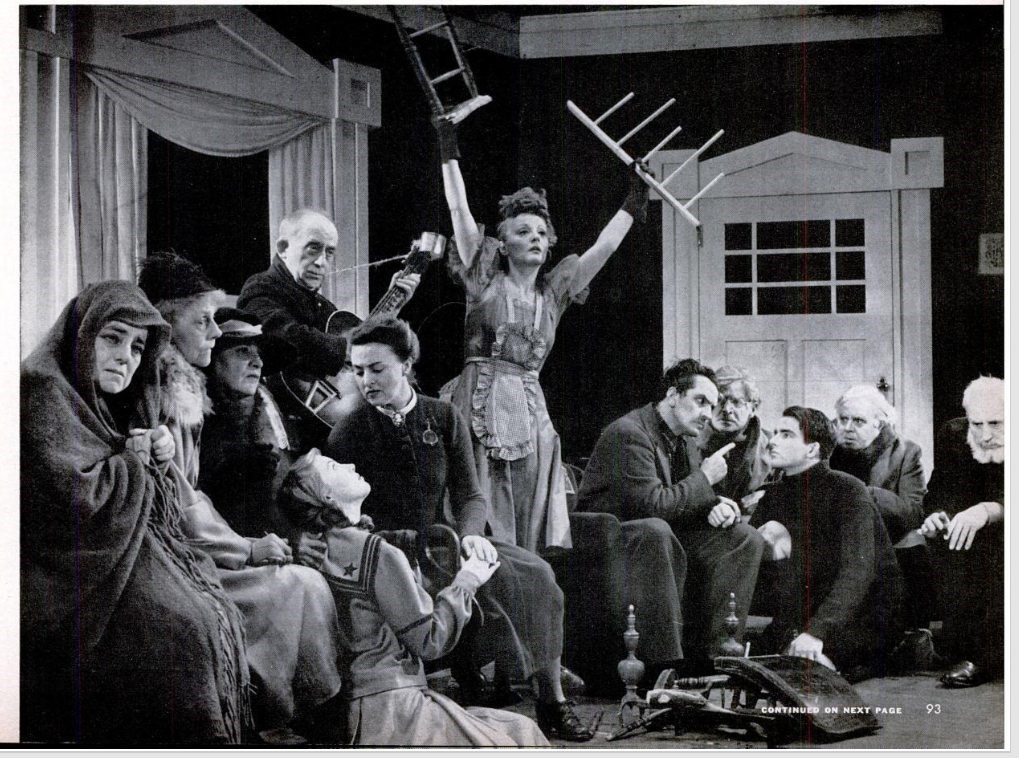
Scene from The Skin of Our Teeth2

“The ice age is coming, the sun’s zooming in.” A scene from the first act of Wilder’s  1942 “The Skin of Our Teeth.” That’s Tallulah Bankhead who’s broken up the chair for kindling.


Shakespeare’s winter song here is immediately preceded by another song in his play (the first song invoked spring.) Each song of the pair features a symbolic bird, and for this winter song we’re given an owl in its refrain,* a bird omen of unseen dread whose song, breaking with the Imagist show/don’t tell rule, is described as “a merry note.”

Merry? A little dark humor there I think. But even if that bird’s a bad omen, the fact that it’s singing means that it’s enduring. And the poem’s second and final stanza continues that theme of endurance. Everyone in church is sick and you can’t hear the sermon for the coughing (but coughing means you’re breathing, and who can tell how useful the sermon’s lesson might be anyway). The visible birds are hunkered down in feathers. There’s some crabs** sizzling in a bowl. There’s a fire. Tom’s brought more wood. There’s someone there to see greasy Joan cooking.

That refrain repeats and the song ends. Shakespeare’s play’s characters are kings, courtiers, and princesses and the plot their fancies. His actual world was full of war and deadly factions, brutal executions; a world of connivers, fools and tyrants, and even those who could combine all three. Yet, here he ends his comedy not with a wedding but with a song about modest endurance.

I think I lucked into this one this week. If one pays attention to this little song, it says something about those of us who are not kings or principal ministers.

Those who’ve endured my singing may be glad to hear this one is spoken word. The music is drums with a mix of four wintery synths played with my little plastic keyboard and MIDI guitar. The player to hear it is below. The full text of this short Shakespeare poem is here. I wish you the sustaining fires that are warm and illuminating, instead of the flames of fools.


*The refrain also features one of the more obscure words in the piece: greasy Joan is “keeling” the pot. I thought “stirring,” and there is some sense of that, though it may be particularly skimming fat off some stew.

**I thought of steamed crabs hissing, but if Shakespeare is remembering his rural Warwickshire it might not be seafood, but crabapples. Hot ale punch with floating crabapples was apparently a thing.

Winter Sleep

What age are we when we write poetry? What age should we be?

Poet Donald Hall while writing memoir in essay form after age 80 said that part of why he turned to prose was that after a certain age he no longer felt he had the urge to, or could, write poetry. I’m not that old yet, but after so many decades of writing poems I’m more likely to ask myself why this poem needs to exist.

This never occurred to me as a younger writer. It was enough that the urge was there, that the work of shaping it was rewarding, that the existence of some new set of words in some novel order representing a moment of experience had occurred. There are times when we may suppose this always is—at least approximately. We’re all our own first reader. For some of us, some of the time, our only readers. Even if we believe we’re writing a poem for someone else, that first audience is still inevitably connected with the poem’s creator.

I don’t know that there’s any pattern in that first audience disliking its own poem at times. Does one get better at crafting poems or observing experience with time? Does one get better at staying out of the way of the poem when that’s necessary? Does one get more preceptive at the ways the poem fails to meet, or cannot meet, some more perfect state? Does one just realize that some days you eat the bear, and other days the bear eats you?

A couple of years back I had some fun looking at a compiled list of the 20 most anthologized American poems of the modern era. Now of course such a list reflects any number of factors, some of which are extra-literary, such as prejudices, impact, and probably even some ivy-tower log-rolling. But still, these poems can safely be considered as successful with an experienced audience early in our century.

One thing surprised me. About half of these poems, the ones that are presumed to reflect the author’s masterpieces, were written in the author’s 40s. Six more were written in the author’s 30s. Just one was written by a writer past 50 (Elizabeth Bishop’s “One Art” published when the writer was 65). Only two were written by writer’s in their 20s (the list’s youngster was T. S. Eliot’s “Prufrock”,  completed when the author was 27.)

But how old were these poets in their souls of experience, the place from where they wrote these poems? It’s not unusual for younger poets to take on the air of more experienced people in their poems. This past fall we presented a couple of well-known and liked poems considered to be about old age: Rilke’s “Autumn Day”  and Shakespeare’s Sonnet 73 “Bare Ruined Choirs.”  Rilke wrote his autumn of one’s years poem in his 20s, Shakespeare’s was penned in his 30s.

Yet neither sounds false to this older reader.

Similarly, there are times when I’m writing that I feel younger than my years. It’s a commonplace that there’s a sense of play in the arts, something that past a certain age is increasingly rare to find in off-hand physical activity.

So perhaps you, like I, may feel unstuck in time when writing. Our writing may not be objectively timeless, but our mental flight seems so.

While thinking about these things this winter, I came upon this poem* that seemed to me to be a fine expression of the experience of old age experiencing the unsettledness of sense of age.

Edith M Thomas engraving

Edith Matilda Thomas. One thing I’ve found out: Emily Dickinson classmate Helen Hunt Jackson helped launch Thomas’ writing career.


There’s not much here today about the author, American Edith M. Thomas, who published “Winter Sleep”  in 1896, when she was just in her 40s. I don’t know that much about her yet. It’s strictly metrical and all rhymed up, but once or twice it seems to strain natural speech to make its rhyme and meter.

What’s impressive about it is that it strikingly presents not just old age, but the approach of death as an unstable state, the dream of life. This isn’t an “autumn of my years” poem—it’s a “winter of my years poem.” I immediately sought to set it to music for performance. To hear what I came up with, use the player gadget below.


*”Winter Sleep”  is another poem and poet I was introduced to by Poem-A-Day from the Academy of American Poets. Here’s a link to the text of the poem and you can sign up for Poem-A-Day there too.

Emerson’s Requiem

In the last hour of 2019 I was sitting on the couch with my son as we exchanged video clips we thought each other should see. I mentioned that Neil Innes had just died, that he was part of the Monty Python circle, and that before Python he had founded a musical group that helped inspire the Pythons called the Bonzo Dog Do-Dah Band.

“I think I’ve heard of the Bonzo Dog Do-Dah Band.”

“Search for ‘Canyons of Your Mind’”  I suggested. Sure enough, the magic of Internet searching brought up a video. “This is the most Sixties song ever” I promised.

Here’s the clip we watched.

Farcical fascicles found  “In the wardrobe of my soul, in the section labeled shirts.”

.

I wasn’t sure if I needed to provide context for it. As the performance shows they’re sending up every bit of performative anguish over absent love as well as the worship of musicians offering it. And the lyrics? They should have mortally wounded a certain kind of Sixties metaphor that was supposed to transcend our mundane world. In the middle of it Neil Innes plays a guitar solo that was likewise a pig cupid’s dart to the heart of every guitar hero moment. Anyone got the tab for that?

Son was not impressed. He had just shown me a Franz Ferdinand video chock-full of early 20th century Dada and Constructivist art moves: Max Ernst, Kurt Schwitters, Alexander Rodchenko visual riffs. In contrast, the Bonzo’s Dada lacked the same danceable drive and sleek black stage dress of the smart and sharp 21st century Glaswegian rock band.

Oh well. I hadn’t seen the Franz Ferdinand videos he showed me and I was glad I saw them. They made me think how we are still working out the Modernist revolution as we enter another decade that will be called “The Twenties.”

Early in the last week, I watched an episode of Apple TV+ Dickinson with my wife. In it Emily was crushing on Benjamin Newton over their mutual admiration for Ralph Waldo Emerson’s poem “Dirge,”  “The one where he’s on a plain with all those ghosts” as TV’s Emily has it.

That made we want to go back and check out Emerson’s “Dirge.”  What might Dickinson have seen in it?

It is 19th century Goth, right full of death and lonely love for the dead. Emerson had suffered at least as much as his early 19th century peers in terms of early deaths in his circle, and his poem is quite similar to a poem Abraham Lincoln wrote around the same time that we’ve featured here. One of Emerson’s charms as an essayist was that his mind might take him anywhere while writing one, and the reader is afterward taken along for the ride. This one-thing-after-another move can also work in poetry, but when Emerson the poet does it, it generally doesn’t work for me. “Dirge”  suffers for that.

Here’s the text of “Dirge”  as Emerson published it. The TV show’s Dickinson latched right onto that arresting image, a rural plain full of ghosts, but Emerson buries the lede, putting another stanza before it. That stanza isn’t entirely bad, indeed its abandoned field with scanty corn could have conceivably informed Dickinson’s “Summer’s empty room” in her later poem we featured this December. I tried performing the poem in its entirety, but it was running nearly 8 minutes (longer than I like to use here) and so I then decided to cut to length by removing those stanzas that were Emersonian digressions. I’m not sure that’s the right way to go, though I think the listener might prefer my more single-threaded version. In some of the excised stanzas, Emerson made the poem’s setting distinctly his Concord hometown; and the mourned, missing folks: his siblings who died young. Specificity also works in poetry, but I’m not sure it strengthens this  poem.

One more thing before I offer you a chance to hear my resulting performance. An 1850s Emily Dickinson would have been reading this kind of gothic romanticism in its moment. The element, performative or not, of contemporary personal emotion in poems was part of the change of 19th century Romanticism. Her models: Emerson, Emily Bronte, Elizabeth Barrett Browning, and others used that mode. Even Whitman made common use of it. Here’s something I find striking: Dickinson generally didn’t. Her poems make little use of sentimentality. She will use emotional words in her poems rather than images meant to invoke feelings in the 20th century Imagist manner, but those emotional terms often seem examined, observed, set to the side.

I asked my son if what put him off the Bonzos was that they were desecrating his musical religion. *

“No, you could have just picked a better one.”

Acoustic guitar and a mix of synthesizer sounds for today’s musical performance of Emerson’s “Dirge.”  The player gadget to hear it is below. Don’t see it? Then this highlighted hyperlink will also play it.

.

*Pedantically one could draw a fairly direct line from the Bonzos to early Roxy Music to “Anarchy in the UK.”  But no more footnotes today! If I’m going to excise Emerson’s digressions, why should I give myself license?

Endless Circle

Here’s another poem by the lesser-known American poet Genevieve Taggard. Taggard was sometimes classed with a group of woman poets of the first part of the 20th century, all of whom suffered from the rise in the 1920s of “High Modernism” that held that longer poems with elevated metaphors referencing prior literature and art were the mark of seriousness in poetry.

Robert Frost* was able to hold out against this to some degree, but most female poets had a harder time of it. Three poets I’ve presented here multiple times: Edna St. Vincent Millay, Sara Teasdale, and Elinor Wylie all suffered from this change in the culture. Before this change in our last century’s Twenties, they were all prize-winning American poets, and all had achieved a reasonable degree of readership and fame. Somewhere nearing 100 years ago, all of these figures started to be classed as writers of unserious work: merely pretty verse. By the second half of the century when I went to school none were taught in my classes. Not part of the canon.

The poet, professor, and blogger I’ve referenced here earlier this year, Lesley Wheeler, recalls the term “The Songbird Poets,” which exclusive of it’s dismissiveness seems apt to me. The whole idea of poetry as song rather than an impressive castle of elaborate and complex images was in retreat—but all of them could write the kind of short poem that sings off the silent page. I can’t resist turning up the volume on them for this project.

Was their gender part of the downward reassessment? No need to make too fine a point about it: yes. To the degree that the critics and canon formers had an objective criteria, it was to see an excess of emotional content in their work, and they wished for a poetry where rote sentimentality was reduced or eliminated entirely and where overt emotional language was replaced by states revealed in those complex and often academic images.

But one can’t take emotional content out of art, whose whole Unique Selling Proposition is to transfer the experience of experience between one mind and another.  Those who’ve followed our yearly April dive into that High Modernist checkpoint T. S. Eliot’s “The Waste Land”  know that it has a harrowing emotional core, so harrowing that Eliot himself seemed embarrassed by it later in his career. By the time I was introduced to it in the second half of the 20th century this aspect of that medley of lyric poems was absent in the syllabus.

I maintain that song, the word-music of a poem, its structure, order, and how it rhymes its observations, can (just as much as some cool classical image formulating an objective correlative) powerfully contain and convey emotion. “The Songbird poets” were vastly underappreciated for the complexity of their examination of emotion and the human condition. Let us judge these means again as we look at Taggard’s poem. We may be able to look at these works and see what the previous generations couldn’t appreciate: The form her verse takes here is integral to the impact of this poem.

Endless Circle Text


This is a poem that holds itself in a mysterious balance, a Mobius loop of a story fulfilling its title. My reading of it is that it’s a love and death poem that portrays neither as final by its spare and graceful text. As I understand it, it opens with lovers under a tree, who by the second stanza have aged and edged into a death, a transition they mark “laughing and leaping” as if rebirth into youth.

The first verse is then repeated, and I’m feeling it ambiguously. Are they a new generation of young lovers under a tree, fated to love and weep, or has the poem’s singer moved on to a new love, a new desire fated to end in weeping—or are our lovers buried under the tree now, their spirits recalling life?

I don’t always know where the musical accompaniment ideas come from for this project. Sometimes I realize after the fact that I’ve been channeling some musical idea subconsciously. After I finished the mix on my performance of Genevieve Taggard’s “Endless Circle”  I suddenly realized that I may be musically recalling The Incredible String Band, a Scottish group from the weirder fringes of “The Sixties.” I admired their asymmetrical and unafraid to wander song structures and their wide-ranging combinations of various instruments, but I’m always hesitant to recommend them to others because their vocals are (like mine often are) more than a little pitchy.

If that part of my music here bothers you, today’s piece will then. This piece called out to be sung, even if mine is the only voice I have available to sing it today. The player to hear “Endless Circle”  is below.


*William Carlos Williams also fought against this, but he seemed to have felt this academic turn hurt his work’s standing. Marianne Moore is a conspicuous example of a woman who was able to buck the trend by writing every bit as cool and hermetic as any of the Modernist men. Frost himself seemed to write fewer of the short lyrics that his early books featured and turned to longer blank-verse narratives. And another Parlando Project favorite, Carl Sandburg, mixed in longer, more Whitmanesque epics, and turned to his Lincoln biography.

Over in the British Isles I don’t think things worked out quite the same. Why this might be is too long a subject for this post, much less a footnote.

**If you want to read a long impression of what it’s like to listen to an Incredible String Band Sixties album with an open mind and an ambiguous conclusion you could click here: “Makes Syd Barrett sound like Neil f’ing Diamond” it says. Or if you’re too young for that writer’s simile to hit home, think of the weirdest chronic-infused hip-hop mix tape you could imagine, only it’s played by two white guys and their girlfriends on a shed-load of acoustic instruments instead of samples and loops, and autotune clearly hasn’t been invented yet. Or if you’re brave, you could take the adventure and listen to one of their records yourself. Yes, an excess of “canyons of your mind” hippie naivete in the lyrics too, something that Taggard’s form and concision here contrasts with, but there may still be some charm in their work since there’s little danger of it taking over the world these days.

Odds and Ends

I’ve not engaged much in re-blogging, but two pieces I’ve read this week really struck me: one for an idea and examples of how it might be executed, and the other for a sharply-written essay on a novel from the same early 20th century era that much of the poetry we use comes from.

The idea? A professor and poet Lesley Wheeler, who teaches a course in American poetry from 1900-1950, gave this assignment in lieu of the conventional essay: “create 8 pages of a little magazine from the period, including a cover, masthead, mission statement, table of contents, and a few ‘solicited’ submissions (mostly real poems from the period, but they were allowed to make up one or two plausible imaginary modernists, too, and write poems in those personas). They also had to write reflective essays explaining their literary and design choices and providing a bibliography of models and other sources they consulted.”

That’s a powerful idea. She shows examples of some of the responses to the assignment, and I’d love to see more of what the respondents chose to do. No one lives in history, even those old dead people were immediate. Here’s a link to her post.

The essay came from an unexpected source. I follow a blog Yip Abides  that features unusually framed urban-midwestern street photography, a genre that follows the photographic aesthetic of my late wife. He also likes to feature videos that have impressed him, often animation. Visual art and musically oriented blogs are a large portion of my follow list as my own portion of reading on literature is taken up almost entirely with things that directly apply to material for this project.

But this week, there was a post there about The Virginian, a novel I’ve never read, but one of that helped formulate a genre, “The Western,” that dominated popular entertainment in the mid-20th century much like a certain kind of SF/Fantasy dominated the last part of it and the beginning of our current century.

The blogger, Bob Roman, writing about The Virginian  ranges perceptively over the areas I’d want a writer to cover. What’s the connection between the cowboy “necktie party” and KKK style lynchings and murders?* How much does the American frontier underlie some particulars in contemporary libertarianism? And there’s more. Well worth reading, and here’s a link to it.

And before I leave to write another post on a new audio piece, a few miscellaneous follow-ups on things discussed earlier in the year.

How has Apple TV+’s Dickinson  turned out? This is one of the premiere offerings of the tech giants new video streaming service, and its over-heated pre-release trailer emphasized a conceptual strangeness that made many dismiss it as a deeply unserious piece of muddled youth pandering.

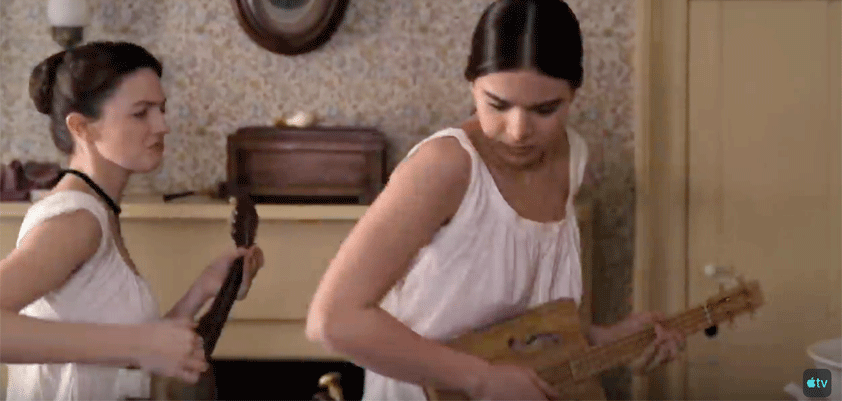
Sue Gilbert and Emily Dickinson rock out

Rebel Girl thinks she’s the queen of the neighborhood. I got news for you: she is!”


I’ve now seen the first episode, and so far it seems to be what I’d hoped it was: a tongue in cheek re-contextualizing of Emily Dickinson’s life which both comments on her actual mid-19th century issues and our own times. Last year’s theatrical film Wild Nights with Emily  tried to do something like this and had its moments, but I thought the overall execution flawed. Wild Nights with Emily  and Dickinson  are both comedies, but it was as comedy that Wild Nights  failed, its portrayals of Thomas Wentworth Higginson, Helen Hunt Jackson, and Mable Loomis Todd were all too broad. True, they are peripheral characters in Wild Nights,  but that too was a choice. As best as I can tell from one episode Dickinson  doesn’t make those choices and is the better for it as a comedy. The characters of Dickinson’s world are more rounded portrayals.

The first episode was full of little footnote-quality accurate factoids about the Dickinson family—the creators apparently wanted to show they had done their research. Two choices Dickinson  appears to make could work or fail as the series continues: It may have trouble showing why Dickinson matters and it makes the choice to play Emily Dickinson as younger than she was.

At least in the first episode, Dickinson is represented as being recognized by some in her peer group as “a genius” and a few lines of one of her best known poems are repeated almost as often as the hook in a current pop song, but we so far get no sense of why her poems are crucial. This may change over more episodes of course, but it’s always hard to show what a writer does visually. If you do a biopic about a great performer you show an actor portraying them performing, if the simulation is good you’ve made your case. Watching someone write, or how that writing works inside the minds of readers, is not so easy to act.

The first episode seems to be set in 1852, when Dickinson was the age that actor Hailee Steinfeld who plays her is in real life, 22 years old. But this is before Dickinson wrote most of her poems. Chronology seems to be a difficult issue for filmmakers trying to portray Dickinson’s life, but if the show works, I’m willing to grant them license for being loose with that. More problematic is that they appear to be portraying Dickinson as a teenager rather than as a 20-something, much less the 30-something that apparently wrote much of the poetry. I’m aware that different times had different norms for childhood and youth, but were 22-year-olds acting more like 16-year-olds in 1852? I couldn’t help but think the history they were unintentionally demonstrating was the TV and Hollywood practice of having high-school age characters played by 20-something actors.

I’ve had to live through an era when Dickinson was thought of as an arid eccentric, frustrated spinster, and even as a corrective I’m not sure I want her now to be portrayed as only the hormone-saturated brain of our adolescences either. We’ll see how they deal with that as the show goes on.

The knowing comic anachronisms and indie soundtrack? Bring’em on! The Parlando Project obviously isn’t opposed to purposely doing that kind of thing.

In closing then another thing relating to a recent presentation of a Dickinson poem here. What might be behind that striking image of windblown snow starting to fill a field as “summer’s empty room” in Dickinson’s Snow  poem? Well, it was one of those poems she enclosed in letters (one of Dickinson’s contemporary uses for her writing). This one went to Susan Gilbert, the woman some modern scholars posit was her lover, and who was certainly one of the intelligent intimates that helped sustain Emily. I think that was an image of longing in the otherwise “winter wonderland” mise en scène of Dickinson’s poem.

An audio piece? As we approach winter solstice, here’s one of my favorite Dickinson presentations from this project, “We Grow Accustomed to the Dark.”  The player gadget is below.


*White-on-white lynchings and extra-judicial killings were a common trope in Western movies and TV shows of mid-century, while terrorism directed at Afro-Americans was almost never the subject of popular entertainment. Consciously or subconsciously, this could have been American culture trying to address that which it was loath to address.

The most popular Parlando piece for Fall 2019 is…

We’ve reached the top of our seasonal top 10 covering the pieces you most liked and listened to over the past three months, but before I reveal the top piece, let me cover one other area.

I know from growth in the audience that some of you are new to the Parlando Project. Because of that, every so often I should explain what this project does. We take words, mostly poetry, mostly other peoples’ words, not our own, and combine them with music we write and perform ourselves. Sometimes we sing the words, sometimes we don’t, sometimes we split the difference somehow.

By intent the poetry we use and the music we create for it varies. Most texts are used under public domain rules.*  What kind of music do we use? I try to make it a whole lot of different. I’ve never been able to answer the simple-sounding question “What kind of music do you like?” because the idea of liking one kind of music is just not in me. So be aware that you may run into music here that you don’t care for, either because of our limitations as musicians or your own tastes and expectations—and that may happen right after a piece you liked. The same applies to the words we use. There are over 400 examples of what we do here in our archives, so you can move on and look at another one anytime. If you wonder if we’ve presented a poem or author, search here and see.

OK, so who sits atop our Autumn 2019 hit parade? William Shakespeare that’s who. That’s no surprise considering that it’s his Sonnet 73 which begins “That time of year thou mayest in me behold” (but which I’ve always thought of as “Bare Ruined Choirs”  for its most famous image)—one of the longest-famed “autumn of one’s years” poems in English.

Shakespeare Sonnets1609 edition Title Page

Let England Shake-Speares. The title page of the first printing.


I wrote at some length about my experience of the poem in my original post here, but I’ll reiterate only one point: even though this poem resonates with many older people and older lovers in particular, it was written by a man in his early 30s. Consider all the exegesis of Shakespeare’s sonnets that seek to tweeze out his sexuality, incidents to fill out his biography, or the identity of the fair youth, the dark lady, or “who really wrote Shakespeare,” and consider that they were written after all by an actor and a famously prolific creator of opposite and varied characters. I too want to invest those sonnets with his experience, to believe that this great artist is letting me see his heart. How much is intentionally or unintentionally “real,” and how much is a good illusion? We may never know, but we have the art none-the-less.

Here’s the player to hear my performance of Shakespeare’s Sonnet 73 “Bare Ruined Choirs.”  And a sincere thank you for listening and reading this fall. I hope that some of the pieces we’ve presented have pleased you and illuminated some matter or another.


*This means that the poetry is usually from before 1924. I happen to like (and have grown to like even more via this project) a good deal of early 20th century Modernist poetry, but we’ll jump around to older stuff than that too. While we’ve done many of “Poetry’s Greatest Hits” over the years, I’ll use lesser-known poets and poems when they strike me as interesting.