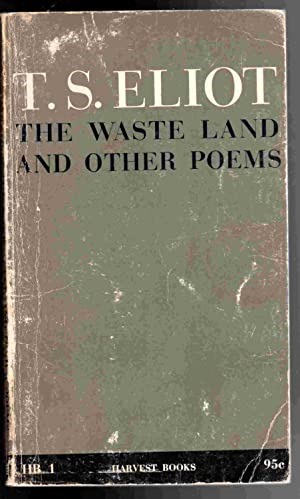
It’s April, time to celebrate U. S. National Poetry Month! We’ve had a tradition here over the past five Aprils of performing “The Waste Land” in serial-installment fashion, and now this year we’ve come to the landmark Modernist poem’s final section: “What the Thunder Said.”
Since the Parlando Project officially launched in August 2016 it’s been a tremendous effort to lead this exploration of a variety of poetry and ways it can be performed with original music. Last year we crossed the 500th piece threshold — an incredible achievement in creative productivity that I’m often proud of. One could spend hours here just exploring the poets we’ve featured and the ways we’ve performed their work. Though I expect most listeners will enjoy only a portion of what the Parlando Project does, I’d say this month is a good opportunity to wander randomly through our archives or use the search function to see what we’ve explored.
Putting a little worn patina on The New, The Modern…
.
I am a little sad and a fair bit intimidated in reaching this section of “The Waste Land,” the ending. It has become harder for some uninteresting reasons to keep up this project’s pace, but as I come to this April, I know I’m going to miss my annual return to the sprawling collage that is Eliot’s great poem. Though I’m hugely grateful for the ability to come this far, sadness is all around me, friends and relatives in suffering situations that I’m unable to address or help, and a sad tribunal is taking place a few blocks from where I sit and write.
I’ve always found this section of the poem a confrontation with sadness, and as it largely removes the masks and personas that have peopled the rest of the poem, I think it’s the most difficult to perform, both for audience-effectiveness and because the performer should/must confront that element inside themselves.
I’ve always found this section of the poem a confrontation with sadness, and as it largely removes the masks and personas that have peopled the rest of the poem, I think it’s the most difficult to perform…
As dysfunctional and damaged as they may have been, today’s section of “The Waste Land” transitions us from the unreal city, its duplicitous characters, and the sweaty faces and the hubbub of “He do the police in different voices” sections, and begins to move us to the titular waste land that will be the stage on which that final confrontation with sadness will occur. Musically, I open this with an urgency as the battle is about to begin. And so, to hear my performance of the first part of “What the Thunder Said” from “The Waste Land” you may be able to use a player gadget below. If you don’t see the gadget, this highlighted hyperlink will alternatively play it.
Thank you for reading and listening. Over the rest of April, I plan on pressing on to the end of the poem, and to present as much other work here regarding the sister arts of poetry and music as I can. Click follow or come back, check out the other things here, and spread the word about this Project. Those of you who’ve done that are what keep this going.
Wait, before I reveal that, let me take a moment to describe what the Parlando Project does: we take words, most often other peoples’, most often poetry, and combine them with original music and present them to you as audio pieces.
I’ve chosen to use other peoples’ words almost entirely because I’m most comfortable writing about that transaction between a writer and myself as reader, composer, and performer in the midst of passing something on to you as another reader and listener.* The project doesn’t use poetry for every audio piece, but I like pieces with some mystery and ability to create an impact in less than 5 minutes, and poets are the ones that do that.
The music you hear is created for this project. I don’t use library music or borrowed music, and except for computer drums, I don’t use samples or canned loops. For better or worse, most everything you hear was played or scored by a real person.**
I don’t always make these combinations of music and words “songs” in the traditional sense — though our modern sense of song has changed so much in the last few decades that “song” has become a much looser expectation anyway. I try to make my musical settings as varied as I can, which means that I expect some will be more to any single listeners’ taste than others.
Now I’ve caught up any new visitors on the Parlando Project concept, we can complete our Winter ’20-’21 Top Ten Countdown with the most popular piece.
1 End of the Sky by Frank Hudson (after Thinking of Li Po at the End of the Sky by Du Fu). OK, this one used my words, though I based it off a classical Tang Dynasty Chinese poem. Since I wrote it last autumn, the meaning I extracted from Du Fu and attempted to convey in my modern English extension of his poem has only deepened in resonance for me personally. When it was written I was thinking about a small group of poets that I’ve met with every month for more than 40 years to discuss our work. I’m the youngest in that group by a short interval and we had all been writing for more than a decade when we first met.
More than a half-century of writing for each of us, yet I think of myself as less accomplished than the rest of the group — viewed objectively from amount of publication and such this is certainly true — but I wonder too if they ask their own version of the questions I ask myself about what’s valuable to say and what we may construct to justify a readers time and attention. Du Fu seemed to be dealing with some of those feelings in his poem addressed to fellow poet Li Po.
The poem’s statement, my attempt at faithful translation from Du Fu’s Chinese: “True literature doesn’t care if it is popular, and/It is only demons that care about a poet’s failures!” is one potential answer to those concerns. Poetry may be what we most care about, but the world cares less than that, and in that is a freedom. “How much difference does that make at this late date?” I ask in addition, a line only implied in Du Fu’s poem. And at the age of the poets in my group, “late date” is a general concern.
Since I wrote it, how has this poem changed for me? Those general concerns have been promoted in imminence. I’ll say in too-brief: two are dealing with existential illness. Loss can be at any hand for all of us. Will it, or any of us, be patient?
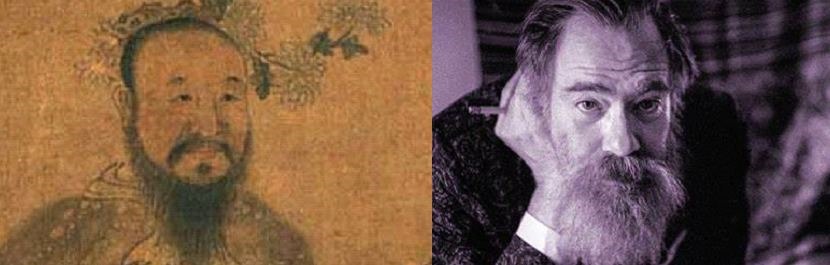
Du Fu’s poem concluded with an understated but devastating conclusion, something I often find in his work. He writes, our creations and our cares about our creation are like a customary gesture that would’ve been known to poets of his time and place: throwing poems as a gift into a river where a Qu Yuan, a Chinese poet from the past had leapt to his death.
They both ran out of patience. Do you see some resemblance? Qu Yuan and John Berryman, “…who was once handsome and tall as you.”
.
My modern English solution to my poem’s ending echoes Du Fu’s superficially, but differs in detail. This is what I meant to convey in my conclusion: Berryman’s mental illness and chemical dependency — fed by his doubts, feeding his doubts — weren’t his art or some driving force for it, for they understood none of that.
Say that, then, to your doubts: you don’t understand my art! Work instead to make your work more whole for yourself and for some potential audience, no matter how small. All doubt and self-abnegation can do is take away — and life and fate will do that for you anyway, it doesn’t need your help.
The player gadget to hear my performance of “End of the Sky” is below. If you don’t see the player, this highlighted hyperlink is an alternative way to play it.
.
*When I write or talk about myself, and later look at what I said or wrote, I almost always cringe. In only a short remove of time it seems disproportionate, self-involved, and vain. Every artist must have, at least episodically, some level of elevated self-regard, but for me that self-regard is always being chased by another that reminds me of my follies. I’ve lived a long life, and neither of those two have stopped running, an endless chase, which has allowed me to create — but as the pursuer and their prey, I’m often out of breath by the time it comes to talk about or promote it.
**Early Parlando Project pieces were often live band recordings, but with age, change, frailty, and finally the Covid pandemic, they’re increasingly all me multitracking myself. Computer drums are a compromise I’ve perhaps too easily fallen into.
Let’s pickup the countdown of the pieces that drew the most listens and likes over this past winter. Each bold-faced listing is a link to the original post on the piece in case you’d like to read what I wrote back then, and those original posts will also contain links to the full text of the poems used.
7 Thursday by William Carlos Williams. Quite often when reading through early 20th century Modernist poetry, I repeat my surprise of how plainspoken and outwardly simple some of it seems. This poem by Williams is one of those. There’s not a single word in it that would be unfamiliar to a grade-schooler. One need know no complex allusions to anything other than ordinary life. Not all his contemporaries wrote like this. Wallace Stevens will pleasingly stump us with his love of obscure words, T. S. Eliot will ask us to consider how history rhymes its myths, and William Butler Yeats will make English sing with beautiful and metrical word-music. Against that sort of thing, this poem by Williams may seem ordinary. As ordinary as a Thursday.
There’s only one bit of word-trickery in it — and having no other in this short poem should invite us to ponder it: that unusual use of the common word “carelessly” in the context of “I remain now carelessly/with feet planted on the ground….” Carelessly? Huh? How many quick readers would slide over that and not notice anything out of place! In the opening of his poem Williams has told us his dream has come to nothing. Is this dream one of our ordinary nighttime hallucinations or a strong and potentially life-changing imagination for the course of things? He doesn’t say and may perhaps mean either. His stance on this? Back to observing the world standing simply and unmoved with both feet on the ground, “carelessly” in the sense of “without a care” regarding that; with the sense also that the overlords of guilt and ambition or the lure of more surreal and spectacular verse are saying he should care and he’s going to ignore them.
In place of that care, of that “tyranny of the shoulds,”* Williams offers us ordinary life, ordinary words, the meditation of breath. That resilience and carelessness, those two steady feet able to stand up to the sky, is this song. You can hear it with a player gadget that may appear below, or with this highlighted hyperlink that will also play it.
.
6 I wake and feel the fell of dark by Gerard Manley Hopkins. What a combination this makes with Williams’ poem that it happens to sit next to in our countdown! Hopkins’ poem has its speaker also awakening from a non-productive dream “Hours I mean years, mean life” — this dream is clearly both a nightly and a life’s dream. And he’s in the opposite of careless: roiled with distress and self-disgusted guilt over it.
What a combination this makes with Williams’ poem…
The language here is extra-ordinarily charged. Some of us have had such a self-castigating night, but few of us could express it in such a tight compressed form as a sonnet that moves musically and emotionally. Hopkins’ feet are not firmly on the ground at all — he’s rolling and tumbling as the great American floating Blues verse has it — and that’s the nature of Hopkins’ song.
This is the distress half of the engine of the Tao. We may more easily recognize it quickly as great poetry, and should, though without some balancing aspect it cannot long whirl.
My performance of this greatest of his “Terrible Sonnets” can be heard with this hyperlink, or in cases where it appears, the player gadget that may be below.
.
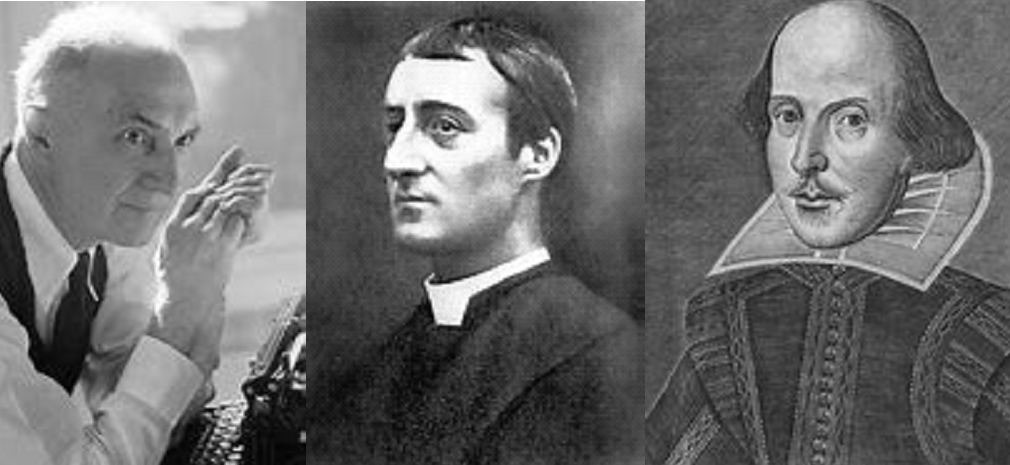
Collar styles of poetry, a retrospective. William Carlos Williams, Gerard Manley Hopkins, and William Shakespeare
Well, the jury’s still out on that one. It is always so with art, as art happens in the present when we look, read, listen, hear. That’s a large part of what this blog is about: encountering stuff written in various ways and times and seeing what we can make of it in the immediacy of a musical performance.
“Sonnet 97: How like a Winter hath my absence been” is neither the calm meditation after a dream’s failure nor the roiling disgust our first pair of poems had. Instead, this sonnet is all about the ambiguity. What kind of ambiguity? Shakespeare will pick several. One of the basest tests of mental state is “oriented to time and place.” This poem certainly isn’t — that’s its most pressing point. Is it winter, summer, fall, or spring? Can’t say for sure. The purportedly male authorial voice dons rhetorical drag and speaks of his sonnets as if they are birthed from a poetic womb as if the addressed “fair youth” is the only begetter in a very patriarchal metaphor for these sonnets. And what’s the true nature of the relationship between that authorial voice and the fair youth being addressed? Complicated. Author as vassal of the ruling class?** Lover? High-minded patronage? Some of all? Well, that’s Shakespeare’s song for us. This hyperlink will play my performance of it, or if you see it, you can use a player gadget that may appear below.
.
*The phrase is psychotherapist and author Karen Horney’s, whose mid-20th century work may still have something useful to say about us today.
**It was while dealing with this sonnet that this aspect of the “Fair Youth Sonnets” first occurred to me. I assume it’s occurred to others, but not being a Shakespeare scholar I can’t say who or where.
I’ve been tardy in many things for this project lately — but let me get on to recounting which pieces were most liked and listened to during the past quarter.
It may be a bit strange to revisit a winter we are glad to be emerging from, but poetry is about remembrance of all kinds of emotions and experiences. Which ones did the Parlando Project readers and listeners most connect with?
As we usually do, this is a countdown, so we start with the 10th most listened to and liked piece, and then over the next few posts we’ll move on to the most popular this winter. The bold-faced titles are links to the original post that introduced the piece in case you want to read what I wrote then.
.
10 Trifles – I Know What Stillness Is by Susan Glaspell. I wanted to do something special for this project’s 500th audio piece, and I decided to try to use some words from my distant relative who was herself a figure in the Modernist revolution of the early 20th Century that I mine for many of the pieces used here. Glaspell is not a poet like most writers I present, but this short scene is from what remains her most famous work: a still effective short play about two women who have accompanied their husbands who are charged with investigating a murder* in a remote 1900 Iowa farmhouse. At this point in the play, we know that a farmer has been strangled there and that his wife, Minnie, has been taken into custody as a suspect, even though there is some doubt that a small, quiet woman could have had the motivation and strength to commit such an act.
While the men continue their very official investigation, the two women discover a dead canary entombed in a fancy box and connect it with the lonely life of the farmwife. Should they tell their husbands what they found?
I solved a difficult problem by treating this scene as “poetic” enough to work with the music and then locating a dialog performance that let me avoid trying to do the voices of the two women myself. I’m also quite proud of the music I composed for this one. You can hear it one of two ways: this highlighted hyperlink, or for some of you, a player gadget below.
.
Susan Glaspell getting her work done. Per the radio-play practical audio-effects tradition: in the wintertime it’s nice to sit next to the crinkling cellophane and work on your manuscript.
.
9 The world is a beautiful place by Lawrence Ferlinghetti. I bent the rules to publish this older performance that Dave Moore and the LYL Band did with my off-the-cuff reading of a piece from Ferlinghetti’s A Coney Island of the Mind collection that so many treasured decades ago. These words are not in the public domain, and I had never received a reply when I sent in inquiry about presenting them here a few years back, but on the occasion of Ferlinghetti’s death I felt I had to share this with you, some of whom are among those that treasured those words.
But maybe some of you hadn’t “met” Ferlinghetti’s words before. Buy or read his book and meet more. Perhaps a few of you have an idea that the label “Beat Poetry” requires a dour and slack protest, a litany of muttered and solipsistic defeat. Maybe that’s not so.
.8 Escape by Georgia Douglas Johnson. I still know little about this “Harlem Renaissance” writer who wasn’t actually located in 1920s New York City. As time for this project gets harder to locate, I still hope to remedy that. Despite my deteriorating ability to complete new pieces, I made an extra effort this year to do work celebrating Black History Month this February, using work found in the landmark The New Negro anthology published in 1925. “Escape” was the one that found the most favor with this Project’s current audience.
Musically, I used the magic of MIDI “virtual instruments” to pay tribute to the Afro-American fiddler tradition, playing the featured violin part on my MIDI pickup guitar. At the end of the recorded performance, I tacked on a verse by the altogether unrelated Moondog, a musician who ironically was connected to New York City. Here’s the link to hear my performance, or if you see it, you can use the player gadget below.
.
*Glaspell was able to use her earlier reporting on an actual Iowa murder case as matter in her ground-breaking play.
Sunday is World Poetry Day and I should do a piece about poetry and poets to mark it. The specific idea of World Poetry Day is to celebrate every nations’ poetry, something I try to do here with fresh translations sometimes, but for today I’ve decided to use works by two American poets. The United States is still a young nation, still used to using the cruder tools of youth to impress itself upon the world, but our poets have had their innings, so today I’ll sing them to the rest of the world. First up: Wallace Stevens.
It’s not uncommon for poets to write poems about art or the art of poetry itself, but Stevens did this often. So it’s no surprise that “A High-Toned Old Christian Woman” starts off with an assertion about poetry, even though the rest of the poem seems to progress into an argument about religion and religious propriety. Here’s a link to the full text of Stevens’ poem in case you want to follow along.
Stevens’ poem slows down our understanding of what it means using two tactics. First, it gives us at best one-half of a conversation: a little like hearing a person talking on a phone in public where the other party is inaudible. It takes considerable effort in comprehension to settle on what issues and points are being addressed in the poem’s speaker’s argument. I’m not totally certain I grasp them myself despite several readings and going on to perform the piece. Our high-toned old Christian woman may be expressing outrage at some more pagan and unfettered artistic expression on Stevens’ part. Stevens’ response is to point out that art has its own religion of a sort, its own myths and beliefs. That unheard party, the HTOCW, seems to make an objection regarding Stevens’ or art’s outrageousness derived from its beliefs and theoretical constructions, and Stevens’ then parries with a short aria on the extremes of Christian asceticism bellowed over a tink-tank Vachel-Lindsay-ish Salvation Army band. In summary he’s claiming they are alike: that the HTOCW and her co-religious cohort and he the poet both have their own guiding constructions (supreme fictions), their own expectation of meaningful belief and actions that promise — well, what do they promise, or rather assuredly deliver?
He’s not sure. A poet’s masque (a play) performed on earth may aspire to cosmic importance, but we can be sure the planets will not be all that moved. And the most fervent displays of religious piety can’t move the heavenly spheres who would at most judge them as unserious “hullabaloo.”
The second way Stevens intentionally slows down our comprehension is with language, the stuff and lexicographic music of his poetry. Most any stanza of a Stevens’ poem is equal to a “Word-A-Day Calendar,” and this poem doesn’t disappoint: nave, citherns, peristyle, masque, epitaph, flagellants, muzzy, and hullabaloo are not common modern English language words, and I’ll wager that most readers, even the most educated among us, would be hard pressed on getting 100% on a definition test with that list.* I’ve always “read” Stevens as having fun with his use of these obscure words, and in many cases here he’s punning on their sound, so we think we understand something we hear in a performance from the sound, while on the silent page they remain stumpers. Making someone a nave/knave is to fool them. A peristyle projecting upwards sounds like a periscope from a WWI U-boat or trench. A masque might as well be a mask. Flagellants with muzzy bellies sounds like flatulence from fuzzy bellies.
And while not an obscure word, “palm” is repeated several times in the poem with different meanings pressed onto it by context. It first seems to be Christian praise, as in the arrival of Jesus into Jerusalem on Palm Sunday, a moment of triumph to be followed by Good Friday (and then, yes, for believers, Easter). In its second mention, the poet might earn laurels, palms of honor for their work, but like the praise of the crowd it may be fleeting, pace what I call Donald Hall’s Law. And lastly, the palm plants become hands I think, the two seemingly opposed, the two sides — the prim believer and the pagan poet that the poem has satirized — I believe, palm to palm, a pair making a prayer.**
Let’s look at the poem’s end at last: Stevens seems to be saying that salvation by faith in art or religion is unclear. Widows wince when doubt says they may not meet their husband in heavenly reward or when that doubt (or belief) is sung impiously by some poet who calls his art, his mythology, the “Supreme Fiction.” God and the muses are both winking at us, telling us that we only half have an understanding, flirting with us on that unknown stage of our best fictions.
Stevens was a famous late-starter, publishing his first poetry collection Harmonium where AHTOCW first appeared at age 44. Millay was already on to her second collection featuring First Fig at age 28.
.
What then to make of the poem I combine with it, a short poem with plain words that many feel they understand at first sight: Edna St. Vincent Millay’s “First Fig,” the one that begins, as so many have memorized, “My candle burns at both ends.”*** Is this not also a poem of faith in poetry? Yes, with the same limits and lack of assuredness. Is it also one half a debate with another point of view? Yes too, though it be a short epitaph “unpurged from bawdiness.”
In effect, “First Fig,” the opening poem in Millay’s A Few Figs from Thistles, is the title poem, the dedication of that short collection that set out the Millay outlook on youth, freedom, and autonomy sexual and otherwise. It made her famous for a while, and unlike Stevens’ knotty poems, hers (and herself) seemed understandable. Here’s its full text.
We understand this poem quickly to say: that one may, from our passions artistically — or otherwise in that mere and yet larger life — expend or risk so much that we allow it to be foreshortened, but that we believe that intensity is illuminating, possibly worth the sacrifice. Note, there’s no explicit conclusion. Millay’s poem doesn’t say outright it’ll be worth it, and other poems in A Few Figs from Thistles are not sure either. Its illumination is brief, a night in length it says. Yet a poem we think we understand, that we might memorize and carry in our muzzy brains may change as we project its light on different walls.****
Given Stevens’ satiric and philosophic wordiness, I came to think pairing it with Millay’s short heart-song would be a worthwhile contrast, each stronger with their lights against the ground of the other. You can listen to the performance and see if that’s valid — but before I go, is there one thing we don’t understand about Millay’s short poem?
Well, there’s the title. It’s such a short poem, yet we forget that there’s this added pair of words. I’d guess that many that know or have even memorized the poem forget the title. One thought was that it might be referencing an idiomatic English expression: “I don’t give a fig about…” which could easily be given an intensifying modifier “I don’t give a single (or the first) fig about…” I had assumed that fig, like the euphemistic interjections sugar or darn, was just a word used to replace a ruder word that started with the same letter-sound. I even wondered: was that idiom around when Millay wrote her poem in 1920? Well, just as I wouldn’t know muzzy or cithern fully when I read Stevens, it turns out I was off a bit. The idiom seems to date back to Shakespeare’s time or even more, which is odd in that the fig isn’t even a native fruit in England. It comes from Spanish and Italian; and it’s not only a word but it has a Mediterranean hand gesture to illustrate the thought, involving the thumb placed between two raised fingers. The intent in gesture or word in this idiom is to refer to low pink-toned lady parts, and in the patriarchal context then it’s an expression of contempt.
Did Millay know the derivation of the idiom? I don’t know — but she likely knew the non-etymological meaning of the phrase. In the context of the one-side of the debate that “First Fig” is presenting, that indicates that the speaker doesn’t give a single fig for the off-screen speaker who disapproves of the possible costs of passion.
Long post, but two poems for this World Poetry Day! The player gadget is below, or if it isn’t, this highlighted hyperlink will also play my performance of Wallace Stevens’ “A High-Toned Old Christian Woman” and Edna St. Vincent Millay’s “First Fig.”
.
*Ones I’d miss or get half-credit for? I knew citherns were an instrument from my interest in unusual instruments, but I wouldn’t be able to describe one definitively. I probably once knew peristyle from an early interest in classical theater, but had forgotten its meaning. Muzzy was dark to me and would have been a clear miss. A good dictionary then or the Internet now allows us to decode the original denotative meanings, but these still keep us from understanding Stevens too soon. And they can just be fun to come upon in a poem!
**This blog post and close reading, perhaps from more knowledge about Stevens’ biography, posits the HTOCW to be based on Stevens’ mother.
***If HTOCW may be Wallace Stevens’ mother, one of those that had memorized Millay’s “First Fig” was my father, who once or twice recited it to me. What caused him to memorize it, or to read Millay? I never knew. He never lived a bohemian life, and as far as I know he lived a modest, constant, and long life. I can guess however why he recited it to me, who did have my bohemian modes and times: to say that he knew something of that, or that I could have faith that something worthwhile could come from that.
****I’m increasingly seeing readings that see coded (intentionally or unconsciously) in this poem an expression of Millay’s bisexual/polyamorous autonomy.
I’m thinking lately of the magic of consciousness, of how we exist as distinct limited illuminations of this world for a certain time, and how strange and inexplicable that is.* Is that funny? Tragic? Is that choice just a matter of emotional weather and sensibility?
Today’s poem by Edna St. Vincent Millay is several things. First, I’ve made it the song it pretends to be, but it’s also something of a fairytale, and in sensibility it aims for humor. And since tomorrow is St. Patrick’s Day, we might see it as commentary on Irish culture from a woman’s perspective, even if American-born Millay is not generally thought of as an Irish culture poet to my knowledge.** Of course all poets have, on one level, a single citizenship issued by our international muses, and our work may cross borders at will — even the well-guarded and maintained borders of time. But still, today’s piece “The Singing Woman from the Wood’s Edge,” is going to use some Irish stuff that might need translation for anyone not versed in Irish culture.
“The Singing Woman…” was included in Millay’s 1920 poetry collection A Few Figs from Thistles which largely created the popular persona that launched her to the height of her fame during the last century. Back then they sometimes called Millay an exemplar of “The New Woman,”*** a label which doesn’t tell you itself anything of the novelty implied. Among those traits that might be contained within the term were unhidden intelligence, independence, openness to Modernist changes, and unabashed agency in love and sex. Was this a problem or an advance? The culture of the previous Twenties wasn’t sure, but they talked about it and had opinions. That currency and conversation, that framing, helped Millay to fame, and yet probably constrained her too. A Few Figs from Thistles was read as part of this to a large degree.
A Few Figs from Thistles often used humor within its poems tweaking of conventions, and “The Singing Woman…” is an example of that. Fairytales can be scary or thinly disguised warnings against stepping into the unknown, but this one takes what could be a rather distressing situation and plays it for knowing winks. Since I know this Project has an international audience of varying ages, let me make sure we unpack the cultural particulars of this poem’s tale.
Another spring task to get underway? Millay, her husband Eugen Boissevain, and Edmund Wilson make a point of planting a “poetry garden.” Not shown: plentiful organic fertilizer.
.
The poem is the first-person story told by a child of the union of a leprechaun and a friar. A leprechaun**** is an Irish fairy creature. Leprechauns are solitary (unlike many other fairy types) and are often thought of as being in conflict with humanity, tricking or being tricked by humans. Friars are monks, and in the context of Ireland, we can suspect that they are monks of a Roman Catholic religious order. They too have elements of solitariness, as some monks live in deliberately separated contemplative communities seeking to avoid the corruptions of the material, human world. Oh, and one of those defined corruptions that all Catholic monks are pledged to avoid: sex and marriage.
So right from the second line we can see that the parents of our singer are both impure creatures in violation of their cultural rules, the powers and expectations of which they also apparently retain as the song further portrays them. Though I shortened the poem for performance length by one decorative stanza, a lot gets laid out in the poem, and a great deal of ambiguity and complexity is hinted at in the incidents recounted, even if they are played as a humorous tale. Our poem/song’s narrator, the fantastic mixed race (species even) woman of the title, seems to have chosen to “identify as leprechaun” in effect, but buried in the poem which gives equal time to the cultures she’s experienced from both parents is a sense that it’s more complex than a binary choice. And let’s not miss an important and primary point: both her parents are in violation of their cultures and vows. Regarding the roles often laid out as cultural “or” binaries she “ands’ them: “harlot and a nun” — we can further suspect she’ll choose to not abide either’s rules.
*Which is another way of saying that I’m momentarily unashamed about talking about the inner-directed and odd things that go on in my head as I wish my wife a happy birthday. I’m so grateful that her consciousness and its light has been held near to mine and our child’s.
**I was unaware of Millay’s Irish ancestral roots until I researched that before presenting today’s poem. Similarly, I’m unaware of how often another prominent American poet Frank O’Hara is discussed as having been influenced by Irish culture, despite that echt Irish name.
***See also last month’s celebration of “The New Negro,” the 1920’s other “New.” New is often getting old. On the other hand, a hundred years later, to this old person anyway, it seems like the last Twenties’ assumptions of independence and value haven’t become fully old-and-settled yet. Maybe this, still young and new, Twenties?
****One oddity in Millay’s mythological choices: even though fairies in general have a rainbow of genders, leprechauns are almost invariably presented as unmistakably male. There’s a riddle/joke using the old-style name “Indian” for indigenous Americans: A big Indian and a smaller Indian are walking by a river. One Indian is the son of the other Indian, but the other Indian is not the father of the other. Who is the other Indian?
Here’s a piece celebrating our Spring springing forward that’s also appropriate for America’s celebration of Irish heritage on St. Patrick’s Day. It consists of three short poems by the Irish poet Joseph Campbell.* I put them together as I think they somehow increase their individual power presented that way. I call the combination “Sail-Moon-Sheep.”
Campbell was also an artist. Here are his own illustrations for the three poems I used today: “Sail Answers Sail,” “The Moon,” and “Sheep.”
.
Campbell is one of the more fascinating discoveries I’ve made while doing this project. As far as I can tell he’s largely unknown in the United States, even though he spent some time here between the World Wars. And while it’s harder for me to assay his position in Irish arts and culture, he doesn’t seem to be highly esteemed and remembered there either.
What draws me to present him then? First, he seems to be an early Modernist poet, who writes in a mode those pioneers used — one that I think bares reconsidering today: short poems that present charged emotional states by physical description while eschewing both tired conventional metaphors or overly elaborate original imagery. A hundred years ago there was a name for this kind of writing. It was called Imagism. It rose as a force in opposition to established literary styles, flourished briefly attracting both writers we still celebrate and even some not-inconsiderable popular interest, and then was largely discarded for further evolutions of Modernism.
Campbell didn’t always write in this style, but he did so often enough for me to have work to present here. I’m not sure exactly where or when he picked up this mode of poetic expression. Today’s pieces are from a 1917 poetry collection of his called Earth of Cualann, a year when Imagism would have been in more common currency as a poetic style, but he seems to have used it occasionally before 1910 when he might well have been independently inventing it — or he could have had some as yet undiscovered connection to the small pre-WWI Anglo-American group in London that would give the Imagist style a name.
Chinese ideograms for sail (or rather, boat), moon, and sheep (though more at goat I gather). Some of Campbell’s poems seem to me to work very much like classical Chinese poetry too.
.
Secondly, he is like Yeats, intimately involved in the Irish cultural renaissance** that was an engine driving to Irish political independence. Indeed, in that second event he seems even more involved, perhaps to the detriment of his poetic career.*** My 20th century brought forward many anti-colonialist artists, but America has it’s own colonialism (both internal and external) and English language eloquence on these matters may be useful to us. Often when reading Campbell I think that aside from some simple translations of particulars I could be reading a poem by someone of American-Indigenous heritage and culture. Campbell’s connection to nature and his native landscape is deep and inescapable.
If one reads a book of Campbell’s poems, this repeated connection to the landscape and its history is so deep that it’s impossible to not think of it as an Imagist expression of a spiritual or religious feeling**** in the poems, even where that is not overtly mentioned. I know next-to-nothing of Campbell’s religious beliefs. Catholic Christianity is sometimes invoked, and at other times a Neo-Pagan-like stance seems to be displayed.
Well, it’s so like this project to say a whole lot about three very short poems from Campbell’s Earth of Cualann that I present in the expectation that they hang together as a portrait of Spring, and then a Spring in a nation in need of renewal. It’s an Irish man’s depiction, and let us celebrate that too, but perhaps I’ve opened you to some further ways to consider that.
*As I must always say when mentioning his name — no, not that Joseph Campbell — this is another man who also used a Gaelic name Seosamh MacCathmhaoil.
**It would not surprise me if the instigators of the Afro-American Harlem Renaissance featured here last month were not aware of the power of Irish elevation of Irish art, history, artists, and culture as a pre-requisite to self-determination as well as a significant argument for their value as citizens. And in other anti-colonialist cross-pollination: consider the mutual admiration of Rabindranath Tagore and William Butler Yeats, or Gandhi’s example to Martin Luther King.
***Imprisonment and exile, for two examples, were involved. Knowing a little now of some of the impassioned factions even among and between the Irish Nationalists, I fear finding out more of Campbell’s actual political beliefs, alliances, and possible revolutionary actions. It’s also plausible that it may have reduced his stature in Irish literature, as political opponents divided by violence often are unconcerned with merely literary merits.
****Remember, Imagism expects there to be few, if any, overt use of words naming emotions or reactions to what it is depicting. It expects — and when it works, it may even compel — the reader or listener to supply their own internal emotional reaction and impact from the poem’s description of a charged moment.
Some people live so long as to make time and its boundaried eras seem a foggy measure. Such a man was Lawrence Ferlinghetti, the American poet, painter, and bookstore owner who predates and post-dates the Beat poetry scene — or for that matter the Hippie scene, and our century’s activist eras and its search for peace and justice. If you are a fan of generational short-hand (I’m not) you will notice that every one of those eras was widely denounceable as impractical, delusional, and in most ways inferior to those that came before that.
“Thank you for your service” is the reflex response nowadays. Surely due, but I think also of his post-war service, helping promote a new more vernacular American poetry via his work, encouragement, bookstore and small press. His own 1958 poetry collection A Coney Island of the Mind was immensely popular,* and seeing it or Allen Ginsberg’s Howl and Other Poems (which Ferlinghetti published**) in their paperback black and white form was once a common marker in smoky apartments during my youth.
Around the time this Project was beginning I performed a couple of Lawrence Ferlinghetti poems live with The LYL Band. I’d actually hoped to get permission to post those performances someday, but emails to City Lights garnered no replies. Hearing today of his death, and thinking of his life that well-lived, I thought inescapably of this poem of his from A Coney Island of the Mind entitled “The world is a beautiful place.” I’ve decided to post our performance here in the spirit of gratitude and in memoriam. If any rights owner objects, let me know, and I will remove. The player gadget for our performance is often below, but this highlighted hyperlink will also work if you don’t have the gadget on your screen. If you want to read silently, or read along, here’s a link to the text of Ferlinghetti’s poem.
.
Want to hear another version of “The world is a beautiful place?”
*Some accounts say Coney Island is the most popular poetry collection ever published in English. I’m not sure of that.
**Was Howl a big “get” that he was lucky to land for City Lights? Not exactly. He was put on trial for publishing it, and Ferlinghetti figured he’d go to jail. The Fifties judge, to some surprise, ruled it not obscene.
A hundred years ago, a teenager is riding on a train to Mexico. He’s just left his high school in Ohio. He’s Black. Most of the school was white. When he was in Junior High, the class was asked to elect a class poet. The teacher suggested it should be someone who understood rhythm, and so they elected him. Ah huh…but then he’s also done well at school and now his teachers are suggesting college. That poetry that he had been elected to is sticking with him, literature too. The first successful Black American poet Paul Lawrence Dunbar had been from Ohio. He thinks “This is possible.”
The teenager is traveling alone on the train. He’s already accustomed to that. If his poppa was a rolling stone, then his mom was moss. They’d split up before he entered school. His father moved far about, following his business interests, and he was the one in Mexico the young man was traveling to. His mother had left him when he was a young child in the care of his grandmother, and then the grandmother died just as he became a teenager. After that, he and his mother tried to reconnect. Mother. Son. Perhaps the deepest tie there is. It didn’t quite work.
The train crosses the Mississippi, the indispensable dividing river of America. He watches out the train window. A train line is a story someone wrote. A river is history — it’s there even if you don’t know it is. But the young man knows more history than many young men knew then, or that many know now.* In particular, he knew that Abe Lincoln, scuffling for work as a young man, had manned a freight-loaded flatboat down that river to New Orleans in 1828. His freight was goods in crates, and New Orleans at the mouth of the Mississippi was a commercial center for goods. While there young Lincoln sees another market, another type of goods: Black people being bought and sold as livestock.
How ignorant was the young Lincoln of slavery? There were a small number of slaves in the Illinois County Lincoln was traveling from.** The slave market in New Orleans was Americas largest. Perhaps slavery was mostly a story someone told Lincoln before that.
Back in 1920, our Black teenager on the train pulls out the handiest scrap of paper he can find, a letter from his father. On the bare places of that paper, outside his father’s words, he composes today’s poem. He’s going to Mexico City to spend some time with his father and to ask him if he’ll help pay for college so he can study literature.
They spend a summer together in Mexico. Father and son. So often there’s a deep tie between such, but in this case it didn’t quite work. In the end this was the deal they negotiated: yes, he’d help his son with college — but no, he had to study something useful: engineering.***
The young man tries to hold up this agreement. He enters Columbia University in New York City to, yes, study engineering. It doesn’t work. The young man drops out of college and begins working as a bus-boy, but he’s writing poems, and in June of 1921 W.E.B. DuBois’ The Crisis magazine publishes today’s poem, the one he wrote on the back of his father’s letter on the train: “A Negro Speaks of Rivers.” In 1925 it also appears in The New Negro anthology which I’m using as a theme here this month. Here’s a link to the full text of the poem.
Our young man was Langston Hughes. Today’s post is a story based on the little I know about how he came to become a writer. Stories are something we have to write, we engineer them, we build them, lay them out. But, history? History is a river. It’s there whether you know it or not. Surely it goes on, whether you know it or not. Shouldn’t you know it? Shouldn’t I know it? Shouldn’t we know it?
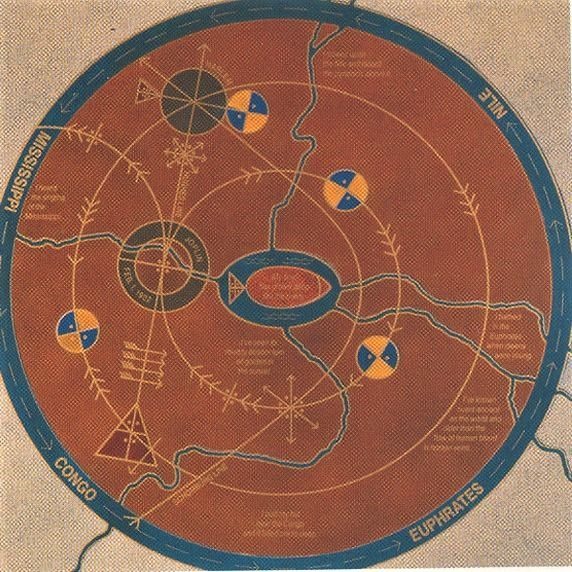
Full circle. After Hughes died in 1967 his ashes were interred in the the middle of this mosaic depicting “The Negro Speaks of Rivers” on the floor the lobby of the Schomburg Center for Research in Black Culture in New York.
.
The player gadget to hear my performance of Langston Hughes’ “A Negro Speaks of Rivers” is below. If you don’t see the gadget, not to worry. This highlighted hyperlink will also play it.
.
*Indeed, somehow our teenager knew more about Black history than many would have in his time, and the chance that he learned much if any of this in school was low. Forty some years later when I was a teenager, I asked my Freshman Western Civ. teacher an innocent question: “Were the ancient Egyptians Black?” He seemed startled at the question. Hughes was hip to that question in 1920.
However interrupted and strained Langston Hughes’ relationship with his family was, he must have been pointed in some directions by them. A chief source was likely that grandmother who took care of him until she died when Langston was 13. Did she know stories or history? Well, Hughes’ grandmother’s first husband was Lewis Sheridan Leary, who died during the 1859 Harpers Ferry raid just before the Civil War.
***I’ve also read that part of Langston Hughes’ father’s issues with his son was that he thought Langston effeminate, and Engineering (than, as still now) was a mostly male field.
Returning now to the poets presented in Alain Locke’s 1925 The New Negro anthology, we’ve come to the poet I most associate with the Harlem Renaissance, Langston Hughes. Though he was born in the Midwest and traveled some, Hughes actually lived for much of his life in New York City, unlike some others associated with that artistic flowering. And though Locke’s book concentrated on young, up and coming writers for the most part (Hughes was 23 when The New Negro was published) Hughes’ literary career continued on a more or less continuous path until his death in 1967.
So, if I was asked “Name a Harlem Renaissance poet.” My first answer would have always been “Langston Hughes.” And if Locke’s book is the launch point for that, Hughes was as prominent as any other young writer featured there and then, even if in 1925 he had yet to publish a single book.
Young Langston Hughes. Hey Pharrell, pretty sharp work on those fedora creases don’t you think.
.
This makes it strange then when I went to do a little research on how Hughes was judged during his 40 plus years as a literary artist. The summaries I read often point out that he was down-rated during his career, and to some degree up to the present day. Why? Well, he did have to go through the dangerous 1930s when political engagement was expected of writers, and like some others he had to handle the double-bind of associations and sympathy for the Russian Revolution and Communism and then later criticism of its faults. Many of the promotors of The New Negro era were so focused on up-lifting the race and demonstrating high-culture acceptance that they were uneasy about Hughes’ embrace of a wider range of Afro-American experience. And finally, there seems to be an element of purely literary judgement he shares with Carl Sandburg and Walt Whitman (two of Hughes’ influences) that what he wrote was judged as too simpleminded and unironic. Sure, the high-culture critics would essay: that kind of poetry might have readership broader than many, but it doesn’t fit the literary criteria ascendant as the 20th century unrolled.
Today’s piece, “Dream Variation,” one of Hughes’ poems printed in The New Negro, is a short nature poem. Here’s a link to the full text of it.* Like a lot of lyric poetry, you can read it quickly and superficially with some pleasure. It has rhyme and its rhythms. It counts off some pleasant if not overly spectacular word-music. The first time through you may think it’s just pointing out a commonplace, something one could summarize as: “Hey, it’s nice when it sunny and you’ve got a day outside. And then a summer night when you finally go to bed — that’s nice too.”
Wait a minute. What’s with Hughes’ title: “Dream Variation?” First off, that seems to say that kind of summer carefree pleasure isn’t something the poem is experiencing right now. Like Wordsworth’s daffodils, the poem’s speaker is experiencing this mentally, as if in a dream. That’s a different thing isn’t it. In the same way that a love poem about lost love is not the same as a poem about present love, this is a poem containing longing. Many of us are reading this during this February in North America. Likely you may relate to that state the poem is actually portraying.
I have no way of knowing what the weather was like when Hughes wrote his poem, but Hughes estranged father lived in Mexico where Hughes visited him before embarking for New York City and the beginnings of his literary career. So that titular variation may be a dream not only of passing seasons but of lost places too.
But there’s another way that variation means. In music it’s when a composer modifies elements of an established motif and we see it morph into a new related shape. Do you see what Hughes does here in his short poem? There’s a statement about dancing, arms wide and accepting, in the sun — and then resting in the evening “beneath a tall tree.” An interlude, when inside the body of the poem they express that this is “my dream” — not what they’re doing as they speak the poem. Next we learn that the “bright” day is now described as “quick” and the following “cool” evening is now “pale” evening. And finally, the real metamorphosis: the poem’s speaker is now not “Beneath a tall tree” — there is just a tall tree that remains as night comes.
This variation is subtle and somewhat undefined, mysterious, once you notice it. Is this a statement of the poem’s speaker’s absence from the warm place, that in the variation he’s no longer present? Has the speaker’s life, the proverbial “quick day” ended? Or, is it something even stranger: in the dream he’s no longer the external dancer beneath the tree, external to the day, external to the night, but now he’s become them?** In dream logic it can be all those separate things at once. That’s part of why a dream experience can be so striking!
In this poem, like in some of the poems of Sandburg that I’ve presented here, I maintain that the simple language and seemingly straightforward scene of the poem has misled some readers and some critics. If I was encountering this poem as if I was translating from some Tang Dynasty Chinese classical poet, I would be aware that the poem may not be whamming me on the head about “Look it’s clever metaphor after metaphor! My, how complex a plot I can stuff into my poem! I bet no one ever said anything as complex as this ever before!” Perhaps the assumption is that a working-class Afro-American or the son of a Swedish immigrant can’t be thinking anything more complex than class-struggle position papers.
In my performance of Hughes’ “Dream Variation” I consciously sought to bring out the mysterious element here. Stubbornly the harmonic progression I composed sticks closely to a core around the D note of the scale. Chords move between major and minor however and there’s a rub up and down with a D# Major7. The player to hear my musical performance may appear below, but if you don’t see it, this highlighted hyperlink is another way to hear it.
.
*I used the text as printed in Locke’s anthology for my performance as it’s in the public domain. The version I link to is later and includes some, well, variations. In the newer version taken from Hughes’ Collected Poems, the title has become plural, “Variations,” “the bright day” has become “the white day,” and a couple of other smaller changes were made. One could speculate that the “bright day” vs “white day” could have been suggested by an editor as less confrontational.
**And I haven’t even entered into the significant racial aspect that is there as well. The dark night in the poem’s first experience as being first external to the poem’s speaker and being one with it in the second “Black like me.” As an Afro-American poet, Langston Hughes almost certainly intends this, and it may be the most consciously intended message he wished the reader to receive: that poem’s journey via its variation is from experiencing one’s Blackness as externally to an internalized appreciation of it, and that later revision from “bright” to “white” for the first instance of the day underlines that reading. I featured the above reading not to obscure that, but because our particulars as persons bleed into our commonalities as people. When William Butler Yeats or Joseph Campbell speak of being colonialized Irish, it’s not just about their particulars. When Du Fu speaks of being overcome by great events, it’s not just 8th century China that has felt that. When Emily Dickinson’s mind grasps onto a flower or abstract thought and sees its edges always curling, she’s not reduceable to a bourgeois New Englander. And so to when Langston Hughes speaks about being Afro-American in 1920s America. And frankly, I’m hesitant to assume an Afro-American identity as a performer of Hughes’ poem, even as I want to bring it forward to your attention.
Update: An alternate primary reading that the first dream variation is an unachieved dream and that the second is a reflection of the reality of Afro-American life colored by racism seems widespread. Widespread enough that I wonder if Hughes wrote of his intent or understanding of his poem’s meaning at some point. For example many of the alternate readings say the poem’s second dance and whirl is work-a-day and likely menial work inside a Capitalist and Racist system that wouldn’t value Hughes. Hughes experience and political thoughts could be consistent with writing a poem that expressed that. As much as I should doubt my reaction to the text of the poem as printed in 1925, I’m still not seeing that as being the inevitable and singular reading of the second variation, but I offer this update as a self-confessed non-expert on Hughes’ work and because I suspect not a few students come here via web searches to seek insight into poems, and so they should be aware of this other reading.



 Frank Hudson