I’ve got things to do today, but I awoke, thought of this piece from the early days of the Parlando Project, and figured I could make a quick “lyric video” for it. I don’t know how many get introduced to the things the Parlando Project does via videos, but I’m always looking to find new listeners to these musical combinations with various words (mostly other people’s literary poetry).
This one is unusual in that I use one of my own poems for the text. Long time readers here will know that one of our mottos is “Other People’s Stories.” It pleases me to generally make these pieces with other poets’ words.
One of the things I’ve loved about doing this Project is the varied ways that poems come into consideration for performance within it. I’m not even sure after reaching 850 of them today, that I could catalog all the ways the words have come forward. Here’s an example: last week my wife was visiting a wildflower area — something she does often enough that I kid her that she’s a nature nymph with all the powers and duties thereof. She’d taken some pictures. One she showed me was of gentian flowers.
“Do you know D. H. Lawrence has a poem about blue gentians?” I asked
“The flower or the dye?”
“Mostly the flower as I recall.”
In actuality, I couldn’t recall much about Lawrence’s poem, only that it had once impressed me around the age of 19 or 20 when I had started to read poetry more widely. Now the old man-me did a quick web search before going to sleep that night and found Lawrence’s “Bavarian Gentians,” likely the Gentian poem I’d barely remembered. I copied it and saved it for further exploration around a Parlando Project performance.
This week I began to work on that. The first thing I noted was the poem’s odd word-music. There is enormous use of repetition: words “blue,” “black”, “dark” and “darkness” reoccur constantly, and the flow of the poem seems less that of normal prose or poetry and more like a stuck-record ostinato.* In performance I couldn’t see how to treat this as an elegant set of refrains, so I based my eventual performance on my first impression of obsession.
But there are twin narratives inside the poem’s babbling: observation of the gentian flower itself in the Imagist manner, and a retelling of the Persephone in Hades myth. What I feel links them (other than the obsessive refraining about the dark blue color of the flower and the coincident darkness of Hades’ underworld domain) is that flowers are the reproductive organs of plants, and the Hades and Persephone, daughter of Demeter, myth is about a male/female couple in the context of Demeter’s goddess of fertility.
The bottle gentians that led to today’s piece. Like the Bavarian gentians in Lawrence’s poem, dark blue and autumn-blooming. This genus’ flowers stay in this closed budded shape, which hampers pollination, while the Bavarian gentians open into the vase or torch shape described in the poem.
.
And then, as I was fairly far along in my work with the musical performance you can hear below of “Bavarian Gentians,” I made a discovery. There are two candidates for the official, presumed final text of this poem. It just so happens, the one I found in my quick bedtime search was the lesser-known one. The version that instead will be found in most cites and collections treats the Hades/Persephone/Demeter material at a more abstract level, while the one I’d been working with is much more raw and troubling. Note:I’m not a strict adherent to content warnings, but the account in the version I was performing likely deserves one: it’s an incident of sexual violence. Here are links to the two versions of the poem: the smoother one, and the rawer one I used. Keith Sagar and some other scholars question the predominance given to the smooth version and argue that the more explicit take was Lawrence’s final revision.
I can see how the more often reprinted version of this poem was chosen. It’s more graceful I think, and one could read that kind of change as the path of an author’s revision where later, more-removed, artistic judgement polishes the rough-hewn inspirations — but it could also be the kind of revision made to make something more marketable. Now knowing of the other version, I briefly thought I should redo my performance using it — it might communicate better to a listener who might only hear it once — and another reason I considered a redo: the sexual violence depicted in the version I had first found presented problems.
I’ll briefly outline that problem. Let me summarize the Hades/Persephone/Demeter myth. Hades, the god of death and the underworld, abducts the young Persephone to be his bride against her will and she is unable to escape from this situation. Her mother, Demeter, a more senior and powerful goddess, intercedes and a compromise is reached. Persephone will be able to rejoin the above-ground world of the living, but she must return every winter back to Hades and his underworld of the dead. The myth here is transparently an explanation of the growing season in non-tropical regions. Told at an abstract PG level, and particularly in the expectations and context of classical non-equalitarian and clearly patriarchal society, it’s a “just-so-story.” We are not to experience horror with it.
But in Lawrence’s lesser-known version, this scene is portrayed: the poet’s speaker, using the gentian flower as if it could be a lamp, follows an abducted Persephone and Demeter, this child’s mother pursuing in rescue. They enter Hades, a place of complete darkness, Persephone and everything else for that matter cannot be seen, but sound remains — and this is heard: Hades (called by his Roman name, Pluto*) is raping Persephone.
Did Laurence mean for this account to make us recoil in horror, as I did when I needed to confront the text for performance? Shouldn’t the text call for that? Or was it intended as just some ancient fantastic myth given a bit of specific detail for which the author had and expected no overwhelming empathetic reaction? There are readings of this poem’ that see a metaphoric synthesis which is only on some surface level horrible, and something else on a metaphysical level.
I don’t know enough to say for sure, if there’s a “sure” in this case. Like the sexual violence and exploitation that was woven into Eliot’s “The Waste Land” without drawing significant emotional weight from most (and mostly male-oriented) readers for decades, it could go either way in authorial intent — but I’m not the author, I have to perform this, I feel that horror, and I expect some listeners will feel the same. Frankly, this makes me a little dissatisfied with my performance of this piece, though I tried not to shirk its implications, however imperfect the result.
What could have driven Lawrence to use this myth in such a way, and in this version, to keep in the horror? He was working on this poem knowing he was facing a mortal illness. Like poets John Keats and Adelaide Crapsey, he was dying of tuberculosis. I have no knowledge of his experience of sexual violence, but Lawrence was undergoing viscerally an abduction against his will into the underworld of the dead. He might have felt that his poem, starting and ending on the consideration of the (by natural fact) bisexual flower justifies that element of considering Demeter and Persephone, and his anima will be taken away to die along with the rest of him by the disease. Make your own judgements on these issues; they may be wiser than mine.
The final line of this version has a contrasting power to what precedes it. The erect yet open gentian flower — which despite its shape was after all useless as a torch in Hades’ dark — spreads in dark welcome at the draught of the light of a day.
If you’ve progressed this far past the trigger warning, you can hear my performance of one version of D. H. Lawrence’s “Bavarian Gentians” with the audio player below. No audio player to be seen? Some ways of viewing this blog suppress showing it, so I offer this highlighted link that will open a new tab with its own audio player for those situations.
.
*I figure much of my audience is old enough to grasp that metaphor, but a footnote for the rest: the vinyl record with a deleterious wound to its groove which won’t let the needle progress beyond one stuttering spiral revolution.
**Lawrence’s use in the poem of the Anglicized Greek names for Persephone and Demeter, but the Roman name for Hades, Pluto, puzzles some readers. I suppose it could just be a Cortez-on-a-peak-in-Darien kind of poetic error, but I wondered if this poem, written in 1929 might have been recently soaked in the Pluto name from the discovery of the then considered 9th planet. Close, but no cigar: Pluto was discovered in February 1930 at an observatory created by the poet-related astronomer Percival Lowell in the American Southwest region that had recently been Lawrence’s home.
My remaining theory on why Pluto? Having the underworld and its god-king both using the same name Hades makes it harder to distinguish between the two.
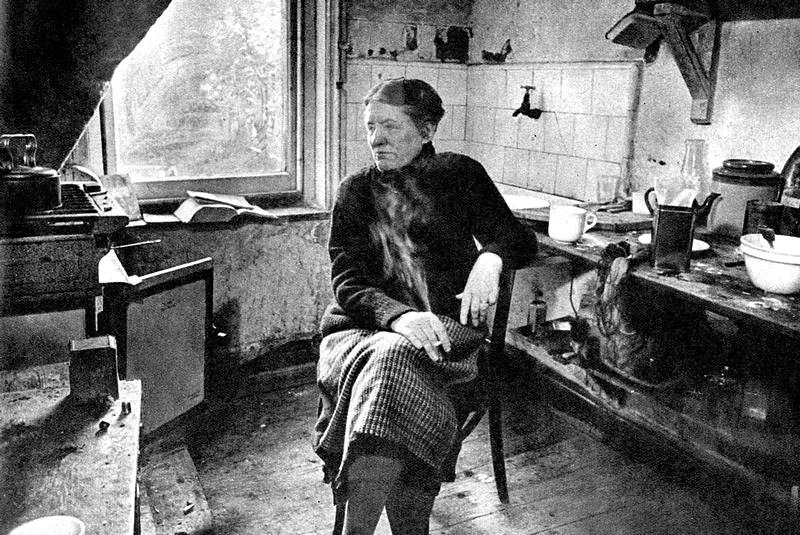
Here’s a poem by a poet you may not know of. I certainly didn’t until early this year when I saw a note about the later life of Anna Wickham on Bluesky, read the linked article (which I recommend), and made a note to look into her poetry.
Well, there’s life and my disorderly path – it wasn’t until this month that I did so. As a page poet Wickham may not capture you easily, depending on your expectations. I read a 1921 American collection that combined two books of hers published earlier in England: 1915’s The Contemplative Quarry and 1916’s The Man with a Hammer.* She wrote almost entirely in short formats, there are quite a few 8-or-fewer line poems that can remind one of Emily Dickinson poems of similar length. Short formats can be favored by those who dash off poems in an otherwise occupied life, and this may be the case here – but at least on first read through, there’s a different general attitude from the American genius. Dickinson to my reading is often playful in her poem’s argument, and even when writing of subjugation or from inside a gothic fantasia, she generally seems in control – and she was after all a member of a family that had achieved local prominence and financial stability. Wickham’s background seems less secure and more bohemian, and from 1906-1929 she was married to a man who is reported to have viewed her poetry as a sequalae of mental illness.** This horrid situation is reflected in the poetry – there’s ample counter-punching wit and protest deployed against the patriarchy in these two collections – but that also presents a certain closed-in feeling. Some of these poems take on the manner of quickly-whispered-where-he-can’t-overhear asides to friends from a woman in an abusive relationship. From extant drafts we know Dickinson had, and took, time to revise her verse, and she often strikes me as a talented structured improviser. Wickham (so far) seems to me to be more a jotter of quick poems from the first-thought-best-thought practice – biographical scraps I’ve read reinforce that conclusion*** – and some (most?) of her papers that might show more about work in progress do not survive.
Anna Wickham in 1946. She made her living by turning her Hampstead home into a rooming house. Still asserting herself, she famously took umbrage with someone declaring: “You’d better retract, my good man. I may be a minor poet, but I’m a major woman.”
.
There’s a good chance my appreciation of her work will increase, but I also didn’t get a sense of compelling word-music on first reading, and that’s a quality that can attract me to a poem even before I understand it – which makes the first poem of hers that I’ll present today a bit of an anomaly. “The Cherry Blossom Wand”is musical, and she even put a notation beside its title on the published page “To be sung.” I have no knowledge if she wrote music for it, or sang it,**** but that sort of thing is taunting the Parlando Project!
I see the poem as being a multifaceted account of beauty or love of beauty (and if we extend that, to love itself). The poem starts with its refrain stanza, telling us a branch of cherry blossoms is a “wand” that can do some kind of merciless bewitching magic. I like the refrain’s final line “a beautiful thing that can never grow wise.” Ambiguously: either we never wise up to the thrall of beauty, or that experience, time and wising up removes the beauty.
Blossoms are of course famously temporary, as the first non-refrained verse reminds us. On the page, Wickham only puts the refrain first and last, but since songs favor repetition, I put an extra refrain between the two verses.
The final verse before the ending refrain contrasts the merciless enchantment of the blossom wand with the “kind” removal of the bewitching beauty, and the verse then ends with its own internal refrain saying that the transience of beauty and time is eternal. There’s no change that can change that change, and the mercy is that we are not taunted long with its brevity.
As a whole then: bittersweet.
Chord sheet for the song I took as commanded by Wickham’s note on the page
.
Musically I got to play my nylon string guitar for the first time in a while. Every time I play that variety of guitar, I’m reminded of the cheap J C Penny nylon string guitar that I bought off the after-Christmas sale table in late 1974 to begin to learn how to play. Classical guitar players may be appalled, but I currently play my nylon string with a pick, which is wrong – but it’s how Willie Nelson does it.
You can hear my performance of Anna Wickham’s “The Cherry Blossom Wand” with the audio player gadget below. Has some merciless hand removed any such player? This highlighted link will bud a new tab with its own audio player then.
.
*Some accounts say Anna Wickham is more read and studied in the U.S., which would be the reverse of some poets I present here, most notably Welsh poet Edward Thomas who has some best-loved poems in Britain, and is hardly known in America. Influential 20th century American anthologist Louis Untermeyer thought enough of Wickham’s work to praise and include it. The Feminist-Modernist angle probably occasioned some interest too, and you can read her as a predecessor to Sylvia Plath in some of Wickham’s themes. Before she had a career as a best-selling novelist, American poet Erica Jong wrote a couple of poems dedicated in part to Wickham: this one, and this one.
**Wickham was eccentric. The linked article that sparked my interest has accounts that make that eccentricity seem charming, but depression seems to have figured in her life too. The complexities of our mental wiring and biochemicals mixed in with the stress of her life makes remote historical diagnosis chancy of course. The close publication of the two books of poetry that I read as a combined collection coincided with her husband going off to WWI, giving her some increased autonomy. Give a moment to imagine Edwin Starr singing a revised song: “War!! Uhh! What is it good for? Giving Anna Wickham a chance to see her poetry in print. Good God! Say it again!”
***The account of her reading one of her poems in public and presenting it with ““Rubbish, but there it is”” indicates this approach.
****After a childhood family sojourn to Australia, Wickham returned to England to take study in performing arts, particularly a singing career, though that doesn’t mean she composed music. The Cherry Blossom Wand” has been set to music as Art Song before, at least this once 25 years ago.
She mentioned abandoning any search for musicality in her poetry in one of the poems I recall reading this month. This could be part of Modernist distain for frippery, or a practical act of triage for a poet without enough time. She’s a contrast to her American contemporaries Sara Teasdale, Elinor Wylie and Edna St. Vincent Millay who wrote very musical verse even as they wrote about Modernist concerns.
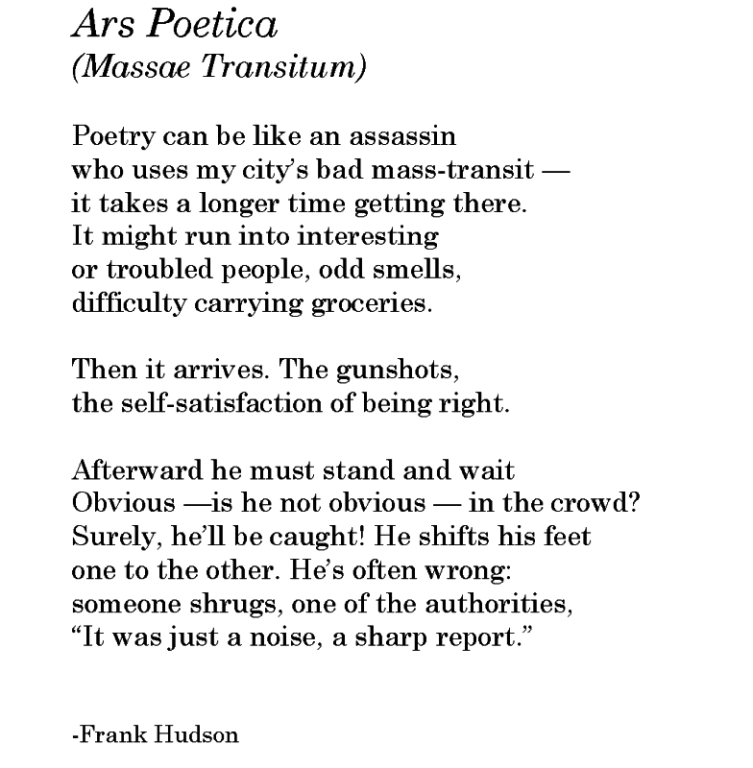
Today I take on one of those poetic expressions a great many poets have engaged with: the poem about the state of poetry. The title gets written in Latin to puzzle readers, and because Horace wrote in Latin back when the world had to worry about the whims of tyrannical kings and poets got their words carved in marble. We’re much more culturally advanced now. You can hear this poem anywhere in the world using the Internet. Dozens will listen with you during National Poetry Month. Dozens! Imagine the value of that if that dozens was of eggs.
I briefly hesitated to share this poem of mine publicly. Not only is this project largely about other people’s words, but my Ars Poetica poem starts off comparing some poets to assassins. That’s a metaphor, a conceit, a simile. I’ve shared other civic poems about the fate of nations this month, but I’m not a big fan of political assassination — but then I’m also not a big fan of making fun of poets, and I’m going to do that today. And it is a civic poem. On my way to comparing poets to assassins I make note of the state of mass transit in my fair-sized midwestern American city, which is: pretty bad. Not assassination bad. No! Rather my point is that it would be bad for an assassin. Or for poets trying to get to and from poetry readings.
32 bar AABA tune. Chords are F C Am G and then Cm Gm Cm Dm in the bridge, though there are some substitutions.
.
Well, you don’t have to go anywhere to listen to the performance. And it’ll be doubly good to do so because the last day of National Poetry Month in April is also International Jazz Day, and I’m going to make some fake Jazz.* Poets, we get a month! Jazz — like a whole world of it — gets only a day. Well, it’s an international day, sliding across the globe’s time zones, but still…
You can hear me reading my Ars Poetica poem with a Jazz combo using the audio player below. No player? The Jazz Police haven’t come for it, it’s just that some ways of reading this blog suppress it. There’s an alternative: this highlighted link will open its own browser tab with an audio player.
.
*Way back in the 20th century, when we had to carry the dead weight of a constitution around all the time with laws, and due process, and so forth, a group of local improvisational comic performers used to get together and the agenda was to play bad Jazz. No, not to parody or put down Jazz, more at an honest admission that their musical skills weren’t up to that level, but the desire to have a go at it was still there. That’s me making up this Jazz quartet today. I’ve cut a corrupt deal with the composer to only write things I can play on bass and guitar, and I give the computer the chords to tickle on the piano.
The attention I’ve been calling forth this National Poetry Month has been divided up between “civic poetry” about the state of nations, and poet’s examination of Springtime. Today’s piece continues with the wildflowers and wildlife side of April, but because it’s by Emily Dickinson, it’s a complex statement.
Dickinson here uses the ballad meter as she often did, a form also used for many Protestant hymns. This form as common as the robin. Simple music, startling images, another disconnect.
.
This poem, approximately dated at 1862, can still startle the modern reader. Over a century and a half of poems have been written since then, yet the language, images, and play of thought within it still seem fresh and surprising. And there’s no wait for the surprise in this one, beginning with the idea that I used for a title for the resulting song I made of it. Dread of Robins? This common North American bird is anything but frightening. It’s not large, or fierce, no raptor or raven. In the context of the poem, the outstanding thing about the American Robin is that it’s a migratory bird whose arrival is a sign of Spring. Yet it causes pain somehow.
The next stanza seems to amplify sound. The song of the robin is not that loud, but the sound of wild birds in Spring taken together does have a choral aspect. In their territoriality and mate-seeking, there is a shout to their throats. Dickinson hears some music in it, but it’s not altogether pleasant. The Piano in the Woods image delights in sideways incongruity. The piano is Dickinson’s instrument, the one she played, but as an acoustic guitarist one thing I know about the piano is that it can be overpoweringly loud. And placing the piano with its wooden case in a woodland implies a metamorphosis. Perhaps ED hears a piano whose notes are bird calls? “Mangle” here is another characteristic unusual word choice by Dickinson. In her day she’d know the machine named with the verb: the wringer for squeezing water out of laundry. Spring is putting the speaker in the poem through the wringer.
Many of this April’s pieces have featured wildflowers, and specifically daffodils, but the colorful brightness of the flower here does not delight even after the dreary monochrome of a Massachusetts Winter.
Bees are everywhere in Dickinson’s poems, more than angels in Blake or Rilke. She often speaks fondly of their seeking sweetness, their industry, their pollinating agency in horticulture. Dickinson had by interest and education knowledge of these details, yet here the Spring bee too is unwelcome and she feels alienated from them.
In the penultimate stanza the creatures and flowers of Spring are present. She grandiloquently calls herself, “The Queen of Calvary,” suffering as if the crucified Jesus of Lenten Spring.
In the final stanza there’s a parade of sorts, with drums and salutes. “Plumes” here strikes me as an odd choice. It may be a bereaved funeral procession. Black ostrich plumes were apparently used for funeral decorations in the 19th century, so oddly we start with a modest small bird and end with the plumage of one of the largest. The poem’s speaker dreads the robin, yet seems accepting of the plucked raiment of the giant.
Is this a poem of disappointment and depression? Yes, that is there — but it’s majestic too. The poem is a catalog of Spring’s changes, all of which the poem’s speaker is unable to find pleasure in: dreaded little robins, pianos in forests, piercing yellow wildflowers, the energy of bees. There’s wit here, and like a Blues singer, there is a power of being able to sing knowing the score of a bad outcome!
I think this is a poem of a divided mind. I can relate. Spring remains wonderful, much as this Spring I’m experiencing this year, but my civic world has presented us with discordant changes, public cruelty, careless acts, all cloaked in self-serving bluster. Dickinson’s poem is dated to 1862 — the American Civil War, which for now still has a singular name, had started.*
I originally tracked my musical setting here with just my voice and acoustic guitar. I thought that spareness might contrast with the last two musical pieces here with full-on Rock ensembles. I had second thoughts though: this may be a poem about internal sensations, but it’s also about change in a fuller natural and national world. Eventually this arrangement, one that evolves throughout with high wind instruments and emerging synth seemed better suited. You can hear it with the audio player gadget below. No dreadful robin, I mean player, to be seen? You may be reading this blog in a way that suppresses the player, so here’s a highlighted link that will open a new tab with its own audio player.
.
*One reader of a Dickinson blog has a detailed theory of the personal particulars that might have faced ED when the poem was written. Deadly Civil War or mentors splitting for the coast would be matters of mismatched scale. Is the Spring of closely watched bees, and little birds and yellow wildflowers smaller or bigger than those things?
Attention is an investment. Today’s piece combines two poets that had my attention this Spring. Regarding one poet, this expenditure was long-standing, for the other, the attention is more short-lived, conditional. My attention requests yours, so let me get on with this as I try to be brief while providing context.
Fifty years ago I had just bought a cheap nylon-string guitar from the unsold Christmas stock at a local J. C. Penny’s store. I was learning to play it because I, a poet, wanted to write songs. I can’t say much for how substantially I’ve mastered guitar playing, but I have learned how to make songs.
I had models in early 1975 for what I was trying to do. My internal list of influences was shorter than it would be now, but it wasn’t just one or two. Certainly one was a young woman roughly my age who I’d read was performing her poetry with an electric guitar player and who had written a few literary pieces I’d seen published.* In the Fall of 1975 she released her first record album. I bought that LP the week it was released, likely at the sprawling Lloyds store on the edge of town.
The Seventies were a heyday for recording. The record business had recently become bigger economically and Rock music was huge culturally. Oddly, at the same time of this growth there was a falling off of the visionary and exploratory stuff that had attracted me as a teenager. Key artists of the previous decade had died or been diminished. Commercial filters along with endemic chemical narcissism and dependency reduced the force of many of those still recording. That debut record I eagerly bought — Horses, by the Patti Smith Group — was nothing like those compromises, and it retains considerable uniqueness to this day. It’s a poetry record as much as it’s a Rock music record. Large portions are chanted rather than sung. Smith’s words, however delivered, demanded a listen from the heart and the pelvis before taking the long-way around to the brain. What Smith was doing wasn’t unprecedented for a woman (or a man for that matter), but it was rare then, and still is. But I don’t want to diminish the music on the record either, the band, the Patti Smith Group, were also doing things underrepresented in 1975, despite their irregular formation. Writer Lenny Kaye had been the electric guitarist backing Smith at those NYC poetry readings earlier in the decade, and now he had another guitarist, Czech refugee Ivan Kral, to expand the sound, along with a rhapsodic keyboardist Richard “DNV” Sohl, and a drummer, Jay Dee Daugherty, who had joined the group just before going into the studio. They were fellow explorers to Smith, willing to go places they didn’t have charts or established trading routes for.
Horses gathered some attention. It was the spearhead of a musical revitalization movement that soon got a reductionist name: “Punk Rock.” Released on a major record label in this era meant that it had to be reviewed. While Horses is now recognized as a landmark, a signpost to new paths, the reviews then were mixed, though usually respecting its ambition. It was not a commercial blockbuster, sales were modest, but that was OK then as first albums were allowed mere “worthy of attention” response. My own reaction wasn’t as a critic or chart watcher — I needed inspiration, and I overwhelmingly welcomed it.
To get to today’s Parlando piece we need to move on to the PSG’s meeting up with the problematic-second-album syndrome. That album, Radio Ethiopia, sold even less than the first, and the Rock critics were even more mixed in opinions. It was a shot-by-both-sides response. These contradictory judgments were issued: it was even less commercial than Horses, it was trying to be a mainstream Rock record and so wasn’t Punk; it indulged too much in Smith’s self-mythologizing (evidence: she, a woman without credentials, played naïve guitar on the LP’s longest jam), it was too much a band-record featuring the Group instead of Smith.
I liked Radio Ethiopia. More inspiration as far as I was (and still am) concerned. A song from that doomed follow up has remained in Smith’s repertoire for the rest of her career: the breakup song “Pissing in a River.” In this linked 20 minute 21st century account of Radio Ethiopia and that song, Smith herself movingly describes her state of mind while making that expression. She was so full of doubts that the wholly committed vocals that mesh with Ivan Kral’s compelling four-chord cycle in “Pissing in a River” are credited by Smith to her brother, who came to the studio just to stand next to her, silently, at the mic. Last time here I spoke of how our relationships with others broaden what we see and report as artists. I teared up listening to Smith’s account this week, another testimony.
The version I used for performance is roughly half the length of the original poem.
.
This Spring, as I made tentative plans for National Poetry Month pieces here, I made a note next to a poem “Lilacs” by pioneering early 20th century Modernist poet Amy Lowell: “Long. Maybe do it Patti Smith style?”
I have not played much attention to Lowell, though one musical performance of a poem of hers is a personal favorite of mine. In the landmark era when English-language Modernist poetry emerged, she was a controversial figure — those mixed reviews again. It’s undeniable that she helped popularize the new free-verse style as a poet, anthologist, critic, and promoter — but otherwise these were arrayed against her: she was a woman, not gender-conforming, overweight, and suspected of being a wealthy bougie poetic interloper on the bohemian Modernists. I’ll add my own personal count against Lowell: a lot of her poetry doesn’t consistently reward my interest. My current theory is that she’s something like Wordsworth, a poet whose best work may be diminished by a mass of undistinguished work, and great lines sit next to meh ones. But also like Wordsworth, her value in theorizing and promoting a new prosody must be acknowledged.**
“Lilacs,” the poem that gathered some of my attention, is an example of the good and bad as I see things with Lowell. There’s immediacy in the poem that attracts me for performance (Lowell was an enthusiastic public reader). “Lilac’s” theme, remembering her New England ancestry,*** would befit her cousinoid Robert Lowell later in the 20th century, and I loved lines that sounded like Allen Ginsberg (“Clerks….reading ‘Song of Solomon’ at night, so many verses before bed-time, because it was in the Bible”) and Frank O’Hara (“Parks where everyone walks and nobody is home.”) ****
So, I did one of my “use what fits me best” editing jobs on Lowell’s original text, excerpting what I thought of as the most vital images in the poem, reshaping some of the lines, and following through on my first-thought of performing it in the manner of the Patti Smith Group.
That incantatory “Pissing in a River” chord cycle was a good match. I needed to rotate myself into each player’s role to create the ensemble, getting the rhythmic core down with a drum program, adding a bass line, and then performing each channel of the song’s double-tracked rhythm guitar bedrock. I used a sophisticated arpeggiator to create a right-hand piano part, but on evaluation I was so proud that I could get the just-little-different precision of the doubled guitar parts that I removed the piano.*****
Now it was time for the vocal recording pass. I made an unusual choice to try to improve what I fear is the least successful part of my recordings: as my expedient to Patti Smith’s brother undergirding her resolve, and only as preparation for the take using Amy Lowell’s words, I recorded an entire “scratch take” performance of “Pissing in a River,”
My four-chord riff cycle isn’t played exactly as the PSG recorded it, but the last part of my recording was an even larger departure from my inspiration. As a musician I’m a full-idiot/half-way savant. The part I’m most comfortable in is lead guitar playing, so my version isn’t a copy of theirs, I looked to another mode, their adventuresome NYC scene-mate guitarists: Tom Verlaine, Richard Lloyd, Ivan Julian, and Robert Quine. The performance in my recording of “Lilacs (version)” includes what some (many?) would consider overplaying. As I (too?) often do, I continue to play during the vocal passages. I know this is incorrect — but more than correctness, I worry that it might detract from the song. Asking myself why I do this, my answer is that because my voice can’t provide the melodic elaboration I’d offer if I was a more skilled singer; and as a poet, I think the words can be (are?) powerful enough to compete with wailing electric guitar.
I leave that last thought with this restatement: as a writer, it’s OK to whisper — understatement has its power — but even if you read unaccompanied, or write for the silent but companiable page, consider if your chosen words are committed so they could go toe-to-toe with a cranked guitar. Sometimes you might want that.
You can hear my performance melding impressions of the 1970s Patti Smith Group with parts of the 1920s Amy Lowell poem “Lilacs” using the audio player below. No player? It hasn’t been dropped by the record company man — it’s un-displayed by some ways of reading this blog. This highlighted link is an alternative way to rock it, as it will open a new tab with its own audio player.
**As I mentioned recently, the issue of being too prolix and prolific with putting out work is something I worry about with the Project and myself.
***Like fellow New Englanders Cummings and Millay (and the British Housman) already performed this National Poetry Month here, Amy Lowell is presenting Spring as a memory of the quill-written past wafting through graveyards unkempt by their Modern age.
****As with a lot of early 20th century female Modernists, Amy Lowell dropped off the canonical map in mid-century as High Modernism and the New Critics came to the fore. Lowell’s popularizing efforts gained little credit as poetry sought a refuge in elite understandings and “serious subject” male-centric viewpoints. Our current century is re-evaluating that.
*****As a naïve keyboard player, arpeggiators are a crutch I often lean on. Give them a chord and their rule-based fingers will present a more sophisticated output. I border on shame when using them, though similar tactics are all over modern music. I’ve tried to bargain with my guilt by referring to my favorite arpeggiator as “DNV” — the nickname Lenny Kaye gave to Richard Sohl who was a vital elaborator of the earliest PSG records. “DNV” stood for “Death in Venice” because Kaye thought Sohl looked like an actor from the movie version of Thomas Mann’s story.
I must apologize for how rapidly these new pieces for National Poetry Month are being released. That must tax some of my valued reader’s and listener’s time. I planned — and still plan — heightened activity here during Poetry Month, but I expect it won’t be near-daily posts.
In announcing this April’s observance, I said that following #NPM2025’s theme of “The Shared World” that I’d like to include some poetry that wasn’t originally written in English. I’ve done a fair number of translations here, despite not being much of a linguist. I’m also not a creative writing teacher, but I highly recommend for poets to follow my example in this and to do their own poetry translations. When I first started doing French to English translations in my 20s I had only my high school French to guide me, and I relied heavily on French to English dictionaries. This was a laborious process, but approachable with short poems. Nowadays, online dictionaries and even reasonably fluent automatic translation features are available on computers or the Internet. Just plugging in a poem’s text into Google Translate isn’t translation, or a translation that will help your poetic skills. The machine translators are pretty good these days for denotative texts, news accounts, manuals, advertisements, directions — that sort of thing. But poetry asks for at least two other things beyond that: a heightened sense of which exact word brings something to the poem, and those word choices are also part of how the sound and flow of the poem is presented in its new language. As a teaching exercise, sitting for a few hours beside the spirit of another poet and their poem of another language, helps one find skills in making those choices when one writes their own poems.
As a non-native speaker, it’s entirely possible you will make mistakes (even embarrassing ones) or come upon mysteries where even experts will not know what the poet intended in the original language. No matter. That’s scholars’ work — honorable work — but as a poet that’s not necessary for your translations.*
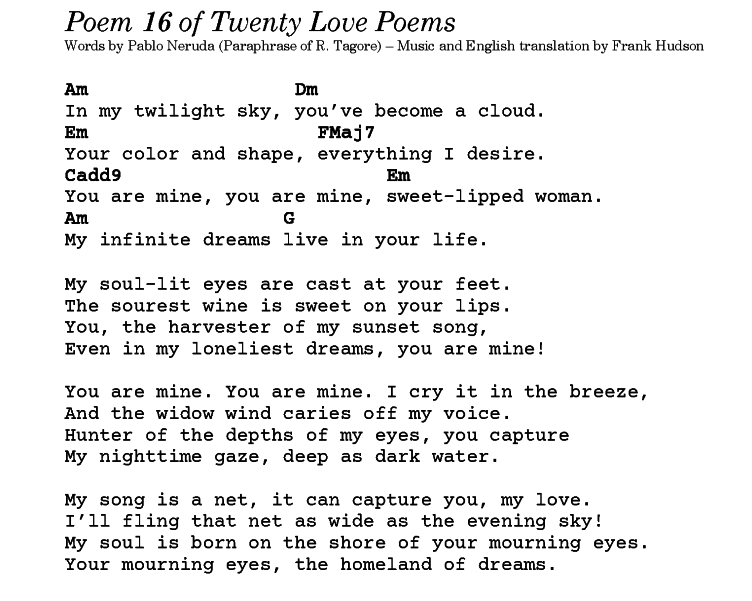
The imagery and the refraining way it’s presented made me think this a good candidate to sing. Looking at a couple of machine translations, I started work on making a poem in singable modern English out of it. This poem is not entirely straightforward to me, but it seemed to be about separation, though I cannot be sure it’s not about a subjective, obsessive, or jealous sense of separation, a “I want you so much, all the time, and all to myself” kind of feeling. As I started to work on the images — the shared-world-vision that the poet’s voice wants to invoke — and those word choices and sequences necessary for word-music, I was overcome with a connection likely unintended by Neruda.
I include a chord sheet because I was inspired by folk revival publications Sing Out! and Broadside back in the day. You might sing it yourself as a prayer and plea for the two Garcias.
.
The poem’s speaker talks about being captured, even imprisoned, constrained as he speaks of his beloved. I thought of a pair of recent news stories of men taken abruptly from their families, one hauled off to a brutal prison in El Salvador, the other pried from the embrace of his wife and children.** The charges, the evidence? They are, what, maybe gang members. How do we know that? “Oh, we just know” says our government. OK, what are their crimes? “No matter, we just have to say so — or maybe we don’t have to say, we can just do.”
It’s possible we have nonsensical laws, though I’d hope our consideration is better than that. But there seems no way this can be just.
I stopped trying to make a better translation. I’d normally want to take more care — after all, this is a work of a young poet who later won the Nobel Prize. I just wanted to put together the sense of this way I could hear the poem’s speaker speaking across our Shared World, because I wanted to sing it to salve my own heart.
The poem, as I now shape it in English, is speaking as a man who loved America, loved his wife, loved his family. All this can be taken away. In one case some executive branch functionary in court, being asked of one of these men, is said to admitted his deportation and subsequent imprisonment there was “an error.” With such slipshod execution, this might be expected. What is to be done? “Nothing can be done. He’s in another country now. Out of our hands.”
This is a project about poetry and music. There’s nothing those two things can do but sing. I did say I would share civic poems this month. Why? To sing a poem, or to listen or read it closely, you must feel it somehow. What you do afterward, I don’t know.
*When sharing such translations publicly, I often take the example of another poet I came to read through this blogging adventure, Robert Okaji. Okaji, like myself, sometimes takes literal, non-poetic, glosses of classic Chinese poems and renders something vital in modern English out of them. He uses the traditional note of “After a poem by…” which indemnifies either of us from lack of fully understanding the Tang dynasty and ancient Chinese.
As it so happens, Neruda in “Poem 16” writes at the top of this poem that he’s paraphrasing another poet and songwriter, Rabindranath Tagore. Tagore’s poetry and song lyrics are sometimes psalms to his country or godhead, written in the language of love poetry.
Here is a piece based on a poem by a second Irish-American poet, Ethna McKiernan, who before her death in 2021 would host a reading every St. Patrick’s Day. I can’t say I knew her very well as a person, though as mentioned last time she was a long-time participant in the Lake Street Writer’s Group with myself, Parlando contributor Dave Moore, and the poet featured last time, Kevin FitzPatrick. I’ll next be going off on a short tangent, as is my nature, but it any of this writing displeases or tires you, just skip to the bottom. I quite like the piece that is the occasion for writing this today, and you are excused to go there and just listen to it.
I don’t think Ethna liked me much as a person, and I can imagine any number of reasons why that might be so. Let me leave most of those guesses behind for today’s purposes. In my old age I’ve come to the realization that I am often a careless and inappropriate person. I suspect that’s for neurological reasons, but who can say, it may be a defect in my soul as would have been said in the old ways.
One peculiarity that I had in writing groups is that I was prone to writing long responses to drafts shared by other members. I’d often get quite detailed with noticing what works, and at least as much so with what I thought didn’t or had alternatives to be considered. The audience of this Project know that I have a broad appreciation for styles and approaches. I don’t hold to a narrow poetic style and down-rank anything that doesn’t follow it, but just as I do with editing audio or trying out compositional ideas in music, I tend to look closely, and over the years of doing this, I’d notice how zoomed in and nit-picky some of my responses were — and I wasn’t at all sure my suggestions for alternative approaches were actually improvements. It’s been a few years since I’ve done that, but I still cringe at some of the things I wrote, particularly in response to Ethna’s poems. After all, here was a poet with several published collections, a grant-winner with a distinct cultural connection to a great poetic culture, and who had taken advanced academic creative writing study. Me? I’m a high-school graduate from nowhere, who has no distinct poetic style to trumpet, who last was published in the 20th century. And need I add one more kicker — I would be in Etna’s case a man writing to a woman poet. Women poets reading this know how that often goes.
So in summary: matters of technique and poetic tactics vs. being emotionally myopic. A lot of the first only emphasizes the second.
My reactions to Ethna’s poems continue to trouble me because, at her best I considered her to be an excellent writer, but one that left me tantalized by another poet within her — a far stranger one, one that only materialized from time to time, and seemed to be constrained by her internal editor and self-anthologist.* Yes, it’s a writer’s prerogative to choose what to present or emphasize, but I wonder if other writer’s group respondents, creative-writing seminars, or outside editorial preferences/fashions kept that element down in McKiernan’s writing. Those things have standing, and it may be me who’s out of step, whose taste is questionable or unlikely. But that’s how I felt when reading the poem “Barn Burning” used to make today’s musical piece. I was compelled to do something that may be regrettable. I strongly thought that a developed image just past the midpoint of the poem was not quite as vivid as possible, and that the poem’s ending was short of how sharply spoken it could be.**
Ethna is some years dead now. Poets have trouble finding audiences when alive, and once they cross the Lethe, our forgetting often matches the dead’s. Improper, inappropriate, imperious, presumptuous — convict me of the lot. I’m taking the risk that I’m damaging the poem, though that’s not my intent. It’s done out of love for the poem and in hopes of bringing forth this element of the poet who might be condemning me from the other side.
If the worst is the case, take the performance below as damaged, counterfeit goods. If the best of the case is so, enjoy this poem’s mystical experience with my best efforts at adding music to it. I’m not Irish, I just hung out with some Irish-American poets, and it seems consistent to make this offense out of admiration.
*I remain puzzled why her poem “Letting Go the Wolves” was not included in her own final new and selected collection Light Rolling Slowly Backwards. While it’s a fine collection, well worth reading, to my tastes that’s a pluperfect anthology piece, one I’d say any poet could be proud of having be the one poem others know of their work. Of the poems included there, poems as strange as “Stones” and “Barn Burning” display moods not widely indulged in, even though her other poems have their virtues too.
**Should be? Let me say again, I don’t know. I’m just one reader, but one who chose to perform it, and who wants to maximize its impact. Here are the last six lines of “Barn Burning” as McKiernan had them in her final collection: “The outline of the lit barn/and its lean bones;/the world changed suddenly/as baptism, my life changed/forever with the knowledge/of fire.” Here is what I performed: “The outline of the barn,/the eager edges of its light/surrounding reluctant bones./The world, now sudden as baptism./My life forever with fire knowledge.” And as evidence of how zoomed in my suggestions sometimes were: I think the poem’s title is stronger with a comma in the middle.
Today is the anniversary of Emily Dickinson’s birthday. Let’s open a small present.
Her poem cataloged by its first line “A face devoid of love or grace” transmits clearly on first reading. I hear it as describing a widespread human feeling: the disgust one might feel looking at a confidently self-satisfied face. So, a simple poem?
Simpler than some of Dickinson’s work, even though we should always consider that she can cloak unique thoughts in cottage-core embroidered-sampler language. The thing I think described is a bit of an odd emotion though. Why can we feel such disgust at sensing resolve and rest on the face of someone we dislike? Is it just our hate transferring to some visage a hate we’re sure we find behind the surfaces? Not if our judgements of the person behind the visage are valid — if what drives us to fury are the actions we know the expression covers.
That’s an F Major 7, mixed in with all those minor chords. That’s been a favorite chord of mine for more than 40 years.
.
This week’s news includes the overthrow of a dictator, an event that brings obligatory photos of newly mutilated portraits of the disposed tyrant, and videos of the toppling of statues — enthusiasts performing the pre-requisite of “Ozymandias.” While in my country, many see the calm, regularized-in-demeanor news-slug faces of our upcoming national administration while reading alongside them their announced motives and plans which horrify — the “sneer of cold command.” There’s a disconnect there that many feel. “He looks so righteous, while your face is so changed” as yet another writer put it. So, the self-absorbed bureaucrats of disorder and disregard look unconcerned behind their hard successful faces.
In Dickinson’s verse I note a choice: she could have described the unconcerned face that stands for someone that disgusts her in a variety of ways. The one she chose, stone-like, brings along with it that idea of heroic statuary. And there’s an unexpected double-twist from her pencil at the end: that face and its metaphoric linkage with stone. Stone is rhymed* with “thrown.” It’s like stone, and like the stone that the angered would want to throw, rock against rock. And then too, something I didn’t notice until I was singing this, a possible intended pun: thrown/throne.
Am I dissecting a bog-simple nobody-frog of this short poem here? Could be. But even if this is a short birthday gift, it’s the thought that counts.
You can hear my musical performance of Dickinson’s “A face devoid of love or grace” with the audio player below. It’ll only take 90 seconds of your time, about as much time as it takes to sing “Happy Birthday.” No audio player to be seen? It hasn’t been blown-out and removed with frosting-feet, it’s just that some ways of viewing these posts won’t display it. This highlighted link will open a new tab with its own audio player.
.
*Speaking of rhyme: I love the off-rhyme of “ease” and “acquaintances” in this poem.
There’s a long tradition in poetry of civic poetry — poems not meant for an audience interested solely in the interior intimate experience of the poet, but speaking to larger, more public themes. I suspect modern poetry doesn’t do this mode directly much, even though some individualist poetry infers that purpose. American poetic Modernism began with an emphasis on the concrete, the thing specific: red wheelbarrow, ripples in a pool, a certain Chicago cat-fog, an exit on the Metro on a rainy day. Yet, a focused subject can still be an example that stands for more.
If the subject is small though, perhaps we poets expect our audience most often to be small too, compared to a variety of other, popular arts. But this was not always so. Longfellow and Whitman expected the nation to listen to their poems of democratic virtues. If the literary set eschew the mode, song-lyricists and non-literary poets will still assay it.
Just under four years ago, a poet Amanda Gorman who has written civic poetry, delivered a poem at the last U.S. Presidential inauguration, speaking of the nation’s fears, hopes, promises. The mode of the next Inauguration has changed. I’m not expecting poetry. Some will think, more-the-better — who wants a poet spouting off what I should think.
Why not, are they not citizens? What are the occupations that are allowed to speak?
Nearly 75 years ago. American poet Edna St. Vincent Millay wrote a long poem for the American holiday of Thanksgiving. She expected a good-sized audience: it was published in the Saturday Evening Post, a weekly general interest magazine, the one that often featured Norman Rockwell paintings on the cover, that claimed Ben Franklin as its founder.
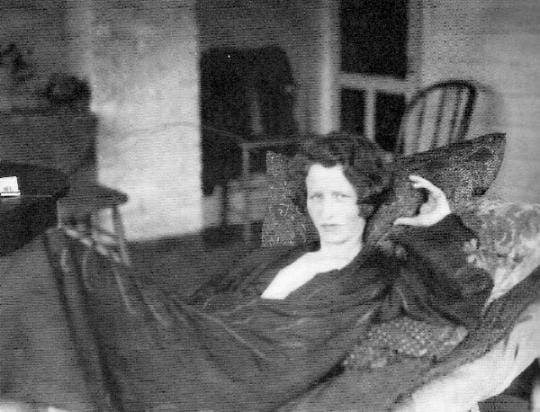
The most often used pictures of Millay show the young romantic adventurer. I’m also fond of this one that seems less all that. The poem which I perform excerpts from today was the last one she published before she died at age 58.
.
I’m sure there were specific things on Millay’s mind, geo-political, American issues. She writes five years after a war ended with two A-bombs. How long would be the peace? In 1950 there was another war going on overseas in Korea, there was a “Red Scare,” and to a large degree some deficiencies in American equality of opportunity were so far off to the side that too few even thought of them as political issues to address then. Millay didn’t cite any of that directly.
Instead, she wrote about how she thinks we, the citizenry, were feeling, assuming a general agreement that might be hard to gather today. Thanksgiving is a dual holiday occasion: it’s our harvest festival, a time to give thanks to what our work brought us, and it’s also a holiday to give thanks for what we’ve come through: it originated in a time of Civil War, and it commemorates the hardy survival of some early 17th century boat-people who landed without papers and survived on American shores. Millay’s Thanksgiving thoughts were more toward the latter than the former.
What will ring true in some American hearts this year will be her words of hopes dashed or at least deferred. Can one give thanks for having hopes that were unfulfilled? Can we at least forgive ourselves for hope? Her poem exists in that question. In the excerpts I performed today for this musically accompanied piece you can hear below, I focused on that sense, felt in my bones. “Cunning and guile persist; ferocity empowers” Millay writes. The lines that stand out for me as a Thanksgiving prayer this year are “Let us give thanks for the courage that was always ours; and pray for the wisdom which we never had.”
As civic prayer goes, that’s humble, but it has some bite in it.
You can hear my performance of portions from Millay’s “Thanksgiving…1950” with the audio player below. The full poem’s text is at this link. No audio player gadget to be seen? This highlighted link will open a new tab with its own audio player.






 Frank Hudson