When I Was a Young Girl

When I look at a more well-known poet or poem, I often find someone else less well-remembered connected with them. This sort of thing naturally intrigues me. Are we overlooking something of interest? Does this lesser-known person change our understanding of the more well-known poet?

I’ve noted earlier this month that Carl Sandburg won the Pulitzer Prize for his 1918 collection Cornhuskers—but that’s not the full story. For some reason, they decided to give out two awards for poetry that year, and another poet’s 1918 work was the co-recipient: Margaret Widdemer’s Old Road to Paradise.

Huh? Who?

I don’t aim this project to literary scholars, who likely know more than I do about the poets whose words I use, but there are indications that Widdemer’s name would stump them too, even those whose field includes the Modernist era. From a look through Widdemer’s Old Road to Paradise  this can be partly ascribed to Widdemer not writing in the Modernist style that triumphed as the century continued. Furthermore, Widdemer’s outlook, though feminist, is middle-class and lacks the bohemian allure of Millay or even Sara Teasdale (the poetry winner the previous year). As time passes, rebels and poètes maudite often retain their outsider excitement while losing their air of present danger, and Widdemer offers none of that. And while I’m hesitant to judge from a skim through one book, a further issue is that she may not be very good.

pre-war-lady-by-margaret-widdemer

Widdemer also had a successful career as a popular novelist between the wars.


Particularly for me, and for the Parlando Project, Millay and Teasdale’s words just want to sing off the page. Widdemer’s, though rhymed and following metrical schemes, generally don’t. There is a flatness to subject matter and a conventionality of imagery that fails to grab me as well. I would have loved to have picked up Old Road to Paradise  and found something as interesting as Fenton Johnson, Edward Thomas, or Anne Spencer; but not this time.

Margaret-Widdemer
Margaret Widdemer


That doesn’t mean there’s nothing there. Widdemer seems a level-headed person, and she is writing from a woman’s point of view that has fewer representations in the literary cannon of her era. What little I know of her biography says she worked to advance poetry and literary efforts. Could I find something to use? As I paged through Old Road to Paradise   I marked “When I Was a Young Girl”  as a possibility.

Why did this one stand out? It seems based on a folk song, but while it takes lines and tropes from folk songs, it presents an alternative viewpoint to the songs it borrows from. Since the post-WWII folk song revival, folk song has been even further associated with bohemianism and adventuresome living, even though the traditional texts used most often tell of sad ends.

From its title and often refrained first line, the folk song we can most easily connect with Widdemer’s poem is the female version of “The Unfortunate Rake”  a 17th Century song with dozens of popular folk song variations, including the American cowboy song “The Streets of Laredo.”  With the “When I Was a Young Girl”  title it’s been sung by Feist and Marlon Williams, and back in the 20th Century by Julie Driscoll and Nina Simone. The general plot of these variations is that a young person is dying after a short, intense life of drink and venereal disease. The too short life of pleasure is valorized even if the song’s singer often remarks that they know they are doomed to hell. No wonder this song has remained popular—both sinners and saints, and listeners on a journey from either pole to the other, can find something in the tale!

Widdemer starts as some of these folk songs do, by telling of the excitement of their youth before the song’s present moment, though in her more circumspect telling, the young girl’s adventures are in daydreams and fantasies, including (in another folk song reference), a longing to run off with the “raggle-taggle gypsies.”

I used a minor key melody for this, not unlike that used in the folk song. I won’t spoil the ending Widdemer puts on her version of this story by foretelling it here, but it’s not where that folk song and its variations take you. To hear it, use the player below.


Long Guns

Here’s Carl Sandburg again, this time from his 1920 collection Smoke and Steel.   Today’s piece “Long Guns”  is a protest poem of a kind. A few decades later, around midcentury, the folk-song revival in America (which Sandburg had helped to kick-off with his pioneering American Songbag  collection of folk songs) grew a wing that wrote protest songs. Bob Dylan, a man who thought enough of Carl Sandburg to want to visit him as he was revolutionizing songwriting, wrote a few of them himself, even though Dylan once categorized the usual efforts of the protest song genre as “finger-pointing songs.”

So how does one go about writing a protest song or poem? There are probably lots of ways, and some work more often than others. Sandburg, the early Modernist, would sometimes write Imagist protest poems, which is quite a trick to pull off, though the classical Chinese poets that influenced Imagism had figured out how to do this centuries before. “Long Guns”  however, is more in Sandburg’s Walt Whitman mode, what with its parallelism and lists.

Sandburg wants to call attention to the disorder of order established by armaments and guns, but rather than doing this as an essay would, or by leading off with some singular event that will arrest our attention, he starts by addressing an otherwise unidentified someone named “Oscar.”

This is a puzzling way to begin, and I have no idea why Sandburg did this. My guess is that most current readers will just figure Oscar is some random name, and stumble past this, but since I hate to leave specific things unexamined, I eventually had to try to figure out who Oscar was.

It’s likely you’ve never heard of him, but I think it’s Oscar Ameringer, a radical humorist who was styled “The Mark Twain of Socialism.” Ameringer was Sandburg’s contemporary, and both spent time working for Socialist candidates in Wisconsin, though their time in Milwaukee missed overlapping by only about a year. At least to fellow Midwestern Socialists, this call out to Oscar may well have been recognized when “Long Guns” was written.

After this mysterious opening, Sandburg lays out a condensed history of the world, a Genesis story of armed nationhood, a litany of the primacy of guns, speaking too of the long-range artillery that had been part of the new warfare of WWI.

And then, just past midway, Sandburg jumps somewhere else entirely—which is the freedom we allow poetry (as we allow it in music)—to a twisted fairy tale, the payoff. In the end, this is how Sandburg makes his protest point. We are like that child, and we are creating the child in that story.

howlin-wolf

How would Howlin’ Wolf comment on this Carl Sandburg poem?


In performing and presenting “Long Guns”  I decided to throw a frame around it. A couple of posts back I mentioned some other Modernists, largely, but not entirely, separate from the recognized literary Modernists. In the same early decades of the 20th Century, some Afro-Americans were “making it new” with a different lyric language and music, which was labeled “The Blues,” and from which Jazz and Rock’n’Roll and modern popular music draw even to this day. There’s no Ezra Pound or T. E. Hulme to point to here, a name that we can say sparked things off. The Blues’ 19th Century Emily Dickinson or Walt Whitman-like predecessors are barely known as names. I still want to say more on this later, but as a frame for “Long Guns”  I used a blues line I know from the singing of Chester Burnett who performed as “Howlin’ Wolf:”

I wore my 44 for so long, it made my shoulder sore.

What a striking and original line! If Li Po or Pound had written it, we might read it in a literary anthology. A man whose fear or anger he must carry, like a heavy revolver, painfully, always. As it happened, I know this poetic line from Burnett singing it, as the Wolf; where as part of his performance style his voice is unnaturally raspy, his delivery as if spoken by a spirit, perhaps not a normal man. A man who lives where the running of the world was all in guns. Is that a normal man?

To hear the LYL Band perform Sandburg’s “Long Guns”   framed with music in the style of Howlin’ Wolf, use the player below.

Sunset from Omaha Hotel Window

Have you ever noticed how little poetry deals with the world of everyday work, with the employments that occupy such a large portion of our lives? Some of this is due to the positioning of art as an escape from all that humdrum and haplessness. We go to poetry, or to music, partly to divert ourselves from it. It promises us the respite of beauty, or at the least a music to shake ourselves down from the defeats and stress of it.

On the poets’ part, some of that may be because poetry is almost never their “day gig”—and that other regular bills-paying job is, at some level, an embarrassment. After all, Lord Byron didn’t have that waitress job, Edna St. Vincent Millay didn’t have to sweat getting the reports done by EOD, and Homer didn’t have to stay awake wondering if he should raise a stink about how his co-workers are dumping too much of their work-load on him. Poets, if they are to make it to the level possible in our modern culture, can at best aspire to the level of college teaching with sabbaticals and a modicum of grants. That necessary rent-paying day gig is an admission that they are marginalized as artists.

Carl Sandburg seems unaffected by that embarrassment, one of the reasons to treasure him in his years as a pioneering Modernist. Since he was politically aligned as a socialist, some kind of workers-solidarity stance might be obligatory. Luckily, the early-20th Century Sandburg rarely reads that way, and his life demonstrates reasons why this is so. He was born of working-class immigrants, and all through his Imagist years, while he was focused on becoming a poet, he remained working class through and through.

You may not share Sandburg’s politics (any more than I share Ezra Pound’s), but even through the superficial changes in the decades since he wrote them, you can find in Sandburg poems a real, felt, understanding of day to day work for pay. His first three poetry volumes are filled with this understanding. Today’s piece, “Sunset from Omaha Hotel Window,”  from his Pulitzer Prize winning collection “Cornhuskers”  is suffused with this.

Much of Sandburg’s 1918 “Cornhuskers”  seems to be reflections published some 20 years later of his experiences while still a teenager in the 1890s when he hoboed out west from his native Illinois, working day labor and various farm jobs. Some of its idiom is unclear to me. I am not sure what is simply obsolete vernacular and what is figurative language invented by the poet.

hotel-by-a-railroad by Edward Hopper

He: You know my boss says I’m in line to be a supervisor if I just keep at it.
She: It says here “An image is that which presents an intellectual and emotional complex in an instant of time.”


“Sunset from Omaha Hotel Window”  tells you right off it’s allegiance to Imagism. It’s titled like a painting or an art photograph, and while Imagism wasn’t dogmatic about visual images, the visual arts were undergoing their own revolution influencing Modernist poetry; and as a practical matter, visual images have a directness that lend themselves to Imagism’s rejection of abstract and tired poetic tropes. And the poem’s first lines start, like many an Imagist poem, with colors and objects: a sunset over the Missouri river valley separating Omaha from Iowa. But then a line that’s a bit allusive: “The long sand changes.” My first thought was “like sands through the hourglass, so are the days of our lives.” That maybe what Sandburg was intending, but I don’t know if it’s some obsolete saying or something Sandburg invented. Sandbanks formed on a river channel are sometimes given this name, and that may be part of the meaning, and the wandering Missouri river has formed and erased many of them.

Later we meet up with two more lines like that: “Time knocks in another brass nail. Another yellow plunger shoots in the dark.” The first is partially clear, as the driving of a nail is a job of work with a sharply defined end. But why brass? It’s something akin to the still extant idiom “getting down to brass tacks” which is clearly understood to mean “getting down to the real, basic, concrete issues,” but the brass-tacks image that idiom presents, and its origin, is a mystery. The second part, the yellow plunger, I understand even less. I thought: meteor? Some meteors have discernable colors. The sun? He says in the dark, and his sunset is red from the first lines. As I sang it I just thought: shooting star, but I would welcome any ideas.

Still, the meaning of the poem is not hard to discern for any working person. As an Imagist, Sandburg doesn’t have to say what he’s feeling—weary, sad, cheated, worried, broke, lonely, unappreciated, angry—he just presents the scene. In my arrangement of this piece, I added repeats of Sandburg’s refrain “Today is a goner and today is not worth haggling over.” Time passes, work is done, and the issues of work, however numerous, enduring, undimmed, and uncontrolled by us are as stars—they are distant and present for a moment in Sandburg’s poem.

To hear the LYL Band’s performance of Sandburg’s “Sunset from Omaha Hotel Window” use the player below.


Letters to Dead Imagists and A Pact

A few posts back I dropped a performance of Walt Whitman’s “Poets to Come,”  a piece where Whitman precisely states his understanding that he’s shown a new mode for poetry and allied arts, but that this new mode of expression will only be fully exploited and explored by artists in the future.

And of course, as Americans we’re still living in his future. And Emily Dickinson’s future. And Ezra Pound’s future. And to a degree we have yet to acknowledge, we’re living in Charley Patton’s future as well (more on that last one later).

So, in “Poets to Come”  Whitman foretold his legacy, but did Pound and the other founders of modern poetry in English fully acknowledge their American predecessors? I’m not sure, this is an area I haven’t studied yet. I’ve already mentioned in earlier episodes that Pound and his British allies seemed eager to point to modern French as well as ancient Greek, Chinese and Japanese influences in their Modernist verse.

Could Pound have been embarrassed by his American origins? Could could Englishmen T. E. Hulme and F. S. Flint have sought to emphasize the continental sources of their new aesthetic to compensate for their decidedly non-posh class status? That would be rash for me, who is not a scholar in this field, to claim on speculation. The strongest evidence in Pound’s case would be that as a man living outside the U. S., his cosmopolitan outlook was well-earned by his travels. Being drawn to the work of LI Bai or Sappho, or the French Symbolists requires no apologies.

Modernists who remained in America may have voted with their (metrical?) feet to more frankly explore the 19th Century American roots of modern poetry. A personal favorite of mine, Carl Sandburg certainly did this. That some of Sandburg’s longer poems sound too much like Whitman’s word-music has, I believe, disguised the degree that Sandburg was a committed Imagist, capable of writing spare, no-wasted word examinations of present objects in the Imagist manner. In his no-less than duality, Sandburg was the first successful poet to combine the innovations of Dickinson and Whitman.

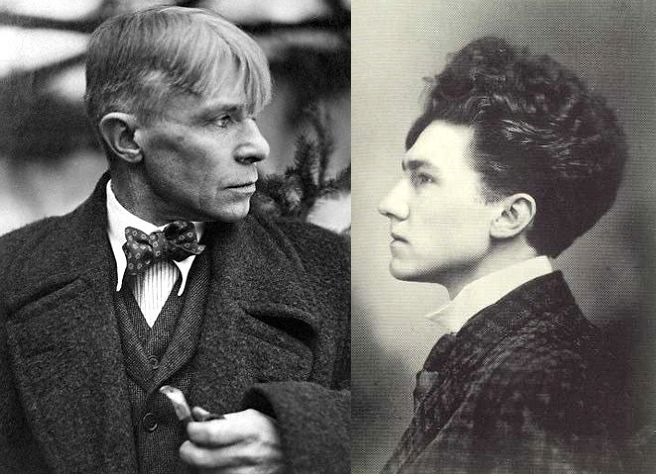
Young Sandburg and Pound

Young Modernists in suits: Carl Sandburg and Ezra Pound


Today’s piece combines two short poems, the first by Carl Sandburg and the second by the indispensable Modernist promoter Ezra Pound. Sandburg’s part “Letters to Dead Imagists”  speaks fondly and perceptively about Dickinson and then moves on to tenderly remember Stephen Crane as a poet, who, like Sandburg, tried to combine Whitman with Dickinson. By calling them Imagists, the term Pound used to promote his “make it new” style of poetry, Sandburg is directly endorsing their claim to being pioneering Modernists.

In the second part “A Pact”  we move on to Ezra Pound’s altogether more cranky voice, where he allows that Walt Whitman had broken “the new wood”, as if Whitman was some sawmill man who had roughly hewn some timber, which he contrasts to his, Pound’s, task and skill, which is to carve it artistically.

Chipewa Falls Water

Know your Modernist family trivia: Ezra Pound’s grandfather started this bottled water company


I’m unsure how much Pound knew about Whitman’s background, so when Pound talks about the “pig-headed father” I at first assumed that famously stubborn Pound was only projecting his own considerable intransigence onto Whitman. But the poem’s closing image, an extended riff on wood and timber, indicates that he may have known of Whitman’s father’s trade as a carpenter. Pound’s own family had connections with the lumbering industry. So in the end, when Pound proclaims that he and Whitman share “one sap and one root” he’s allowing they share the American grain.


Unreal City

Today we continue our performance of T. S. Eliot’s “The Waste Land”  as part of our celebration of National Poetry Month this year (#npm2018). We’ve reached the end section of the first part, “The Burial of the Dead”  which started with it’s famous stance, opposite to April and Spring, before proceeding through some scattered bittersweet pre-war reminiscences and a satirically murky attempt to read the future. In the concluding “Unreal City”  we present today, we move on to an even darker scene.

In a dreary London day cast with brown fog, the poem recounts a hellish procession of desultory men walking to work over London Bridge. Compare this to Carl Sandburg’s Chicago-set treatment of a similar bridge scene written just a few years earlier. Sandburg, the working-class political radical, knows well the worldly bargain the workers face in addition to the human condition. Eliot, the conservative bank officer personally grappling with depression, will connect the weary enervation to a spiritual brokenness.

Readers differ on what level of reality we should ascribe to Eliot’s scene, which after all is labeled “unreal.” Is this a vision of the dead of World War I arising in a zombie walk? Or is this some level of Hell or Purgatory, in which urban London is only imaginary set-dressing for immortal torment? Or is it an actual observed moment in Eliot’s London living life which seems as trapped and without options as death? Imaginary gardens with real frogs in them, or real gardens with imaginary frogs?

Eliot develops this scene with the deepest gallows humor in the whole poem. One of the sighing walkers on his unvarying path is called out, greeted by the speaker in the poem as a fellow veteran of a naval battle between Rome and Carthage in 280 BC. I’m sure Eliot would have appreciated the anachronistic pun before its time, as by happenstance that Punic Wars battle at Mylae can now pun on the infamous 1968 My Lai massacre during the Vietnam war.

“The Waste Land,”  which had begun with lilacs bred by Spring, now speaks of a corpse planted in a garden as if it was the bulb of a prized perennial flower. Eliot’s writing this nearly a hundred years ago, but poetically his iconography has taken a step toward a late 20th Century Heavy Metal album cover. I’ve double-checked Eliot’s notes on this poem. No, he wasn’t listening to Iron Maiden when he wrote this poem.

Unreal City Cover2

Would Ezra Pound have said: Make it New! (Wave of British Heavy Metal)


The section closes with a French quote from Baudelaire that translates to “Hypocrite reader! My fellow, my brother.” Eliot is inviting us into his nightmare, asking us to come along with him. If you haven’t read “The Waste Land”  before, or recently, where do you think Eliot will go next, now that he’s put us in grisly post-World War unreal corpse garden land? Fulfilling his poem’s design, it will be somewhere completely different.

Musically, I didn’t attempt NWBHM to accompany this section of “The Waste Land.”  Instead, I combined a fat synth motif and Rhodes piano with some electric guitar stabs and burbling bass. Listen to my performance with the player gadget below.


God Is In the All Time

I’m continually a few days behind in the past month or so, what with Winter holidays and other appointments and responsibilities. Some of the audio pieces have been recorded especially expeditiously, and another part of this project has been neglected: the searches I take to find words (mostly poetry) I combine with original music.

Because publishers do not respond when I ask for permission to use works that may be in copyright, I am constrained to use written work outside of copyright, typically works published before 1923. Although I respond to, and use, poetry written in various eras, my desire to mix in more contemporary voices leads the Parlando Project to use a lot of poetry from the first two decades of the 20th Century. This is not altogether a bad thing. I happen to like a lot of what these pioneering Modernists did, and in some cases, what we find in the mouth of the “Post-Modern” poetry mainstream delta is worthy of reconsideration in the light of the Modernists. Have stagnant currents deposited silt and detritus at our end of Modernism, its own Mannerism that says that poetry must be written in a special poetic language and syntax, because that is the language that serious poems use? If popular poems are to be about recounting internal personal experience and serious poems are to be about hermetic personal language, what is missed?

Maybe we answer these questions by doing, as we answer other questions (even ones we never ask) by living. In my case, the doing may be by continuing this Parlando Project.

So earlier this month, returning to the research that goes on behind the scenes of this blog, I read two old anthologies of poems now in the public domain, looking for some new material. In one I was attracted to yet another piece by Carl Sandburg, a poet I believe should be reassessed in our time, but hardly an unknown, particularly to readers/listeners here. In the second one I came upon the work of Fenton Johnson for the first time. I’m willing to bet most of you haven’t heard of him.

Johnson, like Sandburg, like William Carlos Williams, wrote Modernist verse while remaining in America. Like William Butler Yeats, his career was long enough that he wrote poems that sounded like the 19th Century before transitioning to a 20th Century voice. Here’s a difference: Fenton Johnson was Afro-American.

OK, let me drop a term here: Identity Politics. I was recently reading a thoughtful blog post on Carl Sandburg compared to Post-Modernist poetry, when the author remarked that Sandburg was able to write in a time preceding Identity Politics. I don’t know enough about Left Write & Centaur’s full thought on Identity Politics, but the implication was that Identity Politics, characterized as the idea that we are silos of individual experience based on membership in social and ethnic groups, who then by implication need to be treated and considered primarily by that identity, is a bad thing.

I agree, that’s a bad thing for the most part. I also believe it’s often a real thing.

The first half: the separation, at least to some degree, of individual experience, is so self-evident I don’t feel I need to argue it. Poetry and literature is to a large part a demonstration of the things that we find unique in individual voices—yes, along with things we can find in common in our lived lives—but if our take on experience wasn’t varied, literature would soon become dull and repetitive (at least to me). Even for those things that we find in common as we read or listen, how would we know without literature or other arts letting us share this?

If we feel that separation is a bad thing, then art is where we go to heal that. The arts are simply a name we give to that sharing of experience.

The second part, that this separation can be handled and considered with bins of people labeled with ethnic origin, sexual orientation, gender, age, class, and so forth, this is where it gets real. We cannot wish away with imagination the ways the world labels and files its temporary inhabitants.

Should I care that Fenton Johnson is an Afro-American poet? Should I mention it? Does mentioning it imply some kind of special pleading? As I present a smattering of his development as a poet, will his work become “Well, it’s a Black thing”—a separation surrendered to?

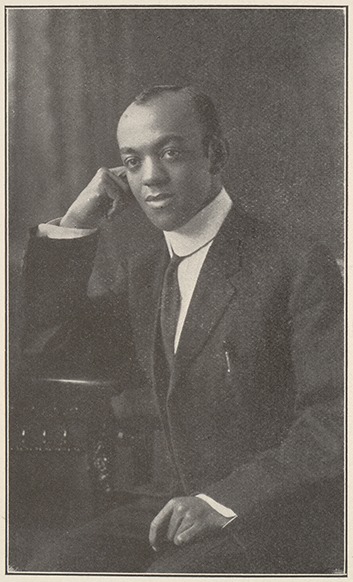
Fenton Johnson

The younger Fenton Johnson. I’m unable to find any later portraits of him.

However we dream our ideal world to come, I know that Fenton Johnson had to deal in the real world of 1918 Chicago, just as he would in 1968 or 2018 Chicago, with his ethnic skin color label on a daily basis. That label doesn’t peel off. No doubt, many he encountered imaginatively filled out that label with a long list of contents, but instead, let’s look from inside Fenton Johnson out at the world.

Will it be the same and different as Frost, Tzara, Sandburg, Rossetti, Tagore, Yeats, and Dickinson? Yes.

Early Fenton Johnson poems often start from a religious theme. This one, “God Is In the All Time”  portrays things from a universalist perspective. To hear my performance, use the player below.

California City Landscape

I beg your indulgence, but once more I feature Carl Sandburg’s words in today’s piece. Variety is a goal here, so perhaps I need to take a personal no-Sandburg pledge for a decent interval. And, honestly, I wasn’t seeking another Sandburg piece when I read through a yearly anthology of American poetry from 1922 last week, looking for fresh public domain material. Reading it I came upon the interesting poem that is the basis for today’s piece.

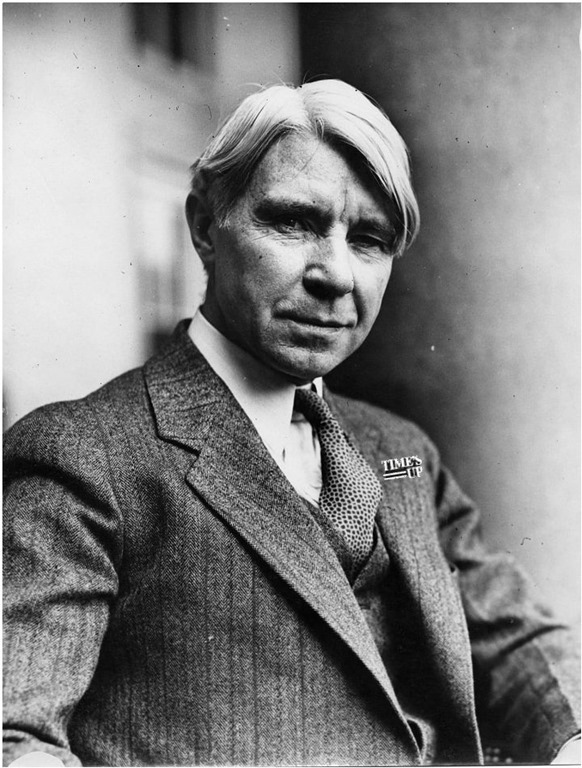
Carl Sandburg Times Up

The younger Carl Sandburg. Prophet?


Besides variety, I like to see connections, and “California City Landscape”  is rich in that. As a poem it may not be as sharp and condensed as Sandburg’s Imagist poems that I like to call attention to, but it does bring to the table Sandburg’s youthful journalism. “California City Landscape”  starts off like a feature story, and the story it tells is like ones written about gentrification in the 21st Century, even though it was written no later than 1922. The incumbent residents may be displaced. But like a poem, or a piece of carefully written prose, the reportage includes sentences which send a reader or listener off into entire dimensions of reality outside its moment in “the peace of the morning sun as it happened.” It was those things that arrested my attention as I read this in the midst of this old annual anthology.

It starts out with this anecdote about a second generation Irish-American goat farmer, connecting as it does to one of second-generation immigrant Sandburg’s great themes: American immigration. But how carefully barbed is the sentence Sandburg uses to sum up the changes this man has seen in California by 1922. He arrived in a covered wagon, and “shot grouse, buffalo, Indians, in a single year.”

If we were Tweeting: “OMG! He went there!”

But there it is in a sentence. An Irish-American, coming from a nation that is widely despised, colonially oppressed, and mired in poverty and starvation, travels in a generation across and ocean and a broad continent, and in the process shoots (and presumably kills) indigenous Americans, an act linked as if it was like hunting for food.

I’ll admit, at first moment I thought it offensive, but I’ve read enough Sandburg to know his toughmindedness, his instinct to not sugar-coat. That Sandburg wouldn’t have included this detail as a thoughtless, bloodless, “Oh, those good ol’ days, when men knew how to handle a rifle” comment.

His next anecdote: two Japanese families, truck gardening for the growing city of Los Angeles. And once again, the undertone: immigrants whose race and culture is understood barely enough to be widely disapproved of in their new country. We don’t need to credit Sandburg with the gift of prophecy, but historically we may know what will happen in 20 years: the Japanese Americans on the West Coast will be taken from their homes by legal fiat and detained in makeshift rural camps.

So, a 95-year-old poem about a problem we might write about today (if our poetry would be politically engaged and socially observant): gentrification. And in talking about it, Sandburg brings in racism, and immigration from those, ah, um—what’s the Presidential term—oh, yes, less desirable countries.

And then the third anecdote: the McMansion of the Hollywood director, with the “whore-house interiors.” Here I’m not completely sure about Sandburg’s prophetic dimension. The epithet of whore-house décor remained even into my time in the second half of the 20th Century as a charge on nouveau riche ostentation, a term used without a direct linkage to sexual oppression.

That Sandburg the poet goes on to add “ransacked clothes,” an odd adjective choice that he could have intended as a knock against Hollywood costumers knocking off “real” European couture—but that sounds more snobbish than Sandburg could ever be—and he next adds the “In the combats of ‘male against female” line. From the era we know the director is male, and Sandburg associates this anecdote specifically with a struggle of “male against female.”

Maybe I’m missing an obvious alternative, but is Sandburg predicting a 95 year #timesup statement?

Finally, I love the last line, echoing a common Sandburg trope about modernity and timelessness: “How long it might last, how young it might be.”


And now for something completely different: Sandburg in his 80s. “Ernest Hemmingway?”


Musically, I’ve been a little short of time. I wanted to do something reminiscent of the mid-20th Century word-jazz bag, but the typical beat poet reading to jazz backing in a small club used piano, and my piano skills are entirely rudimentary. Frequent Parlando Project keyboardist Dave Moore is currently fighting a right hand issue, so I couldn’t go that route, so I used by love of jazz guitarist Jim Hall and my audacious tendency to fake styles beyond my abilities to create this jazz trio with drums, bass, and electric guitar for my reading of Sandburg’s “California City Landscape.” Hear it using the player below.


Winter Milk and Carl Sandburg Revisited

Today is the 140th anniversary of Carl Sandburg’s birth. Sandburg began his long and broad career as an American Imagist poet, political activist, and journalist, and he went on to add prize-winning biographer, folk-song revivalist, and goat farmer to his resume. If one was to make a list, he would be in a small group of American cultural forces in the first half of the 20th Century who created what we today call “Americana,” and helped make sure that this label could be applied, as it can be today, to a musical genre. I won’t have time to go into this today, but in 1927 he published “The American Songbag,”  which is as important a landmark in the American folk song revival as “The Wasteland”  is for high-art Modernist English verse.

I’ve spoken about Sandburg here a great deal in the past couple of years because I believe he’s too-little read, too-little considered in academic circles, and too-often misunderstood from the effects of this quick (mis)understanding and dismissal. To the degree that people encounter him in school or surveys of poetry, it’s for two poems. One, sometimes effectively used as an introduction to metaphor even at the grade school level, is his short Imagist poem Fog.”

The other, better known as the  Carl Sandburg poem, is his Whitmanesque “Chicago,”  with its famous opening litany of praise for Chicago that is ever quoted whenever that city is to be characterized. Some things are odd about the case of “Chicago.”  First, while folks remember and re-use it’s opening stanza of praise, they forget the three lines that follow it, which though stated in century-old language, is unmistakably as stark a report as any OG rap laying out hos, gangsters, and poverty:

“They tell me you are wicked and I believe them, for I have seen your painted women under the gas lamps luring the farm boys.

And they tell me you are crooked and I answer: Yes, it is true I have seen the gunman kill and go free to kill again.

And they tell me you are brutal and my reply is: On the faces of women and children I have seen the marks of wanton hunger.”

Though “Chicago’s”  Whitmanesque/expansive-litany style is one that Sandburg would continue to use at times, its prominence has overshadowed Sandburg’s sparer Imagist voice, the one that he used for the rest of the poems in his landmark “Chicago Poems”  collection.

It’s easy to think that if Sandburg had spent time in Europe hobnobbing with its cosmopolitan demi-mode, if he had included more Latin and Greek in his poems, and if he’d kept his political outlook to something between Tory and crypto-Fascist, that he might have scored more academic cred in the second half of the 20th Century. And his more general popularity, like that of Edna St. Vincent Millay, is in danger of dying out after the death of the fire-starter without the hard-blowing bellows of academia keeping the embers glowing.

If that’s so, who does that leave to keep Sandburg’s poetry more broadly heard?

If anyone remembers Sandburg, particularly the spare, Imagist Sandburg, it’s musicians and composers. He gets set to music often, and his free verse often sings easily. And, it seems to me that musicians, rather than page-poetry curators, more often remember the innovative modernist in Sandburg. One of my favorite records of 2017 was Matt Wilson’s “Honey and Salt”  which, like the Parlando Project, seeks to use a variety of music combined with Sandburg’s underappreciated broader pallet of literary expression in unexpected ways.

A promotional trailer for Matt Wilson’s Sandburg “Honey and Salt” recording

Today’s piece, a slightly remastered version of one I used to test streaming audio here before the official launch of the Parlando Project, is Sandburg’s tender “Winter Milk”  as performed by the LYL Band a couple of years ago. You can hear it with the player below.

Sandburg Family with Helga Sandburg on the left

A slightly older Helga Sandburg on the left with her parents and sisters.

A gentle reminder, I encourage readers and listeners here to share the links to these pieces on social media as it helps spread the work that Parlando Project does very effectively.

The Parlando Project Winter 2017 Top 10 Part 2

Picking up from where we left off yesterday, here are the next three most popular audio pieces based on readers here hitting the like button along with the number of streams and downloads counted during this past fall.

Number 7 is Edna St. Vincent Millay’s “”Sonnet 43”.  I seem to be coming to a greater appreciation for Millay as I do this project. Like my long time favorite Carl Sandburg, Millay “suffered” from too much popularity in her heyday, and like Sandburg I believe that her popularity in non-academic circles at the least caused critics to feel that they need not bother to examine her work more closely.

I’ll admit, I was one of those that thought she sounded like someone trying to be a 19th Century poet when the 20th Century was well and truly underway. Now in the 21st Century, I find this less of a crime, and when I let go of that, I find I like this sonnet’s complex appreciation of love’s limits.

Musically I love that I was able to play a convincing arco bass using a MIDI-controlled virtual instrument for this one. Bowed string bass is like the snoring of the bear mother in a winter den to me, immense, and yet sweet and comforting.


Speaking of Carl Sandburg, his “Autumn Movement”  made it all the way to number 6, and that’s remarkable because it was only released on October 20th and thus had less than half of the Fall interval to pickup likes and listeners. I love the central autumn image in this one from Sandburg’s “Cornhuskers”  collection, and it reminds us that Sandburg, known also for his acutely observed Chicago poems and journalism, was from the very start of his career interested in conveying rural life as well.

Musically, this piece demonstrates how recently I had seen Bill Frisell in concert—and seeing him, and the musicians he plays with, is something I try to keep always recent in my experience. Of course, Bill Frisell has an immense amount of musical vocabulary under his fingers, and I don’t; but I tried to make the best of mine, which is all any musician can do.


Bill Frissell with books

Besides his music, I admire Bill Frisell’s interior decorating sense and, alas, his sartorial style.


Our number 5 piece in popularity this fall was T. E. Hulme’s report from “Trenches St. Eloi.”   Many of the Modernist soldier/poets who served in WWI grew not only to  hate war, but to distrust their country’s cause and justifications for their particular war. Hulme is something of a exception. As far as I can tell, he remained supportive of the British war effort in which he eventually lost his life. That doesn’t make “Trenches St. Eloi”  propaganda, for it’s far from blind to the horrors and difficulties of extended conflict. Hulme’s death shortened his career and helped mask his seminal contribution to modernizing British poetry.

Since starting this blog, I’ve been following the centenary of World War I off and on in the background, which meshes well with much of the material I can present here without running into rights issues, since modern public domain status cuts off at 1924. The material from the poets who served in the war or were otherwise touched by it, is, not unexpectedly, downbeat. Just as the Modernist revolution changed poetry, WWI changed how war was written about, breaking millenniums-long Homeric traditions of war heroes, that however flawed, were able to shape battles by their character, into stories of endurance like this one.

This is another one where the bass guitar gets to carry a lot of weight.


Thanks again for reading and listening. It’s been a huge amount of work this past year to bring you the Parlando Project pieces, hundreds of hours of reading, studying, translating, composing, playing, and recording these unique combinations of various words (mostly poetry) with various original music (as varied as Dave and I can make it). That wasn’t drudgery—far from it—it’s brought joy and amazement to me to see what’s out there that I haven’t heard or imagined before, and I hope some of that wonder and discovery comes through to the readers and listeners here, because it’s our goal to surprise and delight you, to show you new facets of poems or poets you thought you knew and to introduce you to some writers that didn’t get included in your textbooks.

Here’s what I ask you to do if we’ve succeeded in that, even if only for a piece or two out of the more than 160 pieces we’ve presented so far: let others know about it. Tap them on the shoulder, show them the URL, link us on your blog or on social media, stick an earbud in their ear. Every like, listen, link and comment helps me keep doing this. I know I should be a better promoter of this work, but frankly, I’m too engaged in the work itself to do as much as is needed.

And standby, the next three most popular pieces from the past fall will be posted soon.

Autumn Movement

I’ve been a bit long-winded in the past few posts, so a short-winded post about today’s piece. The words are another poem from Carl Sandburg, this time from his 1919 collection “Cornhuskers.”  There’s not very many words to it, a warning that there are not many leaves left here in the upper Midwest.

Cornhuskers cover

They were listening in London, and Sandburg’s “Cornhuskers” won him the Pulitzer prize.

I can compress talking about those words because I’ve already talked about Sandburg on the previous occasions when I’ve used his words here. In his poems of this era, he’s as perfect an imagist as any of the expatriates mixing up modernism in London and Paris around the same time.

Many of the Sandburg poems I’ve used previously have been from his landmark “Chicago Poems”  collection, but Sandburg, a child of middle, rural Illinois, spent time across the Midwest in his youth, from urban centers to the farms and small towns. The poem I use today, “Autumn Movement,”  is from that rural setting.

Images for autumn and fall foliage have been mined forever, which makes Sandburg’s key image here as unusual, even a century later, as T. E. Hulme’s red-faced farmer appearing as the harvest moon in his British autumn poem. Sandburg has the red and yellow of autumn leaves in a farm field vista as a yellow scarf with the copper color of a literally red-necked woman. So nearly has this skin color become an epithet, that few would think of using it today, as honest an image as it is.

Today’s audio piece is musically ars longa to the vita brevis of the words. I’ve been telling myself to allow space compositionally, and then going ahead anyway and filling things up like a compulsive cluttered room with only paths between piles of old newspapers. So, for this one, the drums (which are often quiet and spare) are the densest element. I added a simple bass line played on my fretless bass, a theme played on a Telecaster, and a digital synthesizer part that is a mix of four different patches played together rather than filling up the space with multiple synth parts. Give it a listen with the player  below. Or if you don’t see the player, you can use this highlighted hyperlink to play it.