Isn’t it odd that early 20th century Modernists used the locomotive as one of their talismans? After all the railroad train wasn’t particularly new at the time, though like buildings and the airplane it eventually became a fine armature upon which to sculpt the curved Streamline Moderne style—but that was later in the century, and before it arrived the train was already the nightingale of the make-it-new crowd.
“…Shining, just like gold. Don’tcha hear me cryin? Ah Wooo-Hooo,,,”
It probably comes down to speed and power. Much of America in the pre-1920 years was still held between walking and horse-saunter speed, trains were exceeding the magic mile-a-minute rate, a supersonic difference to then. The sight of a long train rolling through the countryside must have been a majestic contrast of speed, noise, and human-constructed momentum.
Even back in the 19th century, the father and the mother of modern American poetry each wrote a train poem. Walt Whitman with his somber “Locomotive in Winter”, and Emily Dickinson* at her most playful with “I like to see it lap the Miles.” The strength of the train ideal is such, that without motion or even presence its gravity is silently impressed onto two classics of early 20th century poetry: “In a Station of the Metro” and “Adlestrop.”
Limited. Shortly before he died, my father told my son and I that he recalled one thing from his childhood visit to the Chicago Worlds Fair in 1933-34, the Zephyr streamlined train. That year we visited it, exhibited in the Chicago Museum of Science and Industry and sent him a picture of us by the train.
But today I want to celebrate Carl Sandburg during America’s National Poetry Month, and to advocate once again for this forgotten Modernist, the son of an immigrant, born in the Middle West of our continent. The poem I use today isn’t particularly difficult or full of samples and beats from everywhere like “The Waste Land,” or subtle in its questions like much of Emily Dickinson. Sandburg gets into it, drops its Imagist payload in a sentence, and then makes its point. As Harriet Monroe said in reviewing Sandburg’s Chicago Poems, in which “Limited” appears: “His book, whether you like it or not, whether you call it poetry or not, is fundamental in the…majestic sense.”
And a poem like “Limited” is fundamental. What it says isn’t novel, but what it says is low enough down beneath our florid lives to be overlooked. We often ask great poetry to tell us something we don’t know, to surprise us, but there may be a place for it also to tell us something to which we can say, dismissively, “Well, yes, I know that!” and for the poem to remain, silent at its ending, saying “If you know that, why haven’t you acted like it’s something you know?”
20th Century musicians loved the train too and its rhythms, that rattling phrasing and doppler marcato. For this performance of “Limited” I tried to touch on that and let some guitar tracks run out. You can hear it with the player gadget below. Not a long text today, but for those who like to see as well as hear the words, click here.
*One of the interesting side-lights I picked up in Genevieve Taggard’s Emily Dickinson biography, one of the first full-length treatments of her life and work, and written early enough that she could talk to people who overlapped Dickinson’s life in Amherst, was that her domineering father, who looks so stern and austere in his photograph was well known in the community for always wanting the fastest team of horses in for his buggy. I see Vin Diesel et al in a prequel Fast and Amherst, but Drift it Slant. Hollywood, call me, I can put the blog aside….
As we continue our accelerated exploration of poetry for National Poetry Month, let’s look at another way that poetry, and in particular T. S. Eliot’s “The Waste Land,” manifested itself in popular culture in the black & white TV era.
Yesterday’s post about a Twilight Zone episode shouldn’t be all that shocking. Rod Serling made his bones as a screenwriter first, and many of his TZ episodes were adaptations of short-stories, albeit genre short-stories that might not pass muster in Western Lit classes. Burgess Meredith, who embodied the Prufrockian Harold Bemis had a long career in stage plays that were literary adaptions as well, including directing Ulysses in Nighttown and a touring production titled James Joyce’s Women.
Still, in the unnamed straddle-decade of the late ‘50s and early ‘60s, science fiction and fantasy were rarer than televised literary adaptations. What was extraordinarily common was “Westerns.” A plethora of cowboys, gunfighters, sheriffs, horse-soldiers and ranchers rode the gray sage range. Watching them now I’m struck buy some things. They are often surprisingly violent. The small fuzzy low-contrast home screens wouldn’t have portrayed the later exploding blood-squib aesthetic of Peckinpaugh and Tarantino well then, but the Westerns of this era intensified the meanness, meaninglessness, and sadism to Jacobean revenge play levels.*
The moving pencil moustache writes, and fashion notices. Richard Boone as Paladin and Bob “Marshall” Dylan who’s taken to wearing dark western gear in his later years. Not pictured: Johnny “The Man in Black” Cash.
Taken in general they are also shockingly racially ignorant and ahistorical. The lead roles, the protagonists and antagonists, are nearly always white men, and then if the Western is a way to examine the historic violence of white men that could have its value, but it’s often white man against white man that is the central focus on the small screen. The issue of the conquest, displacement and decimation of First Nations people is rarely dealt with in any searching or complex way, and so that fault has become a commonplace in comments on the 20th century Western. What’s even more obtuse is the lack of any significant ethnicity beyond WASP-white. African-Americans, Asian-Americans, and first generation immigrants in general are all highly under-represented and when present, most always stereotyped.** Latin-American characters exist to a greater degree, given that much of the settings for these dramas would make it impossible to white-out them from history.
So, black & white television Westerns of this era are largely white & white.
I can’t hold it up as an exemplar in these matters, but my favorite of the era was Have Gun Will Travel. It wasn’t consistent in mitigating these massive blind spots, but it had its moments.*** And as a half-hour drama, many episodes present almost poetic compression: striking unusual characters that exist for a scene only, tales told in only a few stanzas, epigrams dropped in as dialog. Watching a good episode is so unlike modern season-arcing prestige TV. You’re left to fill in the life before and after of most any character, and conflict doesn’t brew and simmer over hours, but often is “An intellectual and emotional complex in an instant of time.”
‘50s TV may have bleached the Old West, but that didn’t mean Afro-Americans and others had to go along with that.
So how am I going to stretch things to bring“The Waste Land” into this six-gun waving post before I wind it up? Well, the Have Gun Will Travel “Waste Land” referencing episode “Everyman” is so bold-faced that the writer certainly intended it, though I can’t say if anyone thought many viewers would catch the in-jokes in between the cigarette and laxative commercials.
This attempt to incorporate elements of “The Waste Land” fails to succeed overall, but some things about it are still striking. The mysterious Danceman character (a Summoning of Everyman/Seventh Seal dance of death reference?) could appear in a Bob Dylan song and not be out of place. The strange and sketchy dynamics in the shopkeeper and his daughter might subtly be riffing off “The Waste Land’s” sexual anxiety.
Once more, let me leave you with a Parlando audio piece featuring the LYL Band using the words of Carl Sandburg, this time his “Long Guns” which I mix with a little Howlin’ Wolf. The player is below. The full text of Sandburg’s poem is here. And as to Howlin’ Wolf, well you just need to seek him out, but the man learned at the feet of rural mixed-race early-20th century Modernist Charley Patton.
*Alternate reader and keyboardist here, Dave Moore wrote a chapbook about he and his brother watching these shows as kids and making a game of totaling up the dead. It’s certainly math of higher numbers. Even in the half-hour dramas, one can be fairly certain there will be death along with threats of death—often multiple deaths, often murders, along with executions, duels, and battle deaths.
**Historically, the “Old West” was demographically diverse, just as most frontiers are.
***Two examples: “The Hanging of Aaron Gibbs” featuring singer/guitarist Odetta, and a flawed episode with some strong elements written by Gene Roddenberry “The Yuma Treasure.”
Continuing our exploration of National Poetry Month, let’s open another door. You unlock this door with the key of imagination. Beyond it is another dimension—a dimension of sound, a dimension of sight, a dimension of mind. You’re moving into a land of both shadow and substance, of things and ideas…
Yes, I’m speaking of mid-20th century TV, and specifically The Twilight Zone. Once more there is a revival of this series, helmed this time by the talented Jordon Peele. I think there’s something difficult in his task, one that may not matter in terms of audience or financial success, but one that I notice when I look at the old gray-screen stuff from 60 years ago. It’s two of those qualities I look for in poetry: compressed expression and memorability.
If older people remember some of those shows like poems, it’s because they were much more like poetry than prestigious television is today. For one thing the 30 minute drama was a thing. Isn’t this odd? We talk today about ever-shorter attention spans incessantly, as if we ourselves have forgotten that we’ve already talked about that subject—but the predominant television format today is the video equivalent of the serialized novel. Even the basest form of “reality TV’ shows are season-long arcs of hour-long episodes, and most of the prestige shows intelligent critics like to write about unwind over multi-season plots. That’s a valid concept, but it isn’t the only possible one. Those old 30 minute shows had to express the experience and clash of ideas fast, they weren’t about long-form character dynamics, they were about epiphanies.
Do folks feel they remember 21st century television episodes, in a sense they possess them completely as recollections of sensations and apprehensions; in the way that one possesses a poem, even one not completely memorized, where one may hold and carry a key stanza or final couplet in our mind?
There are several Twilight Zone episodes that seem to have the quality of memorability shared with poetry. For the literary sort, the 1959 first season episode “Time Enough at Last” starring Burgess Meredith as a man who so loves to read books would be one. The gist of the story is so memorable I’m not going to summarize the plot, because you’ll remember it if you saw it. If you haven’t seen it, it’s worth the 25 minutes of your time, and there will be no spoilers here. Only the final (spoilers!) scene is available on YouTube, so don’t go there, but I expect some streaming services will have it.
Instead I’m here to note two small things you may have forgotten, though I have no idea if Twilight Zone’s creator, producer, and screenwriter of this episode Rod Serling intended these details.*
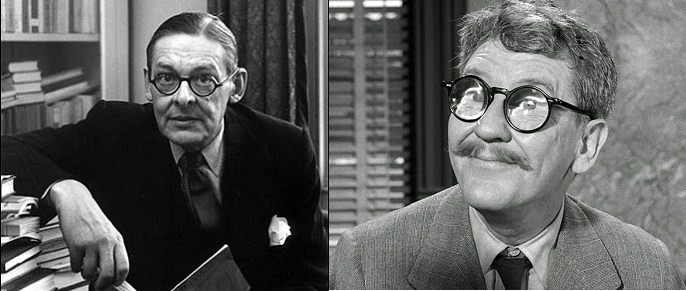
T. S. Eliot and Harold Bemis played by Burgess Meredith. Two bank clerks who’d rather be reading.
First off, Burgess Meredith’s character, Harold Bemis, works in a bank and his marriage is spectacularly dysfunctional. I found it odd that I hadn’t remembered the key scene between the married couple, which is so intentionally cruel and specific as to equal or exceed the empty-hearted offhand cruelty between men and women in “The Waste Land.” Even if the wife’s character is stereotypically shrewish, the ending of their scene is so heartbreaking that I can’t say why it isn’t more remembered. Of course, the whole sexual politics of this echt-’50s trope of the controlling female denying the freedom of the male should be bothersome, but did the TV show intend to reference the scholarly T. S. Eliot circa the writing of “The Waste Land” then working in a bank, famously hamstrung by his own dysfunctional marriage?
Probable? I can’t go that far, but it’s more of an outside possibility than you might think. T. S. Eliot was never Tennyson or Longfellow famous, but in the 1950s he was as well-known as a poet could be then**, and poetry was still considered something of a co-equal branch of literature, a substantial part of culture.
And that was the other detail that stood out watching “Time Enough at Last” again. The couple’s scene revolves around Harold Bemis wanting to sneak a read of a book. A classic novel? A bit of science fiction or fantasy? Hemingway on bullfights and fly fishing? The Second Sex in French? A hard-boiled detective yarn? Philosophy? History? A collection of “Can This Marriage Be Saved” columns?
No, it’s A Book of Modern Poetry. Bemis’ character says of it “This has lovely things in it, really. There’s one or two from T. S Eliot. Edna St. Vincent Millay. Robert Frost. Carl Sandburg.” My ears perked up. That’s the kind of stuff you find here!
Now Harold Bemis is also a stereotype, the nebbish, maybe the idea that the thing his domestic bank clerk life most wants is modern poetry is meant to underline that caricature—that he’s too bookish. It’s not like he wants to anachronistically read The Art of the Deal. Despite the sadness of the scene, it cheered me, it could also mean to say, even a little, that that is what he needs. And in any case, Serling at least thought that an audience in 1960 would know these poets in some way, even superficially. If Jordon Peele or someone would rewrite that scene today and his modern Bemis was to speak of Frank Bidart, Tychimba Jess, Peter Balakian, and Gregory Pardlo*** as the lovely things he most wished to read, would the audience read anything in those names?
Well those four poets could well have as much or more to say to us. Why wouldn’t they? On the other hand, I can perform the older poems I use here freely as I encounter them, and it would be a chore to try to get unencumbered use of current poets for my small project. So, here’s my performance of Carl Sandburg’s “At A Window,” available with the player below, and full text to read along here. All four of the poets he mentions in his scene would have difficult messages that still might console Bemis, all four could write a lovely line, even about harrowing things. But I’d choose this one from Sandburg for him to read aloud.
*Serling’s screenplay was based on a 1953 If magazine short story by Lynn Venable. Venable also has Harold Bemis as henpecked and working in a bank, but her story has Harold’s spouse so dead-set against him reading that it’s said he hasn’t ever been able to finish a book, and the only book author name-checked in the entire story is Spinoza. Her scene between Bemis and his wife is told in a much blander flashback.
**Before there was a national poetry month, on April 30th 1956 T. S. Eliot spoke in the Twin Cities, filling one of the largest capacity basketball arenas in the country (somewhere between 14,000 and 18,000 capacity)—not for a mythic men’s Final Four between Eliot, Robert Frost, Wallace Stevens and Carl Sandburg, but for a solo lecture sure to pack’em in today: “The Frontiers of Criticism.”
***Those are the last four winners of the Pulitzer Prize for poetry. Unfair! Bemis’ book was an anthology of modern poetry, those poets he longs for all had been publishing for 40 years. But just for contrast, here are the poets who won the Pulitzer in the ‘50s, “recent years” to the 1959 TV screenplay: Gwendolyn Brooks, Carl Sandburg, Marianne Moore, Archibald MacLeish, Theodore Roethke, Wallace Stevens, Elizabeth Bishop, Richard Wilbur, Robert Penn Warren, and Stanley Kunitz. Of course, poets in your rear-view mirror may appear larger/greater than they are to contemporaries, and it does look like the Pulitzer committee was more likely to give “lifetime achievement” awards in the ‘50s than they have been in our century.
Let’s continue our celebration of U. S. National Poetry Month!
If Emily Dickinson and Walt Whitman are the parents of modern American poetry, then one poet is most nearly the descendant with an equal inheritance from both: Carl Sandburg.
Sandburg’s poetry has two modes: the tightly compressed Imagist poem and the expansive, iterative, catalogic Whitman-like ode. I find him effective in both styles—and sometimes he mixes both, as in today’s selection. Each line in his “10 Definitions of Poetry” is its own compressed poem, but taken together in a list they express different aspects of poetry.
The forgotten American Modernist. Sandburg! thou shouldst be living at this hour!
.
I’m something of an advocate for Sandburg here, as I feel he’s fallen out of favor during my lifetime and now is more than due to be re-evaluated. The major knocks against him in the later part of the 20th century were that he wasn’t complex and subtle enough, that his poetry didn’t dig deep enough in to the hard-to-grasp philosophic questions at the core of meaning and human existence, and to a secondary degree that his poetry wasn’t, well, poetic, that it was neither lyrically beautiful nor painstakingly constructed.
I won’t lay out a complicated case for Sandburg on those two issues here today, but on the first issue I’ll say that Sandburg’s Socialist and working-class outlook leads him to address universal issues of the human condition, from top to bottom of our current social organization; while other poets, ones with an avowed aesthetic focus or a calling for self-contained spiritual insight look at only part of the situation. Even those that don’t share Sandburg’s politics can benefit from his insights. On the charge of Sandburg not being a poetic craftsman, I’ll say that while I don’t know much yet about his working methods, I can look closely at some of Sandburg’s shorter works and find well-chosen small things—and whether they were intuitively there in his vision or created by exhaustive study and revision, I find that less important than their existence.
I’m also sorry to say that Sandburg’s poetry can sometimes be—as reflected in some of his definitions in this list—fun, funny, entertaining. You’ll just have to overlook that.
And if he’s charged with those things, weren’t Whitman and Dickinson also charged with these faults throughout the 20th century? Our current century looks at Whitman and Dickinson and sees their still startling differences—but has begun to realize that where the past saw in those differences infelicities of expression or simple directness, that they are instead part of their genius, part of why our need for those poets has not been replaced. And if we need Whitman and Dickinson, then perhaps we also need their hybrid descendant Sandburg too—he of his synthesis of hyacinths and biscuits.
I took my musical inspiration today from Sandburg’s first definition: “Poetry is a projection across silence of cadences arranged to break that silence with definite intentions of echoes, syllables, wave lengths.” My guitar part runs through some modulation effects and an echo/delay; and underneath, working with my electric bass-line, a wobbly Mellotron* waves along. Hear this with the player gadget below, (of if you don’t see the player, you can use this highlighted link) Check back soon for more combinations of various words with original music—and, oh yes, please let others know what we’re doing here at the Parlando Project.
.
*No, I don’t have an actual funky tape strip Mellotron. Thankfully the tapes have been converted into digital samples and can be played with an inexpensive MIDI keyboard or controller.
Here we go with our quarterly run down of the most liked and listened to audio pieces over the past season. We’ll be counting up to the most listened to piece over the next few days as we approach winter solstice. Who’ll chart? The most famous poets with their best-loved words? The literary poets’ poets? The poems of the now largely forgotten figures I like to dig up sometimes?
10. “Seventeen Almost to Ohio,” words by Paul Blackburn arranged by me. Where does Paul Blackburn fit now? Probably in the poets’ poet bin, though he’s also verging on forgotten. He doesn’t seem to have benefited from connections to a poetic movement, though he had them in overplus. He’s sometimes associated with the Black Mountain School, though he himself says he wasn’t really. He visited Ezra Pound and shared Pound’s interest in imaginative translation and the old French Provencal poets, and he is there connected to the original English language Modernist movement. He was based in New York coincident with the New York School of poets though he’s never mentioned as one in any summary roundup I’ve read. The Beats touched edges with the New York School—and with Blackburn, and again there are similarities in their approaches. Perhaps the most significant connection is that Blackburn was a leading NYC-based encourager of spoken and recorded poetry, including being the original organizer of the St. Marks poetry readings, a spoken word radio host, and a recordist of many other poets reading.
“Seventeen Almost to Ohio” comes from an aside Blackburn made while recording Mina Loy in 1960, where he (apparently) spontaneously recalls an event from his own youth while asking Loy about hers at the dawn of Modernism. I lightly edited and arranged his anecdote and then composed the music.
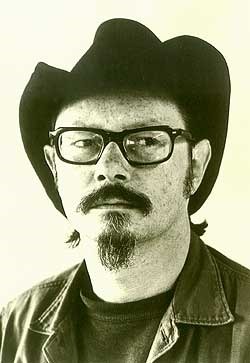
Paul “Does Jeff Tweedy look like me when he looks in the mirror” Blackburn
9. “Fog”, words by Carl Sandburg. Early Modernists were fascinated by extreme compression and very short poems, and anthologists since then so often include Pound’s “A Station in the Metro,” Williams’ “The Red Wheelbarrow,” and this 21-word Sandburg poem. And because it so baldly displays its central metaphor of fog and cat, the poem is often used to introduce grade-school children to metaphor.
In writing about “Fog” this fall I wondered if there’s anything we’ve overlooked for over a century in this short poem, and came up with this question: Might it matter what kind of cat it is?
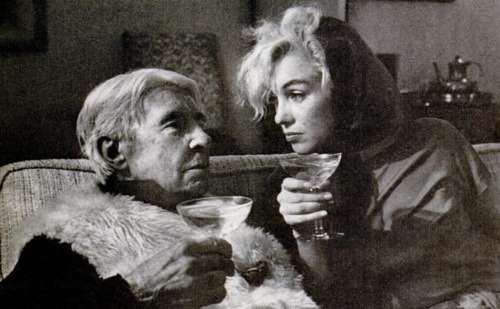
Marilyn: Carl, Carl, you simply must tell me what kind of cat it was!
Carl: In good time, my dear—but first I need to finish inspiring Sonny Bono’s Sixties look.
8. “The Temple of Summer,” words by Frank Hudson. Well, I’m almost as short-winded as the Sandburg of “Fog” in this 31-word Mellotron drenched goodbye to summer. Longtime readers here will already know of my devotion to the sound of this primitive attempt at a sampling instrument used memorably in many late 60s and 70s British Prog-Rock recordings. The real thing is finicky, bulky, and hard-to-find and maintain, but the Mellotron’s sampling of real instruments to strips of recording tapes, whose notes can then be played by a keyboard press, is an easy trick for the computer-hosted Virtual Instruments that the Mellotron inspired and I use.
Robert Fripp, on the right with King Crimson, declared after dealing with voltage issues on tour: “Tuning a Mellotron, doesn’t”
As we enter the week in which we note the ending of World War One a century ago, I want to call attention to some the ways we’ve shown poets wresting with that war in their own time. It’s a longer post, but each one of these pieces presents something different for Armistice Day.
I didn’t start out to feature the WWI generation here. I first intended to include more modern poets’ words, but to do so I would have needed to try to negotiate the issue of finding the copyright holders and getting them to respond to requests for permission when I thought I’d located them. That turned out to be frustrating.
This left me with the pre-1923 generation, the original Modernists, as the most recent voices I could consistently present. Like many limitations this brought an unexpected return. This generation’s members were the pioneers in the new poetic voice that I had to deal with as a young man and young writer, and to some degree we’re still dealing with them now. Even the basic and incontrovertible truth that the majority of published poetry has been free verse in my lifetime is not some inevitable thing, someone had to suggest and prove its efficacy. And the kind of imagery we take for granted as allowed or desirable in literary poetry? That too is their doing.
WWI did not start Modernism. Americans and the French were experimenting with many of its tactics as early as the mid-19th century, and British Modernism was already emerging before 1914. But the events of WWI bent the development of Modernism by their tremendous gravitational pull. Sometimes directly, by poets and artistic allies who were killed, but also by propounding the idea that the established artistic order was incapable of describing the world of the first world war or it’s aftermath. Pre-WWI Modernists writing in English could be straightforward and modest in their poetry. They often valued shorter forms that assumed the elaboration would occur in the minds of readers rather than in endless lines on the page. Post-WWI, the longer poem and much more elaborate and opaque imagery came to the forefront, and the form of the irrational became a large part of the reflected world, even for writers outside the movements like Dada and Surrealism that were formed around that.
It’s been an adventure here reliving those changes. Some of the Parlando Project’s most popular pieces have come from that WWI moment, and here are the six most popular WWI poems we’ve presented here.
6. Christ and the Soldier. Siegfried Sassoon seems to have been somewhat superseded by his friend Wilfred Owen as the representative British War Poet of the anti-war stripe. Owen may have “benefited” by dying in the war, rather than having the long career that Sassoon had. Sassoon was a highly decorated veteran of the trenches when he started to publicly oppose the war, and this lead to the danger that he could have been charged with treason, and a weird compromise was worked out where he was treated instead as a man suffering from mental illness caused by the war instead of being put up on trial, the kind of outcome that Joseph Heller would have relished writing of decades later. “Christ and the Soldier” is not politically anti-war, but it’s stark, darkly-humorous, and yet serious account struck me from the first time I read it. As WWI poems go, it deserves to be much better known.
You probably haven’t heard this one, so use the player below.
5. These Fought. Ezra Pound did not fight in WWI. Pound was an American living in England, which would have complicated his enlistment before and after America’s entry into the war, but in either case a determined man could have overcome those obstacles. Pound’s friend, and co-founder of English Modernist verse in the years leading up to the war, the lesser-known Englishman T. E. Hulme, enlisted, as did others in his wide circle of acquaintances. So, when this post-war poem was published, excoriating the waste and propaganda of the war years, it was in the context of a longer poem that it’s only a section of, “Hugh Selwyn Mauberley.” In the entire poem, Pound, who’s personality seems to have been a strange mixture of generosity and egotism, stubbornness and self-admonishment, also charges himself with failing to decisively deal with the titanic issues of the war. I’d muse that this sounds like survivor’s guilt is mixed in with the contempt for the war stated after the fact. In Pound’s case, his self-correction found him supporting his next foreign home, Fascist Italy, against his native country’s side during the next World War. Ironically, this lead, like Sassoon, to the compromise of “Well, maybe he’s a traitor, but let’s treat him as crazy.”
Still, as a piece of invective, and as a condensed statement of art’s challenges in dealing with monstrous events, I have to hand it to Ezra for his set of words. Pound helped “popularize” the use of phrases from many languages in High-Modernist English language poems, much to the benefit of footnote writers, and in “These Fought” he drops a variation on the same Latin phrase used by Wilfred Owen in Owen’s best-known anti-war poem: “Pro patria, non dulce non et decor” in Pound, “Dulce et decorum est” in Owen. In either case, the Latin phrase, from Roman poet Horace, is about it being sweet and proper to die for one’s country, and neither the veteran Owen or the non-veteran Pound meant to endorse that phrase when they used it. In our 21st century world, large portions of proper Americans would agree with Horace’s original thought, and take umbrage with Pound, or possibly even Owen denying its validity—yes, I could see that being charged against even Owen who gave his life, however sweet or properly.
The gadget to hear Pound’s rant about the waste of it all is below.
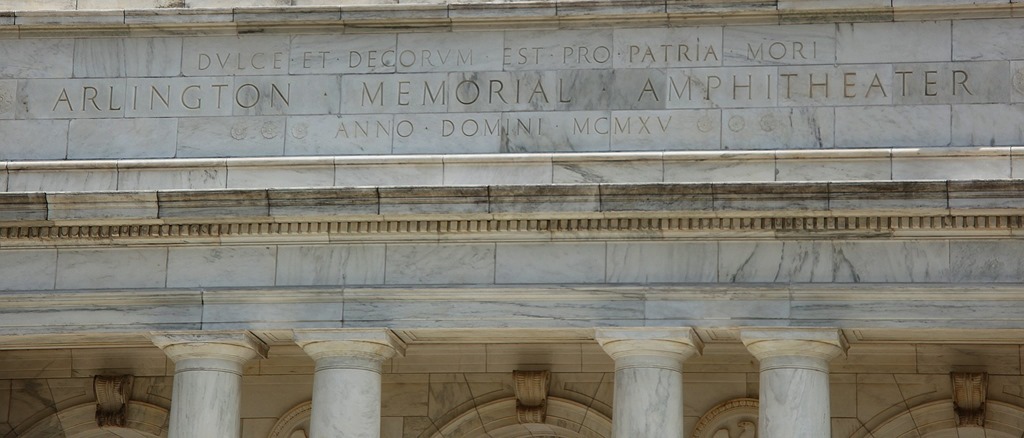
This large American military cemetery engraved Horace’s maxim in 1915. And whether for solidarity, guilt, or respect for duty, many will endorse it still. Some will stand by it with their lives not just a chisel.
4. Trenches St. Eloi. Another poem by a front-line veteran of WWI, one who didn’t survive the war, and a man who was important enough to the founding of English language Modernist poetry that his war death might have alterned post-war Modernism to some degree. T. E. Hulme helped form Pound’s own views on how poetry should “make it new,” and was admired as well by T. S. Eliot, but his own poetry is now little-known because of its sparseness in number and length. Though he was known as a pugnacious talker in person, and was a writer of audacious criticism, his surviving poems have a shocking modesty about them, something I find quite admirable. Though he wrote dispatches to English home-front periodicals during his service (from those I’ve read, they support the English cause) this is his only poem about his experience of the war itself, and it was composed, or rather transcribed, while he was back in England being treated for battle wounds before going back to the front and his death.
To hear Hulme’s ode to soldierly persistence, use the player below.
3. The Death of Apollinaire. Speaking of influential casualties of the war, Guillaume Apollinaire, must be right up there. The man coined the names “cubism” and “surrealism” after all, and his verse influenced not only countless French poets, but Americans like E. E. Cummings. The exact cause of Apollinaire’s death is open to attribution. He was still weakened by war wounds when he was struck down by the infamous 1918 influenza epidemic just two days before the end of WWI. The poem used here is a surprisingly sincere elegy written by a frank shirker of military service, Tristan Tzara, who as a teenager fled the tinderbox of the Balkans where the world war started for neutral Switzerland, where he participated in the invention of Dada at the famous Cabaret Voltaire. Dada had no respect for the pieties of the warring parties, but Tzara’s respect for Apollinaire comes through in my original translation of his poem.
Thinking of Hulme and Apollinaire as front-line soldiers in WWI makes me pause and wonder at the differences in my own time. Can you imagine John Lennon and Bob Dylan serving as grunts in Vietnam? Or Damon Albarn and Jay Z being deployed to Iraq? Of course, there are differences in poet/critics and pop-stars however artistic the songwriters are, but still it’s a different world, and Modernist artists both reflected and helped to form it.
To hear my performance of my own new translation of Tzara’s poem about Apollinaire’s death in the autumn of victory, use the player gadget below.
2. Grass. Carl Sandburg didn’t serve in WWI. He was a Spanish American War vet however. His personal position on WWI is somewhat hard to figure. He was writing for the stalwartly anti-war IWW under a pseudonym and explicitly supporting there the radical IWW line that the war was the Capitalist class enjoying their profits in a cage match between the working people/cannon fodder of both sides. Yet also during the war he wrote pro-war pieces under his own name, taking the same stance as some other parts of the US left: that the Central powers were evil empires lead by ruthless kings that needed to be defeated by the democracies Britain, France and the U. S. In 1918, Sandburg published “Grass” and attempted to synthesize both sides of Sandburg.
“Grass” is sometimes considered a straightforward patriotic poem, a reverent poem about the ultimate sacrifice of veterans, and if read in such a context no one is likely to object. But listen closely. Even though he echoes Whitman’s leaves of grass metaphor, even if you may find it next to John McCrae’s “In Flanders Fields” in some presentation of poems about honored war dead where we might be implored to “Take up our quarrel with the foe!” One might even too-quickly think it’s akin to what Sandburg’s hero Lincoln would say in his Gettysburg Address, that we “cannot forget what they did here.” But, Sandburg’s poem’s point is literally the opposite of Lincoln’s: that we will forget what they did here.
How completely true is that forgetfulness as we approach the centenary of the end of WWI? A discussion point.
You could read “Grass” as an antiwar poem, saying that “It doesn’t matter how important and glorious they tell you the cause you are fighting for is, because the same or equivalent crowd will run things afterward and what you thought you were fighting for will be forgotten.” Speaking of WWI, 50 years after it started, Sandburg admirer Bob Dylan could sing “The reasons for fighting, I never did get.”
I just got done earlier this fall performing Sandburg’s “I Am the People, the Mob,” In that poem, Sandburg makes a subtle point. That thing the leftish political vanguard often bemoans about “the people,” that they forget the injustices committed against their best interests, is in fact how they’ve managed to survive and endure. If they remembered their defeats, their sacrifices, they might not go on, they could be immobilized in grief and despair. Is Sandburg saying the same thing in “Grass?” Is he saying “I was never sure if this was the rich man’s war fought with working man’s blood, or a war to save democracy. It’s over now and the rich and powerful will forget us as unimportant. Or perhaps it was a struggle so our imperfect democratic governments can continue in a long battle to perfect themselves, but that in the end is what we need to concentrate on.”
To hear the LYL Band perform Sandburg’s elegy to soldiers graves, use the player below.
1. On the Troop Ship to Gallipoli. These most-popular-here WWI pieces I feature today: it’s a rather downbeat outlook, even Hulme’s piece is not the sort of thing to inspire sacrifice for one’s country. Pound’s rant openly doubts the beliefs of some that did, and is unequivocal on the base motives of those who lead his host country in the war. WWI war poets did write poems that supported the war effort. A personal favorite of mine, Edward Thomas, volunteered and died at the front with a deep belief in the nobility of service that overwhelmed his suspicion of the war’s rationale. Pete Seeger’s uncle, Alan Seeger, wrote his fatalistic but heroic “I Have a Rendezvous with Death.” Another well-known poem in this mode is British poet Rupert Brooke’s “The Soldier.” If one believes that any active deity must have a dark comic streak, Brooke dying of an infected mosquito bite while steaming to the front lines of one of the most horrific battles of the war could be part of your testimony.
Pound once had to explain that when he was critical of Brooke’s poems he was speaking of their old-fashioned prosody, not his character. When I saw this fragment found in Brooke’s journal after his death I saw an opportunity. What if Brooke’s observation of his fellow soldiers on their way to battle could be shaped to express itself in the mode that Modernists like Pound, Hulme, or Sandburg would have used? You can see the edits I made here, and listen to my performance of my setting of it with the player below.
Last week was a tough week to bear, from the guns of Louisville through Pittsburgh and the man with the bomb plan and his sheets of flag stamps. Evil should not surprise me, it should not baffle me—and yet it does baffle me. Should I also feel sad along with bafflement? A good question for lengthy political analysis, but that won’t change how I feel beholding this.
I’m not naïve. I’ve lived a long life, and I’ve met a fair cross-section of Americans in it. Ignorance, racism, clan and gender prejudice—humans are prone to this. If I had a great deal of experience outside of the U.S., I would expect to find these things elsewhere too. But now and here, we have a benighted charlatan—in over his head—who trashes around in these things, knowing in some simple, instinctual, skunk’s way that this cloud of stink will confuse us from considering him.
In a few days our imperfect democratic republic will have an election. I do not suppose to know what will happen. I’m a poet and musician, go elsewhere for predictions. Poetry and art allow us to see more vividly across our temporary borders of place and time, but that sort of perspective doesn’t necessarily make us better prognosticators. In poetry and music, like in history, everything is possible, and over the long time, a great deal of the possible will become.
So here I sat, in this mere and disturbing week, having trouble considering the attempted and achieved beauty of my arts—because, in this stink and sadness, what can be meaningfully beautiful?
Carl Sandburg essays a look that Leonard Cohen would cop to sometime later
As I did earlier this fall feeling like this, I turned again to reading Carl Sandburg for my soul’s sake, for the early 20th Century Sandburg had seen every evil I have seen, and yet retained an embrace of humanity. Often here I focus in on the neglected Modernist Sandburg, the forgotten Imagist Sandburg of short poems that sing our overlooked, ordinary, humanity. Sometimes I fear the more expansive, Whitmanesque voice that Sandburg also used has drowned out the individuality of his shorter, less shouty poems.
But I needed him to shout some of his heart into me this week, so here’s Sandburg’s “I Am the People, the Mob.” The player is below to hear it.
I’m going to take a break from my Dave Moore series today, if only because I rather like this piece I’ve been working on and want to present it to you.
“Fog” is likely the most well-known poem by Carl Sandburg without Chicago in its title, and it appears in many school textbooks where it serves as an introduction to metaphor. The Carl Sandburg who wrote it didn’t intend it to be a lesson. I think he wanted to write a Modernist, Imagist poem, the way a small group of others were writing them in the era roughly 100 years ago.
One thing I’ve learned searching out pieces for this project was that Modernism in its High Modernism guise has overtaken the work done by those preceding Imagist pioneers. As those who’ve visited here during cruel April Poetry Month will know, I enjoy somewhat those knotty, learned, collaged and college-ruled works that T. S. Eliot’s The Wasteland laid out. And World War I, we should not forget, was a terrible disaster with near untellable loss of life and loss of hope for its generation. WWI probably had to change things. The Carl Sandburg who wrote his early Imagist poems went about his pre-WWI world with an open heart and open eyes. In his poetry and in his political writing there’s a panorama of evil and survival, loneliness and stubborn love.
So, to reduce “Fog” to a lesson on metaphor is to amputate that context, and to forget the Imagist quest to renovate entirely metaphor as it had been received by Sandburg’s generation. Imagist poems often wanted to break through the fourth wall of metaphor, to make it more than an a decorative, this stands for that, analogy. “Fog” is fog, and the cat is a cat. Yes, they have meaning beyond that, all reality does.
You could start by asking yourself, if this is a real cat then, what kind of cat is it?
A house pet, one used to demanding the pricey wet food and best place on the dry, warm bed? No, it’s on the docks. It could be a ship’s cat, a fellow laborer, or a feral cat making do with what it can find there. It can’t call attention to itself for its prey and its own risk, and so it’s silent—and like its life and labor, obscured by the fog, by the cat’s own actions and the actions of the world. Sandburg sees his worth to see that.
Carl Sandburg at the machine of his labor.
That’s an Imagist poem, a direct presentation of reality, with no false rhymes of conventional or show-off imagery. There’s love and respect in it too, for the working common of us, singing the insubstantial and all-covering fog of our lives and labor, that save for the notice of the poet or artist, is silent and then moves on.
That, dear readers and listeners, is why you should pay attention to Carl Sandburg, who’s nearly fallen out of the cannon of important Modernists and consideration as an important poet, who is, I tell you, as you are, more than an example of metaphor.
Remember back to the formation of the LYL Band were we self-labeled ourselves as “Punk Folk?” Given that folk music by definition doesn’t ask for certifications or approval to be performed, that was something of a tautology. It occurs to me that what I’m doing here with pieces like this, using a string quartet I play part by part along with two pianos (one electric) and a drum set could be Punk Orchestral. My string parts are extraordinarily simple, like unto a lot of downstroke strums of power chords in some Punk.
Decades back, the Pixies helped popularize the Punk soft/loud arrangement, but of course orchestral music did it OG before them, and I exploit that in this one. Some other incidental ideas that helped steer me in this piece came from reading some recent posts at the Brettworks blog, where a more trained and accomplished composer talks about some of his processes and inspirations. Specifically Brett was talking about creating a piano part that had enough space where the various notes could have enough time to express their decay trails. Musically, this piece started by exploring that idea, but then the string quartet decided to kick out their jam.
I peform Sandburg’s words like a stalking cat hunts, sliding forward and stopping, then slipping forward again before pouncing. To hear this, use the player gadget below.
Increasingly, I am comprehending the miracle of Emily Dickinson. Fifty years before Ezra Pound and T. E. Hulme constructed a compressed modern poetry replacing conventional imagery with fresh and direct observation, a woman in a rural town in the woods of Massachusetts had already practiced their innovations over a thousand times.
Through a series of happy accidents, Dickinson’s poetry was preserved and published at the end of the 19th Century, just before the Imagists launched their Modernism—but even then, she was still like one of those unexploded bombs dug up by a construction crew decades after the war. Even after publication, the framing of her poetry still obscured it. Her posthumous editors cleaned up her punctuation and gave the poems titles, and on the page they looked so normal. As these were poems by an Emily, they were clearly the work of a woman, and so they were read as women were generally understood, even when not pressed between the boards of a poetry book. And Dickinson herself designed her poems to draw you in with their modest length, their frequent use of pious hymn meters and stanzas, their homey rhymes. Even into my mid-20th Century lifetime, it was perfectly possible to be aware of Emily Dickinson’s poetry and not be awed.
“Hey Joe, there’s a big chunk of metal buried way down in the mud! Here, listen when I give it a bit of a whack with my pipe wrench…”
They still run across stuff like this from WWII around Europe. Decades old, and they can still go “Boom!”
Some early 20th Century Modernists looked more closely, and maybe saw some of what was there. Carl Sandburg straight-out called her an Imagist in a poem. I am unaware of how much attention the other early Modernists gave to Dickinson, but just on a promotional level, it might not be advantageous to talk much about poems written decades ago when your brand is “Make it new!” Remember too how Pound jabbed at Walt Whitman in his tribute poem: Walt Whitman you were a hacker out there in some unharvested forest, I’m a fine wood-carver able to bring out the finest detail. Dickinson’s near-rhymes and loose but familiar meters may have been read as imperfections to Modernism.
It took the last quarter of the 20th Century for Emily Dickinson to finally be seen, and we are still seeing more now as we look closer. What if, back in the mid-19th Century when Dickinson was creating this unprecedented expression, one had been able to talk with her about it? The value of writers’ groups, seminars, and MFA programs is not universally acknowledged, but most think these things at least have some effect on those who participate.
It just so happens, that occurred. Dickinson’s letters to Thomas Higginson give us some of her ideas, but as I read that correspondence I see Dickinson adopting masks, some playfully, some for protection. And Higginson, as varied as he was, was not, as far as I know, a poet, and therefore there was no chance that he would use Dickinson as a model for his own writing. But Dickinson’s long-time friend, neighbor, and sister-in-law Susan Gilbert Dickinson was a writer who dabbled in poetry.
Like Emily, Susan Gilbert was smart, was allowed some access to education, and wrote poetry
No other person saw as much of Emily Dickinson’s poetry while she was still alive as Susan. It’s also probable that no other person other than Emily Dickinson’s sister Lavinia (who seems to have had no artistic interests) was as intimate with the author. There is even speculation that there was an erotic bond between Susan and Emily. Besides the pant, pant passages in the letters between them, Emily praises Susan’s intelligence and cultural companionship. Given what must have been the loneliness of Emily Dickinson’s creative innovation, amplified by the cultural limitations for women in her time, we may all owe a debt of gratitude to Susan Gilbert in helping sustain Emily Dickinson.
Today’s piece uses a poem by Susan Gilbert Dickinson that shows some of the same elements one finds in Emily Dickinson’s poetry. Given that the prolific Emily Dickinson experimented with her expression, if “Crushed Before the Moth” was slipped into some complete poems of Emily Dickinson volume it would not seem entirely out of place.
What elements of “Crushed Before the Moth” are Dickinsonian? A short line length (six syllables, though not Emily’s familiar 6/8/6/8 hymn stanza). Alternating rhymed lines with unrhymed, though here first and third not second and fourth, and the rhymes are all perfect rhymes except the final “moth.” Even the use of a Bible verse (Job 4:19) is not unprecedented in Dickinson, who though a religious dissenter, was steeped in a Christian religious culture.
The poem begins, just as many of Emily’s poems will, with a close observation of nature. In Job, the moth is only a passing metaphor, in Susan’s poem it’s an actual moth, looked at closely enough to see the texture of its body in the evening. The moth is treated here as an Imagist would. It’s not some intellectual counter, a rote symbol only standing for something else, but an actual animal in an actual evening. The second stanza continues in the same vein, the moth the morning after, though with more characterization.
The concluding three lines, though they contain the only Emily-like slant rhyme, are the least like Dickinson’s poetry. That kind of envoi ending with a clear and orthodox moral lesson is not something Emily would write in her mature poetry, and the “Is this thy stronger host” line sounds unnatural and stilted.
Still, this might be the first poem ever written that imitates Emily Dickinson’s strengths and innovations. That Susan Gilbert Dickinson was a more orthodox Christian than her friend, and like all of us, not the genius that Emily Dickinson was, doesn’t keep her “Crushed Before the Moth” from being an effective poem.
I’m back to acoustic guitar for today’s performance of this piece, which is available using the player below.
As I’ve done most quarters, I like to look at the most played and liked pieces during the past season and report back here. Usually a few of the results surprise me, they aren’t always my favorite pieces or even the ones that I think came off best.
I do this in classic countdown fashion, so we start off with number ten and move in the next few days up to the number one. The audio pieces for the Parlando Project can be consumed a number of ways. Some listen to them here using the audio gadget on the blog, but others listen by subscribing to us through any of the leading podcast services. The audio pieces are the same, but the blog allows me to write about the pieces in a much richer manner than I can with any of the leading podcast services. However, if you, or someone you know might be interested in just the music and words, this is a handy way to get them on your phone or other handheld. So, if you just want the tuneage, search for Parlando – Where Music and Words Meet on iTunes, Spotify, Google Play Music, or any of the other podcast services. You should find our audio pieces in their podcast sections.
On to the countdown…
Coming in at number Ten is one of the two pieces from May that gathered enough likes and listens to make it, despite having a shorter time frame to do it in, “Letters to Dead Imagists and A Pact.” I often like to look at who influences the writers we feature here, and this piece lets me do that with short poems from two poets: Carl Sandburg and Ezra Pound. Sandburg tips his hat first to Emily Dickinson and Stephen Crane, while Pound, rather grudgingly, acknowledges Walt Whitman. Despite being contemporaries with similar lifespans, despite both having connections to the American Midwest, despite Sandburg’s use of the early 20th Century Modernist/Imagist poetic practices as promoted by Pound; these are two very different men outside of their work with pen and typewriter. Interestingly, it’s Sandburg’s work that has an obvious Whitman influence though it’s Pound that points to him. Though Pound thought Whitman too careless in his craft, he’s the one that chose to give Whitman his due here.
Speaking of Imagists, at number Nine, we have the poet Hilda Doolittle and her “The Pool.” Pound acted as a high-handed branding consultant would with her, reading her poetry and then scrawling at the bottom of her manuscript her new brand: “H. D. Imagiste.” Doolittle writing henceforth as H. D. went on to a long career, and I’ve read that Hilda herself didn’t care much for the connotations of her family name anyway. Maybe that marketing advice helped, but early H. D. work like “The Pool” is striking short poetry mixing concreteness and mystery, so maybe it was an inspired choice to use the short and less defined H. D. for a pen name.
Musically, I really like what I came up for this one too.
“Now is a time for carving…” Pound once decried “the exceedingly great stench” of Whitman’s poetry
At number Eight, let’s welcome to our stage the man who Pound said in our number-ten-holding poem “broke the new wood” in free verse poetry: Walt Whitman. What an odd image for Pound to use! In looking at why he might have chosen that image I found out that Pound’s family established itself in Wisconsin by building a thriving sawmill there, so it may be that Pound is liking Whitman to a pioneering lumberman, bold in seizing the ground and resources he found there, while Pound seems to say he pictures himself more as a William Morris style furniture craftsman or perhaps even as a skilled woodcarver.
Straining at connections, because I love this photo so much: folksinger Carolyn Hester once recorded Whitman’s “O’ Captain,” but the 3 session men behind her appeared on many great folk records of the 60s: guitarist, Bruce Langhorne; bass player Bill Lee, father of filmmaker Spike Lee, and in the middle. the harmonica player with the shayna punim cheeks is known to trivia buffs as the father of Jakob Dylan, the leader of the 90’s band The Wallflowers.
Whitman’s “When Lilacs Last in the Dooryard Bloom’d” is one of a pair of elegies Whitman wrote responding to the assassination of President Abraham Lincoln, and the one I prefer to the other: “O Captain! My Captain!” regardless of the feelings some have for that other Whitman poem’s use in the movie Dead Poets Society. Furthermore, Whitman’s lilacs here are one of the reasons that T. S. Eliot’s landmark of High Modernism “The Wasteland” begins in spring with that very flower blooming “out of the dead land.”
We’ll have numbers Seven, Six and Five coming back here soon. So don’t touch that dial—wait, this is the Internet, you can touch the dial any time you want—but do check back, as we continue our countdown of the most listened to and liked audio pieces combining various words with original music here over the past season.





 Frank Hudson