The Prodigal Son: Another mode of Fenton Johnson’s poetry

Over this February I’ve presented a variety of early poems by the lesser-known Black Chicago poet Fenton Johnson. Johnson self-published two book-length collections of his verse in the years before WWI, and he’s an interesting Afro-American poetic bridge between the turn of the century Paul Laurence Dunbar and the poets like Langston Hughes who emerged in the 1920s.

I try to remind myself that one of my goals in these posts is to make things accessible with fewer pre-requisites than a lot of other writing about poetry. Effective poetry can have a degree of timelessness, but I’ve come to believe Johnson was pioneering poetic expressions that we might forget haven’t always been available — so let me briefly explain today some more context that makes Johnson’s work especially interesting.

Dunbar and Johnson’s poems that use conventional late-19th century English language verse are a demonstration that Afro-American poets could utilize established prosody and forms while reflecting their own experiences; but then, as awkward as some of it seems to me,*  Dunbar and Johnson’s dialect poems helped further something Mark Twain and other dialect writers were bringing to literature: a sense that the common vernacular had it’s own poetic diction that could have value. By the time we’ve moved onto Johnson’s dialect mode in a poem like “Mistah Witch” we’re getting something that is Afro-American in both sound and sense. My estimation of how valuable “Mistah Witch”  was as an expression increased many-fold in my journey to performance of it this month. More than anything in dialect that I can recall from reading Dunbar, Johnson’s “Mistah Witch”  reflected the Blues poetry that I treasure in Langston Hughes and song lyricists that will follow. Was there a direct flow-line of this innovation? Did Hughes know of Johnson’s work?**

Today’s piece is another example of Fenton Johnson’s prescience. Within his first two collections Johnson included poems reflecting Afro-American preaching modes to tell pointed versions of Biblical stories. He often called them “spirituals,” and in Visions of the Dusk  where “The Prodigal Son”  is printed, he introduces that section saying this:

These songs we offer, not as genuine Negro spirituals, but as imitations. We attempt to preserve the rhythm and the spirit of the slaves, and to give literary form and interpretation to their poetic endeavour. Here and there we have caught a phrase the unlettered minstrels used; here and there we have borrowed of that exquisite Oriental imagery the Africans brought with them.”

Note the careful and crafted way Johnson frames this section, thinking perhaps of the broad “crossover” audience he desired. To extrapolate: You might enjoy this even if you think of Black people as less smart, he pardons. It might seem strange, but strange might be exotic like other “foreign” things that interest you from farther lands, he offers.

Afro-American spirituals as a song-form emerged in the late 19th century as a popular concert music. White audiences found them moving — and to the best of my understanding, they often came to those feelings in a non-condescending way. For the Black intelligentsia, as late as the between-the-World-Wars “Jazz Age,” spirituals were used as an example of successful and laudatory Black musical expression, while Blues and Jazz might be held at arm’s length as too reflective of baser contexts.

Johnson’s spirituals don’t sound to me like the anonymously-authored choral concert music that has come down to us as spirituals. We have sheet music from before Afro-American artists were generally recorded in the 1920s, but those printed scores don’t show something substantially like the word-music I see portrayed in Johnson’s spirituals. What I do  hear in Johnson’s Literary Spirituals — something recoverable once later recordings entered our historic record — is Afro-American preaching modes.***  This style of preaching is musical, and it will (like Johnson) make quick jump-cuts to other ways of seeing an element of the story being portrayed.

The Prodigal Son

Though it appears in the table of contents as “The Prodigal Song,” here’s Johnson’s poem as it appeared in his 1915 collection Visions of the Dusk

.

As it turns out, this is a strong and versatile poetic form. It continues to be a significant part of the Afro-American strain in American literature. Although we “hear” it through Johnson’s silent printed pages, and also through his particular mind and ear, these poems are valuable in preserving some of this tradition.

Johnson, largely based out of Chicago, was well-placed to observe this. Not only because of Chicago’s diverse Black community including many “Great Migration” internal-immigrants from across the American south, but because Chicago seems to have been a key center in the development of the more overtly musical strain from this tradition, Afro-American Gospel music.****

My performance of Johnson’s “The Prodigal Son”  is not exactly Black Gospel — I’m not sure it’s anything genre-wise really — but it’s more my independent attempt to perform the wide-ranging text of the poem with the musical resources I could bring to bear on it this month. “The Prodigal Son”  is easier to see as a Modernist poem than the more formal, redolent of the 19th century verse I started with this February. It uses a free sense of phrasing in its meter. It uses near-rhyme subtly but has no fixed rhyme scheme. And look at how the poem’s narrative cuts cinematically: starting with a specifically northern speaker in a blustery Chicago winter, to a jump to the Biblical parable of the wastrel son who is seen returning home and the father calling for a welcoming feast, followed by what?*****  Not a homecoming to a BCE Middle-Eastern farm settlement, but heaven, cast with Biblical notables — yet, the feast of welcoming does  occur.

As the poem moves on, a litany of the particular sufferings of American chattel slavery are movingly condensed, in this section echoing the abolition/Underground Railroad folk song “No More Auction Block.”  This welcome heaven/home will have no drivers’ whips, no bread and water diets, no more auction block separating families.

Johnson has one more final jump cut, one in time and place: we end at the River Jordan as the River Lethe (the river addressed in “Waters of Forgetfulness”  earlier this month), and at the end we find that our poem’s singer hasn’t yet arrived to what the middle of the poem has described.  This, the concluding metaphor for America: if we’re a nation of immigrants — including kidnapped ones, and ones driven here beyond their wills — we may find ourselves still awaiting arrival to the fulfilled landing of that promise.

My performance, as I said above, doesn’t really use Gospel music elements. Not only would that be a challenge to my singing constraints, I haven’t found the time to build a more grand musical ensemble that this poem could be said to deserve. I hope the sparse voice and acoustic guitar presentation you can hear below does it some justice. You can hear it with the audio player you should see below. No player? This highlighted link is a backup.

.

*I’m not alone in finding this part of their work troublesome. I can’t say how white audiences of their time might have viewed it, but the air of minstrel show stereotypes must have been hard to escape. When performing blues tunes in vernacular I’ve made the choice to not put on vocal black-face — in part because I’d be bad at it — but also because it can’t (for me) escape that burnt-cork shading, even though I’ll retain informal/colloquial syntax.

**Likely Hughes would have known at least Johnson’s later post WWI work as they published in the same journals and were included in early Afro-American poetry anthologies together. But independent observation of less-documented Black musical expression contemporary to them both (though this was not yet widely recorded for posterity) would have been easy for the two of them. There’s no reason I’m aware of to think that Hughes used Johnson as a model, but it’s fair speculation that reading Fenton Johnson, even incidentally, could have validated or confirmed to Langston Hughes that he was onto something worthwhile.

***In the between-wars era, besides “live” sermons in church or over the radio, we have commercial recordings issued by the same “race records” companies that would have pressed Blues songs — recorded sermons which likely reflect what Johnson could have heard prior to WWI from a slightly earlier generation of Afro-American preachers.

****Did Fenton Johnson influence Thomas Dorsey and contemporaries who helped formulate Black Gospel music in Chicago in the 1920s? I have no evidence, not even a likely. I’m reduced to those expressions from bad cryptozoology and UFO documentaries: “What if…” and “Could it be possible….” Weak stuff. Common inspirations is the real likely here — but with Johnson’s poetry we do have interesting examples of how this was emerging.

*****This is one of my favorite parables, because its narrative point is that the other sons are totally non-plussed by the father wanting to welcome the ne’er-do-well who’s been off carousing with outsiders, finding non-productive failure, and generally sinning. Other sons: “We had to stick around with you pops, doing all this righteous stuff day after law-following-day. Where’s our bar-b-que old man?” The point Jesus and Johnson then make from this: you celebrate the ending of suffering, and that goodness is its own reward.

Mistah Witch: Pioneering Blues Poetry

Enjoy the Valentine’s candy if you have it, but this is a longer post, and we’re going to get into some uncomfortable stuff with this one. Yes racism, but then I’ll deal today with musicology and Modernist poetry too. The first is deadly in spirit and body, but then the latter two may often bring on the little death of boredom and indifference. This is why I respect you as an audience: poetry is a minority interest, mixing in the variety of musical styles I use here to the best of my subjective abilities will confound some of that audience, and then to discuss oppression — even the resistance to oppression which should be heartening — well, welcome rare, broad, and appreciated readers and listeners. Let us continue.

I said earlier in this year’s Black History Month series where I’m examining the early work of Chicago poet Fenton Johnson, that it may help us to orient ourselves into the time in which this young Black man in his twenties started writing and publishing. If we look at poetry and music, three big things are happening. They’re going to change how the 20th century, and even our own current century, approaches things.

The Fenton Johnson poetry I’ve presented so far this February has been in the 19th century tradition. It’s a style of poetry his school teachers would have taught him,* and like his chief model Paul Laurence Dunbar, he can speak for and about his fellow Afro-Americans using that mode of poetry. However, at this time something new is brewing in poetry. Over in England a small group of ex-pat Americans are joining forces with a couple of British poets/critics and a man from Belfast to create the first Modernist English poetry.** Few are noticing this yet, it takes a couple of years for it to get a foothold, but in 1909 the first poem in a style that would soon take to calling itself “Imagist” was published: “Autumn”  by British writer T. E. Hulme.

What makes that poem and the Imagist poems that follow Modernist? First off, it’s concise, it gets to the point. The language may combine things in unexpected ways, but it uses much more ordinary and day-to-day language to do it. Indeed, it revels in that — part of its freshness is that it wants to render sublime moments in the same way of speaking that something utterly mundane might be expressed. Its commitment to this is so strong that those mundane moments, the “unpoetic” ones, can be charged with a power. It doesn’t care to have the people in its poetry seem high-flown, they don’t have to be different more “poetic” creatures. Yet these same poems often have an important core of distrust for common or worn-out appreciations of reality. Emotions may be stated, yes, but many of the most vivid poems portray the landscape and the palpable things surrounding an emotion rather than hang signposts or explanatory placards of their feelings. Rhyme and meter could be used, but they aren’t the main point if they lead the poet to ignore these new things to emphasize.

While this is going on, Black Americans are forging a couple of new musical forms that are going to overthrow their nation’s music — and from there, impact the world’s. Because this happened before the full emergence of commercial music recording, some of this is literally un-recorded. Buddy Bolden and his like are playing instrumental music largely sounded on brass-band instruments along with pianos, where access to those instruments is available. Eventually that will be called Jazz. Many mark the first Jazz record as being issued in 1917, though Jazz existed before the recording.

At roughly the same time various strains of music with lyrics made by Afro-Americans are being extracted and refined from the ore of American folk music. I would maintain that the lyrical part of this sung music can be viewed as Afro-American Modernism. The songs love to get to the point of things, stripping away hypocrisy and pretense. They deal with disappointment and sadness, yes, but they most often deal with it in resiliency and wry resistance. Taking from the preexisting tactics of folk musics, they will borrow and reference each other’s individual songs — and like Modernism will soon take to doing, they will collage together unlike things and verses to jump from incident to incident. That sung music will eventually be called Blues, and because it’s a sung music, any instrument can be used for accompaniment, including cheap and portable ones. No Blues? No rock’n’roll, no country music as we came to know it, no rap.*** The first Blues recordings were done in the 1920s, but the first sheet music which might be classed as Blues dates to 1912, though again we know it existed unrecorded and off the books before this.

So, three things — all big, culture shaping stuff. In 1900 there’s no general cultural knowledge that these three things exist: English-language Literary Modernism, Jazz, and Blues. By the 1920s they all become part of the mainstream culture, however misinterpreted and misrepresented they may be. Modernist poetry might be thought of as self-consciously crude esoteric nonsense sticking its thumb into the eye of real poetic verse, while Jazz was thought of as hopped-up fast-tempo music to deaden the mind as rapidly as cheap liquor might, and Blues? That’s merely sad and sentimental music of resignation to fate.

This is Fenton Johnson’s world as a young man. The Harlem Renaissance writers that would come a decade or so later would still be dealing with this world. As we’ve seen in previous Black History Month series here, the Black cultural leaders of the first part of the 20th century were not yet fully on-board with Jazz or Blues, which they often felt reflected badly on their race. They did briefly note Fenton Johnson as a Black Modernist free-verse poet, but this happened in the Twenties as Johnson was withdrawing from writing new verse.

I was thinking of this as I read Johnson’s first collection of poems, no doubt written in the years before the book’s publication in 1913, and I come upon this short poem, “Mistah Witch”  printed in the phonetic dialect meant to represent unlettered Afro-American speech.

Mistah Witch as it appeared in A Little Dreaming

Here’s how it appeared published in Fenton Johnson’s “A Little Dreaming” in 1913

.

What matter of word music is this? I used my musicological knowledge along with literary thoughts as I examined it. It could be a folk-origin nursery rhyme or play song.***  It could just be a short supernatural poem, for we’ve seen last time that fantasy poems were a genre Johnson touched on in his more conventional verse. It may just be me, but I couldn’t help but read it as Blues Poetry — and a very early example of it too.

No, as printed it doesn’t use the Blues’ 12-bar structure or the three-line (two refrained or near refrained lines, and a response in the third line) stanza. Blues has never been purist about that, and early Blues often didn’t fit into regular musical forms. But I got a Blues sensibility from it. Mistah Witch may be mythologically, potentially, or actually, frightening, but the poem’s speaker seems to know Mistah Witch’s game, how he operates. I thought the poem’s sharpest line was (translated from the phonetic dialect) “Ain’t you tired of scaring me?” That implies Mistah Witch’s “magic” terror is weakening out of boredom and the rote nature of it for the speaker!

If Blues, like other Modernist poetry, likes to get to the point of things, it can also enjoy encoding its statements. The tactic is often: I’m going to speak something publicly, and part of the audience (the ones I want to let know we share an outlook) will get what I’m saying — while at the same time those that might not approve of my statement will be in the dark about what I’m talking about. The latter will just be puzzled or indifferent to what they don’t understand.

What could be encoded in “Mistah Witch?”

In plain talk: from the days of Fenton Johnson’s youth, through the years he began publishing his poetry, and continuing after his poetic work faded away, there was beside the slow incremental wear-and-tear of stereotypes and “civilized” discrimination an active and brutal threat of terroristic violence against Black Americans. Threats, attacks, lynching and (white) race riots are a part of American history that wasn’t talked about broadly out of a mixture of shame and “politeness.” *****   Blues doesn’t play that game, but a Blues singer (or a poet looking to find a broader audience) might encode a protest against that terror metaphorically. I did note that the poem concludes with telling us that Mistah Witch (“Mistah” signifying the frightener is someone the singer feels they must make a show of social respect to) has eyes like the sea — the bluest eye perhaps.

I’m not certain if that’s what Fenton Johnson is doing in “Mistah Witch,”  perhaps even unconsciously. I am planning to try to include some information that I have recently learned about Johnson’s political views later in this series. Musically I took Johnson’s original poem, and for this performance turned it more toward an irregular folk-Blues structure to reflect the Blues sensibility I saw in the poem.

And for those who want a little time-machine technical magic to travel back to those early Blues recordings often pressed cheaply for the “race records” market and worn with dust and the needles of heavy-armed Victrolas, I’ve included a Bonus Track today: a simulation of how the recording would sound in that context.

Here’s my rough’n’ready musical performance of Fenton Johnson’s “Mistah Witch” recorded with inexpensive modern equipment.

.

Here’s the simulated worn 78 RPM shellac record version.

.

*Johnson, unlike most Americans and even more so, most non-white Americans, had a first-rate college education, attending Northwestern and the University of Chicago.

**This group coalescing before the start of WWI included T. E. Hulme, from the less fashionable north of England who’d been expelled from Cambridge, F. S. Flint a self-made man of letters who risen from Victorian poverty, the Americans T. S. Eliot, Ezra Pound, and Pound’s former college sweetheart Hilda Doolittle, as well as Robert Frost, and the somewhat forgotten man from Belfast was Joseph Campbell. I count Frost as a Modernist, as I see his poetry aligning in its outlook with Hulme’s theories, differences in prosody aside. Remaining in America, William Carlos Williams, Carl Sandburg, and Edgar Lee Masters would also be early Modernists.

***Jazz musicians will often maintain that the Blues is essential to Jazz as well. In that sense, my reading is that they aren’t just talking about Blues musical structures and vocal inflections portrayed by instruments, but the Blues sensibility.

****Blues could and did use lines shared with those folk music forms.

*****In 1919 Johnson’s Chicago suffered a mass racially motivated riot. In 1909 downstate Illinois had a similar incident in Springfield. Smaller acts of terrorism against Afro-Americans were continuous in Johnson’s time. Black History Month isn’t just about that, history shouldn’t be a flat picture. That stuff is ugly — it was meant to be so — and that ugliness is part of the reason it was suppressed and untaught. But. But. But — you can’t fully comprehend the beauty of resistance to that without knowing the ugliness it opposed.

“Mistah Witch”  in my reading is racism, or white-supremacist terror in general, and it could be specifically referencing the original Klan terrorists who fancied themselves in their costumes as representing murderous ghosts and spirits.

The Wraithie’s Message

Is there anyone reading this far in these posts today mumbling to themselves “It’s Black History Month — and instead of the eclectic variety I expect from the Parlando Project, Frank is giving us this little-known early-20th century Black Chicago poet, this Fenton Johnson guy (who, huh)?”

Let’s keep you here, because Johnson is bringing the variety again today, with a piece that could pass for early William Butler Yeats, or someone else from the Celtic Revival that was happening contemporarily with Johnson’s first poetry collection A Little Dreaming  of 1913. And if our last piece of Johnson’s that had the Roman underworld didn’t warn you, this one is further into the dark fantasy/horror poetry genre as well.

Wraiths and wights, two names given to the wicked messenger in today’s poem have been popularized by later, fantasy books — Tolkien and Rowling et al. But Yeats and others in the Celtic Revival touched on various kinds of supernatural spirits around the time of Fenton Johnson. The non-human beings in these dealings were often at least chaotic or untrustworthy — and as a class, wraiths tended to be even more so. Though named as fairies, not wraiths, I’ve recently presented two linked fairy poems by Yeats and Robert Frost for example where the fairy is seeking to trick a human couple so that they can abduct one of them to fairyland.

Fiery Mask 800

Don’t stay up late reading blogs, for a wraithie might visit you

.

In Johnson’s “The Wraithie’s Message”  the poem’s initial speaker beholds a marvelous creature made of “living flame” at his window. The creature tells our mortal, who the wraith addresses as “dreamer” that there is a lovely sea-side woman, the dreamer’s soul’s desire, who he has beguiled with “burning song” so that this woman is now dreaming of, desirous of, our dreamer.

The dreamer at the window is all in on this. He sees not an untrustworthy wraith in this apparition of living flame, but a “good elf” who might be of service to humans. And besides, as the poem ends, he explains that this dreamer is tired of his  dreams — ones that have not been realized. What really awaits? In my understanding of this poem, the wraithie is a siren by proxy. The promised maiden may be by “the deathless sea,” but that may be in the sense that the enthralled or the dead have no more dying to do.

Should it surprise us that a young Black Chicagoan is writing this poem? Perhaps a little, but it shouldn’t be a lot. I come from the Midwestern city of Prince Rogers Nelson after all. Versatility with many styles has been demonstrated by Black Americans over and over. In regard to Afro-American musicians, I lost my constrained surprise decades ago when I learned that Fenton Johnson’s early 20th century contemporaries, Blues musicians —who I prized for their distinctive “authentic” recorded music — had a wider repertoire and spread of influences than I had guessed, and that they were often capable of essaying a variety of white ethnic styles with aplomb.*

But the choice of this Celtic Revival flavor by Johnson may not have been entirely random. Remember that last time Johnson was trying on the title of “bard,” and a bard for a generation of Black Americans who were trying to propagate an Afro-American culture of achievement and distinction — not just out of some parochial ethnic pride, but out of a very serious need to establish their humanity in a country that still retained nearly its full measure of white supremacy. The Celtic Revival of Johnson’s time was similarly seeking to present themselves as full human beings by displaying a rich culture, and it’s not unlikely that Johnson was seeing what he could appreciate and adopt from that.

With a Celtic myth via an Afro-American, there is after all a story here of a despairing dreamer and an untrustworthy power willing to trick them to their doom.

The Wraithe's Message

Simple guitar chords, but my recorded version will sound different because I used a CGDGBE tuning

.

I had planned to do this Fenton Johnson piece this month, but as I’ve mentioned before, I’m nearly always unsure of what time and focus I will have to do these pieces now. I had written a sketch of the music already (that helps) and in the middle of the day today I was able to try it out. It came together so quickly I was able to complete a basic track before attending a Canadian Zoom salon featuring friend of this blog Robert Okaji reading new poems. Then later tonight I finished mixing it, leaving it simple enough, though I hope it’s effective. This is another piece that may depend a great deal on my vocal abilities “of a subjective quality” — but that’s up to you the listener. You can hear my musical setting of “The Wraithie’s Message”  with the audio gadget below. No player? A substitute can be summoned with this highlighted link which will open a new tab with its own audio player.

.

*Some might be wondering if Fenton Johnson utilized or valued Afro-American music and modes. Yes indeed — he was early and effective in that, a decade before those in the Harlem Renaissance did similar things. I’ve got a couple of pieces planned demonstrating that yet this month.

Waters of Forgetfulness

Here’s the next poem in our series this Black History Month written by early 20th century Chicago poet Fenton Johnson. Like his “Dunbar”  poem from earlier this week, “Waters of Forgetfulness”  was found in his first book-length collection A Little Dreaming  of 1913.

When I look through a poetry collection for material for this Project I think I’m following a few unspoken criteria. I’m looking for poems short enough to be performed in under 5 minutes. I’m looking for unusual qualities or points of view, or striking images, but I’ll also favor poems that seem to have something song-like about them. This one qualified on the first and last parts. The middle part? I thought it was an example of the range of cultural references that this young Black American poet wished to weave into his verse. Two lines in, and we’re not at the Clark Street Bridge in Chicago like Johnson’s contemporary Carl Sandburg, or looking at the Mississippi river and thinking of ancient historic rivers like Langston Hughes, a young poet who began writing a few years after Johnson. Instead, we’re at an imaginary river, the river Lethe, one of the rivers in Hades, the underworld of the dead in Greek/Roman mythology. Before we’re done, will meet an unnamed man from the fabled city of Troy and the final river border to Hades and the dead: the river Styx. What’s an under-25-year-old Black American doing there?

Waters of Forgetfulness

Here’s the poem as it appeared in “A Little Dreaming”

.

When I selected this poem, I didn’t know. Partway into creating the musical performance you can hear below, I still didn’t know enough yet, but this is what I could understand to perform it: the poem’s speaker (let’s call him Johnson for simplicity) seeks the titular quality of the Lethe’s water, that it removes your memory of life.

I had to look up more about Lethe’s particulars to understand more: drinking its water allows the drinker the possibility of rebirth (without that forgetfulness, the reborn would be unable to gain a truly new life).

In the part of the poem that I made a bridge or second musical strain (lines 9-15) this rebirth is linked to some further material. Instinctively I felt it was this poem’s turn or volta, but what’s exactly happing there? Johnson is having a death experience; he sees at least in simile the Angel of Death. And in the penultimate line of this section, he’s glad to see morning. In between he sees himself as like some Trojan who crossed the final river into the land of the dead.

Who was this one from Troy? I had to do some research to find out.

He’s Aeneas, the hero of Virgil’s Latin poem The Aeneid.   In that epic’s Book 6, by oracles, gods, and pluck, Aeneas completes a successful quest for a charmed golden bough and this refugee from the sacked city of Troy is able to cross the river Styx to the land of the dead, though for only a day. He passes through a condensed version of Dante’s circles to the happy land, where the most virtuous dead souls reside.*   It’s there that Aeneas is reunited with the soul of his dead father. There are tears and hugs, and the father, now wise in the ways of the underworld, tells his son that Aeneas will go on to found Rome, and he foretells the mighty empire that will result. Then by one more skillful choice, as dawn is about to break, Aeneas is allowed to return from the underworld knowing the true aim of his task: to form a new nation.

You may wonder: I thought I was reading a poem published by a 25 year old young Black American, did I click a link to footnotes for a section of “The Waste Land”  (published 9 years later) instead? Let me deal with two last things before leaving off for the musical performance.

Remember that middle “Temporarily Like Aeneas” section is a simile, framed in “like” and “as.” I take this to mean that the poem’s speaker isn’t the ancient Trojan, it’s most likely Fenton Johnson, or someone like him, seeking to take up the task of becoming a bard to his race, in his nation, in his time. That means this is a dream poem, in a collection that has other poems as dreams or visions — and is after all titled A Little Dreaming.   Johnson and his Afro-Americans have a lot one might bargain to forget, a harrowing dream to wake up from to live a new life. I started thinking this poem was a curious small example of Johnson’s range of subjects and modes. I’ve grown to think it’s making a serious Black History Month point. When this sleeper awakes, glad in the morn, he knows there’s a nation to build and he’s seen his goal.

And here’s the second point. Virgil might have been a more standard curriculum item at the start of the 20th century than he was in my mid-century, or in your 21st — but how many readers then or now will understand the reference Johnson’s making? I didn’t. Maybe you didn’t. This poem may have been written by the poet to the bard himself, to focus him on his calling. Or perhaps he overestimated his potential audience? We’ll return to that last point elsewhere in the series, providing I can complete all the parts I’d like to share this month.

The music for this is fairly straightforward, though I had some fun sound-engineering the grand piano heard in the left channel. This is another of the pieces where I do my best to represent the poem with my singing, even though I fear this composition calls out for a more spectacular singer. You can hear it with the audio player gadget you should see below. No vision of an audio player? This highlighted link is an alternative, it’ll open a new page with its own audio player.

.

*Unlike me, Dante had read Virgil, and this section helped him formulate his circles of Hell. Virgil writes, and perhaps young poet Johnson is noting this: this happy place in the afterlife includes the noble bards of nations.

Fenton Johnson’s “Dunbar”

Though poetry might aim for timelessness, time as we know it aims to hide itself in the past. For that reason, when I talk about Fenton Johnson this month, I want you to be able to step inside his time a bit. Depending on your expectations for poetry, or poetry by Black Americans, some of the elements of his poetry might seem out-of-place, but Johnson didn’t have the ability to see us — an audience of today — instead he was addressing the expectations of his time.

From reading Johnson’s first collection of poetry, 1913’s A Little Dreaming  it’s clear that one of Johnson’s chief models was Paul Laurence Dunbar. Dunbar was born in 1872, Johnson in 1888. Depending on how you think of the amorphous boundaries of generations, the two are bookends of one generation or a generation apart, but two facts are important to understand in this relationship.

The leading fact? Dunbar was proudly counted as the first Afro-American poet to reach some level of general recognition. How well recognized was Dunbar in Johnson’s time? I can’t say for sure. Some established white critics reviewed his work. Public reading tours were advertised, indicating that there may have been expectations of greater than the folding-chairs in bookstore-aisles readings common for poets today. Part of Dunbar’s potential audience would be something new: an emerging Black American cohort born post-slavery who could read. Their parents might have been enslaved (as Dunbar’s were), and now they had this new broad skill, and they were allowed to indulge in it.* What was it they would read? Newspapers & magazines for sure. The popular press was growing during this time — and it was somewhat analogous to the Internet today, including the breadth of materials and parochial opinions, not all of them on the up and up. Novels and prose books? They were around, some inexpensive editions aimed at the less-wealthy casual reader’s budget. Poetry? Likely closely related to the availability of novels. Does that surprise any of you? In the Dunbar/Johnson pre-WWI era poetry was more a co-equal branch of literature than today. In our early part of our 21st century, open the books section of one of the big city American newspapers, and it’ll be rare to see any notice of new poetry collections. A literary author interviewed on TV is an increasingly uncommon event, but such guests will almost always be novelists. If you were to walk into a bookstore this year, how likely would you see poetry collections prominently displayed to tempt the general shopper?

I have no time machine to visit a circa-1900 bookstore, but my reading of the Dunbar/Johnson era indicates that to readers and the commercial side of publishing then, poetry was not consigned to a specialist interest of a small coterie of folks. Poets like Longfellow and Tennyson were as famous to the ordinary reader, if not more so, than many of the American novelists you might be asked to read in an American Lit survey course today. And there were contemporary, living, popular North American poets who were read by a general public then too: John Witcomb Riley, Ella Wheeler Wilcox, Bliss Carmen, Robert W. Service, and Edgar Guest emerge in this era. All these poets had a general audience, even if these once popular poets might not be covered in an academic survey course today.

So, Dunbar’s intended audience was broad, general. Some of his writing followed the same formal structure and practices used by the most esteemed poets of the 19th century, but not all of it. To a Black audience he may have intended to capture the newly literate while also offering a more serious solace and uplift for these men and women only recently granted rights on paper. To potential white readers of his time a parallel intent: poems at the casual entertaining level to put them at ease, but then poems in elevated literary modes expressing the beautiful thoughts in a Black man’s head or the pressing problems he and his race are encountering.

A young poet today might aim for a published collection, likely with an academic or specialist small publisher. Might aim for poetry awards watched mostly by other poets. Might aim for a teaching position. In the Dunbar/Johnson era it may have seemed possible for a poet to aim for a deeper/wider presence than today in both the literary and popular sense.

How far did Dunbar get in accomplishing that? My understanding, subject to correction from better scholarship, was that he became “Black famous.” His efforts would have been known and recognized by more-educated and culturally ambitious Black Americans, even if he would have been unlikely to be known to my (white) grandparents. To Black literary writers, whatever size that group was? He seems to have been huge.

Which brings us to the second important Dunbar fact. Dunbar died young: 33 years old, in 1906. Johnson would have been 18 and was about to go to college. If you were Afro-American, a poet, and interested in furthering the prestige of your culture in the first part of the 20th century, Dunbar was the man to consider. That Dunbar had fallen, still not meeting his highest expectations, could be seen as a standard bearer staggered short of the wall, but another young poet could pick up the flag and carry it further.

Dunbar by Fenton Johnson

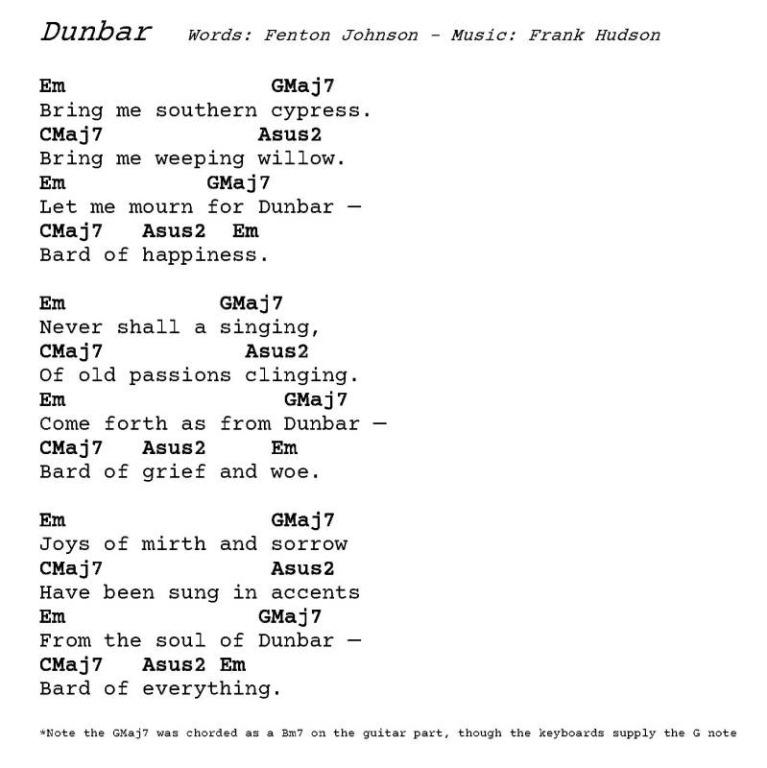
Once again, here’s a chord sheet for those who’d like to sing this themselves.

.

Long time readers here may recall that another of Johnson’s Afro-American poetic contemporaries, Anne Spencer, wrote a short poem linking the died-young Dunbar with early 19th century British Romantic poets like Keats and Shelley.  Today’s piece from Fenton Johnson is a poem with similar goals. Johnson’s “Dunbar”  is just 12 lines itself, but it makes a concise case for Dunbar’s broad worth. In a refrain at the end of each stanza he calls Dunbar “bard” to indicate that he as a poet is representing his culture, and Johnson is particularly interested in bringing forward that Dunbar can do the serious and be a “Bard of grief and woe” but that also he is the “Bard of happiness.” In this claim for Dunbar’s worth in comedy and tragedy he may be exceeding Spencer’s claims for Dunbar — as this best for comedy and tragedy claim echoes one made for Shakespeare.

What does Johnson mean when he writes that Dunbar’s poems were “sung in accents?” Dunbar’s rhymed metrical verse would use standard English (including a willingness to use elevated “poetic diction”). Johnson would begin doing the same. Dunbar also wrote in dialect: poems where the language is meant to portray less-educated speakers, is written in colloquial grammar, and is printed in phonetic approximations of heavy accents. Dialect was a literary vogue in the late 19th century in both prose and poetry. Of the popular poets mentioned above, John Whitcomb Riley, specialized in dialect poems reflecting common-man white speech of the rural Midwest. Dunbar wrote a poem in praise of Riley, Riley wrote a letter complimentary to Dunbar. Modern readers may have an inescapable problem with this sounding like minstrelsy.** And there is correspondence from Dunbar where he wrote that he was increasingly troubled by what he saw as the greater acceptance of the dialect poems. Fenton Johnson may not have known of that, and Johnson would also write in dialect in the mode of Dunbar.

I said at the start of this Black History Month that Fenton Johnson was a bridge between Dunbar and the Harlem Renaissance poets such as Langston Hughes. At the beginning of his writing Johnson is clearly on the Dunbar side of that bridge, so this poem in praise of Dunbar — now song with the addition of my music — is a good place to start. You can hear it with the audio player below, and if that player isn’t there, with this backup highlighted link which will open a new page with its own audio player.

.

*Dunbar’s mother Matilda was born enslaved and illiterate. She worked as a domestic servant after emancipation and took night classes to learn to read. There are stories that she had her children teach her ABCs, perhaps with the dual utility of drilling them while helping teach herself! Paul began writing poetry as a schoolchild, and she encouraged him and organized the family to allow Paul to complete high school. Paul Laurence Dunbar died so young that he was survived by his mother who lived until 1934.

**Bothers me too, and not just because it seems belittling even when it is only so by association with racist beliefs. I have little to no facility for reading or reproducing phonetic speech for some reason.

Black History Month 2024 and Langston Hughes’ birthday

Not to put the curse on things that fate might cast whenever you make plans, but I have a plan for February. I’ve been reading a bunch of Chicago-based early 20th century Afro-American poet Fenton Johnson’s poems this winter. Long time readers here may recall that I did a series on Johnson’s poetry in 2018, still early in this Project’s life.

Johnson is a bridge between Paul Laurence Dunbar, who died young after becoming the first Afro-American poet to pick up much notice, and the early poets of the Harlem Renaissance such as Langston Hughes who more fully brought Black American poetry into greater recognition.

One of Johnson’s poems, “Tired,”  is still included in some anthologies of Black poets, perhaps because pioneering Afro-American poetry anthologist James Weldon Johnson (no relation) included it. In my 2018 series I tried to outline my estimate of how Johnson came to write such a despairing poem and to explore other modes of his verse. Since then more information on Johnson’s early years has become available to me, and I have a more complicated theory of his poetic progress that includes more data points.

I hesitate to lead off with “Tired” to represent him, though it’s a fine poem which James Weldon Johnson selected bringing notice to Fenton Johnson. See this post to see what James Weldon Johnson wrote about it.

.

One thing that attracts me to Fenton Johnson is that he (like Langston Hughes) wrote using his experience of Afro-American musical idioms. Regardless of current panics and nonsense expressed around the issue, Black history is American History—and oh my, is Black music American music!   To keep’em separated would be so damaging to America’s culture. Oddly, believing that misapprehensions and ignorance must be behind such a self-defeating and self-denying idea, I continue to go forward trying to defeat that in my small way, despite realizing that there is much I don’t know and can’t portray as well as it might be portrayed.

Writing on and performing Fenton Johnson is a case in point. He seems to have too few considering him right now or bringing his story forward. I’d rather do the best I can illuminating his work with what skills and time I have, than to shrink from this out of deference or modesty.

Since today was Langston Hughes’ birthday, I’ll precede my Fenton Johnson February series with this piece of his that I performed previously for this Project. Hughes’ “Lenox Avenue: Midnight”  is a beautiful expression of that complex thing: Black Joy. I was audacious enough to add a couplet at the end of Hughes’ poem/text that was my reaction to what Hughes portrayed in his poem, which is just about as presumptuous as my attempt to compose and play something that sounds like Jazz. You can hear my musical performance with the audio player below — or if no player, with this highlighted link.

.

Wrapping up the 1926 Fire!! magazine story

I hope some of you enjoyed this Black History Month look at the premier 1926 issue of Fire!! Devoted to Younger Negro Artists. This landmark of the Harlem Renaissance announced a new generation of young Black writers, many just out their teens — artists who not only filled its pages, but organized and edited the publication. Today I’m going to tie up some loose ends and tuck in the laces on the Fire!!  story and give you a few links in case you want to do your own exploring.

Here’s a fine website done recently by a group of young people who present the entire magazine itself and some of their own encounters with the meaning of the work inside.

It was there I found a link to this completely scientific and accurate Buzzfeed quiz from 2018 “Which Fire!! Magazine Author Are You Most Similar To?”

The quiz says I’m Gwendolyn Bennett. My wife’s results: Richard Bruce (Nugent). Richard Bruce too for longtime keyboard playing and alternate voice contributor to this Project Dave Moore. Dave’s artist partner joined me in the Gwendolyn Bennett result.

So, we looked at the first issue of Fire!!  this month. What about the next issue, other issues? There wasn’t one. The magazine, founded by young artists, was not well funded, and selling and distributing didn’t go well. The gatekeepers were at least privately aghast at some of the content, so their advice and word of mouth was to disparage and discourage this effort. I’ve already mentioned when presenting two of the four poets I selected for musical performance that publication in Fire!!  did not guarantee lasting readership or note for these young people. So, Fire!!  folded, and in a lead-eared note of irony, the mostly unsold print run was destroyed in a storeroom fire. John Keats epitaph says his name was writ in water. Fire!!  and some of its writer’s names were writ in fire, and it all died down.

I often suspect many folks who find these blog posts are looking for homework help or teaching resources. To what I (an old person) can understand, being a teacher or a student covers wider territories than in my days, but there are still skirmishes at the borders and difficult areas under the control of different warlords. Fire!!  magazine sought to cross those borders then — and if one is to study it and its contributors in any depth, it still does. Not only did Fire!!  bring forward new young writers — many committed to Modernist art and radical politics — it purposefully sought to express elements of life that the older generation of gatekeepers wanted to suppress or keep only within the tribe. One of those things was sexuality. So teachers and students, here we have a group of young creators in 1926 writing on race, injustice, and sexual expression that isn’t in committed relationships or straight. On what authority did these audacious writers take to break through those barriers? Not only were the instigators and contributors of Fire!!  young, gifted and Black, they also were often somewhere on the spectrum we could label today as queer.*

Drawing by Richard Bruce Nugent

A drawing by Richard Bruce Nugent from Fire!!

.

So, to teach or discuss Fire!!  and its creators beyond a surface is to go to places where teaching and learning is still constrained. I’d say to learners (a class that includes nearly all teachers) you may choose to go there even if traveling alone. Literature, music, the arts are the forged identity papers that let you cross borders. Though the writers of Fire!!  are all dead, they won’t mind speaking with you.

In the spirit of gratitude to Afro-Americans and their vital contribution to American culture let me repost my Buzzfeed Fire!! contributor-like Gwendolyn Bennett’s summary in poetic “Song.”   Graphical player below, or a backup player will open in a new tab link here.

.

*Here’s one web post by someone who taught school, doing a better job than I can today of discussing the queer aspects woven into the Harlem Renaissance. There is also this low-budget indie movie Brother to Brother  made nearly a decade ago centering on Richard Bruce Nugent, Wallace Thurman, and the non-straight circle that organized Fire!!   The film has some PG13 level sex scenes and self-violence. I found it available for rental from the usual online sources like Apple TV or Amazon Prime.

Railroad Avenue, Langston Hughes’ Locus Solus

Returning to the poems published in the 1926 issue of Fire!!  magazine which proclaimed it was “Devoted to Younger Negro Artists,” we get this simple seeming, yet mysterious poem by one of Fire’s  most famous contributors and organizers: the then 25-year-old Langston Hughes.

“Railroad Avenue”  looks like a simple free-verse street-scene vignette. Here’s a link to the text of the poem if you’d like to follow along.  Yet the more I looked to understand it, the deeper the mystery of it became.

Here are a few things that seem quite clear: it’s evening. There’s a street, likely named by the poem’s title. A few things are seen or heard: lights in two businesses, a boxcar, a record player, a player piano, a boy and a girl, laughter. Largely unremarkable things, so there’s some specific character given to them.

The record player is a Victrola, a short-lived brand from the early 20th century — for example, the ones with the big conical horn as in the original RCA Victor logo. The businesses are a pool hall and a restaurant serving fish. The boy is at leisure, comfortable. The girl has a dark face that is powdered.*  In what may be internal monologue the poem’s narrator gives us the winning number in the day’s policy game.**

So, are we clearly visualizing the place being described? At first I thought I could. I figured without evidence that this was a crowded urban nightlife street, the two other people only examples of many, the sounds and things part of what could have been a larger catalog. Is that reading possible? Two things mentioned that are likely heard not seen: the player piano (reasonably loud) and the Victrola, which would not be. Victrolas were not electric record players. The records turned via clockwork, the sound was produced acoustically from the grooves in the records. So, it’s not blaring out a window over robust street sounds. If the statement on the winning daily number 942 is audible rather than the interior thoughts of our narrator, it too would likely be at a conversational level (given no indication that the speaker/thinker won).

And then there’s that boxcar. Mentioned twice, Hughes really wants us to see that there’s this boxcar there, yet says nothing about it other than also saying twice that it’s forgotten.  What’s that mean? A boxcar is a freight train car. This is not an urban light rail or passenger train line being invoked. Who forgets a boxcar? Is it just one piece of rolling stock left off somewhere as a spare or scrap? While the poem doesn’t say this, I began seeing it as part of a train on a grade-level street crossing, with the boxcar’s location blocking the road, a location so that it has to be mentioned, can’t be ignored. Did Hughes see this clearly in his mind and forgot to make it plain in his poem, or am I imagining things?

This vision invoked in me of a small town to small city location where the freight train line runs on grade-level, not on bridges over the roads or in tunnels under them, let me begin to see this as a much sleepier street. This isn’t the busy streetlight and neon Harlem of Hughes’ Harlem Renaissance. The dusk is “dark,” the street quiet enough to hear things distinctly as the evening begins. As the poem reaches a crescendo portion, it’s laughter we hear. It’s “sudden,” indicating that it startles the relative quiet and is not muffled by it. Hughes metaphorically amplifies that laughter with repetition — stating that this laughter with its transport from the ordinary and unenergetic street is able to shake the shop lights and move billiard balls.

This is a poem published by a 25-year-old, but I get a sense this may well be a memory of an even more youthful time with daylight ending, with sounds and a scattered glow from remembered lit windows. Dusk is a marking time for many young people, between the era when it says “time to go home” spanning to the age of “time to first go out and explore your nighttime world of romance and adult recreation.” I wondered, would the poem have more context if I knew where the poem’s titular Railroad Avenue is? America has lots of Railroad Avenues and streets, so the name alone tells us little, other than this isn’t a boxcar dropped off miles from a rail line.

Broadway AKA Langston Hughes St and Railroad Ave in Joplin MO

A Google Streetview showing the intersection of a main Joplin MO street now renamed for Langston Hughes with Railroad Ave. Google’s camera vehicles didn’t drive & record down the gravel path that is Railroad Avenue right beside the train tracks.

.

I spent half a day trying to figure out where such a street might be in the places the young Hughes was known to have lived. I’ll summarize the candidates as briefly as I can. He was born in Joplin Missouri, and there’s a very good Railroad Avenue there, with everything you might want for this less-populated scene — though the Afro-American population at the time Hughes’ family lived there was low. But Hughes and his parents left Joplin when Hughes was around 1-2 years old, and there’s nothing I could find saying anyone went back. And was Joplin even big enough and ethnic enough for a numbers game? Hughes spent his grade-school years in Lawrence Kansas being raised by his grandmother. Yes, there were some Black neighborhoods,*** but no likely Railroad Avenue. He spent time at Howard University in Washington D. C. There’s a Railroad Avenue in that city, but it’s far from Howard, and seems to be (and likely was) a non-descript industrial area. Afro-American Howard students might spend evenings on U street circa 1920, but like Harlem in that era, it’d be lit and busy, and no likely boxcars there.  Hughes attended Lincoln University in Pennsylvania, and once more I thought I might have a chance. Not as urban circa 1920 — but then no Railroad Avenue, not even a railroad line for more than 15 miles that I could find. And even if he’s a famous figure from the Harlem Renaissance, Hughes’ Harlem is as unlikely for a sleepy dark dusk with a grade-level railroad line as Washington D. C.

Is Railroad Avenue just something Hughes made up? Is it someone else’s story, something he absorbed from a friend, or his mother or grandmother? Did he go back and visit his birthplace Joplin before 1926 and observe a relaxed scene somewhere on that gravel-surface Railroad Avenue? I’ll probably never know.

But what’s up with that boxcar? Why is it so important, and so specifically forgotten? As a short, Modernist free verse poem, we can think: “So much depends/upon/the boxcar/serenaded by a/Victrola/beside a purple/powdered girl.” One theory: the boxcar is a plausible hobo-ride escape out of the town, but our narrator either doesn’t want to leave, or doesn’t know if the train-car is soon going his way. Within a year Hughes published another poem “Homesick Blues”  written more in Southern Black dialect about someone looking to hobo back south.****  Another theory? If, as I imagined without direct evidence, the train has stopped and the boxcar is blocking the road, it’s a symbol of systematic blockage of the people in the scene. Whoever owns/controls the boxcar doesn’t even need to care about this (it’s “forgotten”) — and meanwhile the laughter of the folks in the scene mitigates their lives as they deal with this unfair, indifferent, hindrance.

I’ll conclude by admitting I composed the music and performed Langston Hughes’ “Railroad Avenue”  without knowing exactly what the poem was about. I did have my supposed internal vision while doing so: it’s a small non-urban place, like some in Hughes’ youth. A boy or young man is watching the grownups, thinking without even thinking much, about where he might go, what he might do as he grows up. He knows somehow this, and he, will go away — but this evening he’s there. That personal, practical, vision of mine is, as Hughes has it, “Neither truth nor lie.”

You can hear my performance with the player below, or lacking that, with this highlighted link.

.

*This line is the only one that specifically calls out the racial caste situation in the poem. Powders to lighten the skin tone of darker skinned Afro-Americans were a common cosmetic in Hughes’ time.

**Number or Policy lottery games were present in cities by the time of this poem. The illegal gambling game was usually a daily low-cost bet, winners determined by some coincidental trio of numbers that could be found published daily in newspapers. While associated with Afro-Americans, it was played by other ethnicities too. I don’t know much about its plausible presence in smaller cities and towns before 1926, though Wikipedia says such games go back to Civil War times.

***During the mid-19th century violence of the “Bloody Kansas” struggle to decide if Kansas would be admitted to the union as a slave or free state the pro-slavery forces sacked and destroyed Lawrence more than once. John Brown became a leader of guerilla anti-slavery forces in Kansas, and Hughes’ grandmother, who largely raised him, had a first husband who was killed with Brown at Harper’s Ferry.

****Example that Hughes was comfortable writing either as a collective noun or in the voices of personas.

Southern Exposure, more Waring Cuney

Last time here, as we examined the young “Harlem Renaissance” writers who created the 1926 issue of Fire!!, we met one of its lesser-known contributors, Waring Cuney. Today I present an example of something that Cuney did later in his career. But let’s start by going backwards. Cuney was contributing to Fire!!  around the time he had won a poetry contest prize as a 19-year-old, but he was originally intending to become a musician. His Wikipedia entry says he changed his mind because he thought he had a poor singing voice.

Already you can see why I, with my inconstant voice and a project that uses the subtitle “The Place Where Music and Words Meet,” might take a liking to him. His family’s music and civil-rights connection may be deep and as strange as America could offer. While I can’t confirm this as I write today, he appears to have been the grandson or other descendant of Norris Wright Cuney (Waring’s father was named Norris Wright Cuney II) who was an important figure in Reconstruction era Texas politics and therefore also related to Norris’ daughter Maude Cuney Hare. Even a glance at the Wikipedia summaries for Norris Wright Cuney and Maude Cuney Hare might tell you how rich and fascinating American Black History can be.*

So, what strangeness made Cuney consider poetry? Here’s the story I found: one day Cuney was riding on a bus reading a newspaper when he saw in it a picture of another young black man his age who had just published a book of poetry. He looked up, and there was that same guy, riding on the same bus, Langston Hughes. The two became friends.

If Hughes’ poetry was early in concerning itself with Black musical expression, Cuney was alongside him with that same inclination. Later on, Hughes would occasionally read his poetry with jazz accompaniment. Cuney went Hughes one better, collaborating with Josh White on a remarkable dawn-of-WWII record of Blues songs about racial injustice called, like the lyric I perform today, “Southern Exposure.”

Southern Exposure album cover

The 1941 record where Cuney’s lyric was first performed

.

This song lyric is nothing fancy, but it’s a compressed portrait of the forces that led large numbers of southern Afro-Americans to move North. What moved them? In short: industrial or domestic/pink color work seemed preferable to the feudal system of southern agriculture enforced with outright de jure racial segregation and restrictions. I could step back a bit and say that like Joseph Campbell’s highly compressed portrait of Irish rural poverty and emigration, “Southern Exposure’s”  small cabinet of modest imagery is in the service of describing big things.

I didn’t use Josh White’s music or arrangement for my musical performance of Cuney’s “Southern Exposure,”  preferring to rig up my own. I’m singing with acoustic guitar, the adopted Blues instrument White used, but about halfway in the rustic guitar is joined by a cello, a concert-hall instrument. You can hear my rendering of “Southern Exposure”  with a graphic player if you see that, or with this backup highlighted link that will open a new tab with a music player.

.

*When I read the current controversies being utilized for political leverage regarding American Black History, may I introduce one point that I think gets missed as folks try to maximize white fears about this subject. Yes, horrible things occurred — and they weren’t accidents or fate, they were inflicted with intention. But strange and brave things occurred too. I’d argue that studying evils inflicted with intention is a vital subject for humanity — but also that the second, however bittersweet at times, is marvelous and intensely interesting.

The Dying Bed

I said I’d return to our encounter with the 1926 Harlem Renaissance issue of Fire!!  magazine — and here we are with another poem that was printed there. If you’ll remember from earlier this Black History Month, Fire!!  was largely organized, written, and edited by young people under the age of 25, and as such it wanted to represent a generational change from the curators of anthologies like James Weldon Johnson’s 1922 The Book of American Negro Poetry or Alain Locke’s The New Negro  of 1925. There’s more emphasis on free verse in the poetry section for example, and throughout the issue there’s less attention to propriety. Though only a year separates Fire!!  from The New Negro,  long-time readers here may recall that Locke’s book included an essay on Black music casting a suspicious eye on what the essayist cast as frivolous Jazz music — and Blues, as a vocal music depicting a lot of disreputable situations, wasn’t considered an art at all.

The cohort of Fire!!  didn’t share that outlook. If anything, they wanted to make sure they touched on unconventional thoughts and affinities. And here’s something we now think we know about the young writers in Fire!! — a substantial portion were gay or bisexual. Afro-Americans in the 1920s were coming out as full-fledged contributors to all the public arts — would that other status, fully-illegal and disrespected, muddy the waters of “racial uplift?”

Today’s piece uses a poem by a lesser-known contributor in this issue of Fire!!,  Waring Cuney. Like Helene Johnson, who you may have been introduced to earlier this February, Cuney deserves to be better-known. While not directly part of the Harlem scene, Cuney was friends with Langston Hughes, one of the chief instigators of Fire!!,  and like Hughes he was a young man who was comfortable with the language and outlook of the Blues.

William Waring Cuney

I can’t seem to find a picture of the young William Waring Cuney, but here he is later in life modeling modern vinyl hipsterism.

.

Today’s set of words, Cuney’s poem “The Death Bed”  doesn’t use Blues forms directly, but I’ve already been working with some other Cuney poems that do for possible performance, so I decided that I could include some of that today. “The Death Bed”  is a poem about a dying man who doesn’t seem very interested in his family’s consolations of religion. While getting religion as death approaches is a common trope, our dying man quickly tells his relatives there’s no need for prayer. The relatives leave for another room, and instead of the purposeful theology of public prayer, our protagonist listens to the enigmatic wind. For one moment he tries to join the windsong with his own song, but finds he can find no words. If windsong is nature (likely) or the paraclete (possible), our dying man cannot form his response.

The poem ends with the dying man concerned with what the relatives in the other room are praying. Are they seeking to intercede for the non-believer? Or might they think he needs to be cleansed of some evil — maybe they are even praying to be protected from the sins this sinner personifies?

The Death Bed

Cuney’s poem as it appeared in Fire!!

.

In my performance I sought to open-up intimations of another possibility via music. The Godhead or the universe may not require intercession or last-minute prayers. I made a rare choice to use a conventional musical sample* for this performance. The slide guitar you hear in the main body of “The Death Bed”   is taken from a 1927 recording “Jesus Make Up my Dying Bed”  by gospel/blues guitarist and singer Blind Willie Johnson. While many guitarists think Johnson’s sound and distinctive slide-vibrato is unmatchable, one could suppose I could have tried  to approximate it. However, I was taken with the romantic notion of combining this 1926 poem with a slice of music recorded around the same time. I then included a short coda with a sung variation of this song.** The rest of the music was made with percussion and the sound of bowed cymbals. You can play this performance of Waring Cuney’s “The Death Bed”  with a graphical player below. No player to see?  This highlighted link is a backup method to play it.

.

*Portions of modern popular and art music intentionally use collaged and looped sections of existing recordings. I tend to avoid that for whatever reason, generally choosing to play or electronically “score” my instruments.

**The performers in that short coda are Fred and Annie McDowell. Fred McDowell is another master of the bottleneck slide guitar.