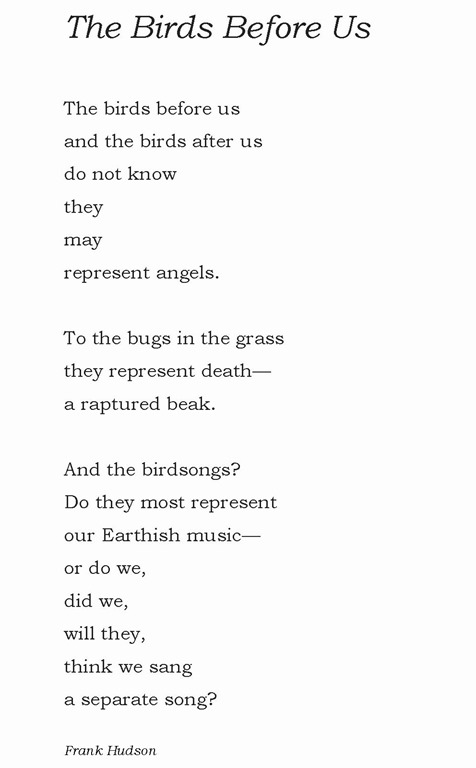
In writing about Sara Teasdale last time here I mentioned that she has been grouped with a set of 20th century female poets as a “Songbird Poet.” The implied charge here is that these poets are less concerned with the deep meaning of poetry and are content to just make pleasant word-music.
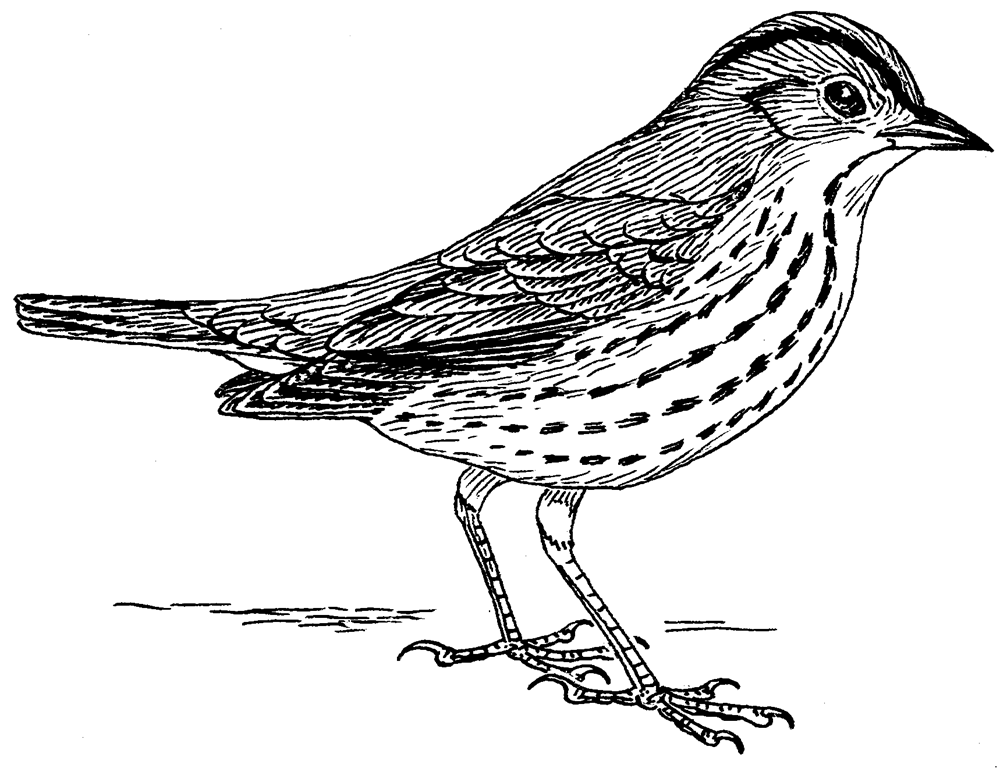
If we are to attend the deeper meaning school, I’d have an opening to report that in nature the songs of birds are not all pleasant and meaningless – for they sing for desire, for companionship, to legislate territory, and for existential defense among other things. If birds are likely deficient in theology and philosophy, I’m too ignorant to know if a sense of avian metaphor is present.
I, of course, am being stubbornly literal there, Teasdale appears to be without feathers and everyone should know this, save for those who are sure the female mind is insufficient and therefore may have doubts. One of the things we may claim as humans is that we are a flexible sort of creature of many moods and levels. One kind of song, one kind of poetry? There’s no handy phone app that can identify our songs as one sort of human.
So, even if calling them “songbird poets” is plausibly belittling, as a person in this Project I have to say that making a song, something one appreciates uttering, can be a worthwhile thing. Here’s another minor poet who I’m sure we’ve kept in a parlor cage as a songbird, one William Shakespeare. This tidy little song, from his play The Merchant of Venice, talks about idle, surface-deep, love (“Fancy”). But wait – like is often the case with the Songbird Poets, there’s a more complex message inside it. In the play, one of a pair of lovers is given a test: a choice of three boxes and selecting the correct one will allow them to marry. Shakespeare, prefiguring the ding-dong theme played when the Jeopardy game-show contestants are making their final answer and wager, provides this song to fill the stage time as the lover thinks it over.*
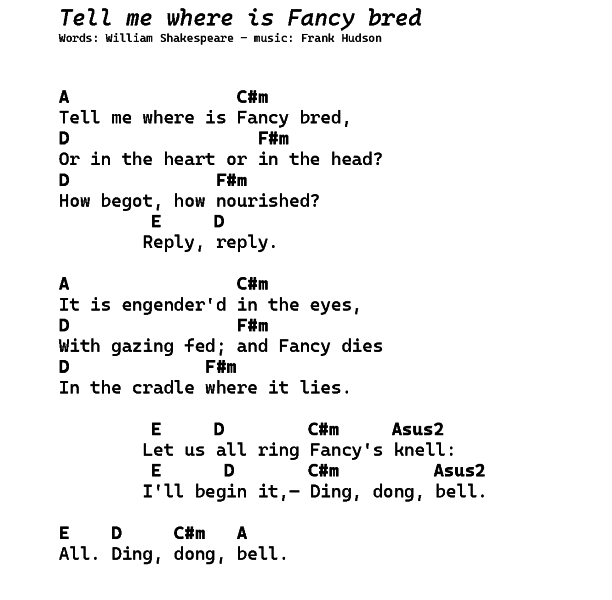
I made a point to write this one entirely with my ham-handed skills on keyboards.
.
As a poem it seems simple doesn’t it. Sure, there’s some now-archaic language in it, but to modern readers or listeners, that probably only makes it seem more the nursery rhyme.
But it turns out there’s a little bit of metaphysics in the modest verse: where does “Fancy,” that insubstantial, fickle, flimsy love come from? From the mysteries of the heart and its desires? From some reasoning of the mind? Nope. It’s all from looks – all “I’d hit that” surface the singer warns – it’s hardly born, and it’ll die. Finally, the singer asks us to celebrate the death of that kind of infatuation, and joyously ring its funeral bell, as time is up and the lover must make their decision.
So, is a little song like a Fancy: never more than a flimsy, momentary thing? Or can it tell us something about food, partnership, where we are, where the predators are?
Well in the present case of my performance of Shakespeare’s song, I’m the dun, leaden box since I needed to use my voice for this, and I made a simple pealing accompaniment with a viol, a reed pump organ, and a harpsichord. You can choose to hear it with the audio player gadget below. No gadget? It hasn’t flown south in a honking V arpeggiation, it’s just hiding in the brush cover of some ways of reading this blog. I offer this alternative then, a highlighted link that will open a new tab with its own audio player.
.
*I believe that none of the music used in Shakespeare’s plays in his lifetime has survived. Merv Griffith, himself a gameshow host and producer, wrote the tune used on Jeopardy. I haven’t watched that long-running TV show in decades, yet his tune (in its original version) is still stuck in my head.