The Wild Swans at Coole

Let us for a moment consider length in English language poetry. Despite the customary inclusion of one or two very short poems in most American poetry anthologies (“The Red Wheelbarrow   or “In A Station of the Metro”  typically), one can easily derive from them an accumulated mainstream judgement that poems shorter than a sonnet’s 14 lines are judged slighter expressions of less merit.

Similarly, in music, for all the glories of the mid-20th Century’s two minute and forty second 45 RPM single, serious composed music demonstrates greater regard for pieces of at least middling length, and the 20 to 70-minute symphony is still regarded with reverence. And so on with improvised music practice, which seem to find the five-minute mark as a minimum. Even the later 20th Century movement that got called “Minimalism” worked the idea of fewer motifs considered at greater length.

And so it is when we consider swans, the largest waterfowl, in words. Our last post and audio piece used Edna St. Vincent Millay’s “Wild Swans,”   a fine poem, but if one looks at the accumulated attention gathered in the roughly 100 years since each was written, Millay’s “Wild Swans”  is overshadowed by William Butler Yeats’ “The Wild Swans at Coole.”

Yeats’ poem is worthy of this attention, and he does pack a lot into his mid-length 30-line poem, written by a late middle-aged poet as his colonized country has experienced a failed revolution and his world has seen the shocking mechanized slaughter of the original World War. All that violence is subtext—not once is it mentioned—and as we read or listen to it now, that violence may no longer be apparent, though the background of disappointment remains.

Millay presents the swans as something she cannot comprehend as they fly over her, with her disappointment, her heart at present “a house without air.” Yeats on the other hand presents an almost OCD-level attention with the swimming swans at the beginning of his poem. He has apparently been counting them on each visit for 19 years. He’s going to count them again. And then they fly off in clamor before he can finish his count even though he reports an exact number.

The specificity of those two numbers is curious. Is the 19 years of visits to Coole in Ireland a mere biographical fact? Are the “nine-and-fifty swans” he’s counted an actual census he took regularly? I do not know. Given that Yeats had a long interest in occultism, there may be some occult significance in one or both of those numbers. They are both large numbers for the things they measure: anything one has done for 19 years has a resonance for that long a duration, and given how magnificent the sight of a few swans gliding on the water are, the idea of 59 of them viewed together is an image of overwhelming swan-ishness.

What strikes me most about the two numbers subliminal effect is that both end in 9, and so, seem to be almost at an ending. As the poem develops, Yeats returns to that effect.

These details, written in Yeats typical lyrical fluency, accumulate throughout the poem. The lake and sky repeating each other. 59 swans. The “bell-beat” weight of their wings as they heavily swing them into flight, equally straining, equally coalescing into aerial rings. Their companionable swimming on the cold water “lover by lover”—ah, there’s that 59 again, an odd number—at least one swan has no mate.

But he doesn’t say that. The poem is all its music, the image after image, the beauty after beauty mixed with the undercurrent of impossibility of its permanency. The world will change, the poet or the swans will not return.

19 years of repetition does not mean 19 years of repetition to come. 59 swans is all but too much beauty, but one swan is without a partner.
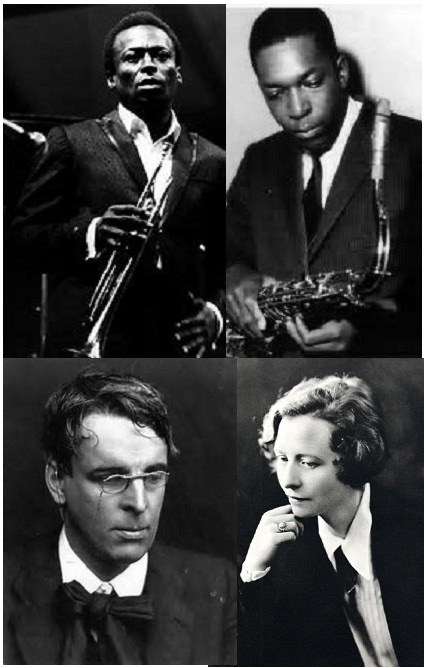
Davis Coltrane Yeats Millay

John Coltrane: “Sometimes when I’m playing there are always new sounds to imagine, new feelings to get at. There’s never any end.”

Miles Davis: “Try taking the f’ing horn out of your mouth”


So, do the 30 lines of Yeats mean it’s a greater poem than the 8 lines of Millay, an objective judgement causing its greater fame?

Why do I have to choose? If Yeats had written 60 or 6,000 lines would “The Wild Swans at Coole”  be better? If Millay had written 80 lines, would her “Wild Swans”  have shown greater skill? We can derive from how anthologists, poetry critics and audiences respond what their preferences are, even those they never articulate explicitly, but in the end it is the longer poems that make the short poems concise and the short poems that make the longer poems seem overwhelming.

How many times have I listened toKind of Blue?”  Does Miles Davis need to play more notes? Does John Coltrane need to play fewer? Looking at these two poems about swans, they illuminate each other.

The gadget below will play my performance of Yeats’ “The Wild Swans at Coole.”


Wild Swans

Let’s return again to Edna St. Vincent Millay as I start a short series of pieces using words by more well-known poets, each of whom considers the book of nature as played out by birds.

Millay’s “Wild Swans”  may be somewhat overshadowed in the Cygnet Committee by William Butler Yeats’ “The Wild Swans at Coole,”  published only a few years earlier than Millay’s poem. The birds of these poems’ central image, the largest waterfowl, are known for white and graceful beauty while at rest or swimming on the water, which contrasts with their somewhat overburdened flight and strangled hinge-in-need-of-oil song.

Other than their pure color and size, it may be the swan in flight that makes them something of the ornithological model for angels, as for such a large bird to have enough strength and wingspan to fly is practically miraculous.

an_angel_playing_a_flageolet-Burne-Jones

No matter how hard you blow on that horn, not enough wingspread to get airborne


In “Wild Swans”  Millay presents that miracle in flight, but by misdirection or misapprehension. The swans are flying as the poem opens, but Millay is instead looking inward—and furthermore, the poet thinks this introspection is bringing no insight.

Swan taking off

Headlong effort transcends grace


But in this short poem’s second part, the images and insights come anyway. In an apostrophe to her heart, Millay addresses it as a “house without air”—an acute metaphor there for despair—and she now asks for the swans to fly over us again, trailing their ungainly legs, crying unselfconsciously their sad and awkward calls.

Wildness, movement, flight beyond bounds, the miraculous after grace, the next day flying over the weeks, then the months and the years.

This is a surprising poem, it’s titular image, those wild swans, are missing, until they are called for in the last five words; not to be beautiful, but straining to be possible.

To hear my performance of Edna St. Vincent Millay’s “Wild Swans”,  use the player below. And remember I rely greatly on readers/listeners helping spread the word about the combination of various words and music here. Tweeting, linking, including in Facebook posts and on other social media, helps this project reach it’s audience. If you don’t do social media, that’s fine too, the amount of work it takes to do this makes that a practical impossibility for me; but if you like this, hitting the Like button for this post helps keep me going.


A Cold Heaven

We’ve already met Irish poet William Butler Yeats with a brief poem earlier this month. Now his words return with a piece suitable for the aftermath of Valentine’s Day, for “A Cold Heaven” is the tale of a rejected valentine. It’s also fitting, because Valentine’s Day comes in the midst of late-winter. February, as Margaret Atwood put it, is a “month of despair, with a skewered heart in the centre.”

Here in the northern Midwest it was a “seasonable” 19 degrees F. this morning, and hardy ice has outlived any soft covering snow. There is a promise of a thaw this weekend, but that will only recall mud and the detritus of what the snow once remembered inside it.

Critics from more temperate climes praise Yeats for his oxymoron here of “ice burned,” but up north we know that’s just what happens to skin in the cold, with no need for poetic intercession. And my back yard, my cities’ parks, and our central greenway have been home to that “rook-delighting heaven” he speaks of as well. Strange isn’t it, that the bird of death is so smart, so intentional, so sure, and yet inscrutable.

In “A Cold Heaven,” Yeats’ winter and his death-omen birds lead to a missed and misunderstood, “crossed” love; and he takes the blame: if not for the season, for the failed love. Like so many, and without the succor of chocolate or flowers, he is left in the rejected lovers worshipful, davening stance, “rocking to and fro.”

But he is a poet still! “A Cold Heaven” breaks itself in two with an image that is also a pun: “Riddled with light.” Yes, we Northerners know that winter light. Brighter than summer, and paradoxically the sign of a piercingly cold day. He knows his love’s in vain, and yet no amount of blame that he can assign himself—even if he exhausts “all sense and reason” to catalog that blame—can account for the failure of his love. What can solve this “riddle?”

Yeats begins again, with a majestic “Ah!” only to take us on a short ghost story, the spirit of his love in purgatory, in bardo, naked as a corpse or as a lover, wandering and asking why clear skies, clear answers, seem like punishment.

So to all those whose valentines were not accepted yesterday: peace. Such riddling has no end to its depths. I know this: that hole is too deep to be plumbed, just know that it’s deep. The correct prayer for such things is unknown.

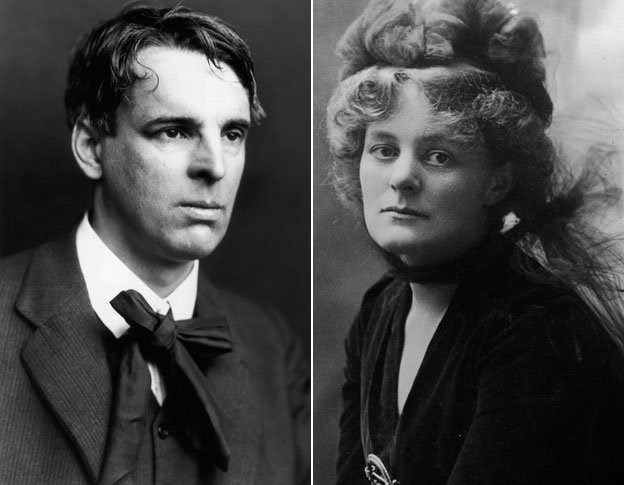
Yeats and Gonne

Look, maybe she’s just not that into you…

As a performance, “A Cold Heaven” had some challenges because Yeats makes use of enjambment, where lines break in the middle of sentences; and where the meaning too, often forks, seeming to mean one thing before the line break and another afterward. Since I like to let the lines “breathe,” so that the music can interject, and so that the words’ impact can sit a little bit before the next line, I resorted to repeating a few words. There are also a couple of other audio tricks in the piece. The string parts, particularly at the beginning have a “backwards tape” articulation where the sound swells from louder to silence, in the reverse of the normal decay of strings, which I hope signifies the drop into the past in Yeats’ text.

To hear “A Cold Heaven” use the player gadget you should see just below this.

A Rustle of Feathers

As promised, here’s my “bird in the house” piece presented as a companion to Dave Moore’s episode from yesterday.

I wrote this about a decade ago. I was going through a bit of a rough spot in my life then, and just as the words place the narrator in the piece, I was alone in a house in the wintertime, acutely aware of the sounds in winter.  In that house, with no other human sounds but my own, I found myself thinking of my aged father, now widowed, living alone as well. In a somewhat morbid, gloomy mood I thought of unwitnessed death, of my father, or myself, dying alone.

Just as in the dream reported in Dave’s piece “The Bird Dream,” the trapped bird image came to me as I wrote the words for “A Rustle of Feathers.”

Odd that that trapped bird image occurred to both of us thinking of our aged parents. I don’t know if this is a common image or archetype, something that waits in our common human unconsciousness, waiting for a writer’s words to awaken. “A Rustle of Feathers,” with it’s aged narrator in an otherwise empty house acutely alert to sounds, shares a bit of the mise-en-scène of Robert Frost’s A Old Man’s Winters Night”  that was presented here earlier this month. Possibly I had read the Frost poem somewhere in my youth, but I don’t believe it was present in my unconscious as I wrote this; but shortly after I wrote “A Rustle of Feathers,” I did think that Edgar Allan Poe’s The Raven”a poem widely known to Americans of my generation—might have been a subliminal influence.

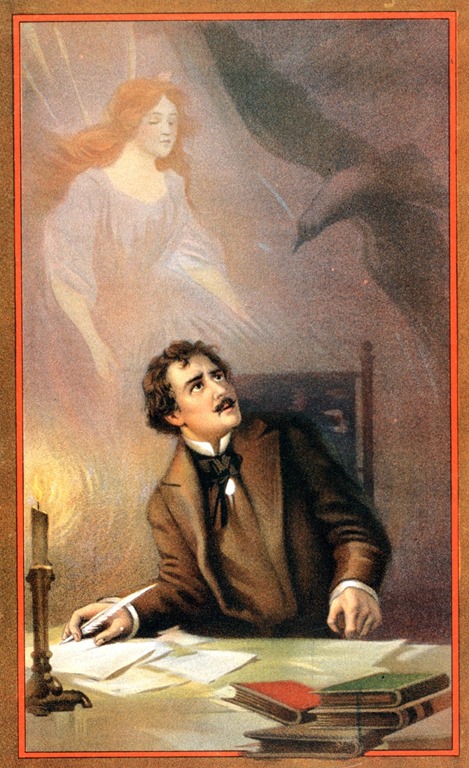
The Raven and Poe

Yes, I am using a plucked feather as a pen—but it’s a goose’s quill—so get out of my house!

Musically I was thinking a bit of a Johnny Cash feel as I composed the music, but I’m not sure that much of that came through in the final result. The guitar sound is a lovely example of a Fender Telecaster using both it’s pickups.

Well the muses keep dancing, and they are hard to keep in our narrow field of vision. The piece got written, and now it’s here for you to listen to. Just click on the gadget that appears below to hear it.

The Bird Dream

You can be in my dream, if I can be in yours. Bob Dylan said that.

You may have noticed that blog post frequency has fallen off a bit this month. Well besides the usual struggle of an upper Midwest winter, both alternative Parlando Project reader Dave Moore and I have had some extra tasks this month. I’ve been helping transition my mother-in-law to new living arrangements, and Dave has been working on editing a book of his father’s sermons.

Today’s post  is a piece that Dave wrote a few years back about his parents, and his father’s experience after Dave’s mother had died.  Like many good stories, it seeks to find meaningful connections in the flow of coincidental events.

And speaking of coincidence or archetypes or something, I wrote another piece myself a few years back. Though I did not mention it explicitly, my piece was also engendered by thinking of my father now living alone after my mother had died. Both pieces used the image of a bird trapped in a house.

I’ll not attach any more meaning than that to this. Today’s piece is Dave Moore’s story, read by Dave. Click on the gadget below to hear his story. Tomorrow I’ll post mine.