Is there anyone reading this far in these posts today mumbling to themselves “It’s Black History Month — and instead of the eclectic variety I expect from the Parlando Project, Frank is giving us this little-known early-20th century Black Chicago poet, this Fenton Johnson guy (who, huh)?”
Let’s keep you here, because Johnson is bringing the variety again today, with a piece that could pass for early William Butler Yeats, or someone else from the Celtic Revival that was happening contemporarily with Johnson’s first poetry collection A Little Dreaming of 1913. And if our last piece of Johnson’s that had the Roman underworld didn’t warn you, this one is further into the dark fantasy/horror poetry genre as well.
Wraiths and wights, two names given to the wicked messenger in today’s poem have been popularized by later, fantasy books — Tolkien and Rowling et al. But Yeats and others in the Celtic Revival touched on various kinds of supernatural spirits around the time of Fenton Johnson. The non-human beings in these dealings were often at least chaotic or untrustworthy — and as a class, wraiths tended to be even more so. Though named as fairies, not wraiths, I’ve recently presented two linked fairy poems by Yeatsand Robert Frost for example where the fairy is seeking to trick a human couple so that they can abduct one of them to fairyland.
Don’t stay up late reading blogs, for a wraithie might visit you
.
In Johnson’s “The Wraithie’s Message” the poem’s initial speaker beholds a marvelous creature made of “living flame” at his window. The creature tells our mortal, who the wraith addresses as “dreamer” that there is a lovely sea-side woman, the dreamer’s soul’s desire, who he has beguiled with “burning song” so that this woman is now dreaming of, desirous of, our dreamer.
The dreamer at the window is all in on this. He sees not an untrustworthy wraith in this apparition of living flame, but a “good elf” who might be of service to humans. And besides, as the poem ends, he explains that this dreamer is tired of his dreams — ones that have not been realized. What really awaits? In my understanding of this poem, the wraithie is a siren by proxy. The promised maiden may be by “the deathless sea,” but that may be in the sense that the enthralled or the dead have no more dying to do.
Should it surprise us that a young Black Chicagoan is writing this poem? Perhaps a little, but it shouldn’t be a lot. I come from the Midwestern city of Prince Rogers Nelson after all. Versatility with many styles has been demonstrated by Black Americans over and over. In regard to Afro-American musicians, I lost my constrained surprise decades ago when I learned that Fenton Johnson’s early 20th century contemporaries, Blues musicians —who I prized for their distinctive “authentic” recorded music — had a wider repertoire and spread of influences than I had guessed, and that they were often capable of essaying a variety of white ethnic styles with aplomb.*
But the choice of this Celtic Revival flavor by Johnson may not have been entirely random. Remember that last time Johnson was trying on the title of “bard,” and a bard for a generation of Black Americans who were trying to propagate an Afro-American culture of achievement and distinction — not just out of some parochial ethnic pride, but out of a very serious need to establish their humanity in a country that still retained nearly its full measure of white supremacy. The Celtic Revival of Johnson’s time was similarly seeking to present themselves as full human beings by displaying a rich culture, and it’s not unlikely that Johnson was seeing what he could appreciate and adopt from that.
With a Celtic myth via an Afro-American, there is after all a story here of a despairing dreamer and an untrustworthy power willing to trick them to their doom.
Simple guitar chords, but my recorded version will sound different because I used a CGDGBE tuning
.
I had planned to do this Fenton Johnson piece this month, but as I’ve mentioned before, I’m nearly always unsure of what time and focus I will have to do these pieces now. I had written a sketch of the music already (that helps) and in the middle of the day today I was able to try it out. It came together so quickly I was able to complete a basic track before attending a Canadian Zoom salon featuring friend of this blog Robert Okaji reading new poems. Then later tonight I finished mixing it, leaving it simple enough, though I hope it’s effective. This is another piece that may depend a great deal on my vocal abilities “of a subjective quality” — but that’s up to you the listener. You can hear my musical setting of “The Wraithie’s Message” with the audio gadget below. No player? A substitute can be summoned with this highlighted link which will open a new tab with its own audio player.
.
*Some might be wondering if Fenton Johnson utilized or valued Afro-American music and modes. Yes indeed — he was early and effective in that, a decade before those in the Harlem Renaissance did similar things. I’ve got a couple of pieces planned demonstrating that yet this month.
Though poetry might aim for timelessness, time as we know it aims to hide itself in the past. For that reason, when I talk about Fenton Johnson this month, I want you to be able to step inside his time a bit. Depending on your expectations for poetry, or poetry by Black Americans, some of the elements of his poetry might seem out-of-place, but Johnson didn’t have the ability to see us — an audience of today — instead he was addressing the expectations of his time.
From reading Johnson’s first collection of poetry, 1913’s A Little Dreaming it’s clear that one of Johnson’s chief models was Paul Laurence Dunbar. Dunbar was born in 1872, Johnson in 1888. Depending on how you think of the amorphous boundaries of generations, the two are bookends of one generation or a generation apart, but two facts are important to understand in this relationship.
The leading fact? Dunbar was proudly counted as the first Afro-American poet to reach some level of general recognition. How well recognized was Dunbar in Johnson’s time? I can’t say for sure. Some established white critics reviewed his work. Public reading tours were advertised, indicating that there may have been expectations of greater than the folding-chairs in bookstore-aisles readings common for poets today. Part of Dunbar’s potential audience would be something new: an emerging Black American cohort born post-slavery who could read. Their parents might have been enslaved (as Dunbar’s were), and now they had this new broad skill, and they were allowed to indulge in it.* What was it they would read? Newspapers & magazines for sure. The popular press was growing during this time — and it was somewhat analogous to the Internet today, including the breadth of materials and parochial opinions, not all of them on the up and up. Novels and prose books? They were around, some inexpensive editions aimed at the less-wealthy casual reader’s budget. Poetry? Likely closely related to the availability of novels. Does that surprise any of you? In the Dunbar/Johnson pre-WWI era poetry was more a co-equal branch of literature than today. In our early part of our 21st century, open the books section of one of the big city American newspapers, and it’ll be rare to see any notice of new poetry collections. A literary author interviewed on TV is an increasingly uncommon event, but such guests will almost always be novelists. If you were to walk into a bookstore this year, how likely would you see poetry collections prominently displayed to tempt the general shopper?
I have no time machine to visit a circa-1900 bookstore, but my reading of the Dunbar/Johnson era indicates that to readers and the commercial side of publishing then, poetry was not consigned to a specialist interest of a small coterie of folks. Poets like Longfellow and Tennyson were as famous to the ordinary reader, if not more so, than many of the American novelists you might be asked to read in an American Lit survey course today. And there were contemporary, living, popular North American poets who were read by a general public then too: John Witcomb Riley, Ella Wheeler Wilcox, Bliss Carmen, Robert W. Service, and Edgar Guest emerge in this era. All these poets had a general audience, even if these once popular poets might not be covered in an academic survey course today.
So, Dunbar’s intended audience was broad, general. Some of his writing followed the same formal structure and practices used by the most esteemed poets of the 19th century, but not all of it. To a Black audience he may have intended to capture the newly literate while also offering a more serious solace and uplift for these men and women only recently granted rights on paper. To potential white readers of his time a parallel intent: poems at the casual entertaining level to put them at ease, but then poems in elevated literary modes expressing the beautiful thoughts in a Black man’s head or the pressing problems he and his race are encountering.
A young poet today might aim for a published collection, likely with an academic or specialist small publisher. Might aim for poetry awards watched mostly by other poets. Might aim for a teaching position. In the Dunbar/Johnson era it may have seemed possible for a poet to aim for a deeper/wider presence than today in both the literary and popular sense.
How far did Dunbar get in accomplishing that? My understanding, subject to correction from better scholarship, was that he became “Black famous.” His efforts would have been known and recognized by more-educated and culturally ambitious Black Americans, even if he would have been unlikely to be known to my (white) grandparents. To Black literary writers, whatever size that group was? He seems to have been huge.
Which brings us to the second important Dunbar fact. Dunbar died young: 33 years old, in 1906. Johnson would have been 18 and was about to go to college. If you were Afro-American, a poet, and interested in furthering the prestige of your culture in the first part of the 20th century, Dunbar was the man to consider. That Dunbar had fallen, still not meeting his highest expectations, could be seen as a standard bearer staggered short of the wall, but another young poet could pick up the flag and carry it further.
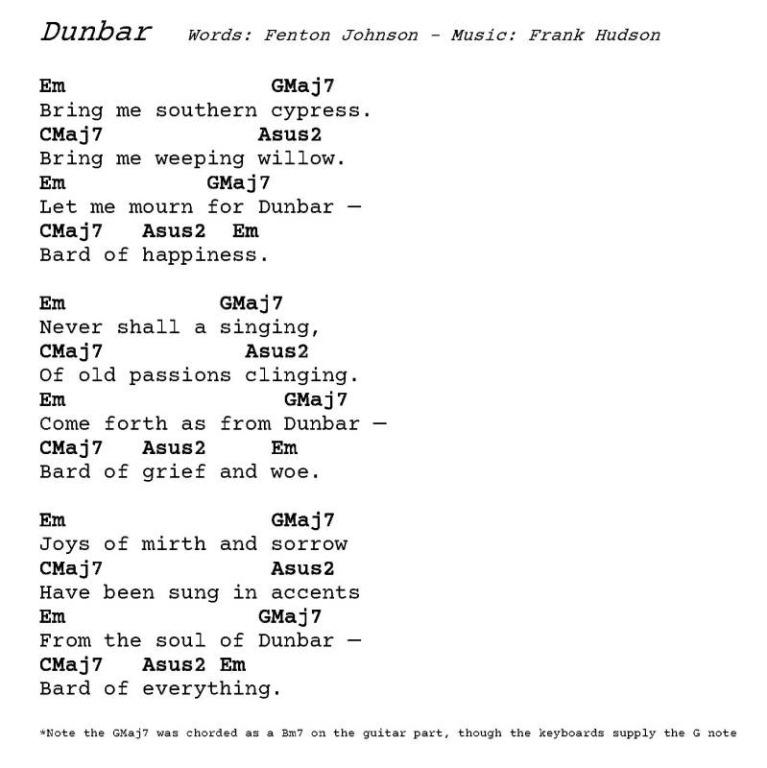
Once again, here’s a chord sheet for those who’d like to sing this themselves.
.
Long time readers here may recall that another of Johnson’s Afro-American poetic contemporaries, Anne Spencer, wrote a short poem linking the died-young Dunbar with early 19th century British Romantic poets like Keats and Shelley. Today’s piece from Fenton Johnson is a poem with similar goals. Johnson’s “Dunbar” is just 12 lines itself, but it makes a concise case for Dunbar’s broad worth. In a refrain at the end of each stanza he calls Dunbar “bard” to indicate that he as a poet is representing his culture, and Johnson is particularly interested in bringing forward that Dunbar can do the serious and be a “Bard of grief and woe” but that also he is the “Bard of happiness.” In this claim for Dunbar’s worth in comedy and tragedy he may be exceeding Spencer’s claims for Dunbar — as this best for comedy and tragedy claim echoes one made for Shakespeare.
What does Johnson mean when he writes that Dunbar’s poems were “sung in accents?” Dunbar’s rhymed metrical verse would use standard English (including a willingness to use elevated “poetic diction”). Johnson would begin doing the same. Dunbar also wrote in dialect: poems where the language is meant to portray less-educated speakers, is written in colloquial grammar, and is printed in phonetic approximations of heavy accents. Dialect was a literary vogue in the late 19th century in both prose and poetry. Of the popular poets mentioned above, John Whitcomb Riley, specialized in dialect poems reflecting common-man white speech of the rural Midwest. Dunbar wrote a poem in praise of Riley, Riley wrote a letter complimentary to Dunbar. Modern readers may have an inescapable problem with this sounding like minstrelsy.** And there is correspondence from Dunbar where he wrote that he was increasingly troubled by what he saw as the greater acceptance of the dialect poems. Fenton Johnson may not have known of that, and Johnson would also write in dialect in the mode of Dunbar.
I said at the start of this Black History Month that Fenton Johnson was a bridge between Dunbar and the Harlem Renaissance poets such as Langston Hughes. At the beginning of his writing Johnson is clearly on the Dunbar side of that bridge, so this poem in praise of Dunbar — now song with the addition of my music — is a good place to start. You can hear it with the audio player below, and if that player isn’t there, with this backup highlighted link which will open a new page with its own audio player.
.
*Dunbar’s mother Matilda was born enslaved and illiterate. She worked as a domestic servant after emancipation and took night classes to learn to read. There are stories that she had her children teach her ABCs, perhaps with the dual utility of drilling them while helping teach herself! Paul began writing poetry as a schoolchild, and she encouraged him and organized the family to allow Paul to complete high school. Paul Laurence Dunbar died so young that he was survived by his mother who lived until 1934.
**Bothers me too, and not just because it seems belittling even when it is only so by association with racist beliefs. I have little to no facility for reading or reproducing phonetic speech for some reason.
Paul Laurence Dunbar is most often introduced as the first successful Afro-American poet, and I guess I’ve just followed form by starting this post that way. That statement is more-or-less true. I’d suppose a case could be made for the primacy of Phillis Wheatley who published a book of poems with some notice in the 18th century even before American Independence. And then too, there’s the question of success levels. Dunbar was able to publish more than a dozen books, got praised by some white literary critics and established poets. Figures in Afro-American culture put him forward as a leading Black poetic voice: Frederic Douglass, James Weldon Johnson, pioneering Black orchestral composers William Grant Still and Samuel Coleridge-Taylor.
As noted in Anne Spencer’s elegant short eulogy poem linking him with other died-young poets, Dunbar was only 33 when he died. Carl Sandburg was just 6 years younger than Dunbar, Robert Frost was but two years younger — both of those poets survived into the 1960s. Dunbar died in 1906 after being debilitated by illness and a series of personal crises. By the time the Harlem Renaissance came around to start making Afro-American artists chic, Dunbar was more than a decade dead. How much more growth and new circumstances could have accrued for Dunbar!
That we still remember him, that a couple of his poems, “We Wear the Mask” and “Sympathy (I know why the caged bird sings),” survive to be widely read and considered, should be counted as a success.* “The Sparrow” is not as well-known, but I’d note that it both comments on the Afro-American experience and a more generalized human experience.**
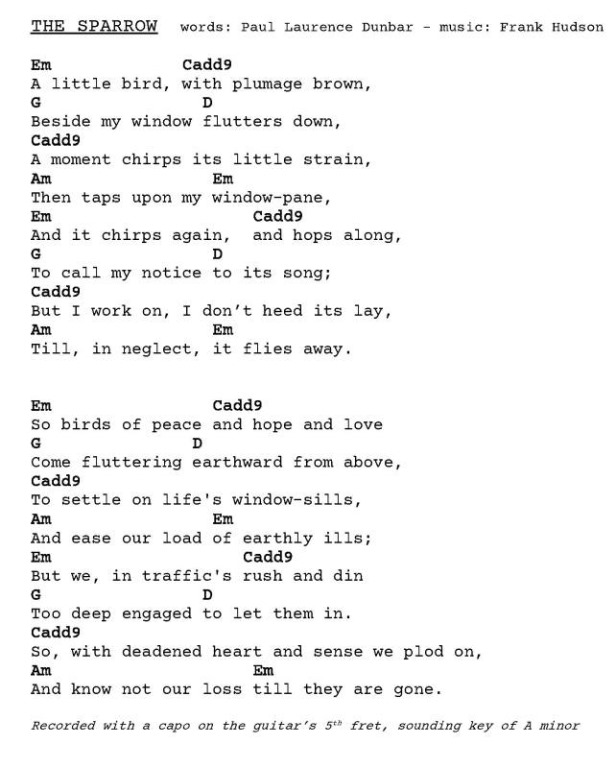
“The Sparrow” is a poem about being sent joy, being sent song, being offered the peace of fellowship, being offered something — and being too callous, or too ignorant, or too busied with the things that aren’t joy and song. In the course of this poem, it may be simply drudgery that is keeping the poem’s singer from noting the bird. Even non-unpleasant rote life can obscure those offered gifts. And oh yes, oh yes, it can be fear and prejudice that shuts them out too.
Guitar chord sheet for those that want that want to perform my song setting of Dunbar’s poem.
.
Beyond his remembered poems, I think often of Dunbar’s own life as a sheaf of strong metaphors. His mother was born enslaved. Sensing somehow that her son had a talent as a child, she herself learned to read to help him along, so that eventually that son wrote of that caged bird and of today’s offering sparrow. After publishing his first poetry collection, Dunbar sold it while working at his job as an elevator operator in his hometown of Dayton Ohio. He would offer it to his passengers migrating a few floors up or down inside his elevator cage.*** He grew up in Dayton with a couple of bicycle mechanics, Orville and Wilbur Wright. Orville was his school classmate and helped Dunbar find a publisher for that poetry collection. After eventually attaining some notice for his poetry and public readings of it, Dunbar got a job in the Library of Congress. Around that time his mortal illness was diagnosed as tuberculosis. I read today that he thought the dust of the books in the library made him — the man who could once charm musicians with the way his poetry sung off the page — choke and cough. He descended into his illness and depression for the foreshortened rest of his life. Three years before he succumbed, those bike mechanics made and flew the first airplane, and some of mankind slipped the surly bonds.
Someone had to be the first men to compose flight — but flying or caged, we need to sing, need to hear the singer, even after they’ve flown away. As Dunbar’s “The Sparrow” has it in its ending line we often “Know not our loss till they are gone.”
I composed the music for Dunbar’s poem earlier this week, and dedicated much of today to completing the arrangement you can hear below with the audio player you may see below. No player? This highlighted link will open a new page with its own player so that you can hear it. You may notice that I changed a few words in Dunbar’s poem while singing it. Some of the longer sentences didn’t give the song (or at least this singer) enough space for breath — and where rhyme didn’t demand it, I unconsciously changed a couple bits of the 19th century poetic diction as I strove to bring out the poems meaning as I sung it. That’s generally considered a fault in classical song settings, but I come from a looser folk songwriting tradition where that sort of thing is allowed. Here’s a link to the poem as Dunbar published it with all his words and syntax intact.
.
*To be known for a single poem, to have that carried by others, even in part, in reader’s memory, is an achievement I’d say. I can remember having a discussion with Kevin FitzPatrick some years back when he put forward that Dylan Thomas should be weighed by only being known for one poem — or maybe just that one poem’s refrain. That’s an arguable assessment, but even accepting that, that’s more than many poets, including prize winning-poets, achieve years after their death.
**In dealing with Autism Spectrum Disorder I often think of Dunbar’s poem of Black code-switching to seek acceptance or protection from mainstream white culture, and apply it to the ASD tactic of “masking” to seem more neurotypical. Dunbar’s caged bird never has to say it’s a metaphor for Afro-American experience to Black folks, but caged hopes are not an exclusive experience. I’ll split hairs on thin ice to mix those metaphors re: cultural appropriation vs. cross-over impact.
***Further risking flippancy on my part, it could be argued that the Wright Brothers invented the airplane, but the enterprising Paul Laurence Dunbar invented the elevator pitch.
A lot of the poetry I combine with music here was published around 100 years ago, making it clearly in the public domain for reuse. Given my age, some of the poetry from the Previous Twenties doesn’t seem all that old — after all, many of the poets’ lives overlapped mine — but some poets and poems look back, as I do now from my 2020s, to older styles of poetic expression, ones from an additional 100 years before the 1920s poet. That may be too much for some younger audiences I think.
Since poetry is at least partly about how something is said, it’s not out of line for style to be substantial when we choose to read or listen to poetry — but, sometimes we might choose to “translate” poetry for performance to make it more immediate.
Here’s an example. I came upon this 1922 poem by Claude McKay while looking for summer poems. I’ve presented McKay a few times already here. A figure stored away in the Tupperware container labeled The Harlem Renaissance, McKay’s poetry is still preserved and sometimes read — often the portion of his poems that speak eloquently about racism and the double alienation of being a Black Caribbean emigrant to the United States. Since these things are still factors in the 2020s, that supplies relevance to continue to consider them. A poem like his 1919 sonnet “If We Must Die,”however formal in prosody, presents clear reasons to our current ears.
But McKay is also a passionate love poet.* Now, to say the least, love is still a contemporary experience, so one might think his love poetry would also get more contemporary exposure. My casual estimate says this hasn’t happened. Yet.
Why not? This poem is significantly old-fashioned, 19th-century-like. Its sentences are poetic in an outdated style, they don’t flow casually in a spoken way. This is a style we might forgive in 19th-century verse if written back then, particularly if the poem is a Hall-of-Fame, “Poetry’s Greatest Hits,” poem — but not so much for a 20th century poet’s less honored selection.
Don’t make the mistake when reading old poetry to think that the poets must be old too. McKay was just 30 when he first published this poem.
.
This poem also makes a mistake writers can fall into. McKay seems to think that leaving a surprise for the ending will strengthen the poem — that when the reader finally sees that surprise they will be happy to have waited for the poem’s context.
There are poems that work that way.** To me, this one doesn’t. Coming upon it, one may not read through the facile but not necessarily compelling nature poem that makes up more than ¾ of the text. Therefore, in my “translation” for today’s performance, I’ve decided to create a refrain out of the poem’s final line, spoiling the surprise but urging the listener to consider the nature and weather report portions of this poem as reports of human desire and inner weather. You’ll hear how it works in the musical performance you can hear below.
Taking liberties like this is one reason I use public domain work: it’s now free for one to do with it what one wants. If you want to read McKay’s work as he intended it, here’s a link to the 1922 version. That link includes its own link to an even earlier published version by McKay, evidence that the poem’s author himself was trying to improve his poem’s impact.
Writers: if you are ever writing a surprise-ending piece, if you ever are withholding something from your reader or listener because you think it’ll be a grand or witty “Aha!” moment at the end, consider the alternative. The alternative here, the bringing out the key context that the poem’s speaker is viewing his summer night and morning “Blind with hunger for your love,” strengthens listener engagement I think, and it lets the listener see that the speaker/singer is just as attracted to the early rain-storm, sleepless-night portion of the weather, as the “miracle” of the subsequent sunny morning which is so incongruent with their present feelings. I’ve doubled down on that revision by making the newly refrained line the title too. ”Summer Morn in New Hampshire,” as McKay titled it, is too specific yet generic in my hindsight judgement.
I did my best with the musical performance of this as a song. I enjoyed playing my big, heavy, 20-plus-year-old 12-string Guild guitar and weaving in the rest of a quartet of ringing and raining instruments. It’s not a humble-brag, but a statement of the song’s potential to say that this piece would benefit from a higher-skilled singer than I am. Perhaps my voice’s approximations can be heard as bringing an imperfect human immediacy to the words? You can hear the performance with a graphic audio player below (if you see that). No player? This is a hyperlink that will open a new tab with its own audio player.
.
*Let me leave this final point to a footnote. Best as can be determined, Claude McKay’s erotic connections seem to have been with men. Given the homophobia of his time — or perhaps from artistic choice — McKay has written this poem, as he has many of his love poems, in an entirely genderless manner.
**This poem isn’t a sonnet, but it is “sonnet-ish,” and the popular English/Shakespearean sonnet conventionally expects a somewhat surprising summation in its final couplet.
Like many days recently with this Project, I have been thrashing about looking for time to find an inspiration for a new audio piece, and some inspiration to spend that time. This weekend I found one sliver of inspiration in musical memory, and then yesterday, I found an Independence Day piece so monumental that I had to figure out how to grasp it inside music.
The sliver? I recalled a song, or rather just a line, a refrain from a song, from my younger years. That refrain was also the song’s title, and the title of today’s piece, but by itself it was insufficient. “Almost Independence Day” is a song that closes an early 1970s album by Van Morrison. It’s a peculiar song,* a lengthy (10-minute) two-chord jam with largely mundane lyrics that earns it’s interest — if it does — by the singer’s investment in presenting the ordinary, and by the unusual combination of instruments it uses to accompany itself. Morrison’s “Almost Independence Day” has drums, bass, two guitars, and keyboards. But the bass is an upright Jazz-sounding bass, allowed a high place in the mix at times, and one of the guitars is a 12-string guitar prominent in the song’s texture. And the keyboards? The keyboardist on the cut is Mark Naftalin, the son of a former mayor of my city. Naftalin was the keyboard player in the classic Butterfield Blues Band lineup, a tough sounding, gritty integrated band that played post WWII Chicago Blues — but on this song, the most prominent keyboard part is a low electronic synthesizer, reportedly played on one of those made by American synth pioneer Robert Moog. Wikipedia thinks it’s one of the earliest uses of that instrument on a “rock” record.
I had only remembered that song’s refrain — but even on re-listening to it, I found little besides the refrain and the song’s odd musical texture that I thought I could use.
Then early yesterday morning I thought of another, more substantial, set of words for Independence Day: a speech given in 1852 by Frederick Douglass, “What to the Slave Is the Fourth of July?” I’ve read it silently before, and I read it silently again. It’s a 19th century oration, the kind of lengthy and precisely enunciated rhetoric that would seem archaic to modern ears and attention spans.** Yet, it’s worth reading because it’s a unstinting analysis of American Ideals (worthy), acknowledging of American scientific and civic achievements (evidence of the possibility of unimaginable change), and yet clear and precise on great failures in extending its best to all Americans. As the title given to the speech makes clear, Douglass spoke at a time when chattel slavery was a large part of our country, when he himself had been enslaved, when a reticent and resistant national government had (through the Fugitive Slave Act) made clear that the whole nation was to support and maintain this evil.
I assume we are all in agreement on that evil, on that horrendous disconnect.*** But continue: Douglass’ speech still speaks to us today if we can translate a bit from its old-style oratory. Doing so, it’s a forceful reminder on this holiday that American ideals, such as the things stated in our historic Declaration on the first Independence Day, aren’t an award citation — they are a to-do list. The work of our founding, the work of emancipation, the work of fulfillment of our ideals, is on-going. So, if we are clear in retrospect about the acceptance and legal enforcement of slavery, that’s only a beginning lesson. We need to be as unstinting in asking where we are today out of step from our best principles and practices.
American ideals, such as the things stated in our historic Declaration on the first Independence Day, aren’t an award citation — they are a to-do list.
In devising a way to use Douglass’ speech in our short musical format, I decided to take a short part of it, a litany of assertions made in 1852, and make them an enduring set of questions to ask ourselves (or for any nation to ask itself) about that disconnect now and in the future. Douglass’ recast litany starts at about 1:20 in the audio piece, and the other words are mine, though I’m seeking in them to convey Douglass’ insights.
So yesterday, in an hour or two that I had available after finding my inspiration, I worked to perform Douglass’ litany of questions, and still was able to finish with a couple of lines from an Irishman’s song. Why was Van Morrison singing about almost Independence Day? Perhaps, it was only July 3rd, and he was noticing, as an immigrant, the expectations of this American holiday. But maybe too, this white man who sang “they can’t stop us on the road to freedom” was thinking that we are always, should be always, like those men in granite who declared our Independence two days before July 4th, looking forward to Independence Day, not remembering it.
You can hear my musical performance of this recast portion of Frederick Douglass’ speech with the audio player below. No player? This highlighted link will open a new tab with an audio player.
.
*Peculiar and a Van Morrison record is a tautology.
**Consider this: for all its elaborate speech, it’s shorter than the usual modern podcast length, and spends less of its time with repetitive familiarities and co-host back-slapping. Have our attention spans really gotten shorter, or is it the density of 19th century speeches like Douglass’ that wears out our attention?
***Well, there are still some neo-Confederates out there who will tell us it was a benign sort of thing, unremarkable really, and so long ago that we need not think about it — and coincidently, we should not think or teach about this example, and so setting out laws or best practices against that.
I’m going to share a musical performance of an Emily Dickinson poem, but before I get to that, I’m going to continue my memoir-of-influences series on things that formed the idea of the Parlando Project earlier in my life. I’m going to try to keep it short, which will force some amputations, but I feel embarrassed spending much time on the small events of my single life. Those in a hurry, or only interested in the new audio piece and what I have to say about that, can skip down to the second section of this post.
At the end of the last post I had moved to Newburgh, a town on the Hudson river about 60 miles north of New York City. I don’t know if the town knew what to do with The Seventies, it seemed between eras; and in some larger sense I might not have known what to do either, but like the town I had a daily job to do, and kept doing it. Can we say that had some value?
I liked many of the people I worked and lived with during my five years there. I still think of some of them from time to time, and they were often kind to me. The folks who worked with me at St. Luke’s Hospital, particularly those in the Emergency Department, worked hard under significant limitations trying to do things that we could only address partway. I could say much of that under-addressed were systematic issues — and I’d be right — and the levers of those systems were outside our direct grasp. Another part of those limitations were closer to us, internal. I said I’d try to be brief. I said there would be amputations. Newburgh had a racism problem. The town, the region, was populated by stratums of immigrants, with the original European WASP colonials to Irish, Italian, and Puerto Rican waves following on. Mixed in there were Afro-Americans who were there, as they were everywhere in the United States. I don’t know the exact demographic details, and I said I’d try to keep this concise, but I’d guess the Black Americans were first in the region from servant and slavery times, and then there was some low-paid and otherwise undesirable work that still may have seemed better than some parts of America for Black folks. Few poor people ever emigrate for marginal gains from acceptable situations.
That work had shriveled over the years, and what jobs there were, those other immigrant waves got some of the employment from the white folks who did the hiring. Again, I’m no expert, I may have some of this wrong, but when I think of the Irish and Italian Americans who can recount the derogatory tropes employed against their ancestors,* I still suspect that even within the cruel othering they received, they sometimes got, in practice, hiring preferences over Afro-Americans.
This led to the town, in the time I was there, with an underclass of underemployed Black folks viewed by too many of the white population as shiftless, ungrateful and unenterprising wards of the state. Think I’m amputating too much to say this was a prominent white attitude? Ten years before I arrived there was a controversy that was called “The Battle of Newburgh.” I didn’t know much of this specific history in 1971, but the attitudes were still easy to hear and feel while I lived there. Here’s a link to a 30 minute podcast on the 1971 controversy. Wonder what happened later? Here’s an article that updates things to 2015.
Back in my Emergency Room, The Seventies, we were the place anyone came when things broke down. Folks needing medical care that couldn’t pay. Victims of violence. Stressed out or addicted people. Worn-out old workers and beneath the working-class people. I worked the 3-11 shift, the busiest one in the ER. We’d typically get 50-70 such situations every shift. What could we do for them, right now, in our imminent place? Patch’em up. Give them a preliminary diagnosis and maybe a shot or some pills. Hand off a referral card to a medical system already fragmenting and requiring insurance levels of payment from various payers. Witness their deaths.
So those folks I worked with, who did this, were they racists? I’m not saying that. I can’t see into the hearts of them — not then, and not with any level of magnification now. I know we were frustrated with the people in and around the treatment beds at times, thinking that what’s close and in front of us was the most significant thing in what was going on. No, no, we’d no doubt say, that thought wasn’t from the color of their skin, that was what they did, or were doing, or weren’t doing. From what some of my coworkers said talking among our tired selves, I could hear racism, hear pat rationalizations. I’d be hearing this from folks on a modest paycheck given the responsibility of a past that isn’t even the past as Faulkner put it. Our actions were mostly care — yes I saw kindness too, even when our philosophies and capacities could not fully appreciate the lives of our patients and their families. Perhaps it was good that we were too busy to think about that incongruity. Would our care have been better if we — speaking now of the whole group of us, including myself — were less ignorant and more broadly empathetic? That’s certain. But such wiser folks weren’t there then, we were. Imperfection trying to heal what could be treated directly.
A couple of years before this, a songwriter was 40 miles to the north of me, goofing off with his Canadian R&B band buddies in a big pink house. Sing heavenly muse, he sang these lines:
Remember when you’re out there
Tryin’ to heal the sick
That you must always
First forgive them.”
To this day, when someone, almost always a white person, concludes some confession to me with a variety of the phrase “You might think I’m a racist because I said that.” I reply “You said it, and you might well be to some degree. So, what are you going to do about that, and about the situation that is before us?” Ignorance and prejudice may not guide us well in trying to solve things, to remedy faulty systems — so what efforts can reduce that so we can see more clearly? But beyond that, even though our thoughts and prejudices can make us work blindly or in the wrong direction, the injured and endangered may be more in need of helpful actions than faultless inner wisdom.
Is writing and performing poetry a helpful action? Well, it’s not clearly so as is binding wounds or performing CPR. Poetry is in the calling-attention business, including part I normally celebrate here as “Other People’s Stories.” With that focus, I feel conflicted in writing so much within this series which touches on individual and sometimes trivial things in my life. What good will calling those things to attention do? Perhaps it helps make you aware of the “unimportant” things in your life, or the dependencies we have in others who have broadened or deadened what we’ve seen and felt. It can be someone else’s story that helps you see the contours of your own story.
And then too, poetry is full of little, trivial things that poets write down to stand for the ineffable larger things. Can our lives stand for the larger things? They do I believe, or they can, in ways we never fully know.
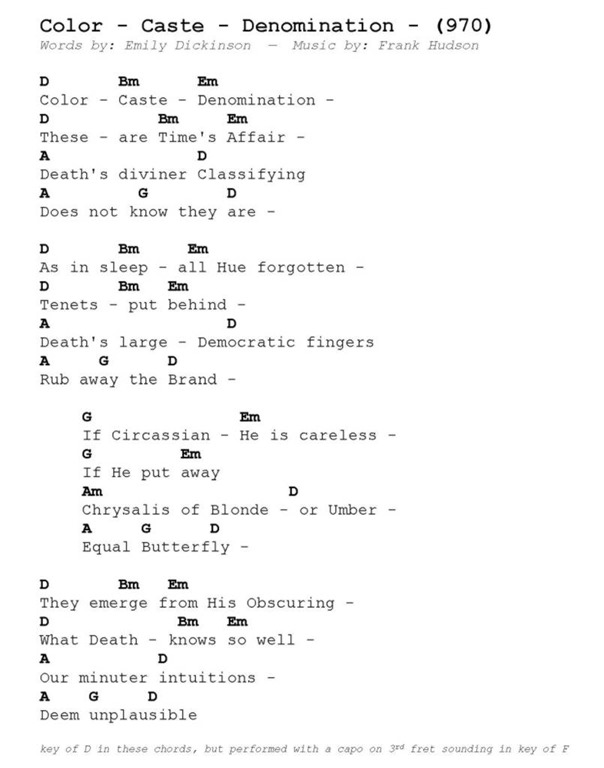
Once more a chord sheet if you’d like to sing this too.
.
The Emily Dickinson Poem
Emily Dickinson has many poems where the small things stand for larger, and then she has others using more philosophical language — yet I was still struck by the first line of today’s Emily Dickinson poem. Poems sometime seek to grab your attention right at the beginning, and this one does that with a trinity: “Color — Caste — Denomination.” These things rule so much of our lives. We may think we don’t let them rule us, but then we see the next person is using them to guide them — or perhaps guide them in how they view us. How can that not affect us. How many next persons can there be without us sometimes being one of those next persons, or yielding to the next person in our lives?
A couple of short notes on things to mention in the poem since we’re running too long. Who’s a “Circassian?” It’s a Middle-Eastern Muslim-believing ethnic group largely exiled from their homeland by the old Russian Empire. “Caste” is a word given by Portuguese colonialists to a hereditary hierarchy they found in South Asia, but it has taken on new usage in modern America to describe the intertwined prejudices and discriminations based on skin color, ethnic background, religion, and economic class. Both terms show a breath in Dickinson’s reading and education. Even though Dickinson’s America was approaching or undergoing a war around race-based chattel slavery when this poem was written, Dickinson seems to give religious prejudice equal or greater weight in the “minuter intuitions” her poem holds that we use to obscure our common humanity. Some scholars have pointed to this poem as a comment on Irish-Catholic immigration in Dickinson’s region at this time which led to a substantial reaction from the existing Protestant settlers.**
My musical setting for it is simple, just guitar and voice, as I’m somewhat rushed for time — and then wanting to use what gifted time I find available when I can record acoustic guitar with open microphones that would otherwise pickup other noise. Though that may have been a practical reason, I think the simplicity works for this hymn from Dickinson’s alternative hymnal. You can hear my performance with the audio player below, or with this alternative, a highlighted link that will open a new tab with an audio player.
.
*Not doubting those stories — see the next note as we see that connect to Emily Dickinson. And I haven’t mentioned anti-Semitism in its Jewish and Muslim varieties. Or the ugly anti-Chinese laws and hate. Oh, and First Nations? I could go on. And that’s just America. I know I have an international readership. Other countries have their own varieties of this, as we’ll see too in Dickinson’s poem. We had all kinds of supposed levels of intelligence and moral fitness that bedeviled us then and now.
**As I mentioned in one of my favorite posts on the roots of Emily Dickinson, her mid-19th century Amherst Massachusetts region had Afro-Americans, mostly in her time in servant class jobs. As she grew into adulthood, the Irish immigrant wave started to displace them, and anti-Irish sentiment ran high. Emily’s brother Austin, who she was close to, at least dabbled with the notorious anti-immigrant Know-Nothings. When young Austin was assigned to teach Irish immigrant kids in Boston, he found the job stressful. There’s a letter from his sister Emily where she jokes that it sounds so bad for him that he ought just as well to go and kill some of them, referencing in the same letter a notorious Boston murder case with anti-Catholic connections. Generously, I sense Emily the satirist there, but this kind of edge-lord humor, then as now, can just be “just joking” license as well. I think: Dickinson, for all her independence of mind, was part of systems, just as you and I are. Even Transcendentalism, the time’s new thought movement that sought to open up cultural enquiry, was not without racism and prejudice. Emerson’s “American Civilization”which I presented part of earlier here, and which is contemporary with this poem, contained portions with racist ethnography.
The most remarkable thing I can think of regarding Emily Dickinson and Irish-Catholic prejudice is that she ended up working elbow to elbow with Irish maids on her rural homestead that retained elements of its former farmhouse work-load carried with other poor first generation Irish immigrants as the hired help. The longest serving maid, Margaret “Maggie” Maher — did she recall Irish poetic bards and song? When Emily’s precious packets of her remarkable poems, overran a portion of a bureau drawer, Maggie offered up her immigrant’s trunk, in which she’d carried her all to America. When the Dickinsons decided they didn’t like the likeness in the oft-seen daguerreotype of Emily we rely on now, they tossed it out, and Maggie rescued it and kept it. Maggie worked beside Emily as she cared for her invalid mother during her prolonged illness, and she then cared for Emily as she lay dying. She was a loyal worker, but it’s said Emily told her to burn the poems. Then, she didn’t obey. When Mabel Loomis Todd was given the task of arranging the poems for posthumous publication, I read that Maggie did housework for Todd to free up her time for the editorial efforts.
And here’s the final thing, as final as death’s equivalence that today’s poem recounts. When Emily Dickinson died, she, this descendant of one of the town old-guard WASP leaders, asked that her coffin be carried by the Irish workers of her homestead. Aren’t you glad you read footnotes, patient reader? You can read a summary account I relied on for much of this in this academic paper available via JSTOR. It’s author Aife Murray expanded her research into this book, which I read a few years back.
I hope some of you enjoyed this Black History Month look at the premier 1926 issue of Fire!! Devoted to Younger Negro Artists. This landmark of the Harlem Renaissance announced a new generation of young Black writers, many just out their teens — artists who not only filled its pages, but organized and edited the publication. Today I’m going to tie up some loose ends and tuck in the laces on the Fire!! story and give you a few links in case you want to do your own exploring.
The quiz says I’m Gwendolyn Bennett. My wife’s results: Richard Bruce (Nugent). Richard Bruce too for longtime keyboard playing and alternate voice contributor to this Project Dave Moore. Dave’s artist partner joined me in the Gwendolyn Bennett result.
So, we looked at the first issue of Fire!! this month. What about the next issue, other issues? There wasn’t one. The magazine, founded by young artists, was not well funded, and selling and distributing didn’t go well. The gatekeepers were at least privately aghast at some of the content, so their advice and word of mouth was to disparage and discourage this effort. I’ve already mentioned when presenting two of the four poets I selected for musical performance that publication in Fire!! did not guarantee lasting readership or note for these young people. So, Fire!! folded, and in a lead-eared note of irony, the mostly unsold print run was destroyed in a storeroom fire. John Keats epitaph says his name was writ in water. Fire!! and some of its writer’s names were writ in fire, and it all died down.
I often suspect many folks who find these blog posts are looking for homework help or teaching resources. To what I (an old person) can understand, being a teacher or a student covers wider territories than in my days, but there are still skirmishes at the borders and difficult areas under the control of different warlords. Fire!! magazine sought to cross those borders then — and if one is to study it and its contributors in any depth, it still does. Not only did Fire!! bring forward new young writers — many committed to Modernist art and radical politics — it purposefully sought to express elements of life that the older generation of gatekeepers wanted to suppress or keep only within the tribe. One of those things was sexuality. So teachers and students, here we have a group of young creators in 1926 writing on race, injustice, and sexual expression that isn’t in committed relationships or straight. On what authority did these audacious writers take to break through those barriers? Not only were the instigators and contributors of Fire!! young, gifted and Black, they also were often somewhere on the spectrum we could label today as queer.*
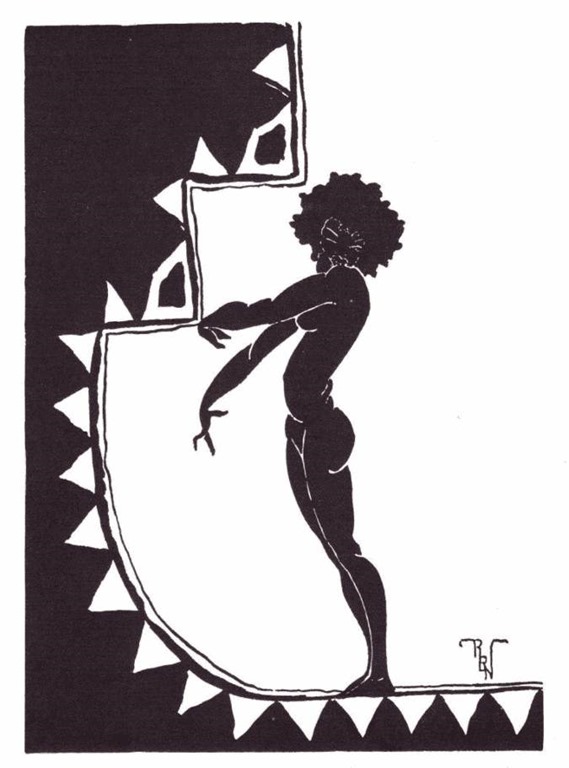
A drawing by Richard Bruce Nugent from Fire!!
.
So, to teach or discuss Fire!! and its creators beyond a surface is to go to places where teaching and learning is still constrained. I’d say to learners (a class that includes nearly all teachers) you may choose to go there even if traveling alone. Literature, music, the arts are the forged identity papers that let you cross borders. Though the writers of Fire!! are all dead, they won’t mind speaking with you.
In the spirit of gratitude to Afro-Americans and their vital contribution to American culture let me repost my Buzzfeed Fire!! contributor-like Gwendolyn Bennett’s summary in poetic “Song.” Graphical player below, or a backup player will open in a new tab link here.
.
*Here’s one web post by someone who taught school, doing a better job than I can today of discussing the queer aspects woven into the Harlem Renaissance. There is also this low-budget indie movie Brother to Brother made nearly a decade ago centering on Richard Bruce Nugent, Wallace Thurman, and the non-straight circle that organized Fire!! The film has some PG13 level sex scenes and self-violence. I found it available for rental from the usual online sources like Apple TV or Amazon Prime.
Returning to the poems published in the 1926 issue of Fire!! magazine which proclaimed it was “Devoted to Younger Negro Artists,” we get this simple seeming, yet mysterious poem by one of Fire’s most famous contributors and organizers: the then 25-year-old Langston Hughes.
“Railroad Avenue” looks like a simple free-verse street-scene vignette. Here’s a link to the text of the poem if you’d like to follow along. Yet the more I looked to understand it, the deeper the mystery of it became.
Here are a few things that seem quite clear: it’s evening. There’s a street, likely named by the poem’s title. A few things are seen or heard: lights in two businesses, a boxcar, a record player, a player piano, a boy and a girl, laughter. Largely unremarkable things, so there’s some specific character given to them.
The record player is a Victrola, a short-lived brand from the early 20th century — for example, the ones with the big conical horn as in the original RCA Victor logo. The businesses are a pool hall and a restaurant serving fish. The boy is at leisure, comfortable. The girl has a dark face that is powdered.* In what may be internal monologue the poem’s narrator gives us the winning number in the day’s policy game.**
So, are we clearly visualizing the place being described? At first I thought I could. I figured without evidence that this was a crowded urban nightlife street, the two other people only examples of many, the sounds and things part of what could have been a larger catalog. Is that reading possible? Two things mentioned that are likely heard not seen: the player piano (reasonably loud) and the Victrola, which would not be. Victrolas were not electric record players. The records turned via clockwork, the sound was produced acoustically from the grooves in the records. So, it’s not blaring out a window over robust street sounds. If the statement on the winning daily number 942 is audible rather than the interior thoughts of our narrator, it too would likely be at a conversational level (given no indication that the speaker/thinker won).
And then there’s that boxcar. Mentioned twice, Hughes really wants us to see that there’s this boxcar there, yet says nothing about it other than also saying twice that it’s forgotten. What’s that mean? A boxcar is a freight train car. This is not an urban light rail or passenger train line being invoked. Who forgets a boxcar? Is it just one piece of rolling stock left off somewhere as a spare or scrap? While the poem doesn’t say this, I began seeing it as part of a train on a grade-level street crossing, with the boxcar’s location blocking the road, a location so that it has to be mentioned, can’t be ignored. Did Hughes see this clearly in his mind and forgot to make it plain in his poem, or am I imagining things?
This vision invoked in me of a small town to small city location where the freight train line runs on grade-level, not on bridges over the roads or in tunnels under them, let me begin to see this as a much sleepier street. This isn’t the busy streetlight and neon Harlem of Hughes’ Harlem Renaissance. The dusk is “dark,” the street quiet enough to hear things distinctly as the evening begins. As the poem reaches a crescendo portion, it’s laughter we hear. It’s “sudden,” indicating that it startles the relative quiet and is not muffled by it. Hughes metaphorically amplifies that laughter with repetition — stating that this laughter with its transport from the ordinary and unenergetic street is able to shake the shop lights and move billiard balls.
This is a poem published by a 25-year-old, but I get a sense this may well be a memory of an even more youthful time with daylight ending, with sounds and a scattered glow from remembered lit windows. Dusk is a marking time for many young people, between the era when it says “time to go home” spanning to the age of “time to first go out and explore your nighttime world of romance and adult recreation.” I wondered, would the poem have more context if I knew where the poem’s titular Railroad Avenue is? America has lots of Railroad Avenues and streets, so the name alone tells us little, other than this isn’t a boxcar dropped off miles from a rail line.
A Google Streetview showing the intersection of a main Joplin MO street now renamed for Langston Hughes with Railroad Ave. Google’s camera vehicles didn’t drive & record down the gravel path that is Railroad Avenue right beside the train tracks.
.
I spent half a day trying to figure out where such a street might be in the places the young Hughes was known to have lived. I’ll summarize the candidates as briefly as I can. He was born in Joplin Missouri, and there’s a very good Railroad Avenue there, with everything you might want for this less-populated scene — though the Afro-American population at the time Hughes’ family lived there was low. But Hughes and his parents left Joplin when Hughes was around 1-2 years old, and there’s nothing I could find saying anyone went back. And was Joplin even big enough and ethnic enough for a numbers game? Hughes spent his grade-school years in Lawrence Kansas being raised by his grandmother. Yes, there were some Black neighborhoods,*** but no likely Railroad Avenue. He spent time at Howard University in Washington D. C. There’s a Railroad Avenue in that city, but it’s far from Howard, and seems to be (and likely was) a non-descript industrial area. Afro-American Howard students might spend evenings on U street circa 1920, but like Harlem in that era, it’d be lit and busy, and no likely boxcars there. Hughes attended Lincoln University in Pennsylvania, and once more I thought I might have a chance. Not as urban circa 1920 — but then no Railroad Avenue, not even a railroad line for more than 15 miles that I could find. And even if he’s a famous figure from the Harlem Renaissance, Hughes’ Harlem is as unlikely for a sleepy dark dusk with a grade-level railroad line as Washington D. C.
Is Railroad Avenue just something Hughes made up? Is it someone else’s story, something he absorbed from a friend, or his mother or grandmother? Did he go back and visit his birthplace Joplin before 1926 and observe a relaxed scene somewhere on that gravel-surface Railroad Avenue? I’ll probably never know.
But what’s up with that boxcar? Why is it so important, and so specifically forgotten? As a short, Modernist free verse poem, we can think: “So much depends/upon/the boxcar/serenaded by a/Victrola/beside a purple/powdered girl.” One theory: the boxcar is a plausible hobo-ride escape out of the town, but our narrator either doesn’t want to leave, or doesn’t know if the train-car is soon going his way. Within a year Hughes published another poem “Homesick Blues” written more in Southern Black dialect about someone looking to hobo back south.**** Another theory? If, as I imagined without direct evidence, the train has stopped and the boxcar is blocking the road, it’s a symbol of systematic blockage of the people in the scene. Whoever owns/controls the boxcar doesn’t even need to care about this (it’s “forgotten”) — and meanwhile the laughter of the folks in the scene mitigates their lives as they deal with this unfair, indifferent, hindrance.
I’ll conclude by admitting I composed the music and performed Langston Hughes’ “Railroad Avenue” without knowing exactly what the poem was about. I did have my supposed internal vision while doing so: it’s a small non-urban place, like some in Hughes’ youth. A boy or young man is watching the grownups, thinking without even thinking much, about where he might go, what he might do as he grows up. He knows somehow this, and he, will go away — but this evening he’s there. That personal, practical, vision of mine is, as Hughes has it, “Neither truth nor lie.”
*This line is the only one that specifically calls out the racial caste situation in the poem. Powders to lighten the skin tone of darker skinned Afro-Americans were a common cosmetic in Hughes’ time.
**Number or Policy lottery games were present in cities by the time of this poem. The illegal gambling game was usually a daily low-cost bet, winners determined by some coincidental trio of numbers that could be found published daily in newspapers. While associated with Afro-Americans, it was played by other ethnicities too. I don’t know much about its plausible presence in smaller cities and towns before 1926, though Wikipedia says such games go back to Civil War times.
***During the mid-19th century violence of the “Bloody Kansas” struggle to decide if Kansas would be admitted to the union as a slave or free state the pro-slavery forces sacked and destroyed Lawrence more than once. John Brown became a leader of guerilla anti-slavery forces in Kansas, and Hughes’ grandmother, who largely raised him, had a first husband who was killed with Brown at Harper’s Ferry.
****Example that Hughes was comfortable writing either as a collective noun or in the voices of personas.
I said I’d return to our encounter with the 1926 Harlem Renaissance issue of Fire!! magazine — and here we are with another poem that was printed there. If you’ll remember from earlier this Black History Month, Fire!! was largely organized, written, and edited by young people under the age of 25, and as such it wanted to represent a generational change from the curators of anthologies like James Weldon Johnson’s 1922 The Book of American Negro Poetry or Alain Locke’s The New Negro of 1925. There’s more emphasis on free verse in the poetry section for example, and throughout the issue there’s less attention to propriety. Though only a year separates Fire!! from The New Negro,long-time readers here may recall that Locke’s book included an essay on Black music casting a suspicious eye on what the essayist cast as frivolous Jazz music — and Blues, as a vocal music depicting a lot of disreputable situations, wasn’t considered an art at all.
The cohort of Fire!! didn’t share that outlook. If anything, they wanted to make sure they touched on unconventional thoughts and affinities. And here’s something we now think we know about the young writers in Fire!! — a substantial portion were gay or bisexual. Afro-Americans in the 1920s were coming out as full-fledged contributors to all the public arts — would that other status, fully-illegal and disrespected, muddy the waters of “racial uplift?”
Today’s piece uses a poem by a lesser-known contributor in this issue of Fire!!, Waring Cuney. Like Helene Johnson, who you may have been introduced to earlier this February, Cuney deserves to be better-known. While not directly part of the Harlem scene, Cuney was friends with Langston Hughes, one of the chief instigators of Fire!!, and like Hughes he was a young man who was comfortable with the language and outlook of the Blues.
I can’t seem to find a picture of the young William Waring Cuney, but here he is later in life modeling modern vinyl hipsterism.
.
Today’s set of words, Cuney’s poem “The Death Bed” doesn’t use Blues forms directly, but I’ve already been working with some other Cuney poems that do for possible performance, so I decided that I could include some of that today. “The Death Bed” is a poem about a dying man who doesn’t seem very interested in his family’s consolations of religion. While getting religion as death approaches is a common trope, our dying man quickly tells his relatives there’s no need for prayer. The relatives leave for another room, and instead of the purposeful theology of public prayer, our protagonist listens to the enigmatic wind. For one moment he tries to join the windsong with his own song, but finds he can find no words. If windsong is nature (likely) or the paraclete (possible), our dying man cannot form his response.
The poem ends with the dying man concerned with what the relatives in the other room are praying. Are they seeking to intercede for the non-believer? Or might they think he needs to be cleansed of some evil — maybe they are even praying to be protected from the sins this sinner personifies?
Cuney’s poem as it appeared in Fire!!
.
In my performance I sought to open-up intimations of another possibility via music. The Godhead or the universe may not require intercession or last-minute prayers. I made a rare choice to use a conventional musical sample* for this performance. The slide guitar you hear in the main body of “The Death Bed” is taken from a 1927 recording “Jesus Make Up my Dying Bed” by gospel/blues guitarist and singer Blind Willie Johnson. While many guitarists think Johnson’s sound and distinctive slide-vibrato is unmatchable, one could suppose I could have tried to approximate it. However, I was taken with the romantic notion of combining this 1926 poem with a slice of music recorded around the same time. I then included a short coda with a sung variation of this song.** The rest of the music was made with percussion and the sound of bowed cymbals. You can play this performance of Waring Cuney’s “The Death Bed” with a graphical player below. No player to see? This highlighted link is a backup method to play it.
.
*Portions of modern popular and art music intentionally use collaged and looped sections of existing recordings. I tend to avoid that for whatever reason, generally choosing to play or electronically “score” my instruments.
**The performers in that short coda are Fred and Annie McDowell. Fred McDowell is another master of the bottleneck slide guitar.
As we continue our 2023 Black History Month encounter with the young Harlem New York based writers in the 1926 issue of Fire!! we reach a much less familiar name: Helene Johnson. Our lead-off poet Countee Cullen was a mere 3 years older than the 20-year-old Johnson when Fire!! was published, but Cullen had already published two books and had two more in the works. Johnson had published mostly though successful writing contest entries. In the upcoming year she’d publish a poem in Vanity Fair. And then? Well, not much.
None-the-less, her poem in Fire!! “A Southern Road” is as strong as any included. I’m going to try to be brief in discussing the poem’s craft — though the poem exhibits those skills — because discussions of meter and imagery against the poem’s subject seem disproportionate to my heart’s response. And let me be clear at the start of this discussion: “A Southern Road” is a lynching poem, and in the last decade called The Twenties most Black American poets assayed a poem on the terroristic acts against Afro-Americans that were then an occurrence as common as mass shootings or questionable police killings are today.* And like those things we experience today, lynchings and other acts of anti-Black violence were both a cause for political organizing and an ongoing hurt that the country seemed incapable of correcting. Let that sink in for cause of sorrow and information: around 100 years ago, in the lifetime of people in our lifetimes, it was considered an insolvable problem that American communities would torture, mutilate, and summarily execute fellow citizens as a public display of their power and the executed’s lack of it. Read that sentence again. Read it once more after that. This level of savagery was thought something that couldn’t be stopped, something inevitable.
Can I appropriately introduce an odd sort of hope into this horrendous history? Yes, the heart and head may be confused on that. Still, people, Black and white Americans, dealing with a nation that collectively thought this just had to continue, eventually made lynchings rare. There’s a long and likely necessary analysis on why this happened that would include how the same hatefulness mutates into new forms, I won’t get to that here. I’ll just say to our current, crucial, Greatest Generation (because, like the last given that name, they’ll have to be great) that pervasive “This can’t be changed. Any solution would be ineffective and worse than the disease” statements about present horrors can be reflexes not reflective of history.
As the poem appeared in Fire!! The Internet has some mistranscriptions likely due to OCR errors.
.
Did Johnson’s poem make this change come about? No, it’s not even well-known as a poem— not even well-known as an African-American Harlem Renaissance poem — but poetry works in each reader and listener, one-by-one. A little over a decade later Abel Meeropol’s song “Strange Fruit” was powerfully realized by Billie Holiday, but Johnson’s earlier work was similarly skillful in giving us a portrait of evil. Even more than “Strange Fruit,” “A Southern Road” is cast as a cold pastoral. “A Southern Road” opens with a somewhat specific yet mysterious image: a dry yellow tongue. A metaphoric rural clay road? A parched leaf? From the poem’s generalized title we don’t know. I think the following “little tune” image developed over the next few lines is birdsong, and our dry forest pastoral ends unexpectedly with a line “Pregnant with tears.”
Johnson’s next sentence spread over four lines is part of why I think the tune, a melody that is a “streaming line of beauty” is birdsong, as there’s a nest that’s been flung down by some indifferent god/fate, before the Sabbath. We are to worship that god? We are to puzzle at a beautiful song despite loss?
The poem’s final five lines have us reassessing the poem’s portion before them. Several antique words are used here, perhaps a conscious choice to make this horror that was contemporary to her time in a way more timeless and generalized. A tree is described as a “predella,” the platform of an alter. We can next tell that the metaphoric altarpiece in this case depicts a crucifixion of a kind, a lynched person. “Sacrificial dower to raff” is near-Chaucerian in language. “Dower” is the inheritance of a dead person, raff is Middle English for rubbish, akin to the slightly less out-dated term “riff-raff.” The sacrificed body does not seem like much of an inheritance, any more that Christ on the cross seems much like a godhead, but I think Johnson is using raff/riff-raff in this line also to refer to the lynchers and their hate’s inheritance.
The poem ends with the tortured body suspended in the air, which I believe the poem compares to a plausible reader’s opinion on this matter: suspended?
There, I said I would keep my account of how we might encounter and understand this poem’s craft brief. I’ve compared “A Southern Road” above to “Strange Fruit,” and so I took it as my job to give Helene Johnson’s poem some further equivalence, albeit with what I could create for music and with a less masterful singer. I needed to put the music together fairly quickly again, but despite having three guitars and an electric piano over the bass and drums it worked spontaneously, as it needed to. You can hear it with the player you may see below, or with this alternative highlighted link.
.
*There’s a figure easily found in web searches that more than a thousand lynchings occurred between 1900 and 1914. The later year 1919 (not included in that selection of years) was notorious for white riots and other forms of violence. US population at the time of today’s poem was roughly 1/3 of what it is today if you’d like to adjust figures. It’s plausible that numbers were not easily gathered for other years — after all, in our century there were no figures on the number of people killed in police encounters until recently. And anyway, technical arguments about collection and accuracy of numbers, like metrical scans of this poem’s lines don’t get at the overall effect of this: that people are going to terrorize and kill you and not enough are going to care about it.







 Frank Hudson