Meeting Music and Words; a personal history. Chapter 4 “Dialogues of the Zappalites”

OK, it’s time for my Frank Zappa story. I’ve told this story a few times, but it’s appropriate that I tell it here as part of this series where I discuss the ways the Parlando Project’s meshing of poetry and music became an idea, and  an idea I could implement. This post will be exactly as short as I can make it in order to move the story from Francis Poulenc to Frank Zappa.

Last time in this series you met Dave Moore and Jim Scanlon. During the year the three of us were all at this small college south of Des Moines in Iowa, we worked on an “underground newspaper” called The Gadfly that Dave and his partner ran. The content consisted of a mix of things, often with a strong satirical streak, commenting on politics, culture, and music. The capsule overview younger people of later generations get of The Sixties* is that every white young American was a hippie, everyone had long hair, and we all lived in bohemian haze coincidentally stoned and angry at political situations and injustices. The reality, as I saw it in Iowa then, was that 1968 was not that different from 1961. One common complaint reflected in The Gadfly  was that the problem wasn’t just The Establishment, it was also our own cohort (at least the ones we were living among) who seemed mired in apathy. We thought new ideas and some ridicule of the old order might change that. Were we, and others like us elsewhere, slowly changing things? Observations differ.

Then came the spring of 1970, when for a brief moment the political activism spirit seemed to change in the matter of a couple of days.

My friends Dave Moore and Jim Scanlon had left for another college in the fall of 1969, Beloit in Wisconsin, where they hoped they would get a better education and find a more responsive group of students. I remained at the small college in Iowa where I had become the editor of the official school newspaper at a premature age. Over the school year, that responsibility slowly spiraled out of my control. I had no idea how to lead a group of people (still don’t). My working theory was to let them exercise their talents and see what happens.

Here’s what often happens under that scheme: many people will valorize what they think is their talent, then not actually exercise it. What will some conclude from that? That they must be restricted yet, somehow — that the actuality that they can’t deliver must be due to outside forces. For those, any extra degree of freedom doesn’t free them, it exposes them.

If you’re considering that carefully, you may wonder, is that what I was suffering from as well? I’d been given this opportunity/responsibility after all. Was I ducking it? Was I not taking advantage of it? I will say this: I wasn’t blaming outside forces, I was blaming myself. The romantic me wanted to see others blossom. The romantic me thought that blossoming was a natural process. Like an inconstant gardener, I was looking at a lot of failed plantings.

Then the spring of 1970 arrived, and with it the shootings at Kent State University, shortly followed by further deaths at Jackson State in the context of the now official expansion**  of the Vietnam war into neighboring countries. This led to an extraordinary expansion of activism on college campuses around the country. I was frankly surprised at the speed and the rapid spread of the college student response, even after the shootings. There had been for at least a couple of years an eminent fear among the young men regarding the draft risk, which while it had helped fuel the anti-Vietnam War efforts, it hadn’t engendered this level of response. Tens of thousands of Americans, our generational contemporaries, had died in the combat, and that’s just considering “our side.”  Activists being shot or killed wasn’t new either. Activists knew all this. I knew this. What had I discounted was that the Kent State shootings were at a very ordinary midwestern university, that dead included non-activists who just happened to be between classes, and that the dead included women.***  Across the country hundreds of colleges were shut down by a fast-rising wave of student activism, including my little Iowa college.

As quickly as the tide of activism rose up, the wave subsided. Our college-based headquarters and its plans for increasing political pressure to end the war depopulated as students returned to home or summer jobs. Eventually it was a few people in an apartment on the town square, lieutenants without any troops.**** I left for New York in an adventure I don’t have time to recount today.

Returning that fall, I was living in a sort-of-commune in the college town, without any funds to attend college, trying to figure out what I should do. Not only didn’t I know that, I didn’t have any idea how I would know that. That’s when I heard that Frank Zappa was going to play at Beloit, at the college my friends had left for over a year before.

I probably heard this news by reading it in a letter. Yes, younger readers today, there was no other way. There was no Internet. There wasn’t even timely press coverage of national tour dates, everything being done through local promoters and short-lived rock concert halls. Phone calls beyond your city were “long distance,” charged by the minute and too costly to use for entertainment gossip. I found out in 1970 the same way as someone would have exchanged this information in 1870.

My interest in Zappa had grown over the two years since I’d first heard Zappa’s Mothers of Invention on recordings. I didn’t realize it fully, but wider music listening and observing Don Williams’ ability to construct music on the fly was mixed with another rare thing my small college supplied me. This little college 20 miles south of Des Moines, with enrollment of barely a thousand students, had a burgeoning opera program. Opera of course is — what does it say up at the top of this blog? — a place where music and words meet. The opera curriculum would grow over the years, but at this time the program was still emerging. The theater used for performances (also the site of some of my classes) was a small old building, with seating for a few hundred. I’ll summarize one part of my experience in this: to see opera sung in a grand opera hall, with elaborate sets and pricey tickets, with a complete orchestra, is a very, well, operatic  way to view the realization of that art. All art is artifice, sure, but the human connection to me in those situations is stilted. Not so, opera sitting a few yards away from another person singing it, perhaps even a person your own young age who you might see in your classes or on campus. That’s another experience, far rarer.

You have not likely seen that impact reflected on my adult life, or on the Parlando Project that you know here. For one thing, my voice is not operatic, it’s barely a singing voice. Yet I can write this today, that I remember seeing for one exact example, a performance of Poulenc’s Dialogues of the Carmelites,  and being carried away about what performed music, voice, and words could do in that small space. It may have helped that this opera makes an extensive use of recitative.

Listening to Rock music in my daily life then in The Sixties, it occurred to me, who in Rock could bring something to opera? Besides the differences in the use of the voice, or the nature of projecting character as opposed to ones seemingly authentic personal voice, there was the problem of extending the instrumental colors. My thought-answers then? Jim Morrison, who had performed a bit of Brecht/Weill on the first Doors album, and Frank Zappa, who claimed the ability to be “a composer,” and was even allowed to demonstrate that he could compose for larger ensembles including orchestral instruments.*****

That I could consider that was consistent with Zappa’s brand then. In those early, heady days of Rock Criticism, it was a given that Zappa was a genius. He wasn’t the sort of musical act that many people listened to with addictive, ear-worm pleasure, sure, but still a genius. Well, there were those smutty lyrics, and an assumed swimming pool of contributory drugs, but still a genius. It was The Sixties, we assumed impossible things could happen, but we still felt genius was rare and worthy of note.

So, a chance to see this genius in a live concert, this artist whose recordings had opened up other considerations for me, couldn’t be missed. I drove there, 300 miles, with other share-the-gas people in a Fiat 1100D.
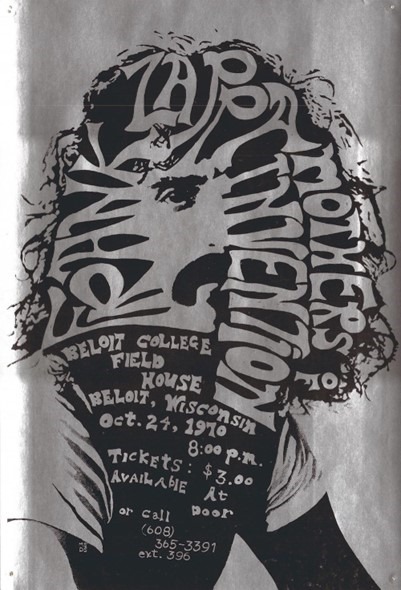
Zappa at Beloit concert poster

Cost of the concert? $3. An amount similar to my portion of the share-the-gas cost too.

.

The concert? Not life-changing. The acoustics in the fieldhouse hall were atrocious, and our seats were in the galleries far from the stage. The music was good, but with the sound bouncing around and the typical poor vocal PA of the time, the result was a mixed pleasure.

We got back in the little car to head back to Iowa. Finding our way through the unfamiliar streets we saw another car occupied with hair as long as ours inside. That car contained some young women. For some reason they wanted to share with the fellow freaky-looking folks that they knew the hotel where Frank Zappa was staying and that they’d been invited to visit him.

Of course we believed them. Of course we followed them. What did we assume was to happen there? Some sex, drugs, and rock’n’roll orgy? I’d just turned 20. I didn’t know what I was going to do with my life, or how I’d figure that out. So, why would I worry about might happen for the rest of some single night in October?

When we arrived, the bunch of us from the two cars, maybe 8 or 9 people, spread out around the non-descript motel room. A couple members of the band were checking in with Zappa. There was a short discussion at the doorway between Zappa and George Duke about what Duke had played at the concert, which got approval from Zappa. The band that night, though billed as the Mothers, was new, containing vocalists who had once been part of the pop band The Turtles, now billed as “Flo and Eddie.”  One of the young women from the other car bounced on one of the beds. Most of us seemed like me, passive, waiting for something to happen. Zappa turned his attention to us, asked us what we’d thought about the concert. There was some short discussion. I think I may have mentioned that a lot of the material seemed new. Best as I can remember, that was accurate. Zappa replied that they were doing some of the old stuff too. Memories fail, but I believe “Concentration Moon”  was replied as one of the veteran numbers. The male part of the room had some hard-core Zappa fans, who started to geekout on questions about the band’s history. I recall one asking about Doug Moon who had played with early versions of Captain Beefheart’s Magic Band. Were they trying to impress the genius with their knowledge, even in the midwest, of the places Zappa had come from? Zappa replied Doug was some guy who’d worked at a gas station. Zappa was patient about the questions, however trivial. At one point he took out a movie camera and filmed us in the room. I remember he moved in close to my face as I was missing one bow on my eyeglasses after that part had broken, and I had no funds to fix or replace the frames yet.

Here’s a few things Zappa conveyed to us in the roughly hour that I, and maybe others in the room, didn’t know before meeting him.

When asked about his doo-wop music parodies, including the Cruising with Rueben and the Jets  LP,  he corrected us that he liked that music. He spoke about Fifties R&B records he was inspired by. Since the lyrics in those songs were satiric, I’d assumed the music was also something he held in contempt. Far from it, he lit up talking about this. In The Sixties there was a widespread critical assumption that good music was “progressive,” meaning that we were to drive our plows over the bones of the dead, so this was news to us.

He nonchalantly corrected any impression that he was inspired by drugs. How he did this without sounding like a “Listen kids…” PSA I can’t exactly recall.

He seemed genuinely interested in us, and what we thought about the music — though at times, such as when he wielded the camera, the idea that we were natives and Zappa was an anthropologist occurred.

For me, the important thing happened near the end of our time in the room with this “…But, a genius” guy. I asked him how much of the show was improvised and how much was composed. He went over to the side of the room and picked up an oversized portfolio. Opening it, he showed it to me. Multiple staves of music, a rather full score as I recall. Dialogue written out, seemingly informal and back and forth, as if the band members were speaking off the cuff. In retrospect, I believe I was looking at scores for 200 Motels which would be filmed a few months later with a full orchestra. As he showed me this, he talked briefly about the effort he put into it, which the score showed. I was immediately impressed with the formality of the effort to achieve what seemed like chance informality. There must have been some serious seat-time in getting that done. The intent of it!

Imagine instead if I had somehow visited the hotel room of Jim Morrison in 1970. Perhaps my romantic notions of the creation of art would have gathered more poète maudit forces. Did something in my subconscious connect what Frank Zappa conveyed that night with William Blake, who when not out talking with the visions of angels, was innovating printmaking techniques and making books with his own skills?

After that significant side-trip, we left the room and returned to Iowa. If you’d asked me that day, I still didn’t know what I wanted to do with my life — not a whit more — but what I did have was a piece of information, and an outlook. From that night I could remember that doing  was a large part of doing something with your life.

This is already a double-length post, so enough for today. To tip my hat to Mr. Zappa, here’s the LYL Band roughly approximating one of his later tunes in a we’ll-give-it-a-go live performance.

We flattened Zappa’s music and arrangement here, but as the video points out, if Zappa were performing this song today he’d be sure to include more screens than just TV.

.

*This oversimplification is more accurate about youth in The Seventies than the Sixties, even the final three years of The Sixties. In terms of clothes and hair, look at a range of contemporary photographs and film from the actual Sixties. Beards and long hair will be sparse on the young men, not movie wardrobe department common. Yes, use of marijuana and other drugs increased during the last half of The Sixties from a very in-group secrecy thing to a sizable minority, but in doing so it lost a bit of its bohemian rhapsodic connotations and became just another illegal high like drinking alcohol before the age of 21 had previously been. Real “counter-culture” bohemianism in an artistic sense had grown from the beatnik Fifties — maybe even doubled or tripled — but was still something a single digit percentage of people engaged in with any seriousness.

**In reality, this regional expansion of the conflict had been going on by proxy and by secrecy for a long time — but in the run up to the Kent State shootings it had become stated policy, driving hard-to-escape fears that there were now going to be additional para-Vietnam Wars.

***This is a complex point, one I need to leave off too briefly. Women of course were involved in anti-war activity before Kent State, but it occurs to me that this small factor may have been more important than recognized in adding to the explosion of activism in the spring of 1970. In case you’re wondering: yes, the anti-Vietnam war organizations, like the counter-culture, weren’t significantly less patriarchal than the rest of Sixties society — and though it may rankle some, I’ll add this as well: the victims at Kent State were also white.

****Any reading this who participated in Occupy Wall Street or the Black Lives Matter activism of this century may have a moment of recognition here. The emotional high of sensing that something is finally being said loud enough, that mass pressure is finally being brought by an unprecedented number of people is shared from this time. The emotions following, when such movements crest and seem to dissipate, need to be considered too. Here’s one piece of wisdom from someone else from this time worth listening to.

*****Will some Classic Rock oldster reading this think “Well, Rock Opera, what about the Who’s Tommy?” Tommy had yet to be released.

Vonnegut and Veteran’s Day, or The Children’s Crusade

Even before I was interested much in literature, I developed a love for history. Today’s Veteran’s Day post will only briefly touch on literature, and instead offer a slice of history. Older readers may think they know all this, or know it better than what I’ll write today. Some younger readers won’t care, but perhaps a few will learn something they didn’t read or hear elsewhere. As with any short piece, I’m going to need to leave out many things. While this post was not written intending to be a puzzle, I noticed that one thing was left out of this Veteran’s Day post. By that I don’t mean some opinion or judgement, or even some biographic item — I mean a particular significant historical Veteran’s Day fact that I expect few will notice is missing. When I reveal it late in the post, I’m also thinking you’ll take that elision as something to consider.

So, a bit over 50 years ago there was a war going on, the Vietnam War. The way it was presented then: our great geo-political rival had invaded another country and we were morally obligated to resist that aggression. This doesn’t seem to have been the case, at least not in any way that could be simplified as such. Another summary would be that Vietnam had invaded Vietnam, as it had been doing since the days of WWII, seeking to become an independent country. In the course of things, they succeeded, and now are one of those more or less unremarkable governments around the world that may be good or bad to their citizens in some mixture that we don’t generally concern ourselves with.

This obligation eventually led to a considerable number of American troops fighting in South-East Asia, but luckily the post WWII Baby Boom had raised a bumper crop of what were considered prime fighting age 20-year-olds. I was one of them. Even though this was a war, there were only so many troops that could be used. The amounts that could be used were filled to a significant degree by draftees, young people conscripted (other words: forced, obligated, duty-bound) to serve in the military, and since there was a war going on, some percentage of those draftees would be asked to kill other people or to be killed themselves.

To a surprising extent, this was not remarkable then. I can imagine how many living adults now find that odd, what with present controversies about wearing cloth masks and getting vaccinations — as not only were these conscripted men plausibly in for the kill/killed experience, they were also vaccinated forthwith and forced to wear entire uniforms. And yes, in certain training situations they were instructed in how to put on masks.

I can say that as a teenager in that crop of draft-age men then, I thought about this, and remarked on it. Others in my cohort did too. But there were whole days when one didn’t think about it, and instead thought about sex, fun, school deadlines, the price of a pizza, the general meaning of life and what that meant for you personally, and so on and so on. Still, it was an issue considered by the young.

But no, in general the adult country was fine with this, and even to observable empirical level it was not the biggest deal for a lot of my immediate cohort. You see, I was in college, a small one in a not very big town in Iowa, and because only a certain number of troops were needed, college students were given “deferments.” They didn’t need to serve while in school, and if this was a political post one could get into why that might be so. I’ll also add that dropping out of school, or failing out, or being short of tuition funds, or just deciding to take a gap year — those things would make the draft imminent for a college student — but for college 20-year-old men it wasn’t a next Thursday kind of worry, though it could be a next year one.

Now I and a few of my friends did think this was a bad thing, the war, the draft — oh, and a lot of other stuff: racism, what recreational drugs were legal, female students having “hours” where they had to be back in dorms by a certain time each night. The “we should do something about this” group was probably around 5% of the student body at my college in 1968.

Then in the spring of 1970 something happened that surprised me. The President made public (as if it was a new decision rather than a more substantial incursion that couldn’t be kept secret) that US troops were going to invade countries next to Vietnam. To those who had been paying less attention, this seemed a sign that this was maybe going to be around a lot longer, like past graduation, with more draftees needed. Opposition to the war on college campuses had been growing for about a year, and this gave it another bump, and on an obscure Ohio campus, Kent State, this boiled over (as it occasionally had elsewhere) into disorder and vandalism which wasn’t enough to cancel classes, but was enough for the National Guard to be sent in.

Something happened, likely a confused Guard squad, and the Guard opened fire, A bunch of students got shot, some were just walking between classes — because again, whatever disorder this was, classes were in session — four died.

Of course, I was appalled, but did that surprise me? Not greatly. Even in my youthful life there had been the drumbeat of the civil rights movement martyrs and assassinations of Presidents and Presidential candidates. In my crowd the fatal Chicago police shooting of Fred Hampton was considered duplicated multiple times against the Black Panthers. And in 1969 there had been a shooting death in the People’s Park confrontations.

Here’s what surprised me more. Not only around the country, but in my little Iowa college, much larger numbers of students thought something had to be done right now about this. One by one colleges and universities suspended normal operations and any number of alternative actions were taken that spring. This was called a strike. Here’s something little remarked on about male students choosing to do this for what was then an unknown duration in 1970: it could’ve led to them becoming subject to the draft.

Veterans Day 2021 2

There are no pictures available of my 1970 memories, so the guy on the left will have to stand in. The statue on the right is a clue to this post’s subsidiary riddle. The Nov. 11th born veteran Vonnegut tried to speak between generations.

.

Ad hoc organization coalesced at my school and as I recall the one concrete action to “really do something” was to try to garner support for a federal bill that would restrict funding or expansion or authorization or some other matter regarding the war in SE Asia. The bill had been co-sponsored, or co-authored, or supported by one of Iowa’s Senators, Harold Hughes.*

Let me stop for a moment and get to a reason I’m writing this on a Veteran’s Day. Sometime, maybe a generation after these events, it became a commonplace that Vietnam war opponents, or college students, or hippies, or leftists, or some Sixties group hated soldiers in general. “In general” is a dodgy term, but I think it’s meaningful in this matter. I spent time with all those supposed soldier-hating groups, in both Iowa and New York (two fairly unlike places), and I never heard anything like that, not once. And it would have seemed so odd to me personally, that if I had heard it, I think I would have remembered it. And it wasn’t reticence or propriety that would have masked those feelings. Expressions against police were so common that I couldn’t count them then, much less now. And fairly soon, as early as 1971, I was running into ex-Vietnam era soldiers who could be put in those loosely defined groups above themselves.**

Back to working with this newly motivated group of Iowa college students who naively thought they had to do something right now about this expanding war. We were going to go door-to-door asking for folks to write letters in support of this bill. Now who takes point walking on a patrol, or even boring days painting what doesn’t move, or for that matter being under a napalm attack — this isn’t on that order (well, maybe the middle one is a little), but for some reason, I have memories of the few days I did this before leaving for New York. I believe now what we were doing was essentially meaningless, if the best we could come up with at the time.

In our door-knocking in town we might run into what was later called “The Greatest Generation.” Most said little to our spiel, but a couple of them, men, wanted to set us straight as to what we didn’t understand. Well, even then I suspected there were things I didn’t know, and now I can drop the suspected and replace it with certainty. The one I remember most vividly responded with a statement that I didn’t know what it was like to watch your buddies die.

I try to replay him saying that through the fog of the years. Although there was anger in it, I think it was a sincere personal statement. I often think since of what did that statement, however incongruous, mean? Did he mean that I should watch my buddies die? That that would be enlightening, educational? I don’t think so, no more than it was his considered opinion that such an experience had been worthwhile or ennobling for him. What he meant, putting my most empathetic interpretation on it, was that a certain sacrifice and commitment added something to one’s opinion on national matters.

More broadly though, his generational experience was why there was not a great deal of concern then, other than a slowly growing one among those of draft age, for the idea that young men could be conscripted to possibly kill or be killed. The Greatest Generation had faced the same sacrifice, and so this was normalized, not even Great yet, unexceptional. In the case of WWII good wasn’t a question, necessary was the question.

In those times, some in my generation eagerly latched onto WWII veteran Kurt Vonnegut’s books (and Joseph Heller’s Catch 22  as well) to portray everything else around the necessary part of WWII. They were our cross-generational allies in seeing and saying that war needed extraordinary necessity. Vonnegut even wanted to connect us 20-year-olds with his Dresden POW book Slaughterhouse Five,  subtitling it “The Children’s Crusade”  which had been a nickname for the 1968 US Presidential campaigning by folks often too young to vote for anti-Vietnam-war candidates, and which he then applied to the 18-20 year old range of his WWII cohort.

OK, what Veteran’s Day historical event did this old man leave out of the above story, dealing as it did with differences and connections between men serving in the Vietnam War era and those who wanted to end that war, and between 20-year-olds and the WWII generation then in middle age? I completed an entire first draft and didn’t notice it myself. And I’m not alone. American Veteran’s Day stories in 1970 and up until now almost always leave it out. It’s the Korean War. As with WWII, few living veterans of that war are left now, but it occurs to me that the fervent man at the door in 1970 could easily have been a Korean War vet. And in historical analysis, that war had as much or more to do with the missteps of the Vietnam War as WWII.

The musical piece today is another song from birthday-boy Kurt Vonnegut’s novel “Cat’s Cradle” in which his trickster guru character Bokonon muses ontologically. You don’t have to look up the word to appreciate this little song. Player gadget below to hear it, and if you don’t see that, you can click this highlighted hyperlink.

.

*I knew all those details then, even if I don’t remember them now. Harold Hughes is a little-remembered figure these days. Capsule description of Hughes: imagine if Johnny Cash had been a governor and then a U. S. senator. As to the general student feeling, I think it was close to how some people felt in the post-George Floyd murder reaction. The watchword was “We’ve got to do something.”

**Some of you may find this striking, The precipitating event of the college strikes of 1970 after all was men in military uniforms shooting and killing students, In this era, various acts were taken against what was considered part of the recruitment and processing of soldiers: draft boards, recruitment offices, ROTC buildings, that sort of place. I can’t know everything, but I never heard any of this characterized as “let’s go get those soldiers” and was more at “let stop more from being conscripted as soldiers.” Given human nature someone somewhere in 1970 may have said or thought that, but speaking of my experience: war-fighting soldiers were what we young men at that point increasingly feared being forced to become. Opinions differ on the nobility of those thoughts then and now, but we might have thought of cops differently if we knew that folks like us, and potentially us ourselves, might be forced to put on a police uniform.

Inside Whales and Lofts, Part 1

Let me momentarily make this place act like a regular blog and remark on a few things I’ve run across trying to do — or avoid doing — new work. Warning: these are not necessarily mainstream things of interest to most people, even people who read blogs about various poetry combined with a variety of original music.

While not sleeping one night this week I ran into an essay masquerading as a book review written by George Orwell at the end of the 1930s: Inside the Whale.  As per the dangers of doomscrolling, it was not the right piece to run into while trying to fall back to sleep. It’s long, covers a bunch of ground, and since it is Orwell it contains a lot of pithy observations and things that incite one to consider not merely what Orwell believes, but what you, yourself believe.

It starts off reviewing a book by the American writer Henry Miller that was already several years old. Or rather, it makes motions like it’s going to take on that task. Orwell tells you little specifically about what’s in Miller’s book, and he speaks of it and it’s outlook in alternatively dismissive and “it’s better than some” statements. Orwell concludes that, whatever the book’s failures and omissions, that Miller’s novel has stuck with him, and that its subjective effects on a reader might be worthwhile.

Then a full-fledged essay breaks out: a meditation on the changes he observes in the literary scene from the 20s to the 30s of his 20th century. In doing so, Orwell also is quite subjective, compressing the wide range of these two important decades with broad characterizations, summations that have the virtue of vigor. Orwell’s overall judgement is the 20s were an explosion of free expression and expansion of subject matter, and then the following 30s had taken a wrong turn into political statements and advocacy. Orwell’s historical summary is one that others have made as well, and as with all such “spirit of the age” high-level views, it can be contradicted by considerable examples of those who didn’t follow the big titles over their decades.

In my middle of the night reading, I found this wrong-turn judgment odd. Writers who avoided political stances or opinions? Orwell would never have been on such a list! He’s remembered specifically as a life-long critic writing on political ideas and operations. This verging-on-hypocrisy stance, similar to pundits and any odd people with Internet access criticizing actors, artists, and writers for expressing political opinions,* can be made rational if one extracts from his argument the more distinct point he’s making: that the expressed political stances and opinions opposed are wrong and based on falsity. But within this essay that point seems less clear, it’s more about the demonstrated failure of that art-for-political-change effort in the 30s leading Orwell to suggest that it’s likely/arguably the better of limited choices to simply write about ordinary life in a way that avoids any evidence of political thinking.**

I’m around twice Orwell’s age when he wrote this essay, and to the glowing 21st century screen I was reading him on, I talked back to him that he had just discovered a universal truth I’ve written here several times: All Artists Fail. Betting odds calculated from a past performance tout-sheet are not a singular reason to not attempt something in art — the odds are always against success in art, that’s partly why we revere it.

Two small things in Orwell’s long essay remain for me to note. There’s an anecdote of Miller meeting Orwell as Orwell was about to embark on his sojourn into the Spanish Civil War. Miller, Orwell says, told him he was crazy to put himself in harm’s way, and then gives Orwell a warmer jacket better than the meager suitcoat he was wearing. That act, that tiny scene, is Orwell demonstrating his point that ordinary life closely observed may illuminate more than many grander political statements. And the other, more poetry related, has Orwell go on this short aside about the American poet Walt Whitman:

It is not certain that if Whitman himself were alive at this moment he would write anything in the least degree resembling Leaves of Grass.  For what he is saying, after all, is ‘I accept,’ and there is a radical difference between acceptance now and acceptance then. Whitman was writing in a time of unexampled prosperity, but more than that, he was writing in a country where freedom was something more than a word. The democracy, equality and comradeship that he is always talking about are not remote ideals, but something that existed in front of his eyes. In mid-nineteenth-century America men felt themselves free and equal, were  free and equal, so far as that is possible outside a society of pure communism. There was poverty and there were even class-distinctions, but except for the negros there was no permanently submerged class.”

Taken in — as we might well in our age — as statement to be evaluated from a woke (or waking) political outlook, this has so many howlers and hold-my-artisanal-higher-hops-content beverage potential Tweet-takes! Start with the “Leaves of Grass  are always greener on the other side” view of America in general. Thanks, I guess, for the “negros” exception that is altogether too large and horrible for a sub-clause. No mention of the state-side colonialism regarding indigenous peoples. And, wait a minute, women! Orwell’s “America men” freedom isn’t just accidental language-convention-gendering in historical context. I could go on, with anti-immigrant prejudices galore, and….

But. What Orwell is demonstrating here, intentionally or not, is that Whitman painted a plausible reality, containing vivid details of ordinary, mundane reality, of an America that supplanted those things, where open desire, freedom, and comradeship existed in plus and overplus. Did Whitman fool the wily Orwell into thinking that was actually, abundantly so in the years before and during an American bloodbath, or is Orwell suggesting, however inadvertently, what art can try to do, and while failing and retrying, help to accomplish?

e2cjqnp
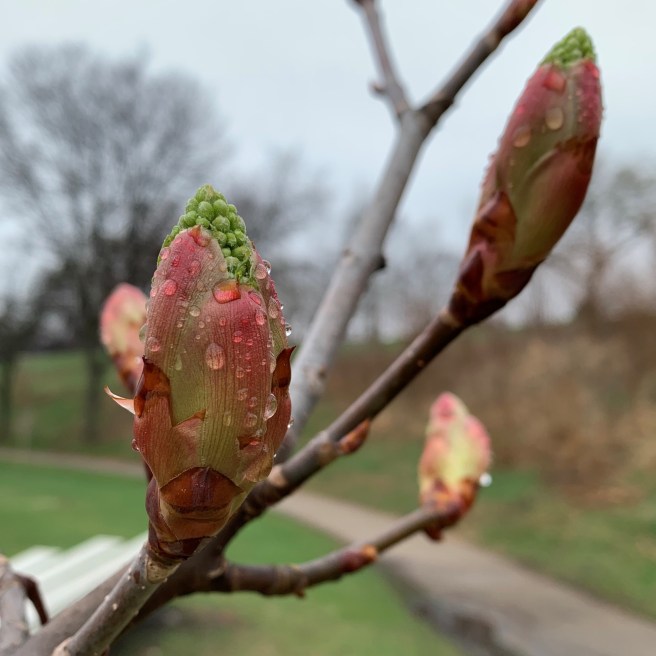
I sometimes misread the “darling buds of May” as the “daring buds of May.”  These seem so strange, so alien, as they emerge.

.

This is enough for a Part 1, but rest, and only later think about this: can your art spur on change — or rather, not just urge it on with the spur and the whip, but with the portrayal of where we must go in a hurry?

As to music, here’s another audio piece you may have missed, using a 1920 poem by German Anarchist writer Erich Mühsam that I translated into English. This post from last July tells what I learned about Mühsam’s life and that of his mentor who first published the poem, Gustav Landauer. In the post, there’s a Whitman connection. Player gadget below for some of you, or if you don’t see that, this highlighted hyperlinkwill play the audio piece.

.

*The hypocrisy of that is: the pundits most often have no more skin in the game in these matters than some artists; and that the ordinary Internet people, who often wish to self-proclaim their ordinariness, may have by definition no more expertise than another person whose job it is to observe and extract transmittable reality.

**Small, dear, peripheral, and personal aside here. Anaïs Nin was the writer specifically noted as existing inside the titular whale, Jonah-like, in the essay — and so, in Orwell’s judgement, then beneficially cut-off and protected from politically-charged writing. My late wife was once writing an article for a national “woman’s publication” on the cultural phenomenon of journaling, circa 1979. In a phone call discussing her sources for the article, her editor suggested she could setup an interview with Anaïs Nin. When the call ended, she and I had the writers vs. editors conspiratorial laugh over that unintentionally Ouija-level suggestion, as Nin was then two-years dead.

O honey-bees, come build in the empty house of the stare

I have my partisan convictions, you may have them too. And yes, our particular governmental and economic  institutions are imperfect instruments. Natural forces only partially in our control and as small as a virus and as large as a changing atmosphere are still arrayed against not just our nation, but our planet. Proud racial and ethnic caste systems divide our forces against these things.

How to be humble and not loose heart? How to rejoice if there are things to do? Well, I believe that without joy we cannot achieve any needed changes or maintain any necessary things—but there’s much I don’t know, and as with all the things I think or say, my beliefs and actions are less important than yours, particularly if you are younger than I am. Laugh at all that clap-trap about named generations with variant but supposedly sharp an defended borders and a fixed list of characteristics like some crummy astrological sign summary. You are, or you need to be, The Greatest Generation.

White House and the US Capitol

William Butler Yeats said about his country a century ago: O honey-bees/Come build in the empty house of the stare.
.

I hope to have new audio pieces with posts  in the next week, and there are lots of them already posted here. Here’s one of those older pieces you may not have heard yet, featuring the words, voice, and keyboard playing of Dave Moore titled “No Common Ground.”  The player gadget to hear it is below.

.

Election Day

I recall being on the shores of Lake Superior, North America’s great internal sea, on the morning of the last U. S. Presidential election, a day very early in the run of this Project. The lake and wind were calm, and I was out alone at dawn at a place where you could hear the water-lapped gravel stones at one part of the shore clinking against others.

I arose this morning at dawn in my diverse urban neighborhood and rode and old bicycle down to a low creek near the border of the city. That waterway is running low, exposing the ragged banks it used to wear. On the way back I picked up a take-out breakfast and rode past my voting place where I saw some of my fellow citizens entering and exiting to do what I had already done a few weeks ago.

I am ill at ease for my country, my family, and myself, something that accelerated throughout this year. I’ve read all the information, added to it all my speculations, but I have no source or way of knowing if that helps. It seems likely that my country’s fate will be decided in varied places across a continent, by a group of people I don’t know, by rank strangers like and unlike me.

We call that system democracy. Our republic filters and strains that democracy, weighs us unequally. There are days that call to mind diverted poet Winston Churchill’s famous line “Democracy is the worst form of government except for all those other forms that have been tried from time to time….” and other days were my mind’s ear hears singing poet Leonard Cohen*  intoning that “Democracy is coming (slight, sly, pause…) to the U.S.A.

Our Books

Books and votes and viruses and a world that weighs them with a right thumb in your eye and a left thumb on the scales. And you? Close your fist to protest. Open your fist to read, to vote, to grasp each others hand.

.

I know some come to this blog to find something other than politics and self-assertion, and others as a break or supplement to earnest efforts at those things. Readership and listening stats here have never been higher, even as many of you have no-doubt been as troubled as I have been this year, so I feel the call to leave you with something today. I have picked a text from a writer that I often turn to in troubles: Carl Sandburg. When I first presented this audio piece, I said that Sandburg had seen every evil and injustice I had seen, would not deny what he had seen, but still retained an embrace of humanity. So, I’ll give you a selection again from his “The People, the Mob”  for this election day. The player gadget should appear below.

.

*That Cohen died on the eve of that last U. S. Presidential election still seems like an epitaphic metaphor.

.

Lola Ridge’s Dream

It was those other Twenties, the last ones before ours. Some people are in the streets, angry and sad in every mixture, protesting lives that will taken away by force of law. Authors Katherine Anne Porter, John Dos Passos, Edna St. Vincent Millay*  are among them. Mounted police are before this ragged line of protestors who are sagging back from the horses of disaster.

Here’s Porter’s account** of a moment in that night, resurrected from her notes 50 years later for a magazine article:

One tall, thin figure of a woman stepped out alone, a good distance into the empty square, and when the police came down at her and the horse’s hoofs beat over her head, she did not move, but stood with her shoulders slightly bowed, entirely still. The charge was repeated again and again, but she was not to be driven away. A man near me said in horror, suddenly recognizing her, ‘That’s Lola Ridge!’ and dashed into the empty space toward her. Without any words or a moment’s pause, he simply seized her by the shoulders and walked her in front of him back to the edge of the crowd, where she stood as if she were half-conscious.”

That’s a remarkable story, one often recounted about Lola Ridge in our newer century, and it was my first introduction to the poet whose text I’ll present today. What might one think from this testimony about Lola Ridge? Brave, foolhardy, self-less, self-harming, committed, able to throw it all away?

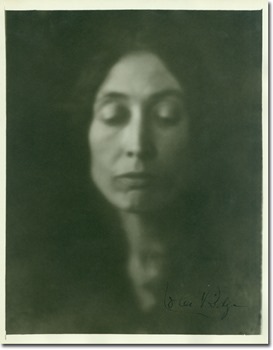
Lola Ridge 1

Perhaps as an aesthetic choice, Ridge never smiled in her photos.

Best as I can tell, she was all these things and more. Before this event she had been born in Dublin Ireland and her family had emigrated to New Zealand while she was a child. Eventually finding herself as a young woman in a bad marriage there she fled to Australia, took up poetry and visual art, emigrated once again to the United States, first landing in San Francisco, but proceeding to New York City and the Modernist and Anarchist ferment there around the time of WWI.

She was published by and was associated with the leading Modernist publications of her time, and her poetry was firmly in the free-verse and Imagist style, but with a significant commitment to portraying poverty and urban grit . Even among her co-revolutionaries in politics and the arts she stood out then by her austere commitment to these then somewhat intermingled causes.

It’s a complicated story about why you may not have heard of Ridge, but today you’ll get to hear one of her poems performed. Titled “The Dream,”  it’s easy to see it as an Imagist poem. Like so many of the Modernist movement poems it’s a charged, compressed moment told with images without a single overt statement of emotion. The uneven lines and unusual line breaks and the use of colors for adjectives are hallmarks of Imagism. The full text of “The Dream”  is linked here if you’d like to read along.

“The Dream”  was published in Ridge’s second book-length collection Sun Up in 1920, but I don’t know when it was written. It’s possible that it, or some version of it, might date back to her days in Australia, since Sydney harbor is mentioned. Following from its title, it can be taken as a somewhat apocalyptic or fantastic vision. Or you can take it as expression of a rough morning’s awaking. It’s also a word painting of an urban scene, and in that guise it seems to focus in on pollution. Indeed, part of it could pass for poetic reportage on the strange Australian and American skies this year after the massive forest fires.

Red Forest Fire Skies US and Australia 2020

“Air heavy…Vapor of opium…Sulphurous mist…Its sun the junk of red iron” skies after massive forest fires in the Western US and earlier this year in Australia.

I made do with a simple demo recording of the main vocal and acoustic guitar track for my presentation of “The Dream”  so that I’d have time to complete the string quartet part of two violas, a violin, and a ukulele bass faking a pizzicato cello part. Real string composers and players will note how simple my parts are for the quartet. I sometimes think of my string writing as “punk-rock orchestral,” in that I hope simplicity in my technique and conception brings a certain focus on the unfussy parts of music that might still have an impact on the listener. The player gadget to hear it should be below (unless you read this on the WordPress reader for the iPhone or iPad, in which case you’ll need to switch to a browser to hear the music, or subscribe to the audio pieces via Apple Podcasts).

.

*Millay wrote about the cause of this protest, the execution of two anarchist immigrants Sacco and Vanzetti, in this bitter poem presented here last October.

**There’s much more in a wider account of the protests and events surrounding this incident written by Porter in 1977 when she was 86 that can be read here.

The Angry Percy Bysshe Shelley: England 1819

My teenager asked me what I’m doing, overhearing me test-shouting the text of today’s piece Percy Bysshe Shelley’s “England 1819.”  Here’s a link to that text if you want to follow along.

“Shelley, the perfect English Romantic Poet, might have been the most radical poet of his time. In matters of sex, religion, politics, aesthetics and philosophy he was explicitly in opposition, and he was chased out of England for it. But still he was capable of being driven to a new level of outrage by events.”

“The ruined statue in the desert guy?”

“Yeah, that’s him. And some readers forget that as beautiful a poem as Ozymandias  is, that there’s real anger behind it—but you can’t miss the anger in this one.”

So, once more I’ll write today about the process of translation. Not from some other language to English, but from perfectly fine English and a past you may not know, to our time. “England 1819”  is 201 years old, and some superficial particularities could make it seem a little antique. It wasn’t so when it was written—and it just so happens that the rhymes of history may make some other specifics in the poem ring out to a reader or listener today.

What was it that set Shelley’s anger to a new heat point? In August 1819 a large meeting was planned by reformers in Manchester England. The organizers seemed to take care that it be a powerful but peaceful demonstration. Chief among the subjects of the event: the granting to ordinary people the ability to vote.* On the appointed day, tens of thousands turned out, including whole families. Many were dressed in their “Sunday best” to hear speakers in St. Peter’s field, an open space in Manchester.

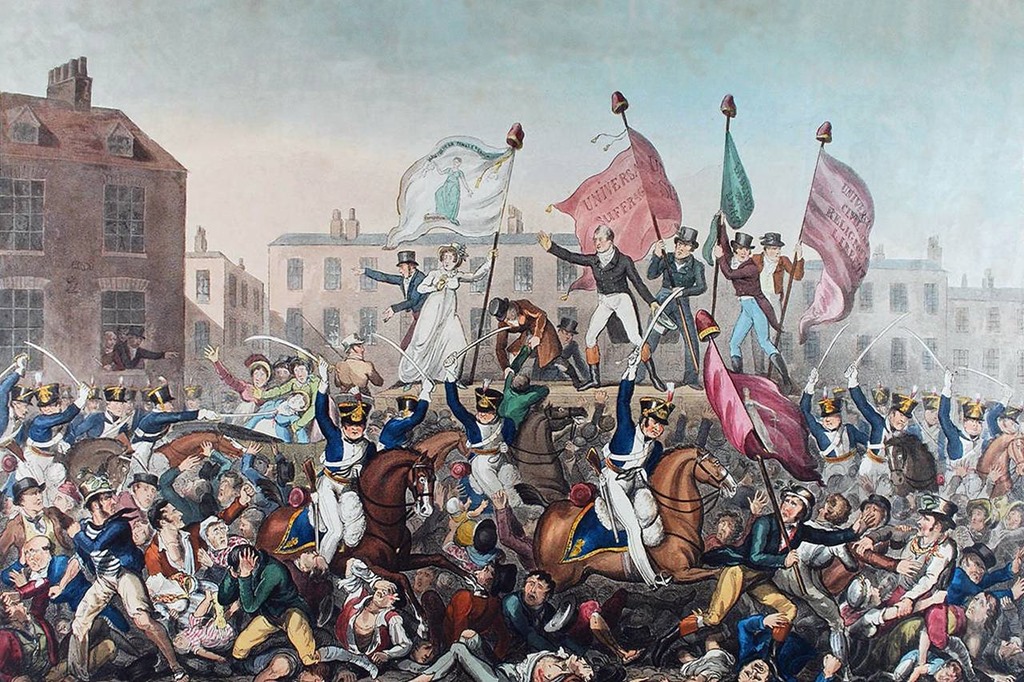
I’ll summarize the brutal details of what happened. Given that it’s 1819 there are no photographs, no bystander cell-cam video: one has to read and use imagination to picture it. Mounted police were sent to arrest the speakers and organizers on a temporary stage in the midst of the large field while the event was happening. Their horses were slowed and tangled in the crowd (described as so dense, that the hat brims of the attendees touched one another). This led to additional mounted militia and eventually regular soldiers that had been held in reserve to be sent against the crowd. Sabers were used as the horsemen struck out at those surrounding them, and of course the horses themselves were trampling on those who fell or were in the way. In some ways it seems miraculous that “only” eleven were killed. Hundreds were injured: men, women, children. The organizers were arrested, convicted, and jailed.

Peterloo_Massacre

Wikipedia says the banner the woman on the left is holding that day would say “Let us die like men and not be sold as slaves.”

One of those who was injured, and who died a few days afterward from his wounds, was a veteran of the Battle of Waterloo, the famous British victory of four years earlier. With bitter irony this event was called “The Peterloo Massacre”

It took a few weeks for the news of this outrage to reach Shelley who was in Italy. That September he wrote today’s sonnet, along with a longer work “The Mask of Anarchy”  and a third poem in a song form. Despite that he was already a self-exile abroad, none of them were published during his lifetime. There was a reason for that: merely publishing an account of The Peterloo Massacre was considered sedition and libel. He asked his friends to not publish them, for there was a real risk of imprisonment for them to do so. The poems were circulated informally, and finally published over a decade later after Shelley had died.

“England 1819”  then has some specifics. The stabbed in line 7, the army in line 8, and the sword in line 9 aren’t only metaphors—they are, albeit second-hand, reportage. Adjusted for the speed of communication in Shelley’s time, they are roughly as immediate as a blog post, just in the form of a sonnet.

What about the possible correspondences of history/rhyme I mentioned? I could write how in some way that the charges laid out against the 1819 English government power structure and the insidious way they used their power could be compared to my country in 2020. I almost wrote just such a section—but anyone who remains in my audience can likely do that for themselves. I personally found some of them as bitterly ironic as the decision to call the 1819 event Peterloo. You may think otherwise. Feel free to do your own translation today. As to prophetic Shelley’s concluding “glorious Phantom,” the Phantom that may emerge from the graves created and filled by those that then recognize they are dying themselves: what tempest will that day bring? A cleansing, nourishing rain, applauded in the leaves of trees, or a hurricane?

The player gadget to hear my performance of Percy Bysshe Shelley’s “England 1819”  is below.

*For over half-a-century in my life, voting is something that would seem uncontroversial—at least since the heroes of the Civil Rights movement, some of whom died to make that mundane. Indeed, how many radicals have I met who invoke the saying that if voting could really change anything, they’d make it illegal. Now I hear that statement backwards. If there are current efforts trying to impede voting, reduce it, and denigrate it—there must be powerful people afraid of some change it could bring.

At the Beginning

Before I present today’s audio piece, once more a story, one that has kept me up reading and thinking about it for the past week. Like many of the stories I’ll tell here, the events may seem at first to be far off and unrelated to you, as much a “who cares” as poetry is to many people. But the story behind the poem affected me, now, in our current age, just as poetry written long before I was born might.

In 1878, a man was born in Germany named Erich Mühsam. When he reached the proper age he was sent off to a fine boarding school where young Mühsam recognized two things: he didn’t much care for the school’s rigorous discipline (“corporal punishment,” the polite word for instructional beatings, was the order of the day) and that he wanted to become a writer, a poet. So, the teenaged Erich wrote an article for the local Socialist newspaper about the school’s abuses. For good or bad, that was his ticket out of there. He was expelled.

As the new 20th century began he returned to his home city of Berlin and fell in with some young folks who were running what in my day would have been called a commune: “Neue Gemeinschaft” (New Society). It’s there that Mühsam met Gustav Landauer, who though only eight years older, became a sort of guru to the young Mühsam. Landauer was a theorist, a charismatic one at that, for a type of Anarchism that believed that the most effective direct action was to begin living the theory rather than seeking (and likely waiting) for some revolution to give Anarchists that opportunity. He encouraged Mühsam to develop as a poet, and poetry was part of Landauer’s world-view. Landauer’s wife was also a poet and a German translator of works of Wilde, Poe, Rabindranath Tagore, and Walt Whitman.

Mühsam absorbed much from Landauer, and you can see that in the text for today’s piece, a poem Mühsam wrote in 1909—but Mühsam was a more active revolutionary, though much of it was through literary efforts: poetry, plays, cabaret works, essays, and editorship of his own anarcho-communist journal Kain. The Left in this period was (as it often is) splintered—sometimes most sure that those with beliefs most adjacent to a segment’s own were as dangerous to the cause as overt opponents. Mühsam was non-violent but open to alliances with those that weren’t. Landauer and Mühsam sometimes found themselves on opposing sides, but their relationship was never severed. Landauer was accused of being to professorial and uninvolved in active struggle. Mühsam was thought by some as too provocative. *

Muhsam-Landauer-Buber
Mühsam, Gustav Landauer, Martin Buber. How does that last guy fit in? Read on. Is it just me or does Mühsam have a little Marc Maron thing going on?


How many of you find this Anarchist theology boring? Well, here comes WWI. Boring also to some, but also deadly and existential.

The war stifled critics of the Imperial German government, at least at first. Even the activist Mühsam had a hot take where defending his country and citizens seemed an imperative.** Write anything critical of the government and you might be arrested and jailed. Support strikes by war-workers? Go directly to jail. So, eventually Mühsam was jailed.

By late 1918 the dam broke. Beside the mountains of deaths on all sides, unimaginable before this first full-scale mass-production European war, Germany was losing, and no amount of government propaganda could convince many that this was not so. Sacrifice for winning can be cast as heroic. Sacrifice for losing is a harder sell.

And if you were waiting for it, here it comes: revolution!

In November 1918 the Kaiser abdicates as WWI ends. In the Bavarian regional capitol, Munich, the Independent Socialist Party declared the “People’s State of Bavaria.” A guy named Kurt Eisner was named its President. Seeking alliances with others on the left, Mühsam and Landauer are offered positions in the new government. They don’t take them up on this, but during this time the two old friends are now in Munich.

Eisner’s Socialists were democratic, republican (small case, they believed in elections). In the midst of this chaos, with even basic social functions in turmoil and the new Socialist alliance unable to prove any of its theories, they held elections in January 1919. They lost. Eisner went to parliament to present his resignation, true to his beliefs. An assassin shot and killed him on the street before he arrived. Now a new government is proclaimed “The Bavarian Soviet Republic.”***  And now Mühsam and Landauer join up.

Ah, so now the story of sleek agitators and thoroughbred theorists pressed into harness as government draft-horse functionaries? If only my story could stay so boring. This government lasted six days. I’ve had left-over pizza that lasted longer than that! And Wikipedia says that during this less than a week time a “mentally ill Foreign Affairs deputy” declared war on Switzerland. How could they go up against all those multifunction knives and prevail? Oh! Such comedy, dark as it is!

Trust that dark. That’s where we’re going.

Now yet another government is declared in Munich, this time led by Communists and a guy that his contemporaries said “Wanted to be Lenin. He thought  he was  Lenin!” Mühsam is arrested by this new government and thrown back in jail. Given that he was so provocative, one doesn’t have to imagine him stretching his talents far to piss them off. Lucky him. The more mild-mannered Landauer has suffered in this winter the death of his talented literary wife (a victim of the 1918-19 flu pandemic) and the dashing of his hopes for wider realization of his theories. He sticks around, out of power. Is he frozen by grief that winter? Spring comes. There’s a revolution one can count on…

…but not just flowers are coming. The Freikorps, a right-wing militia, goes into Munich to put down the revolution. This they do, hundreds die. Who can tell Landauer’s mind, but Landauer had refused advice to leave in that spring. He’s rounded up, imprisoned. The day after May Day, the guards take him to a room. They beat and abuse him. They shoot him. They beat him some more. They shoot him again, finally killing him, and toss him into a common grave.

Mühsam escaped this because he had been imprisoned by the last revolutionary government. But in the aftermath, he’s still a notorious revolutionary, so he’s put in a new prison as an enemy of the new central German Republic government.

While he’s imprisoned, in 1920, a collection of his poems titled Brennende Erde (Burning Earth) is published, and this month I got a pdf scan copy and did a rough machine translation in order to peruse it. Why did I go looking for this obscure collection? I’d read a passing reference to him as a poet and activist, and something drew me to look, in this time when I’m questioning the arts and poetry and the seeming necessity of activism that I feel unequipped to take on.

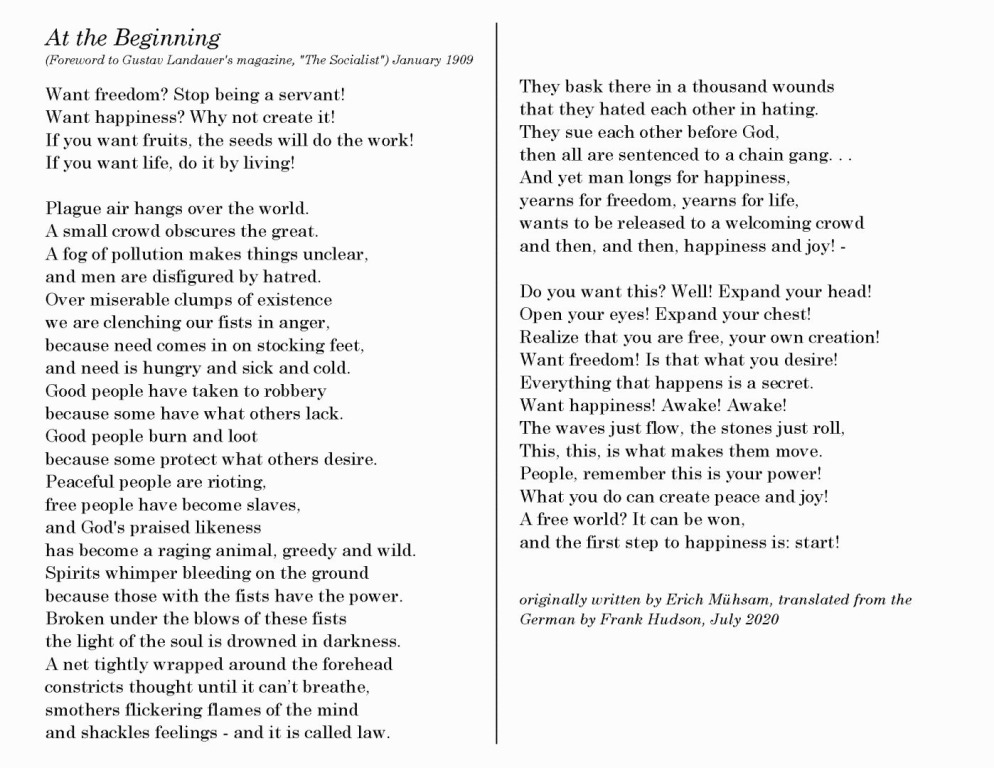
I did a more careful, human, translation of the first poem in that collection, “Zum Beginn “ (“At the Beginning.”)  It carries a subheading there telling that “At the Beginning”  was first published in Gustav Landauer’s magazine, and given the importance of Landauer to Mühsam and the short interval between the publication date for the collection and Landauer’s death, it’s easy to read it as a comment on what Mühsam learned from his teacher. Here’s my English translation, the one I perform today:

At the Beginning


Can one read things in it that seem to speak to today? I believe one can. I wonder if whoever was putting together the collection before publication thought it spoke to 1919 too. That line written in 1909: “Plague air hangs over the world” could be read in 1919 as a comment on the great influenza pandemic, not as a mere metaphor, just as you might read it now in Covid-19 times. The closing litany of people awakening to the power of realization, that too could be more than a dusty relic as folks marched this summer under a growing common understanding of oppression and “nets tightly wrapped around the forehead…until it can’t breathe.”

So, what happened to this young poet who turned activist/poet? In 1924 there was an amnesty declared for political prisoners and he was released. Lucky him! Another lucky man released by that amnesty had tried to declare a new government from Munich too, this time in 1923: a painter turned activist named Adolph Hitler. You probably haven’t heard much of his paintings.

Just as his 1909 poem foretold, Mühsam arrived by train in Berlin after release from prison and was met by a crowd of admirers, cheering and lifting him onto their shoulders. Someone thought things got out of hand, and soon the edges of the crowd were being attacked and beaten, though Mühsam was carried to safety that day. More than a decade after he wrote his poem, those with the fists still had the power—or some of it.

Mühsam took part in the artistic and political ferment in Berlin for almost ten years. Shortly after that pardoned painter/activist succeeded in getting power in Germany, someone burnt down the Reichstag, and it was time to round up those that had ticked off Hitler and his supporters. Mühsam was one of the first taken in. You know the quote attributed to the conservative German Lutheran pastor Martin Niemöller? The one that starts “First they came for…?” Jews, Gays, Leftists, avant garde artists? Was there any group Mühsam didn’t qualify for? Lucky man, head of the line.

He was sent to a concentration camp. There he was beaten and abused. In short order he was taken into a room and abused and beaten until he was dead. The guards hung his body and said he committed suicide.

There are martyrs we remember and martyrs we forget. Phil Ochs wrote a song “Too Many Martyrs”  and we might slag him off for stating the obvious rather than the artful—but the obvious is likely the truth here. At least in the United States we have next to no remembrance of Mühsam or Landauer. As far as I can tell from a brief search, Mühsam’s poetry has not attracted interest from English translators, with one site that did feature some English translations (and tantalizingly, some set to music) now defunct—and the domain name takes you to a place with bogus antivirus pop-ups flashing all over your screen. Both do have some interest to Anarchists as political figures. That’s a bit odd. Isn’t one of the romantic knocks against artists turning activists: ars longa, (and their political concerns), vita brevis? Countering that is what I call Donald Hall’s Law: that poet’s statement that almost all poets, even prize-winning poets, are largely unread 20 years after their death. I fight that here, but Hall may be right.

History had a few more things to offer me as I read this sad and affecting tale of these two men.

Mühsam wasn’t the only one who had their life impacted by Landauer and his idea of practicing egalitarian Anarchism right now in a communal and immediate relationship. His most famous pupil was probably Martin Buber, whose influence on humanism in the mid-20th century was considerable.

Remember Landauer and his wife, and his belief in the monad of domestic life as a model for change? Well that talented writer and translator and that theorist of humanist Anarchism had a child. And that child, Brigitte, survived her parents and married a doctor in Berlin. In 1931 they had a child, Mikhail—and later that decade they got out of Dodge before the painter/activist/ Führer got around to those not first on every part of his list.

They settled in America and adopted an easier to spell-and-say name, so their grade-school-aged son Mikhail Igor Peschkowsky became Mike Nichols. He became a radio folk-music DJ, an influential pioneer in popularizing improv comedy with Elaine May, and then on to a significant career as a stage and movie director.

Strange, the undernotes of history. I’ll likely never listen to a Nichols and May routine or watch a Nichols-directed movie like The Graduate  again without thinking of that grandfather, that heartbroken, widowed man being abused to death after watching the revolution, one he didn’t want to wait for, fail. I’ll still laugh. The laughs are just darker.

Today’s music is more in the “bash it out fast” manner, no pretty string quartets, no subtle sound design, just two electric guitars, bass, drums and my effort to speak the words. The player gadget is below if you read this in a browser. Apple WordPress Reader users, use the Reader’s gadget to open this in Safari to see the player.


*Among Mühsam’s early 20th century beliefs were “free love” and gay rights/acceptance. The communard Landauer believed that a loving and equalitarian family unit was a small-scale model for society.

**He took that back, and wrote anti-violence and war poetry during the war. Can one imagine Twitter in 1914? The telegraph lines would have melted.

***OK, if you stayed with me so far, with “Socialist” and “Communist” being thrown around in addition to the “aren’t they the guys who throw little black round bombs” “Anarchists,” “Soviet” might be the final straw  that chokes your metaphoric dolphin or turtle or other benevolent creature. “Soviet” means in this context, a worker’s council as a source of authority. As far as Anarchists were concerned, that’s a good thing. Anarchists are often against violence, and particularly state violence, torture, and oppression—but they are very much for long boring meetings, which have a special dispensation from being defined as torture or oppression.

The Most Popular Parlando Piece, Spring 2020

Are there people today still falling in love, or not falling in love together, or remembering love and almost love? Seems like a silly or rhetorical question doesn’t it.

So, yes, I suspect there are, as there have been before.

People fall in love on marches, at the barricades. Policemen fall in love. People fall in love in the time of plagues. Old people fall in love. Young people remember love or almost love. Oppressed people fall in love. People fall in love, but their partner doesn’t, and sometimes that partner is the wiser of the two.

So, is this the time for a poem of romantic love to be the most popular piece this past season? This is a time of new dangers and old evils. This is a time that predicts greater uncertainties and promises change if we act, and despair if we don’t. Can poetry put its “Queer shoulder to the wheel” as Ginsberg wrote? Should it?

Dada for Juneteenth

You have nothing to buy but your chains! For today’s Juneteenth, some Dada in advertising algorithms.


I’ll be honest, I think about that a lot this spring. It’s a large part of why it’s hard for me to get around to creating new work here as this spring unfurled. Honestly I have little right to present short pieces here on Emily Dickinson, Du Fu or Arthur Rimbaud, but I may have even less authority to write briefly on politics, economics, sociology, or epidemiology—much less American racial dichotomy and all it’s injuries.

My observation that many who do  write of these things have no more authority than I do is not helpful. Another observation is that all us artists have is that: our observation. We must strive to be careful seers and more exact sayers of what we see, though we tend to be flat seers. Heaven and wildflowers: that’s leveling. Romantic love, that often-brief thing; and disaster, that sometimes-brief thing that harms long and painfully, we see them both, we write about them as if they’re equal.

As this turns out today, I will have slighted Mr. William Butler Yeats. I’ve talked not at all about his poem, the one that you listeners liked and listened to most this spring, though it’s hardly a perhaps to believe Yeats thought some of these thoughts and questions that I’ve filled this post with instead. You can read my original reaction to the poem, linked here, in place of something new today.

The player gadget to hear Yeats’ “When You Are Old,”  this love poem written by a 20-something about old age, is below. Thank you very much for reading and listening, and an extra thank you to those who’ve helped spread the word about the Parlando Project. There’s a lot of stuff here from the four years of this project to listen to, and I’ll still attempt to have new pieces here soon.


Government

Here’s the other pole of Carl Sandburg, a prose-poem about the nature of government. It seems so far from the tight compressed Imagism of “Gargoyle”  that one might wonder how it could be from the same poet. I may have a clue there, so read on, I’ll return to that thought.

But first let me note that Carl Sandburg had some unique experience to bring to this subject. This poem comes from his landmark Chicago Poems  published in 1916, a collection that both established his bonafides as a Modernist poet and as a foundational writer of American proletarian poetry. But before that he’d been a first generation immigrant,* a Spanish-American War soldier, a college dropout from a no-where college, and an itinerant worker. In the first decade of the century, as he turned 30, he was working as a daily paper journalist as he began a period of political activism in Wisconsin as a Socialist party organizer. In 1910, the city of Milwaukee elected a Socialist mayor, and Carl Sandburg took a position in his city administration. He was a self-proclaimed idealist as well as an aspiring poet. In his new job in government he was ready to—well, let me quote how he remembered itin an interview in 1953:

We were to build in Milwaukee the kind of planned city which existed in some places in Germany and in other European cities where socialism had taken hold….Then came the jarred awakening. Hordes of job-seeking Socialists descended on our office wanting the crumbs of victory. They behaved just like the Republicans and the Democrats on that day when they swept into power. This was not idealism; it was the old spoils game.”

In another account he said that his first official act in the new administration was to handle a citizen’s complaint about a dead dog in an alleyway.

Socialist Chickens!

Antifa infiltrator introduces Socialist chickens to Wauwatosa.  Sandburg admirer Bob Dylan was more of a milk and cheese man.


After two years in government, Sandburg kept with poetry but went back to Chicago and to getting his paycheck from the Fourth Estate. Thanks to Ben Hecht, a fellow Chicago newspaperman, we can sense what being a newspaper reporter in Sandburg’s Chicago era might have been like. Hecht’s play The Front Page  has been made into a movie three times, with most favoring the middle version, His Girl Friday,  as cinema, but the original 1931 version is most faithful to the original play and era.**

Sandburg’s “Government”  may not be one of his greatest poems, but I’ve maintained that poetry (like other arts) can serve us even when it’s not some sublime act. You’ve heard me maintain that Sandburg has poems that deserve to be considered in that sublime class, but this one shows us something too.

So now that we’ve detoured in the non-aesthetic realm of politics, let me come back to that thought, however unformed, that I have about the compressed Imagist Sandburg, the one we forget or underestimate, the poet who has poems that can stand with the other Modernists in concrete and incised compression. In “Government”  Sandburg, though in a prose-y and less concise manner than the Imagist Sandburg, shows government in its evil and corruption is us, human us.  It seems an institution as we speak of it in tired language that poets must avoid and repair, an external thing, like a building or statue put up long before our time—or if living, a monster from the other. However impure, however damaged, our republic is; however unclean our language is; however dull, ignorant, insufficient our thoughts are; we are the blunt weapon that damaged it, we are the only tool to repair it. Blunt tools break, sharp tools repair.

Here’s my performance of Carl Sandburg’s “Government”  available with a player gadget below.


*I grew up in a small Iowa farm town with substantial Swedish heritage. In my half of the 20th century I believe I may have underestimated the impact that Sandburg’s parents were immigrants, or that parts of WASP culture may have noticed this about Sandburg more than you or I might think. Last year when reading more about another under-considered Midwestern Modernist Edgar Lee Masters who crossed paths with Sandburg in Chicago, I was struck at how often Masters referred to Sandburg as a Swede/poet in a context that I believe was meant to be read as a natural incongruity, that such a coarse background could be associated with the athenaeum of poetry.

**Footnote fans, be prepared for a wild mouse of a ride in this one. In The Front Page  remember how the corrupt mayor is indebted to “the black vote.” In 1915, the black vote was largely Republican, and the Chicago mayor that year was William Hale Thompson, a character that could give our 21st century President a run for his money. He survived WWI politically despite being pro-German and reflexively anti-English, and with a drain-the-swamp campaign that was working to make sure the money sump-pump went toward his pockets. He was finally voted out of office by the campaign of Anton Cermak, the most important mayor in the history of Chicago. In that campaign, Wikipedia quotes Thompson as Tweeting (well, I guess not, it’s 1931 after all—but the flavor sure sounds reminiscent of our contemporary) “I won’t take a back seat to that bohunk, Chairmock, Chermack, or whatever his name is. Tony, Tony, where’s your pushcart at? Can you picture a World’s Fair mayor with a name like that?”

So, what’d Cermak do that was so important? In 1933 Cermak took a fatal assassin’s bullet that could have hit the U. S. President-elect Franklin Roosevelt standing next to him. Regardless of who took what bribe from who, or who did a better job of expired canine disposal, or even weighed against the epic odyssey of the Afro-American migration to urban centers, the death of Franklin Roosevelt in 1933 would have likely changed America and the world’s history immensely.

By way of footnote dénouement, I’ll note that Cermak’s son-in-law Otto Kerner chaired the commission that was charged with evaluating the urban riots of The Sixties. Read this linked article for a sense of what was said then, and then consider Sandburg’s words in his great poem I Am the People, the Mob:”  “When I, the People, learn to remember, when I, the People, use the lessons of yesterday and no longer forget who robbed me last year, who played me for a fool—then there will be no speaker in all the world say the name: ‘The People,’ with any fleck of a sneer in his voice or any far-off smile of derision.”