Adelaide Crapsey, A Ghost Story

We’re a couple of weeks past Halloween, but let’s finish out our series on American poet Adelaide Crapsey with a ghost story about two families. Perhaps you don’t believe in ghosts? That’s OK. In this story one family believes in ghosts and the other one doesn’t.

As we learned yesterday, a young scholar and writer of poetry, Adelaide Crapsey was struck down just days after she turned 36 in 1914 by tuberculosis. Though greatly weakened by her illness, she had worked on organizing a book-length collection of her poems in her final year, including a section introducing examples of a new poetic form she had created.

Alas, she didn’t seem to have a publisher when she died. It’s uncertain who knew about the poems she’d selected. Adelaide had a strong belief in self-reliance and not burdening her friends and family, and so for as long as possible she’d kept the news of her grave diagnosis from them, and some of the poems in her manuscript (such as the ones used in our last post) spoke frankly about her illness, pain, and thoughts on mortality.

adelaide crapsey grave

A grave marker that doesn’t burden you either. She ended her collection of poems: “Wouldst thou find my ashes? Look/In the pages of my book”

There were some external reasons for this desire not to burden her family. Her father, Algernon Crapsey* had been a prominent Episcopal priest in Rochester New York, one who had practiced a ministry to the poor and other disadvantaged portions of the Gilded Age. Adelaide’s father came to believe that certain spiritual beliefs of his church were not only of doubtful accuracy, but that taken on faith they would hinder service to the poor. Once he decided he was right about this, he wouldn’t shut up about it either. He preached it, he wrote articles and books about this: if you believe in miracles and heavenly rewards you are all too likely to not feel the need to make your own miracles by action here and now, in this life, on this Earth.

This put his church in a bind. Here was a churchman who was known for manifest good works around the state of New York, a Christian hero of a sort—but who was also vocally opposed to church doctrine.

So it was that a few years before Adelaide Crapsey died that a committee of investigators from the Episcopal diocese came to the parsonage where Adelaide had grown up to question her father on these matters. Her father was out, doing those good works. Her mother was worn-out from dealing with this all. Adelaide, like any good PK,** stepped in as hostess. The story is told that she served them tea and kept them graciously talking as the tea went down.

Oh, and she had spiked the tea with rum. It was said the investigators inquisitorial rigor suffered a decline during their wait.

But Adelaide’s father would not keep quiet. He eventually met with a church trial for heresy.***  He claimed the heresy of the church not serving the poor as Jesus commanded was far greater than any they could charge him with over supernatural events, but the church’s hierarchy convicted him. Maybe he wasn’t a heretic who believed in different gods or another heavenly host, but it just wouldn’t do to be a priest of their church who didn’t profess the right beliefs.

No burning at the stake though, he was just written out of his job and the church. The family had to leave the parsonage where they had lived for decades for a house some supporters found for them elsewhere in town.

Adelaide, like her family, didn’t believe in heaven and hell. And now she was dead, and as her poem had put it, her mouth was now part of the quiet as with falling snow and the hour before dawn.

In another part of the same town, there was a successful architect, Claude Bragdon. What kind of architect? Do you know the names of Frank Lloyd Wright, Louis Sullivan, or Buckminster Fuller? Claude Bragdon was that type, committed to artistic principles, in his case to a religious and mystical level. Indeed, he had a strong side-interest in Theosophy, a 19th century unified field theory of spiritualism and hermetic knowledge. He had known the Crapsey family and Adelaide at least somewhat. Adelaide had taken his mystical bent in stride, calling him “cube man” due to his fascination with the hypercube (which I think may be related to Buckminster Fuller’s theories about the geometric nature of the universe).

Claude_Bragdon

“The geometry of innocence flesh on the bone/Causes Galileo’s math book to be thrown” Claude Bragdon sings the Tombstone Blues.

Claude Bragdon had not been married long when Adelaide Crapsey died. His new wife, Eugénie had never met Adelaide. One day, in that silent time of the hour before the dawn, something happened. Here’s how he described it in his autobiography:

One morning in the summer of 1915 I was awakened by my wife Eugénie, who asked me if I knew anyone by the name of Adelaide. I told her that Mrs. Algernon Crapsey’s name was Adelaide, and it had also been that of her daughter, who had died a short time before. “Take me to see Mrs. Crapsey,’ said Eugénie, ‘because I was awakened by the sound of her name, repeated over and over: Adelaide! Adelaide!’ “

Now if a chill runs up and down your spine to hear this, the architect and his wife may have taken it more calmly. Not only were spirit voices and mediumship part and parcel of Theosophy, Eugénie was a “Delphic Woman” in her husband’s estimation, one who used automatic writing to take down sayings and messages from the ether.****  And so now Eugénie’s automatic writing sessions became peppered with messages from the late Adelaide Crapsey. With a little interpretation, the messages seemed to be referring to the poems, the book-length collection Adelaide had been working on.

Book negotiations have been known to get complicated, and I haven’t read all the source materials for this story*****  but somehow the husband and wife mystic family convinced the social-gospel materialist family to go through the late Adelaide Crapsey’s effects, and retrieve the manuscript. I can see this scene written in Mulder and Scully dialog.

Claude came out of the Arts and Crafts movement, so buildings weren’t his only art. He also ran a small press for books on his theories and other Theosophical works. He became the book designer and publisher that introduced the world to Adelaide Crapsey the poet and determined ghost.

What became of Adelaide’s ghostly voice? It didn’t do a book tour or poetry readings—pity that, it would have pipped Tupac’s hologram by nearly a century and spiced up the valves of many a bookstore. The final automatic writing messages thanked the Bragdons for their efforts and assured everyone that the other side was a fine and happy place where she didn’t miss living at all. Just so much “Bread and butter notes” from the beyond.

At this point the man with the skinny tie and narrow lapel suit should step forward from the shadows and wrap things up, but where’s today’s audio piece?

Well, I did say that Claude Bragdon had many artistic interests. One of his friends was Alfred Stieglitz, the pioneering art photographer who was connected to another famous photographer Edward Steichen, a friend and brother-in-law of Carl Sandburg. Either through that connection, or Sandburg’s strong early interest in short poems created with concrete images rather than abstract words, or some Great Lakes leftist linkage between Adelaide’s social gospel preaching progressive father and the Milwaukee and Chicago based socialist Sandburg (maybe more than one of the above?) made Carl Sandburg aware of Adelaide Crapsey’s poetry and story, and he wrote a passionate elegy for her.

Here’s my performance of that poem of Sandburg’s, available with the player below. No player visible? Then use this highlighted hyperlink to play the piece. The full text of Sandburg’s poem is here if you’d like to read along.

.

*I should have warned you: as elsewhere in this story, the 19th century names are full-flavored.  If Lemony Snicket reads this, let it be known that I will defend my intellectual property to the upmost here!

**PK, “Preacher’s Kid.” As a class, they have an opportunity to grow up with an interest in philosophy, ethics and words, but also with a childhood were the expectation to be good and the desire to rebel have to be balanced from a too-early age. Alternative reader here Dave Moore and my wife are both PKs.

***The story of Adelaide’s father Algernon Crapsey sounds eerily similar to a tale from The Sixties and another Episcopal clergyman (a bishop no less!) James Pike.  Pike was also committed to social change and questioning of religious dogma and was threatened with an ecclesiastical trial for heresy. Coincidentally, Pike eventually worked with a medium to try to contact his dead son.

****We now use Twitter. Much better. But are those odd messages we read from bots or….the other side!

*****Two women have worked to discover and catalog much of what is now known about Adelaide Crapsey’s life and work and are the prime source for much of what I know: Karen Alkalay-Gut who has written a biography of Crapsey Alone in the Dawn and Susan Sutton Smith who has written about the Crapsey and Bragdon families’ associated papers and published the Complete Poems and Collected Letters of Adelaide Crapsey.

Besides the Autumn poets sing

Since we’ve re-established that Emily Dickinson can do simple, here’s a lovely poem of hers that introduces more than a touch of “meta” to her poetry.

This poem’s first line starts the meta thing right off. You could quickly read the opening word as “Beside” without the s, and then the poets are singing in the presence of Fall. I suspect Dickinson wished to include that element but subvert it. “Besides”  means in this context “beyond that, in addition to.” So, there’s this thing: “Autumn” that poets sing about that is what? Well, it’s prosaic (i.e. prose and routine, not poetry and unique/charged). It’s small: “few,” and “little.”

Next stanza, the song now riffs with “few:” “A few…mornings,” “A few…eves.” Dickenson’s diction is still casual here, but she drops a couple of unusual adjectives with that repeated pair of fews. Unusual adjectives are often a weak crutch in poetry. Throw together some out-of-the-blue random adjective with a noun and you’re suddenly all surreal, poetically mysterious and creative—but more importantly, do these unexpected modifiers create a charged image?

“Incisive mornings,” is a bit of a play on words. Incisive here means not just perceptive, as in the coolness and lack of light predicting winter’s shorter days and lack of warmth: but taken in its other meanings, its winds are cutting and daylight is being incised, removed. “Ascetic eves” also speaks of removal, evenings no longer long with lingering light and it hints at spiritual matters this removal may reveal.

The second stanza ends with two references to poets, presumably examples of the ones mentioned as the poem opens: William Cullen Bryant, an older poet contemporary with Dickinson, and James Thomson, a Scottish poet of the 18th century. Neither are well-known today (though Bryant was a very important American cultural figure in his time). Dickinson mentions them and says that the stuff in their supposed Autumn poems are “gone.”*

In the context of these two stanzas, Dickinson is saying: the existing poets aren’t telling us much about autumn. I think that Dickinson’s sly inclusion of those two concise, precise, and original adjectives is cutting. She’s showing that in two words she can say more about autumn than they can in some long-winded poetry.

harvesters by Peter Bruegel the elder

Sheaves get mentioned in passing in Dickinson’s poem, so I get to exercise my love for Dutch painting


The second half of the poem has Dickinson unleashing her style of poetry against these musty odes. The third stanza’s word-music is just wonderful. I won’t dance about its architecture today—you can just read or listen to it—I’ll only point out that the end-words “brook” and “touch” have a lovely rhymish echo, even though they aren’t even slant rhyme. This stanza has the superb line “Sealed are the spicy valves” which partakes of the musicality but is an elusive image too. As I read it, I thought of gardeners in our climate planting garlic cloves this time of year, but garlic was not yet a thing in Emily’s New England. After an hour or so of trying to decode the image, to determine what specific spice plant in Dickinson’s time and place is referred to,**  I now think this a more generalized image of withered flowers. “Valves” is used only one other time in Dickinson’s poems, in the more famous A Soul selects her own Society  poem where they appear as “the Valves of her attention.” “Spicy” I’ve judged now is just a biologic/erotic reference to flowers pollination role. We may read the valves anatomically in various ways, but eyelids*** may be intended, as in the closing two lines of the stanza.

The final stanza is Dickinsonian too: nature in Dickinson’s poems is often personified in comical and non-charismatic species, here squirrels. Comically, her thoughts on the matter of autumn and poetry will be of great interest to the squirrel, and in this image she’s pointing out her non-existent status as a literary figure compared to Bryant et al.

It could just be a handy, casual sentiment to finish the poem, but Dickinson may be earnest in her concluding phrase: her mind is the sun that can illuminate the lack of sunlight as Winter solstice approaches.

Mostly acoustic guitar for the music performance today, though if you listen in the background you’ll hear a little harmonium and tambura. You won’t hear it in the rhythm or the instruments timbre, but I put a hidden reference to one James Marshall Hendrix in the music. You can read the full text of Dickinson’s poem here as you listen with the player gadget below.


*Thomson wrote the lyrics to “Rule Britannia,”  and Dickinson is likely referring to his long Miltonic blank verse poem called “The Seasons”  in her 16 line one. Bryant’s poetry may be largely forgotten, but his former cultural salience is still honored with a lot of school, street, park, and place names in the U.S.

**As an adult, Emily ran an extensive garden in the largely self-sufficient Dickinson family homestead, and in her youth she studied botany and produced a remarkable herbarium book filled with precisely identified plants—so it’s not crazy to think that she could have had a specific plant whose lifecycle she understood. A full-fledged farm field operated right across the road under Emily’s window at the homestead. The “sheaves” in Thomson’s poem wouldn’t have been abstract to her either.

*** If one wants to get more biographical in reading the poem, Dickinson famously went for treatment to Boston for some tantalizingly unspecified “eye problems” a few years after this early poem was written.

Parlando Project Summer 2019 Top Ten part 3

Is everyone aligning themselves with autumn already? Here we’re looking back at summer and the audio pieces that the audience made their most liked and listened to, and we’re getting near the top of the countdown, moving toward the most popular single piece of the past three months. Today we look at numbers 4, 3, and 2.

4. Summer Silence by E. E. Cummings. Another one from our “Before They Were Modernists” series, “Summer Silence”  is an early E. E. Cummings poem published when Cummings was a college sophomore at Harvard. One doesn’t usually associate Cummings with constrained poetic forms, but “Summer Silence”  was written in 1913 in the Spencerian Stanza form, long before he could have learned from Hawk or Susan.

I try to do the best work I can with recording the music compositions here within the rapid pace I’ve accustomed myself to with this project. My equipment is modest, and my recording engineer’s skills are too, but I make the effort. That said, this one was recorded on a cell phone sitting in a cabin on the North Shore of Lake Superior: just me, an acoustic guitar, and a few summer birds that you can hear at the very end that wanted to enjoy July there too. The text of Cummings’ poem is available in the original post linked in bold above.


3. Higginson’s June by Thomas Wentworth Higginson. From another series, one that started before this summer but carried over into it: “The Roots of Emily Dickinson.” Higginson is essential to the Emily Dickinson story, the literary insider who Dickinson sought out in what I think was an attempt on her part to verify the worth of her unprecedented poetry. They met at least once, but the rest of the relationship was carried on via letters, of which we have only Dickinson’s side of the correspondence.

From Dickinson’s replies and Higginson’s later recounting, it’s been summarized that Higginson “didn’t get it,” thinking that her work needed some further polish to appeal to the mid-19th century public. Here in the 21st century we feel pretty smug about Higginson, thinking him like the infamous record exec who passed on the Beatles.*

Higginson had a highly eventful life outside of the Dickinson connection, as I’ve talked about in another post, but one thing I discovered this year was that Higginson at least dabbled in poetry himself. I can find no context for the poem of his I used here, but I speculated that it could be something he wrote in his youth. Whenever and for whatever reasons he wrote it, it is a good short summer lyric. And coincidentally it’s opening two lines could stand as the better judgment of Dickinson’s genius as it does in his poem for summer.

The music for this one is as electronic as “Summer Silence’s”  is acoustic. The text of Higginson’s poem to June is also in it’s original post bolded above.


Indian Pipes and 1st Edition of Dickinsons Poems

Higginson wrote the preface and helped edit and promote the publication of the first collection of Dickinson’s poems two years after her death. The flowers on its cover are usually called Indian Pipes and they were said to be a favorite of Dickinson’s. It’s a truly odd summer plant, which my living wife found and photographed in Northern Minnesota this year. The other common name for this translucent apparition: the ghost plant.


2. For You by Carl Sandburg. I kept going back to Sandburg this summer, and you the readers and listeners came along with me. Why? I frankly find him healing.

I started off this project in 2016 with a Sandburg-based audio piece which also served as a memorial for David Bowie; and for the 3rd anniversary of that launch I used this Sandburg poem as a memorial to my late wife who died near the beginning of this century.

That either of those Sandburg poems could be used as memorials does not make them passive elegies, and “For You”  is future-focused—just as it is full of ghosts. I’m not familiar enough to say how English speakers in the British Isles, in South Asia, the Antipodes, or elsewhere feel of the current times and challenges; but in Sandburg’s America when I read or listen to “For You,”  I too feel our ghosts and feel our future—close—even if each are unreal as we stand before the great door of a year with great hinges.

The text of “For You” is here if you’d like to read along.


*”Guitar groups are on their way out” is the famous rejection phrase, attributed to Dick Rowe of Decca Records. In Rowe’s defense, Beatles producer George Martin has been quoted that the Decca audition performance was not very good and that he wouldn’t have signed them on the basis of it either. A few months later, Rowe took a tip from George Harrison and signed another of those guitar groups, The Rolling Stones. Sometimes you get a second chance.

Summer Silence

I’m trying to get back into the swing of production of audio pieces here, so maybe the best way to get around that is to not “produce” an audio piece. Here’s a field recording I made just south of the Canadian border this month while working out music for E. E. Cummings’ early poem “Summer Silence.”

In normal times I’d probably have added a bass guitar part and perhaps some more instruments. Even the acoustic guitar and vocal that’s present would sound better for not being recorded on a cell phone—but it’s a fair representation of what I was aiming for in the piece and it doesn’t sound terrible or anything. If you listen carefully as the last note fades out you can hear some bird song in the background.

E E and John W Cummings

I can’t find out if they’re related: E. E. Cummings and Johnny Ramone (born John W. Cummings). Down sagging air with shimmering bars of sullen silver vs. relentless down-strokes of sullen barre chords.


On the printed page “Summer Silence”  looks awfully conventional for an E. E. Cummings poem. It was published when Cummings was a Harvard sophomore in 1913 in a college publication. And as printed there, it contains the sub-title “(Spenserian Stanza)”  as if this was possibly an academic exercise in trying Edmund Spenser’s old form. The poem reflects 19th century poetic language somewhat. Though the rhymed and metered lines follow the form, there’s a lot of enjambment and phrases beginning in the middle of the printed line, a hint of Cummings later more scattered pages. The imagery shows tendencies toward the Modernist/Imagist ideal. This might be the experience of a real night. The images in the poem aren’t presented as stock-photo stand-ins for what the poet wants to say even though there’s a bit of emotional adjective-overload here and there which the pure Imagist would excise: “Eruptive” and “sullen” for example.

Summer Silence as originally published

Today’s poem when first published in the Harvard Advocate in spring 1913 by the 19-year-old E. E. Cummings.


I don’t know that Cummings ever really abandoned those overt romantic and emotional expressions, a tendency to unabashed overstatement rather than pure Modernist show not tell. That’s part of why many like him while others down-rate him. In the end a set of words either work for you or they don’t. Aesthetic theories may give you a different way to look at them, but why should they take away any pleasure they give you?*

I had collected this poem in search of some summer poems to compose music with last month, but then particularly I was able to work on the music after a night with distant heat lightning over Lake Superior in July. This led me to interrogate the night with Cummings’ poem. Out on the edge of the lake the thunder in my night was distant, muffled by windows and walls, a broadcast on the edge of reception. Its intermittent bark highlighted the “panting silence” in-between lit by the avant garde of the heat lightning. My night had no stars, translated or not. Perhaps Cummings’ night had a storm front approaching a less cloudy night on his lake shore?

So, as tardy as I am with more complex productions recorded more formally, the drill for you my valued listener is the same: use the player gadget below to hear my performance of E. E. Cummings’ “Summer Silence.” 


*There are answers to that question. I used to know some of them, but I’m old now and have forgotten them. Theories and suggested other ways and contexts to look at poems are still fine with me though, adding another soul’s experience to the artistic transfer may enrich it.

They Say Life is Precious

Creativity is escape and sticking-with-it, avoidance and attention. Routine can take you to your place reserved for freedom, you may believe you’re going to the same place, and then something else happens.

Every so often I present a set of words I wrote here rather than following my usual practice of using other people’s words and “other people’s stories.” I didn’t plan to do a piece of mine here, though I did plan to revise this poem from 2016 yesterday. Sticking-with-it.

But first, I thought I should take the opportunity to play a little acoustic guitar in a quiet house on a cold grey day. Avoidance.

This is one of the good things about my multisided creative life. If I put off or am outright avoiding one side, for example, writing or rewriting my own poetry, I may flee to my music side, to the shear tactile pleasure of playing an instrument. Or to the poetry written by others and this project. Escape.

So there I was at the guitar. I tuned it to “double drop D,” and because the guitar that was at hand has too narrow a neck width at the nut to suit my less flexible older fingers, I capoed up to the second fret which gave me a little more room. From there, by ear I started to work on some chord forms that sounded interesting together in this alternate tuning. This is one of the virtues of altered tunings on the guitar. I have some understanding of the guitar’s conventional tuning, but an altered tuning requires new exploration.

None of the chords I ended up playing would have been difficult to find or fret in standard tuning, but the altered tuning I was using has three strings tuned to the same note (though one’s an octave lower than the other two) and that not only makes it easy to get a drone going while playing other notes on top, but that trio of strings resonates sympathetically.*

I was quite receptive to the sound that was developing, and next to me as I played was the manuscript of the poem I planned to revise. Could the resonating chords be fit to it? Yes, it looked like they could. Attention.

Performing a written piece can be an aid to revision. As I worked on the music I was cycling through sections of the poem, and some lines began to volunteer themselves for deletion. The poem lost five lines, and it was the better for it. The ending wasn’t strong enough, so I added a couple of sensuous verbs which I think made it better. The line deletions happened almost without attention. I was years separated from when I thought they were a good idea to be included, and the repetition while thinking mostly about the music and its flow simply made them seem unimportant. The revision of the ending was a more literary endeavor, but by that point the music was coming together, and I came up with choices sharply focused on getting that ending “fixed” so I could record a finished version.

That piece I ended up working on, today’s piece “They Say Life is Precious,”  was intended as a page poem, but the process I went through with it on Thursday made me think it works better as a performance piece—but even on the page I think it works better now because of the time I spent performing it as I composed and recorded the music.

They Say Life is Precious
We pay for life by filling it’s container, time, with attention. You can put money in there, but it can’t read what’s on the currency.


The acoustic guitar part didn’t turn out to be difficult. I recorded it and my vocal. The chords of the piece are E5, E minor 7, and two voicings of Bsus4.**  To fill out the sound I added Mellotron violins and flute, a simple contra-bass part, and an upper-register fretless electric bass line.

Escape and sticking-with-it, avoidance and attention. By avoiding the revision and choosing to play guitar first, I accomplished the revision—and when I thought I was just going to play guitar, my composition routine refused to relinquish itself and drew my attention.

To hear my piece “They Say Life is Precious”  use the player gadget below.


*Many musical cultures have instruments that use drones or sympathetic vibrations. South Asian music is full of them, but so to are Celtic pipes, Norwegian hardanger and any number of African stringed instruments. Even something as common as the piano when played undampened pulls up resonances.

**If there are any guitarists who want to try to play this, it’s a good introduction to altered tunes as the fingerings are easy. First drop your high and low E strings one whole step to D. To match the recording, capo the guitar at the second fret. The following fret-hand fingering positions are used: Chord E5 = 3rd string at 4th fret, 2nd string at 5th fret. Chord Em7 = 4th string at 5th fret, 3rd string at 4th fret and 2nd string at 3rd fret. The higher sounding Bsus4 = 4th string at 11th fret, 3rd string at 11th fret. The lower sounding Bsus4 = 4th string at 4th fret, 3rd string at 4th fret. Technically this Bsus4 also has the C# that makes it a Bsus2 as well.

To Carthage then I Came

Here’s my performance of the concluding segment of “The Fire Sermon”  portion of “The Waste Land”  which I presented for this year’s National Poetry Month celebration. If you want to hear the earlier sections, they’re all here along with over 300 other audio pieces presenting a variety of poetry combined with original music.

The middle of the “The Fire Sermon”  is one of the few times in “The Waste Land”  when who’s speaking identifies themselves, and where they are allowed to speak more than a single line or so, but as “The Fire Sermon”  concludes here, it’s once again altogether confusing who’s talking. Eliot identifies who’s speaking in his footnotes for the poem as the three Rhinemaidens/river nymphs, who had been singing non-words in the previous section—but without the footnotes* I’d have never guessed that.

Miss_Rheingold_1949

The Rhinemaidens are from Wagner’s Das Rheingold. However, when I hear Rheingold, I think of the New York beer.

Even more so than the Typist/Man Carbuncular coupling or the subtle come on from Mr. Eumenides earlier in “The Fire Sermon,”  this is the dirty-book section of the poem. A speaker tells of having sex, flat on their back in a canoe** and furthermore (this may be another speaker/river nymph) tells of another sex act with their “heart under [their] feet.”***

This ends in tears and a question that many who’ve suffered from depression cannot answer from within their hall of dark mirrors: “What should I resent?”

If Eliot’s footnotes are saying it’s just the river nymphs talking, it soon gets specifically personal. The next stanza (“Margate Sands”) refers to the off-season resort where Eliot was taking one of those “rest cures” for his own depression. It wasn’t enough, he next went to a psychiatric hospital “By the waters of [lake] Leman.”

The final stanza (“To Carthage then I came”) is made up of quotes from St. Augustine, who as a teenager traveled to the famous African city to battle his own demons of human sexuality and spirituality, mixed with a refrain from the Buddha’s “Fire Sermon”  which says that all things are burning, consuming any constancy in desire and wanting. Joking doesn’t change what it’s about and what’s at stake: the wheel of suffering. But joking, if observed correctly, is also a demonstration of earthly things passing from significance.

John Fahey

John Fahey. Il miglior fabbro.

I performed this seriously as a solo acoustic guitar piece in Sebastopol tuning, using what I once absorbed from the playing of John Fahey, another man who had both demons and angels to laugh at. To hear it, use the player below. If you’d like to read along as I perform it, the whole poem, including this year’s part “The Fire Sermon”  is here.

*At last, I get to write a footnote on the footnotes! Oh, pedant’s delight! Eliot wrote extensive footnotes for the poem that appeared when an American publisher agreed to print a book containing the poem. These footnotes have always been controversial. Ezra Pound said they were only included to pad out the size of the book. Eliot himself said he originally wrote them to properly cite all the literature that he’d sampled in this extensively collaged work of text, and he sometimes expressed regrets at allowing the notes to be published with the poem, making “The Waste Land”  seem some scholarly treatise instead of an anguished cry.

**As the joke goes. “Q: Why is drinking American beer like having sex in a canoe? A: Because it’s f…ing close to water.” Note “The Waste Land”  was written by a serious poet, who was seriously depressed by the world and his life, and in this section he’s using sexual exploitation as image for that. How serious was he? Eliot took lay religious vows which included a vow of chastity just six years after this poem was published. This footnote is included for scholarly purposes only and you shouldn’t laugh at it.

***Class, if we turn to our Kama Sutras that’s page 112, where the person on the bottom is on their stomach and their legs are bent upward so that their feet are over their thorax. Also, there’s the connotation that one’s heart is being stomped on. More pedantic or podiatric joy: a foot note that’s a note on feet.

Poppies on the Wheat. Before 1890 the most famous woman writer from Amherst wasn’t Emily Dickinson.

I once thought that one of the marvels of Emily Dickinson is that she was able to create such revolutionary poetry without any supporting circle of fellow writers. She had poetic heroes: Shakespeare, Emily Bronte, Elizabeth Barrett Browning, but she never met them. Well, it turns out there’s a bit more to her story.

Last year I followed a thread that her sister-in-law, neighbor, and friend Susan Dickinson wrote poetry, and as a result performed one of Susan’s poemsCrushed Before the Moth.”  Interestingly, it sounds a bit like an Emily Dickinson poem. This year, I’m reading Genevieve Taggard’s biography of Emily Dickinson, one of the earliest written—researched in the 1920s when people in Amherst who knew Dickinson and her family were still living. And it’s inside that book that I met up with Helen Hunt Jackson.

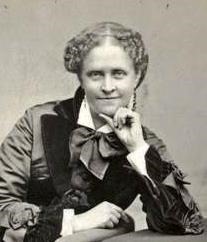
Helen_Hunt_Jackson_NYPL

Helen Hunt Jackson: poet, novelist, activist.


Helen was the same age and a childhood classmate of Emily Dickinson, but she married a brilliant military engineer and left town.*  Taggard’s biography tells me that she returned to Amherst and visited Dickinson several times. By the 1860s Helen too was writing poetry. Like Emily Dickinson, Helen Hunt Jackson was connected with Thomas Higginson, the editor/abolitionist/feminist who Dickinson famously reached out to and corresponded with, and who helped edit the first collection of Dickinson’s poetry after Emily died.

Helen and Emily exchanged work and discussed writing. Genevieve Taggard even says that Jackson was selecting work for her first collection of poetry while visiting with Dickinson. Unlike Dickinson, Jackson aimed to be published, and did so not only in magazines but eventually in over 20 books.**  While Thomas Higginson discouraged Dickinson from publishing, Helen Hunt Jackson adamantly urged her to. Jackson midwifed the publication in an anthology of one of Dickinson’s poems “Success is counted sweetest”  the only poem of Dickinson’s published in a book during Dickinson’s lifetime.

Did their writing influence each other? It’s hard to say. Jackson certainly didn’t convince Dickinson to become a publishing professional author, but another woman of the same age and town selecting and publishing books of poetry had to encourage Dickinson at least as much as the far-away Bronte and Browning. On the other hand, it seems that Dickinson had already written a great deal of her now famous work before she renewed her childhood friendship with Helen.

I was intrigued to find out that Jackson wrote a novel in 1876 Mercy Philbrick’s Choice  which featured a heroine who was socially reclusive, wore white and wrote poetry that some think might be a novelized tale of Emily Dickinson. I skimmed through it this week. At one point in the novel, a friend of the poet character sends two of her poems to a noted editor who responds favorably, and my heart leapt up, as this sounded like a description of Dickinson’s famous letter to Higginson. There seem to be other tantalizing passages that could be a friend roman à clef’ing Emily Dickinson. But one has to remember that the novel’s author herself, Jackson, is a poet, from the same age and home town. Mercy Philbrick  could also contain elements of her own life and character. That certainly seems so of the title character’s poetry quoted in the book—it doesn’t sound at all like Dickinson.

So, here’s today’s piece, a poem written by Helen Hunt Jackson about an Italian wheat field. It’s kind of a revoicing of Wordsworth’s famous “Daffodils”  poem, but it has its own charm and details. We celebrate National Poetry Month here the same way we present poetry the rest of the year, a mix of the well-known and the forgotten. To hear my performance of Helen Hunt Jackson’s “Poppies on the Wheat,”  use the player below. Want to follow along with the text while listening? Here’s the full text of the poem.


*Emily met Helen’s husband Edward Bissell Hunt when the couple visited Amherst and Emily noted that he was one of the most fascinating men she’d ever met. Edward Hunt was killed at the Brooklyn Navy Yard during the Civil War while leading the testing of a top-secret weapon of his own design, a self-propelled torpedo. Helen remarried after Edward’s death extending her formal name to Helen Hunt Jackson, though she often published using the non-gendered pen name H. H.

**While her poetry is not well known today, Helen Hunt Jackson became a campaigner for Native American rights starting in 1879. In 1881 she published her first book under her own name, a book setting out the reasons for her cause A Century of Dishonor which she sent to every member of congress. Three years later she novelized about Native American issues and wrote a best-seller Ramona  which has been characterized as Uncle Tom’s Cabin,  only dealing with Native American mistreatment.

The Lake Isle of Innisfree

Last time we had a young man, an American walking in Paris in 1913 who came upon his poem leaving the Metro. Today, another young man, an Irishman in London in 1890, is walking too. He comes to a shop window, drawn by the sound there of water splashing. Looking in, he saw a fountain on display, its upward spray buoying up a ball.

The sound of water instantly brought memories of his childhood home on the coast of Ireland—and as he had been reading Thoreau’s account of his stay at Walden Pond, a small personal fantasy occurred to him of building and living in a self-sufficient cabin on a tiny island back home. Because that Irishman was William Butler Yeats, a poem came from that shop-street window, “The Lake Isle of Innisfree.”

william-butler-yeats-irish-poet-and-dramatist-in-his-study-at-woburn-buildings-london

If one can’t have a solitary wattled cabin, at least one can have books

 
That poem is now one of those beloved “Poetry’s Greatest Hits.” A few years back it topped a survey by an Irish newspaper as its readers’ favorite poem, and though I can’t find a picture of this, I’ve read that it’s been printed on a page of Ireland’s passports since 2013.

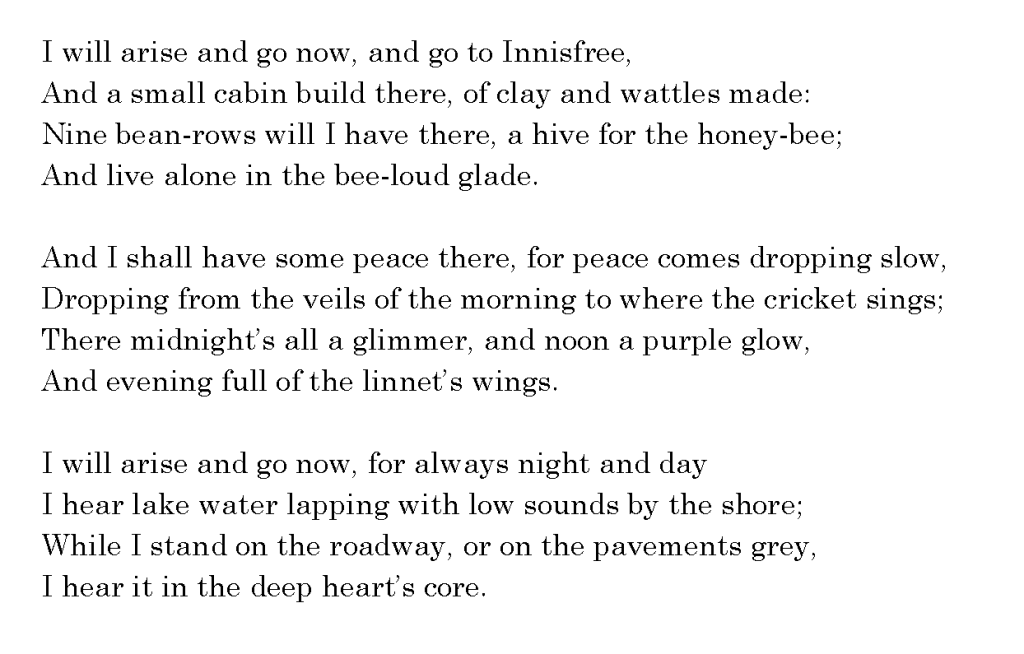
Lake Isle of Innisfree

Ireland’s favorite Irish poem was written in a foreign country


Of course, like most any Yeats poem it sounds lovely. Its language is straightforward, and there’s not much that needs explication. For a sound medium, it’s not always that a poem’s strongest images are sounds, but here the sounds of lapping water, bees’ hum-resonance, crickets, and a bird’s wings in flight carry the story.

Pound too, with his “In a Station of the Metro”  chose to use nature images in his Paris subway poem; but Yeats makes it plain that he’s stuck in the city, walking the grey pavement, not some country path. Thoreau had presented himself as the practical man in his book, making empirical living experiments. Yeats presents himself as the Romantic, helping imagine an Ireland—then viewed conventionally as a poverty-blighted colony—as an Eden, another locus amoenus. Another unusual choice Yeats makes is switching around the way we might describe night and day: night “a glimmer” and noon “purple glow.” Even though this was written before the dawn of urban lights dimming the night starfield, that’s the glimmering I sense, and if Irish coasts are foggy, noon could have a diffused glow. 1890 London might have fog and coal-fired air pollution too, maybe London fog didn’t glow, and maybe something beyond “light pollution” dimmed the stars.

This weekend’s St. Patrick’s day has become an occasion for the Irish diaspora to look toward its former homeland; and this poem, which speaks with Yeats’ humble yet beautiful specifics, invokes generally the homesickness of travelers, exiles, and immigrants. The specific in poetry often does that, the personal history that’s included standing for us all. This morning, as I filled my mouth with the word “peace” that Yeats wrote down twice in his poem, I could think of the island of New Zealand, and other travelers, exiles, and immigrants.

To hear my performance of Yeats’ “The Lake Isle of Innisfree”  use the player gadget below. If you don’t see the player (some blog readers won’t show it) then this highlighted hyperlink will also play it.


The Changeling

Have you heard the name Charlotte Mew? I hadn’t until I came upon it in Herbert Monro’s 1920 Some Contemporary Poets  this month. Last post I presented Walter J. Turner, another now-forgotten early 20th century poet found in Monro’s book-length survey of his era’s British poetry. While I doubt we will ever see a full-fledged W. J. Turner revival, with Mew I think there’s room for growth in interest. She’s that unusual and that good.

I’ll probably spend more time on what I’ve found out about Mew when I present another piece, but to hit some highlights: she cut a notable figure even among the unconventional artists of Bloomsbury, wearing tailored men’s suits and displaying a wide-ranging intellect. Mew was both parodied for her eccentricities and praised. Among her literary admirers: Thomas Hardy, Virginia Woolf, Sara Teasdale, Ezra Pound, Siegfried Sassoon, Walter de la Mare, and Harold Monro himself, who published her first collection of poetry.

Charlotte Mew

Maybe she looks like Gene Wilder as Willy Wonka, but read/listen anyway…


Why haven’t I (and likely you) heard of her? Fame forensics is a fraught subject. She’s one of those authors that straddles the centuries, though she didn’t start publishing poetry until the 20th. Some of her subject matter looks backwards, and individual lines will sound like they could be from a Victorian-era poet. Even so, her poetic style is her own. She uses uneven line lengths and unstable rhyme schemes, yet they don’t fall into doggerel. Mew died in 1928 and was not active in publishing in the last years of her life, so as Modernism was taking over she may have been just a bit “yesterday’s papers.” She may be one of those cases where her career didn’t rise high enough and maintain sufficient altitude to carry her glide-path into the second half of the 20th century. But like her admirer and champion Hardy, Mew is another one of those poets who at first, in some superficial respects, can seem old-fashioned, yet her core outlook is modern and unconventional. If one comes upon her work today and doesn’t expect her to sound like T. S. Eliot or Wallace Stevens, her uniqueness can still deserve your attention.

“The Changeling”  is a fairy story of the chilling variety, more “Belle Dame sans Merci”  than Disney. It’s Peter Pan meets Tam Lin! Like some other Mew poems I’ve already read as I start to look at her work, it’s extraordinarily easy to see modern psychological and sociological analysis in it’s situation. The narrator’s outsider sensibility is right there from the start, and the lure of the old wild natural world makes the order of the urban home and nursery regimen seem like a riot against that.

It’s Peter Pan meets Tam Lin!

Despite there being no regular line lengths or stanzas, I found it reasonably easy to set Charlotte Mew’s “The Changeling”  as if it was a folk song of the “Tam Lin”  variety. Alas, as is the case with many of my favorite old ballads, the result is lengthy by song standards. To compensate and decorate the time while you hear Mew’s tale unfold, I’ve added things that a handful of adventuresome British Isles folk-revivalists might have added 50 years ago: there’s tambura, sitar, and my first effort at playing tabla drums.*

So brew up some tea or elfin grot and listen to “The Changeling”  with the player gadget below.


*I tried an inexpensive electric sitar a few years ago, but never got the hang of it. I now play sitar and tambura using a MIDI guitar, retuning when desirable. For my attempt at tabla today, I didn’t use a drum controller or pads, but instead triggered the drum hits and pitches with my MIDI guitar as well. As I should always do, I offer my apologies to the real masters of those instruments who have given me much listening pleasure over the years.  On the other hand, my 9 minutes or so today is a short piece compared to many traditional South Asian numbers.

The Book of Lu T’ang Chu

Why bother with little-known poets of the early Modernist age? Well, it’s conceivable that we can better understand the context the better-known poets were operating in by looking at the field the greats stood out from. And frankly, I get a kick out of looking at the left-behinds and odd corners. Like a crate-picker at a used record store, I’m looking for those weird finds that you can’t quite believe exist or that reflect some transitory moment in the culture.

I’ve already mentioned Arthur Davison Ficke in an earlier post as one of the Davenport Group, a bunch of Iowans, who with their rural Illinois cross-river neighbors, made a bit of a splash in American culture in the first part of the 20th Century. Ficke is not as obscure a character as Muriel Strode from our last post, but the separating distances of fame and achievement shrink as time moves on, so you’re not going to run into either of them in any survey course or even specialist literary class in school.

Unlike Strode, I could find out about Ficke’s family background. He grew up in one of Davenport’s richest and most cultured families. His father was a prominent lawyer and had amassed a considerable oriental art collection. After education in Davenport, Ficke was sent to Harvard where he was a classmate of Franklin Roosevelt. After graduation he was granted one of those traditions of the well off, an overseas tour which included travel to Japan.

Throughout his school years, Ficke was drawn to the arts, and yet family expectation dictated that he was to practice law. A career as an art critic and poet therefore progressed alongside lawyering. During WWI, and while serving as a military Judge Advocate, he met Edna St. Vincent Millay and eventually a post-war love affair blossomed. You may see some similarity to Millay in today’s Ficke-written piece, a rhymed, metrical sonnet, a form Millay also worked in.

Arthur Davidson Ficke and Edna St Vincent Millay

Arthur Davison Ficke with Edna St. Vincent Millay.


Like Millay, Ficke mixed with the Modernists socially while not consistently writing in the new Modernist style. This ambiguity of Ficke’s toward Modernism played out in an event we’ll cover in a future post.

I don’t find Ficke’s poetry as musical as Millay’s, but his“The Book of Lu T’ang Chu”  still has its charms. The poem combines Ficke’s interest in the Orient with a subtle observation about art in the modern age. This poem’s ancient Chinese emperor and Ficke himself are now both dust in the wind, as we all will be—but we can still listen to his meditation, set to my new music and performed on acoustic guitar, piano, and an attempt at playing (via a MIDI controlled “virtual instrument”) the Chinese traditional zither that came to the fore during the Tang dynasty, the guzheng. Use the gadget below to hear this.