Oh, Maria

Here’s my performance of another poem from Irish-American poet Ethna McKiernan’s final collection Light Rolling Slowly Backwards.  In McKiernan’s later years of life she did social work with people who were homeless, and she dedicated Light Rolling Slowly Backwards  to “the hundreds of homeless clients I’ve worked with through the years — to their resilience, courage and care for each other.” Given that Ethna was somewhat frail even before her final illness, I marveled at her strength in taking that work on.

I recommend this collection, a fine summation of McKiernan’s poetry and its range. Here’s that link again to the Irish publisher of this book.

Why this one to start reading McKiernan? She herself created this “New & Selected Poems” book before she died late last year.

.

When I first encountered “Oh, Maria”  in draft form as a member of the Lake Street Writers’ Group I couldn’t help but flashback to my time working in Emergency Departments as a young man. As one side-point Ethna’s poem tries to convey the feeling of being next to someone experiencing a sudden, and unexpected death. I’d summarize those memories of mine as being full of intense experience, intent action, and if stabilization isn’t achieved, a solemn ceasing. Ethna’s account adds poignancy because it’s missing that middle part. I ached with her both as she feels guilt for not immediately recognizing the mortal nature of Maria’s incident — and then comes the line as she considers if she should have performed CPR: “If I remembered, God help me, how.”

I probably did my usual awkwardness in responding to that first hearing, perhaps mentioning how it reminded me of my experiences — something which was likely no help in her revision process. I think I did express that her missing the initial diagnosis of what was happening was not only forgivable, but par for the course. Could that have been worthwhile?

Indeed, my experience was that most people, even people who are otherwise medically trained, are likely to get this wrong in some way. Although my experience is now decades ago, I’ve seen CPR being performed on breathing people with a pulse — which is not a good thing. And effective CPR requires a degree of skill and frankly cold intent that is hard to practice outside of repeated actual events. Given that I last worked in an Emergency Department more than 30 years ago, and last went through the practice-with-dummies certification around a dozen years ago, I myself would likely not be the best person to be next to you if you were to experience a cardiac arrest.

If you ever take, or have taken CPR training, pay attention to that first step of assessment.   It’s important.*

So, besides the imperfectly empathic personal reaction I had, this poem’s core matter is Ethna’s continued sharing of the experience of those without homes, which exceeds even my old ER experience with our un or underhoused “regulars.” Notice the subtle point Ethna weaves into this poem: she expects that Maria is severely intoxicated when she collapses, and then she concludes her memories of this person dealing with complex problems imperfectly in the telling line “I laughed at your antics weekly.” What were the antics? Maria might have had a sense of humor, that could be part of it. It’s also possible, even probable, that Maria’s human attempts to deal with the difficult state of homelessness and its context were at times comically imperfect or ineffective.**   Ethna knows this from her intimacy with Maria, just as you know it with those you have in your lives. Intimacy isn’t just the experience of joyous connection, it’s the experience of our misapprehensions too.

Same with poetry. We write it imperfectly, read it imperfectly. That is part of our human experience of it.

To hear my performance of Ethna McKiernan’s “Oh, Maria”  you can use a player gadget if you see it below, or this highlighted hyperlink which will work if you don’t see the player.

.

*Several decades ago a book called The House of God  by Samuel Shem was written that was like unto a modern Machiavelli’s The Prince,  only about practical hospital medical training instead of statecraft. In Shem’s book there is a list of “laws,” one of which is “At a cardiac arrest, the first procedure is to take your own pulse.”

**Dealing with homelessness either as one who has reached that state or, as McKiernan did, as someone trying to mitigate it, is much more difficult than dealing with cardiac arrest. In my couple of decades in Emergency Rooms, I’ll admit that in the course of a shift or two dealing with intractable problems and complexly impossible situations, the “break” of dealing with a crash-cart severe trauma case or a cardiac arrest with their steps of immediate choose/act instants was, strange as it might seem, a relief.

Stones

I’m going to write here a bit, but if you’re in a hurry, I urge you to do two things. The first is to simply listen to today’s audio piece. I think that will reward you. You’ll find a way to play that near the bottom of this post along with my second suggestion.

To a large extent this project adapts other people’s poetry in the process of combining it with music I write and record. Occasionally when I mention this, or when the more general topic of a difference between poetry and song lyrics comes up, there will be objections or distinctions brought forward: those two things (poetry found on the page and words designed to be combined with music) aren’t the same, they’re different.

I’ve written about this here in the past. My conclusions in summary: the thing we call poetry includes a great deal of unlike expressions,*  and many are comfortable with that. Why chop off “song lyrics” as an appendix of non-poetry or not-quite-good-enough poetry? Well, if we do that are we forgetting that poetry across multiple cultures began as an oral presentation almost certainly combined with music? Why would that precedent not mean that literary poetry, however prized and skilled, has failed to sing or express its music explicitly?

So, if I move past those differences between poetry meant for the page and poetry meant for performance with music, and seek to test literary poetry in that context, what do I find? Well, a number of things that seem like problems with musical performance of Modernist page poetry are often less difficult than they seem. Poem doesn’t rhyme? That doesn’t help one memorize for unaided performance, but it’s not really a big deal. Uneven meter or line lengths? Modern musical expression has long slipped the bonds of straight beats or fixed length of melodic lines. One can even up shorter lines with musical elements too.

What is challenging? There are auditory challenges. Texts designed for performance often take into account pronunciation obstacles and allow space for breath. At least for myself there is a general difference in attention between words heard and words read in terms of attention. If a word or image requires one to pause for consideration on the silent page, there is an automatic “pause button” in our consciousness, and this is not so in the ear. The richest literary poetry may overwhelm us when listened to, though performance itself may also illuminate things we would never hear on the page, even after multiple readings.

In the context of today’s piece, let me speak of another issue. Work for performance, such a song lyrics, thrives on repetition, or refrains. Rhyme itself is one of those matters of repetition, even if it’s not required. Refrain draws our attention as it combines with the rest of the performed text, allows us to more fully absorb one part of what is expressed, and combines naturally with musical motifs that also repeat.

When I look through a poetry collection looking for Parlando candidates, the poems that use repetition will often be the ones that seem most suitable for performance — but that said, many pieces I’ve performed here have no refrain, no repeating chorus. Particularly with shorter texts this can still work, but piece after piece of poetry performed without repeating elements seems too much of avoiding that useful thing.

More than 50 years ago, a pioneering rock critic Richard Goldstein, published a book, The Poetry of Rock,  examining the possibility that rock lyrics of that era could be considered as poetry. Despite the title, the book did not wholesale advocate for the conclusion that they were simply poetry. Instead Goldstein noted, as I’ll admit, that these two ways of encountering words lend themselves to different experiences.** One tactic Goldstein decided on when dealing with song refrains in his printed examples to be experienced as literary poetry was to not completely transcribe the refrains in his versions of the lyrics. Instead he might just put them once at the end of the set of words. Making them the final statement on the page gave them emphasis, as repetition in a chorus would, without overwhelming the expression of the verses.

Working the other way, as I will do today, one can reverse this tactic. One can simply repeat a stanza, perhaps the first one, as a chorus, or at the end. Or one can take a line and make it a refrain, as I did with Sheng-Yu’s “Lament”  this fall.

Celtic Ouroboros

The Poetry of Rock? A Celtic representation of the ouroboros. This is a mystical symbol beloved by Jung and alchemists that is often used in graveyards. What does it mean? Thoughts differ, so may I offer one: Death can go kiss its own ass.

.

Did you skip to here? That’s fine.

OK, let’s get to the good stuff: this poem “Stones”  appears in the new poems section of Ethna McKiernan’s Light Rolling Slowly Backwards.  It’s a fine poem on the page, and I highly encourage you to experience more of McKiernan’s work there by buying her book or seeking it out via a library. Here’s the publisher’s link.  That’s the other “ask” I have for you today. But “Stones”  is also a poem of lyric experiences, it calls out to be performed with the context of its implied emotions shared in your ear.

And this I did. Besides presuming unilaterally to do that, I made one other adaptation in the piece for performance’s sake: I took a line in the final stanza and made it a refrain. Because that line is repeated now six extra times, I’m bringing it forward for you to make sure you notice it and its possible meanings.***  I could throw in some more paragraphs about what I considered those possible meanings to be as I performed this beautiful poem, but I’ll not do that today. May your ear link to your heart, and listen with the player gadget below —if your way of viewing this blog shows that — or this highlighted hyperlink otherwise.

.

*”Paradise Lost,” “Tyger,” “We grow accustomed to the dark,”  and “The Red Wheelbarrow”  are all worthy poems we might agree. Are they less different from each other than some random literary poem is from some song lyric?

**I may be repeating myself to say this here in a footnote — but that’s part of why I do the Parlando Project: because I expect you’ll experience the texts differently when you hear them performed with music.

***Did Ethna intend that line, now a refrain, to reflect itself in those meanings? I can’t say, but perhaps not. I, who performed it, intend for those extra meanings to come forward. I completely subverted William Butler Yeats intended meaning in one of his poems this fall. Judge me as you will.

The Men in the Basement

Late last year I promised you’d get to hear some pieces based on the poetry of Ethna McKiernan. I thought about which one to start off with, and decided I’d perform this one for you first. Why? Because it may make you smile.

Regular readers here recently will have caught up with my connection with Ethna: how I heard her read work in progress in a small group of other writers who cycled through each other’s homes each month to do that. You’ll also know that the rest of the group was usually men in its later years.

When we met in Ethna’s our meeting would always start in her little kitchen. We’d stand near her sink and stove and brew up some tea and talk a bit about what happened since we last met, until our remaining writer’s group members accumulated. On one side of that room was the clipping and photo-decorated refrigerator door, a generalized cultural artifact, and on the other side a small table and chair. Her house was a modest South Minneapolis bungalow probably built in the last Twenties, a couple of blocks off of East Lake Street. Comfortable and reasonably roomy with the usual shelves of books in its main-floor rooms and a couple of wandering cats as one might find in a poet’s house. I never saw more than the main floor, but there was a second story up a wooden staircase, and as we shall shortly hear, a basement below. That all said, it seems Ethna wrote and revised mostly in that small kitchen.

Kitchens are a physical metaphor, the site of drudgery and giving, sustenance and routine. If I may gender a floorplan: the most female part of most houses.

South Minneapolis is Tough on Barbies by Heidi Randen

Approximately how some of us feel on winter days. If only there was some help…

.

I remember hearing “The Men in the Basement”  at one of those meetings. Everyone enjoyed it, got it, right off the bat, which was far from a universal reaction to the work we shared. I heard her read it at least once at a public reading, and since it was included in her New and Selected  collection* published just before her death late last year, we can be sure that Ethna herself liked this poem and expected audiences to do so too.

Do women understand this poem more than men do? How the hell should I know, though I suppose some raise themselves to opinions on such matters. I myself found it easy enough for my anima to perform it, though maybe some listeners will find that strange. Again, how the hell should I know? Anyway, given that we all bruise, want, wonder, live together and alone — and sorry, buzzkill for this entertainingly arch poem, we all sicken and die — I don’t find it worthwhile to predict or expect right now.

Musically I made this one an assortment of sounds, and I even worried that I may have over-egged it with the variety, but I’ll limit my predictions to that you’ll enjoy meeting Ethna’s text today. There’s a player gadget below for many of you, but you can also use this highlighted hyperlink where the player isn’t shown to hear it.

.

*That book, Light Rolling Slowly Backwards: New and Selected Poems  is a great summary of McKiernan’s poetry. Here’s a link to the publisher’s listing.

Velvet Shoes

I’ve got a gorgeous song for you today, despite a difficult week for new work. I’ll try to get to it shortly, with only a little throat-clearing first.

It was 18 degrees F below zero* this morning. Oh, there was probably some wind chill too, but let’s not put too fine a point on temps like that — Minnesota January winter certainly doesn’t.

Our winter, to speak broadly, isn’t just cold. There’s also ice, snow, and winter cancellations and rescheduling. If that sounds grim, well, somedays it is — but then there’s a little something else about this sort of winter when you run across others out in it. Early this morning I saw another bicyclist with full face mask and goggles sawing their bike over the packed snow pavement. Before that, a woman walking her dog, each of them concentrating on getting such business done. In other duties, some school kids were walking to school. Every one of those fellow citizens are dealing with this shared winter too, and despite not being able to see much of their faces, you can likely feel something of a common cause.

But winter can also be experienced without even such scattered crowds. I used to commute around midnight on a bicycle, and the urban streets on rough winter nights would be the same as some new nowhere, like unto a SciFi paperback cover of the astronaut gazing through alien ruins. My wife sometimes runs just before dawn to a park that has no others but her and the existential animals.

Today’s piece is a winter poem by American poet Elinor Wylie, who wrote absolutely lovely short lyrical poems around 100 years ago. Hers is a slightly different winter. First, she’s walking with someone else. She doesn’t mention the temperature, but I doubt it quite as bitter-brittle as my morning. Hers is explicitly windless, but there is snow, the kind of loose powder that tends to fall when it’s colder than the soggy wet flakes.

Here’s a link to the text of Wylie’s Velvet Shoes,  in case you’d like to follow along.

Wylie’s reputation dropped fairly rapidly after her premature death in 1928. One knock against her pretty poems was that they were that and nothing else but attractive pictures drawn in word music. Well of course music itself doesn’t task itself with more than to be attractive, and visual art doesn’t need to support a philosophical argument or insight explicitly.

Elinor Wylie at the door

Sure it’s a pretty line: “I shall go shod in silk,” but damn it, open the door, it’s seriously winter out here!

.

I rather like this poem’s picture, because it’s something of a white-space void with just scant details coming out of the snow, like a Whistler painting. But it’s not even visual clues for the most part — the details are textures, feel images: veils, silk, wool and fleece, feathers and down, and then the velvet of the title. There is testimony that there is no noise, much less talk. Indeed, her partner in the walk is near-totally obscured, and this choice —conscious or unconscious — seems striking to me. Is she alienated from them, or so close that there’s no novelty in mentioning? The sensuality of the imagery may give undercurrents of erotic love, but the obscuring of the partner makes that reading stranger.

I seem to be specializing recently in taking leaps at alternate readings that even I don’t think likely, though not impossible either, like my wild-ass guess that Truth’s body moldering in the grave next to Emily Dickinson’s Died for Beauty could plausibly be John Brown. Don’t bet your grade on that one, students! But I thought of the woman walking her dog this cold and snow-covered morning. No reason to talk there, nor was the dog taking time out for a barking address. Wasn’t that dog wearing a wool sweater? Less romantic a poem, but not impossible.

Though it’s freshly done, I’m fond of the music I came up with for Wylie’s poem. Maybe you’ll like the little song they make together when I performed it this morning. The player gadget is below for some of you, and if you don’t have that, you have this highlighted hyperlink that will also play it.

.

*That’s minus 28 C. Minus.

The Orphans’ New Year’s Gifts

Last time I said I looked through Arthur Rimbaud’s collected works in the middle of the nighttime looking for something to translate, combine with music, and perform. I guess I could have saved myself some time, because I eventually chose the first poem in the collection, The Orphans’ New Years’ Gifts,  placed first because it was the first poem he ever published. When it appeared in print on January 2nd, 1870 Rimbaud was all of 15 years old.

On first reading, it’s not representative of the poems Rimbaud would be writing in little more than a year or so. While the entire poem is a gothic story, it’s also quite sentimental and largely conventional. For reasons of time and preferring shorter works, I decided to only perform the first part, but spoiler alert: it’s soon revealed that the children are recently orphaned and they are dreaming of their family still being intact and how they will give their now dead mother they expect to find in their dreams a pair of “for mother” plaques from each of them as a New Year’s gift.

But for us, the performer and listeners today of this first section only, this is no matter, because it’s the last day of 2021 and tomorrow is a new year. We know nothing of 2022 save for dreams pleasant or frightening. The coming year is a more mysterious ghost to us than our past years.

It might seem odd to say, but I’m an orphan — that’s not unusual, at my age most everyone is. It’s a different matter to write this as a 15-year-old, as an adolescent, as Rimbaud was. Those are the years that children learn how to gradually break away from their parents in whatever manner they fall into. Rimbaud instead would do this early and abruptly, leaving his mother — and for Paris, and unrest, and rebellion of all sorts  in that “about a year” timeframe. Poetically and emotionally, this poem hardly seems to be a rehearsal for the Rimbaud of 1871 and after.

As I worked on translating this poem, I saw a little window into that other Rimbaud in this short first section. Those intimations were unlikely put there by conscious choice. Maybe they were slipped in by Rimbaud’s future ghost?

A few notes on how I translate. I generally don’t try to bring over the word-music (too tough, too damaging to other elements of the translated poem). I start attempting to be as faithful as I can, but then while in process I am often tempted to sharpen or expand on the images I’m trying to bring forward into contemporary English; because those images expand in my mind as I consider them, and because I want them to remain vivid. I’m of two minds about doing that, and I try to make clear here when I’ve really inserted something altogether invented. If you’d like to read the whole poem in it’s original French, here’s a link.

The Orphans New Years Gifts

My local forecast says –11 F (-24 C) for New Year’s dawn. I think of a blues song Leo Kottke used to sing with the line “So cold in China, the birds don’t even sing.” Maybe that’s why I choose the guzheng today?

.

Here are a few examples in this one, in ascending order of significance. I suspect the curtain Rimbaud has blowing in the winter drafts is a bed canopy, a largely unfamiliar antique item, and instead I’m leading you to see a window curtain. Leading you to the window lets me transition to an image I sharpened. Rimbaud doesn’t explicitly say the cold winter birds are walking, but I think he did intend to tell us they aren’t able to fly in this moment, and I thought I’d underline that. And the final image, the one of New Year arriving as a woman in a dress of snow, I wanted us to see a tipsy celebrant whose party gown is no longer arranged neatly. Did the 15-year-old Rimbaud intend that image? I don’t know, but his future ghost might well have chosen it!

Yesterday I revealed that I wanted to do this piece to honor ardent Rimbaud admirer Patti Smith. Obligation completed, though you may notice this is nothing like how Patti Smith or her band would characteristically perform this. The first instrument you hear is a Chinese guzheng,* a sophisticated zither family instrument, then eventually a variety of drums and percussive sounds arrive along with electric bass, and finally a low synth moan. But did I make clear in talking about Smith yesterday: one of the things she demonstrated was that untapped possibilities of presentation styles are the point, not just duplication of one’s heroes.

The player gadget to hear my new translation of Rimbaud’s New Year’s Day poem is below for some of you. Don’t see it? This highlighted hyperlink is an alternative way to hear it.

.

*With expensive and exotic instruments like this I usually use what are called “virtual instruments” that sample the notes and sounds of the entire range of the instrument; and as in today’s piece allow you to articulate some of the instrument’s particular attacks and variations, like the guzheng’s vibrato. I select and play the notes with a little plastic keyboard or my guitar with a MIDI interface.

Christmas in the Workhouse

One thing about the Christmas and winter holiday celebrations is that they can occasion the sharing of strands of different traditions. For the teenager in the house, hardly old enough to have traditions, it’s been watching Hogfather,*  and at least for this year, as many of the Matrix movies** as can be found to stream. For the wife, it’s been revisiting a memorable-to-her Seventies’ Christmas TV movie The Gathering.***

The Gathering stars Ed Asner, not yet transformed from the comic Lou Grant of the Mary Tyler Moore Show  to the more dramatic Lou Grant of the spinoff series.  One of the pleasures of this cheaply and quickly made TV movie are the scenes where Asner gets to show off some of his range the viewing public probably didn’t know he had, aided by the rest of a cast headed by Maureen Stapleton.

The script’s story by James Poe could be viewed as a blander suburban-set predecessor to The Royal Tenenbaums,  with Asner as the thoughtless and self-centered older father trying to reunite his varied family and his connection to them.

One lovely scene stood out for me, one odd enough that it could have made it into a Wes Anderson version. Male family members surround the partially redeemed patriarch Asner amid Christmas decorations in the old family home to enact what is presented as a family Christmas ritual. Adapting a broad Cockneyish accent, Asner recites a poem he ascribes to Rudyard Kipling while another family member, who well knows the piece, “bleeps” offending words with a little Zuzu Bailey Christmas ornament bell.

Readers here will know this’ll ring the Parlando bell too. I had to know more about this poem! First off, there’s no evidence that it’s by Kipling, though its audience would likely have been familiar with Kipling’s poetic style. Rather it’s an Edwardian parody of unknown authorship of an earlier Victorian sentimental poem by George R. Sims.  Sims’ poem is a critique of the limits and constraints of the workhouse solution**** of poverty and vulnerable citizens without support, couched in a Dickensian weeper of a personal story by a poor man who the system has failed. The original aims to engender angry tears.

The parody on the other hand is a much more compact work, though too a critique of the same workhouse system and limits of charity. This work by an unknown author is meant to make one’s anger laugh at such human coarseness. It can be enjoyed, immaturely, as simple travesty, a variation of the “Jingle Bells, Batman smells…” substitution of sentimental holiday cheer with the lyrical equivalent of fart noises or singing dogs. But Batman is a fairytale character who wears his underwear on the outside of his tights, and riding a sleigh to grandma’s house is unexperienced nostalgia; while residents of a workhouse, or the unhoused modern equivalents, are actual fellow human beings who we emphasize with and aid imperfectly.

If you’re of the mood to shout “balls” at unexamined Christmas cheer or the faults of Capitalism, or if you’ve ever been condescended to by a “better,” then you’re the audience for this piece. Perhaps you’re not of that mood? Well then, here are two Christian Christmas hymns the Parlando Project has done: Christina Rossetti’s sad-sounding yet beautiful and joyous “In the Bleak Midwinter”  and my adaptation of Henry Wadsworth’s Longfellow’s “The Three Kings”  which is full of precise majesty even with undernotes of parental anxiety.

Christmas in the Workhouse chords

Here’s a chord sheet in case you want to form your own workhouse chorus to sing this one

.

In the 1977 movie, the missing but rhyming rude words of this ditty were assumed to be understood even if missing. In modern TV standards they’d all be allowed. Rude British slang probably even adds unintended charm to American audiences. “Beer” of course isn’t a curse other than to abstainers, though too much may be a burden to be coarsely unburdened of. “Balls” or bollocks are testicles, and patriarchally still somehow measurably more polite than the “c word” (also used more freely in British than American slang.) “Sods” is more obscure, but is short for Sodomite, which gets its suppositorian retort from the don’t ask, but will tell, crusty veteran.

Assault your tender ears with my performance of “Christmas in the Workhouse”  using the player below. No player to be seen? This highlighted hyperlink will serve.  I was aiming for a bit of the early Billy Bragg sound for this one, but I ended up somewhere else nearby. Wife and teenager were dragged away from their Matrix series home-viewing festival to play members of the workhouse chorus, so the least you can do is listen. Happy Holidays to all you intoxicated, genital flaunting, gender-queer, ass-owners who despite it all manage to listen to a variety of musical presentations combined with a variety of words — only some of which are solemn — here.

.

*A wonderful British TV movie presentation of an episode from Terry Pratchett’s Discworld. Unreservedly recommended.

**I saw the first one and liked it well enough to not have a great desire to see the continuations.

***Footnotes, it’s like even more gifts to unwrap after that package of socks — and wait…it’s… another…pair of…socks.  Watching The Gathering  made me grateful for the much higher standards expected of modern “event television” productions. The Gathering  won an outstanding dramatic event Emmy for 1977, so it was considered good of kind for that era.

****Workhouses were a British invention to solve the problem of the chronically unemployed, unhoused, indebted, and sometimes frail or mentally abnormal citizens. The idea was that if you couldn’t scrape together enough to survive otherwise your option was to be sent via government edict to a facility where you’d be given enough to arguably survive under a discipline and order that might include being treated as inmate labor.

This sounds exactly Dickensian and out of the mouth of Scrooge before conversion, but this solution was also widely adopted in America. Even in my childhood I can remember driving with my dad past a local Iowa “county farm,” which was founded on the same principle. In practice these institutions varied from hell-on-earth abusive places through ascending circles of shame and shaming up to sites that, at least when under the best administrations, may have been not altogether worse to what came before and after. The degradation was often “designed-in,” as the workhouse was supposed to make even the worst of wage-labor situations look better than the alternative.

In some ways then, today’s piece continues my honoring of the life of Ethna McKiernan, who worked with the unhoused professionally up until the onset of her final illness.

Winter Solstice Consolations

I ran long the last time, let me be short today. Last week after Ethna McKiernan died, Dave Moore and I talked briefly, and I said that I was going to try to write something for Winter Solstice.

“Make it a happy one” Dave requested. I’ve written at length about the losses Dave and I have had with poetic colleagues in recent posts, so for those who want more details, I’ll refer you to the last couple of posts here instead.

How far did I get to that “happy?” Not all the way. The piece I wrote and you can hear my performance of today is more at bittersweet. I’ve talked to Dave about how I’m hearing Kevin FitzPatrick’s and Ethna’s voices, very distinctly at times when I’m quiet. And since I knew them largely as poets, I’m hearing them reading their poetry. I tell you honestly I don’t find this eerie at all. I find it comforting. I expect that those voices will fade with time, but right now to hear them keeps them with me.

I suspect grieving people have heard similar departed voices since we first began to speak, and that those voices would be more sure to come on a long dark winter night. But here’s my modern variation: due to the pandemic the last few meetings of the Lake Street Writer’s group happened over Zoom Internet videoconferencing. I became accustomed to seeing Ethna’s face after she began her cancer treatment on the same home screen I’m typing this on, and so now when I’m on a Zoom conference I sometimes expect to see her face again as one of the squares on my grid — and I will allow myself to visualize my expectation. You can read all 2916 lines of “In Memoriam,”  and you won’t find Alfred Tennyson having that exact image to deal with.

Winter Solstice Consolations

Here’s my own text I performed from. Due to short recording opportunities, I worked out the drums and percussion, and then rapidly laid down a bass, piano, and then an arpeggiated 12-string guitar part to further establish a harmonic flavor. I had time to quickly improvise three passes of a lead electric 12-string part, and this was the best of them.

.

Then the last time I saw Ethna McKiernan, it was her book launch reading at Celtic Junction on August 6th. I recall she wore a brightly colored headwrap on those last Zoom conferences, and for the public reading she was all in bright red. I melded those two visual memories with our seasonal gift-wrapped packages in the poem.

Ethna McKeirnan reading August 6th 2021 2

Ethna with bright red shinning over frailty, on stage for the book launch of “Light Rolling Slowly Backwards” this August.

.

So those are some of the consolations the poem’s title refers to. And too, one of the fine things in winter and on winter solstice is to be inside, in our lights, at home with our partners, family, house-pets, and welcome ghosts.

Here’s what I speak of in the final line: our lakes and ponds and the still parts of rivers have ice surfaces now. Whichever side of the ice you are on: under it and in the underwaters, or over precarious ice not thick enough to securely separate yourself from those cold underwaters — laugh with more than happiness, laugh with that knowledge that that ice is a fragile and temporary division.

A player gadget to hear my performance of “Winter Solstice Consolations”  will appear where possible below. If you don’t see it, you can use this highlighted hyperlink to play it.

I died for Beauty — but was scarce

I’m nearly over the bout of upper-respiratory crud that has laid me low this month, so I felt it time to see if I could test the dulcet tones of my voice again with a new audio piece. Today’s is one by Emily Dickinson: “I died for Beauty — but was scarce.”

This poem is characteristically short, and “I died for Beauty”  has long been one of Dickinson’s “better known” poems. Let’s do what I often like to do with one of Poetry’s Greatest Hits here and see what we may have missed, and why I might archly put that “better known” in quotes. Here’s a link to a blog post that starts with the full text of the poem in case you’d like to refer to that as I discuss it.

Let me get this out first: to certain sensibilities this is a poem that’s easy to find infused with a kind of corny gothic pretension. It’s got all the counters, common already in Dickinson’s mid-19th century, only more so now: graves, decomposing tragic corpses, sad death, and the world’s disinterest in earnest souls. And on top of this: it’s got capital letter Truth and Beauty. Even a school child who’s read and adored some Keats* will see Dickinson as dropping a shout-out to the doomed garageman’s son.

What can we infer about what Dickinson intended here? I’m no Dickinson scholar, but what I’ve gleaned from reading some of her letters as well as her poems is that while she had those gothic urges, she fiercely wielded a skeptical eye and a satirist’s pen. My guess is that she believed in capital letter Truth and Beauty, and Poetry for that matter, but she also knew the comic limits of humans dealing with them. I could be wrong, or projecting, but that’s the Dickinson I “read.”

The poem’s opening line, with its concluding start of a broken phrase “I died for Beauty — but was scarce” lets one suspect that the tomb is not exactly overflowing with heavenly beauty. So, our dead-in-the-tomb “died for beauty” narrator here finds death (like life) is asking for our narrator to become “adjusted.”

But wait there’s another voice! One equally devoted to capital letters! One who died for Truth! In case one thinks those capital letters are shouty, his voice is soft, somewhat defeated, and is asking about failure. Note that the died for Truth voice is male —we’ll have more to say regarding gendering in the poem soon.

I died for Beauty ms

Here’s how Dickinson wrote down this poem of hers in one of her sewn-up fascicles.

.

Dickinson either makes an odd choice or is just awkward in the Truth guy’s opening question.**  She writes it as he’s asking “Why I failed?” in quotes. In ordinary writing this would indicate that the voice is asking: “Why did I, the Truth Guy, fail.”***  However in the context of the poem the Beauty voice, our narrator, answers back as if they  were asked why they died. It’s hard to convey in a single-voice performance, but if Dickinson intended this awkwardness, it’d be a demonstration of Beauty being consumed by their own state and so thinking the question was to them.

The conclusion of the 2nd stanza, Truth Guy’s reply to our Beauty narrator is stilted, even by mid-19th century formal speech standards. I don’t know if this is intended or simply a failure in Dickinson’s prosody. If intended, Truth Guy’s speech is demonstrably meaningful (truthful) while not  being beautiful. I think of my thought about Dickinson growing up in a household consumed with lawyering and contracts and being genetically related to lawyers.

I’m indebted to Oliver Tearle in pointing out something else in Truth’s little speech: he calls our narrator “Brethren” which is continued in the summary of the next and final stanza as “Kinsmen.” Now if we are to assume that our narrator is Emily Dickinson, a woman, then she’s just changed gender or has been miss-gendered by Truth Guy. Now of course even though the poem begins with “I” we can’t be sure that Dickinson — even if consumed by the beauty of poetry and multiple times in her poems apt to cast herself as writing of herself after death — intends that I who died for Beauty to be herself.

This may be leading to the final two lines, where truthfully and beautifully the omnivorous (even consuming mineral!) moss consumes their bodies and eventually their grave’s marker stones, leaving nothing gendered, nothing specific, only their essences returning to our shared essence: the truth and beauty available to us all if we seek it, to borrow and use it, to find comfort with, and to comfort by.

I’ll pause here to note that poet Ethna McKiernan died this past Sunday. I worked on this Sunday and Monday before I heard the news.

A Player gadget is below for many of you to hear my performance of Emily Dickinson’s “I died for Beauty — but was scarce.”  And if you don’t see that, this highlighted hyperlink will also play it.

.

*No shame in that. I was one. The long-running Prowling Bee blog project points out that the Truth and Beauty paring is also present in known Dickinson influence Elizabeth Barrett Browning’s epic poem “A Vision of Poets.”   It’s also worth considering that Keats’ Truth and Beauty urn is not simply a joyful object for contemplation, or even a clear model for the supremacy of art like Rilke’s white-scrubbed statue.

I’ll offer my own tentative and inconclusive possible inspiration: It’s thought this poem was composed in 1862, and while we don’t know the particulars of Dickinson’s intent, there’d be this possible even more contemporary influence: the folk hymn adaption “John Brown’s body (lies a moldering in his grave/but his soul is marching on)” which was transmuted into a more grand literary composition with the chorus of “His truth is marching on.” As “The Battle Hymn of the Republic”  Julia Ward Howe’s poem was published in the February 1862 number of the Atlantic Monthly where Dickinson surely would have seen it. Literally, the antecedent to “His” in Howe’s poem is the godhead, but folk-music-process wise, the antecedent is John Brown.

Posthumous editor and sought-out living “preceptor” (in her words) of Dickinson, Thomas Wentworth Higginson, was a backer of John Brown’s raid.

**Original Dickinson editors Mabel Loomis Todd and Thomas Wentworth Higginson removed the quotes Dickinson put around Truth Guy’s question, making it clearly a question to our died for Beauty narrator in their version. So “He questioned softly ‘Why I failed’?” in Dickinson’s hand then became “He questioned softly why I failed?” on first printing.

***”Failed” here is meant also to have a double meaning as in dying, but the fail in failed is too prominent. As this voice was first introduced, “One who died for Truth” is more noble sounding, as in martyrdom, than failed in truth.

Ethna’s Dream

Long time readers here will know that one of this Project’s ideas is “Other People’s Stories.” I’ve chosen to make that one of its principles for a couple of reasons. First, the Internet is full of folks telling their own stories, and this is fine (after all, to me those would all be “Other People’s Stories”). I wanted to do something different, to focus on how you and I experience a variety of words from a variety of writers with a variety of outlooks. The second is that I’m rather uncomfortable with promoting myself. That one’s complex.*  Like most writers or composers or artists I think my own work has value at some percentage over half the time. Which then, mathematically, allows that I doubt its value, or my handling of its value, or the costs of declaiming its value to the universe a bunch of the time too.

No one creates without the first thought. It would be impossible. And no one who cares about what they create, about their audiences, or about how much craft and care can be devoted to any art; without seeing the faults, the missed communication, the needs for just one more revision or tomorrow for any work.

Many of us create instinctively, because we have to — but sharing that work is a choice. I’m nearing 600 Parlando Project audio pieces presented here. I could have presented at least half or two-thirds of that easily with things Dave or I wrote, but I made a different choice. It’s less conflicted for me to publicly look at, to be honestly surprised and delighted at Emily Dickinson, William Butler Yeats, Carl Sandburg, Langston Hughes, Sara Teasdale, or Du Fu; and then to share that with you.

But there’s a problem with “Other People’s Stories.” I’m likely not understanding everything those authors intended.** And they’re their  stories, their  visions. I’ve talked recently here about how when I translate a poet who wrote in another language how I want to honor their work and transfer accurately their particular powers, and yet then become tempted to break off into something their work makes me see through my own eyes.

A long prolog to presenting today’s piece, one I wrote and titled “Ethna’s Dream.”  Ethna is Ethna McKiernan, a poet who I used to meet and talk about work with once a month or so, along with two to four others. Ethna cared and crafted her work over decades, and in her life did other useful work: running an Irish heritage book and art shop, working with the homeless. She’s currently in hospice, comforted by family, and the reports are that she’s now mostly in an out of what appears as sleep.

I couldn’t call Ethna a close friend. I always sensed a distance there. I think often of her none the less these days, and of every rudeness, awkwardness, or self-dealing on my part around her; and those or any number of things could have caused that. The very fact of writing a poem about her death, her dying, that mostest personal thing, seems problematic.

So, when you listen to my piece “Ethna’s Dream”  you now know all that. This is not a poem about those things I’ve discussed in prolog, or at least I hope so. Instead, my intent is that it’s a poem about what we should treasure of that sharing of the unconscious that we have with artists (including those whose main art is just living). What I present in “Ethna’s Dream”  is not a romantic, imaginary, sentimental metaphor in my own mind — though it may attract or repel you if you see it as such — it’s more at the essences of what we do, share, and take with art.

Ethna's Dream

There’s references to Bottom’s speech in Shakespeare’s A Midsummer Night’s Dream. Am I prettifying  myself up with pretentiousness, or comparing myself to the foolish play character? I wrote it, and yet I can’t tell.

.

There’s a player gadget to hear it below for many of you, but some ways of reading this blog won’t show it, so there’s this highlighted hyperlink to play it as well.

Thanks for reading and listening.

.

*One problem, leading to one fear, is that when offered the chance to promote myself I see myself as overdoing it, and coming off as a self-absorbed narcissist that runs on too long about the arts I work in, prattling about the obvious and the obscure in equally embarrassing ways. If you’re still reading at the footnote stage, you may have forgiven me for that.

**Beside just plain embarrassment of ignorance, we now more often talk about cultural appropriation in regards to this. The travesties of cultural appropriation are real, but my belief is that they should, must, be risked.

Fragmentary Blues

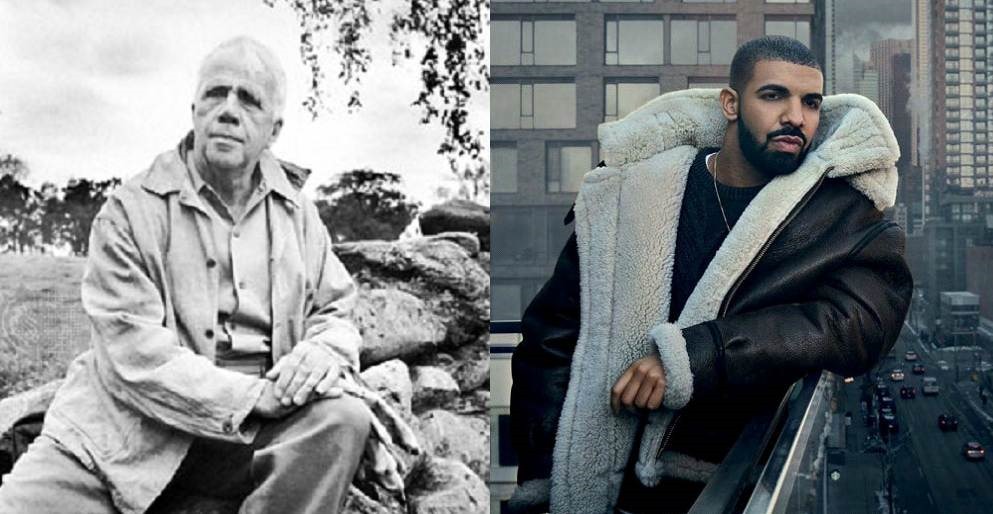
Life events are conspiring again to keep me out of my studio space to record new pieces — but it just so happens that I have this rocking Blues recorded back in 2007 with the LYL Band that’ll contrast with our pensive Frost meditation on work from last time. Today’s audio piece was made from Frost’s short poem titled “Fragmentary Blue,”  now recast as “Fragmentary Blues.”

Unlike Carl Sandburg or Langston Hughes, I have no idea if the 1914 vintage Robert Frost had any experience or appreciation of this Afro-American musical form. A quick search found nothing, even though Frost’s lifetime overrode The Jazz Age, The Swing Era, and even early rock’n’roll.

But as poet Langston Hughes soon discovered, the lyrical expression of the Blues was a vital format worth picking up. A first draft of this post included a long aside about the importance of this Afro-American Modernist form, but on second thought I’m going to take less of our time today so that we can focus on how Frost’s poem can be expressed through that form.

JFK and Frost

JFK: When you wrote “Come on mama, to the edge of town/I know where there’s a bird nest, built down on the ground” were you talking about what I think you were talking about? (wink wink).
Frost: No, you’ve got me confused with another bucolic poet, that’s Charlie Patton — but I believe that’s a philosophic statement about how erotic desire is both natural and elusive. Patton was tuned in open Spanish for that one.”

Blues lyrics often used a stanza format of three lines: one a statement, the second a restatement that may be the same, nearly the same, or subtly varied while still gathering intensity via repetition; and then a third line which can go in any direction the writer/poet/singer wants to take it, though it usually rhymes with the ending of the first two lines. It’s a variation of that ancient and simple poetic scheme the rhyming couplet, but with that repetition allowing for something extra in the balance. And there’s often an element of call and response in the lines: that choral rock, and roll back that Sophocles, Skip James, and Pops Staples could share.

So, let’s go back to our 1914 Robert Frost poem “Fragmentary Blue.”

Why make so much of fragmentary blue
In here and there a bird, or butterfly,
Or flower, or wearing-stone, or open eye,
When heaven presents in sheets the solid hue?

Since earth is earth, perhaps, not heaven (as yet) —
Though some savants make earth include the sky;
And blue so far above us comes so high,
It only gives our wish for blue a whet.

Not in Blues stanza form. Instead, ABBA, and I don’t mean the Swedish pop group.*  But Frost has made the center two lines in each stanza a sort of parenthetical, so that lines one and four are natural couplets and the middle two lines are already couplets that can stand by themselves. This means it was easy to turn “Fragmentary Blue”  into “Fragmentary Blues.”

Why make so much of those fragmentary blues?
Why make so much of those fragmentary blues —
When heaven presents us sheets of a solid hue.

Here and there a bird, or a butterfly.
Here and there’s a bird, or a butterfly,
Or a flower, or a wearing stone, or an open eye.

There’s some savants say the earth includes the sky.
Some say, some say, that the earth includes the sky —
And the blues so far above us, it comes on so high.

Since earth is earth, it isn’t heaven yet.
Earth is earth. It ain’t heaven yet.
It only gives a wish for blues a whet.

So there you go, via show not tell, we rock up Robert Frost in the Blues form. If you read the two sets of words closely, you’ll see something has changed. Frost’s “blue” on first reading seems a stand-in for beauty, while the Blues treats its namesake emotional dissatisfaction as something less than beauty. But, consider again. Frost’s poem says we miss the immensity of natural beauty in our all too earthward human act of trying to possess its emulations. That difference, that dissatisfaction — that’s the Blues. My adaptation only brings out that subtext more overtly. You can hear the LYL Band express Frost most blues-wailingly with the player gadget below, or with this highlighted hyperlink that will play the performance. Most of the better guitar notes here were played by Andy Schultz who played with the LYL Band for a few times, and Dave Moore will once more hear himself back when he could pound and roll on the (plastic) ivories.

.

*Is it too late in their career to suggest that they produce a trans-Atlantic Carl Sandburg tribute record? I’m available, and you need my audience of dozens to hundreds of listeners.