Another Child (“To Any Reader”)

When I used a Robert Louis Stevenson poem last July I wasn’t expecting to follow it up with another. When introducing his “Bed in Summer”  then I mentioned that writing poetry for children, as Stevenson was doing in his A Childs Garden of Verses,  seemed to reduce some of the fustian of a lot of Victorian verse.

So, when I happened upon this other example from that collection I was even more struck by the sensibility of this one. Though I had no reason to believe Stevenson was intending visionary poetry, today’s piece could almost fit inside of Blake’s Songs of Innocence  — though it was written a half-a-century after Blake’s death.
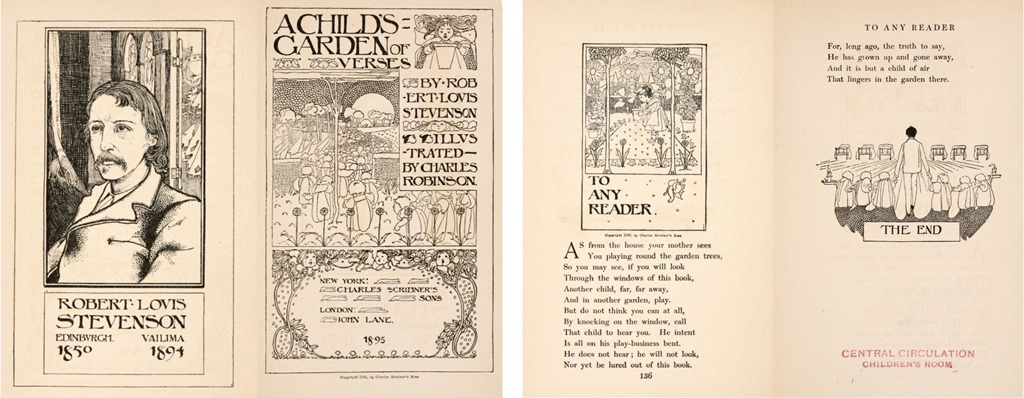
another child layout

Here’s one illustrated edition of the book and the original text with Stevenson’s title “To Any Reader”

.

What was the author’s intent? I first read it as Stevenson making a pitch that even if the poems in his book might someday seem quaint and old-fashioned, they could still relate to like-experiences of some future another child. Was this canny foresight on Stevenson’s part? Stevenson was only 35 when he published this book, so his own childhood memories should not have been all that outdated as he wrote the material. On the other hand, his childhood nurse (to whom the book is dedicated) raised him on John Bunyan, stories from the Bible, and tales of 17th century Scottish Covenanters. That may have made him aware from a young age that tales from past times could be transmitted to young minds.

I do recall encountering A Child’s Garden of Verses  as a young child in the mid-20th century, though I can’t say for sure where. Did someone read it to me in my pre-literate days? Was it a book from my parents’ library, perhaps a keepsake from their childhoods? Did I run into it while exhausting my tiny Iowa town’s small library children’s section?

I would not have minded if it was old-fashioned, for I was from a young age fascinated with the past. It could have seemed juvenile unless I came upon it very early in my reading years, but most editions were illustrated, and illustrations excited the ekphrastic in this young reader. Yet my recall on this is not that specific, I just remember that I had seen it. I have more recall of reading Stevenson’s Treasure Island  and enjoying that.

Oddly, when I finally looked this week, this is not the lead-off, introductory poem in the book. Instead, it’s the final poem — not the place to make the case to continue reading “To Any Reader”  who just happened onto the book. Instead, in this place, it’s a ghostly envoi, a reminder to the child (or to the adult reading to them) that they, their childhoods, will obsolete themselves.

As I did with Claude McKay a couple of pieces ago, I decided to adapt Stevenson’s words slightly for singing. Some changes were to make it less awkward to separate things into a series of sung verses. A couple of changes just fit better to my non-agile tongue. Most significantly, I devised a repeating coda to drive home a final summary to the listener. One subtle thing I did was a covert attempt to speak to my own child’s specific journey to young adulthood.

Another Child song with chords 1080

Here’s my version. Since I want to emphasize that other child of air, I also retitled the poem.

.

An uncomplicated folk-song style setting seemed appropriate. The chords today are simple for the guitarist, though the alt-tuning I used changes the sound of this simple chord progression slightly. You can hear my performance with the graphical audio player below. If you can’t see any player, I also provide this highlighted link which will open a new tab window with its own audio player.

From “The Windy City"

This Monday, Labor Day in the U. S., is a legal holiday which arose from the idea of a day to celebrate workers. Some see this holiday as being in conflict with May 1st, International Workers Day, but I myself have no beef with having two days to celebrate work and those that do it.

Poets and poetry are not, as a rule, oversaturated with attention to labor. Creative work such as writing is, in itself, labor — but the wages are so scant for poetry that it’s hard to see it as allied with such. Currently television and movie writers are on strike, but poets have little in the way of wages and rights to negotiate. If the weekend and the 8-hour workday were obtained through labor struggle, it’s hard to imagine poets picketing for a full honorarium for the 12-line sonnet, or chapbooks for sale on every bookstore shelf that stocks James Patterson books.

What I find less forgivable is that poets don’t write about labor as much as I think is due. Poetry’s Greatest Hits will tell us about mystery, death, love, war, dreams, desire, loneliness, family, friendships, every facet of our non-commercial relationship with nature, all the panoply of pain and joy. What poetry won’t speak of much is the third or so of our lives spent making or getting a paycheck.*  And I don’t think the situation for the subject of labor is getting better. Farm work, even if romanticized into shepherd tropes or the like, supplies many of the poems in the canon that speak of work. As the percentage of Americans engaged in, or even living among others engaged in that line of work decreases, we see fewer of those poems.

Around Labor Day or May Day, I often find myself dipping into the work of Carl Sandburg. Despite his less than illustrious education, not of the Ivy League but more a Row-Crop League college with hobo semesters, and attendance in The Front Page era of journalism, rather than sessions abroad and drawing room soirees. Sandburg was by intent a thoroughgoing Modernist artist, making it new as much as any of the early 20th century Americans, but his Modernist solutions and prosody get little respect currently. Maybe they’re right, though I find Sandburg can be effective for my purposes. Judge those things as you might, he does pay attention to labor and laborers as colleagues. He can portray all kinds of struggle in doing so, but also endurance, achievement, and harbored joy.

Before I get on to the piece I found in Sandburg to celebrate Labor Day, let me suggest a rough analog of the Bechtel Test.  Let me call it the Sandburg Test. To be clear, it’s not my suggestion that every poem has to be about work, about the things we do for our daily bread. But, if we are viewing an anthology or substantial poetry collection from a poet, to pass the Sandburg Test it has to have poems that deal with work in some substantial way. How does the speaker or characters in the poem relate to work? What are they doing that work for? What is it in presenting them that portrays something about life? What are the mysteries, sensations, and systems of that work?

What Sandburg poem did I choose? I picked a selection from the 6th part of a longer, multipart poem, “The Windy City.”   This one is sort of an extended revisiting of Sandburg’s Greatest Hit “Chicago,”  sometimes remembered as a boosterish paean to the great Midwestern American city, which it’s not — “Chicago”  is a poem about a city and a workforce in struggle. “The Windy City”  on the other hand is more mystic, and the section I chose is essentially a labor hymn. Physicists tell us that the things we see about us, solid things apparently, are in fact full of moving atoms and vibrating particles, their close motion making solidity. Sandburg’s windy city is such. The labor we celebrate on Monday, and do most every other Monday, is the gusty current that makes our world.

Carl Sandburg looks out on midcentury Chicago

Looks solid enough, but it’s made of something as transitory as work. Carl Sandburg looks out on mid-century Chicago.

.

My music for today’s piece is in my punk orchestral mode: simple musical structures making use of orchestra instruments and a few interlopers. You can hear it along with Sandburg’s words with a player gadget below. No gadget? Here’s a highlighted link, that’ll open even on Labor Day to present you with an alternative audio player. Want to read more of from the poem from which I selected today’s passage? Here’s a link to that.

Thank you for reading and listening. Thank you for the work you do when you’re not doing that. Yes, you may be paid for that, well or not, but our lives and communities are made out of that work. How can that not be mystical?

.

*My diagnosis of this avoidance is that poets may still feel an expectation that they should either be full-time poets earning a living from their poems, or if not that, rich enough to not need a “day job.” Their day jobs then are not poetic, and so don’t appear in their poems. Poets with academic jobs are a considerable middle case however. I suspect administrative policies and faculty politics still don’t seem poetic. Perhaps office-based work in bureaucracies is harder to press into non-humorous verse than the village smithy or a steel-drivin’ man?

I Was Blind with Hunger for Your Love (Summer Morn in New Hampshire)

A lot of the poetry I combine with music here was published around 100 years ago, making it clearly in the public domain for reuse. Given my age, some of the poetry from the Previous Twenties doesn’t seem all that old — after all, many of the poets’ lives overlapped mine — but some poets and poems look back, as I do now from my 2020s, to older styles of poetic expression, ones from an additional 100 years before the 1920s poet. That may be too much for some younger audiences I think.

Since poetry is at least partly about how  something is said, it’s not out of line for style to be substantial when we choose to read or listen to poetry — but, sometimes we might choose to “translate” poetry for performance to make it more immediate.

Here’s an example. I came upon this 1922 poem by Claude McKay while looking for summer poems. I’ve presented McKay a few times already here.  A figure stored away in the Tupperware container labeled The Harlem Renaissance, McKay’s poetry is still preserved and sometimes read — often the portion of his poems that speak eloquently about racism and the double alienation of being a Black Caribbean emigrant to the United States. Since these things are still factors in the 2020s, that supplies relevance to continue to consider them. A poem like his 1919 sonnet “If We Must Die,”   however formal in prosody, presents clear reasons to our current ears.

But McKay is also a passionate love poet.*  Now, to say the least, love is still a contemporary experience, so one might think his love poetry would also get more contemporary exposure. My casual estimate says this hasn’t happened. Yet.

Why not? This poem is significantly old-fashioned, 19th-century-like. Its sentences are poetic in an outdated style, they don’t flow casually in a spoken way. This is a style we might forgive in 19th-century verse if written back then, particularly if the poem is a Hall-of-Fame, “Poetry’s Greatest Hits,” poem — but not so much for a 20th century poet’s less honored selection.

Young Claude McKay

Don’t make the mistake when reading old poetry to think that the poets must be old too. McKay was just 30 when he first published this poem.

.

This poem also makes a mistake writers can fall into. McKay seems to think that leaving a surprise for the ending will strengthen the poem — that when the reader finally sees that surprise they will be happy to have waited for the poem’s context.

There are poems that work that way.**  To me, this one doesn’t. Coming upon it, one may not read through the facile but not necessarily compelling nature poem that makes up more than ¾ of the text. Therefore, in my “translation” for today’s performance, I’ve decided to create a refrain out of the poem’s final line, spoiling the surprise but urging the listener to consider the nature and weather report portions of this poem as reports of human desire and inner weather. You’ll hear how it works in the musical performance you can hear below.

Taking liberties like this is one reason I use public domain work: it’s now free for one to do with it what one wants. If you want to read McKay’s work as he intended it, here’s a link to the 1922 version. That link includes its own link to an even earlier published version by McKay, evidence that the poem’s author himself was trying to improve his poem’s impact.

Writers: if you are ever writing a surprise-ending piece, if you ever are withholding something from your reader or listener because you think it’ll be a grand or witty “Aha!” moment at the end, consider the alternative. The alternative here, the bringing out the key context that the poem’s speaker is viewing his summer night and morning “Blind with hunger for your love,” strengthens listener engagement I think, and it lets the listener see that the speaker/singer is just as attracted to the early rain-storm, sleepless-night portion of the weather, as the “miracle” of the subsequent sunny morning which is so incongruent with their present feelings. I’ve doubled down on that revision by making the newly refrained line the title too. ”Summer Morn in New Hampshire,”  as McKay titled it, is too specific yet generic in my hindsight judgement.

I did my best with the musical performance of this as a song. I enjoyed playing my big, heavy, 20-plus-year-old 12-string Guild guitar and weaving in the rest of a quartet of ringing and raining instruments. It’s not a humble-brag, but a statement of the song’s potential to say that this piece would benefit from a higher-skilled singer than I am. Perhaps my voice’s approximations can be heard as bringing an imperfect human immediacy to the words? You can hear the performance with a graphic audio player below (if you see that). No player?  This is a hyperlink that will open a new tab with its own audio player.

.

*Let me leave this final point to a footnote. Best as can be determined, Claude McKay’s erotic connections seem to have been with men. Given the homophobia of his time — or perhaps from artistic choice — McKay has written this poem, as he has many of his love poems, in an entirely genderless manner.

**This poem isn’t a sonnet, but it is “sonnet-ish,” and the popular English/Shakespearean sonnet conventionally expects a somewhat surprising summation in its final couplet.

Come August, September

The usual remit of this Project is to take words — somebody else’s words, words that were intended as literary poetry — and to combine them with original music in some way. Every so often, I’ll use my own poetry, but the journey there is similar, not like most songwriting where the songwriter will as likely as not begin with a tune, or a set of words that seem to emerge with a tune.

But I have written that way. No one can spend as much time with music as I do without having the music muse show up dancing with the lyric muse sometimes. Today’s piece is an older composition, one that I considered posting for the Parlando Project since its beginning years ago. You haven’t seen it before today because of that difference, because it always was a song.

I recall distinctly how this song began. I was reading an interview with Brandon Flowers, the lead singer of the modern rock band The Killers. In it he wanted to make plain that for all the traveling showmanship and flash of that part of his life, he was a guy who grew up in a small town where one could see a farm tractor driving down a main street as an unremarkable occurrence.

Bang!

As I read that I thought of the small mid-century Iowa town I grew up in. A tractor on main street? Yes, that had never registered as unusual until this other person made a point to remember that. A version of this song came quickly from that moment of coincident remembrance. Taken back to my mid-century small town in my mind, I could see this teenage schoolkid who had a springtime crush on a fellow classmate, but who couldn’t get up the nerve or words to speak to her of his feelings. And then it would be summer vacation. In my town, my school, in my time, most of the kids lived in the surrounding countryside and disappeared from the town outside of the school-year.

And eventually, as I saw this kid in my mind, this time of year, late August, would arrive. He’d have another chance to speak to her. Would he have the courage? He knows half-way at least that he might not. Does he? We never find out.

Good Tractor 5

Another AI generated image. I couldn’t get the AI genie to generate one of the tall, narrow farm tractors I remembered from my youth, so I had to settle for this.

.

A version of the words came out fairly quickly as I inhabited that kid’s mind and the tune was nearly there simultaneously. The somewhat odd phrase that became the refrain and title was there from the beginning. I don’t know why that phrase came to me. Researching, I see there was a 1961 Rock Hudson movie with the title Come September.   Not a small-town setting, more the Italian Riviera. Our little town did have a movie theater then, or that film might have played on our black & white TV as a “movie of the week.”  Bobby Darin was also in the film and wrote music for it, including a title-tune “Come September.”*  That title laying fallow in my unconscious is plausible — but whatever, I like my variation, as the overlap from late August to September seems a distinct “month” on my calendar, and perhaps yours.

Maybe I should have performed this with a full rock-band setting in honor of The Killers, but my mood and logistics brought this voice and acoustic guitar version out instead. You can hear it with the graphic audio player below if you see that. No player? This highlighted link will open a new tab with its own audio player.

.

*I checked this morning, it was an instrumental.

Langston Hughes “Summer Night”

All too often there is someone dying that interrupts the summer. In my neighborhood, a musician* named August — even doubling the metaphors, named August Golden — was shot and killed last week. His friends speak highly of his kindness and good heart, and we don’t know exactly why he was killed when someone shot up a house concert in a backyard, wounding several and killing him. The story is the shooter came up, said nothing, fired a bunch of shots, and escaped running down an alley. There’s speculation that the attack might have something to do with the young gay and trans audience at the concert, and so — beyond the don’t-knows — that community has fears that this could be.

I’m thinking of August Golden on the anniversary of the poet Lorca’s killing in the midst of the Spanish Civil War. Revisiting Lorca’s story today to see if there was anything new — for example there have been multiple efforts this century to locate where the celebrated poet’s body was buried — I see that there’s also no agreement on who killed him in 1936 or why. It could have been Lorca’s politics, or because Lorca was gay, or even some personal dispute.

Today’s text is not by Lorca, but by his American contemporary Langston Hughes, a poem he called “Summer Night.”   You can follow along as I discuss my impressions with this link to the poem. Hughes doesn’t say what summer month this night was in, but it feels very much like August to me. In America, and its northern parts, August has endings all over it. Long daylight hours recede. The freedom of summer for the young approaches the beginning of school weeks. Autumn and cooler weather beckons, and I’ve started wearing a jacket on some early morning bike rides.

Langston Hughes in front of graphic

Young Langston Hughes, writer and poet, and one of the early proponents of “Jazz Poetry”

.

Hughes’ poem seems like that August of calendared endings, because he starts out with a litany of “lasts” in his poem. As in another Hughes poem I’ve presented here,“Railroad Avenue,”  what he sees is as much what he hears, and it’s full of music of his turn of the century youth: “last” pianos, a “last” wind-up Victrola record player playing Jazz, and the cries of others — or their absence — with a “last” crying baby ceasing to silence. This section ends with the whispers of a heartbeat.

Hughes’ poem continues with its speaker (for simplicity, let’s assume it’s Hughes) now refraining on the word “empty.” What’s this night empty of?**  Music and the companionship of voices. Hughes could have spent the entire poem describing tossing alone at night, but he doesn’t. He spends almost as much time on those things that depart in the poem. Maybe mechanical pianos don’t play in your neighborhood. Maybe it’s break-beats leaking from cars or punk rock not Victrolas, or the house on my corner that plays Mexican music on the weekend as folks gather under an awning on the front yard. This is what we miss when dying interrupts August. This noise that keeps us up, keeps us living.

For my noise tonight, I wanted to summon remote, leaking, night music. I decided to take a cue from the poem and use piano, but as I worked on the piece with my limited keyboard skills I chose to depend on sound design more than other musical ideas. The piano parts are simple triads, but mixed in the grand piano sound is a subtle melding of electric piano. And for the bass part, which was the musical line I followed when speaking Hughes’ words, I decided to mic my Epiphone Jack Casady hollow-body bass as if it was an acoustic instrument and to mix that with the electric pickup output the bass was designed to use. You can hear the result with the audio player below. No player?  This highlighted link will open a new tab with its own audio player.

.

*The stories told about August Golden make him out as an embodiment of DIY punk, the whole idea that you learn to make what you want to have happen by making it happen. I recently wrote of the same spirit as a large part of what animates this project.

**Expanding on that final section where Hughes also talks of desire and “Needing someone, something.” Hughes sexuality is something of a mystery. There are some who believe he was gay, and others who thought he was largely asexual. This poem was included in his first poetry collection published while Hughes was in his twenties, and we do know that in his Victrola-era youth he yearned to be a writer, while this was strongly discouraged by his father.

Warm Summer Sun, the 700th Parlando Project piece

This is a modest little piece — a small number of words, a simple musical setting — so it may seem odd to choose it as the 700th audio piece from this Parlando Project. Well, this whole project is odd, isn’t it? You, for reading this and listening to the audio pieces are unusual. I’d say I’m odd too for taking the uncounted hours this Project has taken: looking for available words that strike me as worthwhile for performance, composing the music, performing most of the instruments, recording them, and figuring out what to briefly say about my experience of these words.

I plan to say more about reaching this milestone in a follow-up post, but I will put that off so that we can get to American author Mark Twain’s words without overwhelming them with my particulars.

I came upon this as if it was a poem written by the famous novelist, something I took immediate note of. Poets who publish novels at least once or twice aren’t extraordinarily rare. Established novelists who take to writing poetry may be slightly more unusual, but there are examples. The two arts are unlike enough that the list of those whose expression in both fields remain worth considering exists, but that list isn’t likely to take more than one page. But Twain’s poem was specifically unexpected. If you have followed this Project completely for a while you will have encountered most of what might be considered poetry by the great novelist Twain. One was a little monolog that performs easily.*  That piece is a still-acute skewering of poète maudit literary stances. Twain’s other poem used here was a satire produced by a character in a novel who wrote rafts of terrible elegies, a poetic form that Twain’s era loved more than any other: Tennyson’s book-length, multi-part, In Memoriam  elegy was a Victorian best-seller. Twain’s USP while he worked in the book trade was instead books full of life and absurdity written in garrulous American vernacular. Yet, here’s a poem by Twain that is:

Heartrendingly sincere
An elegy
Short enough to be engraved on a headstone

Where did this come from? It has both a biographical and literary inheritance. The biographic one: the headstone it was engraved on was for Twain’s beloved eldest daughter, a talented young woman who died at age 24. If you’ve got a few minutes, click this link and read her Wikipedia entry, so that you can mourn along with Twain. The literary antecedent, who Twain credited on the headstone as the author, was a contemporary poem written by an Australian expat-to-Scotland named Robert Richardson. Richardson is next to unknown and I’ve only glanced at the collection in which his poem titled“Annette”  appears. He was a newspaper and periodical poet who wrote (as did Twain) for popular audiences — but unlike the Twain we best remember today, he is (at first glance) conventional in his literary diction and full of the usual Victorian sentiments. Richardson’s “Annette”  takes up three pages and many stanzas, and Twain’s adaptation uses only the final stanza. Twain’s poem is 27 words long. Only 20 of those words come from Richardson’s stanza.

Here’s Richardson’s stanza followed by Twain’s poem as it appears on the headstone:

Warm summer sun, shine friendly here;
Warm western wind, blow kindly here;
Green sod above, rest light, rest light,
Good-night, Annette!
Sweetheart, good-night!

Warm Summer Sun Twain headstone

Here’s a link to a page where I found this picture of Olivia Susan Clemens’ headstone in Elmira New York. The link also includes the full text of Richardson’s Annette.

.

What are the alterations, which I’ll presume to be Twain’s, and which I assume are changes, not Twain using a different version than I found in an 1893 Richardson poetry collection?

“Friendly” is dropped from the description of the sun. “Kindly” is moved to the sun in Twain. “Softly,” a more objective adverb is used for the wind by Twain. Imagists (who’ll arrive only a decade after Twain’s poem) would have preferred kindly to be dropped entirely for an objective word, but on balance Twain is just slightly more modern. “Southern wind” not western may be localizing weather patterns between Richardson and Twain’s locales, but making this change shows a careful choice is being made.

Both Richardson and Twain make the choice to move from the above world of the living to the below ground world of the buried in their stanzas. Richardson has the sod “resting,” personifying in Victorian fustian. Twain has the weightier and more objective “lie.” Small difference, but I hold with Twain’s choice.

“Dear heart” for “Annette” removes the inapplicable specific from Richardson. In the final phrase Twain again adds power in my judgement by refraining “good night” rather than using the specific Victorian term “sweetheart.” Although Twain intended his poem as an inscription, the refrain adds to the effect when sung in performance.

Tiny poem, tiny changes, but of course the greatest difference, one made by a novelist (of all trades) was to presume that these spare 27 words from the end of Richardson’s longish poem make an apt summary of the situation: a beloved, talented daughter struck down by illness in her youth. This may have been a practical choice: carving it on a headstone (though larger headstones with longer inscriptions are found in Victorian graveyards). Intent and practicalities aside, I was moved.

You can hear my performance of Twain’s epitaph/elegy with the following audio player. No player? This is a backup link that will open a new tab with it’s own audio player. As I said, simple music today. Just me playing a nylon string “classical” guitar, the kind of instrument that I first played when I started out.

.

* Besides being credited by Hemingway as the progenitor of “All modern American literature,” Twain pioneered what today we’d call standup comedy.

Lightly, from Aldus Huxley’s novel “Island”

Death is a funny thing, mainly because dying is treated so damn serious. Have you ever asked yourself this: are you afraid of death or are you afraid of dying? If you answer, “Well I’m afraid of death.” I ask you to further question yourself. Non-existence is easy, a gimmie, a non-task. Dying on the other hand? You can fear pain, suffering. You can fear what is left unremedied, unfinished, left undone. One can fear you will not do it well. That you will show too much or not enough emotion. You can fear you will do it too slow and draw out suffering — or have it happen too fast before one can set an agenda for the occasion.

This weekend is the anniversary of the official launch of the Parlando Project in 2016. This weekend is also the anniversary of my late wife’s death decades ago. Last weekend I learned that a poet/blogger who I’ve followed through much of the seven years of working on the Parlando Project has received one of those months-to-live diagnoses.*

In-between those weekends, someone posted the text I’m going to present today by Aldous Huxley. Here’s a link to where I saw it. The poster knew it as if it was a poem titled “Island.”   Instead, it’s a passage from Huxley’s last book, a novel called Island.  In using this as text I decided to call this short excerpt after a repeated invocation in the passage: “Lightly.”

I’m not very well-read when it comes to novels, but as a teenager I read Huxley’s best-known book Brave New World.  I loved the SF world-building of it even if I likely missed good portions of the satire at that young age. After that I tackled Island  as well, promoted on the paperback cover as an updated companion to Brave New World.  I don’t recall much about Island,  certainly not this passage. What could I remember? That Island  had a bunch of ideas to present, but since I read it so long ago and so young, I retained nothing else. Looking at synopsis’s online this week, it appears that Huxley was trying to synthesize a long fascination with Asian spirituality and philosophy and apply that to his contemporary mid-20th century Western world.

Island cover

I think this is the edition I read as a teenager

.

Today I was able to look at a copy of Huxley’s novel, and the passage, presented as I first saw it in broken lines as if it was free verse, is indeed a block of prose within it. I said Island  was Huxley’s last novel. He died of cancer a year after it was published.**   I don’t know if Huxley had received one of those “months left” estimates as he worked on Island,  but the passage spoken by a character in his final book could be the author speaking from, or to, himself —  a reminder of how he felt he should approach dying.

In the book it’s spoken to a woman who is dying, attended by her husband and family. As I read the larger section the excerpt was from, I thought of being beside my late wife as she was dying. Yes, in essence, the teenage me with my youthful experience, could not have read the same book.

I was only able to do that reading for context this afternoon, a day after I had already completed the new audio piece. Maybe that’s of little matter. After all, even shorn of context as I saw it online, it immediately resonated this week with my thoughts for my distant faintly-colleague. Perhaps you will find resonance as you hear it too.***

I made a couple small alterations to the excerpt to generalize it. Then I composed the music for it on acoustic guitar, playing that instrument in a somewhat pianistic style,**** and then combined the two in the performance you can hear using the graphical audio player below. No visible player? This highlighted link will open a new tab with its own audio player.

.

*This poet and blogger, Robert Okaji, has been mentioned elsewhere here in the Parlando Project blog. Besides being a fine poet in general, Okaji helped me by example and brief comment to continue developing my penchant for freely translating classical Chinese poetry, something he also did. Sometimes we would adapt the same poems from the same literal glosses, producing two facets, two impressions, of the Tang Dynasty masters. I never met Okaji, though I’m glad I got to see him read his work online once during the pandemic.

Here’s a link to his graceful announcement of his diagnosis.  Wishing you the best living Robert: lightly.

**A darkly comic touch to Huxley’s death. His fame from Brave New World  was still considerable in the Sixties. After all, in many ways, his book was more relevant to the US/British culture in that era than its quasi-competitor 1984.  Another late work of his, The Doors of Perception about the benefits of psychedelic drugs (also a subplot in Island)  was a pioneering examination of that idea — and the source for a Californian rock band’s name a few years later. But instead of Huxley getting the few days of reassessment that would normally have attended his death, he got bupkis. You see, he died on November 22nd, 1963, the day the American President was assassinated. The world’s news-hole was filled with non-literary matters.

***As it turns out, this excerpt has been shared numerous times that I found when I searched for information about the words this week. Sometimes the passage retains its prose layout, other times it’s presented as if it is a poem. A small point, but most of the online quotes have slight wording differences from what I saw in a 1975 edition of the book I looked at today.

****By using the whole neck of the guitar and alternate tunings, one can expand the pitch and timbral range of the acoustic guitar beyond that of the more folk-song style pieces I present here otherwise.

William Carlos Williams’ Summer Song

One of my favorite Indie rock band names is Yo La Tengo. The name comes from a convention that was formulated decades ago as talented non-English speaking players began appearing in North American baseball teams. “Yo la tengo!” means “I’ve got it!” – a useful term as two or more fielders with their eyes fixed skyward tracking a fly ball might otherwise collide. In such a situation, the most confident player needs to call off the others who also think they might have a chance at making the play.

Today’s piece is by William Carlos Williams, who grew up speaking Spanish. It was published in Williams’ 1917 collection Al Que Quiere!   Wikipedia quotes from a later memoir by Williams where he translates that phrase as “to him that wants it,” a cry that he associates with playing football (AKA soccer). I don’t have access to that memoir, but he expands on that definition to make it sound like it’s an in-game cry meaning “I’m open, I’m confident, I have advantage on the defenders, get the ball to me!”*

Odd to think of WCW as a young athlete. I always picture him in his later years, the time that overlapped my lifetime, as an older man.**  But there is another element of his nature in that cry: if not exactly a poetry ball-hog, he seems to have been a poet who was not ashamed to make claims for his artistic validity. He got the Modernism bug early, and went right on to the business of “Making it new” even before this collection was published. Confidence. Or stubbornness.

William Carlos Williams’ poem “Summer Song”  starts out straightforward, with the Moon still visible just after dawn. If you’d like to follow along, here’s a link to the text.***  WCW is right-off attributing personhood to the Moon. If self-aware, the Moon must know it will soon be washed out by the rising sunlight, but Williams says the Moon is indifferent to that, it goes on smiling, for even if it’s a “wanderer” it also seems to understand that it will come to a new place, a new town, a new day, soon enough.

In the final section I’m a bit less clear at how surreal WCW is going. Let’s presume he’s the poem’s speaker, the man observing this moon in the summer morning. I try to picture the image he portrays. He says he might buy a shirt the color of the Moon (white? gray? silver? ruddy?) and accessorize it with a sky-blue tie. I’m puzzled. Wouldn’t the blue of the sky be the field (the shirt) on which the moon would (whatever color) be the tie in the foreground? Is he purposefully reversing foreground object and background field? Perhaps his intent is to say that the wanderer moon is really bigger than the present blue morning sky?

decalcomania by rene magritte

Painter Rene Magritte reversing field.

.

I’m unsure, but his final line is clear — if he too may be overshadowed — he may wander too, even if fading into invisibility, until his time might come. And here we are, some 106 years later, and I’m singing his words in front of a rock quartet today. You can hear that performance with an audio player you’ll see against the field of this web page. Or not? Well, then this highlighted link will tie you to a new tab which will supply its own audio player.

.

*I’m unable to find any confirmation in a quick search that this is some kind of standard on-field player cry. The Wikipedia excerpt from WCW explaining it also goes on to have him say that “I was there willing to pass the ball if anyone did want it.” So, is “al que queire” the cry of the player who wants the ball — or the cry of someone putting up a long kick in hopes one of their teammates will be there to receive it, a soccer equivalent of an American football “Hail Mary pass?
Again, Willians was like that. He was willing to write and to publish, put himself out there, without the level of attention and praise that some of his Modernist contemporaries received during their lifetimes. Anyone know anything more about this Spanish phrase?

**Also like the band Yo La Tengo, Williams was based in New Jersey.

***Here’s a link to an earlier version of this poem as published in 1916 in Poetry  magazine. As I improvised while singing, unaware of the this alternate version, WCW extended and refrained his ending there.

Bed In Summer

Today’s text was written as a children’s poem by Robert Louis Stevenson. What it notices about the enticing longer days and late sunsets of summer is not limited to children however. I suspect many adults too find it harder to wind down when it’s still light and pleasant out.

Bed In Summer

They say I’m supposed to go to bed, but there’s birds out there, and where’s my phone or my Nintendo?

.

Stevenson published this in 1885 when some things of the earlier 19th century were wearing out. The voice of the child in the poem says they were used to arising from bed by candlelight in winter, and now they are going to bed in the still-daylight of a summer evening. How common was candlelight in a child’s room when this poem was first in print? Gas lighting had given its name to that age, and electric light was soon to become common. The adult Stevenson likely knew of such things, as I read his family business was lighthouse engineering. Perhaps Stevenson was recalling his own childhood, when humble candlelight was the norm? The collection that included this poem, A Childs Garden of Verses,  was still in circulation in my mid-20th century childhood. I guess we young readers just translated the lighting technology, figuring that poems were from olden days when open flames in kids’ rooms weren’t problematic.

One thing Stevenson’s poem might have gained by being aimed at children is that it’s delightfully spare and unfussy. The adult verse of 1885 was often not so, but here there are no classical allusions, no high-flown metaphors, just that memory of candlelight, an evening’s sunlight, some active birds, and footsteps on the street. The poem is not idealized at all, instead it’s simply present in the child’s conundrum.

I performed it with a 12-string acoustic guitar, an instrument I always want to keep around in addition to the more common 6 string guitar. My music is simple and unfussy today, as is fitting for Stevenson’s poem. You can hear it with the audio player you should see below. No player? Some ways of viewing this won’t show it, but this backup highlighted link will open a new tab with an audio player then.

.

.

Helen Hunt Jackson’s “July”

I can’t help it — actually I do  try to help it, but sometimes I can’t. I was in a movie with my wife, the polemical Emily Dickinson biopic Wild Nights with Emily,*  and they introduced Thomas W. Higginson as this nincompoop who couldn’t discern the poetic genius of Dickinson compared to the kind of poetry he preferred. For an example of the latter, the filmmakers briefly gave us Helen Hunt Jackson as a prim, forgettable, mediocrity.

I nudged my wife, “Jackson was better than that” I murmured.

This is what happens when you’re married to someone who likes to look in the odd, unswept-out corners of poetry’s storage shed. Jackson was a childhood classmate of Emily Dickinson. Jackson left for marriage to a brilliant engineer, who Emily then met and sorta-kinda-maybe had a crush on. Jackson’s husband was killed in an explosion working on a secret torpedo weapon during the Civil War, and widow-Jackson went on to a substantial literary career of her own with poems, novels, and early activism for Native American rights.

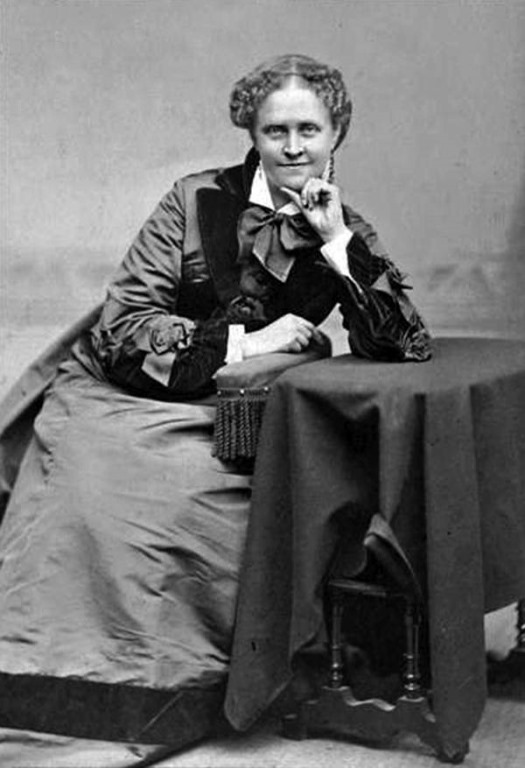
Helen Hunt Jackson seated

mid-19th century photographs often conceal their subject’s personality, which makes this one of Helen Hunt Jackson a bit special I think.

.

No, she’s not as original as Emily Dickinson, but the congress of poets who could claim that level is small even now. She understood Dickenson’s worth enough to plead with her childhood friend to publish — and though it appeared anonymously, she did include the only Dickinson poem to be published between hard-covers during Emily’s lifetime within an international anthology she produced.

One part of Jackson’s poetry that can be found online is a sonnet series on the months of the year. A couple of years ago I presented her August sonnet, and this summer I’m ready to give you her July sonnet.

Like Dickinson, these poems include a close examination of nature, though I don’t sense here the notes of humor often found in Dickinson’s nature. In Jackson’s July example, the flowers mentioned are in danger from heat and drought, something that seems contemporary in my own midwestern summer. Only the poem’s water lily seems immune from the danger.

You can hear my musical performance of Helen Hunt Jackson’s “July”  with the audio player gadget below. Don’t see the player? This highlighted link will open a new tab with a player for you. Want to see the text of the poem? Here’s a link to that too.

.

*Released between the more scrupulous A Quiet Passion  and the joyously anachronistic Apple TV series Dickinson, Wild Nights with Emily  was the less fully realized, perhaps due to a lower budget. Its broad characterizations were intended in the service of satiric exaggeration. The film’s central point is to portray the often-suspected erotic bond between Dickinson and another childhood friend and confidant, Susan Gilbert.