The Route of Evanescence

Here’s another little mystery, a riddle inside a riddle, which makes up a new song using the words of Emily Dickinson — but first a little of me sounding like a regular blog that talks about itself.

As assured time to work on this project has largely disappeared, I’ve been turning to simpler compositions and quicker realizations of them to cope with this, but over the past few months a number of pieces have sat in limbo, waiting to be rediscovered, waiting for decisions to be finished or abandoned. In going through some of these this month and I came upon a recording session for “A Route of Evanescence”  from last August.

I recall the session. It was just me and a couple of acoustic guitars, with access to my quiet studio space. I had some advance notice, maybe a day or so, that I’d have that time. On the hurry-up, I prepared a number of compositions to record, and when the day came, I set about laying down tracks singing and playing that pair of acoustic guitars. I’m not an exact or exacting guitar player by temperament, but when I haven’t played as much, my old hands produce more imperfections. None-the-less the limited time meant that I pressed on. I think I may have recorded basic tracks for at least two or three tunes that day. It’s likely that I’ve already presented at least one of the others here, but not this one. Why?

I might have blanched at releasing too many acoustic guitar tunes in a row. Despite my limitations I like what I can do with that instrument, but “like” means that I could fall into doing that over and over, and my temperament also doesn’t like doing that. I might frustrate you a little* by jumping around musical goals and genres, but a bored artist won’t interest an audience either. Or maybe I had some songs more distinctly about summer that I wanted to get out before the end of the season, and so this one was set aside?

Listening again to the raw tracks I thought it sounded pretty good. It’s harmonically different from some ruts I fall into, and the playing and singing is at a level that represents what the composition is. I may have thought I’d record some additional tracks, build out a more elaborate arrangement back then — but it stood by itself when I listened this month. Therefore, I mixed it and made it ready for distribution. **

route of evanescence

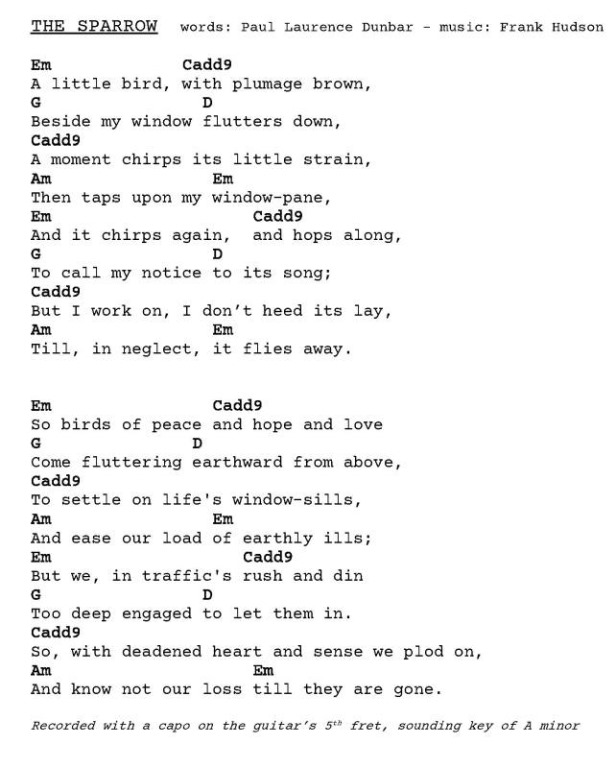
Here the chord sheet for today’s Chimera. That 2nd inversion G is a neat sound.

.

And then, as I went to prepare this blog post, there was one additional surprise. I thought it was one Dickinson poem that I performed back in August, the one named in the recording files, but the song was made from two: “A Route of Evanescence”  (F. 1489) and “Ferocious as a Bee without a wing”  (F. 1492).

Why did I combine them? I don’t remember. They sound good as a combined piece, though doing so may confuse Dickinson’s intended mystery, because both appear to be riddle poems. As a poetic or sung genre, the riddle has a long tradition (folk music, going back to the Middle Ages, has a bunch of them). The lyric gives you hints that don’t exactly make sense until you figure out, or are told, what the subject or answer of the riddle is. “A Route of Evanescence’s”  answer/subject is the ruby-throated hummingbird. “Furious as a Bee without a wing’s”  may be a honeypot ant.***  The riddle poem, and Dickinson’s examples of that, are antecedents of the early-20th century Imagist poem, where the moments details are exact, but inference or the title may be necessary to interpret the details meaning. Evanescence, as in the charged moment, is part of that Imagist creed.

Both of these are later Dickinson poems, written in the late 1870s more than a decade after the vast majority of her work written in the 1860s. Dickinson by then may have been like me, writing shorter and shorter — sometimes on scraps of envelopes or the back of food packaging in her case — trying to find autumn creation in the midst of life.

To hear this Chimera song combining a hummingbird and a honey ant, use the audio player gadget you may see below. No player to be found?  This highlighted link will open a new window with an audio player.

.

*Those I frustrate more than a little likely aren’t reading this. I keep thinking there are a goodly number of listeners who’ve heard one to a few of the Parlando Project audio pieces, but finding even a single ill-tasting example, leave off listening here for something elsewhere where they expect consistent rewards.

**I use an audio streaming service that is designed for podcasters, who are typically long-form talkers about their subjects. I could do a talking podcast, more or less replacing these written posts about the exploration that makes up this Project, but I don’t see the demand. So, the Parlando Project podcast is just these musical performances you see at the bottom of the blog posts. You can subscribe to or browse the last 100 or so Parlando audio pieces on most places you can get podcasts — except for Spotify, which for some reason they never shared with me, dropped the Parlando podcast distribution from their podcast section a few years back.

***A fascinating class of creatures that I knew nothing about. I’m not yet even sure if a species of it was found in Dickinson’s 19th century Massachusetts, or if Dickinson knew of this insect. This poem seems to use many similar words to another very short Dickinson poem (F. 1788) that is the penultimate poem in the Franklin listing of the complete Dickinson poems. However mysterious, it’s an image Dickinson returned to.

Van or Twenty Years After

One of the interesting things about 20th century Modernism was that so much of its propagation seems to be based on a handful of pollinators who migrate from one place to another. Some of these pollinators are known but little-read today, others lesser-known, their names themselves faded from cultural memory.

I suspect Gertrude Stein fits into the first group. As a personage, often handily viewed via Picasso’s painted portrait, she remains known. Her main location, early 20th century Paris, remains revered for its scene, and her salon there filled with Modernist paintings can’t be left off the maps as Americans in Paris then gravitated to her. We can add to that notableness, that as the fluent domestic partner in a long-term relationship with another woman, she remains to this day something of a gay icon.

But is she read? I suspect her The Autobiography of Alice B. Toklas  retains interest for its witness to the era. Her novels? Not sure they’re read much beyond scholars — and maybe they’re under-read even there. I gather her poetry remains controversial in this sense of the word: it’s spoken of in passing, its unusualness taken stock of — and after that its import is generally dismissed. When it was new, Stein’s poetry was often treated as a breathalyzer test. If you heard it and took it as meaningful or important you must be an intoxicated acolyte of Modernist excess. I don’t know if we’ve moved on from that stance. We may forget Hemmingway was a Modernist nowadays,* but we can never see Stein as anything more than an Modernist provocateur.

Reading Stein’s prose-poems today we still find them sounding unlike most literary poetry of the present. If we’re reminded of anything, it might be Dr. Seuss books for early readers, full of repetitions rhythmically repeated.**

Sometime in my Twenties I was curious about her work, part of my early interest in Modernism and the movements that emerged from it in the last decade to be called The Twenties. I remember plowing through one or more of her novels*** and reading what of her poetry I could find, out of consideration that as an experimentalist she might have some discoveries I could put to use in my own writing. What do I remember from doing that a half century ago? Not so much passages or particular elements, more an idea which I continue to hold for: that the way we use language to express reality and consciousness has been constrained by expectations and convention.

What remains of that interest in Stein now decades later? I enjoy her in limited doses because it still can break those expectations on the floor, and stomp on the broken fragments in time to a word-music I can enjoy.

Stein-Van Vechten-Dodge-Seuss

Gertrude Stein, Carl Van Vechten, Mabel Dodge, Dr. Seuss. First 3 pictures are photographs by Van Vechten.

.

I don’t know how much of that old interest of mine my friend, poet, and bandmate in The LYL Band, Dave Moore remembers, but when we got together earlier this fall to record some new things, he broke out this Parlando-worthy selection from Stein’s prose-poetry portraits of those she had met and interacted with. I asked him what he’d want readers/listeners here to know about “Van or Twenty Years After,”  and this is what he wrote back:

To avoid Morrison conclusions, I might shift the title to Van & Stein (Iowa boy made weird) — otherwise, references to Mabel Dodge in a history of first American surrealists, found in the library free stack, made me seek out the Gertrude piece about her, which turned out to be in a collection featuring this piece referencing her friendship with Van (sheesh my brain won’t pull up his name, I’m sure it wasn’t Dyke or Heusen), from which I excerpted this section delighted the way it concluded with a joke, then when I presented it to Frank I was incapable of delivering the sound of repetitious notes I had in my head, so anything salvageable here is probably due to Frank’s remixing skills.”

So, who’s the man the Van in Stein’s piece? Carl Van Vechten. Like Stein, Vechten was another of those Modernist pollinators, and he was an early and ardent proponent of Stein’s writing. His name, his own writing? By now he’s largely fallen into the second group, as Dave’s honest stumble testifies. Myself? I knew his name from my interest in Modernism, but nothing of his biography or work until I began to run into him as I read and studied more about the Harlem Renaissance which he was intimately involved in.****   It was only then that I discovered where he was born and grew up: Cedar Rapids, Iowa. And the Mabel Dodge Dave mentions? If you were to cross-reference Gertrude Stein, Carl Van Vechten, and Mabel Dodge’s blue links in their Wikipedia articles, you wouldn’t have to make more than one Kevin-Bacon-jump to encompass the whole Modernist enterprise in Europe and the United States. Pollinators.

After all that history, some of it often forgotten, we’re left with Stein’s words. Here’s a link to the whole prose-poem portrait which Dave took his segment from. You might enjoy them as word-music not having to judge them, or risking them replacing other poetries you enjoy. I did when Dave performed them. You can hear that performance with the graphical audio player below.  See no player? This highlighted link will open a new tab with an audio player.

.

*We’re likely to charge Hemmingway with a lot of other sins — most of which he committed in flagrante — while forgetting his successful revolutions. Hemmingway, the young writer forging his style, was one of those who sought out Stein in Paris.

**Dr. Seuss (Theodore Geisel) likely knew of Gertrude Stein from the circles he ran in. I did a quick web search and found no instant citation of any considerations of a stylistic influence there. I can’t be the only one this has occurred to.

***An admission: I’ve never been much of a novel reader. Most book and literature lovers can embarrass me by exposing my lack of chair time with novels.

****Van Vechten wasn’t just Iowan, he was white. Some early Modernists recognized elements of Black and African culture as aligned with their Modernist project, and some young Afro-American writers and artists felt the same way. Modernism was not immune to racism, but this cross-pollination brought attention and prestige to Afro-American artists and art. This connection had and has its strained and strange elements — no doubt about it — but it’s important.

Another connector here: Van Vechten was bisexual, so were some of the members of the Harlem Renaissance (though some variation of The Closet was usual then).

The Dumb Soldier

I spent Thursday recovering from a brace of winter vaccinations. I was tired and achy enough that I even missed attending my treasured monthly Midstream Poetry reading, but besides whatever mojo the shots might give me from winter respiratory crud, it made me grateful upon waking up Friday with my usual level of old-guy energy. I took a crisp 34 degree F. bike ride for a veggie sandwich and tea at a local bakery, and then spent a good deal of the day finishing some live LYL Band recordings from last September. Only then did I recall that I should do something for Veteran’s Day — or Armistice Day as it used to be called here in the United States. Armistice Day is still the name in much of the rest of the world that experienced WWI, and perhaps because I’ve been thinking a bit more about British poets this week, I quickly settled on two poems by British authors.

The post just before this one, Housman’s “Soldier from the wars returning”  was the first poem I wanted to do, and it’s a straightforward poem of simple gratitude for a veteran’s service. The second one is a little stranger, and I made it stranger yet. Can we be sure Robert Louis Stevenson wished his poem “The Dumb Soldier”  to be read as a whimsical piece about a child’s toy? He published it in A Child’s Garden of Verses  after all.

There were no sensitivity readers for children’s books then,* but the nature of the poem’s story is not benign. It starts right out with the poem’s speaker burying a soldier, which from the text alone we don’t know yet is a toy. When we read “leaden eyes” we might get the hint that it’s a cast metal toy soldier — but if we were to hear this poem as I performed it, without context, sung by an adult, even that detail might not tell us clearly what is going on.

I leaned into that strangeness. I trimmed a couple of stanzas for better performance length and chose to truncate the final one, leaving off the reveal that this is a toy soldier that will return to the child’s shelf. This left this a more ambiguous buried soldier then unable to tell us anything about what they’ve seen.

The Dumb Soldier

Here’s the chord sheet for my version of Stevenson’s poem. To read his original text, here’s a link.

.

Although written decades before the first Armistice Day in 1918, this mode of the silent war dead is clearly apt for that holiday as celebrated outside the U.S.**

It was late Friday night before I was ready to perform these two poems as songs. I had music written, and for practicalities sake, I was able to quickly use my studio space to record the pair of songs with just acoustic guitar for accompaniment. Neither of these are perfected or sophisticated performances, they are more or less what you’d hear if I was to present them off the cuff. You can hear my version of “The Dumb Soldier”  with an audio player below, unless you don’t see any such player. Some ways of reading this blog won’t display that, so I give you this highlighted link that will open a new tab with an audio player in those cases.

.

*”Dumb” used as a term for someone who cannot speak is now a highly impolite term. Given the sacrifice and suffering of war, that term’s objectionableness might be a lesser concern.

**Since the U.S. had an existing holiday, Memorial Day, for remembering those who died in military service, the U. S. Armistice Day became Veteran’s Day to celebrate all who served, particularly the living. Housman’s poem, couched though it may be in the particulars of WWI, speaks to that element of the holiday. As a mid-century child, I can recall Armistice Day was still used occasionally in my youth for November 11th since veterans and others who had experienced that war were numerous.

Soldier from the wars returning

I’m going to present a pair of poems which are more related to Armistice Day, the former name for the holiday now called Veteran’s Day in the U. S. Here’s the first one.

Earlier this month I was confessing to Lesley Wheeler that I haven’t read much of English poet A. E. Housman, a poet who I believe retains more readership in the UK than here in the States. Well, no matter how little I know of him, his poetry has qualities that attracts musical composers like myself.

Soldier from the wars

Here’s a chord sheet for today’s song. I recorded this with a capo on the 2nd fret, sounding in the key of D

.

This poem, which may not have had a title as I saw it with just the first line in quotes, is clearly a poem for Armistice Day and its veterans, first published a few years after the end of WWI. I don’t find it a complicated poem, but that doesn’t hurt it when one seeks to be comprehensible in an immediate performance such as I gave it. It’s hope, contemporary with Housman and his listeners when he wrote his words, that “wars are over,” now has sort of cruel quaintness, but it was an earnest statement then. Here’s a link to Housman’s words, and then below this is an audio player gadget to hear my performance of the song I made from them.

No audio player? Clicking on this highlighted link will open a new tab with its own audio player in that case.

.

Free to Fall

Allow me to be more internal than I usually am when presenting these pieces. Today’s piece uses my own words (we do that rarely here) and it’s here today for a peculiar reason — and peculiar is something I enjoy indulging in.

Early this autumn I was looking for a musical piece that represented the season, and I recalled this poem of mine that I had written music for. When? I probably wrote the poem early this century, and from a file I found, I was able to determine I wrote the music in 2007. Sometime after writing the music, I recorded what I recall was a pretty good version of it, likely with Dave Moore playing keys.

“Maybe I made this one of the early Parlando Project pieces” I thought. At the beginning of this Project as I was figuring out how to compose and record our combinations of original music with literary poetry, I had used several recordings of that vintage. Having some already completed pieces gave me time to get a handle on other tasks while getting this thing going.

But, what, I didn’t know? Well, I’ve put up over 700 publicly accessible pieces in this Project’s lifetime since 2016 — and that doesn’t count the ones that just didn’t work or didn’t fit the concept. One might like to think I keep my eye on every sparrow — but with that amount of catalog, it’s not fully accessible in my head. So, I looked. Here. For my own work.

Nope. I hadn’t presented it. It might not have made the cut because I wrote the words, and the Parlando Project is about other people’s words. Where else might it be? I looked in my somewhat disorganized collection of sessions and finished non-public pieces. Nope, not found there either.

My solution then was to re-record it. Recording time has been hard to come by lately, but I remembered this poem-which-became-song as being effective, so I tried to have it ready when I could open my microphone and record.

The piece is called “Free To Fall.”  As I wrote at the start of this inward story, I said I remembered it as being an interesting variation on the poetic perennial of autumn. In the first verse I already hit the falling leaves motif (can that one be escaped?) and I think the “every tree grows tall” was me referencing the British folk song “The Trees They Do Grow High.”   I continued to try to bring some longstanding tropes into this brief song: my own restatement of François Villon’s “Mais où sont les neiges d’antan*” starts off the second verse. I think the lines “Old men carry winters/in which the children play” are my own, but like my memory of where I put this song’s older recording, who knows if I just don’t recall some inspiration or reference.

The third verse’s reversion to summer memories and grief may be influenced by what I consider to be one of the great autumn songs, one found in every fakebook: Joseph Kosma/Jacques Prévert/Johnny Mercer’s “Autumn Leaves.**”  That song too begins with falling leaves, but references a summer lover now gone. Having lost my late wife in August might have made sure I made that step back in memory in the song.

Free to Fall Illustration 800

“Everything is free to fall”

.

The originality of this compressed catalog of autumn thought comes in the refrained pair of lines “I grew up believing/everything was free to fall.” What was my intent there? I’m not sure if I’m articulate enough to do as brief a job as the poet me did in writing the poem. Yes, I knew many readers/listeners would think of things like free will and predestination, shibboleths of theology — but in the lines’ first statement I wanted the connotation that autumn’s falling leaves are freed from their work in photosynthesis and now can flutter and drift. The fourth verse refrain may (or may not) put this in a different context. Is this a compressed statement of “free will,” the doctrine that humankind has the choice of choosing good or evil, which also carries a connected thought that this is what makes good, good, not just an inherent trait? I was likely aware of that when I wrote it, but in performing it this fall I took another plausible memory: that there are those who believe in an afterlife, or a rising or rebirth of the souls of the dead, but that the song’s singer believes that however temporary or final autumn’s dying off is, that there’s a freeing element in it, like that leaf that has been loosed at the start. That’s a bittersweet freedom I wanted to convey.

Free to Fall

Here’s a chord sheet so that other singers can extend or improve my performance

.

This poem/song works for me. Maybe it has some worth to you. In summary, the way I think it works is from the ability of compressed verse and song to collect things in a small memorable chunk of words, a portable experience. I’m glad I remembered this 16-year-old song and that I was able to record a new version to share with you. You can hear it with the audio player gadget below if you see that. No gadget? Some ways of viewing this blog won’t show them, but this highlighted link will open a new tab with its own audio player.

.

*“Where are the snows of yesteryear” is the concluding line of his “Ballade des dames du temps jadis”  published in 1533. Yup, those snows are definitely gone.

**One of the abandoned Parlando Project songs you won’t hear came from my idea to do a fresh translation of Surrealist-associated poet/lyricist Prévert’s French “Autumn Leaves” lyrics. I got a hold of those lyrics in French, and found that Johnny Mercer’s English lyrics are a freer, looser sort of translation. Prévert’s lyric is longer and more miserable, while Mercer’s cuts right to the nub of the situation without wasted elaboration. I found there was nothing I could do with Prévert’s French that would even approach the recasting that Mercer had already done.

The Poet’s Afterthought

Does any poet know if their work is any good? Some perhaps have that conviction, but at least during substantial moments I think the majority of poets have doubts. This drives some poets to ever tinker with and improve their writing, and causes others to abandon the idea of poetic writing as a useless pretention. Some even numb themselves to the question — yet anything that numbs doubts can overshoot and numb creativity too.

Do bus drivers and child-care workers have these doubts about their work? Do politicians or generals? Is a poet’s lack of confidence in their work generally less than other artists? Let me only take the last question. I do think more poets have more doubt, because their audience is usually small, and that audiences’ response is so muted. Actors, musicians, or other performers can expect immediate audience response, it’s in the nature of their work that it exists only in front of others. Poets, even successful ones, read publicly much less often than they write. The attempts at bringing performance to poetry, with slam and other spoken word variations are seen by many literary poets as corrupting the complex and more contemplative aspects of their art. Novelists, screenwriters, the authors of non-fiction and memoir, can lucidly dream of paydays that would be fantastical for poets, and it’s not unusual for poets to step aside from their poetry to those other writing fields seeking something they can touch and deposit on account from their work. Visual artists are as abstracted from their audiences while doing their work as poets, but we have no auctions of living artists poetry that bring bidders to the alexandrine numbers.

So, in such solitude, such silence, or even within the quiet, diffuse reverence of award-winning poets, there is most often doubt. What would it be like if poetry was on most everyone’s mind, if living poets were giants in our culture?

Since I started this project I’ve sometimes thought of Longfellow, an American poet who reached that level of achievement. The American culture of Longfellow’s era wasn’t more educated or entitled to access to high culture that we are today. Yet, I grew up in a town, and live in a city now, which from that time created streets and spots, and named them for him like we would for Presidents or Generals. My father and his father would know, would memorize his work. We do not need to travel back to Classical Greece or the Confucian Odes to imagine that level of poetry in our culture.

And yet. Longfellow has disappeared, and as far as those that do care about poetry this is regarded as neither mistake nor injustice. This isn’t due to scandal. AFAIK, Longfellow lived a praiseworthy life. He must have said or written some things we could condemn, but on the big issue of his age, slavery, he was on the side of the angels. He was a nationalist, but an internationalist too. He may have appropriated First Nations names and legends with insufficient grounding, but he did it to ennoble not dehumanize them. No, the main reason we have dumped Longfellow off the bookshelves of our culture is that he doesn’t excite or move us in the least. His poetry seems like old civic statuary covered in pigeon dung, not worth noticing, and not worth any effort to replace.

American poetry is a different country now, and Longfellow is exiled from it.

Inside poetry, in its provinces, and within old classics where we might still retain interest, there’s current discussion about Emily Wilson and her fresh translation of Homer’s Iliad.  Wilson has been clear in discussing her practice of translation. She assumes or assays that there must be something there in the archaic Greek. Her task, she writes, isn’t to make a work that sounds like the original text, or to bring us its most exacting word-for-word translation, but to make a new poem that works like the original must have worked for it to have had the impact it had — a version which we can by extension expect to be something like the authors best intentions. We believe this is what Homer deserves, regardless of if our tactics vary from or agree with Wilson’s.

We do this for Dante. We do this for Du Fu. We even do this to some degree with Shakespeare’s plays. We don’t do it with Longfellow. Why not?

We may think there’s nothing much there. We may think that Longfellow’s English is close enough to our modern English that to do so would be presumptuous or dishonest to the work. This last objection is a funny combination with the first. If there’s nothing worthwhile there, who cares what we do with it?

For a recent live in the studio LYL Band recording I decided to “translate” — or more exactly, extract and arrange for greater direct effect to the modern ear, a portion of a lesser-known Longfellow poem, one he titled “Epimetheus, or the Poet’s Afterthought.”  Epimetheus, for those not up on your Greek mythology is Prometheus’s contrasting brother. If Prometheus is a hero, however tragic his fate, Epimetheus is the “Oops! I did that?” guy, a total fool. Prometheus is the I’ll give humans fire and suffer the eagle eating my liver forever hero. Epimetheus is the ”What’s in that cool box, Pandora. Let me have a look” disaster.

In my version I left Epimetheus out of it. Pandora too. Longfellow’s poem is a Friday-the-13th thirteen stanzas long and would require more melody and virtuosity than I can muster to capture a modern listener’s attention. I cut it to three stanzas, modified a couple of pieces of archaic word-order, killed one perfect rhyme for a near one. I did this because I think there’s a core in the piece that might speak to me or you without delay or overly baroque elaboration — and that’s the intent I found in Longfellow’s subtitle. If you write, particularly if you write poetry, you likely know the feeling: that joy and initial appreciation of the inspiration that carries you into the first draft, only to be followed by the problems of realizing the best poem that escapes us. And the completed poem? It travels out to a place where there are only wanderers like us.

Poets Afterthought

Here’s my much shorter adaptation of Longfellow. The full poem as originally published is linked here.

.

You can find that performance of my revised version of Longfellow with the audio player many will see below. Don’t see any audio player?  This highlighted link will open a new browser tab that will have such a player.

.

Quiet Sanctuary

I have trouble at poetry readings.  Oh, I enjoy them, but they tend to spark off ideas and associations* in my mind. When I come back from those jumps in my consciousness the poet reading in front of me may have gone off to the next poem — and I feel like I have been delinquent in my duty as an audience.

A couple of months ago at the poetry reading series I try to attend regularly,** a poet was introducing a poem, and somewhere in between that poem’s introductory material and the poem itself this connection, this metaphor, occurred strongly to me. I don’t now recall what it was the poet reading said. Was it something about an acoustic guitar? Possibly. Something about a church? Maybe. That I can’t remember says something about the utter rapidity and completeness of my leaving that room and into the germ of this poem.

Quiet Sanctuary

Here’s the poem presented as a chord-sheet with the guitar chords I used to accompany it.

.

I saw immediately the churches of my parents’ and grandparents’ generation, small Midwestern US churches. Usually wooden and white with a steeple’s neck outside, and inside largely one room, the sanctuary within the single story, filled with dark brown wooden pew benches. A basement below, small children’s bible class spaces and a kitchen that smelled of brewing coffee, the sanctum of wives, mothers, and grandmothers of the congregation after weddings, funerals, baptisms.

South Marion church

The particular church most in my memory is decades gone, but this nearby one will serve as an example.

.

When one thinks of churches, I suppose some think of grand spaces, cathedrals or those more modern large urban churches built to approach that scale and presumption. Weighty stone buildings, as unresonate as tombstones, intricate carvings and décor. Grand halls, chambers, perhaps a pipe organ, for they are the pipe organs of buildings, elaborate and encyclopedic, overwhelming anything human that would manipulate it.

The modesty of those small-town Midwest churches, the woodiness of them, has its own glory. And so it seemed natural to connect them to a instrument that is somewhat of a point of origin to me musically, the acoustic guitar.

I don’t know how well this little poem will communicate that to those who do not share my experiences with those buildings. I accept that a poem can’t be everything. There’s one detail in my poem that might not make sense or image to some readers: the attendance list. In my recall, it was common for these churches to have a board that toted up the attendance for the last service. I’m not sure that sign’s entire purpose. To remind those in the sanctuary that they were part of a continuance? Could be. The small continuances are what these churches contained.

You can hear my musical performance of “Quiet Sanctuary”  with the audio player gadget you might see below. No player to be seen? I offer this highlighted link as fall-back then. The link will open a new tab with its own audio player.

.

*It occurs to me that I rarely have ideas as such so much as I have associations, things that seem to recall other things or suggest other things yet to be connected. It’s possible to write poetry without the poems containing metaphor, that kind of association, but most poets don’t. That trait may be why I’m drawn to poetry.

**That reading series, held the second Thursday of the month in St. Paul Minnesota, is the Midstream Reading Series. I know some of my readers are from the Twin Cities area. I find this event worthwhile, and you might too. Though I’m often inarticulate in person, I would try to say hello if you were to greet me there. Next reading is this coming Thursday, October 12th.

Touch lightly Nature’s sweet Guitar

This week while attending the online reading of all 1789 Emily Dickinson poems as part of the yearly Tell It Slant Festival, I have been noticing how many Dickinson poems use music as a metaphor. I know she played the piano herself, but I know little about what her personal musical aesthetic was, or if there were other musical instruments played in her home. Piano could be then, as it still was in my mid-century lifetime, a home entertainment device — provided that the family could afford the space and the cost.

For whatever reason though, Dickinson chose to use guitar in this poem, and seeing my “home” instrument in it attracted me.

In Emily’s 19th century, guitar also played such a home entertainment role. I have a somewhat worn-out, very small bodied six-string that I sometimes play, and in today’s guitar marketplace such guitars are often called “parlor guitars.” The historic usage that name honors was that with less cost in space than a keyboard instrument, a home player could entertain themselves or their housemates with a guitar. These small guitars easily suited smaller-bodied women* and many of the players in the home were women.

A parlor guitar from the Emily Dickinson Museum’s collection**

.

When it came to realize my music for this poem, I didn’t play my parlor guitar — I played an electric model — but as I continued to go over the words in the process of creating the audio piece I’m not sure that Dickinson had an actual guitar in mind either.

Touch lightly Nature’s sweet Guitar
Unless thou know’st the Tune
Or every Bird will point at thee
Because a Bard too soon —

The opening line, used in place of a title as we do with Dickinson’s untitled poems, has somewhat conventional words for playing a guitar: “touch” “lightly” and “sweet.” Indeed, a parlor guitar like mine responds sweetly to a lighter touch and isn’t designed for driving picking such as used in some later American guitar styles. But Dickinson is a master at choosing the unusual word, the one you or I might never come up with. Her opening line calls it “Nature’s…guitar.”

Given that she moves over to bird’s opinions by the poem’s third line, I think this guitar may be figurative. Its wood and strings might be tree branches, and the Bard too soon, a too early storm. Still, the final line might be speaking of prerequisites for musicianship or songcraft, seeming to warn that a player should be cautious until they know their “song well before I start singing” as another songwriter once stipulated.***

I left a middle section open for an additional top line when Dave and I recorded the basic tracks last week. Afterward I wasn’t sure what should go there, but I decided to score one of my simple orchestral instrument parts for this featuring a violin. You can hear the result with the audio player below. No player seen? Touch lightly this highlighted link and it will open a new tab with its own audio player.

.

*They weren’t made especially small, the petite size was normal for guitars in that time. The current standard size acoustic guitar in our era, often called a “dreadnaught” (because it was seen on arrival between the World Wars as big and formidable as a battleship) is much larger in dimensions: deeper, longer, and wider, and often with a longer-scaled neck.

Men played these small guitars too. In an earlier post I showed a picture of what purports to be Mark Twain’s own guitar, which is also that then standard parlor size, though Twain said he played it for the roughs in his California sojourn.

**The Museum has only recently been able to digitally document the artifacts in its collection. Perhaps due to the difficulties in provenance because the houses of Emily Dickinson and her brother and important friend and sister-in-law Susan Gilbert Dickinson did not pass immediately into museum curation, there is no online information as to who may have owned it, or even if it was played in Emily’s presence. I’m somewhat knowledgeable, though not a professional appraiser, and think this guitar could be a 19th century instrument. The collection’s picture of the back of the guitar shows a blacksmith-quality repair at the headstock joint. A common guitar injury, then as now, is for the neck to fracture at that place. My somewhat-informed-amateur’s opinion is that the headstock may be later than the rest of the guitar and was grafted onto it.

***A stipulation I disregarded, as the first song I learned to play was the Dylan song containing that line, “A Hard Rain’s A-Gonna Fall.”   I did not touch it lightly.

The Terror of the Blank Page

I think today’s audio piece is something many writers will relate to, but since it’s one I wrote I’ll be brief later down the page in writing about my encounter with it. The top part of this post will be a process post about music and working “live in the studio” with Dave Moore again after a long break. Feel free to skip to the bottom if this process stuff isn’t your thing.

For many years I’ve taken time every September 18th to remember guitarist and composer Jimi Hendrix. This September 18th I planned to get together with Dave Moore to do what we’ve done off-and-on for more than 40 years: attempt to make music together as The LYL Band.*   For almost all that time we’ve done this in a peculiar way.

I have a space with various guitars, basses, drum pattern software, and a couple of keyboards. Dave comes there after I’ve setup the recording equipment. I start playing something harmonically simple (often a one-chord groove) and Dave walks up to a keyboard. I start with some words (usually something from another writer) as we play off the top of our heads while the recording software rolls.

After that, Dave hands me a sheet of paper with something he wrote or wants to play. Sometimes there are chords handwritten on the sheet, sometimes not. I ask for a key center. He starts off and I try to follow and figure out a part on the spot. We finish playing to that set of words. I hand Dave a chord sheet with chords written out, something I’ve composed or want to play. I start out and Dave tries to come up with a part on keyboards.

We almost never do second takes. We rarely present the songs to each other by playing the sections through to demonstrate before recording. This alternation of I, then Dave, leading a piece continues for a couple of hours with a short break in the middle to rest our hands and voices.

A great many musicians cannot do this, wouldn’t do this, are perhaps afraid to do this. It is not an exact way to accomplish the art of music. Many skilled folk, Blues, and Jazz musicians can do this if they choose to.**  Dave and I are not at that skill level. What comes out can be inarticulate, chaotic, of no use whatsoever. We give it permission to utterly fail.

Are we just lazy or eccentric. Well, maybe the latter, but the aim is to catch moments when something happens spontaneously that has a quality of that type of creation. You know the expression “Building an airplane while it is flying?” That’s the feeling when something coheres as we feel our way into the piece. I believe the best of the pieces that come out of this process may transfer some of that feeling to a listener later on.

When I work on the Parlando Project pieces I work as a composer, usually playing or directing most of the parts myself. It’s a thoughtful process, painstaking to a degree though I try to create more pieces rather than a few most perfect and maximally impressive pieces. There’s lots of do-overs, retakes, instruments attempted and rejected. What Dave and I do when we play together uses a very different part of the brain. I love the change, each type of music-making refreshes the other.

Epimetheus Unbound Cover picture

Part of collating the useable material from a session is creating a cover image. I had no idea who Epimetheus was until I encountered this Greek titan in a Longfellow poem that you may hear more about later this fall.

.

Today’s new audio piece

Back to today’s new audio piece. It’s the first thing Dave stepped up to the keyboards to play with me this past Monday. “The Terror of the Blank Page”  is a poem I wrote more than a decade ago during what the US liked to call “The War on Terror.” I think the germ of the idea may have come from finding out that Saddam Hussein had fashioned himself as a novelist and had several books published attributed to him as an author. The finished piece isn’t really about that, it’s about how we punish ourselves if we are writers for fearing and avoiding starting new work. What if it’s not the best idea? What if it’s bad, embarrassing, revealing of our faults as artists? In the end, I think my poem and this performance makes fun of that fear as it names some imagined incarnations.

The process I talked about above, the one that Dave and I use to make music quickly is a way to get out the door before the fear arrives to arrest us. To hear our live in the studio performance of “The Terror of the Blank Page”  you can use the audio player gadget below. No gadget? This highlighted link is there for those whose way of viewing this doesn’t show the gadget — it will open a new tab with its own audio player.

.

*Various other musicians have played with Dave and I from time to time in The LYL Band. Given our peripatetic musical path, it takes a special kind of musician to enjoy playing with us. One could easily say that a model for The LYL Band is The Fugs, an intently impolite band created around a core of two poets and assorted others. Don’t go listening to The Fugs recordings around your parents, your children, your school board censors, or anyone who can’t help but mention when your singing or guitar is out of tune.

**Two accomplished musicians who have used something like this approach are Miles Davis and Bob Dylan. Dylan’s classic mid-60’s ensemble recording sessions would start off pieces live in the studio which (just maybe) a music director of a sort had prepared the musicians somewhat for. He’d try a few takes, and if it didn’t work, he just went on to something else or some other combination of musicians. A record like Highway 61 Revisited  is corralling the best attempts to make chaos cohere. Miles Davis hired exceptional musicians with extraordinary ears and knowledge of the Jazz repertoire. Even though Davis was comfortable with charts and pieces with set forms and sections, he had periods when he worked with a roomful of musicians given little direction. He made a series of records from In a Silent Way  on that were mostly assembled after these live sessions by editing and collaging the best parts of this spontaneous playing.

That approach by Davis is similar to what I do with some pieces that Dave and I originate together in spontaneous live playing. I’ll add parts and remove or edit parts to create a resulting hybrid recording that contains live and composed playing.

Like trains of cars on tracks of plush

Later this month I’m hoping to attend remote online sessions of the Tell It Slant Poetry Festival run by the Emily Dickinson Museum in Amherst, perhaps as many as I did last year. Something they do that I enjoyed was listening to all the sessions where a range of readers read all of Dickinson’s 1789 poems.

Now was I sitting in rapt, solitary devotion for every hour of that multi-day marathon? No, though I was paying some attention throughout. I restrung some guitars, reduced the clutter in my office and studio space, put away laundry, and tended to the dishes. If I gardened or cooked, I could pretend I was work-a-day Emily herself.

What makes the marathon meaningful, even if one does it only in part? The multiple voices for one thing. A group of several people read the poems in rotation each session, so there was no careful preparation from foreknowledge of which poems exactly each reader would read. A prepared reading might be powerful — having trained actors or voice artists read the whole corpus would bring something to it. This is not that, yet worthwhile.

I’ve heard a lot of folks read poetry over the years. Several of the readers struck me as better than most, even given that they might be reading the poems that came up in rotation for their turn essentially cold.*  Of course, every so often one of the readers in their turn would get one of ED’s greatest hits, and all of us: the reader, the other readers, and the attendant listeners would perk up. If one pays attention to this, that happenstance, it “dazzles gradually.”

But then too the ordinary readers, the times when someone stumbled on a word, the lesser-known poems, the small ones that might be no more than a quatrain or two — they two are part of the fullness of Emily Dickinson. She may have been a genius, but she produced these hundreds of poems among a more-or-less ordinary life, infusing them with worthwhile attention. With this many poems it’s unlikely anyone (certainly not I) can really hold all of Emily Dickinson’s work in memory. And so it is, in such a complete reading, that some poems will spark with my attention as if they were just written and never before read or heard. With the smaller poems especially, it may be not much more than a glimpse we share in real-time with Dickinson’s ability to see and think differently. Yet, those small visions add up over the hours, grander from their numbers of unique takes.

Which are the poems she drafted while baking, head full of the hymnal meter, hands dusted with flour? Which while in the garden? Which while caring for her sick mother?

Virtual attendance is planned for many of the Tell It Slant sessions that run from September 25th through October 1st. You can sign up for them at no cost at this link. No one’s taking attendance — see or not see any of the sessions as they fit into your life or level of interest. Given the uncertainties in my life, I’m not sure how many I will be able to fit in.

One game I played during the readings — where I eventually jumped into the chat window with exclamations — was whenever the poem cycle came upon a bee. Dickinson closely observes many plants and animals, but she seems to have had a particular affinity for the bee. Is it a symbol of the Puritan work ethic? A chunkier, easier to observe bug? A symbol of fertility? A flying rose with sweetness and a sting? A coworker the knowledgeable horticulturalist knows is essential to pollination?

like trains of cars on tracks of plush illustration

Billy Strayhorn and Duke Ellington aside, sometimes the muse takes the bee train,

.

Here’s one of her short bee poems, particularly extravagant in its imagination. And here’s a link to what I believe to be the authoritative text.**  That opening image alone should astound. Bees as a railroad train, with the plush flowers as directive as train-tracks —yet soft, not iron.***  “A jar” in the second line is ambiguous. A jar as in a container for the pollen it collects? Possibly, but I’m suspecting more at ajar’s meaning as apart or out of harmony. Bees as locomotives and their train of cars makes them outsized from reality’s proportions. They may move the petals on close examination, their industry is harder and heavier than the plants.

In the second stanza, the metaphor shifts. Now the bee is a knight, the flower a fortress or castle they assault. The bee-knight seems a strangely chivalrous marauder, if inconstant and ready to move off to the next bloom.

As an Imagist poem, this then can be apprehended as simply a picture, an observation of a charged moment of attention. How strange to see the tiny bee as a train or even a knight — but yes, it must travel in appointed commerce on its compelled track, and yes, like a wandering knight-errant it must move on.

But this bee could be a muse too, couldn’t it? It knows its schedule, even if we don’t. It arrives, shakes us like a passing train, assails our walls, then bids a courtly adieu and passes on to another artist, writer, musician.

You can hear my musical performance of this short Emily Dickinson poem “Like trains of cars on tracks of plush”  below with the audio player gadget you should see there. No player? This highlighted link is another way to hear it, as it will open a new tab with its own audio player.

.

*I once worked for a radio network. Watching the on-air folks, I was reminded that the ability to cold read text is a skill. It sounds easy to do — when it’s done right.

**There’s a twice as long version out there which I think is derived from the 19th century Mabel Loomis Todd and Thomas W. Higginson posthumous collections. These were straightened up for easier public assimilation and were given, by the editors, their ideas of meaningful titles. Did they append two fragments thinking them connected? My apologies for not researching this issue further.

***As striking as Dickinson’s image is here, railroads were as essential to 19th century American commerce as bees are. Towns grew and shrunk based on their routes. Another plausible reason for the train image: one of Dickinson’s father’s commercial achievements for Amherst was assuring that it’d get a railroad line.