It’s time for our every-quarter look back at what pieces you, my valued and appreciated listeners and readers listened to and liked most during the past Spring. This one turned out to be a tight bunch over the past three months, with only a little over a dozen listens and likes between the 1st and 10th position. Given the range of musics I’ll use and the variety of poetry presented, that means that there are a lot of different “yous” out there in this project’s audience, or that some of you don’t mind my jumping around a bit.
We’ll progress in the countdown format, starting with number 10 and over the next few days getting to the most listened to and liked one from this past springtime. If you missed what I wrote about each piece when it was first presented, the bold-faced titles are also hyperlinks to the original post where you can read more about my encounter with it.
10 The Negro Speaks of Rivers by Langston Hughes One of my favorite pieces I’ve done this year. It’s been rare lately that I get to create, record and present an out-and-out electric guitar centered piece like this. This one would place higher except that it was released last winter and its February listens aren’t counted in the Spring Top Ten. As it happens, a great audio piece for Juneteeth though!
9 Branches by Carl Sandburg Sandburg set his poem specifically in April, but as much of the United States has current drought issues it might also serve as an invocation for some summer rain too. Nice to have this one next to the one above — Sandburg was one of Langston Hughes’ models when the younger poet created his own poetic voice.
Limits on recording time this year have led me to present more pieces as simpler and more immediate acoustic guitar and voice arrangements, some of which, like this one, seem to work pretty well.
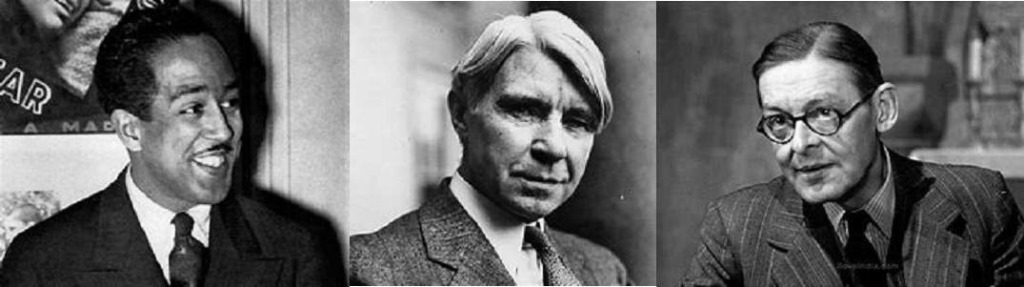
On electric guitar: Langston Hughes, acoustic guitar: Carl Sandburg, and on whistling bats with baby faces: T. S. Eliot.
.
8 What the Thunder Said Part 3 by T. S. Eliot Each April this project has presented a part of the landmark Modernist poem “The Waste Land.” This April I completed that long task with the final section of the poem “What the Thunder Said.” One of the few pieces this Spring where I got to deploy my orchestral instruments forcefully. Player below, alternatively this highlighted hyperlink.
This weekend will see a peak of pieces about Bob Dylan as we approach his 80th birthday. Would the young-person version of myself who first encountered his work as a teenager have expected that?
I think probably I would. He was widely written about back then, as in since, though from different viewpoints and judgements. The Nobel Prize a few years back allowed most of the reductionist and disparaging commentators ample opportunity to remind us of his limits, the ways he demonstrates the rule that you must hear me repeat here again: that All Artists Fail. The current moment has not brought those detractors forward, though I’m sure those thoughts are still with them should they be stirred up.
I do not write this for those who have, with whatever wisdom they’ve accumulated, found those limitations defining. I write instead for the much greater mass of people, those who know nothing substantial of Dylan’s work, even if that’s from the framework of having other things that are important in their paths.
Because he’s still living, because he’s still artistically active, those who care to debate the subject of Bob Dylan will often focus on the performer. I will ignore that, as eventually history’s focus will, even though we have film and recordings which we presume will be preserved. So, no talk here today regarding the charges that he’s a terrible singer or indifferent musician or undemonstrative stage presence. All those charges have evidence — and are wrong.
I’m here instead to say that singing and performing Bob Dylan songs is rewarding, enjoyable, illuminating. I won’t go into great length, because I might not convince you of my case. My case must be proven by your experience, if you take it upon yourself to do that.
In this one photo, Dylan is trying to convince you in a number of ways not to think of him as a performer. He’s almost exactly in the null point of the mic where it’ll hear nothing. Awkwardly, he’s trying to finger an F5 chord on an instrument he was never known to play, and he’s nearly the only Fender Jazz Bass player to ever keep those two chrome covers over the strings and bridge, indicating a straight-out-of-the-box “Here, endorse this!” photo ambush.
.
The songs written by singers of extraordinary technical talents, or by composers with a great deal of musical matter to express can often daunt the general singer. This is not a bad thing, only another kind of limit. Sometime in this century for example, Joni Mitchell has become recognized (yes, tardily) as a songwriter of extraordinary talents. One can enjoy singing her songs; but for some of them, expressing them requires more skills than many of us humans can bring to the task. How well do some of her songs survive a singer of insufficient range, melodic memory, pitch accuracy, and rhythmic sophistication? Or closer to my home, Prince is the most extraordinary performer and pop musician anyone living can recall, but some of his songs are built around superlative vocal effects, and the original arrangements may call for a musical versatility that would daunt most professional musicians. I’m not damming those exemplary songwriters with faint praise. Their achievements are great, and those that want to extend those artists songs by performing them are to be praised.
But to a large degree those merely musical technique challenges are not a problem for those who want to perform Bob Dylan songs. There are a few. Dylan’s most underestimated talent as a singer is his phrasing. With his wordier songs, it can be hard to fit all those word-beats into a regularized musical phrase without successfully playing a game of h.o.r.s.e with his own idiosyncratic phrasing.
What instead does a modestly talented or untrained singer encounter in a representative Bob Dylan song? Two things I think: characters, and a charged, yet ambiguous, emotional environment.
Taking the last first. Many Dylan songs present, as great poetry often does, emotionally intense moments, sometimes several of those strung together. In fewer cases than one might expect, these are not cut and dried here’s-what-we-must-feel presentations. The few times when Dylan does do that —tell us what to feel — those songs in context may gain power for his appreciators because he generally doesn’t. I said I wouldn’t talk about Dylan’s own performances, but over his career he eventually demonstrated different emotional environments that his songs may live in. This design means that we, as individual performers — even those who sing in the shower, while cooking, or going to or from work — are given leeway to impose our own moods and learned outlooks.
Dylan has increasingly peopled his songs with characters over his long career, people who speak from their own varied experience. Actors speak of the enticing challenge of playing Lear or Hamlet and the reams of lines they must master to do that. But in Dylan songs, one may be given a verse or even just a line to embody a character, a challenge of a contrasting sort. I can’t say that the practice of portraying characters not oneself is a sure-fire path to wisdom. If it was, there’d be no foolish actors, and that is not the case. Yet, there is value in that to be found if you want there to be, and it’s fun to not be yourself for the course of a song or a verse! Every child dresses up, plays imaginary games. Adults could need an excuse to do the same, and a Bob Dylan song can be that.
One need not engage with either of those things present in so many Dylan songs in a way that would succeed with an outer audience, that would convey your experience in the songs to some of them. If one can do that, as many professional performers have over the years, that’s great — but it’s not required for enjoyment or reward.
In this project I perform words, mostly other people’s, mostly poetry, because that’s a more intense and intimate way to connect with the text. How successfully it might illuminate something for you, patient listener, I can’t say. As with all art, it will fail some/to most/to all of the time, but if you read other things this month about Bob Dylan, take from this post one thing I wish to suggest to you today: all that commentary and weighing of significance may have some value, but what the man did was write songs, things which do not live or exist other than when some human breath vibrates in a throat. Perhaps some poetry — certainly some writing — exists largely as worthwhile thoughts or impressive inventions. But songs truly exist that way, that way alone: inside us. Why take the hard way to try to generate that experience out of only silent thoughts about Bob Dylan, or even listening to Bob Dylan, when you can put a song of his inside you?
Oh, and not to leave you with the idea that singing Dylan is all heavy going capitol S seriousity. here’s The LYL Band taping up the basement with a set of unused Dylan lyrics a few years ago. Player gadget visible for some, or this highlighted hyperlink for others to play the performance.
I sort of meant to do this last month as I wrapped up my five year serial presentation of Eliot’s Modernist landmark. This will not be a wrap-up of all the discoveries and feeling that living with this poem each April brought forward for me, but instead a single post that allows one to find the whole thing as I presented it over the years. The kinds of music I wrote and performed for this project varies considerably: blues, folk-rock, punk, orchestral instruments, synths, and solo acoustic guitar. I think this fits with Eliot’s design for his poem, which varies its voice and voices throughout too. Listening to all the parts below in one sitting will require a longer period of attention than this project usually asks for, over a hour. Not for you? Feel free to look at other posts and audio pieces here which are usually under 5 minutes in length.
Taking T. S. Eliot off the page and onto the wings of music for five Aprils.
.
First, here’s The Burial of the Dead, the opening section. If you don’t see a player gadget, this highlighted hyperlink will open a new tab that will have a way to play my performance of this section. April and spring and remembrance falls off into a rather gothic take on the “unreal city.” In-between we get the most popular single sub-section in the entire series, the “Hyacinth Girl.”
.
Next, we move on to A Game of Chess, which opens rather sleepily* and finishes with the appearance of the project’s guest voice Heidi Randen. A player will appear for some, and otherwise, here’s the hyperlink for those that don’t get one in their reader.
.
The poem’s third section, The Fire Sermon, has some of my favorite performances of the entire series, the ones that I think work the best, and from first to last it’s the one I’m most proud of. Gadget below for some, or this highlighted hyperlink for others.
.
The Death by Water section is by far the shortest, and here it is. By now you know the drill, gadget if your blog reader allows it, or this highlighted hyperlink.
.
I have not rolled up the final section, What the Thunder Said yet because it would be extraordinarily long. In place of the entire performance of the poem’s longest section, here it is in four subparts as first presented this past April. Highlighted hyperlinks of each part precede the player gadget that some will see and some won’t.
That final, 4th segment, just above differs from every other one in that it’s an earlier LYL Band live performance which is rough, and ready to take on the complex conclusion of The Waste Land from a hotly-felt cold-reading of the text (complete with some mispronunciations on my part) .
As I occasionally warned readers here, The Waste Land is not for everyone, though I think it can be enjoyed simply as a wash of contrasting moods and mysterious words without need for “Will this be on the test?” understanding and extractable meaning. None of these pieces have been particularly popular here, but still the effort to complete this has increased my appreciation for Eliot’s achievement. I’d like to thank in particular Dr. Oliver Tearle over at the Interesting Literature blog whose posts helped illuminate various things regarding this poem and the WWI era while I was creating these performances.
.
*Conceptually, my idea for the opening of this section, to conflate the mood of Eliot’s poem here with Blonde on Blonde era Bob Dylan was fine, but my execution of that kind of languor wasn’t as effective as it should be. If I ever was to do a new, improved version of something in this entire performance, that would be the sub-section I’d think most needs it.
I’ve mentioned before here that Laurie Anderson was one of the inspirations for this project. Even though I don’t closely mimic her Midwestern delivery, that subtle mix of the dry and the droll with muted pleasure in observation. It’s more at the idea that things put into a different context reveal aspects you never noticed before. And yes, she often did this mixed with music she composed.
We rarely go to mothers for new aspects. In the usual course of things, they are our original appreciation of reality — and one that we return to, or long to return to, when the novel has taken a bad turn.
That said — and I’ve said so much in the last few posts that you might welcome a break from my long-windedness — when I considered yesterday evening if I needed to make a post noting Mother’s Day, this song, “O Superman,” by Laurie Anderson came bounding into my head. I recorded a version of it on a similar whim nearly a decade ago, just because it had remained well-balanced in the weird place between understandable and elusive. *
Because “O Superman” is a work clearly under copyright, you won’t see an audio player today for that version I did. Though I’ve probably bent the rules a few times here, this project keeps away from using work the authors have some legal ownership of. Remuneration for almost all poets almost all of the time is tiny, and increasingly this is true of more musicians and artists more of the time. The YouTube video below is my compromise with that.
Yes, there’s a typo in the credits at the end. Embarrassing! I blame the late hour when I was cobbling this together.
.
My rough understanding is that if my video would ever rise to the viewership level of getting YouTube ads inserted, the owner of the rights could/might get the fraction of a penny that would generate. Anderson herself has this video made of her composition back in the day, and it’s worth observing her presentation of her own art, though I note one recent comment on her video:
I played this song at a party in my house once. Ever since then, no one’s even come near my house again.”
Perhaps that comes of the artistic trick in Anderson’s song as she performs it: to make mom strange so that we may observe differently. Mother and strange don’t rhyme for many.
My version is an excerpt of the whole song with different instrumentation, and I’ve never been much for “just like the original record” covers anyway. My shorter version focuses more on the mother aspect and where and when we seek that. Call me a Modernist beset by sentiment, but the ending to Anderson’s song nearly always brings tears to my eyes.
Last time I left you with some impressions I got reading a George Orwell essay, but I also came upon a documentary this week on things this project deals with — things that you, welcome reader or artist, may also want to consider in your art or life. That film was The Jazz Loft According to W. Eugene Smith.*
I had some minor grasp of the loft scene in the ‘70s to early ‘80s, and I figured it might be worth a watch. I got more than I expected, though not quite what I expected. This story is centered in the late 1950’s, a time of tremendous artistic momentum that underpinned much that occurred in the more famous ‘60s later. Oddly the man, Gene Smith, featured in the title isn’t a jazz figure at all, but a photographer who lived in part of a run-down and irregularly converted commercial loft in New York City. Smith gets his name in the title, not only because he’s interesting and because his artistic biography is well-covered in the documentary, but because he had a curious desire at this point in his life to document large portions of his everyday reality via still photos, movies, writing, and copious audio recordings.
This trailer for the film leads with the Jazz, underselling the compelling story about photography it contains.
.
Lofts are often prized by artists, who like a gas are likely to expand to fill any space — and Smith certainly did that. Whenever I pause to consider my own studio space where many of the recordings for this project were done, I am embarrassed by how messy and cluttered it is. Smith matches me in that clutter from what we see, and the documentary would support a viewer who sees obsessive-compulsive elements in Smith. But unlike myself, or the garden-variety hoarder, Smith was a very accomplished black & white photographer in a number of styles. And then, somewhat like me, the clutter didn’t seem to stop Smith’s productivity — or if it did hamper it, his drive to continue to produce art was strong enough to make that issue moot.
I’m unsure how famous Smith is in art photography circles, but the film departs from its Jazz Loft focus to let us know that he was a very effective war photographer during WWII, one who was seriously wounded in the Pacific theater of that war. He worked for the large format magazines and photo services of the day as a photographer, with enough pull and force of personality to be allowed to create multipage photo essays he selected and laid out for publication himself. By the time of the Jazz Loft he seems to have been doing a lot of street photography, often shooting out of his window at the day to day people who had no sense they were being photographed.**
Even if, like me, you are not au fait with photography and photographers, it’s likely you know at least one or two of Smith’s photos. He’s the guy who shot the famous Harry Truman holding up the “Dewey Defeats Truman” headline. And when I saw a print of another photo just pinned up somewhere off to the side in the clutter of his workspace early in the film, I wondered if he’s responsible for another image that I knew: the emotionally resonant “A Walk to the Paradise Garden” photo. If you watch the film you’ll get more context for that photo.
So, is there Jazz in this film called The Jazz Loft? Yes. The late ‘50s were a time when a great many magnificent Jazz records were made, and when high-quality live Jazz performance was still commercially viable. The NYC area was a center of both of those things. The Jazz Loft was apparently like some places I know from my youth just slightly later, it was an open scene, and folks just wandered in and out of some of the loft, including a number of musicians who used it as a place to workshop or jam for their own enjoyment. From Smith’s documentation, it was a somewhat integrated scene at the loft, but predominantly white.*** This may be secondary to the man who apparently owned the loft (he’s said to have been Smith’s landlord during the film) Hall Overton. Overton was a figure unknown to me who was active in what in that era was known as “Third Stream.” Third Stream was an effort to combine composed concert music, often with orchestral instruments, with Jazz. Many, but not all, of the proponents of Third Stream were white musicians crossing over from modern “classical music.” I don’t want to over-simplify this, but while some Afro-Americans coming from a jazz background were interested in such a fusion and contributed significantly, Black Jazz musicians were also involved heavily at that moment in trying to keep Jazz culturally and commercially relevant to their Afro-American peers (“Hard Bop” and “Soul Jazz”) and with the more spiritual and political Black Arts movement.
The film eventually gets to concentrate on Overton for a while, and he’s as interesting as Smith, particularly for someone like myself who’s interested in Jazz and composition. If he sounds like something you’d like to nerd over for a while, I can recommend this lengthy and detailed article by Jazz pianist and composer Ethan Iverson on Overton, but if you’re trying to finish a translation and eventual musical piece using words by Rimbaud, I’d suggest you don’t click on that link.
Other folks who drifted through the Jazz Loft have stories that are told in shorter segments, and I personally like the way the editing and flow of the film allowed the stories to emerge organically, like a good Jazz set. The use of the archival materials (largely from Smith’s posthumous archive) is done very well.
Jazz, “Third Stream,” late ’50 NYC bohemia, and black & white photography are all niche interests. You may need to be interested in at least two of those things to have the highly rewarding experience I had with this documentary. If not, you need to be open to adventure in these areas. No car chases, no who’s sleeping with who dish, no unfolding speculative universe, other than the one that the arts often live in inside everyone else’s: whale’s bellies and lofts.
What did watching The Jazz Loft bring me? An appreciation of Overton’s efforts, which were largely unsuccessful even within the limited expectations of his niche. In Smith’s story, I found a mirror of my own somewhat obsessive drive to make the elements of this project, and a warning of the possible side-effects of that.**** Recall as I concluded Part 1 of this, that one of my artistic maxims is: All Artists Fail. George Orwell was despairing in 1940 at the batting average of artists seeking to change things in his society, while I’m somewhat heartened that they keep trying. Same box score, just different outlooks. So, Smith succeeded, for a while, and then descended into a state that was productive but not healthy. Overton for all his not-even-a-footnote status in musical history, made an honorable effort. They chose their own adventure, followed its path, saw and felt and knew what they saw.
*This assumes you are giving evidence by reading and listening here that you care about some less-mainstream things, and worse yet, a variety of them. “The Jazz Loft According to W. Eugene Smith” is available most places you can rent or buy movies on computers, smart TVs, or tablets. There’s also a podcast-series which I have yet to sample.
**It’s apparent that many folks either didn’t know or didn’t care that they were being recorded by Smith either. The general reaction of those interviewed was that Smith was fairly overt about his documenting everything he could figure out how to capture, but other stories have him placing microphones all over the place. In terms of his photography within the loft, he had the advantage of “always being there” so that the people drifting in and out didn’t strike a pose for the camera.
***No, I’m not getting all woke on the people portrayed in this film. Just stating what I noticed that ran counter to my initial expectations of what I’d see in the Jazz milieu, even in the late ‘50s when de jure Jim Crow was still a thing. Indeed, the folks in the center of this film were probably significantly more cross-racial than their general society, and for that matter probably more than I am in this other century. Afro-American Jazz giant Thelonious Monk does have a sizable part in a story of one project workshopped at the Jazz Loft depicted in the film.
****I hope not that more dangerous take-away trope: well, I’m not that obsessed, or chemically dependent, etc. as that person.
Let me momentarily make this place act like a regular blog and remark on a few things I’ve run across trying to do — or avoid doing — new work. Warning: these are not necessarily mainstream things of interest to most people, even people who read blogs about various poetry combined with a variety of original music.
While not sleeping one night this week I ran into an essay masquerading as a book review written by George Orwell at the end of the 1930s: Inside the Whale. As per the dangers of doomscrolling, it was not the right piece to run into while trying to fall back to sleep. It’s long, covers a bunch of ground, and since it is Orwell it contains a lot of pithy observations and things that incite one to consider not merely what Orwell believes, but what you, yourself believe.
It starts off reviewing a book by the American writer Henry Miller that was already several years old. Or rather, it makes motions like it’s going to take on that task. Orwell tells you little specifically about what’s in Miller’s book, and he speaks of it and it’s outlook in alternatively dismissive and “it’s better than some” statements. Orwell concludes that, whatever the book’s failures and omissions, that Miller’s novel has stuck with him, and that its subjective effects on a reader might be worthwhile.
Then a full-fledged essay breaks out: a meditation on the changes he observes in the literary scene from the 20s to the 30s of his 20th century. In doing so, Orwell also is quite subjective, compressing the wide range of these two important decades with broad characterizations, summations that have the virtue of vigor. Orwell’s overall judgement is the 20s were an explosion of free expression and expansion of subject matter, and then the following 30s had taken a wrong turn into political statements and advocacy. Orwell’s historical summary is one that others have made as well, and as with all such “spirit of the age” high-level views, it can be contradicted by considerable examples of those who didn’t follow the big titles over their decades.
In my middle of the night reading, I found this wrong-turn judgment odd. Writers who avoided political stances or opinions? Orwell would never have been on such a list! He’s remembered specifically as a life-long critic writing on political ideas and operations. This verging-on-hypocrisy stance, similar to pundits and any odd people with Internet access criticizing actors, artists, and writers for expressing political opinions,* can be made rational if one extracts from his argument the more distinct point he’s making: that the expressed political stances and opinions opposed are wrong and based on falsity. But within this essay that point seems less clear, it’s more about the demonstrated failure of that art-for-political-change effort in the 30s leading Orwell to suggest that it’s likely/arguably the better of limited choices to simply write about ordinary life in a way that avoids any evidence of political thinking.**
I’m around twice Orwell’s age when he wrote this essay, and to the glowing 21st century screen I was reading him on, I talked back to him that he had just discovered a universal truth I’ve written here several times: All Artists Fail. Betting odds calculated from a past performance tout-sheet are not a singular reason to not attempt something in art — the odds are always against success in art, that’s partly why we revere it.
Two small things in Orwell’s long essay remain for me to note. There’s an anecdote of Miller meeting Orwell as Orwell was about to embark on his sojourn into the Spanish Civil War. Miller, Orwell says, told him he was crazy to put himself in harm’s way, and then gives Orwell a warmer jacket better than the meager suitcoat he was wearing. That act, that tiny scene, is Orwell demonstrating his point that ordinary life closely observed may illuminate more than many grander political statements. And the other, more poetry related, has Orwell go on this short aside about the American poet Walt Whitman:
It is not certain that if Whitman himself were alive at this moment he would write anything in the least degree resembling Leaves of Grass. For what he is saying, after all, is ‘I accept,’ and there is a radical difference between acceptance now and acceptance then. Whitman was writing in a time of unexampled prosperity, but more than that, he was writing in a country where freedom was something more than a word. The democracy, equality and comradeship that he is always talking about are not remote ideals, but something that existed in front of his eyes. In mid-nineteenth-century America men felt themselves free and equal, were free and equal, so far as that is possible outside a society of pure communism. There was poverty and there were even class-distinctions, but except for the negros there was no permanently submerged class.”
Taken in — as we might well in our age — as statement to be evaluated from a woke (or waking) political outlook, this has so many howlers and hold-my-artisanal-higher-hops-content beverage potential Tweet-takes! Start with the “Leaves of Grass are always greener on the other side” view of America in general. Thanks, I guess, for the “negros” exception that is altogether too large and horrible for a sub-clause. No mention of the state-side colonialism regarding indigenous peoples. And, wait a minute, women! Orwell’s “America men” freedom isn’t just accidental language-convention-gendering in historical context. I could go on, with anti-immigrant prejudices galore, and….
But. What Orwell is demonstrating here, intentionally or not, is that Whitman painted a plausible reality, containing vivid details of ordinary, mundane reality, of an America that supplanted those things, where open desire, freedom, and comradeship existed in plus and overplus. Did Whitman fool the wily Orwell into thinking that was actually, abundantly so in the years before and during an American bloodbath, or is Orwell suggesting, however inadvertently, what art can try to do, and while failing and retrying, help to accomplish?
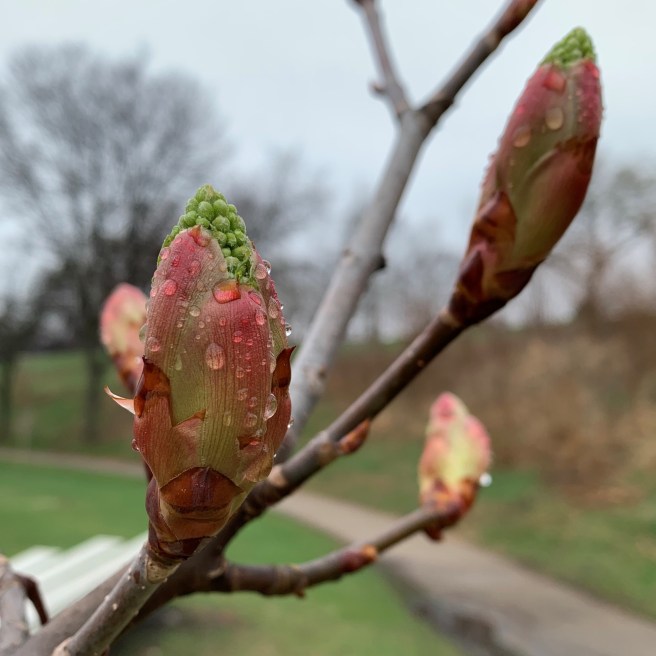
I sometimes misread the “darling buds of May” as the “daring buds of May.” These seem so strange, so alien, as they emerge.
.
This is enough for a Part 1, but rest, and only later think about this: can your art spur on change — or rather, not just urge it on with the spur and the whip, but with the portrayal of where we must go in a hurry?
As to music, here’s another audio piece you may have missed, using a 1920 poem by German Anarchist writer Erich Mühsam that I translated into English. This post from last July tells what I learned about Mühsam’s life and that of his mentor who first published the poem, Gustav Landauer. In the post, there’s a Whitman connection. Player gadget below for some of you, or if you don’t see that, this highlighted hyperlinkwill play the audio piece.
.
*The hypocrisy of that is: the pundits most often have no more skin in the game in these matters than some artists; and that the ordinary Internet people, who often wish to self-proclaim their ordinariness, may have by definition no more expertise than another person whose job it is to observe and extract transmittable reality.
**Small, dear, peripheral, and personal aside here. Anaïs Nin was the writer specifically noted as existing inside the titular whale, Jonah-like, in the essay — and so, in Orwell’s judgement, then beneficially cut-off and protected from politically-charged writing. My late wife was once writing an article for a national “woman’s publication” on the cultural phenomenon of journaling, circa 1979. In a phone call discussing her sources for the article, her editor suggested she could setup an interview with Anaïs Nin. When the call ended, she and I had the writers vs. editors conspiratorial laugh over that unintentionally Ouija-level suggestion, as Nin was then two-years dead.
Many of the visits to this blog are not you, the regular readers who are reading this fresh post, but views of some older posts via a search engine. A gaggle from Google have come recently to a post from a year ago which doesn’t feature one of “Poetry’s Greatest Hits,” though it does use, in a way, the words of one of America’s most loved poets, Robert Frost.
Here’s a link to that post. I looked at this post, and I’m not sure what brought it to increased attention, though after re-reading it today, I complemented my past self — who I alternately think is wiser or more foolish than the current occupant of my consciousness. I thought I did a good job of describing how we as writers may improve our work through revision, even though the example I used in the post was my own revision, for my own parochial reasons, of the words of a recognized great poet.
I do that sort of thing to the Greats from time to time — as recently as the last post here with a simple addition of a line as a refrain from a poem by Robert Browning, or more extensively with my extension and relocating a poem by Du Fu that many liked last winter, or further back with a piece of Rupert Brooke’s that became one of the most listened to pieces in the history of this project. I usually feel ambivalent when I do this. At the least, I try to warn you when I intentionally go beyond the original text. In each case above, the author’s dead, there can be no personal hurt or slight for them to feel, but with this project I do take on some duty to the text the author wrote. Have I cheated at my task? Am I dishonoring their work?
How is this photo connected to today’s post? I don’t exactly know. So what should some translator do when asked to present it in their language?
.
I’m wrestling with these matters currently with another translation in process,* a prose-poem by Arthur Rimbaud, particularly with a common issue I come upon in translation: how much did the author intend to be mysterious, and how much did they (or their ideal, likely contemporary reader/listener) understand to be clear in their original language? With translation, one can’t avoid substituting your own words, and likely things like word-order, idiom, and so forth — that’s inescapable, inherent in the task.
In the case of this poem by Frost, my recasting wasn’t so much for immediacy of meaning, or to make an image clearer to our time and place; but to make the poem more sing-able, to fit and obtain impact in a conventional song performance. Yet, the song that I made of it was not very popular with listeners here. When I looked today, it appears that nobody that has visited the post this month has listened to the performance.
Again, complementing my past self, the one I feel I can more often judge objectively; I think I did a pretty good job of the song I derived from inside Frost’s poem “Ghost House” and retitled “Stones Under a Low-Limbed Tree.” My vocal (often a weak point) was passable — though I idly wish for “cover versions” by a legitimate vocalist for pieces I write and present here — and the rest of the audio piece works well.
So, here’s that audio piece, being presented again for your listening judgement and plausible pleasure. The player gadget should be below, and this highlighted hyperlink will also play it in a new tab if the player doesn’t appear on your device or reader.
.
*Following the practice of Robert Okaji, I’ve taken to casting some of my alterations or freer translations as “After a poem by…” — another way to deal with this, though it doesn’t remove all the questions I ask myself.
I hope to still have at least one more piece ready here this month, but I’ll admit that I waylaid some time yesterday watching the Academy Award “Oscars” while restringing and doing some deferred maintenance on a couple of guitars.
Awards shows — which are of course promotional events regardless of their area of the arts and the event’s prestige or pedigree — seem to be going through a rough patch of late. The Nobel literature prize even got removed for a year, so I’d judge that less prestigious awards stand in greater peril. The question of their value, or even if they have become counterproductive, has become commonplace. The use of these events for airing political and social issue positions is one sore point for some.
Let me not waste too much of your time, but to summarize my belief on that last issue: the whole purpose of art is to share human experiences in a way that nothing else does. How things are run, how we experience that, it just can’t be separated from art, and once that is allowed, the questions about what should change and what should be maintained can’t be fenced off as off-limits. This risks of course that wrong and half-wrong and outright misrepresentation is going to be propagated in shiny works of art. An even more subtle risk is that what will be presented must be simplified in some way, even within arts’ ability to present strange non-binary states. Resulting work can be painful or dreary even for points of view we already agree with — and outright hurtful or disgusting for things we find false. The criticisms are true, but this can’t be avoided if we are to have figurative/narrative art at all.
Film is extravagantly more expensive to produce than poetry, and by reputation successful people in the movies most visible roles are well-paid for their contribution to that capital-intensive industry. Garden-variety actors, directors, and writers outside of commercial film, who may not share this wealth, rarely get to speak about their beliefs on international live TV shows. Does this make it bad when the wealthier artists speak, or should we have no actors, writers, directors speak at all?
As a change, I enjoyed the trimmed back show, with many fewer in the main room and with little attempt to make it a spectacular variety show. Different compared to the traditional Oscars, but also not revolutionary. It made the show very like most smaller awards shows, the kind us regular poets or writers might attend. I felt there was a substantial emphasis placed on current social discussions, particularly diversity, representation, racism, violence. I’m no expert, but I suspect that may well be, to use the old Hollywood term, “box office poison.” So, if the ratings turn out to be bad, I will not be shocked. Given that I agree with many of the viewpoints expressed or embodied, should I consider that then brave?
Here at my keyboard today, I started to write a further reflection on those elements. Then I decided to drop it. Then I decided to include it again. Then dropped it. I doubt there is any demand for my extended thoughts on these matters.
But it is still #NationalPoetryMonth. Two of the award recipients made poetry a substantial portion of their acceptance speeches. Did anyone else note that?
Chloe Zhao began her speech for Best Director by saying that her father would banter with her when she was a child by reciting parts of the Three Character Classic* back and forth to each other from memory. She then recited that poetic work’s opening two lines in Chinese and then in English translation. Let me print those two lines here, and also the two that follow, which add additional illumination I think:
“People at birth
Are entirely good
Their natures are similar
But their habits make the difference”
.
William Carlos Williams concision and white chickens meet Confucian respect for elders. Maybe I need to reassess Dick and Jane?
.
The second bit of poetry was both even more subtle and yet striking too in its poetic compression. Although Best Actress winner Frances McDormand opened with a tiny, informal comic aside, I think she intended her entire acceptance speech to be this:
“I have no words, my voice is in my sword!’
The sword is our work.
And I like work.”
I was stunned. First of all, the concision overwhelmed me, but I believe I caught some intense meaning in these 19 syllables making 19 words. The opening line is MacDuff’s from Shakespeare’s Macbeth. That character utters it as he seeks to revenge the killing of his family. In McDormand’s context, I think the Blakean sword here is not a harvester of souls, but the un-resting illumination of our best work.
Your sword is your work. There is joy in that.
No new audio piece today, but since another Oscar appears in it, and it tells of the plague of humanity being seen as nails, and guns the only tool, I’ll give you former movie critic** Carl Sandburg’s “Long Guns” with a guest appearance by the spirit of Howlin’ Wolf as MacDuff. Player gadget below for some of you, and this highlighted hyperlink will play it if you don’t see that.
.
*Despite developing an attraction for classical Chinese poetry, I didn’t know that work. Zhao’s experience wasn’t unique. I read that it’s long been used as an introductory text for young children. I can only flash back to the Fun with Dick and Jane readers of my grade school years, which I’m not sure bring as much instructional density.
Wait, before I reveal that, let me take a moment to describe what the Parlando Project does: we take words, most often other peoples’, most often poetry, and combine them with original music and present them to you as audio pieces.
I’ve chosen to use other peoples’ words almost entirely because I’m most comfortable writing about that transaction between a writer and myself as reader, composer, and performer in the midst of passing something on to you as another reader and listener.* The project doesn’t use poetry for every audio piece, but I like pieces with some mystery and ability to create an impact in less than 5 minutes, and poets are the ones that do that.
The music you hear is created for this project. I don’t use library music or borrowed music, and except for computer drums, I don’t use samples or canned loops. For better or worse, most everything you hear was played or scored by a real person.**
I don’t always make these combinations of music and words “songs” in the traditional sense — though our modern sense of song has changed so much in the last few decades that “song” has become a much looser expectation anyway. I try to make my musical settings as varied as I can, which means that I expect some will be more to any single listeners’ taste than others.
Now I’ve caught up any new visitors on the Parlando Project concept, we can complete our Winter ’20-’21 Top Ten Countdown with the most popular piece.
1 End of the Sky by Frank Hudson (after Thinking of Li Po at the End of the Sky by Du Fu). OK, this one used my words, though I based it off a classical Tang Dynasty Chinese poem. Since I wrote it last autumn, the meaning I extracted from Du Fu and attempted to convey in my modern English extension of his poem has only deepened in resonance for me personally. When it was written I was thinking about a small group of poets that I’ve met with every month for more than 40 years to discuss our work. I’m the youngest in that group by a short interval and we had all been writing for more than a decade when we first met.
More than a half-century of writing for each of us, yet I think of myself as less accomplished than the rest of the group — viewed objectively from amount of publication and such this is certainly true — but I wonder too if they ask their own version of the questions I ask myself about what’s valuable to say and what we may construct to justify a readers time and attention. Du Fu seemed to be dealing with some of those feelings in his poem addressed to fellow poet Li Po.
The poem’s statement, my attempt at faithful translation from Du Fu’s Chinese: “True literature doesn’t care if it is popular, and/It is only demons that care about a poet’s failures!” is one potential answer to those concerns. Poetry may be what we most care about, but the world cares less than that, and in that is a freedom. “How much difference does that make at this late date?” I ask in addition, a line only implied in Du Fu’s poem. And at the age of the poets in my group, “late date” is a general concern.
Since I wrote it, how has this poem changed for me? Those general concerns have been promoted in imminence. I’ll say in too-brief: two are dealing with existential illness. Loss can be at any hand for all of us. Will it, or any of us, be patient?
Du Fu’s poem concluded with an understated but devastating conclusion, something I often find in his work. He writes, our creations and our cares about our creation are like a customary gesture that would’ve been known to poets of his time and place: throwing poems as a gift into a river where a Qu Yuan, a Chinese poet from the past had leapt to his death.
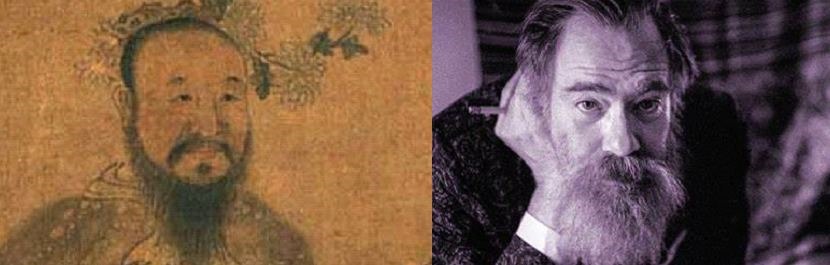
They both ran out of patience. Do you see some resemblance? Qu Yuan and John Berryman, “…who was once handsome and tall as you.”
.
My modern English solution to my poem’s ending echoes Du Fu’s superficially, but differs in detail. This is what I meant to convey in my conclusion: Berryman’s mental illness and chemical dependency — fed by his doubts, feeding his doubts — weren’t his art or some driving force for it, for they understood none of that.
Say that, then, to your doubts: you don’t understand my art! Work instead to make your work more whole for yourself and for some potential audience, no matter how small. All doubt and self-abnegation can do is take away — and life and fate will do that for you anyway, it doesn’t need your help.
The player gadget to hear my performance of “End of the Sky” is below. If you don’t see the player, this highlighted hyperlink is an alternative way to play it.
.
*When I write or talk about myself, and later look at what I said or wrote, I almost always cringe. In only a short remove of time it seems disproportionate, self-involved, and vain. Every artist must have, at least episodically, some level of elevated self-regard, but for me that self-regard is always being chased by another that reminds me of my follies. I’ve lived a long life, and neither of those two have stopped running, an endless chase, which has allowed me to create — but as the pursuer and their prey, I’m often out of breath by the time it comes to talk about or promote it.
**Early Parlando Project pieces were often live band recordings, but with age, change, frailty, and finally the Covid pandemic, they’re increasingly all me multitracking myself. Computer drums are a compromise I’ve perhaps too easily fallen into.
Today’s report on the most listened to and liked pieces featured here over the past quarter will show three experiences of the mystery of winter. So, let’s return to our countdown:
4 Twilight Fallen White and Cold by Joseph Campbell. I seem to have become something of a promotor of this little-known in the United States Irish-born poet who I still know little about. He published a series of poetry collections before the end of WWI, and then his poetic output dropped off, for reasons I’m not yet clear on, though the politics of his country’s decolonization struggle may have contributed. This piece using his words that a lot of you liked and listened to may be the most mysterious of today’s trio.
Best as I can figure it, this winter nature landscape poem may be an expression of his nation’s detracted state and situation, particularly in the invocation of ancient earthworks (raths) and burial mounds — but I cannot plumb the entirety of the refraining line of “wounds of Eliom/weep on me” that I feature in my setting of Campbell’s poem. Eliom is a plural word for gods, sometimes used for polytheistic gods, sometimes used for the singular monotheistic diety, and as it may be here, used for angels. If that’s so, then the starry constellations, the winged vampires, the curlew birds, the floating mists, the carrying sound of the ocean are all the Eliom, the angels in this changed winter nighttime vision.
To hear my setting of Campbell’s poem, you can use this highlighted hyperlink which may open a new window with a player, or in many cases, you’ll see a player gadget below to directly play it.
.
It’s been too long since I’ve said this: thank you for coming to read or listen here. It’s become harder for me to respond to comments or properly promote this project, but I appreciate so much those who come here, listen, and let others know what the Parlando Project does.
..
3 The Snow is Deep on the Ground by Kenneth Patchen. Lawrence Ferlinghetti, whose words we met earlier in this countdown, would sometimes remind folks that he wasn’t really part of the Beat Generation, even if he was associated with others who might have been so thought. Patchen is a similar case, or perhaps more so, in that his poetry career started in the 1930s,
As with many of the best Patchen poems, even the political ones, this is a love poem, delicately poised between the enchantment of love and the world that allows the shattering of it. If one can fully absorb the illumination of this poem, as with some of the best of Patchen, you would cry tears of joy and sadness at the same time.
You can hear my performance of Patchen’s “The Snow is Deep on the Ground” with this highlighted hyperlink, or if you see it, with a player gadget below.
.
2 The Sky is low by Emily Dickinson. Some years back in this project I once compared Emily Dickinson to one of those unexploded, yet potential, bombs that are still unearthed in Britain or Europe from the World Wars. Originally she was found as the creator of curious little poems from an eccentric woman, then as a prescient 20th century Imagist, and now in our deconstructed age we can stare at one of her tiny poems, and like one trying to follow the decent of a single flake of snow in a flurry, fall as far as one can follow.
You can read, or listen to my performance, of “The Sky is low” and find a whimsical nursery rhyme, and find enough enjoyment in that — but let it stick in your memory or repeated ear and a little dialog about predestination, first causes and fate is discernible. To listen, use this hyperlink, or you may see a player gadget to directly play it below.
.
One more post in the Top Ten countdown to go, and then we can move on from the mysteries of winter to the mysteries of spring.