Acquainted with the Night

A few posts ago I said I was holding back some material, going instead with other pieces that weren’t quite as dark. One of the pieces I was holding back was this one: Robert Frost’s “Acquainted with the Night.”

This is often thought of as Frost’s most harrowing poem, even though it achieves that effect descriptively, largely without explicit emotional terms. Some of its tropes have become standard “Noir” features since the poem was written making the nighttime despair, loneliness, and alienation especially easy for modern readers to “read.” Here’s a link to the full text if you’d like to read along.

Frosts Acquainted wit the Black Parade

Representative of Frost’s emocore period? Or if you’d like to see a video making the poem more Ascenseur pour l’échafaud, try this link.


So, we have the poem’s speaker (let’s call him Frost for the rest of this) walking alone at night in a city in that time which is past late but too dark to be early. It’s raining. He meets only one other person, a watchman, and avoids him. He hears but two things: his own steps, and at the poem’s high point, someone else’s voice. The poem ends with him noting a “luminary clock,” and a remark casual or crucial he says it indicates “the time was neither wrong nor right.”

The incident of the cry in the third stanza is the key moment in the poem, the most telling. It’s so quiet in the rain (so not a full-on stormy gale or thunderstorm) and the cry is so far away that Frost stops walking because the sound of his footsteps is the loudest thing in the night city. He wants to make out that cry, which I think is “interrupted” by his own solitary footsteps. And what does he discern in that cry? That it’s not calling him back or bidding him leave either. Whoever he’s walking to get away from, it’s not their voice, but he wants to know if it is.

This incident is highlighted too because the poem opens with the idea of constant walking: Frost says he walked past the city limits and back. I’m hitting a muted low string on the guitar in my accompaniment to try to suggest that footsteps effect, that Frost is in motion even if he doesn’t know where he’s going.*

The last external thing Frost notices in the poem is the incident of the clock. Interestingly he uses an odd adjective for the lighted clock: “luminary” rather than “lighted” or “luminous.” I assume Frost would like us to think of the clock as an auspicious authority, a luminary, not just lit. I should also note that some see the clock as the moon in this poem. I don’t. I think if he’d wanted to depict the moon he’d say so. The lit clock face is  moon-like, so I can understand that alternate reading, and what with its “unearthly height” Frost likely intends that overtone at least.

The poem is often read as a depiction of depression, and there I’ll agree as well. Depression is experienced by different people in different ways, but the situation here is familiar to me. Depression can confuse your judgement and ability to weigh things. Frost can walk all night because he is in some dispute with someone else (that voice he interrupts his steps to hear) but he’ll never figure it out even if he walks the entire dark city. He may step between self-pity and wanting to be seen as right, and self-abnegation and judging himself irrevocably wrong, but that only gets him out and back again. The luminary clock hands down it’s judgement: Frost, you’ll not figure it out tonight, which means you could return again to this night walk some other night—but it means also that one will be able to return, or turn elsewhere. Over time one may come to understand better that old acquaintance, the night. Roughly 30 years after writing this poem, Frost as a then old man said this to an interviewer “In three words, I can sum up everything I’ve learned about life. It goes on.”

In three words, I can sum up everything I’ve learned about life. It goes on.”

Some see today’s poem’s luminary clock moment as an existential consideration of suicide. The clock (or moon if that’s your reading) somehow prompts or symbolizes the decision that this night is not the time for that decision. There’s another way to read “neither wrong nor right,” that the clock** indicates only a moment as time, and Frost’s realization about life is that it goes on, that it moves like this poem’s night walk, that that is its meaning: it’s movement.

Let me just say a bit about the poem’s beautiful structure. It’s a sonnet, and it’s a format I’ve used a bit myself lately: four tercets and a concluding couplet rather than the Shakespearean three quatrains and a couplet. But Frost has used Dante’s terza rima scheme of interlocking rhyme in the stanzas, and this knotted interlocking reinforces the endless walking and knotted thinking. And as one more music-of-thought feature, the poem ends with the first line—it walks out and back again just as the poem’s Frost does.

The player gadget to hear my performance of “Acquainted with the Night”  is below. I wouldn’t decorate such a lonely poem with anything more than a single electric guitar this time.


*This is also the eventual decision in his famous poem “Stopping by Woods  on a Snowy Evening”  where I believe it’s key to that poem to recognize that he’s not considering tarrying there for some pleasant winter sight-seeing, but that he’s likely lost in a entirely dark rural road and he only thinks/hopes he knows whose woods he’s spotted as a waypoint in the darkest night.

**Yet another plausible meaning for “neither wrong nor right” would be that the traditional clock face might say half past four in the most deserted time of the night, just as it will say the same half past four when 5 PM quitting time approaches in the daytime afternoon. The clock’s face is ignorant or unreliable in that regard. It may be saying it’s time to end this night walk as the night is ending and life and people will return soon at dawn, in the same way it would be saying that it’s time to leave the work of trying to figure out the knot of the dispute before the poem starts, to clock out of the work of the night-office where that question was being worked on.

Frost’s poem doesn’t identify the city the walk is taking place in. For those that hold to the clock theory, London’s Big Ben has been suggested as the clock tower. John Timberman Newcomb in How Did Poetry Survive?  suggests the clock tower of the Metropolitan Life Building, which as the tallest structure in New York City when completed in the early 20th century was a lighted timepiece of unearthly height. Many smaller cities of this time would have had prominent courthouses or main transportation terminals with lighted clock towers too.

For the moon theorists, the time is usually assumed to not be the time of day but a more general “time,” though it’s fairly easy to tell the time at night with a full moon (it’s overhead at midnight, like the sun is at daytime noon). However, “high moon” midnight would not likely be as deserted as the night walk time described in the poem.

Obviously Five Believers (Thoreau, McClure, Whitman, Blake, Ginsberg)

Perhaps today’s audio piece and what I came to write about it has an interesting path. In words it’s a medium-length journey—so I beg your patience—but the places it goes are vast. Eventually, we’ll answer a question you may not have asking: who’s buried in William Blake’s tomb?

It started with an illustration drawn by Sergio García Sánchez which I saw on Kenne Turner’s blog this month. Turner’s blog has a great deal of manipulated and beautiful nature photography, mixed in with things he notices in his desert region location and occasional poetry, so it was unusual to see a drawing at first, but his post correctly located the words in the drawing and let me recognize the white haired old man whose beard is a star’s journeywork in this cartoon. The man in the drawing, the words, was Walt Whitman.*

Perhaps because Whitman’s words were embedded inside a drawing, they seemed Blakean to me as I read of that grain of sand, a hinge in the hand across the starry dynamo machinery of night. The main effect was to grab my attention and bring thoughts of doing it for this project.

And so I composed a small orchestra piece of music to accompany my reading of this piece, taken from the 31st part of Whitman’s “Song of Myself,”  using the 1855 edition. I’d normally give you a link to the text, but the two links above to Turner’s blog or to Sánchez’s picture are the best way to see the 1855 text I used which includes a line that was dropped in later editions, the line with the farmer’s girl and her iron tea-kettle that reminds us back to earth and daily life. For many compositions I’d be done.

And then last week poet Michael McClure died. He’s a poet of many events,** he read at the “Human Be-In” in San Francisco at the beginning of 1967, he can be seen briefly in The Last Waltz  movie reading Chaucer to the rock glitterati—but he may be most famous for being an organizer of the famous Six Angels in the Same Performance  reading at the San Francisco Six Gallery in 1955***

I know McClure best from a record album he made with ex-Doors keyboardist Ray Manzarek and flautist Larry Kassen called The Piano Poems  in 2012. This was nowhere near my introduction to the Beat-associated “jazz behind poetry reading” style, but it’s a very good one. Listening to that helped build my own convictions for this project back then.

One of the poems performed on this set is McClure’s “Action Philosophy.” Though he didn’t on Piano Poems  as released, McClure would often introduce it by saying that his poem begins with words written by Henry David Thoreau. That led me to think about combining McClure’s incorporation of Thoreau with Whitman’s Blakean lines about the universe’s manifestation in everyday nature. After all, McClure extends Blake’s and Whitman’s vision, seeking to become the animals he sees, to inhabit them fully. That’s the animal meat of his poem, but it’s in a reality sandwich on this deli menu—those separated first and last lines present a vital dichotomy. Here’s the text of McClure’s “Action Philosophy.”

Five Believers Six Angels

Fifteen jugglers, five believers, six angels in the same performance! Tell your mama not to worry, ‘cause they’re just my friends. Yes, learn to play the triangle and visionary poetic figures will flock to you.


That first line: “That government is best which governs least” is taken from Thoreau’s “On Civil Disobedience,”  an essay that soon became important to certain liberation movements. Thoreau himself was speaking about the Mexican-American War and slavery in his essay, oppressive evils that he felt he had to take action against. Gandhi and Martin Luther King made explicit reference to this work of Thoreau in their movements against colonialism and American racial subjugation. Lines from it had vital currency during the anti-Vietnam War movements of The Sixties.

But that’s not what I associated this line with from my life in the later 20th century, or where you may most likely hear it today. Now if you see this line quoted, (perhaps misattributed to Thomas Jefferson, not Thoreau) it may be used to buttress some form of conservatism, particularly conservatism that has a claim to libertarianism. Libertarianism is a complex subject, too long to explore here today, but on the other hand, elements at the foundation of the Beat literary movement were anarchists, an alignment that would have fitted Thoreau.

Now we take another side-step. Back in the 1990s I worked with Gary, a white database programmer from South Carolina. He aligned strongly (as do some technology people today) with libertarianism and the political right that was ascendant in parts of America at that time. He was a great fan of Thoreau’s line, though I think he’d attribute it to his fellow Southerner Jefferson, rather than the Yankee Thoreau. From talking with him I felt that his philosophical libertarianism might have protected him somewhat from the racism, acknowledged or unacknowledged, that can be found in a lot of American conservatism. When he would talk about his political opinions, I’d say “Well, that’s not me, but you know a lot of the folks I read are anarchists, and they sort of have the same feelings about the dangers of governments.”

Gary replied with a question that might take a long time to answer. “What’s the difference between libertarianism and anarchism?”

What an interesting question, and how long could that answer go on? I improvised my first thoughts, observational ones that day Gary asked it decades ago. “Well, some of it is just cultural associations. They dress differently, they listen to different music. And some of that is reflected from where they are moving from: Libertarians come largely from right-wing backgrounds and anarchists from left-wing ones, though each of them may be disenchanted with something from the Right or the Left respectively.”

McClure’s “Action Philosophy”  takes what might be a book-length examination and instead put a distinction into his poem’s first and last lines. The world of the Randian side of libertarianism is perfectly fine with hierarchies and a thought that the unfortunate are the unworthy, or if not that, the unavoidable. Most anarchists—and from McClure’s final line spoken here today, McClure himself—were not. So the first and last lines today are a meaningful combination.

That was my process, a path of liberties and syndication, from within which the piece emerged as the Whitman Blakean section enclosed in McClure’s poem which seemed so Whitmanesque. My performance and recording was done, and yet I went to bed last night with a question in my mind. “What did Whitman know of William Blake? Those lines seemed so Blakean to me.”

Those who read this blog know that when I’m reading a poem, performing, and experiencing it, there’s often one more question that comes from that process. I did a little research today, and found sources that say that at the time of the 1855 edition of Leaves of Grass, Whitman probably didn’t know Blake’s work, but by later in the 19th century he certainly did; and that some of those reviving and extending attention on Blake also saw the strange connection between Blake and Whitman—I wasn’t the first. Here’s a link to a very fine summary written by Sarah Ferguson-Wagstaffe of what links are known and were noticed in the 19th century, and even a short bit from Whitman’s own private writings about how he felt he was different from Blake. Ferguson-Wagstaffe may be writing for a scholarly website, but she doesn’t bury the lede: Whitman designed his own burial tomb inspired by a drawing of Blake’s.

How did they come to similar forms of poetic expression? The translated Hebrew poetry of The Bible influenced both strongly. And the same political philosophies informed both men, Blake knew Thomas Paine, Whitman was reading Thoreau and Emerson. And maybe the muses, the angels, the wake-waves of ghosts from the last movements of the dead moving in our air pressed similar things into each poets’ ear. Right after Ginsberg read “Howl”  at the Gallery Six reading for the first time (and by some accounts it was the first public reading of any kind Ginsberg or McClure had ever given of any of their work), Lawrence Ferlinghetti contacted Ginsberg from out of the Gallery audience and said “I welcome you on the beginning of a great career.” Ferlinghetti no doubt knew he was echoing what Emerson had written to Whitman in response to that 1855 edition of Leaves of Grass.

For those that note that I’ve borrowed a song-title from Bob Dylan, I point out one of my favorite investigations from this Project: my non-original, but still little-known, discovery that Bob Dylan was filmed doing the famous hand-drawn placard presentation of “Subterranean Homesick Blues” with Ginsberg gesturing in the background in an alley at the very site that William Blake died. To warp the old joke: Who’s buried in Blake’s Tomb? Whitman. Who was illuminated at the site of Blake’s death? Bob Dylan. Is McClure, carrying his nesting twig of Thoreau, and angel or a condor now?

To hear a performance mixing in Thoreau, McClure, and Whitman with my music for a small orchestra, use the player below. Thanks for reading. Thanks for listening. Thanks for sharing these ghosts with me.


*Should I have used the more multitudinous verb “where” here?

**McClure didn’t even have to be there. In the summer of 1970, I was working frying hamburgers in Port Chester New York. Down the road was the Capitol Theater, one of those converted to rock concert venues of the age. At a bar in town Janis Joplin was drinking with Bob Neuwirth, and Joplin started riffing on a line from a McClure poem “Come on God, and buy me a Mercedes Benz.” Neuwirth scribbled the night’s journeywork on a paper napkin. Later that day she performed the resulting song at the Capitol Theater. Me? I just kept frying those burgers.

***True to their anarchist-hearts, the reading seems to have been blessed with several “organizers” but happened anyway. Kenneth Rexroth MC’d, Phillip Lamantia, Gary Snyder, Phillip Whalen, Michael McClure, and Allen Ginsberg read. Lawrence Ferlinghetti, Neal Cassady, Ann Charters, and Jack Kerouac where in the audience. Since it was at this reading the Ginsberg premiered his long poem “Howl,”  that seems to have become the summary of the event, but the edges of the blast broke more windows. The 22-year-old McClure read a poem about the death of whales, showing that his “Mammal Patriotism” was already forming.

Birds Busking

This project doesn’t operate by some master plan, but it does operate keeping in mind a number of principles. I want to explore various ways to combine words with music. There’s a long tradition of setting poetry to music as Art Song or Lieder. While elaborate melodic contours can sometimes detract from the expression of the text, I have no objection to that tradition, just a feeling that there are other approaches.*  I want to vary the music used, as much as my resources and skills allow. I would like the texts to vary in expression as well, so much so that even though this project started with the help of a fellow poet and musician, Dave Moore, it doesn’t use our own poetry or writing for text to connect with music much here. I like to honor “Poetry’s Greatest Hits” but I also like to go crate digging for overlooked writers and poems. And unlike most of the modern web, this blog and this project isn’t out to sell you anything. I’m well past my sell-by date as an indie music act.

I’ve been at this for around five years and presenting things here at this blog for nearly four. Today’s piece makes the 450th combination of various words with various music. My current expectation is to continue this project to the 500th piece. The audience continues to grow, which is gratifying and motivating, but this project takes a tremendous amount of effort. How can one weigh these things? My own subjective feeling right now is that the continued amount of effort involved would make more sense with a larger audience than I’ve been able to attract, even now as this thing nears its fourth-year anniversary.

Parlando 450 Chagall

the 450th audio piece since we launched in August 2016


There are ways that might increase that audience that are somewhat known. Most of them have costs in money, time, focus, and complexity that are daunting to me.**  The introverted, heads-down composer, researcher, writer, and musician for whom those efforts would be undertaken is likely incapable of sustaining that and continuing to do as much creative work as this project has become accustomed to. Other than the rewards of perseverance, much of the growth that motivated me in the past few years has been due to the efforts of readers and listeners to spread the word. If you’ve done this, even a little bit by telling a friend or linking a piece, particularly on those social networks that I don’t have time to participate in, thank you!

I should reach 500 pieces sometime later this year. I continue to think on these things and what to do about this project as I continue to work on new pieces.

Today’s piece violates that principle of featuring other writers. I may bend that way a bit more in the coming weeks than in the past, as I have a few pieces I wrote that I want to present. But it does speak to my thoughts today about this project at piece #450. “Birds Busking”  is about that music offered every morning by those exiled dinosaurs. Oh, they have hopes too, if not actual open musical instrument cases with a few bills salted inside. Maybe some territorial claim, mating opportunities, or commiserating calls to like birds-of-a-feather. But one can think, as poets do as they continue, that they might sing anyway.

Birds Busking

I may have invented a word (“eached”) in the 12th line.


How many poets have listened to that birdsong? I cannot count and neither can you. The countlessness of that is magnificent! The wonder of all those poets and all that music is what this project is about. And so I write and post this new piece here this morning, tenaciously.

The player to hear “Birds Busking”  is below.


*In fact I enjoy Art Song, and just because the style has its characteristics doesn’t mean it doesn’t have its worth. But I can’t sing elaborate melodies successfully (my tune bucket’s got a hole in it). Similarly, I think hip hop can do remarkable things, but the fast rap flow is something my voice can’t quite hack.

**I’m not even good at following up and acknowledging your comments on these pieces. It’s not something you said! I’m just writing another piece of music, or recording it, or researching or looking for a new poet or poem.

Some Rainbow coming from the Fair

There I was, thinking it’s been over a month since I’ve presented an Emily Dickinson poem here. I didn’t start this project thinking that Dickinson would be so prevalent as a source for texts, but that’s what happened, and during the past four years my appreciation and wonder at Dickinson has increased greatly.

One thing I came to sense in her poetry that I had not noticed before was an air of the mystical combined with an almost psychedelic playfulness. This can be dark or light depending on the poem, but since many of the things I’ve been working on lately have been in a darker, more gothic vein, I thought I’d look more to the lighthearted side. I started a search for Dickinson and spring, and while I’m not sure exactly what keywords I used, this poem turned up very near the top, and it immediately captured me. I had thought I’d be searching for a while but found my next piece in less than 10 minutes.

“Some Rainbow coming from the Fair”  is not one of the most famous of Dickinson’s poems, nor has it been commonly set to music (unlike many other Dickinson texts). Here’s the full text and a picture of the manuscript in Emily’s own handwriting if you’d like to follow along.

It opens with two remarkable and attractive lines that don’t present a distinct image. I’m not sure which meaning of the word “Fair” we’re to understand in the first line. Fair as in a celebratory meeting or market (like a county or town fair) or fair as in beautiful, but rainbows and fair in the first line and we could almost be in My Little Pony land if Dickinson doesn’t launch us further out quickly into a “A vision of the world Cashmere.” I first thought of the luxurious wool,*  but she also could be using this word as an alternate name for the Asian region called Kashmir. Peacocks complete the luxurious imagery of the first stanza. In later context we’ll see that this is an image of wildflowers, but at this point we’re still in mystery and allure.

Next stanza is lovely in sound and more specific in what it pictures. Butterflies are butterflies, ponds have insect sounds again, and in an image that might make one laugh out loud, bees are “barons” out of their castles and on the ambling march.

Third stanza, robins have replaced the enrapturing snow that Dickinson so ably described in a poem many liked here last winter. She next gives us an orchis flower prettying up for an old lover, the exotic Spanish nobleman “Don the Sun” who is revisiting her in her swamp.**  The sensual and the silly playfulness keep mixing it up.

In context we now suspect that the poem is describing wildflowers in its more impressionistic and feathered images. And the final stanza marshals the spring blooms into an army. And then, like it started, the poem departs with two lines that end in mystery. What’s up with the flower children of “turbaned seas” and the “Circassian Land?”

Well first, flowers again.*** The spring flowering tulip’s name is derived from the same word as the Turkish word turban because the bud’s shape is of a like shape to the head covering. The Circassians and their native region in the Caucasus mountains were in the news at the time this poem was written. Imperial Russia had invaded the area, and the Circassians were fighting back.**** Some of the coverage dealt with atrocities including the enslavement of Circassian captives and captured Circassian women being held in Turkish harems. As we’ve discussed before, this last trope was an exotic/erotic fixation for some westerners. Circassians were geographically “Caucasians”—and in the archaic understanding of ethnicity of this time, Caucasians were held to be the prototypical white race. Therefore, beyond the usual fascination with underdog fighters against Imperial forces and humanitarian concerns with displaced refugees, there was this additional element of “White Slavery” and a frisson of the forbidden.

So this is a very particular and odd way to end the poem—but even if you know nothing of the current events of the mid 19th century, it does still convey that exotic flavor. A reader reading this without context may still find it an enjoyable spring celebration poem. It certainly captured my interest at first reading. But wait, there’s one more bit of context!

It may well have been intended to capture it’s reader, as it did me, in that it’s one of the poems Dickinson sent in a letter to her friend, sister in law, neighbor, and possible lover Susan Gilbert Dickinson in 1859. If you look at the end of that handwritten manuscript, it ends with this note:

Emily's Dear Sue Note

Dear Sue, I haven’t “paid you an attention” for some time. Girl.


As with all things Emily and Sue, there’s a gathering amount of modern speculation and scholarship to these matters. Just a little friend to friend note or a bread-and-butter obligation repaid to a sister in law? Or is this poem meant to be an encoded mash note to a romantic crush?

If it’s consciously or unconsciously erotic, one may be able to see that reading without strain. Cashmere as fabric for a vest or blouse. The pervasive flowers now as the beautiful reproductive organs of plants. And butterflies. The bees, are they singing Slim Harpo’s “I’m a King Bee”  from a hundred years after Dickinson’s poem? That Orchis waiting for a lover? Oh, for certain. Sensuous feathers. The whole captive in a harem as role-playing. It’s not just the spring wetlands that are getting steamy in here!

In the end, the poem may stand either for spring’s desire and delight or the poet’s. And as I said last time, it captures you with it sound of thought either way. The player gadget for my performance is below.


* Dickinson might have had it in mind, as this textile from Asiatic goats had been introduced to western countries, and Massachusetts in her time had mills that wove it into fabric.

** The informal British English meaning for “bog” was not likely on Emily’s mind. However, one of Dickinson’s poetic heroes Elizabeth Barrett Browning had helped propagate the Latin lover trope with her publication of her love poems Sonnets from the Portuguese in 1850.

***Emily Dickinson was an avid gardener, and as a young woman compiled an elaborate herbarium classifying a great many flowers in her region. Whenever Dickinson mentions a flower you can be sure she knows more about it than the average person.

****These overseas battles were covered in the Springfield Republican,  a Massachusetts newspaper that was read in the Dickinson household and which was one of the few places that published an Emily Dickinson poem while she was alive. Alas for the Circassians, the final outcome of this invasion was diaspora and what in a quaint 20th century euphemism was called “ethnic cleansing.” And to think that I sought out this poem because I wanted contrast to other, darker stuff I was working on.

Stones Under the Low-Limbed Tree

Today’s piece has an eerie history. It started as a poem by Robert Frost, but I think four years ago I turned it into a song. I had more or less forgotten about it, but this past week I found it in some past work that I had separated out to work on for this project.

Looking at it, I put it near the top of the pile. I thought it representative of the best of early Frost, when he was a supple lyric poet. “This’ll be great. So clean in language. So concise in his laying out of the story.”

The process of producing the performance and recording that you can hear below went well enough. So today I was getting ready to write about my experience of Frost’s poem after going through this project’s process. As usual, I wanted to find a location for the original text for those that want to read along. I found a good link to Frost’s poem. It’s here.

Surprise! Turns out I had modified Frost’s poem much more than realized. I had recalled only that I had repurposed a pair of Frost’s lines to create a chorus/refrain—but when looking at the original poem I hardly recognized the text I had been working on during the recording of the performance this month. It turns out, “Ghost House”  (as he titled this piece) was an early poem of Frost’s, written in 1901 and included in A Boy’s Will,  his first collection of poems published in England in 1913. Unlike most of the poems in that collection, “Ghost House”  had been published, back in 1906 in a magazine. The reason A Boy’s Will  was published in England was the Frost had made little headway as a poet in the United States. At that point he was nearing 40 years old, so it’s possible that if Frost hadn’t traveled to and succeeded in England, this greatly loved American poet would be nearly unknown.

I stress the actuality that I had no recollection of recasting the poem extensively when I say that I prefer “my version” to Frost’s original. The lack of any memory of the work I did means that this judgement is rather impersonal. Frost’s “Ghost House”  isn’t bad, but it’s not as distinguished as other poems in his early work. It seems more 19th century for one thing. It also overdoes it, seeming to confuse more elaboration and details for more impact and substance.

Stones Under the Low-Limbed Tree

Here’s Frost’s poem as revised for singing.


When I briefly try to reconstruct what I did to make the text for today’s piece, I see I used his lines for the most part, but I trimmed out much. My lyric is essentially 17 lines. Frost’s is 30. I dropped entire images, some inconcrete and a bit trite (“I dwell with a strangely aching heart”—you’ve shown us that mood Robert, telling us that is less vivid), and some redundant (we’ve got raspberries and grapevines, we don’t need the apple tree* too). Then too, I chopped the entire whippoorwill stanza, which some argue contains the key image in the poem.**

I also may have just been trying to make it more sing-able.

These two things are lessons. First, poetry often gains power by saying something in its most striking, sensual, and strong way—or even when it’s being less direct, by combining a few things (perhaps only two things) in an unexpected but powerful way. Everything beyond that may detract. The second-best or third-best image subtracts by its addition. Frame your best images, don’t embarrassingly hide them in clutter. And secondly, at least with lyric poetry, when it sings it means.  Poetry works through the music of thought. Even something that clarifies the meaning or explains further a point may sometimes be dispensed with in order to make a poem a musical statement that will lodge in the reader/listener’s ear, and via that canal to their brain. In this case I don’t think I sacrificed clarity, but also I don’t think I could sing Frost’s version—and at least in my case, I didn’t remember his.

Did what I do mean I think I’m a better poet than Robert Frost? Nope. I also may not be a better poet than you. But on any one day, on a particular task, with a particular aim, I might be. Frost was a famously grumpy personality, but perhaps his ghost has mellowed with immortality. If so, I hope he might think I served the inspiration of his early poem by trimming it back. Or maybe I didn’t make these changes, since I don’t remember? Perhaps Frost’s ghost came by and made the revision?

To separate this version from the canonical Frost version I call it “Stones Under the Low-Limbed Tree.”   The player gadget for my performance is below. Oh, and do follow at least one of the links in the first footnote below. You’ll visit other ghost farmsteads in search of fruit still yielding outside fallen cellar walls.


*This morning I read this fascinating story that went out on the AP wire. It covers something called the “Lost Apple Project” which is haunting abandoned farmsteads looking for old varieties of apples that sustained—or tried to sustain—homesteaders. Oh man did this resonate when working on this piece!

**I didn’t know, but some readings of “Ghost House”  say the whippoorwill is known as a bird foretelling death or other disasters. News to me. Even if I knew that, foretelling seems to blunt the impact of the poem as I cast it. In my mind the point is that the death/disaster has already occurred. Yes I know, some readings say that the poem’s speaker is either dead or gothically welcoming death for himself. I don’t disagree with that, but it doesn’t change my view. Even if the speaker is still alive but wants death, an omen bird’s warning is gilding the raven.

Corinna, Corinna Let’s Go a Maying

Robert Herrick wrote in the awkward 17th and 18th century era in English poetry where if you aren’t Milton you get tabbed in the minor poet folder. That didn’t stop Herrick, as he wrote a couple thousand of poems without ever achieving widespread cultural impact. There’s likely some overriding reasons why the gap between the inventiveness of Shakespeare, other Elizabethan poets and John Donne; and then Blake, Wordsworth and the Romantic movement was a fallow period for innovation in English language verse.

What poetry of Herrick’s I recall from my youth had a chaste lustfulness about it—a difficult combination to make work. I haven’t thought much since then about refreshing my experience of his work until I came upon this May Day poem looking for material this spring: “Corinna’s going a Maying.”  It’s yet another carpe diem poem, a genre that can’t escape the imprint of the patriarchy on it.*  But Herrick doesn’t really launch into the hard-core let’s get it on before we die argument until after a fair number of stanzas that are so much “Spring! Time to get outside and enjoy that frostbite is no longer the charm that nature has on offer.”

And yet this May, a springtime carpe diem poem has a different cast. We didn’t really folk-dance around maypoles much in our century, but this May we know we can not do what we didn’t do. Even the poem’s warning that our days may run out before we know our liberty, dark as that thought may be, is more present.

And yet this May, a springtime carpe diem poem has a different cast. We didn’t really folk-dance around maypoles much in our century, but this May we know we can not do what we didn’t do.

So mopey guy that I can be** I zeroed in on the final stanza, which seemed to have by far the sharpest lines, and if performed alone wouldn’t tax my listener’s patience. Herrick’s “Corinna”  is written in rhyming couplets, which was in fashion in his age (as it is for Hip Hop now). Since carpe diem tropes go back to Roman poets, Herrick adopted to his English poetry some verbal riffs from Latin.

Which is when I flashed on the idea for how to present “Corinna’s going a Maying.”  It’s easy to adapt rhyming couplets to the Blues Stanza (two repeated lines completed by a third rhyming one that often surprises in its completion). And then the name of the woman addressed by Herrick is the same addressed by an American folk song “Corinne, Corinna”  or “Corinna, Corinna”  that’s been recorded by dozens of blues, folk, country, and rock artists. I knew it mostly from Joe Turner’s blues version from the 50s and Bob Dylan’s mildly electric cover from his  Freewheelin’ Bob Dylan  LP.

So, the die was cast. I would try to perform Herrick’s closing section as a set of blues stanza adaptions. The feel I fell into was my approximation of the Vee-Jay*** records of my youth that featured Jimmy Reed or John Lee Hooker. Unlike ex-big band blues shouter Joe Tuner, Hooker made his early mesmerizing recordings with just voice and electric guitar, but by the time he was recording for Vee Jay they often added drums and sometimes a second guitar to make the records more palatable to the R&B audiences of the late 50s and the early 60s. Which leads to a remarkable thing about Hooker’s Vee-Jay recordings: the singer/guitarist at the center of those recording dates wasn’t the most regular in his song structures. Rather he was steeped in the drifting Delta style where the little breaks and asides were thrown in at various times depending on the feeling he was building in any one take.**** This meant the drummer had their work cut out for themselves in those days before everyone would be asked to sync to a click track and verses are expected to snap to a fixed grid. That “backwards” style where the drummer follows the guitarist has a certain charm to it, and you can see its rock’n’roll descendants in the Rolling Stones and The White Stripes.

Hooker 'n' Herrick

“Let that girl go a Maying. It’s in her, and it’s gotta come out!”


All that is to say that it took some precise work to do the loosey-goosey May Day take of what I call “Corinna, Corinna Let’s Go a Maying”  even if I don’t sound much like Reed or Hooker. I doubt Herrick would mind too much, after all he was adapting Catullus and Ben Johnson for his times, just as John Lee Hooker was adopting his style to the space and tail-fin age. The player to hear my performance of the final section of Herrick’s poem is below. The full text of the Herrick poem is here. Just jump to the final stanza if you want to read along to my performance.


*Are there any poems written to men from a woman’s perspective that make the argument that they need to get busy with the woman poet because, well, you’re aging and death awaits all? There are male to male poems that fit this genre (some of Shakespeare’s sonnets are examples), but I can’t think of an example by a woman off hand.

**Sometimes I wonder if I hold with songwriter Townes Van Zandt who famously stated, “There’s only two kinds of music: the blues and zippety do-dah.”

***Chicago-based Vee-Jay preceded even Motown as a black-owned record company, and besides recording R&B, jazz and gospel they were the American label that cut a deal in early 1963 to release records by The Beatles. You’d think that would be the beginning of a great success story. That’s not how the record business works.

****Lightnin’ Hopkins was another. Jas Obrecht in his book Rollin’ and Tumblin’  quotes ZZ Top’s Billy Gibbons with this tale of a recording session: “We were playing a traditional blues and we all went to the second change, but Lightnin’ was still in the first change. He stopped and looked at us. Our bass player said, ‘Well, Lightnin’, that’s where the second change is supposed to be, isn’t it?’ Lightnin’ looked back and said, ‘Lightnin’ change when Lightnin’ want to change.’”

Confucian Ode on Blake, Dickinson, and Whitman

It’s time to wrap up our National Poetry Month celebration, and once more I’m going to present a piece where I wrote the words as well as the music, a piece in celebration of the unpredictability of poetic genius. In the “Song of Myself”  section I presented a few days back, Whitman proclaims that America contains multitudes, plain and profound things, contradictions—and furthermore that everyone of us can contain all and each of that.

He could have spoke the same of the world, even if he was a believer in American Exceptionalism. But he wasn’t alone in American beliefs. Artist, printmaker, and poet William Blake thought as much in London even as we struggled here for independence. And in the era Blake wrote his “America, a Prophecy,”  in our America, a young woman, who had been abducted from Africa and enslaved, Phillis Wheatley, filled the next fold of her future by writing her book of poetry.

And by Whitman’s time we had Emily Dickinson, born a free white woman in a prosperous household, yes, but not yet in a time when those of her gender could hold for the power of her own mind. Her grandfather, her father, her brother all made and read the law, but she fully became Shelley’s unacknowledged legislator of the world.

In all the oppressions and focused indifference of America and the world, humankind still has these poets. Let us wonder and rejoice in them—and also those living now—who, whatever their given lot in life, open themselves to a blessed consciousness and find someway to convey it to us.

Speaking now of my poem that makes up today’s text: I think I called it a Confucian ode not only because I tried to use whatever understanding I have of how Li Bai and Du Fu expressed themselves in 8th century China, but in the sense that the much older odes collected by the school of Confucius were intended to instruct society as a whole, not just serve as an anthology for other poets.

Confucian Ode to Blake Dickinson and Whitman

Here the text of today’s piece. Classical Chinese poems don’t use punctuation either.


The process of explaining poems can suffer from the explaining the joke or speaking about music dangers. But since I have a passing acquaintance with this poem’s author, let me say a few words about my intent this time. In the first stanza, I note the priors from which our three poets came: William Blake’s father was a hozier, a maker of socks,*  Emily Dickinson, as we’ve already discussed was the daughter of a lawyer, and Walt Whitman’s father was a house carpenter.

If poetic accomplishment was a matter of instruction, none of them would have stood a chance. Of course, there are other poets with fine educations, and poets whose households were steeped in literary culture and expectations; but in the area of poetry, they historically stand side by side with these of more modest backgrounds.

A couple of years back I presented two poems together, one by Carl Sandburg and the other by Ezra Pound that spoke of Dickinson and Whitman. The better educated Pound takes a side-swipe at Whitman who he declares he once merely detested, saying Pound’s time is for carving, though grudgingly, that Whitman “broke the new wood.”

Pound has a point. I too think Whitman could have used a good editor, though perhaps then he wouldn’t be Whitman, so capable of maddening us to contradiction with his excess. In this year’s portion of “The Waste Land,” “Death by Water,”  editor Pound took the exceedingly well-educated Eliot’s lengthy tale of a shipwreck and drowning and carved out the sharpened epitaph we now know, that I could present this month. So, in the second stanza I make my bow to craft, and to those of us who help preserve and present the work and souls of poets. I speak of this craft and preservation as a container, much as the poets are containers for the blessed consciousness they open themselves up to receive.

In the third stanza, I make a new connection to the first two stanzas. I speak of those wealthy in this world, with fine socks and gloves, lawyers to take care of their contracts, and builders to make their towers. If you are an American these days, you may think I refer to a particular someone who puts his name on lots of tall buildings—but that name is writ in water. By such actions and pride they are saying the buildings are not the point, they—their selves—are what is contained in them.

Trump tower with shadow on name

If we’re labeling things, the top on the other side should say “noggin.”


I end the poem with another stanza and a final couplet, continuing to tie the preceding in. This is my attempt at the “music of thought” I speak about often when I speak of poetry: a power that finds harmonies in thoughts, images—rhymes in things not only in words. Why must we say and share our poetry? Because it’s not ours. In acts like the Parlando Project and histories of much, much more, humanity preserves and presents it, and celebrates it in National Poetry Month.

Yes, if we wrote it, we stayed still to write it down, practiced the discipline to convey what blessed consciousness may have conveyed to us, removed the words and other personal cruft that obscured it, cut the cord and buried the now shabby afterbirth. We share it, not because it is ours, but because it has worth.

Thank you for reading and listening, thank you for the kind words. Thanks to Dave, Heidi and Bert for helping make this project happen. April is ending, but May can be filled with poetry too, so follow this and spread the word. The player to hear my performance of “Confucian Ode on Blake, Dickinson, and Whitman”  is below.


*And so, by way of a footnote, our April-born William Shakespeare’s father made gloves.

Death by Water

Long-time readers here will know that the Parlando Project has been performing a section of T. S. Eliot’s “The Waste Land”  each year to celebrate National Poetry Month.*   It’s been a major task, and if one were to listen to all those past sections, you’d get a fair sample of the variety of original music we create for these performances. Similarly, the amount of work that goes into all of the Parlando Project has been huge (we’re rapidly approaching our 450th piece), but this year’s section of “The Waste Land”  is small—the smallest section of Eliot’s Modernist landmark.

I recall when I first encountered “The Waste Land”  as a teenager how puzzling the whole thing was. Right from the start it was confusing, with allusions and foreign language phrases that I had no way of decoding. It was said to be important, and it certainly seemed to be quite the accumulation of something,  but its hard to grasp nature didn’t make it easy to like. I could understand only a little about what Keats was saying in a poem like “Ode on a Grecian Urn”  back then too, but the essence of that poem’s longing and attractive mystery was there from my first reading. Eliot’s poem? It just seemed complex, even in an off-putting way.

But when my past-times teenager got to his year’s section, “Death by Water,”  I found poetry I could take in immediately had slipped into the much larger corpus of this poem. “Death by Water”  is a small elegy, and what allusions it had (like Keats’) were alluring. “Phoenician,” even at that age, had the right kind of mystery, what with the seafaring and alphabet. That feint echo of Shakespeare’s “Full fathom five” sea-change coral-bones. The straightforward sense of mourning.

For all its shortness, I doubt I was alone in finding it one of the most impactful parts of “The Waste Land.”  If you’d like to read this short, 10-line section by itself here’s a link to it.

Teenaged T S Eliot
The teenaged T. S. Eliot before he adopted the Harry Potter eyewear.


In 1952, decades after “The Waste Land” was written, this section took an important part in a literary controversy. A Canadian critic, John Peter, published an article that year claiming that the key to understanding “The Waste Land”  was that it was almost entirely a disguised elegy to a French medical student who Eliot knew in Paris before the war: Jean Verdenal. The strong inference in this theory was that Verdenal and Eliot were gay lovers. In 1952 this was not only sensational to the degree it might still be today, it was outright dangerous. To be homosexual was more than a notional criminal offence—and furthermore by this point T. S. Eliot was the living model of a religiously conservative Modernist and a Tory in his politics.

Eliot was furious at this article. Lean solicitors were called in. Retractions were demanded. In the end, Peters not only apologized, the magazine that had published the article tried to round up all extant copies and destroy them.

A couple of decades later, after Eliot had died, this reading was raised again, and this concept of the poem is still being explored in our century.

On one hand, Eliot made no secret that he admired the young Verdenal. They shared a love for the poetry of LaForgue and Mallarmé and acknowledged times together as college students in Paris. Eliot opened his first published poetry collection Prufrock and Other Observations  with a fond dedication to Verdenal.

“Death by Water”  was a key exhibit in this reading of “The Waste Land.”   In late April of 1915, Verdenal was serving as a medical officer in the doomed WWI Gallipoli** campaign with the French army fighting along with British and ANZAC forces. Accounts written afterward said Verdenal was heroic in trying to deal with the mass carnage on the Allied side as they tried to gain a beachhead at the edges of the Middle East. He was killed, and there was little ability to bury the dead on the beaches as the invasion failed. They were left to the tides or thrown in the water. A cruel month indeed.

Flea Bass

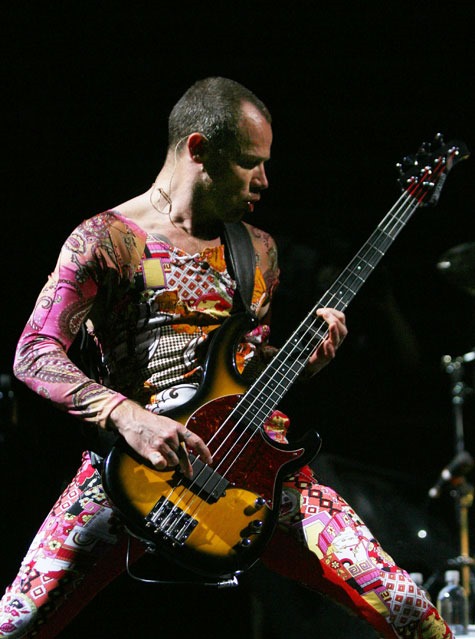
Now to press levity next to death: I used to mispronounce Phlebas as if it had three syllables. Apparently it’s pronounced with two, phoenicianally/phonetically, close to “Flea Bass”—though I think with a short, not long A sound. The next time you see RHCP, you’ll enter the whirlpool and think of T. S. Eliot.


Knowing this, it’s easy to see Phlebas as Verdenal. But I knew nothing of this when I first read “Death by Water.”  And you don’t have to know it either to have the words work for you in some way. Eliot had a theory for that, a well-respected theory back in mid-century: “Objective Correlative.” Eliot, by his own theory then, would hold that it makes no difference what the relationship was for him to this other young man in pre-WWI Paris. Subconscious? Sublimation? Closeted? Self-protection? Platonic, or Dionysius denied? No matter. You consider Phlebas or you don’t. Their bones are picked in whispers now anyway.

So, here’s my new addition to the Parlando Project’s ongoing serial performance of “The Waste Land”  available with the player gadget below. Perhaps another one where a legitimate singer might better serve my composition, but I like the current of the acoustic guitar music enough to submerge you in it.


*You know: “April is the cruelest month….” That one. No one has said as much, but between the opening line to “The Waste Land,”  the prologue to Chaucer’s “The Canterbury Tales,” and Shakespeare’s birthday, April seems like a logical choice for National Poetry Month.

**Another casualty of that campaign, a young British poet-soldier who died of an illness on a ship headed to those beaches: Rupert Brooke. One of the most popular pieces ever presented here is my recasting of a piece Brooke wrote on that troop ship heading to Gallipoli.

An Old Man on Record Store Day

The Parlando Project is mostly about presenting other people’s words. I like that. It adds variety and it lets me write about what encounters with those words bring forth. We’ve done that over 400 times since this thing kicked off publicly in 2016

So, we’re always ready to celebrate National Poetry Month. Any month is poetry month here! But every once in awhile I slip in one of my own poems. Sometimes it’s just because I have something I want to say to this adventuresome audience, but it’s often because I’ve read something someone else wrote and I think of something I wrote (or should write, and then write) that relates to it.

A blog I read regularly by Paul Deaton has ranged over various subjects in the past couple of years, but lately he’s been writing some about the past, including lives that range back into his parents and grandparents generations. I’m not going to go back that far, I’m only going to go back to when I was a young man. Given my age, this is “Boomer” territory that’s been already over-farmed—but bear with me. This isn’t really a poem about the past, it’s about someone in my generation who has a past, but presently. For those Gen X and Millennials who find this insufferable, I remind you that I’ve been priming my High Schooler who isn’t a Millennial to blame Gen X and Millennials for ruining things for the current and subsequent generation. I urge other geezers, crones and wise-ass elders to do the same. As our aged, but still very stable emperor demonstrates, the best thing to do to deflect blame is be proactive in shoveling it elsewhere. I don’t know why that should work, but it does!

Anyway, I’ve presented quite a few poems this year by younger-than-mid-life poets whose poems speak as if they are aged.

Besides National Poetry Month, April is supposed to bring us Record Store Day. It would have been last Saturday, an annual celebration of those venerable little stores that once again were selling dark flat petroleum circles that sing when you poke them with a needle. Our current crisis has canceled that.

Now back in my day…Oh man, having a past and dragging it around does make one insufferable doesn’t it…this sort of thing was serious business for me. I had little spending money, but I would hope to have it in order to buy one of those foot-square pieces of art with the circles inside. Something cool. Something that represented my generation.

I can remember a particular spring afternoon. Somehow my girlfriend and I had caged a ride in a keyboard player’s new AMC Javelin to travel to Iowa’s capital city where there was a “head shop” (which is where the best new records were sold, along with, well, “smoking accessories.”) On the way we listened to an 8 Track tape of the Moody Blues To our Children’s Children’s Children.  When we got there, I could merely marvel, as I had barely enough for one record album, and couldn’t decide which one to get or if I might need the money for something else. So, the only thing I bought was a pinned badge: a smaller, paler circle, containing a bit of the cover art to the Cream’s Wheels of Fire  record.

Badge
A circle from “The Sixties.”


Recalling this day 50 years ago or so, says paradoxically to me what music and recordings meant to me then. A record was a precious clue to take me through days or weeks. Foolishness? It’s always been partly that.

But of course something else was on my mind, and the mind of some of my generation on that non-official, just another record store day. War. Justice. The cutting edge of the then gap between generations and elders that had been through WWI, WWII and the Korean War, and were often sure we were ducking our war turn. Our best thoughts of ourselves were that there were more important battles, and of course some of us didn’t succeed in avoiding the war they wanted us to fight. And some of us went off looking for Eden, a place you can sort of find, and then lose track of again.

What else does that memory mean? What does it mean presently? That’s what today’s short piece is about. The player gadget is below to hear it.


Shakespeare’s Sonnet 152

Besides being National Poetry Month in America, April is also the birth month of William Shakespeare. The 23rd of April is sometimes celebrated as his birthday, though we don’t actually know that, only that his family baptized him and entered him into their church’s records on April 26th. The 23rd is also a handy date in that it’s the day Shakespeare died in 1616 back in the same small English town he was born in, only 52 years old. One theory has it that he’d just celebrated his birthday—well, a little too much—and that did him in.

No one knows exactly when Shakespeare wrote his sonnets, but ironically for our 2020 April they were first published in 1609, when the playhouses of London where shut down due to a plague.

The sonnets present themselves as outpourings of personal feelings and thoughts, which makes them tempting clues to the personality and biography of Shakespeare, but of course Shakespeare made his bones as a playwright, and so was well able to create characters and put them in motion with various plots and outlooks. Since today is the anniversary of his death, I thought I’d perform Sonnet 152, which can be viewed as the last sonnet in the sequence, since the two sonnets that follow it are an unconnected coda based on a classical poem about Cupid.

Sonnet 152 is a lover’s fight where we hear one side, with an overall structure as if the speaker is investigating the matter of lovers’ relationship to the truth as if it was a legal contract dispute. You might think that an odd choice, though there are lawyer-poets. Wallace Stevens comes to mind, and I think at times Emily Dickinson’s mind was fully capable of succinctly absorbing the modes of her family of (male) lawyers.

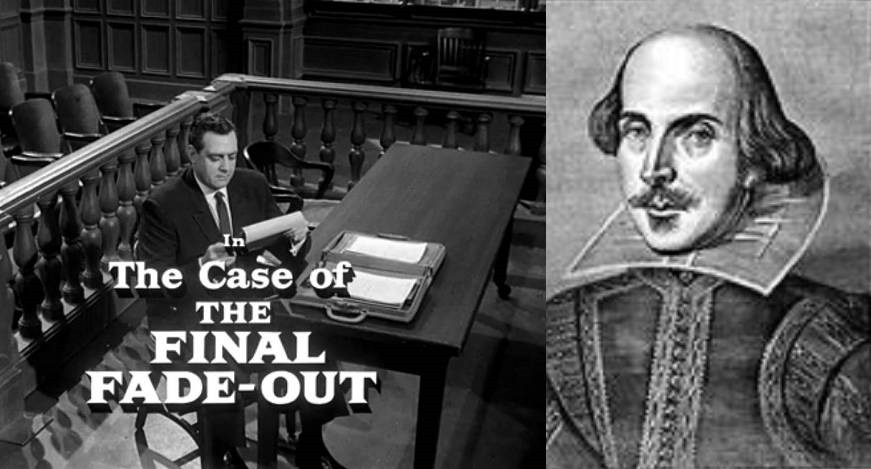
Was Shakespeare having fun with this? Perhaps. Anytime one writes 152 sonnets you’d have the opportunity to try out a lot of metaphors. Even if he was drawing on life experiences of some actual tumultuous love affair, it is a showy poem that renders the breakup as if Perry Mason or John Grisham was closing the case—but since the Elizabethan-era language may make this less than clear, I’ll summarize how I understood this poem today.

Perry Mason and Shakespeare

Well, I’ve looked over this book contract and it doesn’t say you need an ending. But Will, I’ve got this idea for a sonnet…


For simplicity’s sake, I’ll just call the speaker of the poem “he” as if he’s Shakespeare for the rest of this discussion—but as I said above, we don’t know that. And this particular text isn’t even gendered, and a woman could play the text in the first person without needing to change a word.*

He starts out saying that he and his lover are both sworn, as if witnesses or officers of some court, as lovers are often said to be to each other. But he then claims that the lover has in effect taken two oaths. This is ambiguous to me, some read this if the lover is married to another (and if “he” is Shakespeare, so would he have been too). A “bed-vow” has been broken and some faith has been broken too, a state of new hate after new love has broken out. Is this the lover forsaking their spouse for the he of the poem? Or the lover forsaking the he of the poem? Or both? Shakespeare may be intending this confusion, laying out the case that the adulterous lover may be just as untrue to him as to their spouse.

Now goose and gander here, if we play the “he” speaking in the poem as the married Shakespeare, then he’s just as guilty regarding marriage oaths. But he’s onto his next point. He confesses! Look, you broke your vow to me and to your spouse: that’s two. But I’ll say right out I’ve done ten times more oath breaking!

Six lines in, he, and the poem make a turn. He starts to layout his lies, his broken oaths, his sworn perjuries:

Yes, I’ve vowed that I’ll only misuse thee. “Misuse” in this era has a strong connotation of exploiting someone for selfish sexual pleasure. So he’s saying that now, he’s now hooked in love.

I’ve placed faith in you. Sort of a “I’m culpable because I should have known.”

I’ve “sworn deep oaths” that the lover is kind, loving, truthful, and constant.

I’ve been blind to the lover’s deceit, and I made my eyes swear they aren’t seeing what they are seeing.

Obviously every one of those statements is ironic. He’s saying he was “living a lie” when he trusted that the lover was really devoted to him, and that he has moved from thinking of them as someone he could dally with (misuse) and move on. And yes, if you are judging the character of the poem’s speaker, he seems to be a bit slick in his legalese.

So, an odd ending to the series of sonnets. It’s like one of those TV series that gets cancelled right after an episode with a big scene which is never resolved. And that could be exactly what happened. Shakespeare may have left off writing sonnets. Or the publisher may have only had access to part of what Shakespeare wrote. Accidental or not, like the lovers in Keats’ painted urn chasing each other, we’ll never know if anything will be resolved, and that somehow keeps them alive in some strange way, hundreds of years later.

Musically, I threw together a small orchestral arrangement for this.You can read the text of the sonnet here, and unless you’re reading this on the WordPress reader for Apple IOS, you should be able to click on the player gadget to hear my performance of it. IPhone and iPad users who use the WordPress reader should catch the performance by opening frankhudson.org in a regular web browser like Safari on their phone or tablet.


*After posting this yesterday, I looked at the a few other readings/performances of this sonnet. A number of them were by women. I think this one, posted the same day I did mine, is the best I’ve seen.