This Monday is American Labor Day, so here’s a poem about work from Robert Frost: “Mowing.” Like a lot of Frost’s early poetry it’s an example of words that want to sing, and so I’ll sing them today. Also like a lot of Frost’s best poetry it seems simpler than it means. It doesn’t scare the reader or listener away with its surface, but if you really stop to ask why it says exactly what it says, a more complex and subtle work emerges. Here’s a link to the full text of the poem if you want to follow along.
That about scythe’s it up. NC Wyeth’s “The Scythers”
On first reading this poem is a description of mundane work, mowing a field with the time-honored hand tool: the scythe. How old is that tool? It goes back to the pre-historic days of agriculture, to the making of the first blades for that, and then for the battles over that. It was still in use in Frost’s youth, in the late 19th century. And in the house I grew up in, in the mid-20th century in Iowa, in the crook of a tree in the big back yard there was a scythe caught there, high above my head, stored, captured, put away until it seemed as natural as any other part of the tree.
So, the poet or his speaker counterpart is mowing with a scythe. And since that poet is Frost, we get sound imagery regarding that work. The Imagists contemporary with Frost didn’t require their images be visual, but as a practice they strongly preferred them to be. Frost, on the other hand was the audio guy, not the word painter. The scythe as it swings and cuts, punningly sighs, but Frost has it as a whisper. About this, the poet is curious: if it’s whispering, what’s the scythe (and by extension, the work the man and tool are doing) saying?
The maker of this video on Frost’s poem demonstrates the sound
Frost’s poet says he doesn’t know. Interestingly he speculates it might be talking about the heat of the workday, and the phrase he uses “The heat of the sun” may well be reminding him of a poem from Shakespeare we recently featured here: “Fear No More.” Shakespeare’s poem and the connection with the scythe has with the “grim reaper” brings in an overtone of death.
And then he speculates it may be about why it’s whispering, why it’s not speaking something out-loud and plain.
Next the poem moves on to the realness of work inherited from its physicality. It’s not a dream or imagination without consequence. And it’s not some fairy story. Gussying it up with such trappings or comparing it to mental work with no embodiment would be enervating it. The poet instead calls this work “earnest love.*” This isn’t some secret crush, even with the whispers and all, this is actually sweaty stuff.
Frost then drops one of his better-known mottos: “The fact is the sweetest dream that labor knows.” That line is end-stopped with a period, and set off that way it’s a statement that real work on real things is superior to mere fancy. But this is Labor Day, so I performed it as if there’s a colon after “The fact is” and that its meaning carries on through the period and into the last line. The sweet dream then is the scythe whispering and the concluding matter of the hay.
What is the scythe whispering?
Because after all, there’s an unanswered question from the poems opening. What is the scythe whispering? It’s something intimate it wants to say, that good work says, but doesn’t say. It says it is—paid or unpaid, self-employed or employed, the labor of a poet or of a farmer, done grudgingly or with joy, appreciated or overlooked—it says it is done with love. Not the magic love, not the imagined love. The earnest love.
Happy Labor Day to the readers and listeners here. Wishing you good work and earnest love.
The player gadget to hear my performance of Robert Frost’s “Mowing” is below.
*This section of the poem, lines 10 through 12 in this unusual sonnet, is the most mysterious. I had to perform it before I could figure it out. There may be an overtone here (something that English folksong often made a practice of) of farm work being used as a metaphor for sexual lovemaking. There are snakes, flowers, and then named flowers that are “orchises” which are a genus of flowering plants and also etymologically testicles. Frost made a choice for what flowers he names, and his poet/scyther could have scared off a field mouse or chipmunk not a snake.
On the other hand, he may be just saying that like all artists his work will fail, some flowers get scythed. And the snake could be a Garden of Eden thing.
Or the flowers and snakes may be the beauty and the evil of what we do, that the Grim Reaper scythe will cut off.
I’ll often choose a piece to present here from an instant impression. I’ll be reading another blog, looking at a writer connected with something else I’m looking for, or paging through an anthology and there’ll be this poem that strikes me as more interesting than the one before or the next one after.
Somewhere last month that happened with this piece. You can find the full text of Charles Kingsley’s “The Poetry of a Root Crop” here. It starts off as a garden poem (I may have been looking for one of those) but it soon gets a bit strange. “Swede” is the British term for what I (and Swedish-American Carl Sandburg) would call a rutabaga. “Golden globe” is a turnip. The “Feathered carrot” is a nice image, I see the root tendrils—but by the second stanza we’re getting weirder: “angel’s alchemy” is somehow involved and “blood and bone.” I think of the orthopedic snap of crisp root vegetables and what, beet juice? Sure, it is rhymed couplets, but this is very modern imagery. I knew nothing of its author: I thought late Victorian or maybe one of the “Georgian poets” from around the time of WWI who often use modern imagery inside of traditional forms.
And then the poem starts to take on visionary or prophetic imagery. There are also elements in here, pace the “angels’ alchemy” phrase that call to mind esoteric terms of alchemy.* Where is this going? As the poem closes it becomes clear. This is a graveyard—and/or a garden. Which is it? I think it’s to be both.
By the time I’d finished reading the poem for the first time I’d decided I wanted to write some music and perform this. Those who consume the Parlando Project as a podcast hear only the short audio pieces, and I already knew this would be arresting there if my music worked out. But here, for my blog readers, I’d need to find out something about the author. Who was Charles Kingsley? I’d never heard of him, and it’s likely you haven’t either.
Charles Kingsley. If the British royal family is related to Odin, is there a part for Queen Elizabeth in the Marvel Cinematic Universe?
The weirdness didn’t end. First off, this poem was older than I figured it was. It was written in 1845. On first reading I would have guessed a contemporary of Yeats, but instead William Wordsworth was still alive. And Kingsley was strange. He was an ordained minister of the Church of England. He knew the British royal family and Charles Darwin and Thomas Huxley. He was an early proponent of Christian Socialism, and he was an advocate for increased worker’s rights.
But he believed in a historic basis for the old Norse gods, and thought the British monarchy was descended from them. He attacked Catholicism and thought Emerson and the American Transcendentalists were poppycock. He was a defender of the brutal suppression of the Morant Bay Rebellion in Jamaica.** If one wonders if that last was some technical or procedural objection, Kingsley’s Wikipedia page quotes what has to be the trifecta of a racist statement written in a letter to his wife after a visit to the County Sligo*** in 1860: “I am haunted by the human chimpanzees I saw along that hundred miles of horrible country [Ireland] … to see white chimpanzees is dreadful; if they were black one would not see it so much, but their skins, except where tanned by exposure, are as white as ours.”
So there you go: if you are a person of color, Irish, anti-colonialist, anti-racist, Catholic, an atheist libertarian, or I would suppose, a sentient chimpanzee, Kingsley is despicable.
Yes, these ideas caused, and cause, suffering and death, but his little-known poem brought me some pleasurable surprise. Big and little things.
Maybe I’m a bit glad that this poem is older than I thought. The vegetative minerals of Charles Kingsley are long absorbed into the earth, and I’ve performed Ezra Pound poems, so I guess you can put me down in the group that says the art can exist—at least eventually—separate from the artist.
Is the opposite so? The better, the more evolved, just, and righteous that a reader is, the smaller the number of poets they will be able to read?
The player gadget to hear a performance of “The Poetry of a Root Crop” is below. My music for this is acoustic guitar and electric bass today. If you don’t see the player gadget, this highlighted hyperlink will also play the piece.
**Wikipedia says Thomas Carlyle, John Ruskin, Charles Dickens and Alfred Tennyson also served on a committee with Kingsley defending the actions of the British colonial governor of Jamaica.
***I’m moved to mention that within a decade, a certain young boy named William Butler Yeats was in that same County Sligo a lot during his childhood. Some chimpanzee, Kingsley. See Yeats moving poem in his primitive tongue: “Me Tarzan, You Maude Gonne.”
Heard this one? A Chinese poet, a shadow and the moon walk into a bar, and they order wine from a translator…Oh, that was last time, and Le Bai’s “Drinking Alone Beneath the Moon.” Well I promised I’d say a little bit more about translation in another post, as yesterday’s was already long enough.
I’ve translated some poems for this project that have few or no translations I can obtain. After all, this project is a strange mix of poems few have heard about and then “poetry’s greatest hits.” There’s a real need for translations of poems that have been overlooked, but I do feel like I’m driving my translation SUV on thin lake ice when I do them. You see, I don’t speak any language other than English. My only academic exposure to languages was high school French, and most of what I learned then was that my mouth and vocal cords couldn’t pronounce French words correctly. Whatever knowledge of French vocabulary, much less verb tenses and syntax, has faded over the decades since. About all that’s left is recognizing a French word that I would have wrestled with as a teenager, sort as if one might recognize someone at a class reunion as someone you used to know even while their name now escapes you.
So, what do I rely on since I’m monolingual? Machine translation, such as Microsoft and Google translate is helpful. When I’d translate French poems in the 1970s before any such computer/network things, I’d be thumbing back and forth in French-English dictionaries for an afternoon just to get that far, and now in a second I can get something that is a helpful start. With Chinese poems, Chinese-poems.com provides literal/one-for-one translations for the Chinese characters of a number of poems.
But these two ways are just a start. For example, here is the literal from Chinese-poems.com for a poem by Du Fu about Li Bai:
Cold wind rise sky end
Gentleman thought resemble what
Goose what time come
River lake autumn water much
Literature hate fate eminent
Demons happy people failure
Respond together wronged person language
Throw poems give Miluo
And here is Google Translate’s rendering of yesterday’s Li Bai poem:
A pot of wine among the flowers
No blind date alone
Toast to the bright moon
Opposite shadows into three people
The moon is neither free to drink
The shadow disciple with me
Temporarily accompanied by the shadow of the moon
Fun must be in spring
I linger about song moon
My dance shadows are messy
Make friends when you wake up
Disperse after drunk
Endlessly relentlessly travel,
Phase Miao Yunhan
Unless one enjoys the most abstract kind of language poetry, neither is much of a poem, and neither will impress a casual reader with the need to read them or an experience to be savored. What can one, seeking to make an effective English poem, grab hold from these literals?
I almost always start with the images. What is the poet seeing or sensing? As I get some working sense of that, I’m mixing in the question of how these images relate. My primary job as a translator then is to take those things and make them vivid and comprehensible to a modern English speaker. If I fail at that, the translation will fail utterly. If I succeed at that, the result will have some value (assuming your source is a good, effective poem) even if it’s not yet a strong piece of poetry.
I’ve always admired folks who mastered several languages, though I’m not one of them. But, with an open heart and inquiring mind, aided by modern Internet dictionary and research tools, a poet can expand their view of poetry by the process of translating others.
As I polish my translation, I pay attention to what I began to feel are key words. I have spent an hour or two on one word,* and not having any panel of native speakers to refer to, I’ll do Internet searches looking at actual usage of the word in other writing and using online dictionaries to appreciate more about the specifics of meaning.
What about the word-music? Master poet Robert Frost famously said “Poetry is what gets lost in translation.” But Frost was a stoic, maybe even something of a fatalist, so this observation from him doesn’t mean to not try translation—it just means to accept a certain amount of failure is inevitable and to continue. If you are translating a rhyming poem from another language to English should you rhyme it, maybe even try to use the original language’s rhyming scheme? My answer to this was no—or it was, until I ran into Rimbaud’s “Eternity” and found it too bare without the reinforcement of the ringing of the rhymes. But to mess too much with a poem’s matter of images and juxtapositions to make rhyme is a mistake in my mind. Similarly, scholars tell me that Li Bai was a formalist poet: his poetry exactly followed the existing rules of Chinese prosody that I have almost no understanding of. Even if I understood them and had a plan to represent them in English, how much can I afford to sacrifice for that? Even though the original poet had to make tough choices during creation within their language to fit the form or make the rhyme, I as a translator have taken on an additional, difficult task and will say I cannot cripple the poem to retain some shadow of its original music.
Still, poetry is musical speech. I do try to make the resulting translation have a music in English. It just may not be much of a copy of the original poet’s word-music. In the Parlando Project I often have fun matching poets and poems to musical settings that seem, at least at first, to be inappropriate. Any word-music device that adds to the poem’s vividness can be chosen anew during the re-creation that is translation.
In yesterday’s Li Bai, I added a refrain, a repeated line that wasn’t a set line, and so it has an intoxicated repetition effect. This device wasn’t used by Li Bai. My reading of his poem was that it wants to represent the experience of intoxication progressing to the point of being quite drunk, and this musical device reinforced that.
Do I look at other English translations, if available? Yes, I do, though my usual practice was to do this after I have finished mine. I’m not sure if this is right, but I have enjoyed the gradual reveal of a poem’s meaning as one labors over the translation, and so I don’t want to unwrap the present beforehand. In case of yesterday’s Li Bai poem there were an extraordinary number of English translations available,** and I collected all I found on the Internet and read them all. I think I may have been asking myself if another translation is even needed here, or thinking there was a possible post on how there can be so many and how they differed.
Remember that “thin ice” feeling I mentioned when one is translating a language that is not one you’ve mastered even to a rudimentary level? Reading another translation can help you check that you haven’t fallen through and trapped your translated poem under the ice where it needs to be rescued or left to die in the white page darkness of your own abandoned project pile.*** Sometimes I double check where I differ, dive deeper into the original language or what I can determine about the author’s intent or knowledge. Other times, I believe I’ve found a co-equal alternative in the poem’s ambiguity. After all, many of the more than 40 translators I found of Li Bai’s poem knew at least some of these other translations. The inarguable fact that there have been many effective portrayals of Hamlet doesn’t mean we should stop performing the play.
Ideally, in matters of culture and language, a poet-translator should work with speakers and scholars of those things. Many translators do, to at least some degree. My age, resources, project deadlines, and personality have kept me from doing this with the translations in this project, and even though collaboration is a component of some effective art, committee work rarely is. Ezra Pound relied on limited Japanese sources for his translations of Tang dynasty Chinese poets. The results were not very accurate, but they produced vivid poetry that bore, however inexactly, the power of their original verse to English language readers.
Currently, there are additional worries about cultural appropriation in such actions, perhaps even in my own. Some of it comes down to a sort of literary Gresham’s law: that less accurate work by those outside a culture will obscure or prevent work by those within it. This is an issue worthy of a few thousand words on its own, but not today. I tell myself at my level, with a small audience (thank you for being that audience!) and a completely non-commercial enterprise for the past four years, that I’d be putting on airs if I thought I was stopping someone else. As an artist, I’ll testify too that bad or incomplete work can be inspiring. I also have enough faith in the accidental and chaotic parts of artistic inspiration that allows mistakes and misinterpretations to produce good art. And while I acknowledge the issues, I have some inner belief that cross-cultural exchange is both unregulatable and desirable.
Speaking of accuracy, of faithfulness to the original poet: I’ve feel a duty to them. Translating someone else’s work can be an intimate experience, an additional level beyond reading a poem, or even deep reading a poem several times, or performing it aloud, or memorizing it. However inaccurately and fantastically, I feel for a few days as if I’m working as an apprentice to this 8th century Chinese master. This year, following the practice of Robert Okaji, I’ve decided that more of my translations would better be labeled “After…” which is an out if I’ve misinterpreted, and a license to extend what I may have only partially absorbed.
Before I leave the subject of translation, I encourage any of you who write poetry to attempt it. Perhaps pick a poet you’ve liked in translation and double-check the English translation you know by doing your own from the original language. You may be surprised at how freely the translator chose to work, but beyond that: this feeling of co-creation, of apprenticeship and comradeship with another artist, with the choices that need to be made in your language to carry in it what comes from the other’s eyes, heart, and senses—this is a powerful spur to the poetic art. And though the English language can be proud of it’s poets, there’s a world of poetry that was spoken in other tongues. French poetry helped form my early writing, Chinese poetry has expanded the range of my older poetic voice.
No new audio piece today, but here’s a piece about how I eventually came to a theory of how my experience of a song my great-grandfather liked was a “mistranslation” of his experience of it. Oh, and like Li Bai’s poem, intoxicating beverages are involved.
***I’ve been fairly brave or foolhardy given my lack of language facility, but there’s no reason that you have to show anyone your translations, much less perform them as I’ve done here. And while I might be audacious, other people’s work I present here is overwhelmingly in the public domain. I agree that living writers should have a say in the substantial reuse of their work, but your own private translations are not an issue.
Our last audio piece this month had American satirist Mark Twain pointing out incongruities in the longstanding trope of the tortured poetic genius who dashes off “weird, wild, incomprehensible poems with astonishing facility, and then gets booming drunk and sleeps in the gutter.”
How far back does that trope go? Well at least to 8th century China, and the authentic poetic genius of Li Bai.* Li Bai and Du Fu are the two most highly regarded poets of the Tang dynasty period, and given that the Tang dynasty can be viewed as the artistic high water mark of an extremely long and wide culture, that makes this pair probably the most esteemed Chinese poets. The metaphor is rough, but unavoidable: either have been called “The Shakespeare of China.” Their lives overlapped, they knew each other, even wrote poems that drop each other’s names.
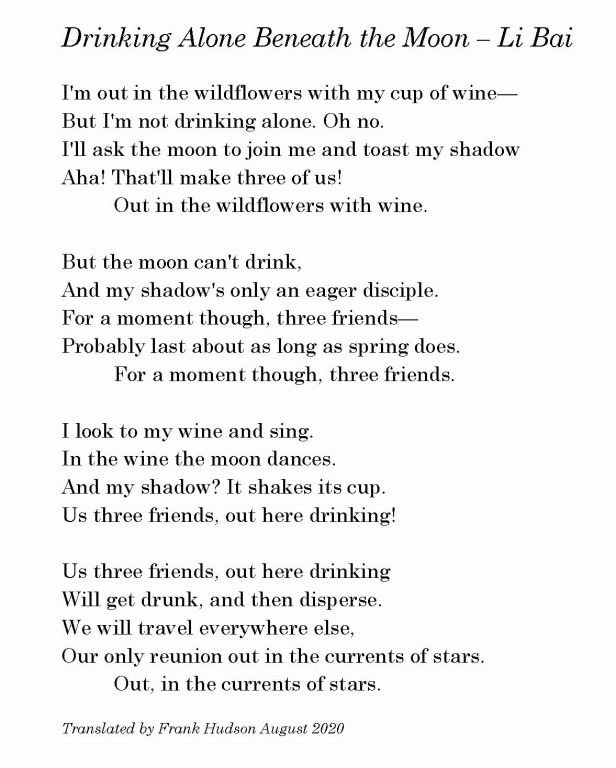
Li Bai both by reputation and through the persona that appears in his poems, has some similarities to Twain’s poetic genius. References to wine** in Chinese poetry are legion, but even against that background Li Bai stands out for the number of poems he wrote about the consumption of wine and examination of intoxicated states. The Li Bai poem I’m performing today, “Drinking Alone Beneath the Moon” is one famous example.
I think this poem pulls off a neat trick. Somewhat like Twain’s “Genius,” on the surface it’s comic: Li Bai portraying himself as a sort of Falstaffian character whose meditation practice this evening in nature is to get hammered on some juice. But to my reading this short poem also portrays the progression of his intoxication subtly. The opening has him cleverly figuring out how to bypass any guilt from society’s admonitions regarding solitary drinking. And then he quasi-surprises himself that his plan is only partly working. I love the image of him finding that his shadow is merely a disciple—that Shadow will only follow Li Bai’s own drinking and not spur him on by proposing additional draughts. Then as his hand gets less steady, the moon’s reflection in his wine cup wiggles and dances. He of course doesn’t sense that he’s getting unsteady himself, but that shadow guy, he sure looks shaky. Finally as intoxication becomes deeper, he senses that his senses are going to be blotto, that the disciple Shadow-man, the companion moon, and yes even Li Bai himself are going to be out of it, cast off into some state not in the here and there of his actual moment.
Where does he go, where does his imagination go? The final image is of stars, moving, swimming it seems, movement-blurred. These could be the actual stars if he’s now flat drunk, or even abstract visual stimuli as his consciousness slips away. Footnotes in some translations tell us the idiom Li Bai uses in his ending may be understood as the Milky Way, the visual smear of our own stellar galaxy visible on some clear non-light polluted nights. My reading is that Li Bai may be using that image, but any stars are blurred and multiplied to his character in the poem now.
My new translation of Li Bai for today’s performance.
Oddly, it takes a clear-headed poet to portray drunkenness. Twain may have had some moment of empathy for his dying in rags and dirt “Genius” poet, however foolish he can portray him. Li Bai starts his poem alone—and though he imagines his two drinking partners, he knows that they too, not unlike real companions absent at the start of his poem, will disappear with his consciousness as the wine flows.
In the original Chinese, Li Bai was a meticulous poet, observant of the traditional forms, a fluent user of rhyme and the Chinese version of meter. I can’t tell if any of the poetry Twain’s genius wrote justified the rough and foolish life, but from Li Bai’s esteemed poetry we know that whatever is true of his now legendary life, that his poetry gives us something worth reading. It’s possible the poet Li Bai used the character Li Bai, the dauntless romantic unconcerned for moderation—just as Samuel Clemmons, the ambitious young man who fled west to become a writer, used the character of Mark Twain.
I’ll probably write a follow-up post regarding the process I went through in creating this original English translation of Li Bai’s poem, but in summary, my observation at the start of that task was that most existing translations worked hard to be poetic, and some achieved that to a degree, but at a cost of not vividly embodying the process and character of the poem’s speaker. So, I went another way.
Musically this started out as a rock quartet: two electric guitars, drums and a very saturated overdriven bass guitar that sounds almost like a synth bass. I used some woozy Mellotron strings again, adding a bit of simulated worn tape cartridge wobble. I was going to go with the infamous Mellotron flute (any two or three notes using that, and many will forget what you’re playing and start to go: “Let me take you down, where I’m going to, Strawberry Fields…”) and then I thought: why not a Chinese bamboo flute instead? The last part I played was an approximation of a guzheng, a long scale zither-like Chinese instrument that I thought of since I had recently seen some examples in a museum this summer.
The player gadget to hear my performance of my fresh translation of Li Bai’s “Drinking Alone Beneath the Moon” is below. Don’t see a player? Here’s another way: this highlighted hyperlink will play it too.
.
*The names we type and read in western alphabet for Li Bai’s name are approximations, and the schemes have varied. Li Bai is also rendered as Li Po and Li Bo and if we take the carom shot off the backboard of Japan’s pronunciation (as Ezra Pound did), he can also be called Ri Haku or Ri Taihaku.
**I had to look and see as I worked on this translation what kind of wine was common in 8th century China and would be known to Li Bai. Most Chinese wine in those days was grain-based from millet or rice. There were regions that made fruit wines then, but they were much less common.
Reader Benjamin David Steele remarked this month that he didn’t know I was from Iowa. It’s true, I don’t talk often about being from somewhere, part of my goal of not talking directly about myself as much as many successful blogs do.
Perhaps that’s my contrary streak. Yet if one has that trait, it may be that it can change direction on itself and careen 180 miles an hour the other way. Here’s something I was going to include as an aside in one of the two Mark Twain pieces preceding this one, but it was too long to be that.
Twain’s books weren’t all I thought of when I performed those Twain pieces ribbing poetry and poets this month. I thought of Hal Holbrook, who liked to say that he played Mark Twain longer than Samuel Clemens did, and I also would think of a beautiful, silent library—but to get to those places I need to think first of my father.
My father had no straightforward vocational life, much like the one I later had. If one thinks of the midcentury male American life as the one-job man during those decades, you may be demographically informed, but wrong about him. He set out to be a Protestant minister, as his father and one of his brothers had been. He changed his mind, ran the third grocery store in a tiny town (didn’t work out), worked on a loading dock, and then took a job driving a bread-truck delivery route between the many little towns in my section of Iowa. The workday was long, the trucks leaving from a barn on the outskirts of the county seat 30 miles away at dawn, driving there on the tractor-putting two lanes and repurposed stagecoach routes. In the afternoon on his route, he’d come through my hometown supplying the two grocery stores that still remained on the one-block main street. In the summer, I could arrange to ride along with him, sitting on the bare treadplate step to the right of the only seat, the driver’s, in his bread van as we’d both leave off for another small town. Behind his driver’s seat and my sideways crouch, the entire back of the box truck was filled with sliding wire racks to be filled and then emptied of loaves, buns, dessert bread products, and doughnuts. Between us, a doghouse cover for the truck’s engine and the long shift lever. My dad had a small transistor radio on a ledge near the windshield which, if there wasn’t an afternoon baseball game, was tuned to a country and western station—but there was music in the truck too, a thrum from the engine between us and an ostinato chiming from all those metal racks behind us.
We talked some, but it was mostly these loud musics and the everyday weight of the afternoons.
I sometimes wonder now if I’m recalling that sound when I play a Telecaster with its bridge pickup that can chime and clangor moreso than any other electric guitar: that sound of 1960 country music combined with those metal racks, all jumping like yapping puppies on their ledges as we traveled over the rural roads.
In each town, a store or two, the bread from trays transferred onto shelves, a few commercial words and small talk with the store owner, and back to the truck and eventually back to the county seat and the bread company’s office and truck barn. There my dad would unload the retrieved old bread and do by hand a series of books on the day’s commerce, something that took about an hour.
I watched this once or twice from my adolescent what’s-this-got-to-do-with-me nonchalance. Most days I had a more desired way to spend this hour.
The county seat had two things our smaller town didn’t have, a hobby store that is another story, and a library multiple times the size of the small one in my hometown. I could be dropped off within walking distance of either while my father did his end-of-day business.
The Kendall Young Library had all the things you’d find in most larger libraries then: multiple levels with steep stairs, the Dewey Decimal System arrangement, a card catalog, newspapers threaded onto majestic wooden rods as if daily Torah scrolls, a quiet and light somehow better than any other quiet and light: a romantic, forest of books light, a quiet of words.
My mother had worked out how to get books by mail from a statewide library system, and that kept me largely supplied throughout my childhood, but there’s a something difference in being in the presence of books and their specific possibilities. History was my main passion then, so that if some of these books in the library were old,* that was no drawback.
On one day there, I may have collected some books more quickly than usual, and I wanted to see what else was in this place. At one side of the largest room there were a couple of record players, a selection of records, and headphones. I don’t know if it was the records or the headphones that caught my eye first. That records could exist in library-sized collections was a marvel, but headphones signified exotic hi-fi technology, though they were more likely only an accommodation to the word-quiet of the library.
One of the LPs that was there was the 1959 “original cast recording” of Mark Twain Tonight, a one-man Broadway show in which the young actor Hal Holbrook in aged makeup played the 70 year old Mark Twain giving one of his turn of the century stage talks.
Holbrook continued to ride that act’s horse until he was playing a man more than a decade younger than he had become.** I was about to find out why it worked so well. I put on the record and enclosed my head in the ‘phones.
Holbrook’s script (such as it was, he always worked from a surplus of Twain material, not a fixed text) was a master of the seamless excerpt. His Twain at first seemed for a moment frail, you wondered if he was going to falter, but the dry jokes were moistened as he worked the timing with an invisible stage cigar on the recording.*** Twain may have been a historical or literary figure, but the first 20 minutes had as much funny skewering of various hypocrisies for me as a contemporary issue of Mad magazine. But along about the middle of the record, things got quite a bit darker. I’d gotten to the second side and a withering compression of the situation of Jim, the escaped slave thrown together with the runaway Huck, each escaping exploitation, when the hour or so expired and I needed to join my father for the ride home. My head came out from between the cups of the headphones, but I’d been inside part of Twain’s book. Huck and Jim couldn’t go home. I had to, and could.
That was my mother’s and father’s doing—both that I could take this journey that could stop at this library, but also that I had a home to return to. I rode home with my father, he was wearing his checkerboard shirt woven to match the printing on the wraps around the loaves of bread.
Period and 21st century views of the Kendall Young Library. How could I not have seen that skylight?
I did two things to check against this memory today. I re-listened to what may be the same recording I heard that day in the library, this time on Spotify. I found it much as I remembered it, which compliments the impressiveness of Holbrook’s performance. And I looked online for pictures of the Kendall Young Library. Here my memory got an adjustment. I recall, yes, that it was a fancy building, but the pictures reveal a beau-arts building more exquisite than I remembered. I was most shocked to see that it has a domed stained-glass skylight, something that no doubt helped with that light I recalled, but that I’d never noticed then with my head in books and sound.
No audio piece today, but thanks for reading.
*The old books were likely less old that I am today. I know I enjoyed books there from the 1920s through the 40s, which seemed like centuries ago then. Perhaps a teenager today with a City Lights chapbook or a Beatles LP considers those too archaeological finds from a stratum nearer the pyramids than their weekly life.
**I wonder, how did the makeup have to change from the 34 year old portraying Twain at 70 to the 80 plus old Holbrook doing the same.
Last time, American satirist Mark Twain took aim at the pretensions of half-hearted sentimental memorial verse. Today’s barbs for bards are from a younger Twain. The text is taken from what was apparently a journal entry written on shipboard in 1866, before Twain was established in his literary career. Elsewhere on the web “Genius” is identified as a poem, and perhaps in manuscript that intent is clear—but when I first read it, I suspected it could be notes for something not yet finished, or even cue-phrases for a humorous lecture.
150 years and the mystery of what it is hardly obscure the points Twain makes. The alienated, self-pitying, and intoxicated artist, damaged by a feeble market that is itself a claim to their originality, is a type we can still recognize—even for some of us, in the mirror. In my performance I chose to bring forward what I think is some ambiguity in the piece. Twain never quite shows the work itself is a worthless affectation, while indicting the affectations around the artist specifically and wholeheartedly. Yes, the poet’s rhymes are said to be “sickly” and “incomprehensible,” heavy charges laid on them by those “with sense” who are not hip enough to appreciate the “genius.” Every single poète maudit* since would take those charges as badges of honor. I sense some mixed admiration for this stubborn guy who sensibly should take available steady work as a sawyer, but instead sticks to writing.
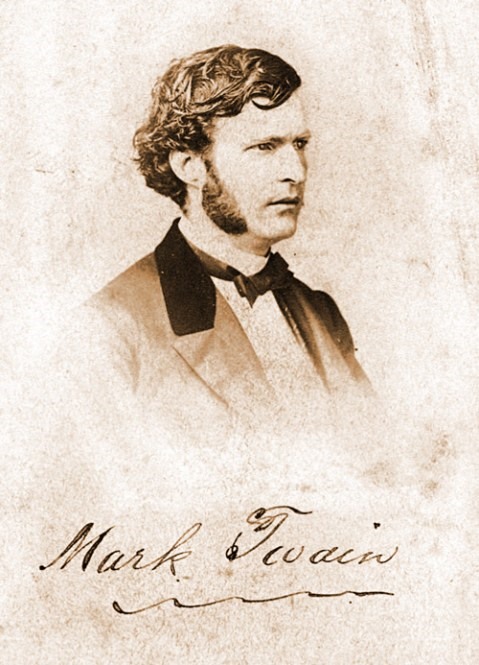
The pen name was still fairly new, and the ‘stache hadn’t yet leapt to his upper lip, but here’s the twenty-something Twain.
After all, Twain himself was not far from that state. He was not yet a successful writer. He hung out with a group of self-described Bohemians in San Francisco. He lived in his Twenties a fairly reckless and feckless life, fleeing to the west from Missouri to escape the Civil War and the draft, fleeing Virginia City for San Francisco to escape a duel occasioned by a slanderous article he had published, and this particular journal entry had him on a ship heading to Hawaii, leaving San Francisco. “No direction home, like a complete unknown…”
And all his life, Twain was two, a man who clearly wanted success and recognition, but whose writing and outlook was distrustful of established norms, propriety, and shibboleths.
If “Genius” is notes for a talk and not an intended page-piece, it points out that Twain’s eventual career included substantial work as a speaker who told humorous stories. We have a name for that sort of work today: stand-up comedian. During his time out west Twain met and befriended Artemus Ward, a man who has since been called the first stand-up comedian. They met in the mining boomtown of Virginia City, and the story goes that after Ward’s performance, Twain took Ward on a drunken tour of the rooftops of the town. Given their state, the risk to American culture of such an intoxicated lark was in retrospect considerable, so perhaps we should thank the town constable who along with a shotgun filled with rock-salt, ended that escapade.
So, Twain lived to write his books and to skewer poetry. The player gadget to hear my performance of Mark Twain’s “Genius” (whatever it is, or was intended to be) is below. Here’s the full text of “Genius” as is appears elsewhere on the web.
*Was Twain skewering a particular poet, or a type? Edgar Allen Poe, the American poet of his time who lived and sang the “songs of a poet who died in an alley” would be one candidate. And it could be in some part a reflection of persons in the West Coast bohemian scene he was sailing from.
I’m of an age when thoughts of death could be excused as more a present issue than a youthful goth affectation. Covid-19, that hit dirge of the summer that would play at every party were there every parties, amplifies that. But the gothic was similarly close at hand in the 19th century when untreatable disease and violence were more common. We still associate poetry with funerals—though I worry too that we can compartmentalize it there—but in the 19th century this was even more so. Real and imagined elegies were all the rage for poets at any level of talent and fame. From extensive demographic research I believe it may be true that just as high a percentage of 19th century people died as nowadays;* but it did seem the opportunistic occasion for poetic mourning was more extensive then.
Now Mark Twain, a satirist, loved subverting the expected, and so in the course of his novel Huckleberry Finn’s catalog of expected human behavior and good taste overwhelming a more rational ethic, he stopped to parody such memorial verse with this tale of romantic death that failed to be, well, romantic enough. In the novel this poem is written by Emmeline Grangerford, who is described as a young poet who rapidly cranked out memorial verse faster than any undertaker or supple lyric muse could keep up.
In today’s audio piece I give some of the story of Emmeline’s poetic endeavor from the novel, and then sing as a folk song of the sadful death of Mr. Bots using for lyrics the example poem of Grangerford’s Twain has given us. The full text of the poem is here.
What is said to be Mark Twain’s guitar still exists and has been acquired by a collector. Small size guitars like this were normal for the 19th century guitar market in America. (photo by Bianca Soros)
Today’s music is just acoustic guitar. Although I originally intended a more elaborate arrangement, I think just guitar suits it well. As I came to the decision for practical and aesthetic reasons, I was reminded that Mark Twain himself was a guitarist.** Just before leaving for the West Coast where he would make a name for himself as a writer, he bought himself a used Martin guitar.*** He says he played it for men and women in the newly founded boom towns, and on shipboard as he sailed hither and yon. Twain’s account says he sang along with the guitar, but I haven’t found any accounts of what his repertoire was. It could well have been a songster’s mix of popular tunes of the day and what we now call “folk music” and I could purpose he just might have slipped in a few originals. Since one can’t tell how Twain would have performed “Stephen Dowling Bots” as a mournful song, I claim my attempt as “close enough for folk music.”
You can hear my reading of how Emmeline Grangerford’s poetry is introduced by Twain and the song made from her memorial poem with the player gadget below.
*I can present the statistical charts and tables for this startling claim when it’s ready for peer-review. A counterclaim is based on the data that many people in our 21st century are not, in fact, dead at this time. (emphasis mine)
**One of Twain’s sisters was a music teacher who taught piano and guitar. Both instruments were often thought of as women’s instruments in that era, to be played in middle-class home parlors for do-it-yourself culture and entertainment. The supposition that Twain’s sister taught Twain how to shred on his axe follows that tidbit.
***The famous American guitar making company was founded by a German immigrant Charles Frederick Martin in 1833 (a year that’s still featured on a Martin guitar’s label.) The Twain guitar pictured here is said to be from 1835, which would make it a “birth year guitar” for Mark Twain. Some collectors today seek out vintage guitars that are coincidental with their birth year, but I doubt that was a thing in Twain’s time. Further clouding the picture, the design of this guitar (particularly the headstock) looks more like the guitars Martin made later in the 19th century, and not those made just after the company’s American start.
I know, I know. Some come to blogs like mine as a break from politics. Carl Sandburg used to mollify the editors of Poetry magazine who wondered about the encroachment of his politics into his Imagist poetry by suggesting that no, he was a poet, an artist—and if a little politics snuck in from time to time, well he couldn’t help it being that it was part of him.
Well, he was a poet, but maybe he didn’t want Poetry to know about the radical writing he was doing for the IWW at the same time he was writing his tight Modernist observations of our working life and living.
Woody Guthrie, who we might think of as the pluperfect tense of a protest singer, once said that anything that is human is anti-fascist, which would make a great deal of poetry into a political act, though I think he has to draw a rather gerrymandered line around the borders of human.
Many on the right find the continued use of racist and fascist as terms of approbation too broad a brush. I’d like to agree with them. I like exact words myself. I find in tired worn-out words a point of sadness, a heaviness in absence, a missed opportunity. But then sadness, oppression, and missed opportunities are not just dreary words I can discard for fresher ones, they are remaining realities.
Trump sucks the oxygen from a room, leaving only in the remaining vacuum assent or protest—but both of those are in an airless room. I post this photo I happened upon this morning because some of you will find enough air to laugh* and get some momentary relief from it.
Listen up team, there should be no “I” in “fascist.”
Will there be a few that won’t get the joke? Well that’s what I’m here for! The story I heard was that Woody Guthrie saw a sign in a war materials factory during WWII, and appropriated it for his guitar. I like that origin story, because it reminds me that my job as an artist is to get my work done, even though we’re in an emergency or emergencies—perhaps best to do it because we’re in an emergency.
Woody Guthrie in the upper left, inspire and inspired, “The workers in song” moving clockwise from Guthrie: Pete Seeger, Tom Morello, the fighting typist, Carl Sandburg (with my suggested machine sign), and two unidentified war-factory workers from WWII.
Those two women riveting an aircraft part in the collage above? That’s a very real part of a victorious war machine. Maybe they would also be part of the Seattle village helping raise war-baby Jimi Hendrix, an artist who made imaginary things. What does something imaginary have to do with winning a battle?** Every struggle, every war, is fought for things invisible as well as real. All progress is moving toward the invisible, like a future humanity that has moved beyond fascism and racism.
No new audio piece today, but of course there are hundreds of them to peruse here as part of the Parlando Project. Here’s one of them by Sandburg about work that you can hear with the player gadget below or with this highlighted link.
.
*More joke explanation. Right now in the U. S. there is a frank and acknowledged effort to reduce voting by mail during the current pandemic. The hope among those in the current administration and Senate is that this might not increase the right voters but it could exclude more of the wrong ones. This assumes that potential right or wrong voters won’t get mad about this.
I’ve already talked here about doing translations from other languages into English and how it can be a strikingly intimate way to get next to another poet’s creative choices. Performance, or even attentive reading, can also bring on this effect.
Let’s take Shakespeare as a mere lyricist today. Of course, he’s a big deal for our English language, a writer from the days when it was beginning to resemble the one we speak today. For many he’s the writer of plays, with characters of which generations of actors measure themselves by the facets they cut from them. For others he’s the writer of sonnets, many of which work by complex arguments and compressed thought, making them memorable from line to line, even if it’s hard to grasp the entirety of even one of them. But occasionally* within the plays he becomes a lyric poet in one or both of the senses of the word: a writer giving us a complex emotional matrix of someone’s experience in a moment of time, and as a writer who expects his words to be sung to music.
Songs meant to be performed inside other, larger works can be problematic. They may refer to particular characters and situations, which when the song is presented separately, become unfootnoted puzzlements. This song doesn’t have much of a problem there. “Fear No More” is sung as a funeral song in the play Cymbeline, but it’s self-evidently that—a situation that is universal, just as the song admits.
So, as I do my task with this project, figuring out what sort of music to write and effect to try to present in performance, I need to read attentively. Though I have done this hundreds of times during the Parlando Project, I often find that no number of silent readings finds what route to take. This may be me, my wandering attention and self-centeredness, but for this one (as with many others I’ve presented here) the subtilties started to emerge as I come to grips with performing it.
On the surface one could say this song is making an argument: they’re dead—but you know life is suffering, so they are no longer suffering. It doesn’t take long to notice that surface is transparent and there are other things to see through this.
First off, many things here are bittersweet. The opening line, for a Minnesotan** “…the heat of the sun” isn’t something we fear or are even displeased by, even during an extraordinary hot spell. “Golden lads and girls” also, not exactly earthly suffering, and we’re given their end with the joke that they’ll come to dust like the occupationally dusty chimney-sweep. Yes, wages, clothing, eating, learning, loving (all referenced here) can have their struggles, their bad as well as good days, but on the whole we don’t wish to dispense with them.
As the lyric proceeds, Shakespeare slides into darker and darker territory though. Those that assume to be our social superiors are going to have opinions on us, and in some cases our rulers will be tyrants. We may be slandered and censured (apparently this could be done before Twitter). And given some storms in the upper Midwest this August, I’m reminded that summer lightning and thunder are not mere theatrical sturm and drang, but can be the light and sound tech-crew of destructive forces.
And the final stanza moves darker yet. Exorcists, vampires, zombies, and vengeful ghosts—but wait: these are all dangers to/from the dead. So, the whole argument of “At least they are now resting” is completely undercut. And it’s here that I started to notice that the singer who’s tasked with merging with the poet’s work is outlining an inconsistent but vivid life that’s not without agency. This vividness argues against its inconsequentiality.
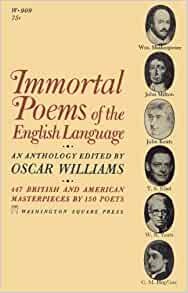
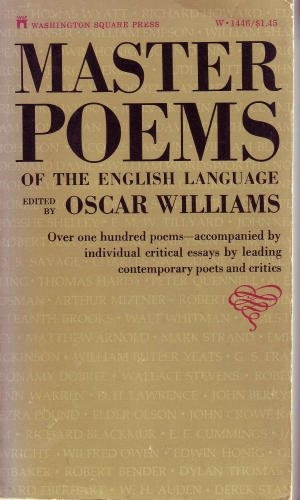
Oscar Williams’ poetry anthologies surprised the mid-century publishing world selling quite well. These two thick yet inexpensive books were part the paperback library of my youth. Maybe it was the titles: “Master” and “Immortal” would be catnip words to an inconsequential young writer. Williams was an ad-man besides being a poet and editor, so this may have been no accident.
Shakespeare’s songs attract composers, and this one has been made into lovely art song, but I like to roughen them up a bit, and do so here with this acoustic guitar and voice setting. The player gadget to hear my performance is below. But before I go, I want to tip the hat to the Stuff Jeff Reads blog which recently reminded me of this beautiful and enigmatic lyric. And it turns out he and I both read it first thanks to the same anthologist, Oscar Williams, who issued some surprisingly great-selling mid-20th century paperback poetry anthologies.
*Besides being a dramatist, he’s also an entrepreneurial content provider for a new form that needs to please nobles who might get their heads chopped off—and then too, folks who couldn’t get good seats for the bear baiting and so had to make do with a play. Given that Elizabethan song had many clever lyricists, it’s not sure if Shakespeare wrote all the songs in his plays. We also don’t know the music composers, or their tunes for the most part. This particular lyric seems “Shakespearean” however.
**And likely too for an Englishperson, with a temperate-climate, but one that’s not too-often sunny. Winter’s “rages” aren’t without joy in Shakespeare either, like this song from another play.
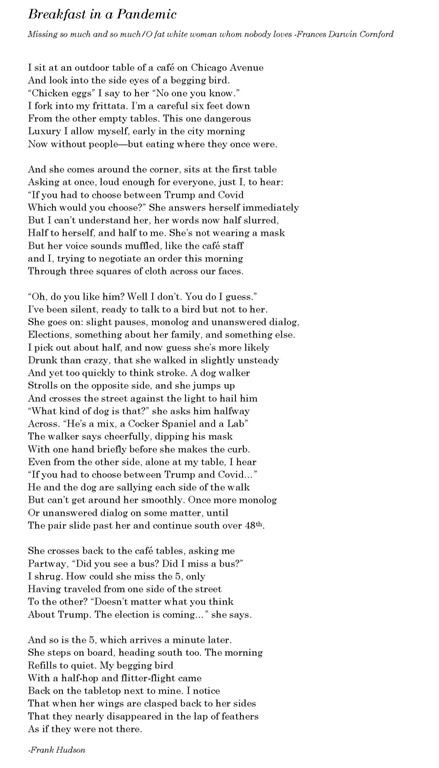
Can we accept a little fall-off from Rilke last time to something I wrote?
As long-time readers here know, the Parlando Project is about “Other People’s Stories.” Dave and I both write words as well as music, but I find it interesting to examine how I experience other people’s words, other people’s outlooks and visions. This project’s focus for the past four years has been an exploration—often into writers I didn’t know, or writers that I, and perhaps you as well, think we know because of what we have been told about them.
I was able to run this piece past a fine poet Kevin FitzPatrick,* before it reached the form you’ll read/hear today. He noted that I was working in my Frank O’Hara mode, and he’s right. For me in my 20s, O’Hara helped me integrate the French Surrealists with the American mode of Carl Sandburg,** with a Modernist touch of exoticism I’d retained from love of the English Romantics.
I had to remind Kevin that a big influence on this poem was his own poetry, about which a reviewer once said included so many “poems with other people in them.” Why, oh why, is that so rare? How many poems are about the poet’s own head space or solitary meditation on nature? Of course, that landscape can’t be avoided. And yes, some very good poetry can be written in that less populated country. Readers here will know how much I’ve come to admire what Emily Dickinson did. Though we now know that her life was not entirely that cloistered myth that once was used to define her, does her extraordinary corpus of poetry ever include another human character speaking for themselves?
So, my poem starts out like a nature poem, albeit in an urban setting, and then another character breaks in and changes the poem. The music I composed and performed seeks to underline that. And a disease pandemic is, after all, a natural metaphor for our separation.***
A long poem for me these days. Some thought it could be shorter and some thought it could include even more detail . They’re both right, but that’d be another poem I decided.
In the text of the poem I use an epigraph from Frances Darwin Cornford’s“To a Fat Lady Seen from the Train.” Dave wondered if that might put off some readers. His concern has merit. Cornford’s poem (better known in Britain) is an earworm best known for being disliked. I have not seen anything from Cornford about what her intent was with the poem, and perhaps she had little conscious intent, thinking of it only as a catchy triolet. However, I think it’s a kind of pointed failed encounter and is written as such.
As I said above, the music here tries for contrast, with acoustic guitar and then drums and bass with a smattering of woozy strings and distant woodwinds. The composer in me isn’t sure the composition or the performer achieved all of his intent. The middle section may be taken at too fast a tempo. My late father who hated poetry read too fast would certainly think so. But I remind myself that plenty of modern spoken/chanted word is taken at a rapid pace, so maybe not.
The player gadget is below, so you can listen and decide for yourself. Stay well, valued readers and listeners!
*Alternative Parlando voice and keyboardist, Dave Moore had some helpful suggestions on it too.
**I don’t know what O’Hara thought of Sandburg, but I wouldn’t be surprised if it wasn’t favorable. Sandburg might have seemed too straight, and too yokel. But Sandburg was working often in the mode of Whitman and Hart Crane which O’Hara also was (along with O’Hara’s French language influences).





 Frank Hudson