This Saturday in Minnesota was marvelous. We already go a little crazy when the temps reach 50 degrees Fahrenheit – there are always folks out in shorts and short sleaves as soon at the bulb’s red rise tips over 49 degrees, but Saturday my thermometer read 79 degrees by the afternoon, and everyone that could was outside. Walkers were everywhere, and if they had dogs, they had a shared happiness. The smaller crew of hardy bicyclists I see within Winter were joined by a fresh multitude of carefree riders in summer attire coursing through the city. I myself rode to a place a block or so away from my wife’s apartment when we were courting, and there I had a double scoop of ice cream which I ate sitting on a bench outside soaking up the sun.
I’m feeling my age as more than just an additional year in 2026, but to be old or young or anywhere in-between in such a Minnesota day induces a feeling of specialness. Perhaps for the young the coming spring and summer can have an interval long enough to induce boredom, a sense of regular expectable warmth, and a dispensable ease of adventure – but to be old is to know the shortness of things.
Sunday returned to gray skies and an ordinary chilliness. Saturday seemed like a dream. Spring and Summer are still promises, more sure than many human promises in this corrupted world, but promises still.
All that dilly-dallying with ice cream delayed me completing making a song from this Edna St. Vincent Millay sonnet. Earlier this month I was saying Millay wrote complex love poems. Well, she wrote complex Spring poems too. The sonnet I was working with is one of the Spring ones, but like her apostrophe poem from earlier this month speaking to mankind, this time it’s an apostrophe to the season. It’s an intimate dialog with elements of greetings to Spring, but as that season arrives, the poem tells us it also knows it will depart.
I’ve found that Millay’s poems often improve with performance. While not exactly a slam poet with planned-in applause lines, Millay’s language (even with its touch of archaic poetic diction) has a pleasing sound, and near rhyme and rhyme add a sensuous chime to the lines. It really is one of those poems that ask to be sung. That said, I found myself modifying Millay’s line breaks as I set it to music. The chord sheet version I provide today can be compared to this link of the printed text to see how I adapted it. I also added a refrain again.
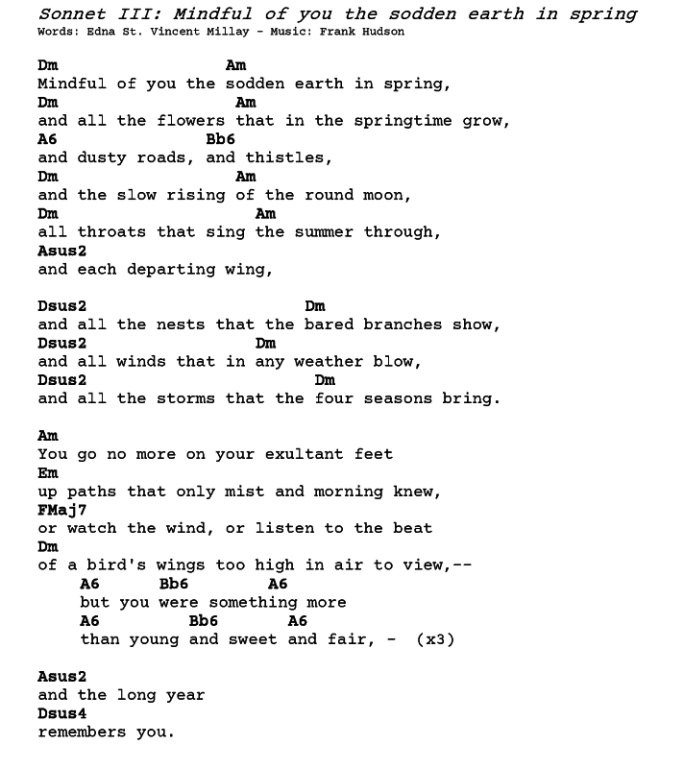
Some less common chords in this one, but I offer these chord sheets in hopes that other singers will try these songs out.
.
One last thing developed from the poem as I did this work: the poem, ostensibly addressing Spring, may be speaking also to the passing youth of the poet, and the line I chose to refrain is repeated to bring forward that which I felt on that extraordinary warm Saturday when I performed Millay’s poem, that we can cherish (and be considered) being more than young and sweet and fair. We all live as promises.
To hear that performance of Millay’s sonnet you can use the audio player gadget below. No audio player seen? That throat isn’t gone on departed wing, it’s just some ways of reading this blog suppress showing it, and so I also offer this highlighted link that will open a new tab with its own audio player.
 Frank Hudson
Our indoor/outdoor thermometer measured 87°F on Sunday in Iowa, then back into the 50s Sunday. Weird weather to be sure, yet plant life is awakening alongside we humans. Migratory birds are returning, too. Cheers!
LikeLiked by 1 person
I’m always saying that the Theater of the Seasons plays in repertory here in the Upper Midwest.: 70s and Snowstorms. Looking forward to reading of kitchen garden again this season.
LikeLike