Here’s another short poem by Claude McKay made into a song. In his “When I Have Passed Away” a young poet seems to be imagining his own legacy – a prediction both restrained and hopeful. As in the first poem of this Black History Month series featuring his poetry, McKay will subtly mention two things that are potentially othering his living voice. Within the poem’s first quatrain he writes of a belief that he, the author, will likely be forgotten and uncelebrated. He posits an unmarked grave, which strikes one as a sad conclusion, but I think his second line “And no one living can recall my face” has an element of release. In this obscure future a reader will likely not know his black-skinned face, that instant, contemporaneous, racial stereotyping will have been overthrown by a forgetting time that has discarded his particular self. And as in “The Cities Love,” he will remind us that he’s writing this as an immigrant, who will likely die and be buried away from Jamaica, the country of his childhood, in “alien sod.”
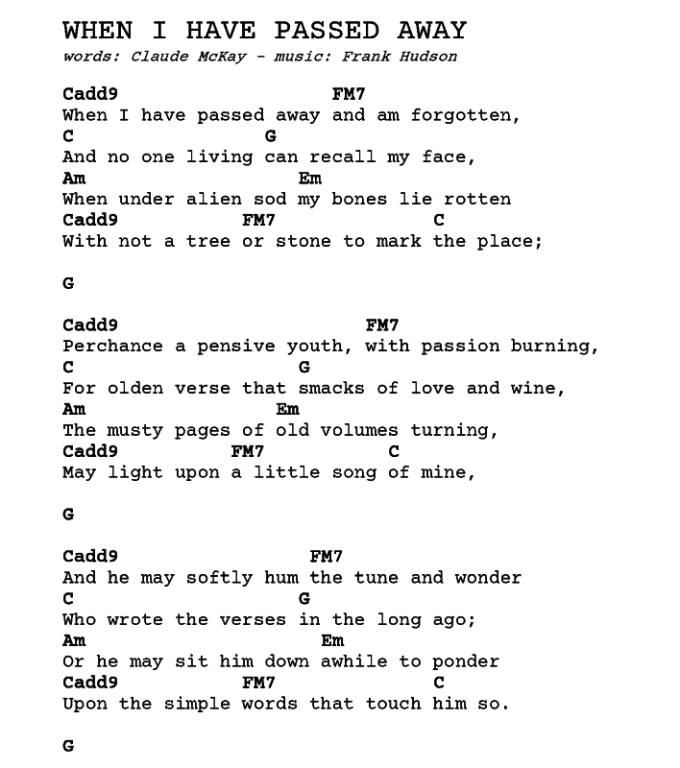
Here’s a chord sheet for today’s song. Somewhat like McKay, it’s my hope that someone else will someday choose to sing some of these Parlando Project songs
.
Let me interject myself into McKay’s story here. I think many, perhaps most, American poets find themselves in a state of exile. Our dominant culture doesn’t greatly care for poetry, and it cares even less for poets than for their art. Yes, I am making a broad generalization, but McKay in his poem seems realistic in his expectations. If we become by choice or exile citizens of poetry, we will speak a different dialect with strange accents, we will be inured to different customs, we will have saints and prophets un-worshiped here. If Claude McKay can realistically expect that – in McKay’s case, it will not be his poetic citizenship that exposes him to common and actively state-sanctioned dangers and discrimination so much as the inherent alienation bestowed upon an immigrant with dark skin.* None-the-less, I write this to point out that McKay the poet might share this smaller, ignored and unvalued, status with other poets too.
McKay’s second quatrain hopes for some distant youth and a surviving dusty volume of verse. Perhaps this youth might be an immigrant from the country of poetry and song who has found themselves a minority in our nation of casual oppression and mercantile investment.
Again, I feel I must appear again here, though I am not exactly what McKay expected. I’m entirely far from young. I read this poem in a scanned e-book – not dusty, though my touch screen had a light scrim of fingerprints over his more than 100-year-old words. When McKay writes of his page poem as a “little song” and implies it has a tune, I’m called to do the Parlando Project thing with it. Here we are then, separate: this young Black immigrant from Jamaica, and this an old white man away from his tiny Iowa town he grew up in – we meet on these simple words of his and, touch – and I find I must hum out a tune for Claude McKay whose name and some little of his life I do know.
You can hear that song with the audio player below. If you don’t see a player, if there’s no tree or stone or html gadget to mark its place, I’ll offer this highlighted link that will open a new first-edition-with-dust-cover browser tab displaying its own audio player.
.
*I think here of Renee Good – killed on the broad avenue across the alley behind the window where I sit writing this – a border-crossing death in a cultural battle where immigrants are the “vermin” from “garbage countries” projected as monstrous invaders to justify thuggery and the decrees of tyrants. As a poet, as she was, no one would have asked for her papers, her hard-won college award for her poetry, even if that made her one who will try to find her way as an immigrant-of-a-sort in the land she was born in. It is also not out of the question that she was executed, at least in part, for her being gay.
 Frank Hudson
You may not be physically young, but you realized McKay’s ambition to be sung & remembered.
I’m entertained by the poem being ONE long sentence! With the aid of two semi-colons…….Inspiring.
LikeLiked by 1 person
nice guitar on this one! heart felt…
Linnea
LikeLiked by 1 person